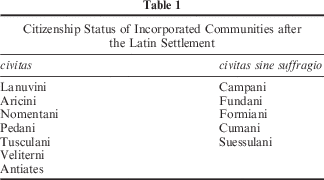
According to book eight of Livy’s Ab Urbe Condita, the decision to enrol communities into either the civitas or civitas sine suffragio in the Latin Settlement of 338 BC was based on the circumstances surrounding each community’s incorporation.Footnote 1 Livy suggests that, following the conclusion of the Latin War, each community was assessed and then offered a form of citizenship based on that assessment – traditionally, with one form representing a reward for ‘good behaviour’ and the other representing a punishment for ‘bad behaviour’. However, Livy’s view of Roman citizenship in the fourth century BC is widely acknowledged to be anachronistic, as it is based on the retrojection of the franchise’s supposed value in the late Republic and early Empire.Footnote 2 Roman citizenship and full access to Rome’s political and legal systems were important rights in those later periods. This retrojection has led to inconsistencies in Livy’s understanding of early Roman citizenship and consequently undermines his account of the fourth century BC settlement, as different values are often attributed both to civitas and to civitas sine suffragio (see below). Had Rome rewarded loyalty with one type of citizenship and punished untoward behaviour with the other, some uniformity ought to be expected. This is not the case. Despite this, many modern scholars have adopted Livy’s interpretation in their analyses, although they have had to offer a variety of explanations for his inconsistencies. Some, such as Howarth, have suggested that communities given ‘full’ civitas were the punished parties,Footnote 3 while others, like Cornell for instance, have concluded that granting citizenship without suffrage amounted to the punishment of a community.Footnote 4 Based as they are on Livy’s inconsistent and anachronistic account, both these solutions are inevitably problematic. This paper offers a different approach, and argues that the differing statuses are, at least in part, the result of pre-existing cultural differences within the communities – most notably linguistic differences – and that these were significant on account of the formalities of Rome’s legal and political systems. The choice by Rome to grant communities either civitas or civitas sine suffragio may therefore have been the result of a conscious appraisal by Rome (and sometimes by the communities themselves), not of their behaviour or attitude towards Rome, but of their ability to integrate successfully into Rome’s legal and political systems.
The idea that language played a role in the decision to grant either civitas or civitas sine suffragio is not a new one, and indeed it has been around in one form or another since at least the 1950s, when it was advanced by Badian, and it has been endorsed more recently by Crawford, among others.Footnote 5 Rome was a Latin community and thus shared a special bond with the other peoples and communities of Latium, as can arguably be seen in the broad cultural koiné of Latinity (visible not only in language, but also religion, etc.) as well as in the existence of Latin Rights and the enigmatic Latin League. In this environment, it would have been incredibly difficult to distinguish ‘Roman’ from ‘Latin’ in any meaningful way, beyond simply noting where someone lived. The argument that pre-existing cultural connections, such as language, therefore lay at the core of the various conceptions of citizenship and identity developing within Latium in the fourth century BC makes some sense. Indeed, this very consideration has been proposed as one factor in Rome’s approach to citizenship in later periods, as various forms of citizenship (civitas, Latin Rights, etc.) are often thought to correspond to differing levels of acculturation in the late Republic and Empire.Footnote 6 However, the idea that this cultural and linguistic connection went beyond traditional associations and could have real-world implications in the middle Republic has rarely been explored in any real depth. The authors of our literary sources for the period lived in a world where such cultural considerations were understood to be secondary to the political realities of citizenship of their day. But underneath the anachronisms in the literary evidence for the Latin Settlement, some hints of the importance of these cultural and linguistic bonds in the fourth century BC are perhaps still visible, and indeed are worth a second look when considering Rome’s renegotiation of identity with its regional neighbours.
Before delving into the subtext of the Latin Settlement, however, it is first necessary to look more closely at the inconsistencies in Livy’s account and to attempt to determine the origin of them. Livy states twice that the communities involved in the Latin War would be assessed pro merito cuiusque, thereby implying that some communities were to be rewarded while others were to be punished.Footnote 7 He then goes on to discuss the different types of citizenship granted to various communities, implying that this was how the ‘rewards’ and ‘punishments’ were meted out – again, traditionally, with one form of citizenship seemingly representing the ‘reward’, and the other ‘punishment’. For this explanation to be plausible, it would be reasonable to expect that the differing grants of citizenship, as either a reward or a punishment, would be consistent across the board. However, in books eight and nine of Livy’s work, grants of civitas and civitas sine suffragio are each said to have been used both as a reward and as a punishment in different contexts. For instance, Livy implies that the Campanian knights received full citizenship as a highly valuable reward for their continued support of Rome, suggesting that this was how the Romans rewarded their faithful allies.Footnote 8 However, this assessment is seemingly undermined just two chapters later when he puts the following words into the mouth of Camillus in an address to the Senate: ‘Do you wish, by the example of our ancestors, to enlarge the Roman state by accepting the conquered into the citizenship?’Footnote 9 In this case, while full citizenship was not necessarily reserved for defeated communities, direct military opposition was evidently not a disqualification either. As for citizenship without suffrage, the status is clearly portrayed as a reward for loyalty when Livy says that ‘citizenship without suffrage was given to the Campani for the sake of their knights’ honour, because they had not wished to rebel with the Latins, and to the Fundani and Formiani, because the route through their borders had always been safe and undisturbed’,Footnote 10 but it is just as clearly presented as something imposed upon the defeated when Livy later reports that the people of Anagnia and the other Hernican people who had warred against Rome had received this status.Footnote 11 Military support, or revolt, were clearly not the only factors in play.
To complicate things even further, there is one instance in Livy’s account of communities supposedly being given a choice in the status they were to have. Livy records that the Hernican peoples of Aletrium, Verulae, and Ferentinum kept their own laws after a revolt in 306 BC, allegedly because they preferred them to Roman citizenship.Footnote 12 This sentiment is reiterated and expanded upon two chapters later.Footnote 13 If the status given to a community had depended solely on factors such as the community’s previous behaviour or attitude towards Rome, there would be no need to take into account the wishes of that community. Furthermore, the Hernican episode reveals that those communities which were given a choice rejected the supposedly more favourable citizenship, regardless of whether this was civitas or civitas sine suffragio. Aletrium, Verulae, and Ferentinum did not take up arms against Rome and so, according to this explanation, ought to have been given the more preferable of the two types of citizenship. Rejections of this sort appear even as late as 216 BC, when a troop of soldiers from Praeneste supposedly refused an offer of ‘full’ citizenship.Footnote 14 This episode in particular should serve as a reminder of something which is most clearly stated by Dench, that one must be careful when attributing value and desirability to civitas at different times and to different people.Footnote 15 The status in the fourth century did not offer the same advantages that it did to those who acquired civitas in the later Republic.Footnote 16 Even then, however, we are told that Neapolis and Heraclea were reluctant to accept civitas when it was openly offered to the allies during the Social War.Footnote 17
In light of these inconsistencies, it is necessary to compare other accounts, to see if they can shed any light on the problem. Velleius Paterculus’ discussion of the extension of Roman citizenship in the middle Republic has received little in-depth analysis in comparison with Livy’s narrative of the Latin Settlement, but his version, although less detailed than Livy’s, contains some interesting features. The most prominent of these is the longer time-frame in which Rome is said to have enacted the changes associated with the settlement.Footnote 18 As Oakley has pointed out, Livy’s account implies that a radical new system of relationships was implemented in less than a year.Footnote 19 I would suggest that these particular differences between the accounts of Livy and Velleius are more likely to be a result, not of Velleius’ brevity, but of the use of different sources.Footnote 20 It is therefore possibly significant that Velleius’ version contains no notion of ‘reward’ or ‘punishment’ in relation to the granting of citizenship; instead, Velleius simply provides a list of communities that were admitted to the Roman franchise.Footnote 21 This should be particularly disconcerting for those who adopt Livy’s explanation, given that Velleius generally reacted positively to the spread of Roman power and its role in unifying the peoples of the Italian peninsula.Footnote 22 Velleius could easily have drawn on the idea of reward and punishment in order to highlight the character of Rome’s tactics. Yet he does not. An argument ex silentio, and moreover from an abbreviated account, is admittedly always problematic. However, as he was writing slightly later than Livy, Velleius would presumably have been aware of this tradition, so its absence from his work may possibly imply the existence of an alternative tradition. The idea of granting civitas and civitas sine suffragio as ‘rewards’ and ‘punishments’ may therefore be a later rationalisation of events and not a core aspect of the tradition.
It is not unreasonable to suggest that Livy’s version contains anachronistic assumptions about the nature of fourth century foreign policy. Not being fully cognizant of the ways in which the past had differed from the present, or at least not willing to let any differences change their narrative, Livy and his sources may have retrojected the conditions of their own day into the past.Footnote 23 As a result, they may have modelled past events on more recent ones.Footnote 24 The reasons given by Livy for the outbreak of the Latin War in 340 BC, for instance, appear to match the general grievances of the allies at the onset of the Social War in 91 BC.Footnote 25 Livy’s account of the Latin Settlement may have also been subject to a similar process of ‘modernisation’ – although it should be noted that while some communities did desire civitas during the late Republic, others still rejected the offer of it. The value of civitas and the status of the Italian communities were still debated for quite some time.
There is also a strong probability that Livy’s inconsistency at least partially originates from the works of the second and first century annalists, who are often argued to have expanded their accounts, both literarily and rhetorically, and frequently with erroneous results,Footnote 26 and whom Livy used as his immediate sources. Some of these writers may have based their perception of civitas sine suffragio on the treatment of Capua and the other Campanian communities that went over to Hannibal during the Second Punic War.Footnote 27 There is little doubt that the removal of Capua’s autonomy was intended as a punishment.Footnote 28 It is conceivable that these writers assumed that the limitations placed upon Capua in 211 BC had also applied to other communities treated in the same way in earlier times.Footnote 29 On the other hand, a number of these annalists lived through the Social War, when the Roman franchise was highly sought after by certain Italic communities.Footnote 30 To the writers of this era, a grant of Roman citizenship may have appeared to be an act of generosity and this may have influenced them to present enfranchisement in a favourable light. In short, the different views of Livy’s different sources and the impact that their views had on the handling of past events may have been the cause of the inconsistencies in Livy’s own handling of those events.
Modern analyses of the Latin Settlement which are based on Livy’s explanation inevitably have to deal with these inconsistencies, and the usual solution is to handle the evidence in a selective manner, so that a coherent account can be pieced together. If civitas is taken to be a reward for loyalty, the hostility of the Pedani, Lanuvini, Veliterni, and Antiates immediately prior to their enfranchisement must be ignored.Footnote 31 Equally, for the granting of civitas sine suffragio to qualify as an expression of favour, it is necessary to disregard the Campani’s involvement in the Latin War as well as that of the Volsci who sided with the Latins.Footnote 32 This need to handle the evidence selectively makes any reconstruction based on this evidence alone aprioristic. The evidence implies that, of the hostile forces that Rome faced in the Latin War, some subsequently received ‘full’ civitas but others civitas sine suffragio. This means that any explanation of the Latin Settlement based on the idea of a straightforward policy of reward or punishment (where one classification is considered a ‘reward’ and the other a ‘punishment’) is difficult to maintain. There is another solution, however, which is to consider the importance of cultural factors in the decision, most notably language.
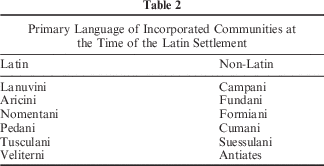
The reason for considering language to be an important factor becomes immediately apparent when a comparison is made between the statuses of the communities, as detailed by Livy in his account of the Latin Settlement (Table 1), and the primary languages those same communities spoke (Table 2).Footnote 33
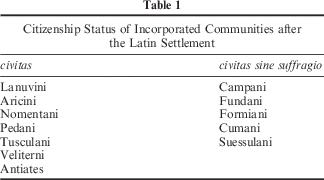
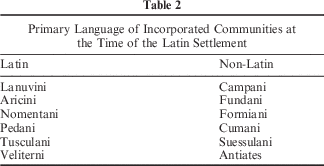
The close match between the status of each community and the primary language used in official contexts within it is unlikely to be a coincidence. Moreover, there is a passage in Strabo that implies that the adoption of the Latin language and the involvement in Roman government, and by extension the possession of ‘full’ citizenship, were related.Footnote 34 Language and political affiliation were evidently linked. This may seem unsurprising given that, until 139 BC, the voting procedure within the tribes required an oral response from each individual.Footnote 35 A voter would indicate his approval or disapproval of any proposed legislation or, in the case of an election, the name of his preferred candidate to a rogator.Footnote 36 While the actual casting of a vote may have only required the barest grasp of Latin, the understanding necessary to make informed decisions about legislation may have been beyond those who did not have a good command of the language.Footnote 37 It has previously been argued that, for this simple reason alone, some communities were granted civitas sine suffragio, so that they were excluded from voting.Footnote 38
Despite these arguments for the importance of language in the Latin Settlement, the position is far from settled and indeed it has most recently been argued that language is not significant enough an explanation for the differences in grants of citizenship, especially when it comes to communities in which bilingualism and multilingualism may have been common.Footnote 39 However, to dismiss language as a factor would be to underestimate the orality of law in Rome and Latium, and the importance of local norms and rituals. The Roman legal framework prior to the second century BC was based on a foundation of oral formulae and this was presumably due to its ritualistic origins.Footnote 40 The need for a strict adherence to these formulae in the legis actio procedure is exemplified by a case preserved by Gaius, in which a man was said to have lost his legal case because he had used the word vites, ‘vines’, instead of arbores, ‘trees’, as it appeared in the Twelve Tables.Footnote 41 We may also note that the deaf and mute were restricted in their legal capacity, specifically because of their inability to carry out the verbal exchanges required by law.Footnote 42 Although there is no record of how non-native speakers of Latin fared in such exchanges, the strictness of these set phrases may have been beyond them; indeed, it is possible that such phrases may have even flummoxed native Latin speakers who were not used to them. To complicate matters further, the correct phrases required by Rome’s legal systems were only made publicly available at the end of the fourth century BC; before that happened, an individual had to approach a pontiff in order to attain the necessary formula.Footnote 43 Even this task would demand a certain level of proficiency in Latin.
Due to the orality of Roman law and society, it could be argued that the exclusion of those who did not speak Latin fluently from voting is equally well explained by the process of census enrolment.Footnote 44 As part of the census, each male citizen of Rome was required to give an oath in Latin swearing to the truthfulness of the stated value of his property.Footnote 45 Although the wording of this oath has not survived, Livy’s phrasing of the commune omnium civium ius implies that its form was indeed fixed, and may reveal a legal nature.Footnote 46 Much like the other legal formulae of the period, precise and correct pronunciation of the words would presumably have been required. Again, this may have been beyond the capabilities of many non-native speakers of Latin and may have necessitated the exclusion of these people from the processes involved in allocation to a tribe and census class. However, if these sorts of exclusions applied extensively across Rome’s legal structures, this would have also necessitated the restriction of these individuals’ legal capacity far beyond the right to vote.Footnote 47 This was not the case. It may be significant then that citizenship without the vote was only ever granted to communities and never to individuals.Footnote 48 This may supply the key to understanding the status itself.
By shifting the focus from individuals to communities, we may overcome the issue of the exclusion of those non-native speakers of Latin who may have been perfectly capable of the uttering the various formulae with the required level of accuracy and precision while native speakers who were perhaps not so capable were nonetheless included. At the time of the Latin Settlement, the communities of Latium had been closely linked to Rome’s political and legal structures since at least 493 BC, although their relationship certainly predates this.Footnote 49 The foedus Cassianum offered something resembling an alliance structure, while the traditional ius Latini (which included rights of commercium, conubium, and migratio) presumably gave all Latins access to Rome’s legal system and Romans access to those of the Latin city-states, thereby creating a ‘form of legal community’.Footnote 50 We might even suppose, as Capogrossi Colognesi does, that these circumstances amounted to the partial assimilation of all Latins into the local citizenship of each individual city-state that was a member of the Latin League.Footnote 51 The move to assimilate these city-states entirely into the Roman citizen body after 338 BC may therefore not have been perceived as a radical step. Not only were Latins more suited to the oral performance of the various formulae, they were probably also relatively familiar with the formulae’s form and function as a result of their close interaction with Rome. It is possible, therefore, that the Romans were more willing to integrate Latin city-states due to their exposure to Roman law and its formulae, as well as the cultural and religious significance of such customs, many of which may have been shared.
A similar level of familiarity with Roman law and its associated formulae cannot be taken for granted in the case of those communities that received civitas sine suffragio as a result of the Latin Settlement. This is not to say that interaction between certain non-Latin communities and Rome did not occur regularly; there is certainly ample evidence of such relationships. But these relationships do not suggest that a similar level of assimilation or acculturation existed.Footnote 52 In these communities, the pre-existing political and legal structures would presumably have been maintained after the settlement. They would likely have continued to operate in the local language and local practices would no doubt have possessed a cultural and religious significance of their own.Footnote 53 Roman law was not absent from these communities altogether; it was presumably utilised when ‘full’ Roman citizens were involved or perhaps when local inhabitants desired its use.Footnote 54 However, it was unlikely to be the norm and the very need for this rather flexible, perhaps parallel, legal system is noteworthy. Although the true motivation behind it is obviously beyond us, the deployment of either local or Roman law in particular situations hints that there was some awareness on the part of both the Romans and the members of the local population of the inappropriateness of enforcing Roman laws and practices across the board. Indeed, on a wider level, there is no evidence – archaeological or otherwise – to suggest that the Romans attempted to influence other aspects of life in these communities, for instance with local cults or religious practices, and indeed quite the opposite appears to have been the case.Footnote 55 I would therefore suggest that the use, and the continued use, of the local language and customs associated with the political and legal systems of non-Latin speaking communities influenced the decision to grant such communities only citizenship sine suffragio.
The question still remains as to why communities possessing civitas sine suffragio were specifically restricted from voting or holding office in Rome. On account of their lack of familiarity with Latin, Rome may have created a separate legal status whereby these Roman citizens were allowed to keep their local laws, in their local language, for day to day use as a practical measure. However, perhaps as part this arrangement, these communities were only permitted to elect their own local magistrates and not Rome’s magistrates.Footnote 56 The flexibility that these communities enjoyed in having a choice between applying Roman or local laws may have made it inappropriate for individuals from them to have a say in the passing of legislation at Rome. It is possible, perhaps on account of the auspices or even simple political practicalities, that citizens were not supposed to be able to institute laws or hold office in more than one community at a time. Individuals in Central Italy may have been forced to choose their political association.
While the relationship between enforcing Roman law and holding a vote at Rome was not always present in the later Republic, the historical context in which civitas sine suffragio developed may offer some clues to explaining this restriction of voting rights. Prior to 338, it is reasonable to assume that a relatively strong overlap existed between citizenship, law, community, and territory.Footnote 57 Populations absorbed into Rome’s fledgling empire received ‘full’ citizenship and, to the best of our knowledge, were completely assimilated – as seen, for instance, with the creation of new tribes on the ager Veientanus.Footnote 58 In Latium, with the possible exception of Tusculum (which became the first municipium in 381 BC), these circumstances only changed after the Latin Settlement, with the introduction of civitas sine suffragio and the Latin status. As the hitherto coinciding identities of ‘Latinity’ and the emerging sense of ‘Romanitas’ slowly separated, the need for an alternative form of political affiliation may well have become evident – located somewhere in between the identity associated with full Roman citizenship and a distinct Latin identity. Apart from anything else, the continued use of alternative legal structures within these communities likely warranted the grant of an alternative citizenship. We might suppose then that civitas sine suffragio was the initial mechanism devised for dealing with non-Latin communities incorporated into Rome’s empire in this liminal position. It should be expected that, as the developments in Rome’s legal sphere and even the practice of empire itself influenced the concepts of citizenship, law, community, and territory, the mechanisms Rome utilised to bind its dependant allies would have evolved concurrently.Footnote 59
If this hypothesis is correct, the ability to maintain and use local laws, even though that came at the expense of voting in Rome (something which, it must be noted, may not have been practical or possible for most anyway), need not be viewed in a negative light. A more neutral understanding of the status is possible. While Rome may very well have utilised civitas sine suffragio as a way to limit the ability of some communities to influence politics in Rome, varying levels of citizenship may have also allowed incorporated communities the option of moderating their level of inclusion; this is hinted at in those instances where communities and groups were offered a choice of status. We may equate voting rights in Rome with power, but there may have also been power in separation, something which was often expressed through linguistic means, as can be seen, for instance, in the inscriptions and coinage of Samnium. Although many in southern Italy would have spoken Latin and Oscan – Ennius represents the most obvious example – the continued use of Oscan in ritual contexts seems to reflect the maintenance of a distinct local identity.Footnote 60 This is not to say that the granting of either civitas or civitas sine suffragio was always politically neutral. Incorporating, or not incorporating, a community against its will could obviously represent a form of punishment. However, it is possible that, in the abstract at least, each type of citizenship (or non-citizenship) carried equal value and importance. The aspect of reward or punishment came down to context and specific application. In this way, if we are to salvage any aspect of Livy’s suggestion that the granting of various types of citizenship was done in a policy of ‘reward’ or ‘punishment’, it might be that it was not the specific type of citizenship which was the reward or punishment, but rather the choice of which one was the most suitable in the given context.
Even if we accept that language was part of what separated civitas from civitas sine suffragio, there is no need to assume that the granting or withholding of the right to vote was intended to promote the spread of the Latin language.Footnote 61 The existence of a systemised language policy aimed at encouraging the spread of Latin with the incentive of ‘full’ citizenship in the republican period is unlikely, simply because Rome lacked the means, and doubtless the interest, to undertake such a programme.Footnote 62 In the absence of such a policy, the use of these different statuses can only have originally been envisaged as recognition of the existing status quo and the different characteristics of individual communities that extended through language into legal, religious, and cultural contexts. By taking this view, it can be suggested that the creation of civitas sine suffragio for the Latin Settlement might have been an innovation designed to facilitate what can be referred to as ‘the cultivation and management of difference’.Footnote 63 Ancient empires, when controlling diverse territories with heterogeneous populations, implemented strategies to regulate such differences, but also benefit from the effect they had upon their rule.Footnote 64 A model of this sort may help to explain the clear linguistic division between those granted civitas and those granted civitas sine suffragio in the Latin Settlement.
In constructing a model of this sort, it is useful to focus upon how Rome managed the incorporated communities. Rome’s heavy reliance on the local elites in controlling local communities has been well attested in modern scholarship.Footnote 65 It was in Rome’s interests to keep the local elites happy and this policy may very well have accomplished that. It is likely that at least some elites would have benefited from the local political and judicial structures continuing to function in accordance with the norms of their own communities, particularly in communities where the shift to Roman law and political systems would have been dramatic, requiring linguistic and religious changes. Indeed, the wholesale introduction of an entirely new basis for legal and political interactions may have created quite a bit of tension between the local elites and the local population and therefore also between the local elites and Rome. The general preservation of the existing legal and political systems within these communities, along with the occasional deployment of Roman law when needed, may have assisted the local elites in managing these systems on a day to day basis. Such a strategy would in turn have benefited Rome. If elites friendly to Rome could exert influence and control within their own communities, Rome’s hold on those communities would become more secure.
The traditional interpretation of the differing grants of civitas and civitas sine suffragio in the Latin Settlement, which is based on Livy’s view that they amounted to a policy of reward and punishment, has limited discussion of their wider significance. The model set out in this paper suggests that the adoption of this particular hypothesis is not required when language and culture are taken into account. Indeed, such factors should not be ignored. Looking at the interaction between Roman culture and the heterogeneous mixture of languages and cultures which made up Central Italy during the fourth century BC, we may instead argue that the granting of different types of citizenship was part of a wider strategy to manage and yet benefit from cultural differences. It is more constructive to argue that language was taken into account because of the oral nature of Rome’s legal and political systems as well as the cultural norms of the incorporated communities. The long relationship between Rome and the Latin communities may have made the grant of ‘full’ citizenship possible because these communities were familiar with the form and function of Rome’s legal formulae. In contrast, it may have seemed inappropriate for non-Latin communities to be fully incorporated into Rome’s legal and political structures. Not only were they more likely to be unfamiliar with Rome’s legal formulae, but these communities also possessed unique cultural differences of their own, most notably in the language they used. We may reasonably suppose then that cultural differences influenced the decision to give these communities an alternative form of citizenship, or at least viewed it as the more appropriate solution.