INTRODUCTION
This conceptual paper extends the current research on knowledge transfer within the firm (Szulanski, Reference Szulanski1996; Argote & Ingram, Reference Argote and Ingram2000; Héliot & Riley, Reference Héliot and Riley2010) by proposing novel explanations of a major impediment to knowledge transfer: causal ambiguity. The ability to transfer knowledge within a firm allows it to replicate practices in other parts of the organization or in other markets. The literature suggests that knowledge transfer can be difficult (Szulanski, Reference Szulanski2000; Garavelli, Gorgoglione, & Scozzi, Reference Garavelli, Gorgoglione and Scozzi2002). The focus of this paper is on the attributes of knowledge that cause that difficulty. I build on Simonin's (Reference Simonin1999) work on knowledge transfer between two firms by bringing the theoretical conversation inside the firm and contribute two other constructs to the conceptual model. The resulting framework in this paper is a conceptual structure in which the four attributes of knowledge lead to transfer difficulty via the mediating role of causal ambiguity.
When knowledge transfer occurs, an effective practice is replicated by the firm in other contexts or businesses (Helfat & Eisenhardt, Reference Helfat and Eisenhardt2004). Transfer of knowledge from one unit in the firm to another is strategically important because it allows the firm to leverage fundamentally important knowledge assets (Zander & Kogut, Reference Zander and Kogut1995). For instance, a detailed case study of Xerox Europe (Jensen & Szulanski, Reference Jensen and Szulanski2007) showed that knowledge residing in the firm was not fully leveraged; top management identified significant performance differences among the various units conducting similar practices in different European countries and undertook a comprehensive and deliberate effort to transfer knowledge associated with the sales processes. In the units to which knowledge was successfully transferred, sales increased nearly threefold.
The benefits of knowledge transfer within the firm are emphasized in strategy research, particularly in the knowledge-based view. According to this perspective, a given firm's effectiveness in knowledge transfer has serious consequences for its performance (Zander & Kogut, Reference Zander and Kogut1995), and the effective creation and application of knowledge provides the basis of sustainable competitive advantage (Grant, Reference Grant1996a; Spender & Grant, Reference Spender and Grant1996). For such firms as McDonald's, Walmart, and Starbucks, the strict replication of existing knowledge in new contexts is the growth strategy (Winter, Szulanski, Ringov, & Jensen, Reference Winter, Szulanski, Ringov and Jensen2012). The most strategically important knowledge is usually complex, tacit, causally ambiguous, and embedded in the operations of the firm (Nelson & Winter, Reference Nelson and Winter1982; Rivkin, Reference Rivkin2000; Jensen & Szulanski, Reference Jensen and Szulanski2007).
Managing a firm's knowledge proves to be a different problem than managing any other type of resource, in the traditional sense of the term (Goh, Reference Goh2002). This is the case because knowledge has unique attributes that make its transfer within the same organization theoretically interesting. In broad terms, most widely studied attributes of knowledge are tacitness and context dependence. Those attributes explain how knowledge differs from mere information and underpin why the information-processing view of the firmFootnote 1 (Simon, Reference Simon1957, Reference Simon1965; Galbraith, Reference Galbraith1973; Arrow, Reference Arrow1974) cannot answer the knowledge transfer puzzle alone. There is much more to ‘what the firm knows’ than what is covered by explicit information (Machlup, Reference Machlup1980). Knowledge is not given to anybody in its totality because of the specifics of time and place (Hayek, Reference Hayek1945). Knowledge is also differentiated from information by its inherent tacitness (Polanyi, Reference Polanyi1962). Tacitness is not only a problem of knowledge residing in individual minds but also in organizational units. This makes an organization a distributed knowledge system that ‘lacks the cognitive equivalent of a control room’ (Tsoukas, Reference Tsoukas1996: 22). Therefore, within the firm there will be units that engage in similar practices but with significantly differing results (Chew, Bresnahan, & Clark, Reference Chew, Clark and Bresnahan1990; Szulanski, Reference Szulanski1996). For instance, a detailed study of steel wire manufacturers with multiple subunits showed that high-performing routines did not disseminate easily to neighboring units (Lapré & Van Wassenhove, Reference Lapré and Van Wassenhove2003). Some units continued conducting lower-performing routines even when other units in the same organization possessed and demonstrated higher-performing routines. In other words, knowledge is heterogeneously distributed across the organization.
This paper contributes a theoretical model focused on the attributes of knowledge that partially explains the difficulty of knowledge transfer within the firm. Existing research on knowledge transfer identified several sets of reasons that make knowledge ‘sticky’ (Szulanski, Reference Szulanski1996). The motivation and willingness of the parties (Héliot & Riley, Reference Héliot and Riley2010), the capabilities of the parties (Chang, Gong, & Peng, Reference Chang, Gong and Peng2012), available communication methods (Argote & Ingram, Reference Argote and Ingram2000), contextual organizational structures (Argote, McEvily, & Reagans, Reference Argote, McEvily and Reagans2003; Raman & Bharadwaj, Reference Raman and Bharadwaj2012), and finally attributes of knowledge (Szulanski, Reference Szulanski1996; Winter & Szulanski, Reference Winter and Szulanski2001) are potential sets of factors that make knowledge transfer within the firm difficult. In this paper, I propose a conceptual structure on the latter set of reasons: the attributes of knowledge. The theoretical model identifies five attributes of knowledge that make its transfer difficult and maps their relationships to each other. Causal ambiguity plays a central, mediating role. The other four reasons make knowledge transfer difficult via their effects on causal ambiguity. The next two sections revisit the literature on the difficulty of knowledge transfer and the central role of causal ambiguity in that process. Then I discuss the four antecedents to causal ambiguity and develop propositions about their relationships to it. The paper concludes with the research and managerial implications of the model. From a practical perspective, if managers know the obstacles to knowledge transfer they can develop tools and mechanisms to overcome them. From a theoretical perspective, this critical investigation into the nature of knowledge sheds on how causal ambiguity undermines knowledge transfer.
DIFFICULTIES OF KNOWLEDGE TRANSFER
According to Grant, (Reference Grant1996a), the firm's basic function is the application of available knowledge. Effective management of knowledge flows within the firm provides sharing and transfer of knowledge assets and facilitates new knowledge creation (Nonaka & Takeuchi, Reference Nonaka and Takeuchi1995). Kogut and Zander (Reference Kogut and Zander1992) state that sharing and transfer of knowledge within the firm is more efficient than the replication of the same process through market transactions. Organizations need to leverage their knowledge assets to achieve the greatest possible strategic advantage (Sanchez, Reference Sanchez1997). Since firms benefit from leveraging of their knowledge, differentials in this capability in turn lead to differentials in firm performance (Hoopes & Postrel, Reference Hoopes and Postrel1999). In a competitive environment the benefits of leveraging knowledge assets translates into a competitive pressure that does not apply to other resources in the same manner (Arthur, Reference Arthur1994). Knowledge-based assets demonstrate increasing returns such that they lose value if they are not applied and shared within the firm. Those firms which can leverage their knowledge in other domains and replicate existing practices in other units outperform firms which lack those capabilities (Prahalad & Hamel, Reference Prahalad and Hamel1990). For all its importance, management researchers maintain that managing knowledge flows within the firm is a challenge (Haas & Hansen, Reference Haas and Hansen2007; Williams, Reference Williams2007; Håkanson, Reference Håkanson2010), and much has been written about why.
Existing literature reflects the wide variety of contexts in which knowledge transfer may occur. There is transfer of knowledge among competitors, which might be described as imitation (Lippman & Rumelt, Reference Lippman and Rumelt1982; Attewell, Reference Attewell1992; Appleyard, Reference Appleyard1996); transfer of knowledge between two cooperating firms in the context of strategic alliances and joint ventures (Simonin, Reference Simonin1999); and transfer of knowledge between subunits within a given firm (Szulanski, Reference Szulanski1996). Not only are the contexts of the transfer but also the analytical structures employed by the researchers not the same. Adding to the conceptual confusion, they examine different causal mechanisms to explain the differences in knowledge transfer in those various contexts. Some studies refer to the basic factors borrowed from information theory to examine the properties of the sender, receiver, channels, and the content of information (e.g., Teece, Reference Teece1977; Rogers, Reference Rogers1983; Cohen & Levinthal, Reference Cohen and Levinthal1990; Leonard-Barton, Reference Leonard-Barton1990; Hayes & Fitzgerald, Reference Hayes and Fitzgerald2009). Others look at cognitive and motivational forces that might influence the willingness and the ability of those involved in the transfer (e.g., Katz & Allen, Reference Katz and Allen1982; Hayes & Clark, Reference Hayes and Clark1985; Perloff, Reference Perloff1993; von Hippel, Reference von Hippel1994; Héliot & Riley, Reference Héliot and Riley2010). A related set of factors is uncovered by looking at the economic incentives that might be affecting the difficulty of transfer. For instance, individuals choose to share their knowledge for reciprocity and reputation effects. They agree to engage in knowledge transfer activities when they believe that it will help their tenure in the organization (Verbeke, Belschak, Bagozzi, & Wuyts, Reference Verbeke, Belschak, Bagozzi and Wuyts2011).
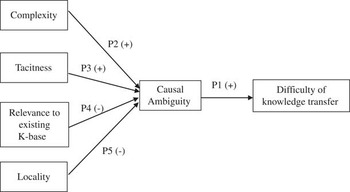
The focus of this paper is the attributes of the knowledge, rather than the context or process of transferring it. Existing literature identifies a number of attributes that affect the transferability of knowledge, such as tacitness, causal ambiguity, relevance, carriers of knowledge, and type of knowledge (Winter, Reference Winter1987; Zander & Kogut, Reference Zander and Kogut1995). Generally, researchers consider how these attributes facilitate or impede knowledge transfer and emphasize the direct effects of these factors. However, in his examination of strategic alliances, Simonin (Reference Simonin1999) argues that causal ambiguity plays a mediating role. This paper takes a similar stance in acknowledging the centrality of causal ambiguity in the transfer process within the firm. I provide further rationale on the mediating role of complexity and tacitness, and the effects of these factors on causal ambiguity in the transfer process within the firm. As the knowledge being transferred becomes more complex and tacit, causal ambiguity increases, hindering the transfer process. Additionally, two other attributes of knowledge, which influence the ease of transfer through their effect on causal ambiguity, are included in this model: relevance and locality. Both variables are negatively related to causal ambiguity. When knowledge is relevant to the existing knowledge-base of the firm, causal ambiguities related to the particular problems are likely to be resolved in a shorter time. Similarly, when it is possible to locate the crux of knowledge within a small set of individual minds, it will take less effort to resolve causal ambiguity. These factors facilitate the transfer process. Figure 1 depicts the proposed conceptual model which develops a mediating mechanism explained below.
Conceptual model: determinants of causal ambiguity and difficulty of knowledge transfer

CAUSAL AMBIGUITY
Causal ambiguity is identified as a fundamental attribute of knowledge in the knowledge transfer literature. Broadly defined, ambiguity refers to a lack of clarity in interpretation and understanding. However, this definition is too generic for our purposes. More specifically, in the context of the knowledge-based view, a particular type of ambiguity gains importance. Within the context of a firm, the knowledge-based view emphasizes a particular lack of clarity in understanding a set of actions which produce a successful business outcome. These repeated sets of actions with certain expected outcomes are the routines of the firm (Nelson & Winter, Reference Nelson and Winter1982). Because of uncertainty and the collective nature of the routines, not all causal relationships between the actions and their outcomes are clear (Lippman & Rumelt, Reference Lippman and Rumelt1982). Firms might be able to perform tasks relatively effectively, but that does not necessarily mean that the impact of a given action is known completely by the actors or observable to an outsider (Williams, Reference Williams2007; Lakshman, Reference Lakshman2011). Accordingly, causal ambiguity is defined as the lack of understanding of the linkages between actions and their results in this context (Lippman & Rumelt, Reference Lippman and Rumelt1982; Ambrosini & Bowman, Reference Ambrosini and Bowman2010).
Previous research postulates a negative relationship between the degree of causal ambiguity and the transferability of knowledge. For example, Szulanski (Reference Szulanski1996) proposed that causal ambiguity would increase the eventfulness of transfer especially in the initial stages of the process. Eventfulness is Szulanski's measure of difficulty; when knowledge transfer does not proceed as expected, the participants note problems and the process is classified as eventful. In his results, causal ambiguity proved to significantly impact eventfulness in all stages of the knowledge transfer process. Similarly, Simonin (Reference Simonin1999) shows that it is harder to transfer causally ambiguous knowledge in a strategic alliance context. This yields the following proposition, depicted in Figure 1:
Proposition 1: Causal ambiguity of knowledge is positively related to the difficulty of its transfer.
COMPLEXITY
The complexity of knowledge is defined as the magnitude of interactions among the components of a specific knowledge asset. As the number of distinguishable pieces and their interactions within the knowledge increase, it becomes more complex. This increases ambiguity simply because the sheer number of possible alternative causal models will increase, and it will be more difficult to tell which action produced which result. The effect of complexity on knowledge transfer is as expected. Some researchers construct a direct link between the inherent complexity of knowledge and its transferability (e.g., Smith & Zeithaml, Reference Smith and Zeithaml1996). Rivkin (Reference Rivkin2001) states that the more complex the knowledge, the harder it is to replicate. Similarly Kogut and Zander (Reference Kogut and Zander1992) propose that the ease of transfer decreases with increasing complexity. And finally Hansen (Reference Hansen1999) argues that complexity requires stronger ties between communicating parties in order to facilitate transfer. The connection between complexity and what we can loosely term transfer difficulty relies, however, on a mediating factor.
A close reading of the literature suggests that complexity makes it difficult for the knowledge to be transferred because it makes the causal connections hard to decipher. Complex knowledge is hard to transfer because that knowledge is more likely to be causally ambiguous to the parties. In a different context, Reed and DeFillippi (Reference Reed and DeFillippi1990) construct a similar link between causal ambiguity and the complexity of firm strategies. They argue that complexity is a factor that leads to causally ambiguous competencies. Following their model, Simonin (Reference Simonin1999) demonstrates the existence of the correlation between complexity and causal ambiguity. Applying this model to the transfer of knowledge within the firm yields the following proposition depicted in Figure 1:
Proposition 2: Complexity is positively related to the degree of causal ambiguity of knowledge.
TACITNESS
In management studies, Polanyi (Reference Polanyi1962) was the first to introduce the idea that individuals are capable of more than what they can tell. Tacitness refers to the aspect of knowledge that is not articulatedFootnote 2, and it has been widely studied in terms of its effects on knowledge transfer. A measure of tacitness, the degree of codification is related to the speed and the ease of transfer (Zander & Kogut, Reference Zander and Kogut1995). The effect of codification to help alleviate that difficulty is also shown in a study of an Italian industrial district by Albino, Garavelli, and Schiuma (Reference Albino, Garavelli and Schiuma1998). In their analysis of international joint ventures Inkpen and Dinur (Reference Inkpen and Dinur1998) also propose that tacitness makes it harder to transfer knowledge. In the context of acquisitions, a similar effect is proposed as well: tacit knowledge is more difficult to be appropriated by the acquiring firm (Bresman, Birkinshaw, & Nobel, Reference Bresman, Birkinshaw and Robert1999). And finally, in the case of entrepreneurial firms Knockaert, Ucbasaran, Wright, and Clarysse (Reference Knockaert, Ucbasaran, Wright and Clarysse2011) propose that tacitness impedes knowledge transfer.
Similar to the discussion above, the mechanism that links tacitness with the ease of transfer involves causal ambiguity as a central phenomenon (Reed & DeFillippi, Reference Reed and DeFillippi1990). Those previous studies mentioned above explain the connection between tacitness and the difficulty of transfer via the lack of understanding of causal connections. If knowledge is tacitly stored in the individual or the collective mindFootnote 3, then the causal relationships among particular actions and their results are less likely to be identified. The portion of knowledge that might explain why a certain practice leads to successful results is more likely to be overlooked or misunderstood. That means the causal ambiguity associated with that particular practice will be greater, and consequently its transfer will be harder. This yields the following proposition depicted in Figure 1:
Proposition 3: Tacitness is positively related to the degree of causal ambiguity of knowledge.
RELEVANCE TO EXISTING KNOWLEDGE BASE
Tsoukas's (Reference Tsoukas1996) work on organizational knowledge demonstrates that it is not possible to localize knowledge and draw its boundaries within a part of the organization. Organizational knowledge is dispersed and collective. This observation leads to another factor that will influence the process of knowledge transfer. Because of the dispersed nature of knowledge, the particular practice to be transferred will be shared to varying degrees by the rest of the organization. The unit that has access to knowledge will make use of the preexisting knowledge base provided by the organization. The overlap might be of varying degrees and will help the transfer of knowledge by providing a similar collective cognitive baseFootnote 4.
The broader idea that preexisting knowledge influences the adoption of new knowledge is not a novel one (e.g., Cohen & Levinthal, Reference Cohen and Levinthal1990). For example, Presutti, Boari, and Majocchi (Reference Presutti, Boari and Majocchi2011) found that cognitive proximity increases the likelihood of knowledge transfer within start-ups. Teece (Reference Teece1977) found that previous experience with a technology reduced the costs of transferring new knowledge about it. This might be explained by the relevance of the new knowledge to the firm's preexisting knowledge. Schulz (Reference Schulz2001) argues that the newer the knowledge, the more intense the vertical outflows (between subsidiary and headquarters). This finding supports the necessity of aligning unit knowledge with the existing knowledge base in the rest of the firmFootnote 5. Furthermore, Szulanski (Reference Szulanski1996) argues that unproven knowledge is difficult to transfer. This too might be explained by a lack of relevance to the existing knowledge base, since provenness is a function of applying existing proven practices. Simonin's (Reference Simonin1999) finding that experience with a practice is negatively related to ambiguity can be explained using the same rationale. In their analysis of Swedish multinationals, Birkinshaw, Nobel, and Ridderstrale (Reference Birkinshaw, Nobel and Ridderstrale2002) show that the system-embeddedness of knowledge has an effect on organizational structure. Their conception of system-embeddedness suggests that ‘some knowledge is much more sensitive to its social and physical context than other knowledge’ (Birkinshaw, Nobel, & Ridderstrale, Reference Birkinshaw, Nobel and Ridderstrale2002: 278).
Relying on the information processing perspective, Huber (Reference Huber1991) proposes that relevance to the receiver's knowledge would positively influence the ease of transfer of information. However, Szulanski (Reference Szulanski2000) found a surprising result: that preexisting knowledge slowed down the transfer process due to the need for unlearning. Simply having access to related knowledge did not help with the transfer process; the receiving unit had to ‘forget’ preexisting knowledge in order for new knowledge to be successfully transferred (Cegarro-Navarro, Eldridge, & Sánchez, Reference Cegarro-Navarro, Eldridge and Sánchez2012). On its face, this appears to contradict the idea that relevance eases transfer, but it is not merely knowing about similar phenomena, but having similar solutions for relevant problems that counts as having relevant knowledge. Otherwise, the causal ambiguity perceived by the receiving unit might intensify if the new knowledge is inconsistent with the existing practices.
Another related argument is made about asset-specificity, a concept borrowed from Williamson (Reference Williamson1985). Reed and DeFillippi (Reference Reed and DeFillippi1990), and then Simonin (Reference Simonin1999), argue that specificity leads to causal ambiguity because the knowledge emerging from transaction-specific assets will remain ambiguous to competitors. But their reasoning can only explain ambiguity as perceived by a competitor; this might be a barrier to imitation, but not other types of transfer, of the transaction-specific knowledge. As convincingly argued by Williamson, it is understandable that transaction-specific knowledge arises in certain circumstances and its transfer is difficult to negotiate. However, it is unclear from this perspective why transaction-specific knowledge will be ambiguous to the very firm using it. Not surprisingly, in Simonin's (Reference Simonin1999) empirical analysis, asset specificity turned out to be insignificant to ambiguity. I propose that the lack of support in his study can be explained by the relevance construct in this model. Asset specificity makes transfer difficult if the knowledge created and applied is not closely related to the firm's pre-existing knowledge base. Transaction specificity per se does not mean that the practice associated with the particular assets is irrelevant to the existing knowledge base of the firm. It is the specificity of the knowledge rather than other assets, which is captured by the idea of relevance to the existing knowledge base. This yields the following proposition depicted in Figure 1:
Proposition 4: The relevance to the existing knowledge base is negatively related to the degree of causal ambiguity of knowledge.
LOCALITY OF KNOWLEDGE
From Nelson and Winter (Reference Nelson and Winter1982) to Nonaka and Takeuchi (Reference Nonaka and Takeuchi1995), many researchers have acknowledged the importance of the type of carrier in which knowledge resides. Basically, they identify four different carriers: individual, group, organization, and network. Tsoukas (Reference Tsoukas1996) has stated that it is not possible to fully localize any knowledge used by an organization. In his study of new product development, Carlile (Reference Carlile2002) shows that the location of the knowledge matters. As a critique of the capabilities-based view, Felin and Hesterly (Reference Felin and Hesterley2007) maintain that knowledge resides mainly in individuals. However, strategic management research convincingly demonstrates that there are various possibilities along a continuum from one to many carriers: a practice might be best encapsulated within an individual mind, or a team, or the involvement of a whole subunit might be necessary to cover the bulk of knowledge to be transferred.
Inkpen and Dinur (Reference Inkpen and Dinur1998) found a positive relationship between the difficulty of transfer and the number of the carriers of knowledge. Similarly, Argote and Ingram (Reference Argote and Ingram2000) argue, knowledge embedded in all possible carriers (i.e., people, tasks, and tools) is harder to transfer than knowledge that is embedded in a single carrier. Knockaert et al. (Reference Knockaert, Ucbasaran, Wright and Clarysse2011) propose that the human resources might need to be relocated for knowledge to be transferred effectively. In a recent empirical study, Gardner, Gino, and Staats (Reference Gardner, Gino and Staats2012) find that the previous relationships among team members have an effect on how their knowledge is brought together. I propose that causal ambiguity mediates this effect. The task of linking actions with results to reduce causal ambiguity becomes harder as one moves from a smaller set of carrier minds to a larger set, because of the increased dispersion of knowledge. Accordingly, the transfer will be harder. If knowledge is located in an individual mind rather than a team of individuals, it will present less causal ambiguity since all individual-specific hazards will already exist in the team with the addition of group cognition dynamicsFootnote 6. By the same token, enlarging the locality to the subunit level will make the ambiguity more severe. This yields the following proposition depicted in Figure 1:
Proposition 5: Locality of knowledge is negatively related to the degree of causal ambiguity of knowledge.
IMPLICATIONS FOR RESEARCH AND FUTURE DIRECTIONS
The theoretical model in this paper advances a framework that rests on the following premise: something unique about the nature of the knowledge makes its transfer difficult inside a firm and there is a structure to this difficulty. Consistent with the previous literature I maintain that complexity and tacitness are two critical attributes of knowledge in the context of transfer. Additionally, I advocate two new constructs: relevance and locality. When knowledge is complex, tacit, not relevant to the receiving unit's knowledge base, and not locally identifiable within a small group of people, it is more difficult to transfer. As importantly, the framework advances a meditation structure. I argue that causal ambiguity (Reed & DeFillippi, Reference Reed and DeFillippi1990; Simonin, Reference Simonin1999) plays a central role. All four antecedents make knowledge transfer difficult because they make the knowledge more causally ambiguous.
The theoretical development in this paper is intended to shed some light on the question ‘why do organizations not know what they know?’ By comprehending some possible sources of causal ambiguity, researchers might be better equipped to understand not only causal ambiguity in general but also the knowledge transfer process. The framework proposed in this paper might aid understanding of the impediments to leveraging of knowledge assets within the firm, identified by researchers (Kogut & Zander, Reference Kogut and Zander1993; Spender & Grant, Reference Spender and Grant1996; Tsoukas, Reference Tsoukas1996; Guzman & Wilson, Reference Guzman and Wilson2005) as a fundamental function of organizations.
The arguments in this paper, especially those related to the relevance of knowledge to the existing knowledge base, apply Tsoukas’ (Reference Tsoukas1996) observation of the dispersed nature of knowledge in the firm. The issues identified by Becker (Reference Becker2001) in this respect are also shown to be effective in the context of knowledge transfer. Depending on the dispersion of knowledge, it is argued that the causal ambiguity of a particular practice is more likely to be addressed and resolved when subunits (especially those that are vertically linked) share knowledge.
The central treatment of causal ambiguity and the two new attributes of knowledge proposed in this framework have implications for the theory of the firmFootnote 7. According to the knowledge-based view, firms exist in order to integrate specialized knowledge (Grant, Reference Grant1996b) and replicate it across space and time (Nelson & Winter, Reference Nelson and Winter1982; Kogut & Zander, Reference Kogut and Zander1992). They provide efficiencies over market transactions by providing a common identity and knowledge base across the organization that allows the firm to exploit similar opportunities in new contexts (Kogut & Zander, Reference Kogut and Zander1996; Dyer & Nobeoka, Reference Dyer and Nobeoka2000; Håkanson, Reference Håkanson2010). The relevance construct advanced in this model provides an explanation for this advantage and simultaneously points to its theoretical limits. As long as the firm's common knowledge-base is able to provide the receiving units with relevant knowledge, transfer of new knowledge will be easier within the firm than between firms. On the flip side, this suggests path dependence story in which valuable but less relevant knowledge will be perceived as causally ambiguous by the receiving parties. This will limit the leveraging of such ‘deviant’ knowledge assets inside the firm and favor market solutions for solving the problems those knowledge asserts pertain to.
Similarly, the other novel attribute, locality, has implications for the scope of a firm. When knowledge is transferred from one unit to another within the organization, the firm can make better use of its resources. Penrose (Reference Penrose1959) asserts that managers’ imaginations of how the resources can be used are the main impetus for firm growth. Imagining the services obtainable from the resources on hand is the result of a process that takes the knowledge-base of the organization as its basic input. However the theoretical development in this paper points to some knowledge-based limits to the growth of the firm. If the unique knowledge the firm wants to replicate and exploit is encapsulated within a small group, the firm will be in a favorable position to grow internally. But as the firm grows, the dispersion of knowledge also grows (Tsoukas, Reference Tsoukas1996); knowledge resides, instead of merely in key individuals, in teams and organizational routines. When this happens, causal ambiguity associated with the knowledge increases, thereby making the firm hierarchy less efficient at replicating key practices.
Previous literature identified three broad categories of factors that might affect difficulty in transferring knowledge within the firm. First, cognitive and psychological factors are related to perceptual problems and motivational dispositions. An alternative conception of these categories is to think of them as the capability of transferring and the willingness to transfer (Wang, Tong, & Koh, Reference Wang, Tong and Koh2004; Héliot & Riley, Reference Héliot and Riley2010). Economic incentives are the second category that will influence the willingness of the parties in the process of transfer. Finally, factors that are about the nature of the knowledge itself include those that are studied in the scope of this paper. There is a need to study the effects of these factors simultaneously. Szulanski (Reference Szulanski1996) studied a subset of these constructs and found that knowledge attributes affected transfer more significantly than motivational aspects. More empirical evidence is needed in order to understand the relative importance of the factors. It is also probable that there is a moderating relationship among these categories of factors – for instance, high willingness in the receiving unit might make even nonrelevant information easier to transfer by alleviating causal ambiguity. More empirical evidence is needed about the relationships between and relative importance of the factors.
While knowledge can also be transferred between organizations (e.g., Bojica, Fuentes, & Gómez-Gras, Reference Bojica, Fuentes and Gómez-Gras2011), in this paper the scope of the conceptual model is limited to the focal firm and the transfers within. An often-repeated concern in the literature (Reed & DeFillippi, Reference Reed and DeFillippi1990; Badaracco, Reference Badaracco1991; Kogut & Zander, Reference Kogut and Zander1993; King & Zeithaml, Reference King and Zeithaml2001; Rivkin, Reference Rivkin2001) is the possibility that ease of transfer might mean ease of imitation. A fruitful avenue of research might be to look at the role of the constructs used in this study and the mediating effect of causal ambiguity. However, the relationships are not so straightforward when one considers the threat of imitation. For example, Rivkin (Reference Rivkin2001) proposed an equilibrium effect in which the distance between the threat of imitation and ease of transfer is at a maximum. Therefore, moderate levels of complexity were considered preferable to other levels. However, the relevance of new information to a focal firm's knowledge base may protect it from this vulnerability, perhaps even increasing its advantage over imitators as new knowledge gets more integrated with the existing knowledge-base. For this construct, moderate levels might not be the optimal choice.
The interactions among independent variables also need examination. The knowledge attributes discussed in this study might not be orthogonal to each other under all circumstances. For example, the difficulties caused by the complexity of knowledge might be alleviated by strong relevance. In that case, the effect of complexity might be reduced for those practices that are highly ingrained with the supervising unit that facilitates the transfer. Similar effects may be discovered among the independent variables above.
MANAGERIAL IMPLICATIONS
This research identifies some of the factors that need to be taken into account by the managers who are responsible for transferring and replicating practices within the firm (see Argote, Reference Argote1999 for examples). All of the factors outlined above are amenable to managerial action that will influence the perception of causal ambiguity associated with knowledge. For instance, a focus group of practicing knowledge managers found that tacit knowledge was especially hard to transfer (Smith, McKeen, & Singh, Reference Smith, McKeen and Singh2007). Tacit components of knowledge might be manipulated by further codification and appropriate use of knowledge management tools, perhaps decreasing its effect on causal ambiguity and enhancing the transfer process.
Another managerial implication is the correct specification of the problems by showing possible sources of causal ambiguity. Transfer of knowledge is a complicated process (Szulanski, Reference Szulanski1996). Managers may find it hard to track down the sources of difficulties they face throughout the process. Demonstrating the effects of the four constructs may assist managers in identifying the possible reasons for problems and point out potentially different solutions. For instance, difficulties related to complexity of the practice will require different solutions than those related to tacitness, although both might be observed as causal ambiguity of the practice without proper analytical reasoning. Current literature, especially knowledge management discussions, focuses on codification solutions for knowledge ambiguity and its capture. Reading of current managerial literature might lead to extensive use of codification techniques wherever ambiguity creates problems for transfer. Codification, however, is not a universal solution to knowledge transfer difficulties (Haas & Hansen, Reference Haas and Hansen2007). This paper argues that other factors increase causal ambiguity associated with knowledge. Solutions that pertain to only one factor might not be helpful when other factors are influential.
CONCLUSION
Knowledge-based perspectives point out intangible assets of the firm that can be used for sustainable competitive advantage (Watson & Hewett, Reference Watson and Hewett2006). Knowledge transfer has been shown to be a challenging process with unique difficulties (Szulanski, Reference Szulanski2000). But there is economic pressure on the firm to leverage its knowledge and foster transfer of best practices (Kogut & Zander, Reference Kogut and Zander1993; Grant, Reference Grant1996b). Managers need to know what factors play significant roles in the transfer process. In addition to cognitive, psychological, and economic factors, knowledge attributes are also influential in the success of the transfer. Relying on Reed and DeFillippi (Reference Reed and DeFillippi1990), Simonin (Reference Simonin1999) proposes that complexity and tacitness of the knowledge are two attributes that influence causal ambiguity associated with the knowledge. In turn, causal ambiguity poses difficulties to the transfer process.
In addition to further elaboration of these linkages, this paper proposes two more factors (relevance and locality) that influence the causal ambiguity of knowledge. When the transferred knowledge is more relevant to the existing knowledge-base of the firm and when the transferred knowledge resides in a smaller set of locations, the process gets less cumbersome. Empirical testing of these propositions will further complement the existing literature and help managers to identify and solve problems in transfer and replication.
Acknowledgement
I thank Mine Cinar for inspiration and Kathleen Getz for support in this research.