INTRODUCTION
Over the past thirty years, London's East End has been transformed from a poverty-stricken district characterised by high levels of deprivation and crime to an area which has become home to some of the most fashionable neighbourhoods in the world (Butler & Robson Reference Butcher, Dickens and Thomas2003; Saumarez Smith Reference Saumarez Smith2017). Historically a working-class area characterised by large-scale manufacturing industries and sprawling social housing estates, several decades of urban regeneration and deindustrialisation have substantially altered the identity of East London. Factories and workhouses which once housed vast industries have since been converted into luxury apartment complexes and upmarket commercial districts, advertised to a new, economically mobile middle-class (e.g. Davidson & Lees Reference Davidson and Lees2005). Consequently, many of the traditional working-class population have been displaced (Lees, Slater, & Wyly Reference Lees, Slater and Wyly2008) with residents forced to relocate to boroughs in more affordable—and geographically disparate—neighbourhoods.
In this article, I draw inspiration from a recent body of research on the sociolinguistics of place-making (Johnstone Reference Johnstone2013; Britain Reference Britain and Coupland2016; Montgomery & Moore Reference Montgomery and Moore2017; Cornips & de Rooij Reference Cornips, de Rooij, Cornips and de Rooij2018) to examine the dynamics of ‘belonging’ and ‘place’ in the gentrifying East End of London. Drawing on insights gathered during two separate ethnographic projects in the area, I examine the discursive strategies that young people who are part of the ‘gentrified’ community (i.e. those working-class individuals who have hereditary and generational ties to the area) and those who are part of the ‘gentrifying’ community (i.e. those middle-class individuals who have recently relocated to the area) use to conceptualise ‘place’. Adding to a growing body of research which addresses the sociolinguistic implications of urban regeneration (see inter alia Papen Reference Papen2012; Trinch & Snajdr Reference Trinch and Snajdr2016; Baro Reference Baro2017; Goncalves Reference Goncalves, Peck, Stroud and Williams2018; Vandenbroucke Reference Vandenbroucke2018), I explore youth perspectives on gentrification and place from an intersectional perspective (Yuval-Davis Reference Yuval-Davis2006; Christensen Reference Christensen2009). Specifically, I analyse the ways in which young people's ethnic and classed identities influence and affect their attachment to the local neighbourhood and the wider city of London. Examining the discursive strategies present in their narratives leads me to argue that whilst members of the two communities physically reside in the same geographically bounded neighbourhood, these individuals metaphorically and socioculturally occupy two very different cities.
In the next section, I briefly review the existing literature on gentrification and language before introducing the concepts of ‘place’ and ‘space’. I then detail the context of my fieldwork and research methods before analysing the discursive strategies that working-class and middle-class individuals use when discussing place. Finally, I conclude with an overview of the ramifications of these findings.
GENTRIFICATION AND LANGUAGE
The term gentrification refers to ‘the transformation of a working class or vacant area of the central city into middle class residential or commercial use’ (Lees et al. Reference Lees, Slater and Wyly2008:xv). Since the term was coined in the 1960s (Glass Reference Glass1964), research has attempted to examine the political, economic, and social consequences of gentrification (see inter alia Palen & London Reference Palen and London1984; van Weesep Reference van Weesep1994; Butler & Robson Reference Butcher, Dickens and Thomas2003; Lees et al. Reference Lees, Slater and Wyly2008; Butler & Hamnett Reference Butler and Hamnett2011; Campkin Reference Campkin2013; Saumarez Smith Reference Saumarez Smith2017). This includes work that has explored the racial and ethnic inequalities associated with the displacement of communities (e.g. Hwang Reference Hwang2015; Lees Reference Lees2016), the restructuring of class populations caused by the influx of a new middle class (e.g. Munt Reference Munt1987; Bridge Reference Bridge1994; Jackson & Butler Reference Jackson and Butler2015), as well as the changing cultural identity of the regenerating neighbourhood (e.g. Erbacher Reference Erbacher and Kaltmeier2011; Pratt Reference Pratt, Lees and Philips2018).
Recently, scholars have also addressed the sociolinguistic dynamics of urban regeneration. Much of this research has examined changes to the semiotic landscape of the gentrifying neighbourhood. A case in point is Trinch & Snajdr's ethnographic research in Brooklyn, New York. In their work, they analyse shop signs as ‘place-making technologies’ (2016:80), using interviews with residents to contextualise their findings. They distinguish between what they refer to as old school vernacular signage, and distinction-making signage, which they argue promote two distinct language-based ideologies that reference traditional class struggles. The first type of signage—which they describe as those that include nonstandard forms of written English, large typefaces, and other non-Roman scripts—represents ‘small-scale, free-market capitalism and independent, diverse, open commerce’ (2016:86). This is contrasted with distinction-making signage, defined as those signs which are text-sparse and signal exclusivity. A similar approach is used by Papen (Reference Papen2012) who combines textual and visual analysis with interviews with sign producers to analyse the Linguistic Landscape in the Berlin neighbourhood of Prenzlauer Berg. In that analysis, she demonstrates that street artists use public space as a site of contestation, where they represent their political and artistic ideas—what she sees as a form of citizen protest.
The current article adds to this trajectory of work by focussing on youth perspectives of urban (re)generation. Whilst there is a growing body of research on discourses of gentrification (e.g. Baro Reference Baro2017; Goncalves Reference Goncalves, Peck, Stroud and Williams2018; Vandenbroucke Reference Vandenbroucke2018), much less work has examined the ways in which young people relate to and experience changes in the urban environment (Howarth Reference Howarth2002; Butcher & Dickens Reference Butcher and Dickens2016). Nevertheless, as a demographic who have little control over the displacement and precarity caused by gentrification (Watt Reference Watt2013; Butcher & Dickens Reference Butcher and Dickens2016), it seems necessary to explore the perspectives of youth and young adults (Butcher & Thomas Reference Butcher, Dickens and Thomas2003).
Before introducing the research context of the study, it is necessary here to define how I conceptualise gentrification. Following other scholars, my analysis is informed by three assumptions. First, since gentrification leads to a displacement of working-class residents due to an influx of more affluent residents and businesses, I assume that it is a classed process, such that its effects can be examined in relation to London's entrenched social class structure (Butler & Robson Reference Butcher, Dickens and Thomas2003; Lees et al. Reference Lees, Slater and Wyly2008). Second, I assume that gentrification is a ‘global urban strategy’ (Smith Reference Smith2002) that is a product of neoliberalism where the ‘city’ is central to the accumulation of wealth and market success (Kelly Reference Kelly, MacLaran and Kelly2014). Neoliberal urban policies are seen in the support of public-sector housing schemes, an increasing emphasis on home ownership (e.g. the right-to-buy; Hackney 2019), as well as the policing of gentrification activism and protest itself (Lees et al. Reference Lees, Slater and Wyly2008:166). Third, I assume that gentrification—particularly in London—is racialized in the extent to which Black and minority ethnic individuals who experience higher levels of poverty and deprivation are disproportionately affected by the effects of urban regeneration (Atkinson & Bridge Reference Atkinson and Bridge2005; Kohn Reference Kohn2013; Hwang Reference Hwang2015; Lees Reference Lees2016). This point is particularly important for the current article, since I argue that it is necessary to examine ‘place-making’ from an intersectional perspective. That is to say, the multiple and intersecting social characteristics of the individual (Yuval-Davis Reference Yuval-Davis2006; Christensen Reference Christensen2009) influence and shape the ways in which place is experienced and discursively constructed.
I discuss these points here not only to clarify my definition of the term gentrification, but also to expose the assumptions that inform my interpretations of the data discussed herein. Before turning to a discussion of the data, I introduce the notions of ‘place’ and ‘place-making’ that I analyse in relation to the changing social landscape of East London.
PLACE
The concept of ‘place’ has always been a central focus in sociolinguistic research. As early as Labov's (Reference Labov1963) influential work on Martha's Vineyard, scholars have sought to analyse language use in relation to geographically bounded communities. In earlier research, however, ‘place’ was conceptualised as a relatively static concept. As Coupland (Reference Coupland, Llamas and Watts2010:101) notes, many of these accounts were influenced by a dialectical tendency to conflate ‘place’ with the ‘speech community’. Consequently, ‘place’ was often conceptualised as some objectively given location, usually a geographic locale, as determined by the placement of isoglosses and boundaries on a map (Johnstone Reference Johnstone and Fought2004:68; Coupland Reference Coupland, Llamas and Watts2010:101; Montgomery & Moore Reference Montgomery and Moore2017:1–2).
In more recent work, however, and influenced largely by earlier developments in human geography (e.g. Relph Reference Relph1976; Buttimer Reference Buttimer1976), sociolinguistic research has often taken a phenomenological approach, making a theoretical distinction between ‘place’ and ‘space’. Within this school of thought, scholars have analysed ‘place’ not just in relation to some physical location, but as a process that emerges in the lived world of everyday experience (Tuan Reference Tuan1991). Consequently, there has been a shift away from theorising ‘place’ as a static, bounded entity, towards examining how place is constructed and produced in interaction (Johnstone Reference Johnstone and Fought2004). Much of this work has focussed on the ways in which language functions as a type of ‘place-making activity’. This includes discourse-analytic work which examines the discursive construction of place in interaction, as well as research which has examined the sociolinguistic distribution of features and their place-related socioindexical meaning(s) (e.g. Papen Reference Papen2012; Johnstone Reference Johnstone2013; Trimaille & Gasquet-Cyrus Reference Trimaille, Gasquet-Cyrus, Jones and Hornsby2013; Trinch & Snajdr Reference Trinch and Snajdr2016; Ribbens-Klein Reference Ribbens-Klein2017; Montgomery & Moore Reference Montgomery and Moore2017; Cornips & de Rooij Reference Cornips, de Rooij, Cornips and de Rooij2018).
In the move towards embracing more fluid notions of place that are grounded in human experience, scholars have often documented the diversity of ways in which urban spaces and locales are conceptualised by different communities. For instance, research has examined how speakers index ‘belonging’ in relation to specific place-linked identities (e.g. Yuval-Davis Reference Yuval-Davis2006) as well as the ‘centralization’ and ‘peripheralization’ of different place-related identities. For Cornips & de Rooij (Reference Cornips, de Rooij, Cornips and de Rooij2018) it is through the discursive construction of ‘place’ that we can observe the marginality that is experienced by those who are excluded from mainstream discourse. A case in point is Banaś’ (Reference Banaś, Cornips and de Rooij2018) analysis of the discursive construction of belonging in narratives by migrant Japanese women living in Amstelveen, the Netherlands. She suggests that the women use linguistic features, such as the pronouns ‘I’ and ‘we’, to orient away from the native community, instead aligning with their migrant peers. This creates a sense of belonging amongst the ingroup of migrants whilst reaffirming the (perceived) exclusionary divide between the community they belong to, and the society they find themselves in.
Issues of marginalisation and belonging are likely to be magnified in gentrifying neighbourhoods where the emergence of a bourgeoisie leads to inevitable social, cultural, and economic disparities between the two communities (Atkinson & Bridge Reference Atkinson and Bridge2005; Lees et al. Reference Lees, Slater and Wyly2008:xxi). For some, these disparities may result in a type of ‘Othering’, where in-group and out-group distinctions are exacerbated in relation to class, linguistic, and cultural differences (cf. Duszak Reference Duszak2002; Krzyzanowski & Wodak Reference Krzyzanowski and Wodak2011). Such issues are likely to be observed not only in the ways in which members of the working-class community discursively construct belonging in relation to the newer gentrifying community (cf. Banaś Reference Banaś, Cornips and de Rooij2018), but also in the ways in which the gentrified community are ‘Othered’ by members of the newly arrived middle class. Amongst youth, these issues may be heightened, given that this demographic experience higher levels of urban marginalisation (Butcher & Thomas Reference Butcher, Dickens and Thomas2003). In what follows, I explore these issues in the context of the gentrifying East End of London.
RESEARCH CONTEXT: EAST lONDON
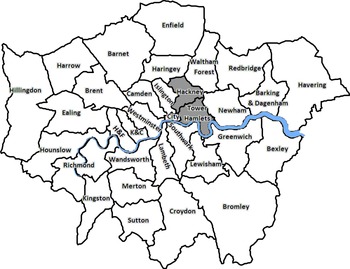
The research context that I discuss here is the inner-city area of East London, broadly defined by the two councils, Hackney and Tower Hamlets (see Figure 1). Historically, London's East End was home to large-scale production and manufacturing industries owing to its proximity to the River Thames and the construction of the London Docks in the 1800s. At this time, the population was mostly employed in manual industries such as the silk-weaving trade in Spitalfields and the ship-building yards in the Docklands.
The Inner East London boroughs of Hackney and Tower Hamlets (shaded) within the wider conurbation of Greater London (Greater London Authority 2020; contains ordnance survey data © Crown copyright and database rights).

With an influx of new industries came an increased demand for affordable housing. Residents often experienced cramped and dangerous living conditions, with many living in slums. As a consequence, East London quickly became synonymous with poverty, criminality, and deprivation (Saumarez Smith Reference Saumarez Smith2017). These issues were compounded during World War Two when, owing to the concentration of industry in the area, intensive bombing campaigns devastated East London.
To address labour shortages following the war, migration was actively encouraged. Initiatives such as the introduction of the British Nationality Act in 1948, which conferred citizenship on Commonwealth members, invited migrants to reside in the UK, with many settling in East London. There, migrants established vibrant diasporic communities, such as the African-Caribbean community in Hackney Town and the Turkish community in Stoke Newington (north Hackney).
From the 1960s, however, East London fell into decline and a period of de-industrialisation ensued, leading to the closure of many of the industries that employed the local community. In search for better opportunities, many of the White working-class community, often referred to as ‘Cockneys’, relocated to outer London boroughs and parts of Essex to new suburban towns—a period sometimes referred to as ‘White flight’ (Bridge, Butler, & Lees Reference Bridge, Butler and Lees2011; Fox Reference Fox2015).
For some time, East London continued to see higher levels of deprivation than elsewhere in the capital. In the 1950s and 1960s, much of the East End was controlled by gangs, such as the infamous Kray Twins. The area continued to be associated with high levels of crime and deprivation well into the 2000s. In 2002, The Independent newspaper dubbed a stretch of road in the Hackney neighbourhood, Clapton, ‘Britain's murder mile’ in reference to the eight people who were murdered on the road over two years (Mendick & Johnson Reference Mendick and Johnson2002). To some degree, perceptions of criminality were reflected in statistical measures of crime and deprivation. In 2007, Hackney and Tower Hamlets were reported as the second and third most deprived boroughs in the UK on the Index of Multiple Deprivation (2007).
Nevertheless, over the past twenty to thirty years, East London has seen considerable improvements in living conditions. Since 2007, the two boroughs have seen an exponential decrease in levels of crime and poverty. Just eight years later, Hackney and Tower Hamlets rank as the forty-ninth and twenty-fourth of deprived boroughs in the UK (Index of Multiple Deprivation 2015).
These improvements have occurred alongside visible and perceptible changes in East London. Today, Hackney is home to a vibrant cultural scene, comprising leading artists, musicians, and fashion designers. It is often described as one of the ‘trendiest’ neighbourhoods in London (Saumarez Smith Reference Robson and Butler2017). In 2017, Shoreditch—a neighbourhood in the south of Hackney often labelled ‘hipster heaven’ (Anthony Reference Anthony2018)—became the most expensive tech and creative district in the world (Rayner Reference Rayner2018). To account for the increased demand in residential and commercial space, councils have often adopted intensive regeneration and densification policies (e.g. Hackney 2019). These policies have led some commentators to warn of an apparent ‘cultural cleansing’ (Anthony Reference Anthony2018) in which the distinctive cultural and ethnic genealogies of East London are erased.
RESEARCH METHODS
The setting that I describe here, and the data that I consider herein, are taken from two separate ethnographic projects conducted in East London. First, an extended period of fieldwork with twenty-six adolescents at a youth group that was part of a wider project on language use in East London (Ilbury Reference Ilbury2020) and second, a separate ethnography of sixteen London-based young adults’ digital practices on the mobile messaging app, WhatsApp, that is part of a broader project on digital interactions.
The first dataset is from an ethnography of a Hackney youth group which I refer to as ‘Lakeside’ where I was involved as youth worker in the general running of the centre for two years from October 2016 to October 2018. There I conducted research on the linguistic practices of the young people in relation to more general patterns of sociolinguistic variation in East London (cf. Cheshire, Fox, Kerswill, & Torgersen Reference Cheshire, Fox, Kerswill, Torgersen, Ammon and Mattheier2008).
The dataset that I focus on in this article comprises mainly interviews which took place at Lakeside with eleven adolescents aged between eleven and seventeen. The group are ethnically diverse, but most are second generation African-Caribbean, representing the largest ethnic group in the area. The youth centre is based in the centre of a social-housing estate that continues to experience some of the highest levels of deprivation in the borough. Interviews covered a range of topics such as their heritage, the youth group, and their interests. This was concluded with a task where the participant was presented with a map of the local area and asked to identify areas that they were familiar with. When they recognized a location, I would ask probing questions to find out more about their perceptions of the area. This task was directly related to the focus of the broader study which considered variable patterns of language use amongst adolescents in East London. Thus, the discussions I examine and the themes that I analyse are not contrived but rather emerged in the natural course of the interview and the map task. To protect the identities of my participants, all identifying information is anonymised and participants are assigned pseudonyms.
The second source of data is a corpus of WhatsApp messages sent by sixteen young adults (fourteen females, two males) aged between twenty-four and twenty-five across three conversational groups. The WhatsApp corpus was collected as part of a wider project on digital patterns of interaction amongst young adults in London, which involved ethnographic observations of participants outside of the mobile messaging app. All individuals are middle class and highly educated with all but one completing university education. There is less ethnic diversity amongst them with all but two individuals identifying as White British. All users are originally from the South/South-East of England. Importantly, all of these individuals can be classified as ‘gentrifiers’, with most of this group relocating to gentrifying neighbourhoods of London. Those who did not live in East London were based elsewhere in the city but frequently visited the area, most often to experience the East London's notorious cultural and nightlife scene. Thus, whilst some of these individuals did not physically reside in the area, their experiences of and engagements in East London significantly shape the group's experience of and attachment to ‘place’.
The WhatsApp interactions that I analyse here are taken from a corpus of 96,463 messages sent between August 2015 and May 2017. Conversations are diverse but are mainly informal interactions amongst friends. Topics include general phatic communication, social plans, and life events. Thus, as with the interviews recorded at the youth group, the discussions and themes that I analyse in this article are not contrived but emerged naturally in conversation. Relevant interactions were identified by performing keyword searches on the dataset, using derivatives of the terms ‘gentrification’, ‘London’, ‘city’, and various East London place names. All data has been anonymised and participants were assigned pseudonyms.
Here it is worth acknowledging that there are clear differences in these two datasets, and this is likely to affect the generalisability of my claims. The Lakeside dataset was elicited directly from the young people in synchronous interviews. The WhatsApp conversations, by contrast, were extracted in textual format, retrospectively. Whilst these differences may have an impact on the structure and the nature of the data, it should be noted that the two research projects that inform this analysis were not designed to examine the sociolinguistic consequences of urban regeneration (cf. Papen Reference Papen2012; Trinch & Snajdr Reference Trinch and Snajdr2016; Baro Reference Baro2017; Goncalves Reference Goncalves, Peck, Stroud and Williams2018; Vandenbroucke Reference Vandenbroucke2018). However, given the dramatic changes to East London and the perceived impact of urban regeneration on those who reside in the area, it is notable that these themes emerge in the everyday conversations of these communities. Indeed, at Lakeside, many of the youth workers lamented the loss of local and independent shops in the area whilst club management often expressed concerns that rising living costs in the area would affect the operation of the centre. Over time, several youth workers were forced to relocate in more affordable, outer-London boroughs and so volunteering at the club was no longer feasible. Whilst amongst the young adults in the WhatsApp study, aware of the regeneration in the area, conversations about new shops and restaurants that emerged during their time living there were common, both on WhatsApp and in face-to-face conversation. Thus, I combine these data sources to analyse more generally the extent of gentrification discourses in everyday conversations amongst young people in East London. Whilst I focus on a select few extracts in this article, the themes that I analyse here are reflective of more general trends that I observed whilst conducting my ethnographic research.
Before presenting my analysis, it is necessary here to specify my positioning in this article as someone who is part of the ‘gentrifier’ community. I am a White, middle-class, London-born academic, who relocated from a more affluent area in South-West London to the borough where I conducted my research. Thus, it is necessary to acknowledge that my account is articulated through the ‘gaze’ of the gentrifier and my interpretations are necessarily constrained by these biographical facts (Tedlock Reference Tedlock1991; Irvine & Gal Reference Irvine, Gal and Kroskrity2000; Bucholtz Reference Bucholtz2001; Hegelund Reference Hegelund2005). Nevertheless, by exercising a degree of self-reflexivity in my research, I aim to provide an accurate and unbiased account of the narratives that emerged in my fieldwork.
CONCEPTUALISING PLACE AS THE GENTRIFIED
In the first section of the analysis, I examine how working-class adolescents at Lakeside discuss the effects of gentrification. Extract (1) is from an interview with Michael and Josh. Both boys are fifteen. Michael is White British, and Marcus is second generation African-Caribbean. In the extract I ask whether they would be able to identify the specific part of London a speaker was from based on their speech. In this case, the area is Finsbury Park—a North London neighbourhood approximately three miles from Lakeside.
(1)
1 Christian:could you tell if somebody's from F--Finsbury Park?
2 Michael: nah, not really cos it's kinda similar
[…]
3 Michael: but if […] central London, they have a different way of speaking and
4 then different people live there
5 Marcus: differently
6 Christian: yeah in what like how are they different?
7 Marcus: more formal
8 Michael: central London are more formal people
Michael initially responds to my question by suggesting that he wouldn't be able to identify if someone was from Finsbury Park because of the similarities between the two areas (line 1). In many ways, this area is comparable to the locale where the youth group is based. Like the area surrounding Lakeside, Finsbury Park is ethnically diverse and, whilst the town centre has undergone some regeneration, the area has not yet been fully gentrified. As such, it is perhaps unsurprising that Michael does not distinguish between the two areas. Rather, Michael indexes an alignment with the working-class demographic that reside in Finsbury Park as a comparable demographic to himself and his community (line 2).
In the following lines, however, and with no prompt, Michael shifts from describing a relatively similar locale, to one that he perceives to be poles apart from his neighbourhood: central London.Footnote 1 At first, Michael frames the differences between the two areas in terms of the distinct linguistic varieties that are spoken there (line 3). However, as he elaborates, his assessment reveals that the differences that he perceives are not purely linguistic but also sociocultural, in terms of the ‘type’ of the person that resides there (line 4). The nature of these differences is clarified in lines 7–8. Here, Marcus and Michael's evaluation of the differences between ‘us’, the people of the local area, and ‘them’, those in the city, indirectly references a class-based opposition between the working and middle class, metaphorically indexed as a scale of ‘formality’. At this point Michael draws on an ideologically imagined stereotypical persona—or what Agha (Reference Agha2003) terms a ‘characterological figure’—of the archetypal White city-worker. For Michael, this persona is imbued with the ‘appropriate’ linguistic, aesthetic, and cultural forms of ‘social capital’ (Bourdieu Reference Bourdieu1984) that is conducive to obtaining and benefiting from the professional and economic opportunities that the city offers.
In what follows, Michael describes the ‘differences’ between himself and his community, and the city-worker persona (line 5). This leads Michael and Marcus to claim an identity that is the antithesis of the archetypal person who lives and works in the city. Here, Michael and Marcus align with an ‘informal’ self-presentation style—an identity that is deemed suitable for the neighbourhood in which they reside. This ‘us’ vs. ‘them’ classification (Banaś Reference Banaś, Cornips and de Rooij2018) infers that the boys reject a monolithic ‘Londoner’ identity and instead align with a much more peripheral, localised identity: the working-class community in East London (cf. Cornips & de Rooij Reference Cornips, de Rooij, Cornips and de Rooij2018).
(2)
1 Christian: do you go central London?
2 Josiah: I do not go central London, no way
3 Christian: why don't you go central London?
4 Josiah: central London, pigs everywhere, everywhere like--it's--it's basically like
-
right next to what's her name, Theresa May's house
Similar themes are seen in extract (2). This excerpt is taken from a discussion of the map task with thirteen-year-old Josiah who is second generation African-Caribbean. In the discussion, I ask whether Josiah ever travels into central London—to which he responds with an emphatic “no way” (line 2). When I attempt to clarify the reasons for this response, Josiah claims that there's “pigs [police] everywhere” before going on to suggest that the area is adjacent to former UK Prime Minister Theresa May's residence. Of course, whilst this is factually accurate—Downing Street, the residence of the Prime Minister is located in central London—it is perhaps notable that like Michael in extract (1), Josiah draws on an enregistered characterological figure (Agha Reference Agha2003) to distance himself from the cultural habitus (Bourdieu Reference Bourdieu1990) of those he associates with the city. In this extract, it is Theresa May who serves as the archetypal White, middle-class, ‘formal’ individual who works and/or resides in central London.
However, perhaps the most illuminating comment that reflects Josiah's alignment with an ‘outsider’ status is his comments regarding the prevalence of police (“pigs”) in central London. As I have argued earlier, it is necessary to examine ‘place-making’ from an intersectional perspective (see Yuval-Davis Reference Yuval-Davis2006; Christensen Reference Christensen2009). Here, I suggest that Josiah's comments in line 4 cannot be analysed solely in relation to his social class position, but rather must be understood in relation to his intersectional experience as a young Black working-class man in London. As a member of a demographic is disproportionately targeted by the Metropolitan Police (e.g. ‘stop and search’ measures; Dodd Reference Dodd2019), it is highly likely that Josiah's concern—and his alignment away from central London—reflects his awareness of the potential issues that he, and other Black individuals, experience in the city. Indeed, in other interviews, nonwhite participants expressed similar sentiments. As such, the ‘outsider’ status that they claim reflects their negative experiences with and perceptions of institutions that appear to uphold the values of the city, in this case, the police force. Thus, we see that the (perceived) inaccessibility of the city that Josiah describes hinges not just on his awareness of the differences in socioeconomic class between those in the city and his community, but also his awareness of his racialised identity in a dominant ‘White space’ (Atkinson & Bridge Reference Atkinson and Bridge2005).Footnote 2
To some degree, it is possible that these narratives are influenced by the status of central London as the administrative and financial centre of the city. However, it is notable that areas geographically closer to the youth group are framed in comparative ways. Indeed, similar discourses emerge when the young people discuss the neighbourhood of Shoreditch—an area approximately one mile away from Lakeside that is often described as the poster child of gentrification (e.g. Anthony Reference Anthony2018). A case in point is found in extract (3). Sam is fifteen and is African-Caribbean British. Talisha is thirteen and Mixed-White British.
(3)
1 Sam: yeah Shoreditch is er--
2 Talisha: yeah
3 Sam: --kinda different to Hackney it's
4 Christian: how come?
5 Sam: it's not, it's—it's on the outskirts of Hackney and people like act and talk
6 differently in Shoreditch but it's--it's more
7 Talisha: yeah
8 Sam: posh actually
Initially, Sam describes Shoreditch as “different” from his neighbourhood (line 3), in a similar respect to how Michael frames central London in extract (1). Sam's comment suggests that whilst the neighbourhood is administratively and geographically tied to the borough, he perceives the area to be culturally and socially distinct from what he knows to be “Hackney”. This interpretation is supported by his use of spatial deixis (“outskirts”, line 5), which Sam uses to distance himself not only from the physical geographic locale but also metaphorically by indirectly emphasising the conceptual distance between the dispositions and practices of his community and those who reside in Shoreditch.
As Sam elaborates on these differences, we see that, like his peers in extracts (1) and (2), he draws on the imagery of the ‘archetypal resident’ to emphasise the disparities between the two neighbourhoods. In lines 5 and 6, Sam relates these differences to the social (“act”) and linguistic (“talk”) characteristics of his community in contrast to those who reside in Shoreditch. Like Marcus and Michael, Sam details some of the enregistered (Agha Reference Agha2007) qualities of that person—in this case indirectly attributing the differences to social class distinctions, using the euphemism “posh”. This descriptor not only alludes to the ‘standard’ and upper-class models of speaking (e.g. Rampton Reference Rampton2006; Preece Reference Preece2009:1; Gates & Ilbury Reference Gates, Ilbury, Wright, Harvey and Simpson2019) that he associates with gentrifiers, but also to the disparate economic realities of the two communities, in particular the luxurious and expensive commodities that index the middle class. Thus, as is the effect in extracts (1) and (2) in relation to central London, Sam indexes a distinction between ‘us’, his community, and ‘them’, those residing in the neighbouring and gentrifying area of Shoreditch.
(4)
1 Christian: what part of Hoxton?
2 Josiah: what part? Hoxton, just off of Hoxton Market
3 Christian: Shoreditch, oh Hoxton Market
4 Josiah: yeah, Shoreditch-ish Shoreditch-ish. Basically you know where's St John's
5 Christian: yeah shak--
6 Josiah: yeah go straight down there where all the posh people live
A similar assessment of the encroaching gentrification of Hackney is offered in extract (4). In the excerpt, Josiah is describing a park where he would often hang out with his friends in an area just north of Shoreditch—Hoxton—a neighbourhood that is undergoing regeneration. Struggling to ascertain the exact location of the park he is referring to, I ask whether it is near the highly gentrified neighbourhood of Shoreditch. This leads Josiah to distinguish between the two areas by referencing the disparate economic realities of the two communities (line 6). Like Sam in extract (3), Josiah associates this area with upwardly mobile and economically stable, that is, middle-class residents. He does this by referencing an enregistered quality of the stereotypical ‘resident’ by using the term “posh” to distinguish himself from this social identification, delimiting a sociospatial boundary between himself—and his experiences of Hackney—and those in the gentrifying district of Shoreditch. This allows Josiah to adopt an antithetical identity, aligning with those who are not deemed to part of the area “where all the posh people live”—the working-class community in his neighbourhood.
Analysed collectively, these two extracts reveal that gentrification is framed by Sam and Josiah as a class struggle, where regenerating neighbourhoods become perceived as ‘exclusionary areas’ (see also Trinch & Snajdr Reference Trinch and Snajdr2016:83). This bipartite distinction is reflective of what Robson & Butler (Reference Robson and Butler2001:78) refer to as ‘tectonic’ social relations, where interactions between middle-class and working-class residents are seen to operate in a ‘parallel rather than integrative nature’. In other words, what Sam and Josiah's comments reveal is that, whilst these neighbours reside in the same physical locale, they conceptualise their attachment to place as distinct from the ‘Other’—the ‘posh’ community. In taking this stance, they not only index their belonging with the local working-class community in Hackney, but they also index their ‘unbelonging’ (Yuval-Davis Reference Yuval-Davis2006; Christensen Reference Christensen2009) of the newly arrived gentrifying community in the area and their associated cultural and social values.
Similar themes of segregation and ‘disbelonging’ are also evident in those discussions that centre on changes to the sociocultural diversity of the local area. These narratives often reflect broader concerns that gentrification poses a threat to the distinct cultural genealogy of East London (e.g. Anthony Reference Anthony2018). In other areas, researchers have argued that whilst the ethnic, linguistic, and cultural diversity of the working-class neighbourhood is initially advertised to prospective residents positively, offering middle-class residents an ‘experiential lifestyle of exciting Otherness’ (Erbacher Reference Erbacher and Kaltmeier2011:258), gentrification often leads to the loss of diversity as areas become more ethnically and culturally homogeneous (Atkinson & Bridge Reference Atkinson and Bridge2005; Kohn Reference Kohn2013; Trinch & Snajdr Reference Trinch and Snajdr2016). In conversations with the young people, an awareness of these discourses was evident. Many acknowledged the changing identity of the local Highstreet, and several spoke of the loss of local initiatives, such as youth groups and community centres, due to regeneration works. A case in point is the following extract where Sam elaborates on his earlier comments in extract (3).
(5)
1 Sam: Shoreditch there's a big difference in areas
2 Christian: but do you feel like it's changing here even so like?
3 Sam: yeah it's--it is
4 Talisha: yeah
5 Sam: cos they're just making council houses so they was all--they're trying to make it
6 all the same
7 Christian: what--what do you mean they're making council h--what do you mean?
8 Sam: like they're building flats like everywhere just to make everyone live in home so
9 they're all what's the word, erm they're all the same like--there's--they're maki–
10 different areas were different for good that were good for different things, but
11 now they're just making it all the same
12 Christian: mhm
13 Sam: like one big whole city but we're not
In the extract, Sam's assessment of the changing landscape of the neighbourhood references the homogenisation of the local area and the displacement of working-class communities and their cultures—two main effects of gentrification (Butler & Robson Reference Butler, Hamnett and Robson2003; Lees et al. Reference Lees, Slater and Wyly2008; Kohn Reference Kohn2013). Sam first acknowledges the displacement of his community by describing the loss of “council houses” (line 5), that is, social housing that is primarily occupied by working-class or low-income residents. As he elaborates, Sam argues that “they're trying to make it all the same” (lines 5 and 6), a comment that demonstrates his awareness of the cultural and homogenisation of his neighbourhood as signalled by the increasing number of so-called ‘identikit’ developments (Kallin Reference Kallin, Albet and Benach2018) in the area.
As the conversation progresses, I ask Sam to elaborate. In what follows, he provides a mature and comprehensive account of the effects of gentrification, describing the homogenisation or ‘cultural cleansing’ of the area (Lees et al. Reference Lees, Slater and Wyly2008; Anthony Reference Anthony2018). In line 8, Sam notes that “they're [the council] building flats like everywhere”. Here, Sam references the intensification of residential building-works in the borough following a council initiative that called for higher density developments in key wards (Hackney 2019). This includes the neighbourhood in which he resides. Whilst densification initiatives have often been justified as ways of addressing the lack of affordable housing in the city, these policies often have negative consequences for residents already residing in the area (Hubbard & Lees Reference Hubbard and Lees2018).
As the conversation progresses, Sam adds some support for his claims. In line 10, he views the council's densification campaign as promoting a type of social cleansing, claiming that areas which were once “good” (i.e. distinctive) for certain reasons (line 10) are becoming more socially homogeneous (line 11). Finally, he concludes that he is concerned that the distinctive ethnic and cultural identity of the neighbourhood will become obsolete as the neighbourhood becomes part of “one big whole city” (line 13). Thus, like his peers, Sam rejects a monolithic ‘London’ identity, instead aligning with a more peripheral identity that is tied to the working-class history and cultural genealogy of the local neighbourhood.
Of course, it is necessary to acknowledge that Sam's narrative—as with all of my participants—is articulated from the perspective of his lived experience. For Sam, his account of the effects of gentrification are articulated from the gaze of a young working-class Black man. Thus, these comments are racialised in the extent to which the homogenisation that he speaks of directly affects those with similar ethnic and cultural backgrounds. For Sam, these issues are perhaps more salient since urban regeneration in the area is likely to dramatically alter the racial composition and ethnic heritage of the local neighbourhood (Lees Reference Lees2016). Indeed, the area surrounding Lakeside was home to a large Black African-Caribbean population, and local shops were seen to cater specifically for this demographic, including restaurants that served Caribbean cuisine and hair stylists that specialised in Afro-textured hair. Over the course of my time at the youth group, many of Sam's concerns in extract (5) became realities. Many of the local commodities that catered to his community closed, with craft beer stores and upmarket coffee shops opening in place of these venues. Whilst many of these venues catered primarily to the tastes and social habits of his parents’ generation (e.g. restaurants and bars), and similar complaints were expressed by the adult youth workers, it is perhaps notable that Sam—at just fifteen—recognises the catastrophic potential of losing these commodities. Thus, the homogenisation that Sam speaks of in extract (5) does not just reference the sociospatial displacement of the working-class community more generally, but also a specific concern that urban regeneration poses a threat to the distinct cultural heritage of his community.
Whilst there has been some research that suggests that there is ambivalence amongst working-class youth towards urban regeneration and gentrifiers (e.g. Butcher & Dickens Reference Butcher and Dickens2016), this does not appear to be the case in this context. Whilst I explore only a limited set of examples here, the themes that I describe in those extracts are indicative of a more general perception amongst the participants at Lakeside. Across interviews, urban regeneration was repeatedly framed as a threat to the cultural and social life of the local community. A potential explanation for this framing is that, whilst other neighbourhoods were seen to benefit from improved living conditions due to regeneration, the estate where Lakeside was located remained heavily deprived. In fact, the only perceptible effects of gentrification in the estate were negative: increased living costs, the displacement of friends and family, the loss of cultural heritage, and the emergence of a middle class who were seen to seldom interact with the local community.
However, whilst these narratives reveal how working-class young people conceptualise place in a rapidly gentrifying neighbourhood, it is unclear how this relates to the middle-class experience of the same area. To explore these questions, I now turn to an analysis of interactions between gentrifiers.
CONCEPTUALISING PLACE AS A GENTRIFIER
This section examines discourses of place and gentrification in the narratives of young adults based in London. Although this group do not bear the corporate social responsibility of urban regeneration (cf. Lees et al. Reference Lees, Slater and Wyly2008), these individuals represent the characterological stereotypes (Agha Reference Agha2003) that the young people are seen to reference in interviews at Lakeside. As such, I argue that this demographic represents an appropriate point of comparison to explore how gentrifiers conceptualise place.
First, however, it is necessary to acknowledge that, since this group of individuals have largely secured employment in the city, we do not see comparable discourses regarding the inaccessibility of central London. Rather, these individuals already have access to the appropriate social habitus (Bourdieu Reference Bourdieu1990) to benefit from the economic and professional opportunities offered by the city—prospects that are deemed unobtainable by those at Lakeside. Nevertheless, there are still some prevalent discourses of gentrification in their discussions. However, unlike the young people at Lakeside, when urban regeneration is discussed amongst this group, these changes are generally characterised as ‘positive’ developments that ‘improve’ the area. These narratives form part of a broader legitimisation ideology that is imbued with colonial overtones (Atkinson & Bridge Reference Atkinson and Bridge2005).
Most often, these themes emerge in discussions of areas that were previously designated ‘no-go zones’ (Milani Reference Milani2020) due historical levels of crime and deprivation in the area. In these cases, gentrification is framed as a ‘transformative process’ that restores areas once deemed ‘off-limits’ and turns them into attractive neighbourhoods that offer new exciting cultural and professional opportunities for this community.
(6)
1 Monica: So I think I'm doing dinner on Sat with Laura but Aaron is up for going out after.
2 Only problem is he doesn't like Hackney…
3 Rachel: Okay, maybe another time we will see him

4 Monica: when he stops being a wimp. Apparently he just doesn't like Hackney as he
5 thinks it's dodgy
6 Rachel: Wtf
7 Is that a joke
8 It's so gentrified
[…]
9 Monica: I know but he doesn't know that because he's not been there
10 Rachel: Well if he can't get a grip, feel free to come without him

A case in point is extract (6). In the excerpt, Monica and Rachel are discussing organising a social event with friends Laura and Aaron. In line 1, Monica suggests going out after the meal, before noting a potential problem with her choice of location: that Aaron “doesn't like Hackney” (line 2). As the conversation progresses, it becomes clear that Aaron's reservations of going out in Hackney relate to a perception of the area as unsafe or “dodgy” (line 5)—a stereotype based on the historically high levels of crime and deprivation in the area. This assessment is swiftly quashed by Rachel in lines 6–8, where she ridicules his assessment (“WTF” ‘what the fuck’) by ascertaining whether his comment was sincere (“Is that a joke”). Finally, in line 8, Rachel further seeks to disprove Aaron's assessment by claiming that Hackney's “so gentrified” (line 8).
In this extract, we see how gentrification is framed as a ‘transformative’ process that ‘revitalises’ the urban environment. This legitimizing ideology is drawn on directly by Rachel when she equates gentrification with the reduction of criminality in the neighbourhood (cf. Brown-Saracino & Rumpf Reference Brown-Saracino and Rumpf2011). Suggestions that the area is unsafe, therefore, appear to be unfounded given the extent of the regeneration, signalled by the intensifier “so” (line 8). This framing is not only problematic, but it is also unfounded. Whilst some research has shown gentrification can lead to better community provisions, in some areas crime has risen following periods of urban regeneration (e.g. Van Wilsem, Wittebrood, & Dirk De Graaf Reference Van Wilsem, Wittebrood and De Graaf2006).
Nevertheless, in the lines following, we see a similar legitimising strategy when Monica aligns with Rachel's standpoint by suggesting that Aaron's misconception of Hackney is based on a lack of awareness, noting that “he's not been there” (line 9). Here, Monica's comment suggests that the changes to an area can be ‘experienced’ by simply visiting. Whether Hackney is deemed to be a ‘safe’ or ‘unsafe’ area is judged a posteriori, based on the individual's experience of the aesthetic and visual landscape of the neighbourhood, as opposed to empirical measures of crime and deprivation. Thus, for Monica, it is through experience that the ‘positive’ effects of gentrification on the (linguistic) landscape can be judged (Papen Reference Papen2012; Tinch & Snajdr Reference Trinch and Snajdr2016).
Similar legitimising discourses are seen in extract (7) below. In this excerpt, a group of housemates are discussing moving to a new house at the end of their tenancy agreement. This topic leads Lisa to ask London native, Paul, which area he dislikes more—the South London neighbourhood of Elephant and Castle or an area that borders Hackney in North London, Tottenham. Paul responds that it is Tottenham that he dislikes more (line 3), before suggesting that he feels that Elephant and Castle is slightly nicer because it is becoming gentrified (line 3–4). Thus, for Paul, whether these traditionally working-class areas are deemed habitable is dependent on the extent to which they have been regenerated.
As the conversation develops, we see the nature of these ‘positive’ effects, with gentrification attributed as a ‘solution’ to crime and deprivation. In line 5, this is made explicit when Paul refers to Tottenham as the “Mark Duggan area”—an individual who was murdered by the Metropolitan Police in 2011 and whose death led to the notorious London Riots of that year.
(7)
1 Lisa: Paul which do you hate more
2 Tottenham or elephant and castle
3 Paul: Tottenham. My God. Elephant and Castle at least it's getting the gentrification
4 thing
5 Tottenham was the Mark Duggan area
6 Lisa: Hahaha agreed
7 Am I the only one in tonight?
By referencing this high-profile incident, Paul not only characterises Tottenham as ‘off-limits’ but also infers that the area's high crime rates can be directly attributed to a lack of regeneration in the area. For Paul then, gentrification is perceived to be a ‘positive’ process that reduces criminality, and ultimately, makes the area more habitable for him and his middle-class peers. This legitimisation ideology not only asserts and justifies the expansion of ‘White space’ and privileges middle-class preferences of urban living (Atkinson & Bridge Reference Atkinson and Bridge2005:2), but also validates those perceptions of the sociospatial segregation that emerged in the young people's interviews at Lakeside.
The appearance of these legitimisation ideologies can be understood in relation to the ‘value’ of urban regeneration in the area. Whilst young people at Lakeside face increasing constraints on their access to the city and the loss of their cultural heritage, for middle-class residents, the emergence of craft beer shops, luxury residential apartments, and artisan coffee shops that specifically cater to the tastes of the gentrifiers provides new social opportunities for these individuals. An appreciation of these changes is evident in extract (8).
(8)
1 Jal: Holy Shit guys
2 Just went to my mates flat in London fields
3 He lives in a converted warehouse
4 It is the coolest thing ever
5 We need to move to one hahaha
6 Lisa: Amazing!!!!
7 Laura: Yessss
8 Let's do it
The discussion starts when Jal returns from her friend's apartment—a warehouse conversion—in the Hackney neighbourhood of London Fields. Like many areas of Hackney, London Fields has seen considerable regeneration, with much of the industry in the area repurposed for residential use. As the discussion unfolds, Jal positively evaluates the ‘urban cool’ aesthetic of the conversion before flippantly encouraging the rest of the group to move to a similar residential unit.
In this extract, we not only see how urban regeneration results in an increase of commodities that cater to middle-class tastes, but also how the inevitable expansion of White space (Atkinson & Bridge Reference Atkinson and Bridge2005) eradicates the area's distinctive sociocultural histories and traditions—a concern expressed at Lakeside by Sam in extract (5). With these individuals expressing a desire for the ‘edgy’ urban aesthetic of these developments (Erbacher Reference Erbacher and Kaltmeier2011), we see how warehouses and factories that once provided employment for the working-class community are appropriated to meet the residential requirements and tastes of the middle-class. In this sense there is both a physical displacement, through the loss of industry, and cultural erasure, through the appropriation of industrial symbols, histories, and commodities of the working class.
Similar themes are observed in discussions which centre on the emergence of commodities that cater to the enregistered (Agha Reference Agha2007) class practices and dispositions of the newly arrived middle class. In extract (9) below, we see how the group participate in this enregistered habitus (Bourdieu Reference Bourdieu1990). Prior to the excerpt, the group are discussing their plans for the evening, before Laura interjects with the observation that there's a new “cute” coffee shop in town (line 1). She juxtaposes this observation with the location of the coffee shop, noting that it is attached to the “butters” (i.e. ugly) City Central Hotel—a budget hotel that predates the redevelopment of the area.
(9)
1 Laura: Guys there's a really cute little coffee shop and cafe attached to that butters city
2 central hotel
3 Gentrification
4 Lisa: Hahahah

In line 3, Laura—somewhat flippantly—associates the opening of the new coffee shop with the gentrification in the area, signifying her positive evaluation of this development by using three love-heart emojis. The relevance of the commodity (“coffee”) in this extract is striking. Appreciation of coffee, particularly artisan and high-grade coffee, is often considered stereotypical of middle-class tastes and dispositions (Cotter & Valentinsson Reference Cotter and Valentinsson2018). Indeed, the emergence of upscale coffee shops in an area is often considered symptomatic of gentrification (e.g. Grier & Perry Reference Grier and Perry2018). Thus, we see here how Laura's celebration reflects a more general appreciation of those emerging commodities that are intended to serve the tastes and dispositions of the middle-class community. It is therefore unsurprising that legitimisation ideologies that justify gentrification are so prevalent in gentrifiers narratives since, unlike the youth at Lakeside who experience increasing restrictions on their access to the city, regeneration results in greater sociospatial access for middle-class residents.
Nevertheless, whilst the excerpts I analyse here may suggest a lack of ambivalence towards gentrification amongst this demographic, there was some awareness of the negative consequences of these changes. In ethnographic observations of the group outside of WhatsApp, the group demonstrated some self-reflexivity as gentrifiers in East London. For instance, some of the individuals who occupied a house share in the area often mentioned that they felt uneasy about residing in a flat that was ex-social housing, whilst others acknowledged that the area was becoming ‘too gentrified’. However, whilst these comments reflect some awareness of gentrification, this group were seldom seen to engage in any social action that could address these concerns. In the next section, I provide some suggestions as to how research conducted by members of this community could increase intercommunity engagement.
GENTRIFICATION RESEARCH AND INTERCOMMUNITY ENGAGEMENT
Before drawing this article to a conclusion, I wish to suggest that the issues explored here should not be purely debated, but rather should act as the impetus for increasing intercommunity engagement through research. Specifically, I suggest that urban research contexts such as the one described here present researchers with opportunities to engage with marginalised communities beyond the scope of our research questions. As social researchers who occupy a privileged standpoint (Bucholtz Reference Bucholtz2001), we not only have a duty to represent the voices of the marginalised—such as those negatively affected by urban regeneration—but also to help improve the conditions of those who we learn from. In our fieldwork, we can make an active difference to our research population by supporting community initiatives such as youth groups or local events, as well as leading outreach initiatives to increase access to academic research. In doing so, we will not only be able to increase engagement in sociolinguistic research (e.g. Wolfram Reference Wolfram1993), but also work towards deconstructing perceptions of the ‘Other’ to attempt to improve intercommunity relations.
CONCLUSION: A TALE OF TWO CITIES
In this article I have examined how working-class youth and middle-class young adults conceptualise ‘place’ in the context of gentrifying East London by exploring the ‘tectonic’ (Robson & Butler Reference Robson and Butler2001:78) relationship between the two communities. I have argued that, for the working-class youth, place attachment is localised in relation to the specific cultural and ethnic heritage of the immediate neighbourhood. For these young people, urban regeneration and redevelopment are perceived to be threats to their ethnic and social identities. Place attachment is thus dependent on their alignment with the local community, as opposed to the city.
For the gentrifiers, by contrast, regeneration and urban redevelopment are conceptualised positively, with these developments justified through a series of legitimising discourses that emphasise the perceived positive social changes, such as the reduction in crime. The resulting expansion of White space, I argue, results in a type of ‘urban colonialism’ (Atkinson & Bridge Reference Atkinson and Bridge2005), where gentrifiers are afforded greater access to the city, including areas that were previously designated by this community to be ‘no-go zones’ (Milani Reference Milani2020). Thus, the working-class population are not only socioeconomically displaced in terms of the rising living costs associated with regenerated areas, but are also culturally and physically displaced (Lees et al. Reference Lees, Slater and Wyly2008) as the ‘appropriate’ areas for this community to reside and socialise in become more restrictive. This sociospatial segregation I argue leads to a situation where, although the two communities physically reside in the same city (and indeed, in some cases, the same neighbourhood), they conceptualise ‘place’ in radically different ways by indexing a type of ‘disbelonging’ (Yuval-Davis Reference Yuval-Davis2006) from one other. Thus, whilst residents physically reside, work, and socialise side-by-side, they conceptually and metaphorically occupy different cities—essentially, a ‘tale of two cities’.