1. INTRODUCTION
New product development requires collaboration from a variety of disciplines. In the design research literature, attention has been given to how interdisciplinary teams collaboratively create a better grip on the design challenge and possible solutions (Maier et al., Reference Maier, Dönmez, Hepperle, Kreimeyer, Lindemann and Clarkson2011). Such research analyzes current practice, identifies barriers and enablers of shared understanding in design teams (e.g., Bucciarelli, Reference Bucciarelli1996; Kleinsmann et al., Reference Kleinsmann2008), or identifies correlations of factors that influence collaboration (e.g., Maier et al., Reference Maier, Kreimeyer, Lindemann and Clarkson2009). Much of this research focuses on exchange of information between designers or between designers and other stakeholders. Who shares what information with whom, and how do such exchanges support a better understanding of the design challenge by the team? Less attention has been paid to the role of the local physical setting, concrete interactions with artifacts, and situated activities of designers in a shared workspace. At the same time, various lines of research on collaboration and cooperative work stress such “local” factors. For example, Allen (Reference Allen1984) famously showed how the physical distance between coworkers in the office directly influenced the amount of information that got shared between them. The Scandinavian participatory design movement acknowledged the contribution of concrete activities and “the actual situation” by means of which stakeholders in a group process try to understand one another and the evolving design (Schuler & Namioka, Reference Schuler and Namioka1993; Ehn, Reference Ehn2011). Design researchers have tried to frame such processes in terms of social and behavioral theory (Binder, Reference Binder2007; Ehn, Reference Ehn2011; Koskinen et al., Reference Koskinen, Zimmerman, Binder, Redstrom and Wensveen2011; see also Arias et al., Reference Arias, Eden, Fischer, Gorman and Scharff2000; Kaptelinin & Nardi, Reference Kaptelinin and Nardi2006). Influenced by this work, we engage in a further inquiry into the specific ways the local environment contributes to the formation of shared understanding. We propose to broaden the scope of potential factors that influence shared understanding by including effects of the immediate social and physical situation. Since we operate in a design context ourselves, developing interactive systems in support of design team work, this perspective is not only desired but also necessary: in order to take design decisions for our systems, we were forced to think about the social and the physical situation in which the user–technology interactions we envisioned would be embedded.
1.1. The creative meeting space
Our case environment is the design meeting room, a place where a group of people collaboratively engages in a creative design activity. Think, in this context, about possible influences of the spatial layout of the room (including walls, tables, etc.), the use of available materials (pens, whiteboard, flip-charts, sticky notes, tinkering materials, etc.), and the creation and use of design artifacts (sketches, notations, prototypes, etc.). Consider, also, the social structure of the situation (the context of the meeting, shared norms, roles, nonverbal interactions, or even the way people position themselves relative to one another in the space). Given this setting, we design interactive systems in support of such meetings. Our general aim is to design interactive systems that form a natural, integrated part of the physically and socially situated design team space, rather than replacing real-world practice with virtual processes in a digital environment (see also Dourish, Reference Dourish2001; Geyer et al., Reference Geyer, Pfeil, Höchtl, Budzinski and Reiterer2011).
1.2. Embodied cognition informing research and design
Our studies draw on a large body of recent research in cognitive science investigating the ways in which physical environmental structure and social situatedness contribute to the formation of (shared) understanding. Embodied cognition explains how people use the locally available physical and social aspects of a situation in an embodied, interactive way to make sense of the world and each other (Suchman, Reference Suchman1987; Hutchins, Reference Hutchins1995; Clancey, Reference Clancey1997; Clark, Reference Clark1997; Dourish, Reference Dourish2001; De Jaegher & Di Paolo, Reference De Jaegher and Di Paolo2007; Kirsh, Reference Kirsh2010).
In the two cases presented below, we have directly applied embodied cognition theory in our prototypes. These prototypes can be seen as physical hypotheses of what embodied cognition amounts to when applied in a design communication context. Based on structured reflections on insights gained by the process of designing the prototypes, as well as on detailed observations of people using the prototypes, we attempt to offer to the field of design communication some concrete, design-inspired proposals of how embodied cognition theory may enrich theories on design communication in general.
In sum, this paper aims to provide insight into the following questions:
1. How may we design interactive systems in support of shared understanding in design teams?
2. How may an embodied, situated perspective on shared understanding inform theories in design communication?
The work presented here consists of explorations, resulting in the identification of design suggestions that may be tested in more fully developed prototypes in later phases. Our design-based theoretical insights are open for validation in more formal, experimental settings.
The remainder of this paper is organized as follows. We discuss relevant theory in Sections 2 and 3. We then, in Section 4, present two interactive prototypes developed to support the creation of shared understanding. In Section 5 we discuss the knowledge gained in the process of developing these prototypes and through testing the prototypes with users. We conclude, in Section 6, with a general reflection on the design cases.
2. SCAFFOLDS FOR SHARED UNDERSTANDING
Cognitive scientists have studied how the physical space scaffolds various kinds of problem solving activities, either individually (Clark, Reference Clark1997; Kirsh, Reference Kirsh2010) or in service of collaborative tasks and group communication (Hutchins, Reference Hutchins1995). The underlying theoretical assumption here is that cognition is not purely a matter of brain processing but instead is distributed across a person's bodily dispositions for action, the physical structure of the environment, the agent's personal history, and the social situation, including norms, conventions, and social input from other people (Clark, Reference Clark1997). Clark (Reference Clark1997) translated Vygotsky's (Reference Vygotsky1956) original notion of social scaffolding of child development into the more general domain of everyday intelligent action. Cognitive scaffolding, as Clark calls it, refers to the way elements in the environment can be used as “things to think with” (Kirsh, Reference Kirsh2010). He included as resources for scaffolding not only social feedback from other people but also the moment-to-moment feedback every organism receives as a result of his own actions in a structured environment. Norman (Reference Norman2002) identified roughly the same principle in his discussion of knowledge in the world. For instance, Norman famously puts his bag against the front door of his house, such that he will not forget to take it with him to work the next day. Such actions can be seen as epistemic, focused not directly on achieving a goal but instead on restructuring the environment such as to create maximum possibility for effective cognitive scaffolding (Kirsh & Maglio, Reference Kirsh and Maglio1994). The power of scaffolding lies not just in the availability of certain objects in the environment. The activity of restructuring the environment may itself function as a scaffold as well. For example, one may repeatedly reshuffle one's tiles on a Scrabble tray in order to let the various combinations of letters trigger possible word associations. The idea of scaffolding understanding by (acting on) the environment can be traced back to the early days of design thinking research. For example, McKim (Reference McKim1972) described the sketches on the walls of a design space as a “collective graphic memory,” providing an easily accessible database of earlier ideas, information, and considerations. Schön and Wiggins (Reference Schön and Wiggins1992) argue how producing a sketch is not a way of expressing an idea in the mind but rather that the idea develops through an “interactive conversation with the medium.”
Applied to our present context of use, one may consider two people in a creative meeting using a sketch in order to support their talking while using deictic references: pointing to the sketch and using phrases like “this one” and “over there” (Clark, Reference Clark1997). By utilizing the sketch as an external scaffold, much of the knowledge needed for shared understanding need not be made explicit: one may simply show/see.
The activity of creating a sketch can also function as a scaffold: each action is a quick trial, its result directly available, which may then guide further action (Hutchins, Reference Hutchins1995; Clark, Reference Clark1997). Thus, a sketch grows interactively as the idea is formed (van der Lugt, Reference van der Lugt2005). Physically positioning items in space can be seen as scaffolding, for instance, organizing sticky notes into groups on the wall is a way of organizing one's thoughts (Kirsh, Reference Kirsh2010). Finally, making changes in the environment is often a form of epistemic action (Kirsh & Maglio, Reference Kirsh and Maglio1994): people reorganize the world in such ways that it better suits the task at hand and their means for solving it. For example, it is easier to find a sticky note if one first lays them out in groups than if one searches in one big pile. We propose that the gradual formation of shared understanding in a group session is supported by continuous interactions with, and adaptations and reorganizations of, physical elements created by people in the environment such as texts on sticky notes, sketches and diagrams on the whiteboard, personal notes, and so on. These physical elements are not just results; once they are available, they are also actively used as “things to think with,” that is, as cognitive scaffolds.
Scaffolding relates to the way design communication researchers observe design artifacts as media. Crilly et al. (Reference Crilly, Maier and Clarkson2008) describe ways in which such design artifacts help gain shared understanding:
1. the process of “reflective representation,” whereby designers get a grip on their design task by iteratively reflecting on the design representations they construct; and
2. the process of “interactive interpretation,” which describes the way end users come to develop an understanding of an artifact by cycles of feedback they receive from manipulating artifact.
In this latter case, the context of use is mentioned as an important aspect: users manipulate not only the product but also the context, and their understanding develops on the basis of this holistic user experience. Although (1) is framed as a designer activity and (2) as a user activity, the two processes are actually very much related from an embodied cognition perspective. They both involve a process of sensemaking on the basis of active involvement with artifacts in the local environment. Crilly et al. (Reference Crilly, Maier and Clarkson2008), based on Forlizzi (Reference Forlizzi2007), explain how interacting with artifacts is always a social process, contextualized by existing social norms and dynamics. This relates to research on how embodied interactions shape such social dynamics in situ (Goodwin, Reference Goodwin2000; Dourish, Reference Dourish2001; De Jaegher & Di Paolo, Reference De Jaegher and Di Paolo2007). Rather than a further description of these theories based on current practice, we try to get a hold on potential future practice, by applying these theories in the design of prototypes. How this generates knowledge is presented in the next section.
3. RESEARCH THROUGH DESIGN APPROACH
Our aim is to explore the actionability of the phenomenon of cognitive scaffolding by means of designing tools to support design collaboration. In order to move beyond current practice, we engaged in a theoretically informed design process, also referred to as research through design (Stappers, Reference Stappers and Michel2007; Zimmerman et al., Reference Zimmerman, Forlizzi and Evenson2007; Koskinen et al., Reference Koskinen, Zimmerman, Binder, Redstrom and Wensveen2011). This relates to action research (Susman & Evered, Reference Susman and Evered1978; Argyris, Reference Argyris1985). The premise is that knowledge is developed in the real world, using real situations as a test bed and accepting the complicating consequences in the research process: Sometimes choices have to be made that are in favor of operational feasibility rather than scientific purity. Action research (Lewin, Reference Lewin1951) is based on an iterative learning cycle of planning, acting, observing, and reflecting (McNiff, Reference McNiff1988). In research through design the knowledge gained lies not only in the resulting designs (the interactive prototypes) and how they are used but even more so in the deliberations, reflections, and design decisions that were taken along the way. As such, we embrace the grounded theory adagio “all is data” (Glaser, Reference Glaser2001, p. 145), meaning that everything one encounters in his inquiry is relevant information to the research, whether observations, field notes, literature, pictures, or thoughts. Our approach is further shaped by three basic principles:
Grounding in theory: At each major design decision, we discuss whether and how the concept fits the theory of embodied situated cognition. The prototype is our physical hypothesis, our operationalization of the theory in the context of practice.
Grounding in practice: We continuously contrast our design proposals with observations of creative meetings, either with or without prototypes. We also organize cocreation workshops with stakeholder parties (professional facilitators, designers, and owners of creative facilities).
Observations before opinions: The focus is on patterns of embodied, situated action, which may not necessarily be accessible to people consciously and in post hoc reflections. Therefore, our primary focus is on what people actually do (including natural talk). Post hoc responses (e.g., from interviews) are always interpreted against the background of the embodied interactions we observe in situ.
By adhering to the principles above, we have a structured means to contribute to theory on design communication from the perspective of embodied cognition.
4. TWO INTERACTIVE PROTOTYPES FOR SHARED UNDERSTANDING
We present two interactive prototypes that support shared understanding in design teams and discuss what we learned in developing these prototypes. The prototypes are intended to support the way people in design meetings use external surfaces like whiteboards, sticky notes, or sketching paper to draw sketches and models and to write down words or phrases, as part of the ongoing attempt to gain shared understanding through discussing important insights and problems, generating and evaluating ideas. We call these physical results of the ongoing activity the “traces” of the design process. Such traces are conventionally seen as “representational media” in which to store insights or ideas, to be retrieved later on when needed. The embodied cognition theory discussed in the previous section suggests an alternative use of traces as environmental scaffoldings that are not just a result of the cognitive process but play an active part in it as well. In the present section we will show how the theory of embodied cognition was grounded in concrete design concepts for two interactive prototypes.
4.1. Design study 1: NOOT
Reflections on participating in two brainstorm sessions and a qualitative analysis of a video recording of a session at a commercial brainstorm company revealed the following patterns: participants in sessions not only come up with new ideas but also talk quite a lot about those ideas during the session. People exchange personal perspectives, question underlying assumptions, provide relevant facts, hit on potential problems associated with the idea, and so on. However, people write down only very little of these discussions: typically they will jot a few keywords on a sticky note representing “the idea” or draw a quick sketch on the whiteboard. These sticky notes work well as cues for recall within that same activity. At later stages (e.g., during integration phases, where sticky notes are clustered), the sticky notes provide shallow representations that fail to capture the richness of the conversation that lead to the creation of the sticky note, with the danger of losing essential aspects of the “ideas behind the idea.”
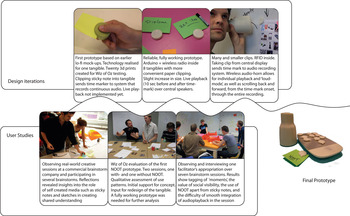
In response, we designed NOOT, a tangible interactive tool that captures audio of the ongoing conversation, linked to physical tags that can be placed anywhere in the meeting space (see Fig. 1). The name NOOT derives from the Dutch dual meaning of the words note, as in “footnote,” as well as nut, as in “in a nutshell.” Using NOOT, participants may play back earlier episodes of the conversation, as part of the ongoing conversation itself. When creating external scaffolds like a sticky note, one now couples a recording of the associated conversation to that scaffold, by placing the tag onto the medium (e.g., the sticky note, a sketch, a prototype, or the whiteboard). This creates a dynamically present audio memory of the design process (van Dijk et al., Reference van Dijk, van der Lugt and Overbeeke2009).
The design evolution of NOOT. See http://www.youtube.com/watch?v=XzZoq-5dJnE for the concept in the form of a use scenario. [A color version of this figure can be viewed online at http://journals.cambridge.org/aie]

4.1.1. The prototype
The prototype consists of a large number of small clips, mounted with a radio-frequency identification tag and a small magnet (see Fig. 1). The clips are presented to users on a dispenser tray with an embedded wireless audio time tagging function. Taking a clip from the tray causes the time tag to be placed in the audio file. Holding the playback horn close to a clip causes it to start playing the audio from the time tag onward, in “individual listening mode.” To encourage “playing around with,” the playback device has a large wheel on top that allows scrolling back and forth through the audio. When one has found “that one bit” one was looking for (or another interesting bit one happens to hear), one may ask the attention of other participants and push a button, which activates a “play out loud” mode. When one scrolls to a starting point one feels comfortable with and stops playback, the clip will remain linked to that new point in time (although the software stores older, discarded time tags as well).
4.1.2. Design considerations and user studies
We developed NOOT over three iterations, including several user studies (see Fig. 1 for an overview). Over the course of these iterations, several issues emerged:
1. Engagement: Participants needed time to play around with the new tool, in order to experience its value. Early designs were not inviting enough to elicit exploration. Central playback was disturbing: People hesitated using it. The small number of tangibles also caused hesitation. The final design includes a dispenser tray and many tags (possible using radiofrequency identification), as well as a private playback horn, to elicit exploration.
2. Public acts: In the first version, placing a time tag would be an implicit effect of clipping a tag on a sticky note. When observing use, we saw how the public availability of tagging actually offers a means for establishing social contact between participants. In the final prototype, therefore, “tagging” is an explicit, public act.
3. Aligning: Listening to conversation is attention demanding: One cannot listen to two speakers at the same time. People also need time to “tune into” an audio sample being played, before they are able to make sense of it. An unexpected sample played over central speakers confused and disturbed the process. Instead, using the individual playback horn one can individually explore the audio trace and scroll until a part is found that “makes sense.” Later on, after first asking plenary attention, one may turn on “loud” mode to share a moment with the group.
4.1.3. Reflections on the design case
NOOT is a new kind of scaffold
Our original idea was to extend the function of sticky notes. People did not act according to that concept. Sticky notes have their own way of being used, and there was no readily perceived value for people to add NOOT clippings to existing sticky notes. NOOT tags instead created a new kind of scaffold in and by itself, which may either be combined with or used apart from sticky notes or other scaffolds in the space. A NOOT tag invites all kinds of flexible scaffoldings in reference to the physical space. One may position audio moments on a prototype being discussed, on a sketch being referred to, on a mind map being drawn, in reference to one's own body (“these are my moments”), and so on.
Reflection tagging instead of memory storage
Originally, we saw NOOT as a tool extending the memory function of sticky notes. Over the course of the project, we found out that the biggest value for NOOT lies instead in its ability to support in situ reflection on the present situation. Taking a tag means: “I find this moment of value, and it may be worthwhile returning to.” The facilitator we followed closely over seven subsequent sessions used tags to mark certain moments of lively conversation, when the group seemed to be “onto something.” These moments are intuitively experienced but hard to define as words on a sticky note. NOOT instead provided a means to be able to hold on to such moments that normally do not get represented well in terms of written notes.
Social sharing
One of the most interesting emerging topics was the social effect of tagging a moment of conversation. People may for instance wonder: Why did you just tag what I said? People may also use playback to make others aware of what they deem important. By grabbing a tag, a personal moment of reflection now becomes publicly available (Goodwin, Reference Goodwin2000; Dourish, Reference Dourish2001), supporting the sharing and integration of these personal views.
4.2. Prototype 2: FLOOR-IT
In the last phase of NOOT, we started to use the word traces for external scaffolds like sticky notes or sketches in reference to the way foraging animals leave traces in the environment, which over time turn into paths, which then guide those same animals (Clark, Reference Clark1997). We engaged in a new design study with this concept as a starting point. Our design question became: how may we augment the circular process of both creating and using design traces, in service of shared understanding in teams?
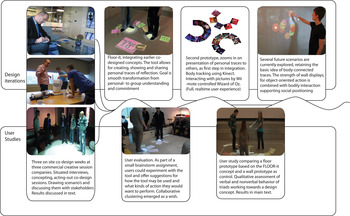
We organized three in-company labs (see Fig. 2) at stakeholder companies that had creative session facilitation as part of their core business. These on-site, 1-week labs consisted of situated interviews, live observations of sessions, and codesign sessions where stakeholders were asked to act out and reflect on concepts we had developed over the week. A number of insights emerged that provided input to the final design: first, people are ambiguous about what a “result” is. They talk about the traces as “the results” but also believe that “the real result” is “in the people themselves.” Pictures are taken of all traces, but people told us they would probably never look at these pictures later on. Second, within a session, people use their own traces as scaffolds for communication. Sketches would be drawn in order to explain, to maintain focus, or to draw attention. Third, traces have personal value in a social context. For instance, people would draw their model, to position their perspective in relation to that of others. Adding a trace of another person's idea to one's own sketch means one “accepts” that idea. There was particular concern over whether or not all participants have commitment to the group-level outcome. A critical moment involved going from a smaller subgroup session to a large plenary session. Summarizing individual traces into generalized conclusions, one risks losing personal commitment of the people for which precisely these individual traces held special significance. The concept FLOOR-IT evolved out of an integration of the three initial concepts developed during the in-company labs (van Dijk & Vos, Reference van Dijk and Vos2011; see Fig. 2).
The design evolution of FLOOR-IT. Further details can be found in the main text. See http://vimeo.com/22075247 for the concept in the form of a use scenario. [A color version of this figure can be viewed online at http://journals.cambridge.org/aie]

4.2.1. The design of FLOOR-IT
The use of FLOOR-IT starts with each individual, using a personal camera, taking pictures of whatever one considers interesting enough to “take with you in the creative design process.” In what would normally be a plenary integration session, participants enter a large interactive floor. By means of beamer projection, each person's current set of traces (the pictures taken) are projected in a circle around the person's body. Pictures will move along with the people over the floor. People can interact with their own traces using their feet, by either tapping or swiping. One may reorient one's circle, reorder pictures, enlarge them, or “show” them (an action that flips the picture vertically such that it faces the conversation partner). Interacting with traces provides a scaffold for conversation. One may show a trace to another person, tell the story that goes along with it, and the other person may ask clarifying questions about it. One may copy traces to one another. Over time, the most popular pictures (the ones that are copied and used a lot) will stick as fixed elements on the floor. Gradually, the floor itself and the traces that remain on it will be a reference to the fact that shared understandings in the team have been formed.
4.2.2. Design considerations and user studies
In this section we focus mainly on results from a large-scale study comparing the basic setup of FLOOR-IT in a full experiential prototype (we call FLOOR), with a more conventional interface to the same digital pictures projected on a wall (we call WALL). By comparing these situations, we were able to test some of the basic assumptions of the FLOOR-IT concept (see Fig. 2). Ten groups of three participants worked for 15 min with FLOOR. Ten other groups worked with WALL. Each group was asked to integrate ideas for an interactive game they had developed in an earlier exercise into one coherent concept. Analysis of verbal and nonverbal interactions based on video recordings of all sessions revealed the following patterns:
1. Ownership: Connecting bodily movement to that of the traces created ownership. People would speak from their perspective about the design problem in (attempts at) one integrated story, using their pictures as scaffolds for getting their perspective across.
2. Object oriented: In WALL, each picture would be explained as a separate idea, and integrating the ideas often turned into an activity of ordering and clustering the pictures. That is, the wall display invited pictures to be used as objects about which one talks, whereas using FLOOR, pictures provided background context against which people would talk with one another.
3. Social positioning: Observing FLOOR, we saw numerous instances where a third person would be actively invited to contribute to a conversation evolving between the two other participants. People would positively reward other people's traces with remarks like “I like that one of yours” in particular as an entrance remark toward a first proposal for an integrated design solution. WALL posed more of a social challenge for participants: since participants were facing the wall, active interventions were needed for a third person to get access to the dyad.
4.2.3. Reflections
At present, social interactions between team members are mainly conceived of as separate to the cognitive task of having to create shared understanding. Instead, FLOOR-IT presents a vision in which social dynamics and collaborative idea development is seen to be one integrated process, scaffolded by embodied interactions with the technology. The main challenge we currently see for FLOOR-IT is how to combine both the desire of people to work with their traces as objects (e.g., for ordering, clustering, selecting, or discarding) and at the same time have these traces scaffold what we have come to call social positioning, the process by means of which individual participants become recognized and accepted group members and by means of which they feel committed to the group outcome. Another question that needs to be addressed is what is actually beneficial for a successful shared understanding: increased social tension (as in WALL) or a relief of it (as in FLOOR). A stronger felt need to socially position oneself may actually benefit the process, bringing up issues that would perhaps be left untouched if no social tension would arise at all. Bluntly stated: Sometimes one needs a bit of a fight to get to the core of an issue. At the same time, one would not want participants to bail out of the process altogether, feeling not recognized as valuable participants. FLOOR-IT provides important lessons, but as a product it needs to be further developed. One obvious direction, explored in one of our future scenarios (see http://www.youtube.com/watch?v=LHknFGMT7yY, courtesy of Sijme Geurts), combines both WALL and FLOOR, keeping strong elements of each. Another direction we are exploring takes a conventional wall as the main workspace but incorporates insights from FLOOR-IT by connecting people's movements to their set of pictures (see Fig. 2).
5. GENERAL REFLECTION ON THE DESIGN CASES
5.1. Traces for reflection
Originally, we focused on coupling rich context to ideas in the service of memorizing them. However, in the moment itself, people do not experience the fact that these sticky notes will be poor memory stores later on, and so the situation of speaking and writing sticky notes itself did not elicit NOOT use. Instead, someone listening to a conversation would use NOOT, to mark a worthwhile moment of discussion, in the role of a listener, comparable to making a mental note. This change in direction for NOOT made a distinction between “storing an idea for later,” and “tagging” and revisiting moments of reflection on a conversation (e.g., concerning how ideas were evaluated or understood by various participants). These reflections are important for shared understanding, given the way each participant has her own understanding of the idea and reflects on ideas from her own perspective (Schön & Wiggins, Reference Schön and Wiggins1992). Along this line of reasoning, one may offer that all design artifacts generated during a session are in the end themselves primarily scaffolds for supporting reflective action, that is, things to think with, in line with Crilly et al.'s (Reference Crilly, Maier and Clarkson2008) “reflective representation.” NOOT tags, more so than sticky notes, illustrate this idea.
Adopting embodied cognition as a framework to understand design communication also means a shift from thinking about the environment as a resource for manipulating and storing contents toward thinking about the environment as being taken up in the real-time loop of ongoing, situated activities. Following from this shift was our relabeling of the design artifacts as traces of group activities that would immediately be taken up into the loop, functioning as scaffolds supporting those same activities. For one thing, this suggests that in the process of designer's reflective representation as mentioned by Crilly et al. (Reference Crilly, Maier and Clarkson2008), there is a strong, active component, resembling the way users by exploration and active engagement come to appropriate new technology into their practices (a process called “interactive interpretation” by Crilly et al., Reference Crilly, Maier and Clarkson2008). We believe those two notions are very much related and both grounded in basic forms of embodied sensemaking.
We propose that NOOT and FLOOR-IT form deictic references (Clark, Reference Clark1997), not to particular contents, but to people's acts of reflection. That is, by creating a trace, I explicitly show others that I had a moment of reflection, and later on we can all literally point to that moment (i.e., to the tag or to the picture on the floor) and use that tag or picture to communicate my reflections to others. If I have forgotten about one of my reflections, someone else may point to the trace and ask me about it. Pointing at a reflection will of course initiate a further reflective process, shared by all participants that join the deictic conversation. This means it does not necessarily matter what is written on a sticky note or sketch, what matters is the (deictic) role it plays in the reflective activities of the people in the session (Goodwin, Reference Goodwin2000). In such activities, physical aspects of the situation do matter. For instance, what we saw in the FLOOR-IT study is that organizing pictures on the wall, as objects on a workspace, creates altogether different communication between people than when those same pictures are projected on the floor around a person, inviting her to express to others her personal view on the matter. In the first case, the implicit task, as elicited by the interactive layout, was to get the visual organization of pictures right. One person would take the lead, and others would add here and there, in service of finishing the puzzle. In the second case, the pictures served as a subtle background for communication of one larger design story.
5.2. Social positioning
There is a tradition of investigating the role of artifacts in relation to social conduct (Goodwin, Reference Goodwin2000; Suchman, Reference Suchman2000). Much of this work tends to emphasize the ways in which people may come to understand each other or collaboratively understand, or deal with, some problem (Hutchins, Reference Hutchins1995). We extend this analysis by showing how next to acts of exchange of information, such as explanation, questions of clarification, reasoning, categorization of items, and so on, the manipulation of external traces supports at the same time a continuous process of what we call social positioning, involving the creation of interpersonal contact, the recognition of the other, negotiation of each other's perspectives, and the acknowledgment of the other's contributions relative to one's own.
Applied to the practical context of design meetings, we question creative problem-solving methods that assume no attachment to ideas personally. In such methods, group members lend their brains to the problem owner without any personal attachment. This might be the case in an ideal situation, but in real-life design teams generating ideas together, social processes do have an important role. Below the surface-level process of creatively exploring a design space, a social process takes place in which roles and power relations are played out. This means that Crilly et al.'s (Reference Crilly, Maier and Clarkson2008) reflective representation critically involves social positioning as an inherent part of what makes this process work. Instead of trying to suppress this social aspect, we think it is inherent to the way that people together make sense of the world (De Jaegher & Di Paolo, Reference De Jaegher and Di Paolo2007; Forlizzi, Reference Forlizzi2007). This is why it does matter to hold on to who came up with what and to make reflections publicly available.
People need to be able to express their own ideas and then hold on to them, because this is what gives them a position from which they are able to start becoming interested in the ideas of others. This implies that there should be recognition of each participant's contribution, especially in a context where laypeople are invited to joint the session. In addition, people's personal attachments to certain external scaffolds, and the particular associations, meanings, vision, and personal experiences that they may hold in connection to this scaffold, may be of central importance to creating the necessary breakthrough in the design process. These personal experiences may go unnoticed if the physical traces in the space only connect to group-level insights or present summary descriptions. A connection to people's personal line of thought, in relation to the physical scaffolds in the space, then, would provide a much more firm basis for creating a shared understanding. Both in the latest version of NOOT and in FLOOR-IT, one's personal moments of reflection becomes socially accountable (Suchman, Reference Suchman2000; Dourish, Reference Dourish2001): I see you marking this moment, and so I think: What might be interesting about this moment? Likewise, using FLOOR-IT people would mostly refer to the pictures of others not as ideas as such but as your idea, as in “I like your idea in that it shows how. . . .” This turned the mere referencing of a picture in a person's verbal utterance to a positive reward on the part of the owner of that picture. Often, the positive gesture would be returned with a favor: “Ok, well maybe we could combine it with that one you have there.”
5.3. Implications for design: External media scaffolding ongoing interaction
At present, we have only the beginnings of understanding how to make this really work effectively in useful technological tools that are ready for market. The question of how to integrate face-to-face interactions between people with work–space–style manipulation of design artifacts into one coherent interaction design is only partially resolved in our current prototypes. Hopefully the further development of our systems will result in new insights. We dare to speculate however, that if, as we propose, both ongoing reflective conversations and the development of social commitment are integral to shared understanding, then the physical presence of people in one and the same space will turn out to be a crucial precondition for any collaborative tool to really work. This concluding proposition, if true, presents of course a tremendous challenge for designing virtual collaboration tools (see also Bjorn & Hertzum, Reference Bjørn and Hertzum2006; Ciolfi et al., Reference Ciolfi, Fitzpatrick and Bannon2008)
Our studies ask for a critical assessment of the implicit information-processing metaphor present in most of today's collaborative tools. An information-processing view conceives of the external environment as a medium in which to represent, store, combine, present, and communicate ideas. The computer, the information-processing machine par excellence, may be seen as the ultimate cultural artifact corresponding to this view (Latour, Reference Latour, Lynch and Woolgar1990). This view remains basically unchanged even when one adopts distributed cognition, a modest version of embodied cognition, and popular among human–computer interaction engineers for some time now (Hollan et al., Reference Hollan, Hutchins and Kirsh2000; Carroll et al., Reference Carroll, Neale and Isenhour2003). Following distributed cognition, for example, one may say that by storing intermediate results in external representations, one reduces cognitive load on working memory during task execution (Kirsh, Reference Kirsh2000). The external environment would then function as an external medium through people exchange information in service of shared understanding (McKim, Reference McKim1972).
However, a trace created by a designer is open to further action, and on the basis of that property it not only functions as an external representation of some fact or idea but also works to scaffold the ongoing process by which people share individual perspectives and build further understandings. This process evolves in continuous embodied interaction with the external environment and is always embedded in a social context. A shared sense of what is important in a meeting emerges as part of the ongoing activities of the participants in the space, which goes beyond one person communicating what he knows to others by means of external media. Shared understanding, then, is expressed in ongoing interactions between people, the developing designs proposals, and the group's reflections on these proposals, and it is scaffolded by the physical traces people create and use as part of their collaborative efforts. This means that designers will have to think much more explicitly about the concrete spatial form and temporal dynamics by means of which traces can be acted upon: It is not only the “content” but also the “interactive form” that matters (Djajadiningrat et al., Reference Djajadiningrat, Matthews and Stienstra2007). Furthermore, designers will need to be aware that any artifact they create will function only as one element within a larger physical and social context (Ciolfi et al., Reference Ciolfi, Fitzpatrick and Bannon2008; Trotto et al., Reference Trotto, Hummels and Cruz Restrepo2011).
5.4. Implications for design communication: The distributed and the social
We now discuss some implications for design communication research. Our central research question concerned the role of the external environment in the development of shared understanding in design meetings. Crilly et al. (Reference Crilly, Maier and Clarkson2008) already discussed processes of reflective representation by designers, by means of interacting with their own design expressions, and interactive interpretation by product users, by means of manipulating artifacts. In our view, both of these processes tie into the first of the two main conclusions of our study so far: shared understanding is sustained in ongoing reflective conversations between people and artifacts during real-time group activities. Shared understandings are fluid, dynamic entities. A participant may have “a sense that what is discussed now is important,” even without being able to define precisely how. External media in the space do not so much represent any particular shared understanding. Instead, ongoing manipulations of these artifacts keep alive these fleeting moments of reflection.
As said earlier, we see in this process no strict separation between interactive interpretation and reflective representing: both amount to the same basic process of interactive reflection.
Our second main conclusion is this: shared understanding is strongly socially scaffolded. Embodied activities in the space directly facilitate participants' social positioning, which in turn directly influences the way the session evolves. Achieving a shared understanding is at the same time also achieving a satisfactory interpersonal stability in the relations between the actual people who participate in the process.
What we see here is, in the microenvironment of the moment-to-moment interactions between people in a design meeting, the kinds of social effects that Forlizzi (Reference Forlizzi2007) discusses (see also Trotto et al., Reference Trotto, Hummels and Cruz Restrepo2011).
In sum, through the use of the interactive traces, participants display a subtle and fluid intermixing of reflective conversation and social positioning. This ensemble of social and physical interactions together grounds the formation of shared understanding in teams. This view relates to the design dialogue research by Vaajakallio (2008).
6. CONCLUSION
This paper reflected on two design cases, representing two concrete proposals of what embodied cognition theory, and specifically the notion of scaffolding, may mean within the context of design communication. We focused on the formation of shared understanding in design team meetings. By reflecting on the design process and outcomes, and by discussing our findings based on several user studies with working prototypes, we were able to distill at least two phenomena that are of crucial importance for the way people communicate with one another during design meetings: a continuous process of reflective conversation, in which external traces take on the role of scaffolding the subtle emergence of understandings and make possible sharing such fleeting moments of insight with others, and the grounding of the integration process as on underlying processes of social, interpersonal positioning, by which people personally relate to the emerging shared understanding as well as to each other. Through the use of the interactive traces, participants display a subtle and fluid intermixing of reflection and social positioning. Based on our results, we therefore propose that it is the ensemble of social and physical interactions that together grounds the formation of shared understanding in teams. Particular details of our vision are open for further testing in more formal experimental settings. At present, the current analysis at least suggests a conceptual shift from asking how to represent information in external media toward the question of how to support an active, embodied engagement with external traces, a shift that may be of relevance to anyone involved in designing interactive systems supporting design communication.
ACKNOWLEDGEMENTS
Thanks to our stakeholders: Van Berlo Design, YOUMEET, and Future Centre LEF. We also thank the students for their valuable work, in particular Janneke Sluys, Marnick Menting, Jirka van der Roest, Edouard Messager, Gerrit-Willem Vos, Sijme Geurts, Aniek Lambregts, and Tim Bakker. Part of this work was funded by the Creative Xcellerator program initiated by the Dutch Ministry of Economic Affairs and the city of Utrecht.
Jelle van Dijk is a Researcher in the Research Group on Codesign at Utrecht University of Applied Sciences. Jelle is in the last phase of his PhD project at the Designing Quality and Interaction Group at Eindhoven University of Technology. His research relates theories of embodied cognition to the design of mixed physical–digital interactive systems.
Remko van der Lugt is a professor of codesign at Utrecht University of Applied Sciences. In addition to his work in Utrecht, Remko is a Researcher at Delft University of Technology and a Facilitator of Creative Processes at PinguinXL. His research focuses on involving users as experts of their experiences throughout the design process. Dr. van der Lugt's current topics are service design, context mapping, and sustainability by design.