Introduction
A common theme in research focused on the contemporary Canadian feminist movementFootnote 1 is its shifting nature (Brodie, Reference Brodie2008; Dobrowolsky, Reference Dobrowolsky and Smith2008; Rodgers and Knight, Reference Rodgers and Knight2011). Whether framed as differences in the second and third waves of the movement (Newman and White, Reference Newman and White2012) or in the changing relationship between the organized movement and political parties (Young, Reference Young2000), research has chronicled these changes and investigated their causes. This article adds to this research by focusing on continuity and change in the beliefs and strategies of contemporary feminists. More specifically, it examines intergenerational change within the Canadian feminist movement.
Social movements are “clusters of organizations, overlapping networks, and individuals that share goals and are bound together by a collective identity and cultural events” (Whittier, Reference Whittier1997: 761). Members of the collective negotiate the strategies and beliefs of that identity and continually contest and redefine what it means to be a “feminist.” The contemporary Canadian feminist movement includes a diverse set of individuals whose beliefs and tactics comprise the movement's collective identity. These include longstanding members, with a historical memory of and commitment to the movement's key issues and strategies over the years, and more recent recruits with their own understanding of the movement's goals and tactics. I focus on understanding how recruitment at different points in time is reflected in the contemporary movement.
I adopt the generational approach introduced by Whittier (Reference Whittier1997), which recognizes that changing contexts introduce change in social movements partly through processes of recruitment and cohort turnover. Whittier builds on the work of Mannheim (Reference Mannheim and Kecskemeti1952), who contends that the specific events encountered by a cohort when it comes of age can have a lasting effect on the generation's perspective; this generational outlook will differ depending on the formative experiences encountered by each generation during its adolescent period and will remain relatively fixed over time. Rather than identify a generation by its age cohort, Whittier defines a social movement's political generation as the set of individuals, whatever their age, who join during a particular period of protest, for she “regards immersion in protest as transformative at any age” (Reference Whittier1997: 762). As such, she argues that political generations are directly shaped by the environment and context in place at the time they first entered the movement, and that these first beliefs and strategies will be relatively fixed over time.
Whittier conceptualizes the shared perspective of each political generation as a collective identity, one that provides “a delineation of group boundaries, construction of an oppositional consciousness or interpretative frameworks for understanding the world in a political light, and politicization of everyday life” (762). For feminists, this includes what it means to be feminist, common beliefs about gender politics, and the strategies and behaviours consistent with that identity. The transformative importance of self-identifying as a feminist is sufficient for it to have a lasting impact on individual beliefs and actions.
The investigation adds to our theoretical understanding of social movement recruitment and collective identity, and the role of political generations for continuity and change within movements. It also offers, through the use of online survey data, a larger window into the movement than is possible through smaller sample qualitative studies and personal narratives. And finally, it offers an important case study given Canada's differences from its American and European counterparts. Adopting a predominantly liberal feminist ideology, Canadian feminism reveals strong socialist feminist tendencies and a statist focus due partly to the existence of its strong Quebecois branch (Rebick, Reference Rebick2005: 18; Young, Reference Young2000).
The main question guiding this investigation is whether intergenerational differences are evident within the contemporary feminist movement. More specifically, do older recruits to the movement reveal attitudes and strategies that reflect the environment and collective identity in place when they first identified as feminist? Or is it the case that the attitudes and tactics of older recruits mirror the changing environment and changes in the movement's collective identity over time? The findings provide evidence of the existence of political generations. Contemporary Canadian feminists do possess a shared understanding of the importance of many issues and adopt a number of the same strategies of collective action. But the timing of recruitment does appear to help explain variation in some of the beliefs and tactics of Canadian feminists.
The Shifting Environment and Collective Identity
Whittier (Reference Whittier1997) suggests that understanding change in a social movement requires an understanding of the internal dynamics of recruitment and collective identity. As she notes, “cohorts construct different identities as the external environment and the movement context change” (762). Long-time activists provide continuity by maintaining elements of the identity constructed when they first identified with the movement; new recruits can bring about change if the feminist identity they adopt deviates from those of earlier recruits. This change in identity stems from changes both inside and outside the movement.
The period from the 1980s to the 2000s in Canada experienced significant change in the social, political and economic spheres, ones that had a direct impact on the feminist movement. Whittier's approach argues that newer recruits to the movement will embody this shifting terrain in their feminist thinking and actions; older recruits to the movement will be less open to these shifts, their thinking and actions more reflective of previous eras. A complete review of changes of importance for the feminist collective identity during this period is beyond the scope of this paper; nevertheless, several can be highlighted given their importance for intergenerational shifts in Canadian feminism.
Without question one of the key changes during the period is a marked shift to the ideological right (Brodie, Reference Brodie2008). For Canadian feminism, this shift was most keenly felt in the movement's increasingly restricted access to the state, reductions in and limits placed on state funding and the framing of gender as a “special interest.”
The contemporary wave of Canadian feminism is normally traced to the creation of the Royal Commission on the Status of Women (RCSW) and the 1970 Abortion Caravan (Rebick, Reference Rebick2005; Thomson, Reference Thomson2004). One outcome of the RCSW was a close working relationship between many feminist groups and the state. During what Findlay calls “the consultative period” (Reference Findlay1988: 7), federal government funding for women's groups grew substantially from the early 1970s and late 1980s. Concomitantly, significant state machinery appeared that institutionalized feminist claims-making, including Status of Women Canada (SWC) and the Canadian Advisory Council on the Status of Women (Rodgers and Knight, Reference Rodgers and Knight2011: 572). Accepting the organization's legitimate role in speaking for women, the federal government met regularly with the leaders of the National Action Committee on the Status of Women (NAC), an umbrella organization founded in the early 1970s. Government agencies considered feminist organizations to be important partners in the goal of achieving women's equality.
The election of the Conservative government in 1984 is identified as the point at which this successful relationship began to unravel; the election of the Liberal government in 1993 ended it fully (Bashevkin, Reference Bashevkin1998; Brodie, Reference Brodie2008; Collier, Reference Collier2014). In what Brodie (Reference Brodie2008) refers to as ‘the politics of displacement,” social liberalism was displaced by a neoliberal ideology focused on reducing the state, fiscal restraint and market dominance. In this new era, funding was cut, access denied, and the state machinery tasked with promoting women's equality dismantled. Among the changes were a $5 million reduction from Status of Women Canada's operating budget and the disallowance of advocacy by organizations seeking federal funding (Brodie, Reference Brodie2008; Collier, Reference Collier2014). The loss of funding, and in some cases its complete elimination, left many feminist organizations struggling to survive (FAFIA 2010) and was a serious blow to the movement's professional research capacity on issues of importance (Rodgers and Knight, Reference Rodgers and Knight2011). The loss of funding meant that many feminist groups had no alternative but to focus singularly on providing services to women on the ground (Dobrowolsky, Reference Dobrowolsky and Smith2008).
These changes occurred alongside the government's increased silencing of gender as a legitimate political identity (Brodie, Reference Brodie2008). Indicative of this was the removal of the word equality from the mandate of the Women's Program in 2006 and the shift in framing of child care from a women's to a children's issue (Collier, Reference Collier2014). The backlash expanded as Canadians adopted increasingly negative views of feminists; indeed, any group seeking equality came to be seen as a special interest (Newman and White, Reference Newman and White2012: 79–80).
More broadly, neo-liberalism's emphasis on individual choice over structural explanations for inequality has altered younger generations' framing of gender (Dobrowolsky, Reference Dobrowolsky and Smith2008) and the perceived need for feminism. Young women have become increasingly blind to gender inequality—“they take for granted that their gender is not, or at least should not, be a limiting factor in their lives”—and identify disadvantage as the “outcome of individual choices made in the context of individual life chances” (Stevenson et al., Reference Stevenson, Everingham and Robinson2011: 134, 138). Neo-liberalism's “undoing of feminism” —making it seem simultaneously second nature and unnecessary—also explains the increasing absence of feminism within public discourse (Baer, 2015).
The second key source of intergenerational change points to the “internal dynamics of recruitment and collective identity” (Whittier, Reference Whittier1997: 761) of the feminist movement itself, with some but not all of these shifts stemming from the changing state-movement relationship and the rise of neo-liberalism. Key changes over the period, often identified through a comparison of its second and third waves (Newman and White, Reference Newman and White2012), include an increasing diversity of voices, the concomitant expansion in feminism's understanding of the forms and intersection of oppressions, and shifts in political strategy and tactics.
From the 1980s onwards, a growing diversity of voices was evident in NAC's leadership and constituent groups, resulting in a decline in the dominance of liberal feminism and a rise in the movement's more radical and socialist branches (Vickers et al., Reference Vickers, Rankin and Appelle1993; Young, Reference Young2000: 76). Increasing diversity also resulted in changes in feminist thinking and focus, including the desire to balance equality with a need for gender equity—the latter underscoring the diversity among women themselves—and an acknowledgement of the intersectionality of oppression (Arneil, Reference Arneil1999). This diversity has made it increasingly difficult for the movement to present a united front on some issues, including the mega-constitutional politics of the 1980s and 1990s (Young, Reference Young2000).
The “third wave” of the movement, originating in the 1990s, is often identified specifically by its focus on the intersectionality of identities and multiplicity of oppressions (Miller, Reference Miller2008). According to Harris, young feminists “acknowledge differences within and between groups of people, understand racism, homophobia and sexism as interconnected, acknowledge shift and flux in definitions and identities, and uphold self-ascriptive meanings as opposed to assigned labels” (Reference Harris2001b: para. 18). This multiplicity is inherently messy, reflecting postmodern thinking that rejects the concept of a rational, universal woman.
The individualization of feminist activism—linked to the rise of neo-liberalism—is also a hallmark of the third wave (Baer, Reference Baer2016; Harris, Reference Harris2001b). For contemporary feminists, “the personal is political” justifies the use of individual acts to serve collective ends (Arneil, Reference Arneil1999: 189–90). The adoption of DIY (do-it-yourself) feminism reflects a rejection of the need for hierarchical organizations to “speak for” feminists given the risk of exclusion or silencing of voices in the movement (Harris, Reference Harris2001b). One particular tactic—the use of self-produced, computer-generated and informally distributed zines and ezines—challenges mainstream media and creates communities based on shared personal experiences (Ferris, Reference Ferris2001).
Further changes in strategy can also be underscored. Not surprisingly, as the federal government restricted access and the ideological focus of the organized arm of the movement shifted, feminists adopted a much more confrontational approach on issues such as the inclusion of gender in the Charter of Rights and Freedoms and the decriminalization of abortion (Rebick, Reference Rebick2005; Young, Reference Young2000). Alongside this shift, neoliberalism's adoption of free trade, privatization and deregulation resulted in the movement's increasing focus on social and economic policy and to the establishment of closer connections with unions and labour organizations, especially during the debate over the Canada-US Free Trade Agreement (McKeen, Reference McKeen2004). Others have argued that feminists are employing new sites—cyberspace in particular—and tactics, especially around social and cultural forms of resistance in the neoliberal age (see, for example, Baer, Reference Baer2016; Harris, Reference Harris2001a).
The Young Feminist Women in Canada Survey
The objective is to determine whether intergenerational change is evident in the beliefs and tactics of the contemporary feminist movement. The investigation employs data collected in the 2008 Young Feminist Women in Canada Survey (YFWC), a bilingual online survey undertaken from November 18 to December 16, 2008.Footnote 2 I sent an email to the 1,978 addresses on the Waves of Resistance/Toujours Rebelles distribution list, asking women over 18 years of age to participate and to distribute the invitation widely across their feminist networks. The distribution list was gathered by the organizing committee for the Pan-Canadian Young Feminist Gathering, an event held in Montreal, Quebec, in October 2008.Footnote 3 The survey included over 140 questions, taking on average 34 minutes to complete, and once the data were cleaned, the sample included 569 self-identified feminist women.Footnote 4 As self-identified feminists, their commitment to the movement is strong and their knowledge of the movement's goals and tactics deep given their explicit willingness to adopt feminism as part of their identity.
The survey provides an important snapshot of Canadian feminists. This large sample data set is the first of its kind in Canada and provides an important opportunity for adding to a literature that has been criticized for being largely rooted in personal narratives and small sample interview-based investigations. It is not, however, a randomly selected sample and, as such, it should not be used to generalize to the population of Canadian feminists. We can, however, evaluate the demographic characteristics of the sample (see Table 1 in the online appendix). While we have little basis on which to determine what an accurate sample of Canadian feminists should look like, the YFWC sample does appear to include a wide range of Canadian women from diverse groups and from across the country, mirroring the diversity of feminists themselves. To note is that the regional distribution reveals a possible oversampling of feminists from Quebec and an undersampling from Ontario; thus the findings may overly reflect the experiences of Quebecois feminists (see Dumont, Reference Dumont2012).
Socio-Demographic Profile by Political Generation

Note: Unless indicated otherwise, entries are the percentage of women who met the criteria. Columns indicate period when respondent first identified as a feminist.
a Indicates differences significant at p < 0.10; b Indicates p < 0.05; c Indicates p < 0.01.
The survey data are also cross-sectional, which limits our ability to render definitive conclusions about how feminist attitudes and tactics have changed over time. First, it means that although the sample includes feminists who came to the movement at different times, the survey itself was undertaken in 2008. Thus inferences regarding temporal shifts in the beliefs and activities of longstanding feminists must be speculative. The ability to separate generational, life-cycle and periods effects is also limited. Differences among feminists might be due to variances in when they joined the movement, in their age—and hence moment in their life cycle—or to specific period effects. Theoretical considerations will be used to help shed light on which is more likely to be the case.
Whittier makes clear that the context in place when an individual joins a social movement defines a political generation.Footnote 5 As such, respondents were grouped according to the year when they first identified as a feminist: 1989 or earlier; 1990 to 1999; and 2000 to 2008. This provides three significantly sized groups: 108 in the earliest political generation (25.2% of the sample); 112 in the 1990 to 1999 generation (26.2%); and 208 in the most recent (48.6%).Footnote 6 These periods correspond roughly to the peak (1970s and 1980s), significant cuts and removal of access (1990s) and the further cementing of these changes (2000s). While feminists who came to the movement after 1990 could be combined into a single group, the creation of two groups tests for the existence of a “micro-cohort” in the 1990s during the particularly tumultuous period surrounding major budget cuts faced by the movement. One can reasonably debate these cut-off points, but the complexity of the changing political opportunity structure and the movement's collective identity, as well as the need to ensure a sufficient number of cases in each period, provide support for this operationalization strategy.
Results
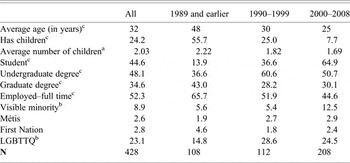
An examination of certain demographic characteristics provides insight into difference across the three generations (see Table 1). Unsurprisingly, the earliest political generation of feminists (pre-1990) is also the oldest (48 years of age), is far more likely to have children (56%) and to have a greater number of children (2.2) on average than the two later generations. These demographic factors are important for understanding whether life-cycle differences might lie behind any generational differences. Recruits from the three periods also have differing educational profiles: the earliest generation of feminists is more likely to have obtained graduate degrees than more recent recruits. Finally, while no differences are apparent in the percentage of Métis and First Nations respondents among the three generations,Footnote 7 recent recruits to the movement are far more likely to identify as a member of a visible minority and as LGBTTQ.Footnote 8
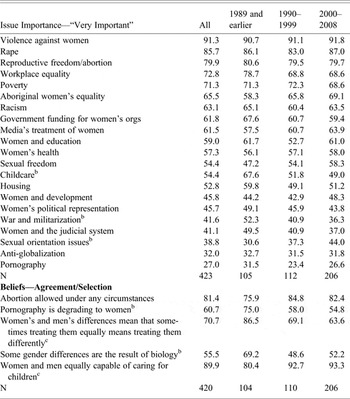
The working hypothesis is that shifting contexts as Canadian feminists came to the movement are likely to be reflected in generational differences in their beliefs and strategies. To test this, I begin by comparing the importance assigned to a range of issues by each political generation, an important element of collective identity (see Table 2). The results reveal significant continuity. When one was drawn into the movement appears to have little consequence for the importance assigned to most issues. Three issues assigned the highest priority, with 8 out of 10 women in each generation noting each to be “very important,” include violence against women, rape and reproductive freedom/abortion; each has long been a focus of attention and action within the Canadian women's movement (see Rebick, Reference Rebick2005) and obviously remain so.
Issue Importance and Beliefs by Political Generation (percentages)

Note: Beliefs: Entries are the percentage within each cohort agreeing with the statement. The last three questions were forced choice. Columns indicate period when respondent first identified as a feminist. See online appendix for question wording.
a Indicates differences significant at p < 0.10; b Indicates p < 0.05; c Indicates p < 0.01.
Only three of 21 issues reveal differences in assigned importance across political generation: childcare, war and militarization, and sexual orientation issues. A significant gap is found for the importance assigned to childcare: while 68 per cent of longstanding members see it as “very important,” only 49 per cent of the latest recruits do. This could reflect a life-cycle pattern; few women within the two latter generations have had children, which could account for the low priority assigned to the issue. It could, however, be generational and reflect young women's increased identification of childcare difficulties as an individual rather than a collective issue, in line with neo-liberal thinking (Stevenson et al., Reference Stevenson, Everingham and Robinson2011).
Differences on the remaining two issues are likely generational. The decreased importance assigned to anti-military positions among newer recruits reflects the decreased importance of the peace movement over time; Voice for Peace activists were once a key element of the Canadian women's movement but have become increasingly less so (Rebick, Reference Rebick2005: 3–6, Vickers et al., Reference Vickers, Rankin and Appelle1993: 267). Generational change also likely explains the increased importance assigned to sexual orientation issues among recent recruits; while lesbians have always been involved in the Canadian women's movement, the increased space accorded to them and attention directed towards sexual orientation issues over time within the movement has been documented (Smith, Reference Smith and Smith2008). The increased share of LGBTTQ among recent recruits (see Table 1) is also likely tied to this shift.
The YFWC asked respondents for their beliefs on some key issues (see Table 2). On this dimension, the generational differences are striking. On the issue of pornography, for example, significant differences of opinion are evident. Just over half of women in the two most recent groups of recruits agree that pornography is degrading to women. Among the oldest generation of feminists, however, a full 75 per cent agree with the statement. The debate over pornography has always polarized feminists (Rebick, Reference Rebick2005: 168) but the attitudinal shift across generations on this issue directly corresponds to evolving debates in the movement regarding its relationship to harm and to changing legal regulation of the issue (Karaian, Reference Karaian2005). Moreover, it reflects the tendency among many newer recruits to argue that women's sexuality, including that depicted in pornographic material, ought to be appropriated and employed as a form of power (Valenti, Reference Valenti2007).
On the question of abortion, on the other hand, there appears overwhelming agreement. The vast majority of feminists within each political generation, between 76 and 85 per cent, believe that abortion ought to be allowed under any circumstances. Abortion is a longstanding issue of importance in the Canadian feminist movement and was the first to unite the second wave (Rebick, Reference Rebick2005: 156). An absence of legislative change on the abortion issue since the Morgentaler ruling in 1988 and continued concerns regarding access likely contribute to common thinking across political generations. Canadian feminists agree on the fundamental importance of the right to a safe and affordable abortion, regardless of when they came to the movement.
The remaining questions address gender and gender role socialization, ones that reveal significant inter-generational difference: older recruits are more likely to select responses that reveal a belief in gender difference. More specifically, recent recruits are less inclined to select responses that suggest that equitable treatment is necessary, given differences between women and men and that gender differences are the result of biology, and more likely to select the response that states that women and men are equally capable of caring for children. These gaps range from 12 to 21 percentage points in size. These might stem from life-cycle differences. As newer recruits are less likely to have had children than older recruits, they are less likely to have experienced persistent differences in gender role expectations surrounding the care of children, for example. Additionally, differences could also reflect changes in feminist theorizing over the period (Arneil, Reference Arneil1999) and changing conceptions of gender role socialization (Newman and White, Reference Newman and White2012). They might also reflect the fact that recent recruits are far more likely, by a gap of 21 percentage points, to have adopted their feminist identity because of courses they took in either high school, college and/or university and less likely due, by a gap of 16 points, to personal discrimination (results not shown).Footnote 9
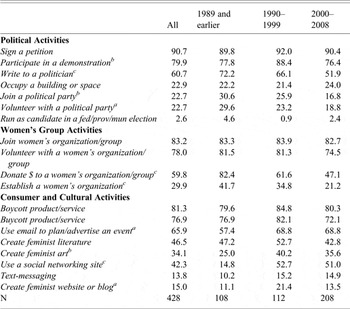
In addition to differences in beliefs, changes in the environments faced by the movement might drive differences in the political strategies and activities of political generations. Table 3 provides the results for responses to a number of questions asking respondents about the political, civic and consumer/cultural activities undertaken in an attempt to promote women's equality. The findings reveal a number of significant differences.
Feminist Activism by Political Generation (percentages)

Note: Entries are the percentage who indicated having undertaken the activity in an effort to bring about women's equality. Columns indicate period when respondent first identified as a feminist. See online appendix for question wording.
a Indicates differences significant at p < 0.10; b Indicates p < 0.05; c Indicates p < 0.01.
As reviewed above, Canadian governments provided increasingly restricted access and funding to Canadian feminists beginning in the 1990s. Moreover, an increased individualization of strategy has been identified in the most recent wave of the movement. Thus we might expect that recent feminist recruits would be less likely to employ electoral strategies directed at governments and political parties. And indeed, this is the case. Recent recruits were significantly less likely to have written to a politician (by 20 percentage points), and to have joined (14 percentage points) or volunteered with a political party (11 percentage points) than older ones. It is unlikely that these differences are due to life-cycle effects, given research noting equal rates of engagement with political parties across different age groups (Samara Canada, Reference Canada2015). Instead, the shift is likely generational.
We might expect more recent recruits to have increasingly adopted protest tactics given the withdrawal of political access. There are, however, no significant differences recorded across the three groups in their use of strategies such as signing petitions or occupying a building or space. The one exception to this is found in the number who report having participated in a demonstration: recruits who came to the movement in the 1990s are significantly more likely, by 10 percentage points, to report having demonstrated at some point. Given that feminists in the 1990s were confronted with a radical shift in the movement's status and significant reductions to their core funding, the significantly increased involvement in this form of protest by this group reflects the movement's capacity at the time to mobilize its constituency in response to the cutbacks (Rodgers and Knight, Reference Rodgers and Knight2011). Recruits to the movement in the next decade, however, entered a movement that had a significantly reduced organizational capacity.
Respondents were also asked about their involvement in collective organizing and advocacy work with women's groups. There might be little reason to expect that shifts in the environment and context would be reflected in these kinds of activities, given their central importance for bringing about women's equality; the rise of neoliberalism, however, has been linked to the increasing individualization of feminist activity. As shown, the vast majority of feminists in each generation reports having joined and volunteered their time with women's organizations in equal numbers. Differences that are recorded—in donating to or establishing a women's organization—are very likely to be due to life-cycle differences. Recent recruits, significantly younger than older ones, are much less likely to possess the economic resources to make donations to women's organizations. Their age is a possible explanation for their more limited experience in forming a women's organization or group: the lack of resources or of perceived organization skills is likely to account for such differences. Alternatively, the focus on individualized forms of resistance among recent recruits might explain the difference.
The final set of activities reported in Table 3 relates to consumer and cultural forms of activism, as well as the use of technology and social media as a tool of feminist activism. The findings reveal that a significant percentage of Canadian feminists have incorporated consumer activities into their repertoire; political generation matters little for the use of boycotting and buycotting in an attempt to bring about women's equality. If these forms of activism are more recent additions to the movement's repertoire, feminists from every generation appear to have adopted them. Similar expectations might apply for cultural forms of activism. The responses reveal, however, that while no differences exist in the creation of feminist literature as a form of activism, there is evidence that more recent recruits have increasingly adopted feminist art as a form of activism, adding new forms to this type of activism including those noted elsewhere, such as culture jamming (Harris, Reference Harris and Harris2004).
Finally, we might anticipate that the technological changes beginning in the mid-1990s would be reflected in its increasing use among more recent recruits to the movement given the slow speed with which social movement tactical repertoires change (Taylor and van Dyke, Reference Taylor, Van Dyke, Snow, Soule and Kriesi2007: 266). And indeed this is the case for the newest forms of communication. Recent recruits are significantly more likely to employ email, social media, blogs and websites as activist tools as noted by others (Baer, Reference Baer2016). Research has shown that some women's organizations, for example, were forced to move completely on line with the elimination of government funding (Rodgers and Knight, Reference Rodgers and Knight2011).
Discussion
The objective of the article was to examine whether a group of self-identified Canadian feminists exhibit differences in their beliefs and activities related to differences in the political, economic and social contexts in place at the time when they first identified with the movement. The findings provide some evidence of change across subsequent generations of feminist recruitment. Importantly, however, they also reveal evidence of strong continuity. Canadian feminists are of one mind in the importance assigned to a range of issues and in their commitment to advocacy work and engagement with women's groups and organizations despite increasing diversity among its members and significant changes over time in the social and political contexts in which it is located.
While we cannot be certain of the specific dynamics underlying the differences, we do find preliminary but convincing evidence that the collective identities and strategies adopted by Canadian feminists coming to the movement at different times over the past several decades differ in several respects. Increased diversity among recent recruits is reflected in the increased importance assigned to sexual orientation issues. A changing understanding of gender is reflected in shifting beliefs across the three political generations. So too is the changing legislative framework and theoretical understanding of pornography since the 1980s mirrored in attitudinal beliefs on the issue across the groups. Decreasing political access and reduced funding to women's organizations parallels a shift away from the use of conventional strategies of mobilization targeting governments and political parties. Technological change, and perhaps the necessities created by reduced organizational capacity, matches the increasing use of social media as a mechanism for bringing about women's equality. The Canadian women's movement's changing collective identity is likely due in part to shifting political generations and turnover.
These conclusions are necessarily tentative. A snapshot of the movement at one point in time provides little certainty in the particularly dynamics underlying changes in its beliefs and activist repertoire. Where we find continuity, for example, we cannot know whether it is the result of older recruits modifying their beliefs and actions in response to environmental changes. Repeating studies like this one would assist in disentangling the impact of generational from life-cycle forces. And qualitative investigations are required to dig more deeply into the perceived forces underlying changes in the movement's collective identity. Do longstanding Canadian feminists believe that their beliefs and actions have shifted in response to changes in the external environment? Do newer recruits sometimes feel out of step with older feminists when they first enter the movement, and if so, in what ways? Untangling the different forces at work in shaping the Canadian women's movement requires a closer look at recruitment and replacement in its membership over time.
Supplementary materials
To view supplementary material for this article, please visit https://doi.org/10.1017/S0008423917000087.