
Introduction
This article explores mortuary practices among Chinchorro hunter-gatherer-fisher societies (on the Pacific Coast of present-day Chile, from c. 7000 BP), focusing on their most essential material dimension: the human body (Rautman Reference Rautman2000; Sofaer Reference Sofaer2006). We address the social and material complexity of those practices and its significance in relation to social embodiment in order to provide new insights into the relationships between Chinchorro groups and their surroundings over 4000 years of mutual interagency (Ingold Reference Ingold1986). Chinchorro treatment of the deceased was influenced by a range of decisions (Uhle Reference Uhle1922; Allison et al. Reference Allison1984; Guillén Reference Guillén1992; Arriaza Reference Arriaza1995a; Standen Reference Standen1997), which were centred on the use of natural substances and manufactured goods, although “For practical purposes, natural desiccation sufficed to preserve bodies: artificial treatment was preservation overkill” (Dillehay Reference Dillehay2012: 14722). External and internal manipulation of the dead included the removal of soft tissues, such as the organs, and the addition of non-human or foreign substances: mineral, vegetal or animal. This manipulation produced a hybrid, relational body—a ‘dividual person’—whose interaction with the environment and the living re-situated him or her in another social dimension (Fowler Reference Fowler2005, Reference Fowler2016). This creative process involved the reconstruction of bodily features through different technical and aesthetic procedures.
To understand the relational perspective (Ingold Reference Ingold2006) of Chinchorro mortuary practices, here we focus on the body as the central unit of analysis, followed by funerary goods and dress—the latter defined as “an assemblage of body modifications and supplements” (Eicher & Roach-Higgins Reference Eicher, Roach-Higgins, Barnes and Eicher1994: 16). Our analysis of artificially treated bodies concentrates on anatomical features and the incorporation of cultural products and natural materials from the surrounding landscape. The questions we address are:
(i) To what extent did the opportunities offered by the local environment (affordance) shape post-mortem embodiment?
(ii) What characterises these material choices and what is their role in embodiment?
(iii) How did material variability in mortuary treatments develop over time?
In turn, the specific answers to these questions about Chinchorro hunter-gatherer-fisher societies can help us understand how the treatment of the dead more generally relates to human environments and how it can contribute to constructing a collective identity.
Relational embodiment in funerary art
The human body forms the existential basis of culture, making it an instrumental and active medium of expression (Csordas Reference Csordas1990). Embodiment can be defined as:
the experience and social presence, presentation, engagement, and construction of the material body; embodiment is not the raw body but rather the nexus of discourse and practice entangled with the materiality of being. (Hassan & Smith Reference Hassan, Smith, Milledge and M. Rosen-Ayalon2002: 55)
Social theory envisages the body as a key medium of relational practices, involving links not only between humans but also between humans and their environment (physical, social, metaphysical), between human components (spirit, mind, emotions), between living and dead humans and between human and spiritual entities (Jaye Reference Jaye2004). In the present case study, the bodies of certain dead individuals were physically modified and transformed, becoming powerful agents of symbolic action (Arriaza et al. Reference Arriaza, Hapke and Standen1998a). This process reveals a ‘design plan’ with varying degrees of manipulation and plastic reconstruction, both visible and non-visible (Montt Reference Montt2014). The creation and production of these after-death social beings, or ‘bodyfacts’ (J. Sofaer pers. comm.), entailed the use of several elements, whose material-symbolic relevance we examine here.
Landscapes and places are mediated by human agency, which elicits material and symbolic values throughout the production and reproduction of social life (Anschuetz et al. Reference Anschuetz, Wilshusen and Scheick2001). Engagement with the affordances of these surroundings may be expressed in both the choice of burial locations and the materials used to modify the body before primary or during secondary burial. The raw materials, tools, customs, decisions and choices involved in these post-mortem practices were materialised in the bodies of the deceased, and therefore have archaeological visibility (Fiore Reference Fiore2020).
Body transformations through funerary art construct and mirror social relations via their materiality. The plastic treatment of a human body involves the removal and/or addition of material elements from or to the interior and/or surface of the body as an expression of the relations maintained with the deceased. This process was twofold: first, by considering the individual's roles and relationships when alive (e.g. according to their age, gender, social rank and kinship, among others); second, by constructing new relationships with the deceased's body (Fahlander & Oestigaard Reference Fahlander and Oestigaard2008). Although both possibilities are not mutually exclusive, in the case of the former, one or several of these individual factors may be reflected in the funerary art. In the latter case, patterns may reflect more the actions of the mortuary practitioners (e.g. chosen methods, technical protocols, choices of plastic treatment), regardless of the deceased's physical or social features, reducing their individuality and orientating their transformation towards a particular style, thereby assimilating each body into a larger social ‘entity’. Both processes share an underlying relational nature: although the deceased's social persona may be considered, it is the mortuary practitioners who apply their own agencies to body treatment, thus generating a ‘relational personhood’ (Budja Reference Budja2010).
Here, we show that relational personhood among the Chinchorro entailed the construction of ‘new bodies’ using several plastic techniques, such as the incorporation of natural raw materials (e.g. fibres) and artefacts (e.g. textiles) into and onto the body, adding new colours, textures and substances. These transformations provide archaeological links across several scales of human experience: individual, site and environment. In sum, funerary art is associated with diverse realms of human experience and offers insights into connections between the worlds of the living and the dead.
Previous archaeological and bioanthropological research on Chinchorro bodies has included analyses of material supplies, such as clay, pigment and wood (Belmonte et al. Reference Belmonte2001; Arriaza et al. Reference Arriaza2012; Sepúlveda et al. Reference Sepúlveda2013). Interpretations regarding the nature of and motivations for Chinchorro funerary practices range from a response to hydroarsenicism (the presence of arsenic in water; Arriaza Reference Arriaza2005) to an ideological innovation driven by the need to break with natural mummification (Marquet et al. Reference Marquet2012). Our analysis is based on the notion that these bodies were the product of sensibilities, social choices and material options, as well as activities and relationships established between the dead, those manipulating the bodies and the natural environment.
The Chinchorro case study
The Chinchorro people inhabited the hyper-arid coast and lowlands (<2000m asl) of the Atacama Desert in northern Chile (18°–21° south/70°–71° west; Figure 1) from the Middle to Late Holocene (c. 7400–2840 BP). Organised in small groups, the Chinchorro subsisted predominantly on seafood (Standen et al. Reference Standen, Santoro, Arriaza and Coleman2018), such as Choro mussels (Choromytilus chorus), corvina fish (Cilus montti) and sea lions (Otaria flavescens). They also exploited marine and terrestrial raw materials, including local narrowleaf cattail (Typha sp.) and Peruvian pepper tree (Schinus molle), as well as manganese and chalcedony from further afield, to produce a range of artefacts (Schiappacasse & Niemeyer Reference Schiappacasse and Niemeyer1975; García & Belmonte Reference García, Belmonte, Arriaza and Standen2016). The Chinchorro not only developed one of the Americas’ first mortuary arts (Arriaza et al. Reference Arriaza, Cárdenas, Kleiss, Verano, Cockburn, Cockburn and Reyman1998b), but also the earliest-known form of artificial mummification (c. 7000 BP). Initially involving only infants, at least until c. 5434 BP, the practice persisted for around 4000 years (c. 7000–3250 BP; Allison et al. Reference Allison1984; Arriaza Reference Arriaza1995b; Standen Reference Standen1997).
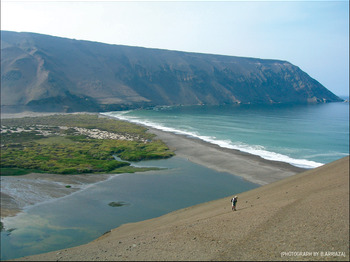
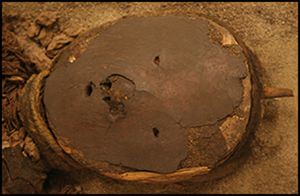
View of the mouth of the River Camarones from the north bank (photograph by B. Arriaza).

The present-day Chango people, who were recognised by the state of Chile as an Indigenous Ethnic group in October 2020, practise similar coastal subsistence to that of the Chinchorro, as well as ancestral relationships that have been studied via genetic analyses (Rothhammer et al. Reference Rothhammer, Moraga, Santoro and Arriaza2010).
Materials and methods
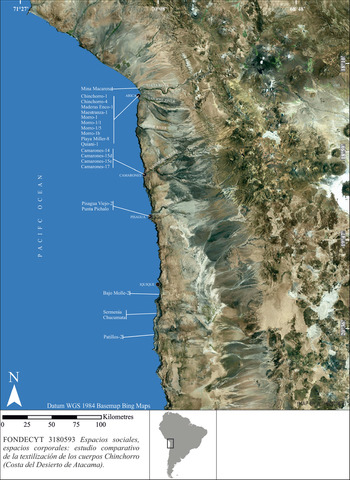
We analysed 162 artificially treated human bodies from 21 coastal archaeological sites in Arica, Camarones, Pisagua and Iquique in present-day Chile (18°–21° south/70°–71° west) (Figure 2). Twenty-seven bodies came from six domestic burial contexts, and a further 110 bodies from 15 cemeteries located away from domestic areas. In 25 cases, site provenance is known only at the local level (Arica). Thirty-nine of the 162 bodies came from collective burials (containing two to four individuals) and eight were from single burials, while information on the remaining individuals is unavailable. Almost all the individuals were buried in pits, three of which had associated structures. Bodies wrapped in twined plant-fibre shrouds and/or animal skin are common. A total of 1019 objects has been catalogued in association with the Chinchorro bodies (21 per cent comprising dress elements) (Montt Reference Montt2014).
Chinchorro funerary sites (figure by A. Oyaneder).

Data were obtained from a systematic appraisal of over 100 unpublished and published scientific reports (1917–2017). Information concerning site, chronology, mortuary installation, artificial body treatment and associated funerary goods was recorded in a relational multi-scale database. Radiocarbon dates were mostly gathered from the published literature (Table S1 in the online supplementary material (OSM)) and are discussed here in their uncalibrated form. We systematically recorded data from 101 artificially treated bodies located in five Chilean museums. Up to 76 artificial treatment variables and 22 dress variables were recorded per body, depending on levels of preservation. The data analysis includes descriptive, univariate and bivariate statistics (Montt Reference Montt2014).
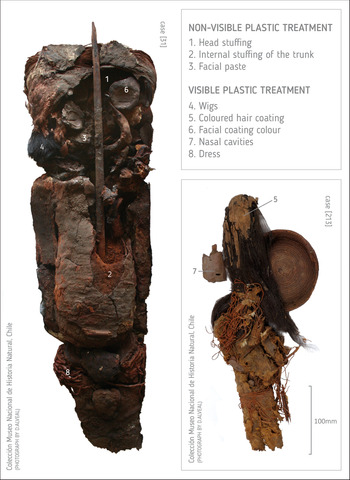
Our analysis follows Montt's (Reference Montt2014) typological classification of Chinchorro plastic-constructed bodies based on materials and formal treatment used on the torso. To analyse the substances and techniques used in Chinchorro funerary art, we discuss eight descriptive variables (Figure 3) classified according to their origin: animal, vegetable or mineral. These Western categories do not entail theoretical assumptions or ontological implications regarding Chinchorro meanings or conceptualisations about animal/vegetal/mineral distinctions. Rather, they are simply applied as an analytical device to search for potential spatio-temporal patterns in the selection and use of materials. Such patterns would shed light on the existence of shared social practices in Chinchorro funerary art. They may also help identify time-space variability, changing or persisting attitudes towards substances, the environment from which they were obtained and their embodiment in the preparation of dead bodies.
Plastic reconstruction of Chinchorro bodies and associated features (photographs by D. Alveal).

Results
Classification of Chinchorro body types defined by funerary art procedures
The 162 artificially treated bodies, dating from c. 7000–3250 BP (n = 32 dated individuals), were classified into two categories:
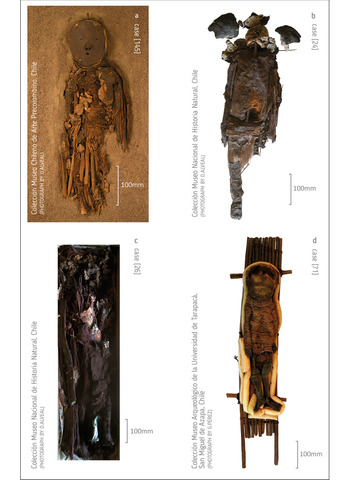
(a) Bodies with complex treatment, both internal and external (n = 91), involving handling of the internal organs, along with soft-tissue preservation. This group was further divided into: (a–1) modelled style (MS, n = 21; Figure 4a) and (a–2) stuffed style (SS, n = 70). The latter includes two substyles: (a–2–1) stuffed-with-sediment-and/or elements style (SSES, n = 55; Figure 4b) and (a–2–2) stuffed-with-vegetal style (SVS, n = 11; Figure 4c). For some bodies, the internal stuffing could not be determined (indeterminate stuffed style: ISS; n = 4).
(b) Bodies with simple treatment, external only (n = 30), were defined as natural-treated style (NTS, n = 30; Figure 4d). Internal cavities were unmodified and external treatment was superficial, consisting of coating and facial masking.
Artificially treated body types: a) modelled style (MS); b) stuffed-with-sediments-and/or-elements style (SSES); c) stuffed-with-vegetal style (SVS); d) natural-treated style (NTS) (photographs by D. Alveal & G. Pérez).

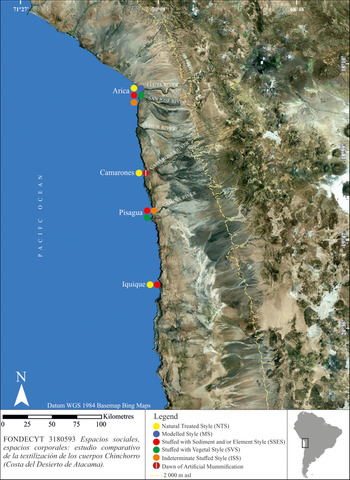
In some cases the nature of body treatment could not be determined (n = 41) (see Table S2). These artificially treated body types demonstrate different geographic distributions, with some present in only a few localities (Figure 5).
Geographic distribution of Chinchorro artificially treated bodies (figure by A. Oyaneder).

Chronological range for artificial treatment of the torso
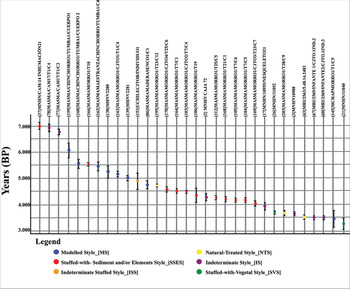
Out of the 76 variables applied in each body's recording (Montt Reference Montt2014), the type of trunk treatment procedures and materials demonstrated chronological variation (group a) (Figure 6), determining different styles predominant in specific periods. This allows us to define four consecutive stages: stage I (Undetermined Style), stage II (MS), stage III (SSES) and stage IV (SVS) (Table 1).
Temporal distribution of Chinchorro artificially treated bodies. Nomenclature (e.g. [139]MHNV2281) corresponds to Body Code FONDECYT 3180593, Museum and Origin Code (figure by V. Alcalde).

Chinchorro complex treatment styles, stages and dating. MS = modelled style; SSES = stuffed-with-sediment-and/or elements style; SVS = stuffed-with-vegetal style.

* Calibrated dates are provided in Table S1.
Radiocarbon dates (n = 3) for simple treatment natural-treated style bodies (NTS, n = 30) range from 4721–3504 BP. Their material, contextual and stylistic features date to the transition between stages II and III, continuing through stage III and into stage IV.
Material aspects of Chinchorro mortuary treatment
Chinchorro funerary art involved non-visible (points 1–3; for details, see Table S3) and visible (points 4–8; for details, see Table S4) plastic attributes:
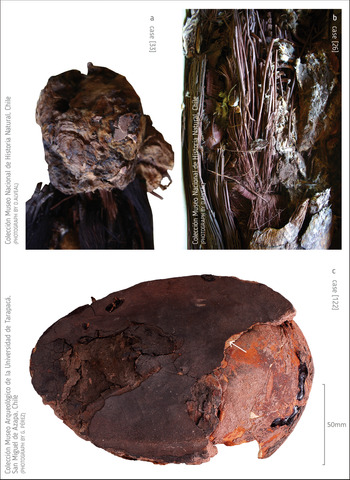
1) Head stuffing. Vegetal fibres and mineral sediments constituted the primary stuffing materials in stages II–MS and III–SSES, respectively, along with mammal skins. The use of mammal-skin stuffing increased between stages II–MS and III–SSES, and even more so into stage IV–SVS (Figure 7a).
2) Internal torso treatment. This includes using mammal and bird skins, terrestrial and marine plants, sediments, whitish clay and vegetal fibres. During stage I, sediment combined with mammal skins predominated, despite the high frequency of indeterminate cases. In stage II–MS, torsos were modelled only with high-quality whitish clay (Arriaza et al. Reference Arriaza2012). In stage III–SSES, sediments alone, or combined with mammal skin, were predominant. Other combinations include bird skins, land and marine plants and, in one case, camelid yarn. During stage IV–SVS, longitudinal bundles of vegetal fibres (Typha sp., or bulrush) contributed to shaping the bodies (Figure 7b).
3) Facial paste. Clay pastes were used for modelling Chinchorro faces or masks, sometimes with added colouring. In stage I, red pastes were predominant. In stage II–MS, a whitish clay paste was most frequently applied—similar to that used to model the torsos (Figure 7c). Black pastes predominated in stage III–SSES, identified mainly as mixtures of manganese oxides (Arriaza et al. Reference Arriaza, Atoche Peña, Rodríguez Martin and Ramírez Rodríguez2008).
4) Wigs. In stage I, wigs were made primarily from tufts of human hair, a practice that continued throughout all stages (Figure 8a). In stages II–MS and III–SSES, bodies predominantly kept their own natural hair, which was not modified. In stage III–SSES, hair and wigs were coated with clay, an innovative feature that persisted into stage IV–SVS. Of the 162 artificially treated bodies, 100 wore wigs—a trend apparently without gender differentiation. Wigs crafted from adult human hair were more frequently observed in infants and foetuses (n = 20/28) than in adults (n = 4/28).
5) Coloured wig coatings. No coatings were recorded for stages I and II–MS. In stage III–SSES, red and black-coloured clay coatings were common, and, in some cases, wig remains are possibly concealed by them. In stage IV–SVS, black or white rather than red coatings were used. A few cranial fragments without an associated torso, probably from stage IV, had an unusual green-painted wig coating (Figure 8b).
6) Facial coating colour. Faces were finished with a thin coating of coloured paint. In stage I, this was mostly red paint, resembling the pastes used in facial modelling in the same stage. In stage II–MS, black paint was used (Figure 8c), sometimes with a top coating of red paint. In most cases from stage III–SSES, masks remained uncoated, although a few were painted black—like the paste used in facial modelling—or red. Occasionally, in stage IV–SVS, a green coating was applied in addition to red paint.
7) Nasal cavities. This anatomical feature, made visible via incisions (Figure 8c), was recurrent throughout all stages, though its frequency varied over time, and was at its most prevalent in stages II–MS and III–SSES.
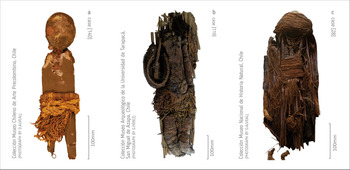
8) Dress. Clothing is present throughout but increased in frequency towards the latter stages. In stage I, only a single body in the sample was dressed in vegetal fibres (headband or turban). In stage II–MS, clothing (girdles and fringe skirts) was made from animal fibres (Figure 9a). During stage III–SSES, clothing elements predominated, with a notable increase in animal fibres (e.g. in headband or turbans, girdles, skirts and yarn wrappings) (Figure 9b), along with plant fibres (in girdles and skirts). In some individuals, clothes of plant origin coexist with others made from animal fibres. Animal fibres reached a peak in stage IV–SVS (headband or turbans, girdles and yarn wrappings) (Figure 9c). Most dress items for NTS bodies were made primarily from animal fibre (e.g. headband or turbans, girdles, skirts and yarn wrappings).
Non-visible plastic treatment: a) animal-fibre head stuffing; b) vegetal-fibre bundle to form the inner torso; c) whitish clay-paste mask (photographs by D. Alveal & G. Pérez).

Visible plastic treatment: a) remains of cranium with wig made from tufts of human hair; b) green-painted wig coating; c) black facial coating and nasal cavities (photographs by D. Alveal & I. Montt).

Dress according to body type: a) modelled style (MS): animal-fibre fringe skirt; b) stuffed-with sediments-and/or elements style (SSES): animal-fibre skirt, and arm and leg yarn wrappings; c) stuffed-with-vegetal style (SVS): turban and torso yarn wrapping (photographs by D. Alveal & G. Pérez).

Discussion: Chinchorro mortuary embodiment over time
Post-mortem treatments of Chinchorro bodies demonstrate distinct spatio-temporal distributions. The sequence begins at Camarones (Figure 2)—considered the ‘cradle’ of complex artificial body intervention (Arriaza Reference Arriaza1995a)—with NTS bodies, some time after c. 7000 BP. The larger assemblage of bodies from Arica, dating from c. 6070–3500 BP, features all of the complex-treatment types (MS, SSES and SVS). Finally, the southernmost localities present only stuffed styles, such as Pisagua (SSES, SVS and ISS; c. 4880 BP) and Iquique (SSES; c. 3504–3484 BP)
Stage I bodies (c. 7000–6780 BP) correspond to the SSES and undetermined categories. Some traits from this stage persisted over time: substances were fundamentally terrestrial in origin (i.e. no freshwater mollusc shells, fish bones or algae have been identified in stuffings or external preparations); nasal cavities were visually defined by incisions; and all stages involved the use of wigs, mostly made from adult human hair.
At Arica, from c. 6070–4750 BP (corresponding to stage II–MS), the physical volume of the deceased and creation of a soft-contoured body were achieved exclusively by adding locally sourced clay, though the exact provenance has yet to be identified (Arriaza et al. Reference Arriaza2012). Facial features were defined using a black coating of manganese oxide sourced either from high Andean environments (>2000m asl) (Sepúlveda et al. Reference Sepúlveda2013) or acquired locally from sediment carried by floods during seasonal highland rainfall (Van Hoesen et al. Reference Van Hoesen, Arriaza, Ryan and Grady2019).
The highly standardised production of modelled-style bodies seems to indicate a particular social focus on the affordance of specific mineral substances (e.g. whitish clay) to render external and internal aspects of the body (limbs, torso and facial volumes). We interpret this standardisation as an intention to create a new ‘compound’ body, which comprised collective plastic and visual features via the addition of natural substances, rather than intending to re-create the individual living person (Standen Reference Standen1991; Arriaza Reference Arriaza1994; Montt Reference Montt2014). Fringe skirts were the preferred dress item during this stage, but, as they are removable objects (Sorensen Reference Sorensen1997), it cannot be excluded that they were added to the bodies decades or centuries later, as a maintenance device. All stage II burials were collective (Montt Reference Montt2014).
Between c. 5000 and 4000 BP (late stage II and stage III), territoriality, social tension, complexity and the incidence of warfare increased among Chinchorro social groups. These changes took place in a context of a growing population and ecological deterioration, as declining rainfall on the western slopes of the Andes reduced water availability, biodiversity and environmental productivity (for the possible relationship between population increase, social complexity and environmental change in the history of the Chinchorro, see Marquet et al. Reference Marquet2012: fig. 4). Coastal marine ecosystems also began to be affected by the increasing intensity and frequency of El Niño Southern Oscillation events. Technological innovations, including spear throwers (atlatls) and basketry, as well as other long-known devices, such as harpoons, hooks and weights, all had a signficant effect on the exploitation of both coastal marine and inland resources (Marquet et al. Reference Marquet2012; Santoro et al. Reference Santoro2017a, Reference Santoro2017b; Standen et al. Reference Standen2020).
Innovations also involved the post-mortem plastic reconstruction of stuffed-style bodies (Montt Reference Montt2014). This period (stage III, c. 4570–3484 BP) saw an increase in the number of complex-treated bodies, while certain procedures for internal and external treatment were simplified. SSES treatment continued until c. 4040 BP at Arica and Pisagua, and at Iquique until c. 3484 BP (with a lower frequency). Body-volume reconstruction entailed a range of stuffing options, using mineral sediments (e.g. sands, clays, colouring minerals, ash), animal and plant fibres, and/or feathers. Other choices included the application of new red-colouring minerals to coat the body, and black pastes and coatings for different body parts. Despite depending largely on marine resources for subsistence (Standen et al. Reference Standen, Santoro, Arriaza and Coleman2018), the Chinchorro used inland resources, especially camelids, to produce SSES bodies. It is possible that stuffing preferences may have reflected socio-ecological changes that fostered new ways of relating to inland resources (e.g. camelids). Body treatment was simplified in terms of volume and formal detail attainment, but became more complex as a greater variety of substances became incorporated. This is especially relevant in the case of animal fibres, which may have involved observation of animal behaviour and the development of shearing techniques and wool-fibre management processes. Chinchorro archaeological contexts suggest scarce use of camelids beyond obtaining fibres and skin, as evidenced, for example, by the small number of bones recovered (Standen Reference Standen1991). Other stuffing materials, such as sediments (e.g. ash, sand, clay) and plants could have been obtained through more opportunistic strategies, given the number of potential local sources.
In stage III–SSES, treated bodies combined human, mineral and animal elements. A significant proportion of torsos contained animal fibres (42.1 per cent, n = 22), referred to as “camelid fibre” (Standen Reference Standen2003: 180; Arriaza & Standen Reference Arriaza and Standen2009: 124). Around half the SSES bodies were dressed in animal-fibre yarn, used for both removable objects (e.g. fringed skirts) and more fixed elements (e.g. yarn wrappings). This supports our argument that human-camelid relations intensified during stage III (c. 4570–3480 BP.) This interagency resulted in the systematic incorporation of animal substances into the bodies in an attempt, figuratively speaking, to ‘make flesh’ by replacing internal organs and soft tissues and compensating for the post-mortem loss of abdominal and thoracic volume. The transformation of wool through yarn spinning also increased in this period.
This use of camelid elements in funerary art coincides with increasing occupation of inland ravines, which resulted in the establishment, during stage III, of the first inland cemetery, where bodies were buried in extended positions—a typical Chinchorro feature—but without artificial manipulation (Standen & Núñez Reference Standen and Núñez1984). During this stage, individual burials were slightly less prevalent than collective ones (Montt Reference Montt2014).
At Iquique, SSES treatment continued until c. 3484 BP, and in Arica, SVS bodies were dated to c. 3690–3254 BP; there, they were more often single burials, perhaps due to a degree of social fission reflected in the funerary realm (Montt Reference Montt2014). Around c. 3600–3500 BP onwards, some bodies began to be buried in semi-flexed positions and without internal treatment. In both individual and collective burials, simple and complex Chinchorro body treatments reflect an increasing appreciation of fibres as textiles among all age groups and genders. There is no evidence that animal-fibre dresses were linked to social status; rather, they were an indication of shared social identity.
SSES bodies from Iquique, SVS bodies from Arica and NTS bodies from both Arica and Iquique (c. 3600–3250 BP, stages III–IV) were wrapped in yarn and textiles. During this period, the wrapping was intended to cover the whole body, except the face (Cases & Rojas Reference Cases and Rojas2001: fig. 1). SVS bodies were mainly constructed with plant fibres (Typha sp.), perhaps gathered from nearby wetlands. The SVS involved limited manipulation to re-create bodily volume, and, as with the NTS bodies, little effort was invested in producing facial features. By contrast, in both styles, complexity was derived from the presence of numerous labour-intensive textile dress items.
Other features show little diachronic variation. Nasal cavity incisions were used in all stages and styles of Chinchorro embodiments, suggesting that such visual features were meaningful and deeply valued across generations; they could have been used to add realism to faces or to effect some kind of relationship between the inner body and its surroundings. In turn, the use of adult human-hair wigs in infants and foetuses may represent a compensation strategy by which physical attributes not originally present in the individuals were added to achieve artificial ageing beyond the age at death. These trends emphasise the conflation of collective and individual elements in Chinchorro bodies.
Conclusions: the creation of relational bodies
The socioeconomic and spatial relationships established by the Chinchorro with their environment and its affordances were influential in the heterogeneous mortuary embodiment practices. The internal and external transformation of the dead was achieved through the incorporation of various substances from the surroundings. The differential selection of materials caused these complex treatment patterns to change over time, as is evident in the reconstruction of the torsos in particular.
Whereas subsistence was based predominantly on marine-coastal resources, materials used in Chinchorro funerary art were not obtained from the coastal ecosystem, with few exceptions. In stages I–III (c. 7000–3500 BP), mineral substances were used to achieve volume and to ‘flesh out’ the body. From a Western perspective, minerals belong to the inanimate world; for Indigenous communities, however, their provenance, symbolic importance deriving from their characteristics, or qualities related to animism may have imbued them with a sacred meaning. From c. 4570–3250 BP (stages III–IV), a greater use of animal and plant substances in funerary rituals is evidenced by their increased incorporation into the embodiment processes. Given that animals and plants are usually regarded as living agents in both Western and non-Western cultures (though with different implications), the presence of camelid wool and yarn in the artificially treated bodies becomes especially significant. Moreover, it became the expression of a burgeoning textile industry.
Over the longue dureé, such changes in body treatment reveal different modes of engagement with the substances selected from the environment (e.g. clay, wool, plants), their technical transformations (e.g. into yarn), and substances obtained from the human body itself (e.g. hair). This involved a twofold process of embodiment within the treated bodies: ‘invisible plastic’, in which the complexity of producing corporeal volume decreased over time; and ‘visible plastic’, in which the complexity of external body treatment using animal fibres increased over time.
Although “each body is unique” (Arriaza Reference Arriaza1995a: 138), recurrent patterns in the transformation of the dead—independent of age and gender—were neither intended to emphasise the deceased person's individuality nor their social status. They do, however, suggest that embodiments were designed to construct a collective identity through the physical and composite creation of new social subjects. In these earliest-known funerary art expressions, non-human substances were key elements in the intentional intervention of heads and torsos, allowing artificially treated Chinchorro bodies to transcend their human lifetimes symbolically.
Acknowledgements
We are grateful to the two anonymous reviewers for their insightful comments, and to the museums which house these Chinchorro bodies. Thanks also to Nick Charlesworth for revising our English.
Funding statement
This research was funded by the FONDECYT 3180593 project and by ANID Doctorate Grant 21061130.
Supplementary material
To view supplementary material for this article, please visit https://doi.org/10.15184/aqy.2021.126