The new generation of conservative politicians in Japan
This article will suggest that the nature of Japanese conservatism may look the same as it always has but right-wing ideas and beliefs have become more prominent as countervailing forces, particularly political party factions and other salient features of postwar politics until 1993, began to recede slightly in importance. Ideological issues have become clearer. The aim is to assess the degree to which ideology became more important in negotiating the boundaries of a new generation of conservative politics in Japan between 1993 and 2010.
This paper will trace the rise of ideology in Japanese politics, particular in the main conservative party, the Liberal Democratic Party. It will also engage in a detailed case study of an entire cohort of LDP politicians, the so-called ‘Koizumi's children’. This cohort is significant because it was meant to represent a shift to a new type of politics, so the political dynamics of these politicians and their political fate may be instructive. This research is effectivley process tracing of the rise of ideology in the LDP and is based on the culmulative weight of the evidence to demonstrate a shift in LDP politics to the political right. The case of the ‘Koizumi children’ provides one important piece of evidence on top of the others, i.e. not the only piece of evidence.
Ideological proclivities are manifest in the pronouncements of conservative political leaders and the formation of political organizations so this evidence can be used to measure ideological change. There are alternative methods of teasing out these differences, such as in-depth personal interviews or discourse analysis, but these are costly and limited by access to top politicians and the historical nature of the issues involved. Put simply, few scholars can gain access to senior politicians, they may not be candid with an academic interviewer, and in some cases the key figures may be dead. This paper is focused on documented evidence of leadership and organizational changes within the LDP in recent years in order to trace the rise of ideology as a factor in the dynamic of Japanese conservative politics as one means to explore the role of ideology in Japanese politics.
Japanese conservative ideology defined
It is essential to pause for a moment to define ideology. Political ideology is a set of ethical ideals, principles, doctrines, myths, or symbols of a social movement, institution, class, or large group that explains how society should work, and offers some political and cultural blueprint for an ideal political and social order (Baradat, Reference Baradat1979/2003: 11). Thus, a political ideology usually includes specific suggestions and injunctions about goals and methods/means to its ends. These are usually relatively simple principles of action and foundational beliefs rather than complex and subtle philosophies.
Conservative ideology is notoriously difficult to define. This is in part because one of its characteristics is a distaste for abstract, rational, and comprehensive systems of thought, which is implied in the definition of ideology, but analysts of ideology, such as Baradat (Reference Baradat1979/2003: 23–8), do propose the outlines of a distinctive conservative ideology. In the Japanese context, it can be defined in contrast by gradualist pragmatic policies rooted in traditional ideas and symbols, which are beyond or not subject to scrutiny and critical examination.Footnote 1
In the Japanese context, core conservative ideology can be defined by looking at three areas of conservative beliefs:Footnote 2
Cultural/traditional roots
Japanese conservatives give a central role to the Emperor and deep rooted cultural traditions as the wellspring of Japanese identity. Most accept the purely symbolic role of the Emperor in the postwar political system, but would still argue that the Emperor has a cultural heritage which extends back to pre-history. It is one of the features of Japan which make it a divine country (Ishikawa and Yamaguchi, Reference Masumi and jirō2010: 202). These beliefs are based on a combination of nativist (kokugaku) ideology, neo-Confucianism, and conservative nineteenth-century Prussian ideas which helped to create the pre-war Meiji State and continue to be important in areas such as education on which conservative ideologues focus in particular (Shively, Reference Shively, Nivison and Wright1959; Tsurumi, Reference Tsurumi1974; Shibata, Reference Shibata2004).
Us versus them
The second feature of Japanese conservative ideology is a definition of what it means to be Japanese and a lack of tolerance for criticism of the essence of what Japanese stand for. In its extreme forms, Japanese are seen having a unique status in the world, and there is an imperative to preserve the purity of the Japanese spirit and blood (both seen as intertwined in a way that is not supported by modern science) (see Dale, Reference Dale1986; Befu, Reference Befu1987). This suggests that foreigners within Japan should not have equal rights and must be restricted in various ways. It also leads to a lack of tolerance of dissent, in particular criticism of the Emperor or deep analysis of Emperor's family. This includes little tolerance for historical criticism which questions the actions of the Japanese nation in the past (Sneider, Reference Sneider1986; Japanese Society for History Textbook Reform, 1996). It also implies the need for a strong economy and military to protect the nation.
Tensions with socialism and liberalism
As noted above, conservatives are skeptical of modern ideologies such as liberalism and socialism (in the Japanese context see Fujiwara, 2005: 35–64) but there is a willingness to incorporate elements of the goals of such ideologies pragmatically. Traditionally, the LDP was opposed to state-based social welfare but various forms of patronage served the same function, and LDP politicians were not opposed to use the state to provide benefits (see, for example, Calder, Reference Calder1991), or to use anti-free market rhetoric against wealth speculation and profit making (Nakagawa et al., Reference Nakagawa1973). It is true that some conservative politicians such as Nakasone Yasuhiro and Koizumi Junichirō introduced elements of free market thinking, such as privatization and reducing the size of the state, but these created considerable tensions, including the purge of so-called forces of resistance (teikō seiryoku), towards economic reform. For the most part, however, the LDP was considered so inhospitable to this type of thinking for so many years that some neo-liberal ‘conservatives’ ended up in the Democratic Party of Japan (particularly Matsushita Institute of Management and Government graduates). Even those in the LDP who held these views have found it difficult to gain influence and some left the party altogether. This is not to suggest that free market ideology was the only driver of divisions in the LDP in recent years, but it was an important one.Footnote 3
Any diversity in Japanese conservatism need not distract scholars from examining ideology, especially if it is important to the understanding of political developments. When ideological convictions are stated clearly and have an impact on events, then one should be able to argue that ideology mattered. If organizational and leadership change has clear ideological reference points, then, again, ideology would seem to matter.
The rise of ideology in LDP politics
It is easy to over-emphasize the novelty of ideology in the LDP given its increased prominence in recent years, but we have to remember ideology is not new to the LDP even if becoming more prominent in recent years. Ideology has been important in the LDP, therefore, as a broad set of principles and ideals which set them apart from the left parties and the Komeitō, There were tensions over ideological differences in the past, but they did not form the basis for any organized form of internal group organization until the most recent two decades for reasons which will be discussed in this paper. Until 1992, elections for the leadership of the LDP and selection for key posts or benefits for most of the party's existence were not based on competition between ideologically distinct groups. The main internal competitive organizations in the LDP have been factions which are mainly based on personal followings of major politicians. Even if these politicians have had strong political even ideological leanings, the need to build factions by recruiting large numbers of supporters often diluted ideological tendencies.
The presence of right-wing politicians in Japanese politics is now new, even at the highest levels. Kimura Tokutarō, minister of justice under Prime Minister Yoshida Shigeru, and Kimura Takeo, who was one of the key leaders of the Tanaka faction as it emerged in the late 1960s, were both clear right-wing LDP politicians (Morris, Reference Morris1960: 121, 175, 204, 241). More significant was Nakasone Yasuhiro who became prime minister and before and since campaigned to promote the right-wing political agenda (Hori, Reference Hori1983/2000: 244–78). To this one might add the Seirankai and its members which supplied much of the leadership of the right for the past 35 years, including Ishihara Shintarō (Babb, Reference Babb2012). Therefore, it is not being argued that there has necessarily been a net increase in the number of right-wing politicians. It is merely that political dynamics now allow and even encourage them to express these views more clearly.
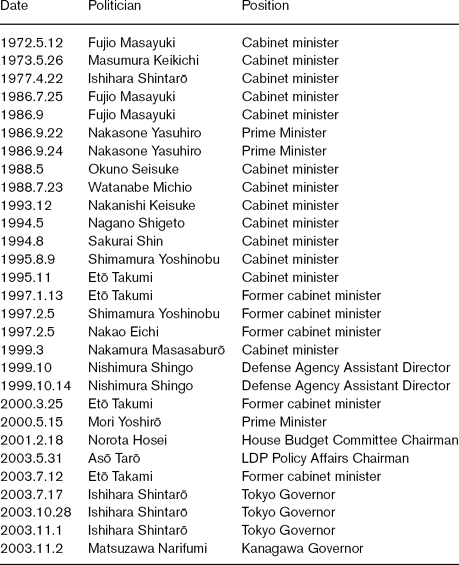
One needs only to look at the numerous instances of ‘misspeaking’ (shitsugon) over the years to realize that most right-wing politicians have said privately things that they now openly admit (see Table 1). What has changed is that the taboo against expressing some of their beliefs is now weaker. It is important to notice that the frequency of these controversial comments has increased dramatically since 1992.
Conservative ‘mis-speaking’ Incidents 1972–2003

Source: Shitsugenō Nintei Iinkai (2000) and major national Japanese newspapers on the relevant dates.
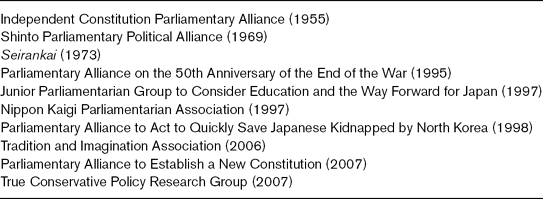
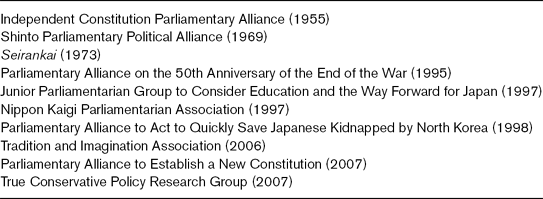
There has also been an increase in organizations created to promote right-wing political ideas. Table 2 gives a partial list of the political groups open to participation of politicians; though not all are exclusively for national politicians, many key politicians have been or still are involved. Note the date of formation for most of these groups. They are largely a recent phenomenon. Again, the period after 1992 seems an important turning point.
Right-wing parliamentary groups
Source: Respective group websites.
The origins of the recent shift to right-wing ideology are mostly likely found in 1994 at the very point when factions seemed to have lost their function in the LDP. The LDP had struggled to get back into government by making an unlikely alliance with the Socialist Party, their longtime adversaries. The Socialist leader Murayama was made Prime Minister rather than the LDP leader Kōno Yōhei, despite the LDP's larger number of seats, in order to persuade the Socialist to join the coalition government. As crisis after crisis rocked the Murayama government in 1995, Hashimoto emerged as the leader of LDP MPs determined to get the LDP back into its position of dominance. Following on the success of trade negotiations with the United States, he helped to sabotage a parliamentary resolution, promoted by the Socialists and moderate MPs in the LDP, to apologize for Japanese actions in World War II on the fiftieth anniversary of the end of the war.
Important right-wing LDP support groups, such as the Japan Bereaved Families Association (Nihon Izoku Kai) opposed the apology. Hashimoto was the chairman of the Japan Bereaved Families Association at the time and spoke actively on their behalf to oppose or tone down the resolution (Kano and Osada, Reference Kano and Tatsuji1996: 453–7). Hashimoto used his connection with these groups to build a coalition in the LDP to defeat Kōno, who resigned rather than fight, and Hashimoto easily won the Presidency of the LDP in September 1995 against token opposition by Koizumi who campaigned on a platform of deregulation and privatization. Once he was prime minister, Hashimoto's visits to the Yasukuni shrine in the face of Chinese and Korean government opposition were the start of years of stormy relations with China (Okumura, Reference Okumura1998: 80–4). He clearly set the tone toward the political right from his bid for the LDP presidency into the initial years of his term in office as Prime Minister.
Parallel to this development was the formation of the Japanese Society for History Textbook Reform (Atarashi Rekishi Kyokasho wo Tsukuru Kai). The group was formed with the express purpose of creating textbooks based on good sense (ryōshiki) which can convey confidence to Japan's next generation (Japanese Society for History Textbook Reform, 1996). It criticized the tendency of textbooks to portray the first Sino-Japanese and Russo-Japanese wars as wars of invasion, to characterize the Meiji State as bad, and promote the view of Japan's modern history as criminal. As an example, it alleged that textbooks had a tendency to engage in self-criticism over ‘Comfort Women’ without adequate evidence that the women involved were forced to participate. These are deeply controversial issues but adopted by many leading conservative politicians.
On 27 February 1997, a group was formed by MPs to support the work of the Japanese Society for History Textbook Reform. The group was called the Association of Junior MPs to Consider History Education and the Way Forward for Japan (Nihon no Zento to Rekishi Kyoiku wo Kangaeru Wakate Giin no Kai, eds., 1997). Kōno Yōhei, former President of the LDP, was called before the group in order to demand he retract earlier statements that Comfort Women had been forced to join.Footnote 4
The Nippon Kaigi (Japan Congress) is another development in this period which also deserves mention. It is an umbrella organization of many of the groups noted above. It has been traced back to the Congress to Realize a Law Establishing an Imperial Calendar which was formed in 1978. On 30 May 1997, this was merged with the Association to Defend Japan which was primarily composed of right-wing religious organizations such as those noted above, though significantly it excluded ‘non-Japanese’ religious groups such as the Unification Church which also has strong right-wing connections. Nippon Kaigi is a national organization with branches in all 47 prefectures of Japan.
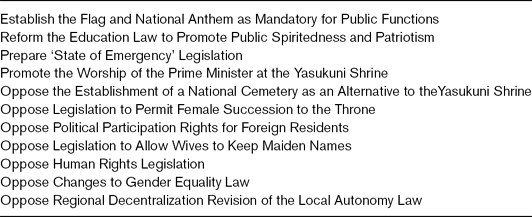
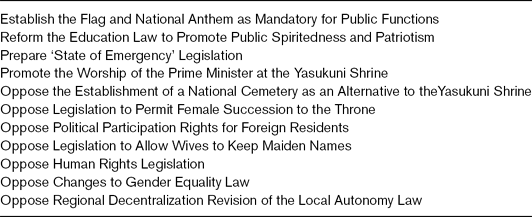
The organization brought together right-wing groups, business leaders, intellectuals, and politicians into one umbrella organization. For several years, the chairman was the LDP politician Hiranuma Takeo. Its initial policy programme on political issues is very similar to the LDP policy initiatives of recent years (Table 3).
Key policy goals of the Nippon Kaigi
Source: Nippon Kaigi, www.nipponkaigi.org/activity, 29 April 2012.
Even when the LDP was out of power after 2009, it helped to block the seven pieces of legislation also opposed by the Nihon Kaigi. When it was in power, the LDP political leaders realized the first four goals. Under Prime Minister Obuchi Keizō, the first objectives were achieved with the passage of a law to make the display of the Japanese flag and the signing of the national anthem mandatory for public occasions, including state school assemblies (Ishikawa and Yamaguchi, Reference Masumi and jirō2010: 200). Obuchi's government also passed legislation permitting surveillance of private communication by the police.
It was under Prime Minister Koizumi Junichirō that many of other goals of the Nippon Kaigi and other right-wing groups were achieved. In 2003, legislation was passed to create a legal framework for the use of force in national emergencies as the basis for State of Emergency legislation. Koizumi's controversial visits to the Yasukuni shrine, which enshrines Japanese war dead including those accused of war crimes, caused serious friction with Japan's neighbors in Asia. Again, both of these policies were consistent with the Nippon Kaigi policy platform of the late 1990s.
It is true that Koizumi visited North Korea, much in the spirit of the conservative US President Richard Nixon, to improve relations and attempt to raise the issue of the Japanese who had been kidnapped by Japanese agents over many years (Ishikawa and Yamaguchi, Reference Masumi and jirō2010: 208). The North Korean government admitted their activities and allowed the surviving abductees to return to Japan. There were suspicions that North Korea was continuing to withhold key information and in the end Koizumi's visit increased rather than lessened tensions between the two countries. The issue of secret kidnappings of the Japanese by North Korean agents continued to be used by the right-wing to promote a more assertive attitude in foreign affairs and toward minority and left-wing groups within Japan.
It should be no great surprise that the conservative LDP contains many right-wing politicians, but with the decline of factions ideology seemed to be supplanting factional balance as the dynamic behind LDP internal politics. There is no doubt that other LDP politicians in the past tried to push an ideological agenda, including Kishi, Sato, and Nakasone, but the reaction to these initiatives was blunted by opposition even within the LDP. The rise of very different leaders such as Ikeda, Tanaka, Takeshita, who focused on non-ideological consensus building, can almost be seen as a reaction to the ideological approach. It may be that the LDP, especially the new generation of conservatives, lacks easy solutions to economic problems, so can most effectively define its identity through ideology.
What is certain is that far right-wing group members were prominent in the Koizumi administration toward the end. A study of the group affiliations of the LDP cabinet ministers, vice-ministers, party officials, and parliamentary committee chairs in the second Koizumi cabinet indicates the extent of right-wing interests (Koizumi Daini Naikaku no Chotakaha no Daijintachi, 2003). Ten cabinet ministers, 17 vice-ministers, 14 parliamentary vice-ministers, the three top posts in the LDP (Party Secretary, Policy Affairs Research Council Chair, and General Affairs Council Chair), and four key parliamentary committee chairs were members of the Shinto Political Alliance Parliamentary Advisory Group (Shintō Seiji Renmei Kokkai Giin Kondankai). Among the goals of this organization are to promote the notion that Japan is a ‘Land of the Gods centered on the Emperor’. In addition, eight cabinet ministers, ten vice-ministers, seven parliamentary vice-ministers, the Party Secretary and Head of PARC in the LDP as well as chair of the Upper House Education and Science Committee are members of groups which are attempting to play down Japanese wartime atrocities and promote patriotic education, including the LDP History/Inspection Committee, Young Parliamentarians Group Considering History Education and the Way Forward for Japan, LDP Special Investigative Committee on the Basic Education Law, and the Bipartisan Parliamentary Alliance to Consider the History Textbook Problem.
Two key allies of Koizumi stand out in the list: Abe Shinzō and Nakagawa Shōichi. Not only are they members of the above-mentioned organizations but they have the most affiliations with right-wing causes of any of the cabinet ministers and party officials. Abe was a member of the ‘Parliamentary Alliance on the 50th Anniversary of the End of the War’ which grew out of a movement to stop and repeal the apology given by the Japanese government on 15 August 1995 for Japanese actions during the war and which as we have seen was the springboard for the rise of Hashimoto Ryutarō to take control of the LDP. Abe came to prominence subsequently because of his involvement with the North Korean kidnapping issue, which was pursued by the Parliamentary Alliance to Act Immediately to Save Japanese Kidnapped by North Korea. Nakagawa was involved with this group as well. Finally, both are members of the Japanese Conference of Parliamentary Deliberations (Nihon Kaigi Kokkai Giin Kondankai) which is supported by many right-wing politicians and is dedicated to constitutional reform on conservative principles.
Abe was the anointed successor of Koizumi, as we shall see, and he fostered the passage of two key pieces of legislation favored by the political right. The Education Basic Law (2006), which reintroduced moral education based on collective spirit, tradition and patriotism, made education a legal rather than a societal responsibility, and eliminated the stipulation that state education should not be gender segregated. The other law was legislation to make possible a public vote on constitutional reform. Both of these issues, conservative educational reform and constitutional revision, have been long-standing right-wing conservative causes. In short, the rise of Abe Shizō to the post of prime minister was a triumph for the growing trend of right-wing conservatism in the LDP.
Possible reasons for the rise of ideological politics
There are three primary reasons which might be suggested for the shift to more ideological politics since 1992. One is the end of the Cold War. This is a poor explanation because the Cold War ended in 1989 or 1990 but the initial movement was not ideological confrontation. In fact, it was the opposite. Kanemaru worked hard to incorporate the JSP into government and the JSP tried to soften its opposition to politics which had previously formed the ideological divide between left and right (Yamagishi, 1995: 91–5). The decisive shift toward a more right-wing conservative ideological politics did not come until 1994, four or five years after the end of the Cold War, and there is little evidence to suggest that key events or political dynamics changed in the initial years to foster a more ideological approach. If anything, there was a sense that there was a softening of ideological divisions towards a more centrist conservatism (Ishikawa and Yamaguchi, 2010: 179–85).
The second explanation that might be suggested is the change of the electoral system in 1992 from a multi-member constituency to a mixed electoral system of single member districts and a regional proportional representation (PR) block system. It could be argued that the single member constituencies led to a redrawing of district boundaries and created a straight contest between left party candidates and the LDP candidate. This might foster clearer ideological positioning of LDP candidates. However, this also cannot explain the timing of the change. The next election held under the new electoral system was not until 1996. Moreover, the left had effectively collapsed by that point and the main competitor to the LDP was another center-right party, the New Frontier Party, composed of former LDP politicians in an alliance with minor center-right parties. LDP attacks on the New Frontier Party were not ideological. Finally, the key politicians who led the shift of the LDP to the right all had stable seats with secure majorities so it is unlikely that they were using ideology to appeal to their own constituents.
The final explanation is the decline of factional power in the LDP. Until the fall of the LDP from power in 1992, factions decided who would be the leader of the LDP. There were some attempts at reforming the system to permit more participation by party members, but they were made meaningless when factions used their resources to organize the membership on factional lines (Ishikawa and Yamaguchi, Reference Masumi and jirō2010: 136). Once the LDP was out of power, however, factions were significantly weakened. The most important change was political funding. So long as factions controlled the government, powerful interest groups gave generous funding to the factions but with the fall of the LDP from power, political funding dried up. The most significant was the end of funding from the powerful business federation, Keidanren, but other funding direct to party leaders also disappeared (Babb, Reference Babb2001: 56–7). This weakened the ties of MPs and party members to faction leaders.
More importantly, political finance reform weakened the role of factions as there were restrictions on political contributions to individuals. These could be circumvented to a degree when contributions made to the local party branch were effectively given directly to the LDP MP or dominant candidate in the local district, but this did not favor faction leaders. Moreover, most funding, especially new public funding of political parties, was now channeled through the party executive rather than faction leaders. The result is that factions appeared to have been weakened (Park, Reference Park2001).
Even when the LDP was back in power in a coalition government with their long-time adversaries, the Japanese Socialist Party and the Harbringer Party, the LDP was still weakened by the need to share posts and decide policies collectively. For most of the subsequent period it was in power, the LDP was forced to share cabinet posts with coalition partners. Therefore, there were fewer posts to distribute to faction followers, so the allure of faction declined. The influence of factions over key aspects of power continued to decline, so ideology became the new mechanism to mobilize support within the party.
As for most of the period since the formation of the LDP in 1955, most Japanese LDP politicians were pragmatists and power brokers, not ideological mavericks. This is not surprising because factional politics in the form it takes in Japan and similar states tends to be based on non-ideological imperatives. Those comparable political parties with the most extensive party factionalism, primarily based on personality, are communist parties. Both the old Communist Party of the Soviet Union and the Communist Party of the People's Republic of China share extensive networks based on personality and patronage much like factions in Japan, though in the case of the Soviet Union the focus was often personal gain (Willerton, Reference Willerton1992: 11–15), whereas in China divisions can also include generational change, organizational position, and personal gain (Pye, Reference Pye1980; Nathan and Tsai, Reference Nathan and Tsai1995). In both parties, ideology was, or has been, too dangerous to serve as the basis for political grouping, and when it did in Chinese Communist Party history it had the tendency to modify the nature of factions and reduce their influence (Pye, Reference Pye1980: 51). Once the LDP was no longer the dominant party, the logic of factions weakened and new forms of internal party contestation were possible.
Sartori makes the distinction between ‘fractions’ (a general unspecified group), ‘tendencies’ (a patterned set of attitudes) and faction (a specific power group) (Satori, Reference Sartori1976: 75). Fractions are personalized but not permanently organized. Factions are aimed at gaining power and more organized. Tendencies are the most ideological. However, if fractions, factions, and tendencies harden into specific groups and deepen within a party, there is the danger of factionalism based on ideology in the division of the party, leading to the development of splinter parties. The LDP was able to maintain single-party dominance and the coherence of the conservative centre-right precisely because internal party disputes were managed by factional balance and patronage rather than by potentially divisive ideological competition (Hrebenar and Nakamura, Reference Hrebenar, Nakamura and Hrebenar2000: 112). Once factions were no longer helpful in gaining access to posts and political promotion, alternative means of attracting attention and gaining support within the party were needed.
Even if all three explanations for the rise of ideological politics are plausible, the change in the LDP due to the decline of factions is most plausible. The mainstream political science literature would generally agree with this assessment of the change in LDP organization, though there is a tendency to ignore ideology due to an excessive focus on institutions and organizational dynamics as if these were all that mattered. For example, Krauss and Pekkanen examine organization change in the LDP over a number of decades but their focus is on why specific party ‘institutions’ [sic] continued to persist despite predictions that they would disappear as a result of electoral reform (2011: 285). The aspects of the LDP that they examined were koenkai (constituency organizations), factions, party policy making and party leadership.
The problem with Krauss and Pekkanen is that their arguments are confused by poor theorization. First of all, a clear distinction needs to be made between institutions and organizations. Institutions are legal frameworks, such as constitutions and laws, including electoral law. Organizations are formed and adapt within these legal frameworks. Institutions are more like bottles and organizations are contents. Institutions shape organizations but rarely change their character or determine their existence. Secondly, the focus on electoral law is too narrow. Other significant institution changes, which had an impact on the LDP, were reforms to political finance law and administrative reforms reducing the number of ministries and other changes to the availability of posts in government and the power of the cabinet office and the prime minister. These are discussed in the substance of the chapters in Krauss and Pekkanen, but not systematically or comprehensively in the theoretical discussion at the end of the book. Therefore, it is unlikely that institutional change, that is change in the legal framework such as electoral law, would immediately and directly change political organizations that operate within that legal-institutional framework, especially when there are no direct legal sanctions against or incentives to change that aspect of the organization. The LDP adapted to institutional changes. At points in their book, Krauss and Pekkanen seem to adopt the view that unless phenomena, such as factions, disappear then there was no change, but throughout the book they do demonstrate substantial change, including the weakening of the power of factions. In this paper, it is simply argued that factions are weaker and that this weakness has consequences.
Similar problems exist in the work by Reed et al (2009). They correctly point out that there has been a decline in clientelist networks and the old interest groups upon which the LDP relied in the past are no longer as powerful as they once were. As we will see, they were correct in arguing that most of the individuals in the 2005 cohort were weak candidates who were only elected as a result of their party label. In fact, most lost their seats in the 2009 election. What is more significant is that those you retained their seat were significantly more likely to be affiliated to an ideological group than those who were affiliated with economic interest group or no group. Even if economic interest groups and clientelist networks are in decline, it is possible that ideological groups and networks will replace them to some degree.
The point of this paper is not to repeat in detail the institutional and organization changes which had an impact on the LDP over the past two decades. It has only mentioned institutional and organization changes as a background to the shift to ideological politics. It also is trying to emphasize the ideological aspect and consequences of change which seem to have been ignored by those who focus only on insittutions and organizations. Neither Krauss and Pekkanen nor Reed, Scheiner and Thies contradict the argument in this paper. The difference is that they ignore ideology. They do not even mention it. You would not know that the LDP is a conservative party. However, if as this paper suggests ideology is more important, then it can be expected to have an impact on the LDP in how it mobilizes supporters (including the constituents of koenkai), on the internal organization of the party (factions versus ideological groups), and on its appeal to voters (patronage versus ideology). The shift to a stronger emphasis on ideology in koenkai or on how a party appeals to voters is not the subject of this study – such research would be useful but must be deferred to another occasion. This study focuses primarily on how politicians have used party and parliamentary groups to carve out a niche in competition with factions in the organization of LDP politicians based the study of one cohort of first term politicians.
The study will be based on two cases studies, representing the two models of generational change in Japanese conservatism. The first is based on the notion of Koizumi's children, a new generation of conservative MPs recruited by Koizumi and his allies, who are supposed to be free of the taint of old political practices, in particular have been discouraged from joining a faction. The second model is based on an analysis of a series of ‘wakate’ or junior MP groups which are believed to have played a role in the internal management of the LDP, independently of established organizational structures, such as the LDP executive and party factions. Ultimately, the ideology driven model seems empirically to be more successful.
Koizumi's ‘children’ as a new generation of conservatives
When his post office privatization bill failed to pass the Upper House of parliament in 2005, Prime Minister Koizumi took the unusual and bold step to use his powers as prime minister to dissolve parliament and call for an election. Of course, he only had the power to dissolve the Lower House (which had passed his controversial legislation), but he used the election to punish those politicians in the Lower House who had attempted to block his bill as a warning to the Upper House and to obtain a mandate for his reforms. The result was a spectacular success. Those MPs who had opposed his legislation had not only been thrown out of the LDP, but most lost their seats. The opposition had also been overwhelmed by voter support for the LDP in what Koizumi successfully made a referendum on his reform.
The MPs newly elected in 2005 are collectively called ‘Koizumi's children’. The term was originally used to describe politicians who represented new type of politics and one specifically opposed to typical postwar political practices, including factionalism. One might also call them Koizumi's and Takebe's children. Koizumi is of course important as party leader and the inspiration for many of the candidates, but, as Liberal Democratic Party Secretary, Takebe Tsutomu oversaw their selection as candidates and put the resources of the party behind them. By doing so, the party executive performed the role previously undertaken by factions.
These new MPs selected and supported by Koizumi and Takebe formed the 83 Association on 30 September 2005 and officially registered as a political group on 17 March 2006 (83 Association, 2006). Two further members joined in October 2007 as a result of wins in subsequent by-elections. Koizumi and Takabe encouraged these new MPs not to join a faction though in effect they were considered supporters of Koizumi and almost acting as factional members in that sense. Nonetheless, many did eventually become members of factions, a process which accelerated as time passed, though they still constituted the largest group of MPs without a factional affiliation.
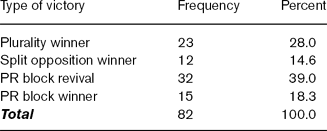
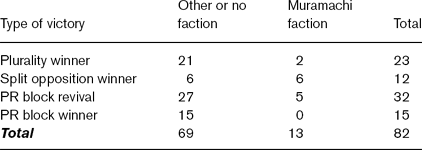
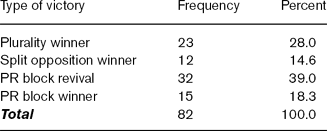
The key factor to be considered is how they won their seats (Table 4). In the elections to the Lower House of the Japanese parliament, seats are chosen either by a plurality in a single member constituency or from the party list in regional PR blocks based on party vote. Some candidates run in both the district and the regional block. Plurality winners were the strongest candidates because they won their single member district seats with a majority or clear plurality of the vote. On the other hand, there were some candidates which might be called ‘split opposition winners’ who won their district because the combined vote for the opposition (primarily the Democratic and Communist Parties) was larger, indicating that the seat was not entirely safe. Those who were PR block winners had lost their single member district seat but been ‘revived’ by their placement on the party list for proportional representation in one of the regional blocks. PR block winners only ran in the PR block lists. Given the swell of support for the LDP due to Koizumi's making it a referendum on reform, many more of the PR list candidates were elected than would normally have been anticipated.
Margin of victory
Source: Composed by the author using election results published at www.yomiuri.co.jp/election2005/.
Indeed, most of the LDP MPs newly elected in 2005 had seats that will be difficult to defend in more normal circumstances. Only about one-third (28%) won their seats with a substantial majority or clear plurality. A little less than 15% were able to win because the opposition vote was split between the Democratic Party and Communist Party. These tended to be urban seats, which the LDP had found difficult to win in the past. Even without opposition party cooperation to run a joint candidate, which is unlikely, this result indicates a narrow margin of victory. Similarly, only a small number of those who won as PR revival or PR block candidates would be expected to win in a normal election with the numbers falling further when the LDP lost popularity.
It is possible that the prospects for these MPs in future elections could have been enhanced by their rapid career advancement in the government. Indeed, it could be suspected that the promise of a good post in government helped to convince some of the more prominent candidates to run and success in these posts could have enhanced their future electoral prospects. For example, the academic Inoguchi Kuniko was given a cabinet post immediately after she was elected, which is extremely rare for a first term MP. Katayama Satsuki, a newly elected MP and a top career civil servant, was made vice minister for Economy and Industry in the last Koizumi cabinet. Similarly, Tsuchiya, the leader of the group of new MPs, was given a vice-ministerial post in the Abe cabinet even though he was only a freshman MP. These rewards of early advancement for members of the group were implicitly or explicitly the price paid to convince them to run for office at relatively short notice.
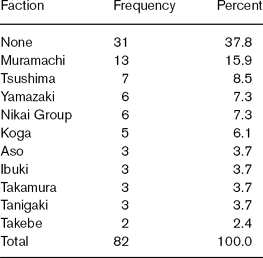
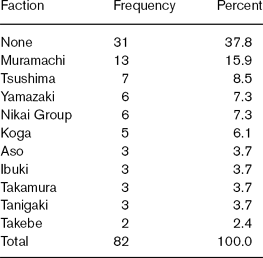
The traditional means for MPs to obtain electoral support and posts in government has been factions and from the beginning some of the new MPs joined factions despite pressure from the party executive, particularly Koizumi and Takebe, not to do so. It is not surprising that the factions were able to recruit some of the new MPs as candidates since they would have normally been expected to do so. Moreover, most of the members of the 83 Association drifted into factions, despite the fact that the party executive had tried to provide the socialization and information needed for the new MPs. This is demonstrated in the data in Table 5.
Factional affiliation of first-term MPs elected in 2005
Source: Composed by the author collating various sources (including Jimintō Tōnai Habatsubetsu Shōzoku Giin Ichiran, http://home.a07.itscom.net/kazoo/seizi/seizi.htm (12 February 2006 version) and Jimintō/Habatsu Meibō 2007 [Shūgiingiin], www.geocities.com/jiminlist/shuin.htm (accessed 26 February 2007) and where possible confirmed by official MP websites.
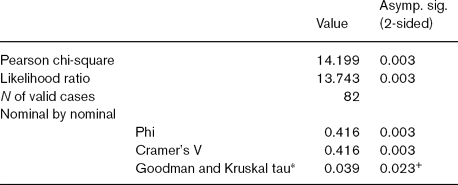
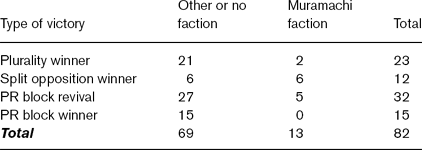
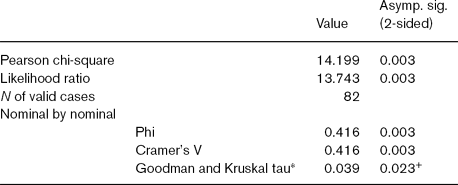
The dominant faction among the first term MPs, the Muramachi faction, is the faction to which Koizumi belonged – a large number elected to what is effectively the ruling faction is what one might expect when a senior member of the faction is in power. Significantly, the faction historically has strong right-wing ideological tendencies among its members. However, the more important point to be made about the first term Muramachi faction members is that they were significantly more likely than any other faction member or non-faction member to be from districts in which the threat from the combined Democratic and Communist Party vote was greater indicating a slim majority (see Table 6). Statistical tests indicate this distribution is unusual and suggests a significant relationship between affiliation with the Muramachi faction and marginal urban seats (Table 7).
Margin of victory and factional affiliation
Source: Composed by the author using data from Table 2 and election statistics published at www.yomiuri.co.jp/election2005/.
Statistical tests
Notes: * Based on ‘margin of victory’ as the dependent variable.
+ Based on chi-square approximation.
Candidacy type and tendency to be a faction member
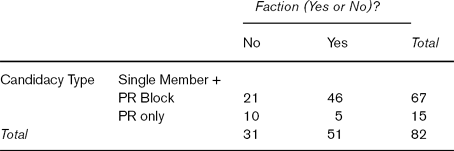
Source: Composed by the author from data in Table 2 and election data published at www.yomiuri.co.jp/election2005/.
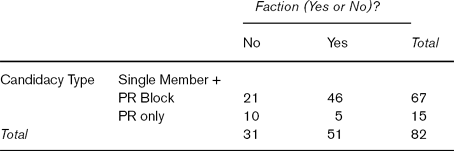
The pattern of those with no factional affiliation is also revealing. Those who remained out of factions have generally been civil servants or those elected on the PR block list where they were more likely to have been selected by the party than by a faction which would have more influence over candidate recruitment in local districts.
As membership in factions increased, the idea that the new MPs could remain outside of factions became less tenable. By late December 2006, even Takebe felt compelled to form a group ‘New Wind’ which looked suspiciously like a faction. The group included 21 of the Koizumi children and two two-term MPs. However, it might also be viewed as a cross-factional group because even though most were not members of a faction, a few were members of the Yamazaki faction, of which Takebe originally was a member, or the Tsushima faction and Koga faction (www.asahi.com, 20 December 2006). The impetus for the group was the sense of betrayal felt by some of the no-faction MPs when some former LDP candidates, who had run against the party in the 2005 election (for which the new MPs were specifically recruited), were allowed to return to the party. Even though they had encouraged the new MPs not to join a faction, now it seemed as if the factions were once again strong enough to readmit MPs who had been expelled under Koizumi.
Nonetheless, one of the members insisted that the Takebe group ‘New Wind’ was not a faction because there were no-faction fees as in a normal faction nor were their quotas for fundraising and recruitment of supporters (Yasui, 2007). Some of the members were also reportedly members of factions. Takebe's own website suggested that the group is an attempt to keep the spirit of the next generation alive by insisting that, with a bit more perseverance, they will succeed (Takebe, Reference Takebe2006).
Regardless of whether or not it was a faction, the formation of the Takebe group was recognition of the failure of the Koizumi children to act as a coherent political group within the LDP. On the 25 February 2007, the 83 Association effectively went dormant. One member of the group, Moriyama Masahito, who joined a faction only days before the group went dormant was reported to have commented that under the Koizumi administration the party executive took care of the new MPs but the new party leadership has left them with no choice but to seek the assistance of factions (www.yomiuri.com 25 February 2007). The formation of the Takebe group merely confirmed the failure of the 83 Association and the inability of the party executive to keep new MPs out of factions.
In contrast, there was one form of organization, explicitly ideological, created by the 2005 cohort of first term MPs which not only survived but appeared to thrive. The Tradition and Imagination Association (Dentō to Sōzō no Kai) is ‘study group’ composed entirely of Koizumi children with a clear ideological agenda and a membership which cuts across factional lines. It seemed to be the most viable of the new groups emerging in the new internal politics of the LDP at the time. It was founded by Inaba Tomomi who is Chair of the group. The members considering themselves ‘True Conservatives’ (shinsei hoshu) formed the group on 11 February 2006 on the 2666th anniversary of the founding of Japan by the legendary first emperor Jimmu Tennō. At its inauguration, there were 34 MPs in attendance and reports in early 2007 put the number of members at 41 or nearly half of the membership of the old 83 Association (Sonoura, 2006). Not all members publicly advertise their affiliation but many do and participate actively in the activities of the group.
Thus, the pure no-faction alternative to LDP internal management failed even for the new MPs who were most likely to be managed by the party rather than by factions given the methods by which they were recruited and/or inducted into the party. Cross-factional ideological groups involving these same MPs seemed to be more of a success at least initially. Thus, trends in ideological organization as one alternative to factions should be kept in mind as we examine one other model of generational change in the LDP which is also cross factional but involves a variety of groups, ideological and purposive, constituting loose alliances organized independently of the party executive and the formal structures of the party.
A second (less obvious) model of generational change
This ideological tendency in the leadership of the LDP should be contrasted to a parallel phenomenon of non-ideological cross-factional and even cross-party alliances. The most notable of these was so-called ‘Seisaku Shinjinrui’ or Policy New Humans, particularly Ishihara Nobuteru of the LDP and Edano Yukio of the Democratic Party whose very name implied a challenge to existing political practice. Ishihara also played a prominent role in the formation of Association to Make Tomorrow (Ashita wo Tsukuru Kai) in July 2000. The Tomorrow Association was cross-factional although it did contain a large number of members of the faction of Kato Koichi, and when Kato's attempt to unseat Prime Minister Mori in November 2000 failed, the group waned. Nonetheless, the group had some notable features which suggest a pattern with similar groups. First of all, the leaders of the group were primarily second generation politicians (Kono Tarō, Watanabe Yoshimi, Ishihara Nobuteru, and Shiozaki Yasuhisa). This leadership, like the membership, also crossed traditional factional boundaries appearing to be similar to the YKK group. Nonetheless, as in most cases of cross-factional groupings, there is a bias toward one faction or set of factions, with others excluded.
Many of the individuals involved in the Tomorrow Association resurfaced in two smaller scale groupings. The first was the Four Horsemen of the Apocalypse (Yonki no Kai) which was composed of Nemoto Takumi, Ishihara Nobuteru, Shiozaki Yasuhisa, and Watanabe Yoshimi who attempted to cut across factions in order to support party reform efforts (Fukushima Minpo, 19 March 2000). The group evolved to incorporate Abe Shinzō and was termed the NAIS association (NAIS no Kai) based on the names of Nemoto, Abe, Ishihara, and Shiozaki. These alliances of a small number of junior or middle-ranking politicians were autonomous from faction, with their own power bases.
These groups appeared to culminate in the ‘Association to Create a New Generation Prime Minister’ (Shin Seidai Sōri wo Tsukuru Kai). The group formed on 3 October 2003 after the re-election of Koizumi as prime minister in September. It claimed its purpose was to support the Koizumi reform program during his three-year term as leader of the party, but it also argued it was necessary to promote a new generation of politicians with the sensibilities and communication skills who were not bound by the existing interests or the old political culture to carry the reform movement forward in the future and create a vision of new Japan. The group was led by Ishihara Nobuteru and started with 15 members, most notably Shiozaki Yasuhisa, Nemoto Takumi, and Kōno Tarō. It eventually grew to include 24 junior and middle-ranking MPs. Three important non-members were Abe Shinzō, Watanabe Yoshimi, and Noda Seiko.
The first problem for the group was to raise the funds for various activities, including conferences, town meetings with the public, a touring campaign car, and websites. Unlike factions, they had no membership fees or other sources of funding. In fact, the group expressly opposed factionalism. One of their slogans was ‘From Factions to the New Generation’. In the end, the organization was primarily a series of meetings involving group members and with speeches given by prominent party leaders sympathetic to their cause. The political views were not unified but they did make the distinction between the Minzoku-ha, who they associated with veteran politicians (the old generation) such as Mori Yoshirō and Shizuka Kamei and who were opposed to opening Japan to foreign companies, and ‘Internationalists’, who were common among the ranks of junior MPs and included prominent members of the group, such as Shiozaki and Kōno Tarō. They argued that such a distinction was a key to overcoming the hold of factions on the party (www.nikkei.co.jp, 9 April 2005). On 2 November 2006, the group was formally dissolved because with the election of Abe Shinzō the original objective of the group was achieved (Kobayashi, Reference Kobayashi2006). It is probably impossible to objectively determine the impact of the ‘Association to Create a New Generation Prime Minister’, though given the range of MPs involved and their subsequent success in obtaining greater influence in the LDP, one could suggest that the group had some influence over the course of events.
Finally, there were two other groups which provide evidence of the character of new bases of support for the Abe premiership as non-factional. The two groups are the Non-Faction New MP Association (Muhabatsu Shinjin Giin no Kai) and the Rechallenge MP Support Alliance (Saicharenji Shien Giin Renmei). These two groups demonstrate the extent to which new and unaffiliated MPs tipped the balance in favor of Abe in a way that is different from previous factional politics, though faction still plays a role.
The first group that indicated support for Abe among first-term MPs without factional affiliation was the New Politics Study Group (Shin Seiji Kenkyukai) formed on 19 April 2006, which had interest from 54 of the first-term MPs and 23 of them attended the first meeting. Abe Shinzō was the group's tutor and it was widely viewed as part of his strategy for gaining support in the upcoming LDP presidential election (Seiron editor, 2006). The key group in this process was the Non-Faction New MP Association run by the first term LDP MP Ono Jirō with 37 members. It has tried to maintain the no-faction affiliation of the first term LDP MPs independently of other initiatives. However, during the LDP presidential election of 2006, it quickly gave its support to Abe Shinzō as the best candidate to continue with party and economic reform. However, one attractive aspect of the Abe approach to economic reform was his notion that free competition must include the opportunity for anyone to have a fair chance to compete even if it takes more than one attempt (www.yomiuri.com, 24 August 2006). A similar group of first term MPs led by Nagashima Tadayoshi, specifically formed to support Abe for LDP president (Ikkisei in yoru Abe Shinzō wo Gekireisuru Kai), was also convened on the 29 August 2006 – most of the first term MPs, including nearly all non-faction MPs, met with Abe prior to his election. It was clear that most of ‘Koizumi's children’ were supporting the Abe candidacy (www.yomiuri.com, 30 August 2006).
The support of first-term MPs, particular those without a factional affiliation was part of a larger cross-faction strategy used by Abe to build support. The overall group he formed for this purpose was the LDP Re-Challenge Support MP Alliance. The concept of ‘rechallenge’ or saicharenji was proposed by Abe as a principle of promoting a second chance to those who failed in employment or education. The ideological emphasis was on a form of self-help liberalism with a limited second chance safety net. This is hardly radical free market liberalism, but contrasts distinctly with the paternalism and patronage approach of the LDP in the past. At the outset of his administration, Abe created a special minister for Rechallenge as minister of state with a portfolio the Re-Challenge MP Support Alliance which was the forerunner of this initiative.
The group was formed by Yamamoto Yūji upon the request of Abe Shinzō in March 2006 who wanted to organize the support of the junior ‘wakate’ MPs (Mainichi Shinbun (Tokyo edition), 11 July 2006). Yamamoto was a six times veteran MP and was from the Takamura faction and not the faction to which Abe belonged, the Mori faction. The group was formally launched on the 2 June 2006 as an Abe support group including both middle-ranking (chūken) and junior (wakate) MPs. The specific objective of the group as a means of replacing factional power as decisive in the LDP was announced by Abe himself (www.asahi.com, 4 September 2006). There was some concern within the Mori faction about these developments when a group of 13 middle ranking and junior MPs from most factions (except the smaller Tanigaki, Kōno and Nikai factions) and representatives of no-faction MPs met to discuss election strategy for Abe in opposition to existing factional politics in the LDP (Mainichi Shinbun [Tokyo edition], 17 August 2006). Defections and splits within the Hashimoto faction suggested that there was a real danger from the new trends to the coherence of factions (TBS News, 10 September 2003).
Statistical test of types of organization: ideological, cross-factional, interest based
One can be suspicious of the degree to which these developments are significant, especially in ideological terms. Even though Abe attracted a good deal of support from junior faction MPs who refused to join a faction, and Abe himself has strong right-wing views and background, it does not follow that the groups supporting him are similarly right-wing. It is noticeable that most of the members of the Tradition and Creative Association did NOT join the Rechallenge Alliance. It has even been alleged that the Rechallenge MPs were simply interested in promoting their careers by association with Abe (Mainichi Shinbun [Tokyo edition], 11 July 2006). In short, the new group could perform part of the functions, such as securing posts in the party and government, formerly the remit of factions and in that sense are faction-like.
Nonetheless, there is certainly a new degree of fluidity in factions as they increase again in number, and non-affiliated MPs of various types seem to persist. Groups and alliances clearly can cut across factional lines and have an influence, perhaps an increasing influence on internal LDP politics. These manifest themselves as openly ideological or at least pro-reform. The net effect is to weaken the non-ideological dynamic of the old factional politics and introduce more opportunities for ideology to make a difference.
The impact of ideology can be seen most clearly in the fate of ‘Koizumi's children’ in the general election of 2009. The MPs in this cohort had swept into parliament on a wave of reformist fever and the popularity of then Prime Minister Koizumi. However, Koizumi's successors, Abe Shinzō and Fukuda Yasuo, were unpopular and quit only one year after assuming power. Their successor, Asō Tarō, was also unpopular but was forced to call an election in the late summer 2009. The opposition Democratic Party of Japan was increasingly popular and looked set to win power easily. In this context, it is not surprising that several of Koizumi's children announced they would step down as MPs and that most that stood for re-election for the LDP, 63 out of 71 lost their seats.
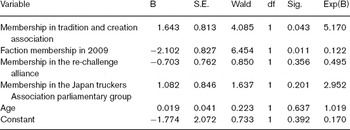
Test of five key variables as factors in electoral success of ‘Koizumi's Children’ in the Japanese general election of 2009

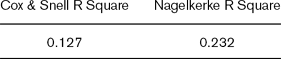
Explanatory power of logistic regression model in table 6
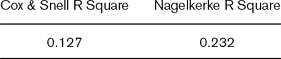
The most interesting point is that it was those candidates who were the member of a right-wing group or were not affiliated with any faction that were most successful in gaining election. Table 6 displays a logistic regression analysis of five factors with the potential to explain the electoral outcomes of Koizumi's children in the 2009 election: factional affiliation, membership in the right-wing Tradition and Creation Association, membership in Abe's Re-Challenge Alliance, membership in the Truckers Association, and the age of the candidate.
Only factional affiliation and membership in the right-wing group were significant correlates with election success. As one would expect, if factions were becoming less important, there was a negative relationship between membership in a faction and election success, that is non-faction members did better than members of a faction. This is particularly important because three-quarters of Koizumi's children had joined a faction by 2009, but it did not help them electorally. On the other hand, it appears as if the strong ideological stance of those members of the right-wing group helped to mobilize their supporters despite the overall decline of support for the LDP. Anedotal evidence suggests that neo-liberalism, the other potential ideological pillar of Koizumi's children, actually seemed to undermine their chances for re-election (Inoue, Reference Inoue2009).
In contrast, there was no significant relationship between membership in one typical interest group association, the Japan Truckers Association, and re-election success. Membership in this group was included because it had widespread membership in the cohort and is typical of the interest group links that traditionally have been associated with electoral success. In this context, it is interesting to note that there was no overlap between the members of the right-wing group and the Trucker's Association which reinforces the argument that traditional interest-based non-ideological support for the LDP is less important than ideologically based support groups. In short, the non-ideological interest-based factional politics of the LDP is weakening and ideology is now more important for this new generation of MPs.
Conclusions about the changing boundaries of Japanese conservatism
As others have argued (Krauss and Pekkanen, Reference Krauss and Pekkanen2011), factions will not likely disappear in the near future but this chapter adds to the growing evidence that factions are playing less of a role in Japanese conservative politics than they did in the past. The problem is that the alternative to factionalism might be greater emphasis on ideology. One might ask which would be the greater evil: consensual closed-door factional politics or open divisive ideological politics? Of course, the alternatives are not likely to be so stark but the potential re-emergence of ideology does raise some important issues.
The axes upon which debate on the right-wing conservatives unfolds has logic and complexity which are worth exploring further. It is significant that the ‘Association to Create a New Generation Prime Minister’ made a distinction between the Minzoku-ha, which is traditionally associated with the New Right, and Internationalists which they portrayed as more free market in orientation. It is doubtful if the New Right were ever ideologically dominant in the LDP, but debates over whether or not to pursue neo-liberal market reforms (with the keywords often ‘winners and losers’ or kachigumi/makegumi) are often part of a set of disagreements within conservatism in Japan and represent distinct forms and combinations. Abe's concept of rechallenge was part of the attempted shift to a more free market approach. Again, it will be important to see how conservatives believe others should be treated in this context.
The best that can be said is that there is no consistency or coherence to the views of the conservative right in Japan and one must be sensitive to the range and the dynamics of debates. It is not enough to tar all these views as simply right-wing. Even if ideology appears to play more of a role and factions are weaker, factions will not disappear. At the same time, the internal politics of the LDP is more fluid and more open to non-factional groups playing a role. This is likely to be driven by ideology with the mass media as well as support groups playing a key role. As for the new generation of politicians themselves, the general election in 2009 was the end of the political careers of many of Koizumi's children but a large number are still active and planning to run again. If their ideological stance is perceived as helpful or unhelpful in survival, then this may have an impact on ideological trends in the LDP.
The point is that party politics in Japan is more fluid or volatile as Reed et al. (Reference Reed, Scheiner and Thies2009: 8) suggest. At the same time, Japanese conservatives are, not surprisingly, conservative and the right-wing nationalist variety continues to play a major role in defining the terms of debate. This all suggests that it is not a question of whether or not the new generation of Japanese conservatives will tend to the right but what kind of right-wing tendencies will emerge?
About the author
Dr James Babb is Senior Lecturer in Politics at the University of Newcastle-upon-Tyne. He is the author of Tanaka and the Making of Post-war Japan and Business and Politics in Japan. He was a visiting professor at the Ohara Social Research Institute of Hosei University in Tokyo. He is currently editing the Sage Handbook of Modern Japanese Studies and writing a series of articles on the evolution of Japanese conservatism.