Introduction
Christensen et al. (Reference Christensen, Kyvik and Kessing2006) investigated cognitive function in healthy twins discordant for bipolar disorder and found evidence for an association between cognitive dysfunction and genetic liability. The authors concluded that cognitive dysfunction may be a candidate indicator of genetic risk or endophenotype (Gottesman & Gould, Reference Gottesman and Gould2003) for bipolar disorder. Thus, there is evidence that cognitive dysfunction persists in euthymic bipolar patients (Savitz et al. Reference Savitz, Solms and Ramesar2005a; Robinson et al. Reference Robinson, Thompson, Gallagher, Goswami, Young, Ferrier and Moore2006) and also non-twin genetically sensitive studies suggest that aspects of cognition can possibly be regarded as endophenotypes for bipolar disorder (Glahn et al. Reference Glahn, Bearden, Niendam and Escamilla2004; Savitz et al. Reference Savitz, Solms and Ramesar2005b; Hasler et al. Reference Hasler, Drevets, Gould, Gottesman and Manji2006). Possible candidate neurocognitive endophenotypes in bipolar disorder are executive function (Glahn et al. Reference Glahn, Bearden, Niendam and Escamilla2004; Savitz et al. Reference Savitz, Solms and Ramesar2005b), attention (Burdick et al. Reference Burdick, Goldberg, Harrow, Faull and Malhotra2006; Hasler et al. Reference Hasler, Drevets, Gould, Gottesman and Manji2006) and verbal memory (Glahn et al. Reference Glahn, Bearden, Niendam and Escamilla2004; Hasler et al. Reference Hasler, Drevets, Gould, Gottesman and Manji2006). A recent meta-analysis of cognitive deficits in euthymic bipolar patients (Robinson et al. Reference Robinson, Thompson, Gallagher, Goswami, Young, Ferrier and Moore2006) provides further evidence for executive function and verbal learning as possible endophenotypes for bipolar disorder.
The aim of the present review was to estimate the meta-analytical effect size of cognitive functioning in euthymic bipolar patients and their first-degree relatives, thus updating a previous systematic review of patients (Robinson et al. Reference Robinson, Thompson, Gallagher, Goswami, Young, Ferrier and Moore2006), and adding a new review for first-degree relatives. The hypothesis was that first-degree relatives show cognitive deficits in the same areas as bipolar patients, albeit to a lesser degree.
Methods
Study selection
Articles were identified through a literature search in PubMed/Medline, PsycINFO and EMBASE covering the period between January 1985 and September 2006, using the keywords ‘bipolar disorder’ or ‘manic depress*’ and ‘family’/‘familial’ or ‘first-degree relative’ with ‘cognit*’ or ‘neuropsych*’.
The following criteria were used for inclusion: (i) the study evaluated cognitive performance using standardized and reliable neuropsychological testing procedures; (ii) the study compared adult asymptomatic bipolar patients who were diagnosed using a recognized criterion-based diagnostic system and/or first-degree relatives with a healthy control group, matched for age, sex and education; (iii) the study reported uncorrected mean test scores and standard deviations for both the patient and/or family and control group; (iv) the study was published as an original article in a peer-reviewed English language journal; and (v) the study with bipolar patients clearly defined euthymia or provided scores on mood rating scales indicating that patients were euthymic (euthymia defined as a cut-off score of <8 on the Hamilton Depression Rating Scale and the Young Mania Rating Scale, and/or a score on mood rating scales below this cut-off point).
The references of retrieved articles were hand-searched for further relevant articles. A second study on the same patient group was only included if it reported different tests.
Data analysis
Meta-analyses were performed using stata (version 9.2; StataCorp, College Station, TX, USA), using a random effects model. For each test parameter an effect size was calculated, which was Cohen's d, the difference between the means of both groups (bipolar patients and/or first-degree relatives v. controls) divided by the pooled standard deviation. Effect sizes were weighted for sample size, in order to correct for upwardly biased estimation of the effect in small samples. Effect sizes were expressed in such a way that positive effect sizes always indicated poorer performance by the patient or family group. The corresponding z value and significance level provide an indication of the two-sided statistical significance of the association at 5% α. A homogeneity statistic was calculated in order to test to what degree the studies can be taken to share a common population effect size. A significant χ2 statistic indicated heterogeneity of the individual effect sizes.
Meta-regression is a technique for trying to work out whether particular characteristics of studies are related to the sizes of the treatment effect. Thus, in the case of significant heterogeneity, meta-regression, using stata (version 9.2; StataCorp), was performed in order to examine whether any heterogeneity found could possibly be explained by study differences in age structure, sex ratio and mean educational level.
Results
Bipolar patients
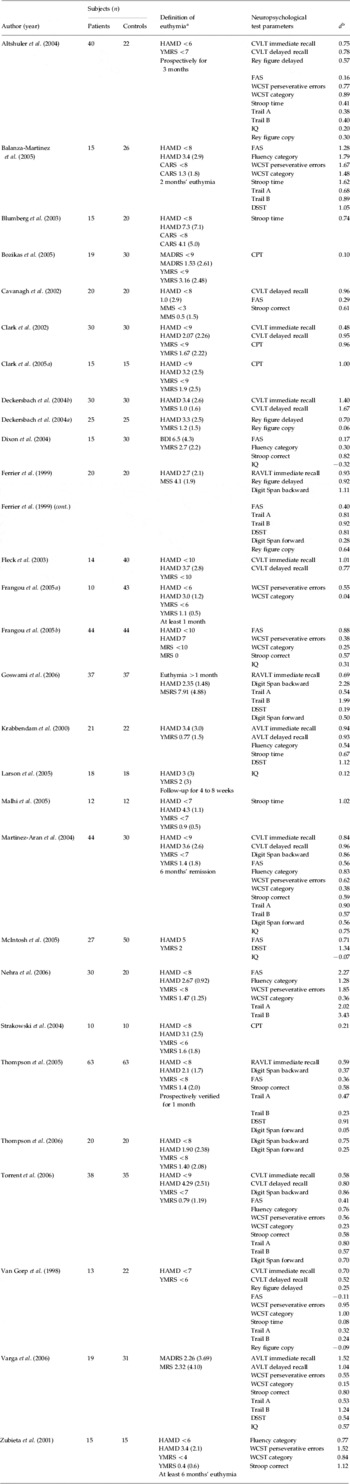
Twenty-eight studies were included in the meta-analysis (Table 1). Four of these stratified their samples by a third variable (van Gorp et al. Reference van Gorp, Altshuler, Theberge, Wilkins and Dixon1998; Ferrier et al. Reference Ferrier, Stanton, Kelly and Scott1999; Nehra et al. Reference Nehra, Chakrabarti, Pradhan and Khehra2006; Torrent et al. Reference Torrent, Martinez-Aran, Daban, Sanchez-Moreno, Comes, Goikolea, Salamero and Vieta2006). For reasons of homogeneity, in the case of stratification, only one study group was included, with bias to the less severe patients or those with a better-established diagnosis. Thus, Ferrier et al. (Reference Ferrier, Stanton, Kelly and Scott1999) stratified by outcome, contrasting a good outcome versus a poor outcome group; for the purpose of the current meta-analysis only the good outcome group was included. The study by Nehra et al. (Reference Nehra, Chakrabarti, Pradhan and Khehra2006) used first- and multiple-episode patients; only established bipolar patients with multiple episodes were included in the current analysis. Van Gorp et al. (Reference van Gorp, Altshuler, Theberge, Wilkins and Dixon1998) included patients with and without prior alcohol dependence; only the group without alcohol dependence was used in the analysis. Finally, Torrent et al. (Reference Torrent, Martinez-Aran, Daban, Sanchez-Moreno, Comes, Goikolea, Salamero and Vieta2006) used bipolar I and bipolar II patients; only bipolar I patients were included.
Studies with bipolar patients included in the meta-analysis

HAMD, Hamilton Depression Rating Scale; CVLT, California Verbal Learning Test; YMRS, Young Mania Rating Scale; FAS, verbal fluency test; WCST, Wisconsin Card Sorting Test; IQ, intelligence quotient; CARS, Clinician Administered Rating Scale for Mania; DSST, Digit Symbol Substitution Test; MADRS, Montgomery–Asberg Depressive Rating Scale; CPT, Continuous Performance Test; MMS, Modified Manic Scale; BDI, Beck Depression Inventory; RAVLT, Rey Auditory Verbal Learning Test; MSS, Manic State Scale; MRS, Manic Rating Scale; MSRS, Manic State Rating Scale; AVLT, Auditory Verbal Learning Test.
a Values in parentheses are standard deviations.
b Effect size; positive values indicate better performance in controls.
Neuropsychological domains
The neuropsychological tests used in these studies were divided into 11 categories measuring approximately the same cognitive construct (adapted from Krabbendam et al. Reference Krabbendam, Arts, van Os and Aleman2005). A neuropsychological test was included by the a priori criterion of having been used in at least four different studies. Immediate verbal memory was assessed using word list learning [California Verbal Learning Test (CVLT; Delis et al. Reference Delis, Kramer, Kaplan and Ober1987); Rey Auditory Verbal Learning Test (RAVLT; Rey, Reference Rey1964); Auditory Verbal Learning Test (AVLT; Brand & Jolles, Reference Brand and Jolles1985)]. For the purposes of the analysis, results of these comparable tests were included together. Delayed verbal memory was assessed using the delayed recall version of the CVLT, RAVLT and AVLT. Delayed visual memory was measured using the delayed recall version of the Rey Osterrieth Complex Figure (Rey, Reference Rey1941). Working memory was assessed using the Digit Span (Wechsler, Reference Wechsler1955). Verbal fluency was measured using either words from a certain category or beginning with a certain letter (verbal fluency test; FAS) (Benton, Reference Benton and Hamsher1978). Concept formation and shifting was assessed with the Wisconsin Card Sorting Test (WCST; Heaton, Reference Heaton1981); number of perseverative errors and categories achieved were separately analysed. Executive control was measured using the Stroop Color-Word interference (Stroop, Reference Stroop1935) and Trailmaking Test part B (Reitan, Reference Reitan1958). Sustained attention was assessed using a variant of the Continuous Performance Test (CPT; Kurtz, Reference Kurtz, Ragland, Bilker, Gur and Gur2001). The test parameter used was number and/or percentage correct response. Mental speed was measured using the Digit Symbol Substitution Test (DSST; Wechsler, Reference Wechsler1955) and the Trailmaking Test part A (Reitan, Reference Reitan1958). Visuoperception was assessed using the copy version of the Rey Osterrieth Complex Figure (Rey, Reference Rey1941). Intelligence was measured using the full-scale National Adult Reading Test (Grober & Sliwinski, Reference Grober and Sliwinski1991) or the revised Wechsler Adult Intelligence Scale vocabulary score (Wechsler, Reference Wechsler1981), both good estimates of premorbid intelligence.
Meta-analytical results: patients
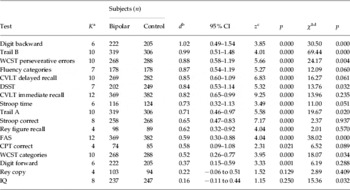
All effect sizes were in the same direction (Table 2), suggesting worse performance in euthymic bipolar patients compared with healthy controls.
Results of meta-analyses of cognitive test performance differences between bipolar patients versus normal controls

CI, Confidence interval; WCST, Wisconsin Card Sorting Test; CVLT, California Verbal Learning Test; DSST, Digit Symbol Substitution Test; FAS, verbal fluency test; CPT, Continuous Performance Test; IQ, intelligence quotient.
a Number of studies included in the analysis.
b Mean, weighted effect size Cohen's d.
c Test of significance of effect size (p).
d Test of within-category heterogeneity between studies (p).
In all instances, with the exception of visuoconstruction (Rey copy) and intelligence, bipolar patients displayed significantly poorer performance compared with controls. The largest effect sizes were evident for working memory (Digit Span backward), executive control (Trail B), concept shifting (WCST perseverative errors), fluency (categories), delayed and immediate verbal recall (CVLT) and mental speed (DSST) (effect sizes >0.8). Medium effect sizes (0.5<d<0.8) were observed for executive control (Stroop), mental speed (Trail A), delayed visual memory (Rey figure), fluency (FAS), sustained attention (CPT) and concept shifting (WCST categories). A small effect size (0.2<d<0.5) was noted for visuoperception (Rey copy) and working memory (Digit Span forward).
For eight out of 17 analyses there was evidence for significant heterogeneity between the results of the different studies. The largest heterogeneity was found for working memory (Digit Span backward), concept shifting (WCST perseverative errors), executive control (Trail B) and fluency (FAS). Three studies were largely responsible for this heterogeneity, namely the studies of Balanza-Martinez et al. (Reference Balanza-Martinez, Tabares-Seisdebos, Selva-Vera, Martinez-Aran, Torrent, Salazar-Fraile, Leal-Cerbos, Vieta and Gomez-Beneyto2005), Goswami et al. (Reference Goswami, Sharma, Khastigir, Ferrier, Young, Gallagher, Thompson and Moore2006) and Nehra et al. (Reference Nehra, Chakrabarti, Pradhan and Khehra2006). All showed larger effect sizes. In a sensitivity analysis of working memory (Digit Span backward) excluding the study of Goswami et al. (Reference Goswami, Sharma, Khastigir, Ferrier, Young, Gallagher, Thompson and Moore2006), the observed heterogeneity largely disappeared (before exclusion: χ2=30.50, p=0.000; after exclusion: χ2=5.70, p=0.223). The effect size reflecting bipolar–control differences remained significant (d=0.73, p=0.000). The studies by Goswami et al. (Reference Goswami, Sharma, Khastigir, Ferrier, Young, Gallagher, Thompson and Moore2006) and Nehra et al. (Reference Nehra, Chakrabarti, Pradhan and Khehra2006) caused most of the heterogeneity in the analysis on executive control (Trail B). Leaving these studies out resulted in non-significant heterogeneity (before exclusion: χ2=69.44, p=0.000; after exclusion: χ2=10.54, p=0.160), with significant bipolar–control effect size after exclusion (d=0.57, p=0.000). In the case of concept shifting (WCST perseverative errors), heterogeneity was largely caused by the studies of Balanza-Martinez et al. (Reference Balanza-Martinez, Tabares-Seisdebos, Selva-Vera, Martinez-Aran, Torrent, Salazar-Fraile, Leal-Cerbos, Vieta and Gomez-Beneyto2005) and Nehra et al. (Reference Nehra, Chakrabarti, Pradhan and Khehra2006) (before exclusion: χ2=24.17, p=0.004; after exclusion: χ2=7.05, p=0.424) (bipolar–control effect size after exclusion: d=0.64, p=0.000). Finally, heterogeneity in the analysis on fluency (FAS) was mostly due to the same two studies (before exclusion: χ2=38.02, p=0.000; after exclusion: χ2=10.11, p=0.342; bipolar–control effect size after exclusion: d=0.43, p=0.000). The fact that the most significant heterogeneity was due to only three studies suggests that certain characteristics of these studies may be responsible for this finding. The study by Balanza-Martinez et al. (Reference Balanza-Martinez, Tabares-Seisdebos, Selva-Vera, Martinez-Aran, Torrent, Salazar-Fraile, Leal-Cerbos, Vieta and Gomez-Beneyto2005) was relatively small and used a bipolar population with rather low educational level and no specification of characteristics of disease (duration, number of episodes etc). One could speculate that they described a rather severely ill population. The same probably applies to the study by Nehra et al. (Reference Nehra, Chakrabarti, Pradhan and Khehra2006). Their population of patients had a relatively large number of psychotic episodes and all patients used both a mood stabilizer and an antipsychotic, possibly indicating a negative effect of medication on cognitive functioning. Goswami et al. (Reference Goswami, Sharma, Khastigir, Ferrier, Young, Gallagher, Thompson and Moore2006) used a rather young population with a relatively long duration of illness and early illness onset. This study also probably included a rather severely ill group of patients.
Meta-regression revealed a significant effect of sex ratio on the concept formation and shifting case–control difference (WCST) (p=0.001, B=−2.63, 95% CI −4.156 to −1.11). This finding indicates that studies with higher male/female ratios showed smaller effect sizes. Age had a significant effect on the case–control difference of concept formation (WCST) and working memory (Digit Span backward) (p=0.000, B=−32.51, 95% CI −43.6 to – 21.4; p=0.029, B=−11.18, 95% CI −21.2 to −1.18). Thus, studies with higher mean age showed smaller effect sizes. Finally, educational level had a significant effect on the working memory case–control difference (Digit Span backward), fluency (FAS) and concept formation (WCST) (p=0.03, B=−0.014, 95% CI −0.027 to −0.001; p=0.007, B=36.93, 95% CI 8.38–52.24; p=0.014, B=2.53; 95% CI 0.52–4.55). This points in the direction of larger effect sizes in studies with higher educated participants.
In conclusion, part of heterogeneity may be due to differences between the various studies in these independent variables.
Meta-analytical results: first-degree relatives
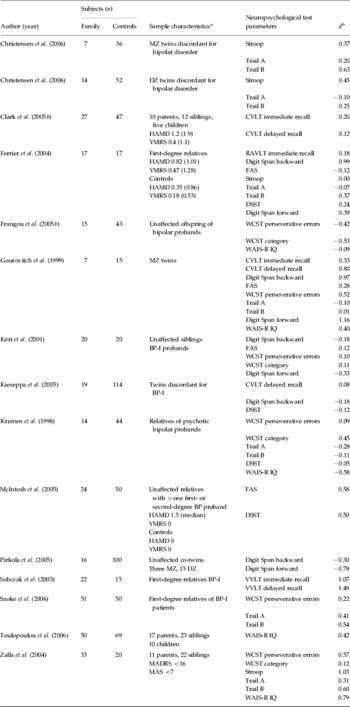
A total of fourteen studies were included (Table 3). Two of these studies used more than one family group (Sobczak et al. Reference Sobczak, Honig, Schmitt and Riedel2003; McIntosh et al. Reference McIntosh, Harrison, Forrester, Lawrie and Johnstone2005). In the study by McIntosh et al. (Reference McIntosh, Harrison, Forrester, Lawrie and Johnstone2005), a group of unaffected relatives from bipolar families and a group from ‘mixed’ families was used; only the group from bipolar families was included in the analyses. Sobczak et al. (Reference Sobczak, Honig, Schmitt and Riedel2003) used a group of first-degree relatives of bipolar I patients and a group of relatives of bipolar II patients; only the group of family-members of bipolar I patients was used in the meta-analysis.
Studies with first-degree family members included in the meta-analysis

MZ, Monozygotic; DZ, dizygotic; CVLT, California Verbal Learning Test; HAMD, Hamilton Depression Rating Scale; YMRS, Young Mania Rating Scale; RAVLT, Rey Auditory Verbal Learning Test; FAS, verbal fluency test; DSST, Digit Symbol Substitution Test; WCST, Wisconsin Card Sorting Test; WAIS-R IQ, Wechsler Adult Intelligence Scale Revised intelligence quotient; BP, bipolar; VVLT, Visual Verbal Learning Test; MADRS, Montgomery–Asberg Depressive Rating Scale; MAS, Beck–Rafaelsen Mania Scale.
a Values in parentheses are standard deviations.
b Effect size; positive values indicate better performance in controls.
The neuropsychological tests used in the studies were divided in the same categories as described earlier and included only if used in at least four different studies. This resulted in fewer cognitive domains analysed than in the bipolar studies. These domains were immediate and delayed verbal memory, working memory, concept formation and shifting, verbal fluency, executive control, mental speed, and intelligence. The Visual Verbal Learning Test used in the study by Sobczak et al. (Reference Sobczak, Honig, Schmitt and Riedel2003), measuring immediate and delayed verbal memory and resembling the CVLT and RAVLT (Lezak, Reference Lezak1995), was added to the analysis.
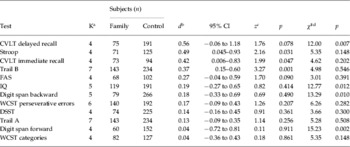
Meta-analysis of the neuropsychological domains indicated that all meta-analytical effect sizes were in the direction of worse performance in the first-degree relatives compared with the healthy controls (Table 4). Effect sizes, however, were much smaller than in the bipolar–control comparisons (<0.5), with the exception of delayed verbal memory (d=0.56), and only significantly different for executive control (Stroop and Trail B) and immediate verbal recall (CVLT).
Results of meta-analyses of cognitive test performance differences between first-degree relatives v. normal controls

CI, Confidence interval; CVLT, California Verbal Learning Test; FAS, verbal fluency test; IQ, intelligence quotient; WCST, Wisconsin Card Sorting Test; DSST, Digit Symbol Substitution Test.
a Number of studies included in the analysis.
b Mean, weighted effect size Cohen's d.
c Test of significance of effect size (p).
d Test of within-category heterogeneity between studies (p).
There was evidence of significant heterogeneity for four out of 12 analyses, namely for the domains of delayed verbal memory (CVLT), intelligence and working memory (Digit Span forward and backward). Thce greatest degree of heterogeneity was found in the same cognitive domains as in the patient group, with the exception of verbal memory. Heterogeneity may be due to the small number of studies with small, heterogeneous groups of first-degree relatives with different family histories and genetic load. The study by Gourovitch et al. (Reference Gourovitch, Torrey, Gold, Randolph, Weinberger and Goldberg1999), for example, using monozygotic twins, showed relatively large but differential effect sizes for working memory and verbal memory, contributing to heterogeneity.
Meta-regression revealed no significant effects of the independent variables examined.
Discussion
Patients
This meta-analysis of cognitive functioning in euthymic bipolar patients provides evidence of cognitive impairments in these patients, particularly in the realm of executive functioning and verbal memory. Large effect sizes were found for working memory, executive control, concept shifting, fluency, verbal recall and mental speed.
The finding of both executive and memory impairments has been described in the quantitative meta-analysis by Robinson et al. (Reference Robinson, Thompson, Gallagher, Goswami, Young, Ferrier and Moore2006), despite the fact that we used somewhat stricter inclusion criteria for euthymia and included more recent studies.
There was substantial heterogeneity between the results of the different studies, the largest heterogeneity being noted for working memory, concept shifting, executive control and fluency. Three studies (Balanza-Martinez Reference Balanza-Martinez, Tabares-Seisdebos, Selva-Vera, Martinez-Aran, Torrent, Salazar-Fraile, Leal-Cerbos, Vieta and Gomez-Beneyto2005; Goswami et al. Reference Goswami, Sharma, Khastigir, Ferrier, Young, Gallagher, Thompson and Moore2006; Nehra et al. Reference Nehra, Chakrabarti, Pradhan and Khehra2006) largely caused this heterogeneity, possibly because of inclusion of relatively severely ill patients with a higher number of (psychotic) episodes. Thus, greater number of episodes, greater length of illness and higher number of hospitalizations have been associated with greater level of neuropsychological dysfunction in bipolar patients (Robinson & Ferrier, Reference Robinson and Ferrier2006). Heterogeneity may also be caused by the differential effects of age, sex, and education on the cognitive domains mentioned above, as revealed by meta-regression.
Heterogeneity may additionally be caused by residual mood symptoms, because of the variation in the criteria used to define euthymia. It was not possible to include measures of mood as a variable for the meta-regression, however, as the studies included did not use, or did not report, uniformly measured items of mood. Another confounder is medication, the use and reporting of which varied between studies. The effects of different types of medication on cognitive function in bipolar patients are not systematically studied, but the effects of lithium may be rather modest, given the small effect size (d=0.3) in the study by Goswami et al. (Reference Goswami, Gulrajani, Moore, Varma, Young, Khastgir and Sharma2002). Furthermore, cognitive deficits are still evident in medication-free patients (Goswami Reference Goswami, Gulrajani, Moore, Varma, Young, Khastgir and Sharma2002; Strakowski et al. Reference Strakowski, Adler, Holland, Mills and DelBello2004). Another source of heterogeneity may be the type of bipolar disorder under investigation. Although most studies used bipolar I patients, not all studies specified the type of patients included. Bipolar I patients may show greater, and/or different, deficits in cognitive function than bipolar II patients (Harkavy-Friedman et al. Reference Harkavy-Friedman, Keilp, Grunebaum, Sher, Printz, Burke, Mann and Oquendo2006; Torrent et al. Reference Torrent, Martinez-Aran, Daban, Sanchez-Moreno, Comes, Goikolea, Salamero and Vieta2006). Matching on education versus IQ may be a confounder too, given the study by Glahn et al. (Reference Glahn, Bearden, Bowden and Soares2006), who describe less educational attainment despite comparable IQ levels in bipolar patients versus normal controls. Matching on educational attainment could thus give rise to underestimation of the difference in cognitive function between bipolar patients and normal controls. Finally, differences in somatic comorbidity (and comedication) between bipolar patients and normal controls could contribute to differences in cognitive performance (Newcomer, Reference Newcomer2006).
First-degree relatives
The meta-analysis in first-degree relatives showed worse performance in all cognitive domains studied, compared with controls. Effect sizes, however, were small, but significant in domains that also differentiated patients from controls: executive functioning and verbal memory. This suggests that these cognitive functions may be trait markers for the genetic liability for bipolar disorder. Heterogeneity between the results of the different studies may be due to the small number of studies with relatively small, heterogeneous groups of first-degree relatives with different family histories and genetic load. Contrary to the patient meta-analysis, meta-regression revealed no effects of sex, education and age on the meta-analytical effect size, suggesting more robust results and less sources for underlying heterogeneity.
The possible influence of family history as a source of heterogeneity is illustrated by the study by Schubert & McNeil (Reference Schubert and McNeil2005), who described greater cognitive impairment in offspring of mothers with schizophrenia-spectrum psychosis versus offspring of mothers with affective-spectrum psychosis. Furthermore, Sobczak et al. (Reference Sobczak, Honig, Schmitt and Riedel2003) found more pronounced cognitive impairments in first-degree relatives of bipolar I patients compared with relatives of bipolar II patients. Another possible source of heterogeneity is the fact that only a small number of studies controlled for subclinical mood symptoms in first-degree relatives and controls. Finally, only a small number of studies directly compared cognitive function between bipolar patients, first-degree relatives and healthy controls (Ferrier et al. Reference Ferrier, Chowdhury, Thompson, Watson and Young2004; Frangou et al. Reference Frangou, Donaldson, Hadjulis, Landau and Goldstein2005b; McIntosh et al. Reference McIntosh, Harrison, Forrester, Lawrie and Johnstone2005).
Our meta-analysis on cognitive function in first-degree relatives of bipolar patients is, to the best of our knowledge, the first in the literature. Comparison with other meta-analytical reviews is therefore only possible with first-degree relatives of other patient groups, for example patients with schizophrenia. Such a comparison is topical, given the fact that bipolar and schizophrenia phenotypes probably share genetic risk factors (Craddock et al. Reference Craddock, O'Donovan and Owen2006). Various meta-analyses of cognitive function in first-degree relatives of patients with a diagnosis of schizophrenia (Sitskoorn et al. Reference Sitskoorn, Aleman, Ebisch, Appels and Kahn2004; Szoke et al. Reference Szoke, Schurhoff, Mathieu, Meary, Ionescu and Leboyer2005; Snitz et al. Reference Snitz, Macdonald and Carter2006) describe the largest effect sizes (d=0.5 to 0.6) for executive functioning and verbal memory, with somewhat different effect sizes for different executive tests used and greater effect sizes in multiplex families (Heydebrand, Reference Heydebrand2006). This qualitative pattern of effects sizes and tests are rather similar to those presented here for the relatives of patients with bipolar disorder. In the review by Snitz et al. (Reference Snitz, Macdonald and Carter2006), the type of biological relative, parent, sibling or offspring did not impact on effect sizes of cognitive deficits in unaffected first-degree relatives of patients with a diagnosis of schizophrenia. Asymmetric psychiatric exclusion criteria and screening controls more stringently than relatives did influence the effect sizes in the review by Snitz et al. (Reference Snitz, Macdonald and Carter2006). Therefore, this source could also contribute to the heterogeneity observed in the current meta-analysis.
Heydebrand (Reference Heydebrand2006), reviewing meta-analyses on cognitive function in relatives of patients with a diagnosis of schizophrenia, concludes that the most consistent deficit shown by relatives is impaired performance on ‘maintenance plus’ frontal-lobe tasks, requiring increased effort and higher central executive processing. This cognitive phenotype therefore may be a likely candidate endophenotype for both schizophrenia and bipolar disorder. In this respect it may be important that memory performance is affected by executive dysfunction, as shown by shared variance of 50–60% (Duff et al. Reference Duff, Schoenberg, Scott and Adams2005). A quantitative review of cognitive functioning in patients with schizophrenia and bipolar disorder yielded largest (differences in) effect sizes on executive function and verbal memory, bipolar patients generally better performing than patients with schizophrenia (Krabbendam et al. Reference Krabbendam, Arts, van Os and Aleman2005). Important in this respect is the fact that there were only quantitative, and not qualitative, differences between bipolar patients and patients with a diagnosis of schizophrenia, which fits in with current models of the relationship between both disorders. Murray et al. (Reference Murray, Sham, Van Os, Zanelli, Cannon and McDonald2004) hypothesize that certain shared susceptibility genes may predispose individuals to psychosis in general. A candidate gene may be neuregulin 1, which influences susceptibility to bipolar disorder and schizophrenia, especially in bipolar patients with mood-incongruent psychotic features and patients with a diagnosis of schizophrenia with mania (Green et al. Reference Green, Raybould, Macgregor, Gordon-Smith, Heron, Hyde, Grozeva, Hamshere, Williams, Owen, O'Donovan, Jones, Jones, Kirov and Craddock2005). Polymorphisms of neuregulin, influencing, amongst others, synaptic signalling by glutamate receptors, play possibly a role in cognition (Schillo et al. Reference Schillo, Pejovic, Hunzinger, Hansen, Poznanovic, Kriegsmann, Schmidt and Schrattenholz2005; Harrison & Law Reference Harrison and Law2006; Scolnick et al. Reference Scolnick, Petryshen and Sklar2006). Other candidate genes in this respect are Disc 1 (Cannon et al. Reference Cannon, Hennah, van Erp, Thompson, Lonnqvist, Huttunen, Gasperoni, Tuulio-Henriksson, Pirkola, Toga, Kaprio, Mazziotta and Peltonen2005; Porteous et al. Reference Porteous, Thomson, Brandon and Millar2006; Ross et al. Reference Ross, Margolis, Reading, Pletnikov and Coyle2006) and brain-derived neurotrophic factor (Bath & Lee, Reference Bath and Lee2006), both related to susceptibility to schizophrenia as well as bipolar disorder on the one hand, and cognitive dysfunction (executive function and memory) on the other. Finally, catechol-O-methyl transferase (COMT) polymorphisms may play a role as well, in particular the COMT Val158Met polymorphism and other polymorphisms on the same gene, that have been associated with prefrontal cognitive functioning in schizophrenia and bipolar patients and their first-degree relatives (Goldberg et al. Reference Goldberg, Egan, Gscheidle, Coppola, Weickert, Kolachana, Goldman and Weinberger2003; Rosa et al. Reference Rosa, Peralta, Cuesta, Zarzuela, Serrano, Martinez-Larrea and Fananas2004; Bertolino et al. Reference Bertolino, Caforio, Petruzzella, Latorre, Rubino, Dimalta, Torraco, Blasi, Quartesan, Mattay, Callicott, Weinberger and Scarabino2006; Mata et al. Reference Mata, Arranz, Staddon, Lopez-Ilundain, Tabares-Seisdedos and Murray2006; Minzenberg et al. Reference Minzenberg, Xu, Mitropoulou, Harvey, Finch, Flory, New, Goldman and Siever2006). Interestingly, the COMT Val158Met polymorphism influences the improvement of cognitive functioning in patients with a diagnosis of schizophrenia treated with clozapine (Woodward et al. Reference Woodward, Jayathilake and Meltzer2007), and differential effects are described of these polymorphisms on the results of different tests of executive function (Tunbridge et al. Reference Tunbridge, Harrison and Weinberger2006). Furthermore, the COMT Met158Met genotype is associated with heightened reactivity and connectivity in corticolimbic circuits, leading to inflexible processing of affective stimuli contributing to emotional dysregulation (Drabant et al. Reference Drabant, Hariri, Meyer-Lindenberg, Munoz, Mattay, Kolachana, Egan and Weinberger2006). Tunbridge et al. (Reference Tunbridge, Harrison and Weinberger2006), reviewing the literature on COMT polymorphisms, conclude that the Met allele is associated with improved executive function compared with the Val allele, but also with impaired emotional processing. Bilder et al. (Reference Bilder, Volavka, Lachman and Grace2004) hypothesize that the COMT Met allele, associated with low enzyme activity, results in increased levels of tonic dopamine (DA) and reciprocal reductions in phasic DA in subcortical regions and increased D1 transmission cortically, leading to increased stability but decreased flexibility of neural networks. This model fits in with results from, amongst others, functional magnetic resonance imaging studies pointing in the direction of dysregulation of prefrontal area influence on subcortical neural regions, explaining cognitive dysfunction and mood symptoms (Strakowski et al. Reference Strakowski, Delbello and Adler2005; Brooks et al. Reference Brooks, Wang, Strong, Sachs, Hoblyn, Fenn and Ketter2006; Yurgelun-Todd & Ross, Reference Yurgelun-Todd and Ross2006).
To summarize, executive function and verbal memory may be candidate endophenotypes for the genetic liability for bipolar disorder, as suggested by the current meta-analyses on bipolar patients and their first-degree relatives.
Guidelines for future research on cognitive deficits in schizophrenia and bipolar patients and their relatives (adapted from Heydebrand, Reference Heydebrand2006) are: (i) sufficient sample size to allow the examination of specific cognitive deficits as well as for genetic testing; (ii) use of cognitive measures that are sufficiently specific and sensitive, and have ecological validity; (iii) longitudinal studies; (iv) recruitment of heterogeneous control samples; (v) control for psychopathology; and (vi) investigation of heterogeneity of cognitive function in patients and relatives, in relation to neurobiological findings.
Acknowledgements
None.
Declaration of Interest
None.