When asked during a primary debate about how her presidency would be different from President Barack Obama’s, Democratic presidential hopeful Hillary Clinton responded, “Well, I think that’s pretty obvious. Being the first woman president would be quite a change from the presidents we’ve had, including President Obama.” (October 13, 2015)
Candidate gender has become a major theme in the 2016 presidential campaign. Secretary Clinton’s campaign announcement alluded to her status as a new grandmother; and her campaign underscores her position as the only viable female presidential candidate. Clinton’s emphasis on her gender led the Republican Party nominee, Donald Trump, to accuse Clinton of “playing the woman card,” or attempting to use her gender to appeal to voters. Footnote 1 Clinton responded that “if fighting for women’s health care and paid family leave and equal pay is playing the woman card, then deal me in!” The exchange was fortuitous for Clinton’s campaign, which used Trump’s comments to draw attention to her policy positions and to solicit donations. Her supporters also created the hashtags #womancard and #dealmein, both of which quickly exploded on Twitter. By the day after Donald Trump’s claim that Clinton played the woman card, Twitter tracked more than 37,000 tweets using the #womancard hashtag. Footnote 2
While Secretary Clinton’s campaign employs appeals based on the historic nature of her candidacy, our understanding of the effectiveness of such novelty appeals or the media’s tendency to frame candidates as novelties remains limited. Little empirical scholarship assesses how emphasizing the novelty of female candidacies, either by the candidates themselves or by the news media, affects voter perceptions. Emphasizing the historical nature of a campaign may reinforce a news frame that the media frequently employs for female candidates, even when candidates themselves choose not to emphasize their gender (Lawrence and Rose Reference Lawrence and Rose2009). This frame may undermine the credibility of female candidates by drawing attention away from their political positions and past accomplishments (Dunaway et al. Reference Dunaway, Lawrence, Rose and Weber2013; Heldman, Caroll, and Olson Reference Heldman, Carroll and Olson2005), or it may increase their appeal to voters by suggesting the transformative nature of female candidacies (Meeks Reference Meeks2012). The scholarly uncertainty about the effects of playing the woman card appears particularly problematic given the recent prominence of female political candidates such as Hillary Clinton and Carly Fiorina, who ran for the Republican Party nomination before signing on as the vice presidential running mate in Senator Ted Cruz’s campaign.
This manuscript explores how emphasizing the gender of a candidate and presenting her as an historic first may increase her appeal to voters, particularly among women, minorities, and those with the most progressive beliefs about gender roles. To the extent that certain voting groups are demographically concentrated within different parties, this suggests that Democratic and Republican women do not benefit equally when campaign strategy or media coverage emphasizes the historic nature of their candidacies. Focusing on novelty may benefit Democratic candidates more than Republicans during both the primary and general election campaigns, perhaps explaining why female Republican candidates, including Carly Fiorina, are more hesitant to emphasize their gender during primary campaigns.
Focusing on novelty may benefit Democratic candidates more than Republicans during both the primary and general election campaigns, perhaps explaining why female Republican candidates, including Carly Fiorina, are more hesitant to emphasize their gender during primary campaigns.
PLAYING THE WOMAN CARD IN AMERICAN POLITICAL CAMPAIGNS
Recent work indicates that political consultants believe that citizens stereotype candidates based on gender. This belief leads them to shape campaign strategies around gender stereotypes, either by attempting to neutralize these stereotypes or to make them work to the candidates’ advantage (Dittmar Reference Dittmar2015). Footnote 3 Playing the woman card by drawing attention to the historical nature of a candidacy, as Secretary Clinton has done, likely reflects an attempt to make a candidate’s gender work to her advantage. The belief that “playing the woman card” benefits female candidates rests on the assumption that this strategy is a tactical choice to appeal to voters in some unique way (Falk Reference Falk2013). The media uses the “woman card” metaphor to describe female candidates using tactics to (1) highlight gender as a component of their candidacy, (2) appeal to woman voters, (3) imply that women provide fairer representation, and (4) argue that politics remains gendered and/or women experience sexist attacks (Falk Reference Falk2013). Despite media claims that the woman card acts as a “trump card” in American political campaigns, we lack empirical evidence that playing the woman card or covering the novelty of female candidacies “confers any advantage to women candidates” (Falk Reference Falk2013, 201). On the contrary, emphasizing a female candidate’s gender may reinforce existing differences in how the media covers female candidates, negatively affecting voters’ perceptions of female candidates and their qualifications.
The media covers candidates of different genders in different ways, which in turn influences the knowledge and attitudes of voters. For instance, the media dedicates more time to discussing the political viability of female candidates relative to similarly situated male candidates (Falk Reference Falk2008; Heldman, Caroll, and Olson Reference Heldman, Carroll and Olson2005; Lawrence and Rose Reference Lawrence and Rose2009). Female candidates running for offices not yet held by a woman, like the presidency, also receive coverage focusing on the historic achievement that comes with a potential win (Falk Reference Falk2008; Heldman, Caroll, and Olson Reference Heldman, Carroll and Olson2005; Meeks Reference Meeks2012). Novelty frames in news coverage, sometimes explicitly but more often implicitly, present women in government as abnormal or atypical. Thus, calling attention to the novelty of female candidates may encourage voters to view women as “bench warmers rather than as an integral part of government” (Braden Reference Braden1996, 2). In addition, coverage of women candidates as novelties displaces issue coverage (Dunaway et al. Reference Dunaway, Lawrence, Rose and Weber2013; Falk Reference Falk2008) and affects voter knowledge and attitudes. For instance, Senator Elizabeth Dole received more trait-based coverage than issue-based coverage of her presidential campaign in 2000 (Heldman, Caroll, and Olson Reference Heldman, Carroll and Olson2005). Unsurprisingly, voters knew more about her appearance and character than her political positions (Aday and Devitt Reference Aday and Devitt2001).
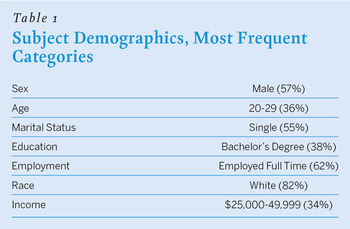
Those interested in the political realities of playing the woman card remain unsure of how voter perceptions of female candidates may change when coverage of female candidates, or even the campaigns themselves, emphasize the novelty of their candidacies. To gauge the effects of “playing the woman card” in this way, I conducted an Amazon Mechanical Turk experiment with American subjects (N = 593). Each subject received $1.50 to participate in a 15-minute experiment. Footnote 4 Participants provided basic sociodemographic information and answered questions about their political predisposition. Footnote 5 These questions assessed the participants’ partisanship as well as their level of sexism as measured by the Modern Sexism Scale, which assesses more subtle forms of sexism, such as resentment toward policies designed to help women correct practices and institutions that are perceived to be discriminatory (Swim et al. Reference Swim, Aikin, Hall and Hunter1995). Footnote 6 Higher scores on the Modern Sexism Scale reflect more support for conventional gender roles and a greater acceptance of sexist attitudes (Russell and Oswald Reference Russell and Oswald2015; Young and Nauta Reference Young and Nauta2013). While the resulting sample was younger and more likely to be male than the American population, the subject pool provided a representative sample in other pertinent aspects (table 1).
Subject Demographics, Most Frequent Categories

The study randomly assigned each subject to one of two experimental conditions, both of which asked the subject to read a news article about a female state house representative, Representative Jennifer Adams, who has decided to enter a gubernatorial race. The control group article included information on Adams’s background but did not mention that she would be the state’s first female governor if elected. Participants in the experimental group read a version that included three additional sentences framing a potential win by the candidate as an historic first, announcing that “should [Jennifer Adams] win in November, she would be the first female governor in the state’s approximately two hundred and fifty-year history.” Neither version of the story provided voters clear cues about the candidate’s party identification, as it attributed both Republican (promotion of business friendly policies) and Democratic policies (promotion of education spending) to the candidate. Footnote 7 Both versions of the article use the name Jennifer Adams and female pronouns, allowing participants to make inferences about the candidate’s gender. After reading the article, participants assessed the candidate’s favorability and reported their likelihood of voting for the candidate. Footnote 8
Results indicate that the experimental framing succeeded in increasing the appeal of the female candidate only among certain groups of voters. These findings suggest that playing the woman card provides strategic advantages, especially for Democrats trying to appeal to independent voters. This frame proves less advantageous for—and may potentially harm— candidates trying to appeal to other voting blocks.
RESULTS
Experimental subjects responded positively to the fictional candidate. On scales ranging from 1 to 5, where 5 indicated the highest levels of favorability and vote likelihood, she received average favorability ratings of 3.745 (s=.790) and an average score of 3.594 on the likelihood of receiving a vote (s=.875). Women viewed the candidate more favorably, rating her at 3.924 (s=.704) on favorability and 3.767 (s=.799) on vote likelihood, while men rated her 3.614 (s=.826) and 3.473 (s=.899) respectively. These gender differences are statistically significant (p < 0.05).
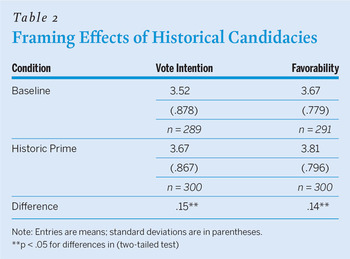
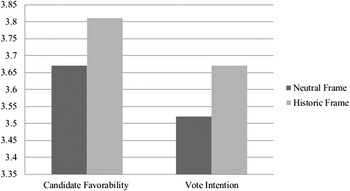
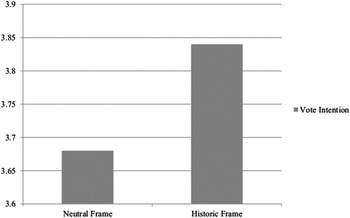
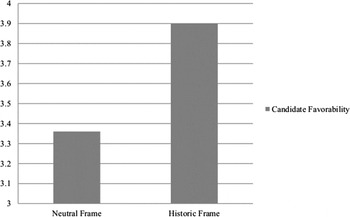
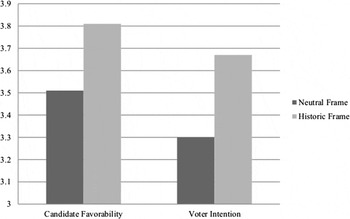
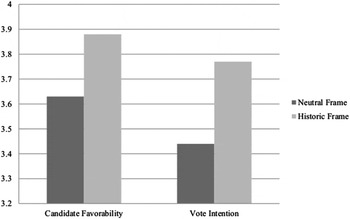
Framing Jennifer Adams’ candidacy in terms of being an historic achievement for women increased the subjects’ positive affect toward and intention to vote for her only among specific groups of voters (table 2, figure 1). Footnote 9 While women’s intention to vote for Adams increased with exposure to the experimental frame, male participants exhibited no commensurate increase (figure 2). Similarly, exposure to the experimental frame increased the perception of favorability among African American subjects by almost a full point (figure 3). Footnote 10
Framing Effects of Historical Candidacies

Note: Entries are means; standard deviations are in parentheses.
** p < .05 for differences in (two-tailed test)
Effects of Priming an Historical Candidacy, Entire Sample

Effect of Framing as an Historical Candidacy, for Women

Effect of Framing an Historical Candidacy, among Black Voters

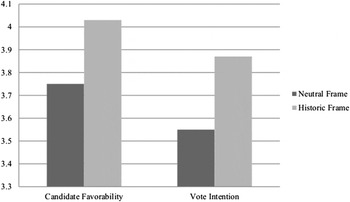
The effects of the experimental manipulation also varied as a function of partisanship. Among independent voters who did not lean toward either party, exposure to the novelty frame increased their evaluations of the candidate’s favorability and their likelihood of voting for her (figure 4). While weak Democrats were similarly affected, strong Democrats and Republicans were not (figure 5).
Effects of Framing an Historical Candidacy, among Independent Voters

Effects of Framing an Historical Candidacy, among Weak Democrats

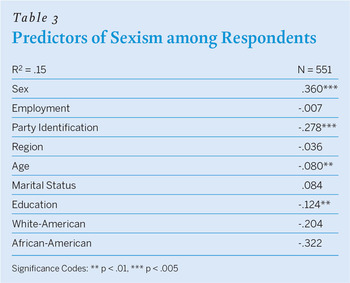
The novelty frame appeared most effective in garnering support among those who scored lowest on the Modern Sexism Scale. Those who scored at intermediate or high levels did not change their evaluations of her favorability even after exposure to the experimental frame (figure 6), nor did they express a higher level of intent to vote for her. As younger and less educated conservative men are most likely to exhibit the highest levels of modern sexism (table 3) Footnote 11 , this suggests that playing the woman card is less likely to work on members of these demographic groups.
Effects of Framing an Historical Candidacy, among Respondents Lowest in Sexism

Predictors of Sexism among Respondents

Significance Codes: ** p < .01, *** p < .005
As with all experiments, we should be cognizant of the limitations of these findings. This experiment demonstrates the difference between presenting a female candidate and presenting a female candidate as an historic first. Subjects may have already considered the candidate’s gender even without the historic frame and may have been inclined to think positively about any female candidate. This orientation toward Adams may have been especially likely for those sensitive to social inequalities, such as strong Democrats, women, or minorities. Using a gender-neutral name in the experimental stimulus would have provided a cleaner test, and it is possible that stronger effects could be evident if the candidate’s gender had not been cued by her name. Thus, the experimental design employed here was more likely to underestimate the effects of framing female candidates as historic firsts than to find effects where none existed. Additionally, using a gendered name increases the external validity of this study, as only 1% of Americans have unisex names and most candidates’ names clearly indicate gender. Footnote 12 Further, the experimental manipulation also involved a journalist invoking the novelty of a candidacy. Voters may respond differently to claims about the novelty of candidates based on the source of the information. How coverage from different sources affects the efficacy of playing the woman card should be an avenue of future research.
Playing the woman card by emphasizing the historic nature of a woman’s candidacy, as Secretary Clinton did when she claimed that being the first woman president puts her outside the political establishment during a February Democratic primary debate, appeals to some voters, particularly those traditionally under-represented in politics.
WHEN PLAYING THE WOMAN CARD IS PLAYING TRUMP (AND WHEN IT ISN’T)
Political scientists have identified the “lay of the land” when it comes to patterns in how the media covers female candidates. The viability of female candidates receives more media coverage than does the viability of similarly situated men (Falk Reference Falk2008; Heldman, Caroll, and Olson Reference Heldman, Carroll and Olson2005), as does their novelty in politics (Falk Reference Falk2008; Heldman, Caroll, and Olson Reference Heldman, Carroll and Olson2005; Meeks Reference Meeks2012). The media also pays a disproportionate amount of attention to the appearance and familial relationships of female candidates—the “husband, hemline, hair” problem—that has been shown to displace coverage of their positions on substantive issues (Dunaway et al. Reference Dunaway, Lawrence, Rose and Weber2013; Falk Reference Falk2008). Candidates who play the woman card by emphasizing novelty also receive substantial coverage in the media, as the Clinton–Trump exchange demonstrates. Given the focus on the viability and novelty of female candidates, playing the woman card in ways that reinforce the novelty of women’s candidacies may further undermine their credibility as candidates in the minds of voters.
Despite Secretary Clinton’s invocation of the historic first of her potential presidency and the media’s general tendency to underscore the historical achievement of a potential win, scholars know little about how focusing on the novelty of a woman’s candidacy influences citizens’ attitudes toward and support for those candidates. My analysis demonstrates that the effects of playing the woman card in this way are more complex than often portrayed. While playing the woman card may be disadvantageous in some instances, such as when candidates are trying to appeal to less educated or conservative voters, such tactics may favorably sway other voters.
Playing the woman card by emphasizing the historic nature of a woman’s candidacy, as Secretary Clinton did when she claimed that being the first woman president puts her outside the political establishment during a February Democratic primary debate, appeals to some voters, particularly those traditionally under-represented in politics. The effects of framing candidates as novelties may prove particularly important in primary campaigns, where a candidate’s party identification will not negate framing effects related to candidates’ use of their gender (Dolan Reference Dolan2014). Playing the woman card also appears to have a strong effect on weak partisan (Democrats) and independent voters, something important for campaigns trying to attract new or undecided voters. As more people self-identify as independents, strategies that attract the attention and commitment of those voters will be of particular interest.
Candidates do not play the woman card in a vacuum. They have unique histories and personalities that affect how the media presents them as well as how voters respond to them (for discussion see Lawrence and Rose Reference Lawrence and Rose2009), a fact particularly true for Secretary Clinton. However, young voters, like the participants in this experiment, have a far more limited memory of Clinton’s tenure as First Lady or even her first campaign for the presidential nomination. Their relative lack of familiarity suggests that emphasizing the historic nature of her candidacy might be beneficial in helping Clinton appeal to young voters who lean Democratic or identify as independents, regardless of her more polarizing effect on older voters.
This research adds to our understanding of the scholarly and practical importance of novelty frames and appeals in influencing voter attitudes. Especially important given the increase in female candidates as well as rhetoric about or examples of them playing the woman card by presenting themselves as historic firsts, analysis of this framing may also provide campaigns with a better understanding of when and how to deploy gender frames effectively. The findings presented here suggest that playing the woman card is much more nuanced than the media and current political science research present it. Whether as a proactive campaign strategy or because the newsmedia tend to focus on the novelty of female candidates, voters are exposed to frames of female candidates as historic. The effects of these frames vary across people of different demographic groups and parties, and are influenced by levels of sexism. Playing the woman card is not always playing trump, as the efficacy of these gender frames appears more grey than black or white.
SUPPLEMENTARY MATERIAL
To view supplementary material for this article, please visit http://dx.doi.org/10.1017/S1049096516001438.Footnote *