Introduction
Dogs can be infected by several species of filarial worms; species found in Italy are Dirofilaria immitis, Dirofilaria (Nochtiella) repens, Acanthocheilonema (syn. Dipetalonema) reconditum and, less frequently, Acanthocheilonema (syn. Dipetalonema) dracunculoides and Cercopithifilaria (syn. Acanthocheilonema) grassii. These species can also infect cats and wild animals, as well as foxes and wolves, and occasionally humans. Filarial nematodes differ in the localization of adult parasites: D. immitis adult stages live in the right side of the heart and in the pulmonary artery, D. repens lives in the subcutaneous tissue, while A. reconditum, A. dracunculoides and C. grassii live in the peritoneal cavity, in adipose tissue and in intramuscular spaces, respectively. Their life cycle is indirect, with definitive vertebrate hosts and arthropods as intermediate hosts, also acting as vectors. After mating, adult female worms release microfilariae into the haematic circulation of the definitive host. Arthropods, in which first-stage larvae complete their development to the infective third stage, are mosquitoes belonging to genera Culex and Aedes for Dirofilaria spp., and fleas (Ctenocephalides spp.) and ticks (Rhipicephalus spp.) for Acanthocheilonema spp. and C. grassii.
Dirofilaria immitis and D. repens are filarial species of major concern in Europe for both canine and human health (Simón et al., Reference Simón, Morchón, González-Miguel, Marcos-Atxutegi and Siles-Lucas2009). Dirofilaria immitis is the aetiological agent of canine heartworm disease and it is the most pathogenic species, as it can be lethal; in dogs D. repens is considered less dangerous and causes pruriginous dermatitis. In Italy current data on canine dirofilariasis confirms the expanding trend of parasites as observed in the rest of Europe (Genchi et al., Reference Genchi, Rinaldi, Mortasino, Genchi and Cingoli2009). Today D. immitis is present, not only in the hyperendemic area of the Po River Valley, but also in the northern part of Italy (Lombardy and Friuli Venezia Giulia), in central Italy (Umbria, Abruzzo and Tuscany), in the south (Campania, Apulia and Calabria) and in the islands (Sicily and Sardinia). Dirofilaria repens is distributed in almost all of the Italian territory.
Acanthocheilonema reconditum has a worldwide distribution in dogs (Quinn et al., Reference Quinn, Donnelly, Carter, Markey, Torgerson and Breathnach1997). In Europe it has been reported in Serbia (Tasić et al., Reference Tasić, Rossi, Tasić, Miladinović-Tasić, Ilić and Dimitrijević2008), in Spain (Aranda et al., Reference Aranda, Panyella, Eritjia and Castellà1998), in Greece (Vakalis & Himonas, Reference Vakalis and Himonas1997), in Austria (Hinaidy et al., Reference Hinaidy, Bacowsky and Hinterdorfer1987) and in Italy (Cringoli et al., Reference Cringoli, Rinaldi, Veneziano and Capelli2001). Acanthocheilonema dracunculoides has rarely been reported: in Europe it has been found in dogs in The Netherlands, Greece, Spain and Portugual (Bolio et al., Reference Bolio, Montes, Alonso, Gutiérrez, Bernal, Rodríguez-Vivas and Sauri2004). In Italy it was found in foxes in Latium and Tuscany (Cancrini, Reference Cancrini1986; Magi et al., Reference Magi, Macchioni, Dell'Omodarme, Prati, Calderini, Gabrielli, Iori and Cancrini2009) and for the first time it has been reported in a dog in Sicily (Giannetto et al., Reference Giannetto, Poglayen, Gaglio, Brianti, Ferlazzo and Giudice2003). Cercopithifilaria grassii was discovered in 1907 in a dog from Rome (Noè, Reference Noè1908), subsequent sporadic reports have occurred (India: Balasubramanian et al., Reference Balasubramanian, Anandan and Alwar1975; Greece: Vakalis & Himonas, Reference Vakalis and Himonas1997). In Italy microfilariae were found in the blood of a dog from Sicily (Giannetto et al., Reference Giannetto, Poglayen, Gaglio, Brianti, Ferlazzo and Sorgi2004) and of a cat from the Aosta Valley (Tarello, Reference Tarello2004).
All canine filarial species have the potential to infect humans; D. immitis can cause pulmonary nodules, D. repens ocular and subcutaneous nodules and pruriginous dermatitis (Pampiglione & Rivasi, Reference Pampiglione, Rivasi, Genchi, Rinaldi and Cringoli2007; González-Miguel et al., Reference González-Miguel, Rosario, Rota-Nodari, Morchón and Simón2010) and A. reconditum can affect the eye (Huynh et al., Reference Huynh, Thean and Maini2001). The aim of this study is to investigate the prevalence and the distribution of different filarial species in an area of central Italy (Tuscany).
Materials and methods
The study was carried out between April 2007 and December 2009 in Tuscany, a region with natural breeding sites for a great variety of mosquito species, such as Culex pipiens, Culex modestus, Anopheles maculipennis, Coquilletidia richardii and Aedes albopictus (Cancrini et al., Reference Cancrini, Magi, Gabrielli, Arispici, Tolari, Dell'Omodarme and Prati2006), which have all proved to be suitable vectors of dirofilarial nematodes (Cancrini & Gabrielli, Reference Cancrini, Gabrielli, Genchi, Rinaldi and Cringoli2007).
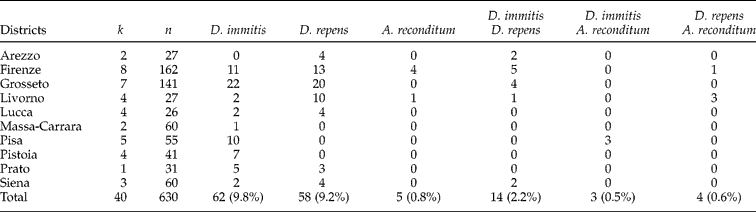
Blood samples were collected from 630 dogs; 40 kennels were involved in the study (see table 1). The sample size was chosen so that the number of subjects enrolled in each municipality was roughly proportional to the surface area of the municipality itself. Animals were housed in outdoor kennels located in different towns in every district of Tuscany. They were all autochthonous, older than 6 months of age and had not undergone any prophylactic treatment for filariasis. Dogs were sampled in kennels, as most privately owned dogs currently undergo chemoprophylaxis. Individual data about sex, age, breed, living habitat and geographical origin were recorded. Each blood sample was divided into two fractions: 1 ml of whole blood was mixed with 9 ml of 2% formaldehyde solution for the detection of circulating microfilariae; and at least 2 ml were collected in tubes with anticoagulant, in order to obtain plasma for D. immitis antigen detection. Samples were submitted to the Department of Animal Pathology, Prophylaxis and Food Hygiene of Pisa University.
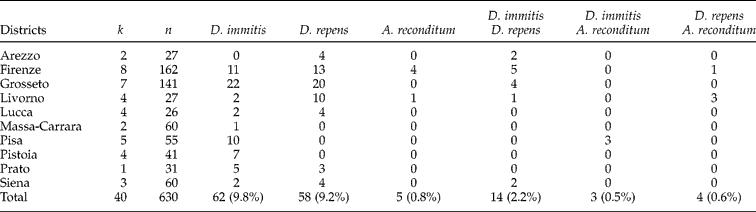
Dogs classified according to districts and detected filarial species; k=number of kennels sampled; n=number of dogs sampled.
The identification of microfilariae species was carried out using modified Knott's technique (Lindsey, Reference Lindsey1965). In order to confirm the morphometric identification, blood samples which were Knott's positive were further analysed using the naphthol AS-TR-phosphate method for acid phosphatase activity as described by Barka (Reference Barka and Thompson1966). This staining distinguishes microfilariae of D. immitis, D. repens, A. reconditum (Chalifoux & Hunt, Reference Chalifoux and Hunt1971; Balbo & Abate, Reference Balbo and Abate1972) and A. dracunculoides (Ortega-Mora et al., Reference Ortega-Mora, Gomez-Bautista and Rojo-Vazquez1989) by four different patterns, depending on the different activity of the acid phosphatase enzyme: D. immitis microfilariae have two red areas corresponding to the excretory pore and the anal pore; D. repens microfilariae only have one red area corresponding to the anal pore; A. reconditum microfilariae show a reddish colour on the whole body and A. dracunculoides microfilariae show a very intense red colour on the central part of the body, at the anal pore and at the excretory pore.
Samples were also subjected to an enzyme-linked immunosorbent assay (ELISA) for the detection of antigens of D. immitis with the Canine Heartworm Antigen kit (DiroCHEK®, Synbiotics, Kansas City, Missouri, USA). The procedure was conducted following instructions contained in the kit.
Results were subjected to statistical analysis, using the χ2 test, and were considered significant if P < 0.05.
Results and discussion
Amongst 630 samples tested, 146 were positive for filariasis (prevalence 23.2%; 95% confidence interval: 19.9–26.5%). Dirofilaria immitis was found in 79 cases (12.5%), D. repens in 76 (12.1%) and A. reconditum in 12 (1.9%). Several cases of double infestations were found; the detailed situations in each district are summarized in table 1. The difference amongst the prevalence of the first two species in the various districts is highly significant (P < 0.0001). No sex- and age-related differences were observed.
Filarial infections in Italy have, in recent years, shown an expanding trend, as reported for all Europe (Genchi et al., Reference Genchi, Rinaldi, Cascone, Mortarino and Cringoli2005). The prevalence (23.2%) of filariasis in untreated dogs found in this study, shows that in Tuscany the parasitic pressure and the risk of infestation are high. Dirofilaria immitis and D. repens were the dominant species, showing widespread diffusion throughout the region and similar prevalence values (12.5% and 12.1%, respectively), whereas A. reconditum (1.9%) was less common and was found in only three districts (Firenze, Pisa and Livorno). Different intermediate hosts and the easy control of fleas and ticks in contrast to dirofilariasis vectors could explain the lower prevalence of A. reconditum. The widespread diffusion in Tuscany of mosquito species, potential vectors of dirofilariae (Cancrini et al., Reference Cancrini, Magi, Gabrielli, Arispici, Tolari, Dell'Omodarme and Prati2006), including Ae. albopictus, might have played a determining role in the presence of dirofilariasis. The identification of species achieved with the modified Knott's technique was validated by the acid phosphatase histochemical staining.
The ELISA test for D. immitis antigens was positive for 65 dogs, 42 of these were also found to be positive using Knott's modified test, while 23 were negative for the presence of D. immitis microfilariae (occult filariasis): this could be due to a unisex infection, a prepatent period or an immune-mediated clearance of microfilariae. On the other hand, 10 animals were found to be positive for D. immitis microfilariae using Knott's method and acid phosphatase staining but negative for antigen detection; this could be explained by the immune-mediated clearance of antigen–antibody complexes.
This study shows that the monitoring of filariasis should be kept at a high level because, despite the common use of prophylaxis, parasites are widespread. Dogs' sanitary status should be constantly monitored, for the protection of both animal and human health, taking into consideration the zoonotic potential of filarial worms, in particular D. repens. A complete diagnosis with the correct species identification is needed in order not to underestimate the presence of species that are not detectable using serological tools. Finally, awareness of prophylaxis, accurate diagnosis and correct treatment by veterinary surgeons are important.
Acknowledgements
We would like to thank all veterinary surgeons who kindly collaborated during the sampling.