Although the evidence adduced by Barbey & Sloman (B&S) clearly supports fuzzy-trace theory (FTT), there are key differences in the mechanisms used to explain base-rate effects. That is, FTT's prediction that “Base-rate neglect is reduced when problems are presented in a format that affords accurate representation in terms of nested sets of individuals” (target article, Abstract) has been confirmed repeatedly. B&S's account “attributes base-rate neglect to associative judgment strategies” (target article, Abstract), but it is questionable whether associative processes are implicated by the data, whereas distinct ideas omitted from their account have been supported through rigorous testing. Therefore, in the remainder, we briefly summarize those differences in mechanisms used to explain the nested sets prediction, note that each assumption in FTT has been separately tested empirically (unlike many competing claims which are philosophical), and spell out some important next steps in theory testing as well as further implications for rationality.
“Diagnosing whether a patient has a disease, predicting whether a defendant is guilty of a crime, and other everyday as well as life-changing decisions” and “people's tendency to neglect base-rates” (target article, sect. 1, para. 1) have been explicitly investigated in the context of FTT (e.g., Reyna & Adam Reference Reyna and Adam2003; Reyna & Farley Reference Reyna and Farley2006; Reyna et al. Reference Reyna, Holliday and Marche2002; Reyna & Lloyd Reference Reyna and Lloyd2006; Reyna et al. Reference Reyna, Lloyd and Whalen2001; Reyna et al. Reference Reyna, Mills, Estrada, Brainerd, Toglia, Read, Ross and Lindsay2006). Four factors are essential to our explanation: (1) Confusion about which classes are referred to (present for all ratio concepts, including probability), defaulting to the focal classes in numerators and consequently neglect of denominators; (2) the allure of a salient gist or meaning relation that applies to the focal class and that seems to answer the posed question, but does not; (3) developmental and individual differences in the ability to inhibit this salient gist; and (4) the presence or absence of cues to retrieve known reasoning principles, such as the cardinality principle that subsets cannot be more numerous (or probable) than the sets that include them. Empirical evidence supports each of these theoretical factors and, together, they predict the nested sets findings discussed by B&S.
For example, using these assumptions, we, too, have shown that “Facilitation in Bayesian inference … can be attributed to the facilitory effect of prompting use of the sample of category instances presented in the problem to evaluate the two terms of the Bayesian ratio” (target article, sect. 2.3, para. 6), that this effect extends to improving single-event probability judgments, and that the form of the question matters (e.g., Brainerd & Reyna Reference Brainerd and Reyna1990; Reference Brainerd and Reyna1995). Like Girotto and Gonzalez (Reference Girotto and Gonzalez2001), we also showed that defective partitioning decreased the facilitative effect of making nested sets transparent (Lloyd & Reyna Reference Lloyd and Reyna2001). In addition, Girotto and Gonzalez (in press) provide developmental evidence that echoes earlier developmental findings by Brainerd and Reyna (e.g., 1995), and Sloman et al. (Reference Sloman, Over, Slovak and Stibel2003), Yamagishi (Reference Yamagishi2003), and Bauer and Johnson-Laird (Reference Bauer and Johnson-Laird1993) provide evidence of facilitation using diagrammatic representations that also echoes our earlier findings (e.g., Brainerd & Reyna Reference Brainerd and Reyna1990; Lloyd & Reyna Reference Lloyd and Reyna2001; Reyna et al. Reference Reyna, Lloyd and Whalen2001), all of which support FTT's nested sets hypothesis.
These findings have been summarized by Reyna and Brainerd (Reference Reyna and Brainerd1995) as follows:
Class-inclusion reasoning, probability judgment, risk assessment, and many other tasks, such as conditional probability, conjunction fallacy, and various deductive reasoning tasks, are subject to what has been called inclusion illusions (Reyna Reference Reyna1991; Reyna & Brainerd Reference Reyna, Brainerd, Davies and Logie1993; in press). Inclusion illusions occur because part-whole relationships are difficult to process, for children and for adults. (p. 34)
According to Reyna and Brainerd (Reference Reyna, Brainerd, Davies and Logie1993), neglect of base rates is a special case of denominator neglect: Because of the complexity of processing nested classes, subjects focus on numerators (e.g., joint probabilities or relative frequencies of targets, depending on the task). (p. 35)
Processing can be simplified, however, by providing a notational system in which elements of parts and of wholes are distinctly represented. For example, Venn diagrams, used in syllogistic reasoning, represent subsets and more inclusive sets using a system of overlapping circles. Superordinate-set tags can be used to similar effect in class inclusion. (p. 33)
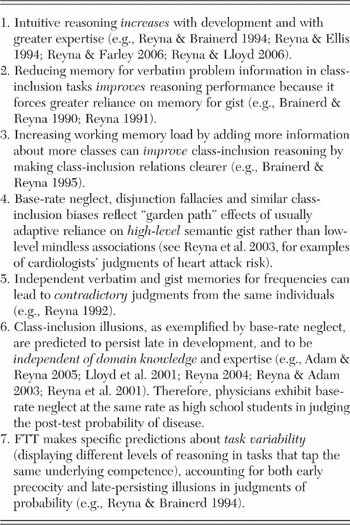
As these examples illustrate, B&S's evidence favoring “nested sets and dual processes,” except for that presented in section 2.8, is a replication or extension of earlier findings derived from FTT. Therefore, not surprisingly, their conclusions about the nested sets hypothesis are virtually identical to earlier statements. However, the mechanisms are not identical and the characterization of System 1 (the intuitive system) as “primitive” (sect. 1.2.5, para. 2) is the opposite of what is claimed in FTT (and our claim has received repeated empirical support). We offer a dual-processes account that encompasses the findings presented here, but also has been used to predict additional, counterintuitive findings, some shown in Table 1.
Examples of counterintuitive findings that differentiate FTT from Barbey & Sloman's dual-processes approach

In contrast to ecological and other perspectives on rationality, FTT places unique emphasis on developmental data in informing judgments of rationality. Evidence points to simplified, intuitive, gist-based thinking as a key feature of advanced reasoning that develops with age and expertise, but also accounts for increases in gist-based biases. According to FTT, these cognitive biases are irrational. However, FTT's process model distinguishes types of errors that vary in severity – that is, in degrees of rationality. For example, errors caused by susceptibility to a compelling (but incorrect) gist or by retrieving the wrong reasoning principle are more severe than those caused solely by processing interference from overlapping classes. This theoretical taxonomy maps onto observed trends in development and in the acquisition of expertise (Reyna et al. Reference Reyna, Lloyd, Brainerd, Schneider and Shanteau2003).
In summary, although the target article's account of base-rate effects is consistent with FTT's (supporting the nested sets hypothesis and refuting an adaptive preference for frequency formats), the proposed dual-processes model differs in important respects. FTT stands in sharp contrast in its characterization of intuition (System 1) regarding rationality. Standard dual-processes models, such as the one advocated by B&S, attribute successful performance on base rate and other inclusion tasks to the operation of an advanced (logical and quantitative) System 2 and the inhibition of a primitive System 1. In contrast, in FTT, intuition is advanced, and focusing on quantitative minutia is primitive (lowering class-inclusion performance). This surprising prediction, among others, is supported by converging evidence from multiple tasks.
ACKNOWLEDGMENTS
Preparation of this commentary was supported in part by grants from the National Institutes of Health (MH-061211) and the National Science Foundation (BCS 0553225), and by the National Cancer Institute (Basic and Biobehavioral Research Branch, Division of Cancer Control and Population Sciences).