Introduction
Sclerotherapy is a well described treatment for venous and lymphatic malformations of the head and neck.Reference Sichel, Udassin, Gozal, Koplewitz, Dano and Eliashar1, Reference Minkow, Laufer and Gutman2 There are many other options, both pharmacological and surgical;Reference Giguere, Bauman and Smith3, Reference Bloom, Perkins and Manning4 however, complete surgical excision presents a technical challenge due to the frequent interposition of tumour with important anatomical structures within the head and neck. Sclerotherapy may be used as an adjunct to surgery.Reference Kane, Morris, Jackson and Woods5
Sodium tetradecyl sulphate is an anionic surface-active agent used industrially for its wetting properties. Its application in medicine is as an irritant sclerosing and thrombosing agent for haemorrhoids and varicose veins. Sodium tetradecyl sulphate has been used in prolonged treatment courses for haemangiomata, with minimal side effects reported.Reference Woods6 Within vessels, its mechanism of action is thought to comprise a damaging effect on vascular epithelium, causing platelet aggregation and thrombosis.Reference O'Donovan, Donaldson, Morello, Pensler, Vogelzang and Bauer7, Reference Stroncek, Hutton, Silvis, Vercellotti, Jacob and Hammerschmidt8 Compression sclerotherapy in the head and neck is preferably performed under ultrasound image guidance.
OK 432 (marketed as Picibanil; Chugai Pharmaceutical Co., Ltd, Tokyo, Japan) is derived from Streptococcus pyogenes bacteria. For this reason, caution is advised in patients with a history of penicillin hypersensitivity reaction. This agent's mode of action is thought to be related to the potent inflammatory response stimulated when it is injected into a cyst.Reference Fujino, Moriya, Morikawa, Hoshino, Watanabe and Shimojima9
Reported complications of the use of sclerosing agents include swelling at the infiltration site, pyrexia, localised erythema and facial nerve palsy.Reference Sung, Lee, Kim, Lee, Hwang and Park10 More serious complications have included proptosis, cellulitis of the neck and respiratory distress requiring a tracheostomy.Reference Giguere, Bauman, Sato, Burke, Greinwald and Pransky11
We report the unusual case of a young patient with a mixed venous-lymphatic malformation of the parotid gland, who experienced severe, chronic pain following intralesional injection of sodium tetradecyl sulphate. The patient's pain ultimately required management by a specialist pain service.
Case report
A 14-year-old girl presented to our department, a tertiary referral centre for paediatric otolaryngology and head and neck surgery. She had a long history of facial swelling, previously extending into the tonsil, pharynx and root of neck. Small lymphatic malformations had previously been excised from her tongue with carbon dioxide laser.
At the time of review, the most troublesome feature was intermittent, left-sided parotid swelling and occasional discomfort.
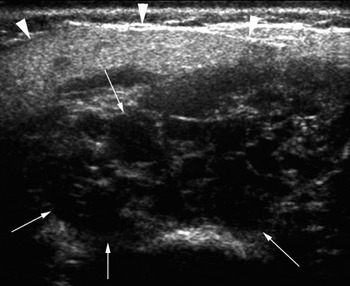
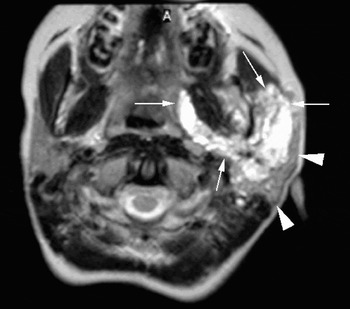
Previous ultrasound (Figure 1) and magnetic resonance imaging (Figure 2) had confirmed an extensive lesion, arising deep to the superficial lobe of the parotid and extending into the parapharyngeal space and infratemporal fossa.
Transverse ultrasound image showing a hypoechoic lesion comprising numerous fluid-filled spaces (arrows) lying deep to the superficial lobe of the left parotid gland (arrowheads).

Transverse T2-weighted magnetic resonance image showing displacement of the superficial lobe of the parotid (arrowheads). The lesion (arrows) extends into the left parapharyngeal space.

The patient was keen to undergo treatment of her left-sided facial swelling. A more recent magnetic resonance imaging of this region had confirmed an extensive lesion extending into the parapharyngeal space and infratemporal fossa. Superficial parotidectomy was not felt to be an option in view of the extensive nature of the lesion and the potential risk of facial nerve damage.
Ultrasound and magnetic resonance imaging suggested that the lesion was a multicystic lymphatic malformation. The lesion was therefore punctured under general anaesthesia, using ultrasound guidance, and lymphatic fluid was aspirated from some cysts and venous blood from others. Sclerotherapy was then performed, and repeated on two occasions over the next seven months.
Sodium tetradecyl sulphate 3 per cent (as Fibro-Vein®, STD Pharmaceutical Products Ltd, Hereford, England, UK) was injected as follows: 2 ml at the first visit, 4 ml at the second visit, and 5.5 ml at the final visit, representing a total of 11.5 ml in seven months. The external jugular vein was compressed during the procedure to prevent extralesional migration of the sclerosant. (An alternative technique would have been occlusion of the vessel with an endovascular balloon.)
Three months after the first injection, the patient was experiencing severe, chronic pain in the region of her sclerotherapy. This was not ameliorated by a combination of paracetamol and ibuprofen. The patient was subsequently seen by our centre's (anaesthetist-led) pain control service, and was managed on a combination of paracetamol, ibuprofen and codeine phosphate.
Despite this treatment, the patient was still experiencing severe pain at nine months post-treatment. Ultrasound and magnetic resonance imaging showed a reduction in the bulk of the swelling, without any localised collection of fluid or pus.
Twelve months after her initial treatment, the patient finally commented on a marked improvement in symptoms, and the lesion remained reduced in size. The patient was satisfied with the cosmetic improvement, and at the time of writing remained under regular clinical review. No further radiological or surgical intervention was planned.
Discussion
Haemangiomas and vascular malformations in the head and neck of children can present a treatment dilemma. Input will often be required from plastic surgeons, dermatologists, otolaryngologists, maxillofacial surgeons, radiologists and pharmacists. Combined venous and lymphatic malformations are unusual in this location. The diagnosis in our patient was confirmed by the aspiration of venous blood from some spaces in the lesion and lymphatic fluid from others.
Most vascular malformations cause only cosmetic problems, so the benefits of conservative and surgical management must outweigh the risks of treatment.
Surgical treatments can leave noticeable and prominent scarring of the head and neck, may provide incomplete resection, and are subject to the usual potential complications of bleeding, wound infection and those of general anaesthesia.
For this reason, sclerotherapy with agents such as sodium tetradecyl sulphate (for venous malformations) and OK 432 (for lymphatic malformations) has been recommended in the literature as a sole treatment or adjunct to surgery in cases in which operative procedures are considered inappropriate first line treatment. Much of this recommendation is based on the relatively low incidence of side effects.
• Sclerotherapy is a well described treatment for venous and lymphatic malformations of the head and neck
• This paper describes the unusual case of a young patient with an intraparotid haemolymphangioma who experienced severe, chronic pain following intralesional injection of sodium tetradecyl sulphate
• Knowledge of this rare but nonetheless important side effect may better clinicians' decision making regarding the management of these complex cases
Over a four year period, our unit (a tertiary referral centre for paediatric otolaryngology) dealt with 61 cystic hygroma patients. Of these patients, 14 were observed, 18 received surgery as their only treatment modality, 11 received sclerotherapy alone, and 16 underwent combined treatment with surgery and sclerotherapy. Sclerotherapy with OK 432 was associated with low grade local inflammation only. Of the four patients treated with sodium amidotrizoate (Ethibloc; Johnson & Johnson, Brussels, Belgium), three experienced partial extrusion of the compound, requiring treatment. Only one patient received sodium tetradecyl sulphate sclerotherapy – the present case. Overall, the complication rate for sclerotherapy was 14.8 per cent (4 of 27), as compared with a surgical complication rate of 28.6 per cent (10 of 35). Surgical complications included seroma formation, infection and nerve paralysis.
We report the present case in order to highlight the patient's prolonged post-procedural pain, which proved distressing and debilitating and lasted some 12 months after treatment. Knowledge of this rare but nonetheless important side effect may better inform clinicians' decision making regarding these complex problems.
Acknowledgement
We thank Kuan Ooi, Pharmacist, Great Ormond Street Hospital for Children NHS Trust, for her assistance in the preparation of this manuscript.