Nitrate assimilation and signalling in seedlings
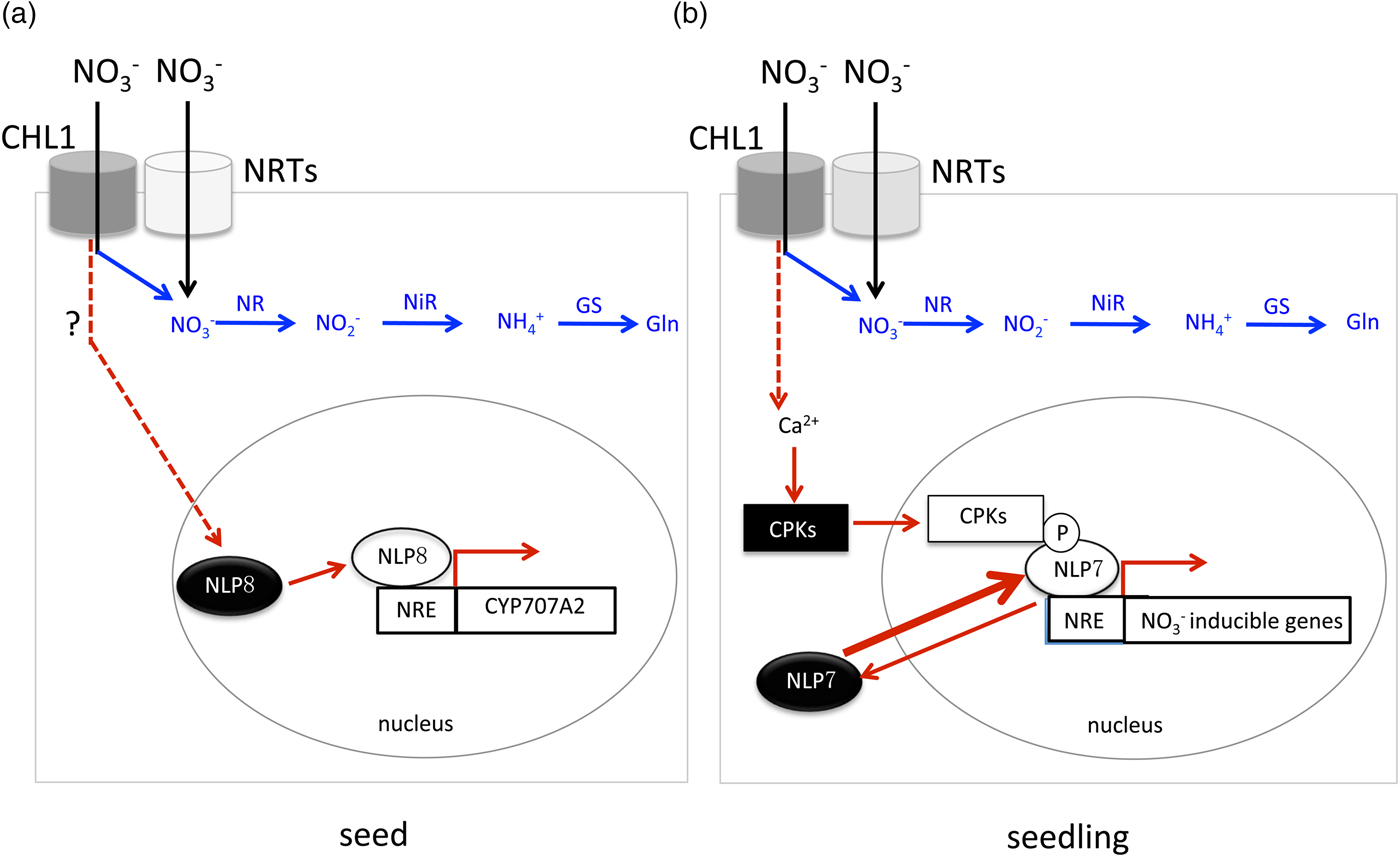
The uptake of nitrate from the soil and its transport within the plant body is regulated by active transport mechanisms, via high- and low-affinity nitrate transporters (Tsay et al., Reference Tsay, Chiu, Tsai, Ho and Hsu2007). After nitrate is taken up by the plant, it is reduced in the first committed step by nitrate reductase (NR) to become nitrite (NO2−). Nitrite is then further reduced by nitrite reductase (NiR) to become the ammonium ion (NH4+), which can be incorporated into amino acids (Fig. 1A,B). In addition to its role as a nutrient, nitrate itself acts as a signalling molecule that elicits the primary nitrate response (PNR) and subsequent secondary responses. The typical PNR is characterized as the initial and rapid response that occurs independent of nitrate assimilation, after the addition of nitrate to plants that have either been starved for N or grown on N sources other than nitrate. Indeed, nitrate-induced reprogramming of transcriptomes occurs in the NR null mutant (Wang et al., Reference Wang, Tischner, Gutiérrez, Hoffman, Xing, Chen, Coruzzi and Crawford2004), and the PNR is maintained in the presence of protein synthesis inhibitors (Deng et al., Reference Deng, Moureaux and Caboche1989; Redinbaugh and Campbell, Reference Redinbaugh and Campbell1993). Microarray studies on the Arabidopsis root and shoot demonstrated that nitrate functions in regulating many genes involved in carbon, nutrient and amino acid metabolism, the pentose phosphate pathway, glycolysis and gluconeogenesis, iron transport, sulphate uptake and reduction, and genes involved in nitrate assimilation and transport (Wang et al., Reference Wang, Okamoto, Xing and Crawford2003; Scheible et al., Reference Scheible, Morcuende, Czechowski, Fritz, Osuna, Palacios-Rojas, Schindelasch, Thimm, Udvardi and Stitt2004), and can involve the altered expression of almost 10% of the detectable Arabidopsis thaliana (Arabidopsis) transcriptome (Gutiérrez et al., Reference Gutiérrez, Gifford, Poultney, Wang, Shasha, Coruzzi and Crawford2007). Nitrate regulates gene expression at concentrations as low as 100 nM within a short period of time (~10 min) (Wang et al., Reference Wang, Xing and Crawford2007), consistent with its function as a signalling molecule.
Nitrate assimilation and signalling in Arabidopsis. External nitrate can be imported and sensed by nitrate transporters (NRTs). CHL1 is the nitrate transceptor that acts as both a nitrate transporter and a nitrate sensor in signalling. Inside the cell, nitrate functions as both a nutrient and a signal. As a nutrient, nitrate can be catalysed by nitrate reductase (NR) to nitrite. It is then further reduced by nitrite reductase (NiR) to ammonium, and incorporated into amino acid synthesis. Arrows for nitrate signalling and nitrate metabolism are shown in red and blue, respectively. Dashed lines indicate that the molecular mechanisms remain unidentified. GS, glutamine synthase. (A) Nitrate signalling in imbibed seeds. Among the nine NLP members, NLP8 is the master regulator for the expression of the primary nitrate response (PNR) genes in seeds. NLP8 localizes to the nucleus regardless of nitrate application, unlike NLP7 whose subcellular localization is regulated by nitrate. Nitrate post-translationally activates NLP8 by an unknown mechanism for the up-regulation of the nitrate inducible genes, which includes CYP707A2. The ’?’ beside the arrow indicates the minor role that CHL1 plays in seed nitrate signalling. (B) Nitrate signalling in seedlings. As a signal, nitrate triggers calcium-CPK signalling, and this leads to phosphorylation of the transcription factor NLP7 and its accumulation in the nucleus. NLP7 activates the transcription of the nitrate inducible genes.

An Arabidopsis nitrate transporter NRT1.1/CHL1 has a dual function, acting as both a sensor and transporter of nitrate (also called a transceptor) (Ho et al., Reference Ho, Lin, Hu and Tsay2009). NRT1.1/CHL1 has both high- and low-affinity forms for nitrate, depending on phosphorylation at the T101 residue by the CBL-interacting protein kinase 23 (CIPK23) (Liu and Tsay, Reference Liu and Tsay2003; Ho et al., Reference Ho, Lin, Hu and Tsay2009), and can induce the PNR independent of its transport capabilities (Ho et al., Reference Ho, Lin, Hu and Tsay2009). CIPK23 is regulated by the ABI2 protein phosphatase 2C that affects both nitrate transport and signalling, and is mediated by NRT1.1/CHL1 (Léran et al., Reference Léran, Edel, Pervent, Hashimoto, Corratgé-Faillie, Offenborn, Tillard, Gojon, Kudka and Lacombe2015). It is unlikely that NRT1.1/CHL1 is the only nitrate sensor in Arabidopsis as some PNR can be observed in the chl1 null mutant (Konishi and Yanagisawa, Reference Konishi and Yanagisawa2010; Yan et al., Reference Yan, Easwaran, Chau, Okamoto, Ierullo, Kimura, Endo, Yano, Pasha, Gong, Bi, Provart, Guttman, Krapp, Rothstein and Nambara2016).
Once nitrate is sensed by the sensor(s) it elicits a specific signalling cascade to induce expression of the PNR genes. Genetic analysis led to the identification of mutants defective in the NIN-like protein 7 (NLP7) transcription factor gene that failed to induce expression of nitrate-responsive PNR genes (Castaings et al., Reference Castaings, Camargo, Pocholle, Gaudon, Texier, Boutet-Mercey, Taconnat, Renou, Daniel-Vedele, Fernandez, Meyer and Krapp2009; Wang et al., Reference Wang, Xing, Wang, Tran and Crawford2009). Moreover, the Arabidopsis NLP6 transcription factor has been shown to be post-translationally activated by nitrate signalling to induce the PNR genes (Konishi and Yanagisawa, Reference Konishi and Yanagisawa2013). NLP7-GFP is abundantly present in the cytosol of nitrate-starved plants, while nitrate application enhances its nuclear retention within a few minutes, and induces NLP7-GFP accumulation in the nuclei (Marchive et al., Reference Marchive, Roudier, Castaings, Bréhaut, Blondet, Colot, Meyer and Krapp2013). This indicates that nitrate signalling affects the expression of PNR genes by regulating the localization of NLP transcription factors. Calcium signalling is required for the NRT1.1/CHL1-mediated induction of the PNR (Riveras et al., Reference Riveras, Alvarez, Vidal, Oses, Vega and Gutierrez2015). Recently, it was shown that nitrate increases cytoplasmic Ca2+ levels within a minute to activate the subgroup III Ca2+-sensor protein kinases (CPKs) (Liu et al., Reference Liu, Niu, Konishi, Wu, Du, Chung, Li, Boudsocq, McCormack, Maekawa, Ishida, Zhang, Shokat, Yanagisawa and Sheen2017). The subgroup III CPKs phosphorylate NLP7, which is required for the nitrate-dependent nuclear retention of NLP7 (Liu et al., Reference Liu, Niu, Konishi, Wu, Du, Chung, Li, Boudsocq, McCormack, Maekawa, Ishida, Zhang, Shokat, Yanagisawa and Sheen2017) (Fig. 1B). NLP transcription factors form either homo- or heterodimers with other NLPs or the transcription factor TEOSINTE BRANCHED1/CYCLOIDEA/PROLIFERATING CELL FACTOR1-20 (TCP20), which can add diversity in downstream signalling events depending on the condition (Guan et al., Reference Guan, Ripoll, Wang, Vuong, Bailey-Steinitz, Ye and Crawford2017).
Nitrate and seed germination
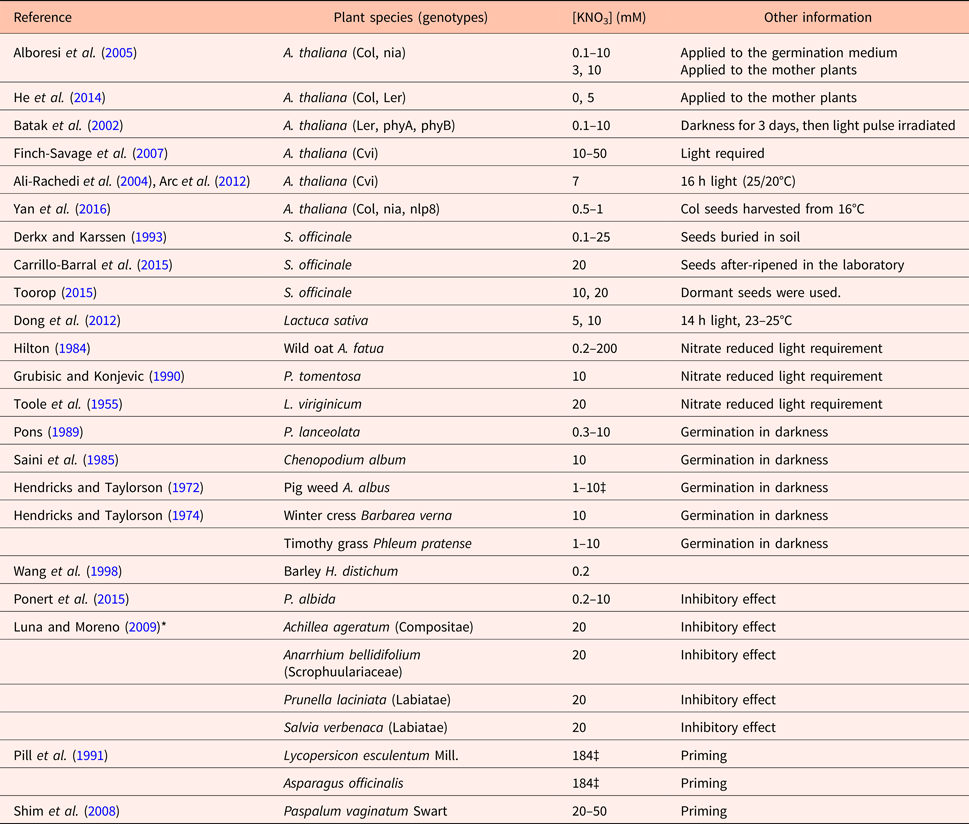
Seeds perceive and respond to a change in environmental conditions such as temperature, light, storage periods (after-ripening), moisture content and nitrate. Nitrate is a macronutrient that exists in the soil and is often a limiting factor for plant growth. Nitrate is known to be a germination stimulator for a wide variety of plant species, thus it is used as an agent for seed priming (Pill et al., Reference Pill, Frett and Morneau1991; Shim et al., Reference Shim, Moon, Jang, Raymer and Kim2008). Nitrate is capable of stimulating seed germination at low concentrations (Table 1) in Arabidopsis (0.1 mM; Alboresi et al., Reference Alboresi, Gestin, Leydecker, Bedu, Meyer and Truong2005), Sisymbrium officinale (0.1 mM; Derkx and Karssen, Reference Derkx and Karssen1993), wild oat Avena fatua L. (0.2 mM; Hilton, Reference Hilton1984) and barley Hordeum distichum (0.2 mM; Wang et al., Reference Wang, van der Meulen, Visser, van Schaik, van Duijn and de Boer1998). Nitrate can also inhibit the seed germination of some species (Luna and Moreno, Reference Luna and Moreno2009; Boudell and Stromberg, Reference Boudell and Stromberg2015), even at low concentrations (0.2 mM; Ponert et al., Reference Ponert, Figura, Vosolsobe, Lipavská, Vohník and Jersáková2015; see Table 1). Hendricks and Taylorson (Reference Hendricks and Taylorson1972) reported that nitrate promotes germination of the pigweed Amaranthus albus seeds even in the presence of tungstate, a NR inhibitor. Hilhorst and Karrsen (Reference Hilhorst and Karssen1989) also reported that nitrate-mediated promotion of S. officinale seed germination occurs independently of its assimilation. NR-independent promotion of germination was shown by experiments using the Arabidopsis NR-deficient nia1nia2 mutant (Alboresi et al., Reference Alboresi, Gestin, Leydecker, Bedu, Meyer and Truong2005). Collectively, these reports support the notion that nitrate itself promotes seed germination by acting as a signal.
Representative germination conditions and nitrate concentrations used in the papers cited in this article

Nitrate regulates the germination of seeds in various species under different conditions. *Luna and Moreno (Reference Luna and Moreno2009) investigated 53 species and found nine and four species whereby nitrate both positively and negatively affects germination, respectively. For the Luna and Moreno paper, only those species that reacted negatively to nitrate are listed here, due to the limitation in space. ‡NaNO3 is used to see the effect of nitrate.
Sensitivity to nitrate changes during the season when seeds are buried in soil or during after-ripening in the laboratory. The seed sensitivity to nitrate (or its requirement), but not the seed nitrate content, fluctuates during seasons in S. officinale seeds buried in soil (Bouwmeester and Karssen, Reference Bouwmeester and Karssen1993; Bouwmeester et al., Reference Bouwmeester, Derks, Keizer and Karssen1994). The patterns of changes in the nitrate sensitivity during seasons are different between winter annual Cape Verde Island (Cvi) and summer annual Burren (Bur), and is under the control of temperature-driven dormancy cycling (Finch-Savage and Footitt, Reference Finch-Savage and Footitt2017). Seed sensitivity to nitrate largely depends on after-ripening in the Arabidopsis Cvi accession (Finch-Savage et al., Reference Finch-Savage, Cadman, Toorop, Lynn and Hilhorst2007) and S. officinale (Carrillo-Barral et al., Reference Carrillo-Barral, Matilla, García-Ramas and Rodríguez-Gacio2015). Experiments with Plantago lanceolata seeds that are buried in soil with or without other plants to consume nitrate in the soil, suggests that nitrate acts as a component of a gap detection mechanism (Pons, Reference Pons1989).
Seed sensitivity to nitrate is often associated with light sensitivity for seed germination (Footitt et al., Reference Footitt, Huang, Clay, Mead and Finch-Savage2013; Table 1). Seed germination of S. officinale requires both nitrate and light (Hilhorst et al., Reference Hilhorst, Smitt and Karssen1986), as nitrate fails to promote seed germination of S. officinale in the dark. The sensitivity to nitrate and light changes similarly during the season and regulates seasonal dormancy patterns in soil-buried S. officinale seeds, which is different from the pattern of the changes in GA sensitivity (Derkx and Karssen, Reference Derkx and Karssen1993). Nitrate reduces the light requirement for germination in various seeds such as Lepidium vriginicum (Toole et al., Reference Toole, Toole, Borthwick and Hendricks1955), Arabidopsis and S. officinale (Hilhorst and Karssen, Reference Hilhorst and Karssen1988; Batak et al., Reference Batak, Dević, Gibal, Grubišić, Poff and Konjević2002), A. fatua (Hilton, Reference Hilton1984) and Paulownia tomentosa (Grubisic and Konjevic, Reference Grubisic and Konjevic1990). The dormant Arabidopsis accession Cvi seeds germinate either when the seeds are fully after-ripened or when both light and nitrate are supplied in the germination condition, but not in the presence of nitrate alone (Finch-Savage et al., Reference Finch-Savage, Cadman, Toorop, Lynn and Hilhorst2007). Nitrate action is not restricted to photoblastic germination and is capable of promoting germination in the dark for various plant species (Hendricks and Taylorson, Reference Hendricks and Taylorson1972, Reference Hendricks and Taylorson1974; Pons, Reference Pons1989; Saini et al., Reference Saini, Bassi and Spencer1985).
Nitrate action during germination
Functional genomics research in Arabidopsis has revealed that nitrate triggers downstream events that are similar to other germination stimulators, such as after-ripening, light and stratification. Finch-Savage et al. (Reference Finch-Savage, Cadman, Toorop, Lynn and Hilhorst2007) performed a transcriptome analysis on seeds of Cvi, an Arabidopsis dormant accession treated with germination stimulators (light, after-ripening, stratification and nitrate). The patterns of seed transcriptomes indicate that these germination stimulators elicit a similar change in transcriptomes. A proteome analysis revealed that dormancy release induced by cold stratification and nitrate supply to Arabidopsis Cvi seeds stimulates a similar change in proteome patterns (Arc et al., Reference Arc, Chibani, Grappin, Jullien, Godin, Cueff, Valot, Balliau, Jon and Rajjou2012). In addition, metabolome analysis also indicates that the effects of nitrate and temperature in the mother plant are mediated through partially overlapping genetic mechanisms during seed maturation in Arabidopsis (He et al., Reference He, Willems, Batushansky, Fait, Hanson, Nijveen, Hilhorst and Bentsink2015). This collectively suggests that the distinct environmental signalling pathways impinge on a common (or shared) regulatory machinery to elicit the downstream process and determine whether seeds germinate or not.
The plant hormones abscisic acid (ABA) and gibberellins (GAs) are possible targets for environmental signalling, as it has been reported that the hormone levels and seed sensitivities to these hormones are influenced by environmental factors (Kucera et al., Reference Kucera, Cohn and Leubner-Metzger2005; Nambara et al., Reference Nambara, Okamoto, Tatematsu, Yano, Seo and Kamiya2010; Yamaguchi, Reference Yamaguchi2008). In many plant species, ABA is involved in the induction and maintenance of seed dormancy during seed development and inhibits seed germination, while GA promotes seed germination. ABA accumulates during seed development, and dry seeds contain a high ABA content which decreases during seed imbibition (Nambara et al., Reference Nambara, Okamoto, Tatematsu, Yano, Seo and Kamiya2010). Levels of bioactive GAs are low in dry seeds and its synthesis is associated with seed germination (Yamaguchi, Reference Yamaguchi2008; Seo et al., Reference Seo, Nambara, Choi and Yamaguchi2009). In Arabidopsis seeds, nitrate-induced gene expression is observed after 6 h of imbibition in the presence of nitrate (Matakiadis et al., Reference Matakiadis, Alboresi, Jukumaru, Tatematsu, Pichon, Renou, Kamiya, Nambara and Truong2009). This induction temporarily coincides with the decrease of ABA content in imbibed seeds, but not with the induction of GA biosynthesis which occurs just prior to seed germination (Preston et al., Reference Preston, Tatematsu, Kanno, Hobo, Kimura, Jikumaru, Yano, Kamiya and Nambara2009; Ogawa et al., Reference Ogawa, Hanada, Yamauchi, Kuwahara, Kamiya and Yamaguchi2003). It was shown that a low concentration of nitrate leads to a decrease of the ABA level in dormant barley seeds (Wang et al., Reference Wang, van der Meulen, Visser, van Schaik, van Duijn and de Boer1998), and in Arabidopsis Cvi seeds (Ali-Rachedi et al., Reference Ali-Rachedi, Bouinot, Wagner, Bonnet, Sotta, Grappin and Jullien2004). This acceleration of the ABA decrease involves the nitrate induction of CYP707A2 (Matakiadis et al., Reference Matakiadis, Alboresi, Jukumaru, Tatematsu, Pichon, Renou, Kamiya, Nambara and Truong2009). CYP707A2 encodes an ABA 8′-hydroxylase, the major ABA catabolic enzyme in imbibed seeds (Kushiro et al., Reference Kushiro, Okamoto, Nakabayashi, Yamagishi, Kitamura, Asami, Hirai, Koshiba, Kamiya and Nambara2004; Okamoto et al., Reference Okamoto, Kuwahara, Seo, Kushiro, Asami, Hirai, Kamiya, Koshiba and Nambara2006). Importantly, nitrate fails to decrease the ABA content in the cyp707a2 mutants when nitrate is supplied to the germination medium, and decreases the sensitivity of germination to nitrate (Matakiadis et al., Reference Matakiadis, Alboresi, Jukumaru, Tatematsu, Pichon, Renou, Kamiya, Nambara and Truong2009; Yan et al., Reference Yan, Easwaran, Chau, Okamoto, Ierullo, Kimura, Endo, Yano, Pasha, Gong, Bi, Provart, Guttman, Krapp, Rothstein and Nambara2016). Nitrate also induces the expression of SoCYP707A2 in S. officinale seeds (Carrillo-Barral et al., Reference Carrillo-Barral, Matilla, Iglesias-Fernández and Rodríguez-Gacio2013, Reference Carrillo-Barral, Matilla, Rodríguez-Gacio and Iglesias-Fernández2014). Nitrate induction of SoCYP707A2 in S. officinale seeds precedes the up-regulation of SoGA3ox2 (Carrillo-Barral et al., Reference Carrillo-Barral, Matilla, Iglesias-Fernández and Rodríguez-Gacio2013, Reference Carrillo-Barral, Matilla, Rodríguez-Gacio and Iglesias-Fernández2014), the homologue of the GA 3-oxidase gene encoding the key enzyme in seed GA biosynthesis (Toyomasu et al., Reference Toyomasu, Tsuji, Yamane, Nakayama, Yamaguchi, Murofushi, Takahashi and Inoue1993; Ogawa et al., Reference Ogawa, Hanada, Yamauchi, Kuwahara, Kamiya and Yamaguchi2003). This suggests that the PNR in seeds is at least in part conserved between Arabidopsis and S. officinale.
Nitrate action during seed development
The genotype and environment of the mother plant impacts the degree of primary seed dormancy (Penfield, Reference Penfield2017). Some recent work in Arabidopsis reported that, when varying concentrations of nitrate are applied to the mother plant, the harvested seeds display different degrees of seed primary dormancy, which negatively correlates with the nitrate dose applied to the mother plant (Alboresi et al., Reference Alboresi, Gestin, Leydecker, Bedu, Meyer and Truong2005; Matakiadis et al., Reference Matakiadis, Alboresi, Jukumaru, Tatematsu, Pichon, Renou, Kamiya, Nambara and Truong2009; He et al., Reference He, Vidigal, Snoek, Schnabel, Nijveen, Hilhorst and Bentsink2014). In addition, the accumulation of nitrate in the dry seed correlates with the nitrate concentrations applied to mother plants (Alboresi et al., Reference Alboresi, Gestin, Leydecker, Bedu, Meyer and Truong2005). When nitrate is applied to the mother plant, its effect depends on both the genotype (i.e. accession) and temperature (Huang et al., Reference Huang, Footitt, Tang and Finch-Savage2018). Importantly, the effects of maternally applied nitrate on seed dormancy can be seen even in the NR null mutant in which two Arabidopsis NR genes are mutated.
Nitrate accumulated in dry seeds negatively correlates with the ABA content, which is CYP707A2-dependent (Matakiadis et al., Reference Matakiadis, Alboresi, Jukumaru, Tatematsu, Pichon, Renou, Kamiya, Nambara and Truong2009). In Arabidopsis, both CYP707A1 and CYP707A2 are differentially involved in regulating seed dormancy and germination. CYP707A1 plays a major role in reducing ABA levels in immature seeds in the mid-maturation stage, while CYP707A2 acts in the late-maturation stage and during seed imbibition of mature seeds (Okamoto et al., Reference Okamoto, Kuwahara, Seo, Kushiro, Asami, Hirai, Kamiya, Koshiba and Nambara2006). It is worth noting that CYP707A2-dependent nitrate action in the late-maturation stage coincides with the timing of primary dormancy induction in Arabidopsis (Karssen et al., Reference Karssen, Brinkhorst-van der Swan, Breekland and Koornneef1983). An Arabidopsis transporter AtNRT2.7 was shown to impact the seed nitrate content during seed development, and its loss-of-function affects seed germination. AtNRT2.7 is localized to the vacuolar membrane, suggesting that this transporter possibly regulates the nitrate storage in the vacuole of seeds after nitrate transport from the mother plant until its utilisation during seed germination (Chopin et al., Reference Chopin, Orsel, Dorbe, Chardon, Truong, Miller, Krapp and Daniel-Vedele2007).
Nitrate-regulated genes in imbibed seeds
Transcriptome analyses in Arabidopsis seeds have identified nitrate-regulated genes in imbibed seeds. Nitrate-dependent differentially expressed genes (DEGs) vary in their expression depending on the seed properties (i.e. the amount of nitrate supplied to the mother plants, after-ripening, and genotypes such as accessions or mutants), and the concentrations and period of nitrate treatments. Despite this, the nitrate-regulated seed transcriptome in the early stage of imbibition tends to be similar to other nitrate-regulated transcriptomes in other tissues (Matakiadis et al., Reference Matakiadis, Alboresi, Jukumaru, Tatematsu, Pichon, Renou, Kamiya, Nambara and Truong2009; Yan et al., Reference Yan, Easwaran, Chau, Okamoto, Ierullo, Kimura, Endo, Yano, Pasha, Gong, Bi, Provart, Guttman, Krapp, Rothstein and Nambara2016). This suggests that the molecular mechanisms underlying the PNR are similar between seeds and other organs. Nitrate-regulated DEGs in imbibed seeds include genes involved in nitrate assimilation (such as NR, NiR), nitrate transport (such as CHL1/NRT1.1), carbon metabolism and energy production (such as glucose-6-phosphate dehydrogenase), and the GARP-type transcription factors, as well as genes involved in hormone metabolism and signalling. It is noteworthy that the seed PNR genes CYP707A2 and NIA2 are induced by nitrate, and exhibit peak transcript expression at 6 h and decreases thereafter (Yan et al., Reference Yan, Easwaran, Chau, Okamoto, Ierullo, Kimura, Endo, Yano, Pasha, Gong, Bi, Provart, Guttman, Krapp, Rothstein and Nambara2016). On the other hand, nitrate-regulated transcriptomes in the late imbibed seeds (i.e. 24 h imbibed seeds) resemble those found in imbibed seeds treated with other germination stimulators (Finch-Savage et al., Reference Finch-Savage, Cadman, Toorop, Lynn and Hilhorst2007).
Regulators for seed nitrate responses
Mutants defective in seed nitrate responses are useful for evaluating the role of these genes. Some Arabidopsis loci have been reported to confer less sensitivity to nitrate in seeds. The chl1 mutant defective in the CHL/NRT1.1 nitrate transceptor shows nitrate-less sensitive germination (Alboresi et al., Reference Alboresi, Gestin, Leydecker, Bedu, Meyer and Truong2005), consistent with its function as a nitrate sensor (Ho et al., Reference Ho, Lin, Hu and Tsay2009). The cyp707a2 mutant is less sensitive to nitrate during both seed development and germination (Matakiadis et al., Reference Matakiadis, Alboresi, Jukumaru, Tatematsu, Pichon, Renou, Kamiya, Nambara and Truong2009; Yan et al., Reference Yan, Easwaran, Chau, Okamoto, Ierullo, Kimura, Endo, Yano, Pasha, Gong, Bi, Provart, Guttman, Krapp, Rothstein and Nambara2016). In addition, the nlp8 mutant defective in NLP8, the most abundantly expressed NLP in seeds, displays the prominent nitrate-insensitive phenotype in seeds (Yan et al., Reference Yan, Easwaran, Chau, Okamoto, Ierullo, Kimura, Endo, Yano, Pasha, Gong, Bi, Provart, Guttman, Krapp, Rothstein and Nambara2016). The nlp8 mutant does not show a nitrate-induced ABA decrease in imbibed seeds and fails to promote germination in response to nitrate. A transcriptome analysis showed that the nitrate-responsive gene expression is fully halted in 6 h-imbibed seeds of the nlp8 mutant. Moreover, NLP8 directly binds to the CYP707A2 promoter region required for its nitrate induction. NLP8 is post-translationally activated by nitrate signalling in imbibed seeds. However, NLP8-GFP is localized to the nuclei regardless of the application of nitrate (Yan et al., Reference Yan, Easwaran, Chau, Okamoto, Ierullo, Kimura, Endo, Yano, Pasha, Gong, Bi, Provart, Guttman, Krapp, Rothstein and Nambara2016) (Fig. 1A). This indicates that both seeds and plants post-translationally activate NLP transcription factors for the PNR, but that the upstream mechanisms are distinct. Moreover, the nitrate-insensitive phenotype of the chl1 mutant seeds is much less prominent than that of nlp8, suggesting that another nitrate sensor is present in seeds to activate NLP8.
Nitric oxide (NO) breaks seed dormancy (Arc et al., Reference Arc, Galland, Godin, Cueff and Rajjou2013). A NO scavenger blocks the nitrate action to promote germination in Arabidopsis and lettuce (Bethke et al., Reference Bethke, Libourel, Reinohl and Jones2006; Dong et al., Reference Dong, Tong, Xiao, Cheng and Song2012). In addition, both nitrate and NO induce the expression of CYP707A2 (Matakiadis et al., Reference Matakiadis, Alboresi, Jukumaru, Tatematsu, Pichon, Renou, Kamiya, Nambara and Truong2009; Liu et al., Reference Liu, Shi, Ye, Liu, Jia and Zhang2009). Therefore, it was postulated that NO acts downstream of nitrate signalling (Bethke et al., Reference Bethke, Libourel, Reinohl and Jones2006). Recently, some regulators for NO responses in seeds have been identified. Group VII ethylene response factors (ERFs) are transcription factors targeted by the N-end rule protein degradation pathway in the presence of NO (Gibbs et al., Reference Gibbs, Isa, Movahedi, Lozano-Juste, Mendiondo, Berckhan, Marín-de la Rosa, Conde, Correia, Pearce, Bassel, Hamali, Talloji, Tomé, Coego, Beynon, Alabadí, Bachmair, León, Gray, Theodoulou and Holdsworth2014). Group VII ERFs regulate the expression of ABSCISIC ACID-INSENSITIVE5 (ABI5), which encodes a bZIP transcription factor that binds to the ABA-responsive cis-element essential for seed ABA responses (Finkelstein and Lynch, Reference Finkelstein and Lynch2000; Lopez-Molina and Chau, Reference Lopez-Molina and Chau2000). Another NO pathway that promotes germination is the direct S-nitrosylation of ABI5, which induces the degradation of ABI5 (Albertos et al., Reference Albertos, Romero-Puertas, Tatematsu, Mateos, Sanchez-Vincente, Nambara and Lorenzo2015). Therefore, mutants defective in N-end rule pathways, prt6 and ate1ate2, and the abi5 mutant display NO-insensitive seed germination (Gibbs et al., Reference Gibbs, Isa, Movahedi, Lozano-Juste, Mendiondo, Berckhan, Marín-de la Rosa, Conde, Correia, Pearce, Bassel, Hamali, Talloji, Tomé, Coego, Beynon, Alabadí, Bachmair, León, Gray, Theodoulou and Holdsworth2014; Albertos et al., Reference Albertos, Romero-Puertas, Tatematsu, Mateos, Sanchez-Vincente, Nambara and Lorenzo2015). The NO-insensitive prt6 and ate1ate2 mutants are sensitive to nitrate (Yan et al., Reference Yan, Easwaran, Chau, Okamoto, Ierullo, Kimura, Endo, Yano, Pasha, Gong, Bi, Provart, Guttman, Krapp, Rothstein and Nambara2016). In addition, expression of ABI5 is not altered in the nlp8 mutant (Yan et al., Reference Yan, Easwaran, Chau, Okamoto, Ierullo, Kimura, Endo, Yano, Pasha, Gong, Bi, Provart, Guttman, Krapp, Rothstein and Nambara2016). This indicates that NO signalling is not a simple and linear pathway that is downstream of nitrate signalling. Nitrate and NO signalling form two distinct pathways that are also likely to have extensive interactions between one another.
Future perspectives
As physiological dormancy is dynamic (Baskin and Baskin, Reference Baskin and Baskin2004; Huang et al., Reference Huang, Olcer-Footitt, Footitt and Finch-Savage2015), more studies need to be conducted to address the mode of nitrate action for the different aspects of seed dormancy and germination in various plant species (Thompson and Ooi, Reference Thompson and Ooi2010; Finch-Savage and Footitt, Reference Finch-Savage and Footitt2012). The seed's sensitivity to nitrate is affected by other environmental factors, such as light and after-ripening. Interestingly, the mode of these interactions is diverse among plant species (Table 1). Our understanding is still limited for genotype-dependent diversity of physiological responses and the interaction between environmental signals. Recent advances in genetic and genomic tools will be helpful to address these questions.
Although the physiological effect of nitrate-mediated regulation of seed dormancy and germination has been well documented, the molecular mechanisms underlying nitrate regulation in seeds is still poorly understood. The complexity of nitrate action results from its dual function as a nutrient and a signal. Its signalling role has been well studied in Arabidopsis and S. officinale, but the majority of this work was reported without discriminating between these two functions. Indeed, there are some limitations in genetic materials such as NR-deficient mutants in most plant species. However, careful examination with time-course and dose-dependent experiments might help further the understanding of its signalling role in other species (Hilhorst and Karssen, Reference Hilhorst and Karssen1989). In addition, conservation of nitrate-regulated transcriptomes, as well as current rich genome information from various species, would give us molecular markers for the seed PNR genes. Furthermore, the nitrate effect during seed development, which supports its role in regulating primary dormancy has only been reported in Arabidopsis (Alboresi et al., Reference Alboresi, Gestin, Leydecker, Bedu, Meyer and Truong2005; Matakiadis et al., Reference Matakiadis, Alboresi, Jukumaru, Tatematsu, Pichon, Renou, Kamiya, Nambara and Truong2009; He et al., Reference He, Willems, Batushansky, Fait, Hanson, Nijveen, Hilhorst and Bentsink2015). Recent genomics tools such as transcriptomes, proteomes and metabolomes are highly sensitive and robust (Finch-Savage et al., Reference Finch-Savage, Cadman, Toorop, Lynn and Hilhorst2007; Arc et al., Reference Arc, Chibani, Grappin, Jullien, Godin, Cueff, Valot, Balliau, Jon and Rajjou2012; He et al., Reference He, Willems, Batushansky, Fait, Hanson, Nijveen, Hilhorst and Bentsink2015), and are widely available in many plant species. Understanding the response of the plant to varied environmental conditions during seed development and filling are crucial for both academic and agricultural research. Investigation of such nitrate-related maternal effects in different plant species will be the key to filling in our current gaps in knowledge.
It remains unclear if particular seed tissues are responsible for the nitrate response. In S. officinale seeds, nitrate promotes cell expansion in the embryo and induces testa rupture, which accelerates water uptake (Toorop, Reference Toorop2015). In Arabidopsis seeds imbibed in water, CYP707A2 is expressed in the radicle, endodermis of the hypocotyl, and endosperm (Okamoto et al., Reference Okamoto, Kuwahara, Seo, Kushiro, Asami, Hirai, Kamiya, Koshiba and Nambara2006). Recently, it was reported that a spatially embedded small region in the radicle called the decision-making centre plays a key role in breaking seed dormancy (Topham et al., Reference Topham, Taylor, Yan, Nambara, Johnston and Bassel2017). Moreover, the endosperm plays an active role in regulating seed dormancy and germination (Yan et al., Reference Yan, Duermeyer, Leoveanu and Nambara2014). The endosperm regulates its physical strength by regulating cell wall modifying enzymes (Leubner-Metzger, Reference Leubner-Metzger2003), and secretes ABA as a communication tool with the embryo to regulate embryonic growth potential (Lee et al., Reference Lee, Piskurewicz, Tureckova, Strnad and Lopez-Molina2010). It is noteworthy that the endosperm cell itself is capable of sensing light and activates downstream events (Lee et al., Reference Lee, Piskurewicz, Tureckova, Carat, Chappuis, Strnad, Fankhauser and Lopez-Molina2012). Because the endosperm is the most outer layer of living tissue in seeds, the role of the endosperm in the communication between the seed and the environment, and not just between the embryo and endosperm itself, would be worth investigating. Studies on seed nitrate action are still in the very early stages. More in-depth understanding of the mechanism and more widespread understanding in various plant species and different physiological states is required for fully understanding the nitrate action in seeds.
Financial support
This work is supported by Natural Sciences and Engineering Research Council of Canada (NSERC) Discovery Grant RGPIN 355784 and benefits from the support of the LabEx Saclay Plant Sciences-SPS (ANR-10-LABX-0040-SPS).