The frequency of climate-related disasters is on the rise in the United States and worldwide.Reference Crimmins, Balbus and Gamble 1 , Reference Coughlan de Perez, van Aalst and Chetan 2 Climate-related disasters, such as severe hurricanes, can lead to significant distress and psychological impairment.Reference Bonanno, Brewin, Kaniasty and La 3 , Reference Furr, Comer, Edmunds and Kendall 4 In particular, research identifies children and parents as vulnerable populations after destructive disasters.Reference Crimmins, Balbus and Gamble 1 , Reference Bonanno, Brewin, Kaniasty and La 3 , Reference Norris, Friedman and Watson 5 , Reference Reininger, Raja and Carrasco 6
With respect to hurricanes, much is known about their impact “during” and “after” the storm,Reference Bonanno, Brewin, Kaniasty and La 3 , Reference Furr, Comer, Edmunds and Kendall 4 although substantially less attention has been devoted to understanding the stress associated with the “before the storm” impact of evacuating one’s home and leaving behind one’s belongings. Such information is critical to emergency planners who must issue effective evacuation orders and prepare for the safe displacement of large numbers of individuals when a potential disaster is about to strike. Such information is also useful for families preparing for impending storms to minimize potential psychological distress.
The 2017 Atlantic hurricane season provided an opportunity to formally evaluate “before the storm” experiences and stressors associated with the evacuation process among families, as Hurricanes Harvey, Irma, and Maria affected millions of families in the mainland United States and Puerto Rico. 7 In particular, Hurricane Irma – which to date, with peak winds of 185 mph, the strongest hurricane ever recorded in the AtlanticReference Potenza 8 – was initially projected to hit Florida as a Category 5 hurricane (ie, sustained winds exceeding 165 mph) and to strike South Florida before heading up through the state’s center.Reference Samenow and McNoldy 9 Irma’s projected path led to the largest mass evacuation of Florida residents in state history, with over 6.5 million residents, largely from South Florida, ordered to evacuate.Reference Argos 10 Hurricane Irma eventually struck South Florida twice as a Category 3 or 4 storm, making landfall in the Florida Keys and Naples; however, the entire South Florida peninsula was affected by the storm,Reference Alanez and Fleshler 11 with over 60% of the state (and over 6 million homes) losing power for an extended time.Reference Lovelace 12
In the context of this massive evacuation, this study’s objective was to examine the experiences and stressors associated with the evacuation process among families residing in South Florida at the time of the storm. We targeted parents of children (under age 18 years), because parents and children are particularly vulnerable populations in such disasters.Reference Norris, Friedman and Watson 5
Do Evacuees Experience More Stress Than Non-evacuees? Do They Feel Safe? What Is Most Stressful About Evacuation?
Given the destructive power of hurricanes, evacuation is among the most widely used strategies for protecting lives in the face of impending storms.Reference Archibald and McNeil 13 , Reference Wilmot, Levitan and Wolshon 14 However, the evacuation process involves risk and could be a major stressor for families. Studies have not examined the perceived stress of families who evacuated versus remained in their homes. In the face of an impending, major hurricane, evacuees might experience more “relief” than those who remain at home and in harm’s way. On the other hand, the evacuation process itself can be fraught with multiple logistic problems (eg, transportation hurdles) that could prove extremely stressful for parents and families. Such stress might impede a successful evacuation process and thus would be of considerable interest to emergency planners. To our knowledge, no empirical studies have identified aspects of the evacuation process that are most stressful or aversive to families.
Prior research has examined factors that contribute to individuals’ intentions to comply with mandatory evacuation ordersReference Reininger, Raja and Carrasco 6 or differentiate individuals who do or do not evacuate.Reference Edwards and Bateman 15 – Reference Kulkarni, Gu and Tsai 20 For example, some studies reveal that women and households with children are more likely to evacuate.Reference Edwards and Bateman 15 , Reference Smith and McCarty 18 Although such information is important for disaster planning, it is also critical to understand what specific aspects of the evacuation process are stressful/aversive. Stressful experiences could affect families’ physical and mental health and influence future evacuation intentions and behavior. Moreover, it is important to determine whether families that evacuate feel safer during the storm.
Study Aims
The present study surveyed South Florida parents about their perceptions of stress and safety before, during, and after Hurricane Irma, as well as their evacuation experiences. Our specific aims were to (1) determine whether evacuees reported greater perceived stress before, during, and after the hurricane compared with families who remained at home; (2) evaluate whether families who evacuated felt safer before and during the storm than those who did not; and (3) identify aspects of the evacuation process (before and after the storm) that families found most stressful. We expected that parents who evacuated would report feeling safer during the storm, but would report greater stress before and during the storm than those who remained at home, possibly due to challenges associated with evacuation, to discomfort being displaced from home, and to the uncertainty of knowing how one’s home is faring during the storm. Further, we expected transportation and family issues to be paramount among the experiences that parents would find stressful, both before and after the storm. Transportation issues (eg, traffic, fuel scarcity) have been emphasized in the media as challenges for hurricane evacuees,Reference Eisenman, Cordasco and Asch 19 , Reference Clark and Bousquet 21 and could affect evacuees as they leave and as they return home. Family issues (eg, pressures to leave/stay) also influence the evacuation decision-making processReference Riad, Norris and Ruback 17 , Reference Eisenman, Cordasco and Asch 19 and could be stressful. In addressing these aims, we considered whether families were under mandatory evacuation orders, as such individuals are more likely to evacuate than those not under mandatory orders.Reference Kulkarni, Gu and Tsai 20 , Reference Lazo, Bostrom and Morss 22 Finally, given the lack of research on evacuation-related stress and, because there may be positive aspects to the evacuation process (eg, psychological relief due to feeling safe), our last aim was to (4) obtain parents’ perspectives on the evacuation process by asking them about the “best” and “worst” parts of evacuating.
METHODS
Participants
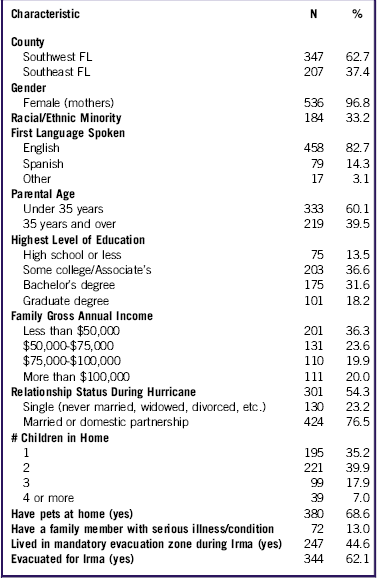
Parents of children (under age 18 years) residing in South Florida counties most directly impacted by Hurricane Irma were eligible to participate. The counties included were Miami-Dade, Broward, and Monroe in Southeast Florida, and Lee and Collier in Southwest Florida. Table 1 contains participant characteristics (N=554). Most parents identified as white, non-Hispanic, female, and under age 35; most (83%) reported English as their first language (17% reported Spanish or other). Socioeconomic status varied, but over a third of families were low income. Almost half (44.6%) reported residing in a mandatory evacuation zone at the time of Irma, and 81.8% of those families evacuated. Of the families not residing in an evacuation zone, nearly half (46.1%) reported evacuating. Overall, 62.1% of the families evacuated their homes.
Socio-Demographic Characteristics and Evacuation Status of the Sample (N=554)

Procedures
The Institutional Review Boards at the University of Miami and Florida International University approved study procedures/materials. Participants provided informed consent and completed study questionnaires via an online Qualtrics survey; nearly all parents chose to complete the forms in English. Parents were recruited via Facebook ads specifically targeting the five South Florida counties. Participants either received a $25 gift card or donated funds to hurricane relief. Surveys were completed mid-December 2017 to early January 2018, 3 to 4 months after Irma. The survey was closed upon approaching 600 respondents due to funding constraints.
In all, 584 surveys were completed. We excluded 30 participants due to concerns about valid responses. We followed a standard protocol to check response validity: (1) checking that the participant’s home address was valid and located in a target county; (2) having several “roadblock” items (eg, Do you live in Montana?) embedded in the survey to ensure responses were from an attentive human; and (3) checking for response consistency (eg, child’s birthdate and reported age matched, zip codes matched), among other checks. One participant was excluded for indicating he or she lived in Montana, another for providing inconsistent zip codes, another for substantial missing data, and 27 for incomplete or inconsistent child birthdate/age information (final N=554).
Measures
Demographic Questionnaire
Parents completed items regarding age, gender, ethnicity, race, income, educational level, county of residence, and family characteristics (see Table 1). These items served as potential control variables in the analyses. The county of residence was consolidated into Southeast Florida (Miami-Dade, Broward, Monroe) and Southwest Florida (Collier, Lee). Initially, Irma was predicted to strike Southeast Florida and the Keys, and these areas received early mandatory evacuation orders; however, the storm eventually veered west, primarily affecting Southwest Florida. Parents reported whether they lived in a mandatory evacuation zone and whether they evacuated.
Perceptions of Hurricane-related Stress and Safety
Six items from the Hurricane-Related Traumatic Experiences-II (HURTE-II)Reference La Greca 23 questionnaire assessed parents’ perceived stress levels and perceived safety levels before, during, and after the hurricane. Participants rated each item on a 4-point scale (0=not at all to 3=a whole lot). Initially developed after Hurricane Andrew in 1992, the HURTEReference La Greca, Silverman, Lai and Jaccard 24 , Reference La Greca, Silverman, Vernberg and Prinstein 25 is a widely used measure of hurricane-related experiences.Reference La Greca, Silverman, Lai and Jaccard 24 – Reference Weems, Taylor and Cannon 26 The HURTE-II includes a section on pre-hurricane events and is being used in multiple studies examining the impact of the 2017 hurricanes on children and adults.
Hurricane-related Evacuation Experiences
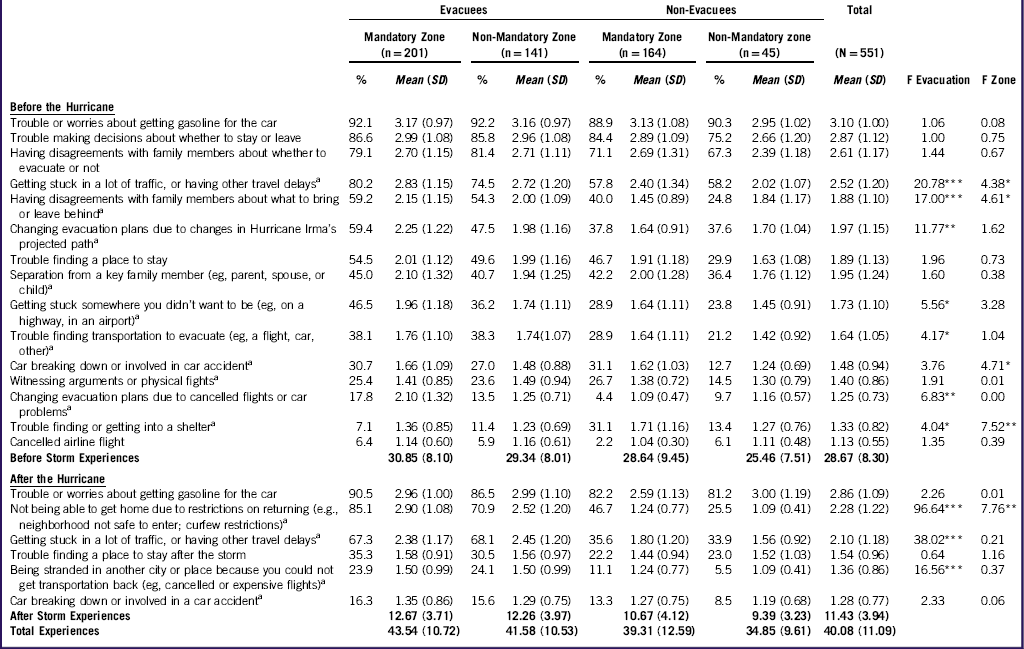
We developed a 21-item measure of before (15 items) and after the storm (6 items) experiences (Before and After the Storm Experiences). Because our entire research team experienced Irma, we initially generated items based on our experiences, extensive local and national news reports, and experiences from the scores of South Florida families with whom we work clinically. We incorporated items that reflected reasons why adults reported evacuating (or not) for prior hurricanes.Reference Riad, Norris and Ruback 17 After generating a list of experiences, we piloted the measure with parents who experienced Irma, which resulted in a total of 21 evacuation-related items (Table 2). Participants rated each item on its stressfulness (1=did not happen/was not stressful to 4=very stressful). Ratings were summed across relevant items, and scores were calculated for Before the Storm, After the Storm, and Total. See the Results section for psychometric support.
Evacuation Experiences: Items From Before and After the Storm Experiences

Note: % refers to percent endorsed as at least a little stressful. There were no significant interaction effects.
a Did not meet homogeneity of variance assumption for F test.
Best and Worst Experiences
Parents who evacuated during Irma were asked two questions: What was the best part of evacuating? and What was the worst part of evacuating? All responses were coded, as described in following sections.
Current Perceived Stress
Parents also completed the Perceived Stress Scale,Reference Cohen, Kamarck and Mermelstein 27 a widely used 10-item scale, to index their current levels of perceived stress. This was considered a potential control variable in the analyses.
Data Analysis
Data were analyzed for missingness. Descriptive statistics, correlations, internal consistencies, and primary study analyses were conducted in SPSS Version 24. Demographic variables related to key outcomes were controlled, and associations were examined using t-tests for categorical variables (eg, gender) and correlations for continuous variables (eg, age).
Quantitative
For Aims 1 and 2, a 2x2 analysis of covariance (ANCOVA; Evacuated versus not; Mandatory zone versus not) compared parents on their perceived levels of stress and of safety before, during, and after the storm, controlling for demographics. For Aim 3, internal consistencies were calculated for the “Before,” “After,” and “Total” scores of Before and After the Storm Experiences; these scores were correlated with HURTE-II items of perceived stress before, during, and after the storm for validation purposes. Next, 2x2 ANCOVAs (Evacuated versus not; Mandatory zone versus not) compared parents’ ratings of stressfulness of “Before” and “After” evacuation experiences, controlling for demographics.
Open-ended
For Aim 4, we used a summative approachReference Hsieh and Shannon 28 to analyze parents’ reports of their best and worst evacuation experiences. The research team reviewed responses and collaboratively developed separate codebooks for best and worst experiences based on observed themes. Two assistants used the codebook to categorize each response. For responses that included multiple themes, the first or most prominent theme was categorized. Inter-rater agreement was high (96.1% for best experiences, 87.7% for worst), and discrepancies were discussed and resolved (100% agreement).
RESULTS
Preliminary Analyses
Missingness was minimal (ie, 0.5% or less for every variable). Demographic variables were examined in relation to key variables on the HURTE-II and Before and After the Storm Experiences. Those residing in Southwest (versus Southeast) Florida reported greater stress on the HURTE-II for before, during, and after the storm; those with lower educational levels reported more stress during the storm; non-white individuals reported more stress before and after the storm; and females reported more stress before and during the storm (Ps<0.05). Being female, non-white, over age 35, having lower income, having less education, and living in Southwest Florida each were associated with greater stressfulness ratings for Before and After The Storm Experiences (Ps<0.05). Thus, these demographic variables were controlled in study analyses.
Were Evacuees More Stressed? (Aim 1)
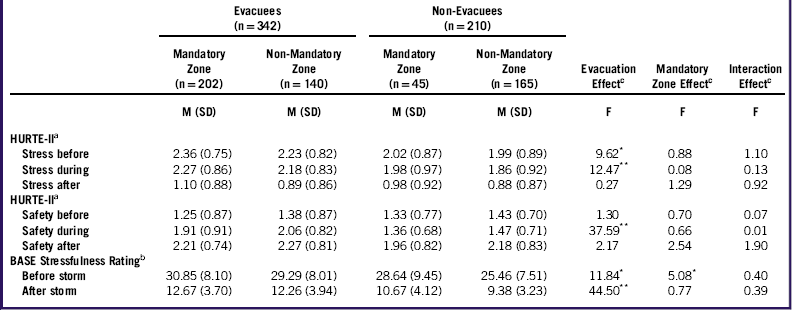
Parents who evacuated reported significantly greater stress before and during the hurricane than non-evacuees (Table 3), but not in their perceived stress after the hurricane. In general, evacuees reported moderately high levels of stress before and during the storm; parents’ stress before and during the storm were moderately related (r=0.55, P<0.001; Table 4). There were no significant differences between those residing versus not residing in mandatory evacuation zones, nor any interactions between evacuation and residing in a mandatory zone. As an exploratory follow-up analysis, we controlled for parents’ current levels of perceived stress, but this did not change any of the findings.
Perceived Stress Before, During, and After the Storm a and Ratings of Stressfulness for Hurricane Experiences b

**P<0.001, *P<0.01.
a Items from Hurricane Related Traumatic Experiences-II.
b Items from the Before and After the Storm Experiences (BASE) assessment.
c ANCOVAs controlling for gender, racial/ethnic minority status, education level, family annual income, county (southeast/southwest).
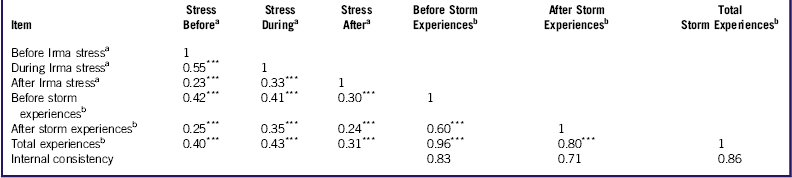
Correlations Between Stress Ratings on the HURTE-II and Ratings of Stressfulness of Hurricane Experiences

Note: N=554
***P<0.001
a Stress scores from the Hurricane Related Traumatic Experiences-II.
b Ratings of perceived stressfulness from Before and After the Storm Experiences.
Did Evacuees Feel Safer? (Aim 2)
Parents who evacuated reported feeling significantly safer during the hurricane than non-evacuees (see Table 3), but there were no differences in perceived safety before or after the storm. Both evacuees and non-evacuees reported feeling safer after the storm than before the storm. No other effects were observed. Follow-up analyses controlling for parents’ current levels of stress did not change any of these findings.
Comparing Experiences of Evacuees and Non-evacuees (Aim 3)
First, we examined the psychometric properties of the Before and After the Storm Experiences; means and internal consistencies were calculated (see Tables 3 and 4). As expected, ratings of Before, After, and Total experiences had acceptable internal consistency and were significantly correlated with parents’ reports of perceived stress before, during, and after the storm on the HURTE-II (see Table 4). These data provide initial psychometric support for Before and After the Storm Experiences.
Next, parents’ endorsements of evacuation experiences before and after Irma and their ratings of stressfulness are reported in Table 3. As expected, evacuating parents reported that their experiences were significantly more stressful than non-evacuees both before and after the storm. Parents residing in mandatory evacuation zones also reported that their “before the storm” experiences were more stressful than those not in an evacuation zone. Follow-up analyses controlling for parents’ current levels of stress did not change these findings.
We also examined individual evacuation experiences (see Table 2). (Items should be interpreted cautiously because some did not meet the assumption of homogeneity of variance, possibly because some items were less relevant for non-evacuees.) The most frequent and stressful “before” the storm experiences focused on transportation-related issues and family decision-making. Specifically, the largest differences between evacuees and non-evacuees were for the experiences of getting stuck in traffic, having family disagreements about what to bring or leave behind, altering plans due to changes in the hurricane’s projected path or because of transportation difficulties, and getting stuck somewhere they didn’t want to be. Interestingly, several experiences were comparably frequent or stressful for evacuees and non-evacuees, such as trouble finding a place to stay and separation from a key family member.
Overall, few differences emerged between those residing in mandatory evacuation zones versus not, although “trouble finding or getting into a shelter” was especially stressful for non-evacuating parents living in mandatory evacuation zones. In general, the lowest ratings of stressfulness were reported by parents who did not live in mandatory evacuation zones and remained at home (ie, did not evacuate).
Similarly, “after the storm” experiences were substantially more stressful for evacuees (see Tables 2 and 3). Transportation-related experiences (eg, getting stuck in traffic, being stranded away from home) and not being able to return home due to (local government) restrictions were more common and stressful for evacuees. Follow-up analyses controlling for parents’ current levels of stress did not change any of the aforementioned findings.
“Best” and “Worst” Aspects of Evacuation (Aim 4)
Best
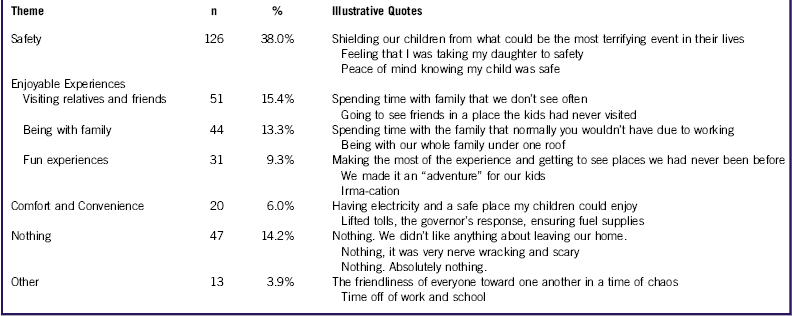
Of the 334 parents who evacuated for Irma, over one-third (n=126, 38%) reported that the best part of evacuating was safety or feeling safe (Table 5). They felt that evacuating kept their children safe from physical and psychological harm. Some described how evacuating reduced their worry or gave them “peace of mind.” The same number of parents explained how they turned evacuating into an enjoyable experience. Many discussed how their family spent quality time together or visited family or friends. Parents also used the evacuation as an adventure or vacation, taking their children to places like Disney World or the mountains. Others described the best part of evacuating as comfort and convenience; several described how they would not have had power or air-conditioning at home. A few mentioned that the best part was smooth logistics, such as having tolls lifted on highways. Interestingly, many parents (14.2%) said “nothing” was the best part of the evacuation (ie, there was nothing good about evacuating).
Descriptive Summary of Parents’ Open-Ended Reports of the Best Part of Evacuating (N=332)

Note: Only participants who evacuated their home (N=344) responded to this question; 12 participants left it blank.
Worst
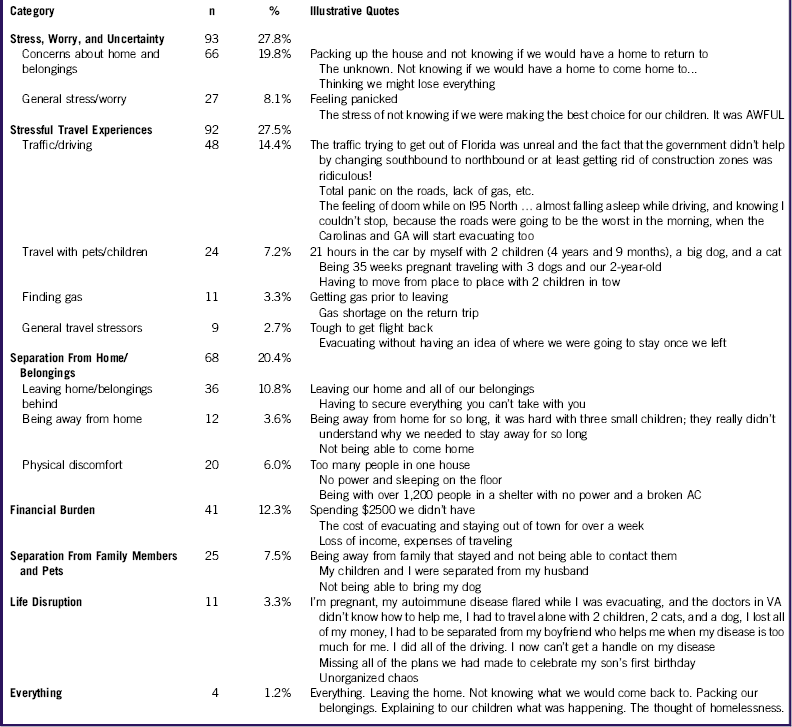
When parents who evacuated were asked about the worst part of evacuation, 27.8% of parents described general feelings of stress, worry, and uncertainty (Table 6), using phrases like “the unknown” and “not knowing.” Many parents (19.8%) were concerned about what would happen to their home or belongings; others worried about whether evacuating was the right decision for their family. Stressful travel experiences were reported by over a quarter (27.5% of parents), including trouble finding gas and spending long hours in heavy traffic. These responses largely mirrored the experiences frequently endorsed as stressful by evacuees (see Table 2).
Descriptive Summary of Parents’ Open-Ended Reports of the Worst Part of Evacuating (N=334)

Note: Only participants who evacuated their home (N=344) responded to this question; 10 participants left the item blank.
The open-ended responses provided further important details about why these evacuation experiences were so stressful for parents. Some discussed difficulties traveling with young children and pets (7.2%). Several parents faced these difficulties alone, because their partners stayed behind for work or to secure their home. In fact, 7.5% of parents named separation from family members or pets as the worst part of the evacuation. An additional 20.4% described the worst part as their separation from home and belongings; being away from home was both psychologically and physically uncomfortable. Several parents (6.0%) discussed the physical discomfort associated with the place where they stayed, such as overcrowding and unpleasant shelter conditions. Others (3.6%) felt homesick and struggled to explain to their children why they needed to stay away from home for so long.
Of particular importance, the evacuation was also a major financial burden to some families; 12.3% specifically named financial stress as the worst part of the evacuation process. Many parents said they spent money they did not have to keep their families safe and away from the storm. Others (3.3%) described the worst part of evacuation as disrupting their lives, from changing plans to causing medical conditions to worsen. A few also named “everything” as the worst part of evacuating, noting multiple aversive aspects of the process.
DISCUSSION
Although hurricanes are increasing in frequency and intensity and pose a threat to human safety, little is known about the psychological impact of the evacuation process or the aspects of evacuation that are most aversive to families. Such information is extremely useful to emergency planners who work to protect the health and safety of the population during impending storms and to facilitate families’ evacuation from potentially unsafe residential areas. To our knowledge, this is the first investigation to examine the experiences that parents perceive as stressful in the face of an impending storm. This is especially important because parents and children are vulnerable populations in the aftermath of natural disasters.Reference Crimmins, Balbus and Gamble 1 , Reference Norris, Friedman and Watson 5
Evacuees Feel Stressed But Safe
Evacuation from vulnerable areas may help families stay safe in the face of potentially disastrous hurricanes.Reference Archibald and McNeil 13 , Reference Wilmot, Levitan and Wolshon 14 Consistent with this perspective, our findings indicate that parents who evacuated reported feeling significantly safer than non-evacuees during the storm. Parents’ descriptive reports also confirmed that a primary benefit of evacuation was feeling safe and keeping children safe. Safety concerns may have been especially salient for Irma as it closely followed Hurricane Harvey, which led to substantial flooding and destruction in Texas.Reference Blake and Zelinsky 29 Moreover, the week before Irma’s landfall, most of South Florida was under a Category 5 hurricane warning,Reference Samenow and McNoldy 9 with potential for catastrophic impact.
Evacuating one’s home also comes with a financial and personal cost and is associated with multiple, stressful experiences that are significantly less likely to affect non-evacuees. Evacuees reported higher levels of stress both before and during the hurricane than non-evacuees, regardless of whether they resided in a mandatory evacuation zone. Such stress could interfere with families’ ability to deal effectively with the aftermath of a destructive disaster and might affect future evacuation decisions.
What Evacuation Experiences Are Most Stressful?
Parents cited traffic and travel delays (before and after the storm), difficulties returning home, and trouble getting gasoline or finding a place to stay as key evacuation stressors. Although most of the transportation issues affected evacuating parents to a greater extent than non-evacuees, trouble or worry about getting gasoline both before and after the storm was the most frequently endorsed stressor for all parents. Descriptive responses also cited aversive travel experiences and highlighted additional stressors, such as financial concerns, feelings of anxiety and panic, and separation from home, belongings, family members, and pets.
Such information is critical for emergency planners to manage families’ safe exit and return after disasters. Paramount for emergency planning should be efforts to ease local and highway traffic (both statewide and interstate) before and after a storm, such as by removing highway tolls, dedicating southbound highway lanes to northbound traffic (or vice versa), clearing roads of debris, enhancing local traffic control and monitoring (especially in heavily populated areas with storm-related power outages), and providing increased assistance for disabled vehicles. Also critical are efforts to ensure the delivery of fuel and other supplies, and mandate price regulations so that vendors (eg, gas stations, hotels, food suppliers, airlines) do not escalate prices during these periods of high demand. Emergency planners also might expect that many parents (especially those with young children or pets) may arrive unprepared and “panicked” at shelters, and that most parents will be anxious and stressed during the evacuation process, even if they were not required to evacuate. Finally, efforts to provide positive (even fun) distractions from the stress of evacuation (such as in shelters) might help the evacuation process go more smoothly for families.
Moreover, parents’ reports of stressful evacuation experiences also highlighted troubles with decision-making and family disagreements (eg, stay versus leave, what to bring/leave behind). Separation from family members or pets, traveling with young children, and the discomforts of being away from home were also named as among the worst parts of evacuating. These personal and family-related issues point to the importance of having families discuss and develop a family disaster plan as a routine part of disaster preparation. Numerous resources are available to assist families in making a disaster plan, such as those provided by the American Red Cross, 30 the US Department of Homeland Security, 31 or other freely available family-friendly resources.Reference La Greca, Sevin and Sevin 32 For example, the Ready.gov website’s Make a Plan 31 includes materials geared toward a wide range of situations that families might encounter (eg, households with school-aged children, pets, or individuals with disabilities; financial and “tech” preparedness; planning for evacuation locations). Discussing the challenges surrounding evacuation prior to an actual event might reduce the stress associated with families making difficult decisions during the frantic days before an impending storm.
Further, to the extent that finances allow, family disaster plans might also include ways to make the evacuation process more pleasurable, especially for children, once necessary disaster preparations have been made. Some possibilities include opportunities to visit friends and families who reside in “safe” locations or taking a “mini-vacation break.” Parents’ and children’s “emergency kits” for disaster evacuation 33 also might include low technology activities (eg, playing cards, books, puzzles, journals for writing or drawing one’s personal story) that could be distracting and fun. In disaster-prone areas (eg, US East Coast and Gulf Coast for hurricanes),Reference Zachry, Booth, Rhome and Sharon 34 schools might routinely help children (and thus parents) update a family disaster plan on an annual basis, as a community prevention and preparation strategy. Furthermore, future research might specifically ask parents who evacuated “what they might do next time” to improve the evacuation process.
Finally, parents might consider setting limits on their (and their children’s) exposure to media reports of hurricane preparation, to reduce stress prior to a storm. Disaster-related media exposure, particularly via television viewing, is associated with higher rates of stress, anxiety, and depression after a disaster in both adults and children.Reference Robles, Semple and Pérez-Peña 35 , Reference Pfefferbaum, Newman and Nelson 36 Repeated viewing of severe weather warnings prior to a storm, via television or other media formats, could create anxiety and stress and interfere with rationale decision-making and disaster planning. In the current study, we found high evacuation rates even among families who were not in mandatory evacuation zones. The frequent and frightening news reports about Hurricane Irma prior to the stormReference Robles, Semple and Pérez-Peña 35 may have increased parents’ anxiety and led them to believe that they needed to evacuate to stay safe. Further study of media effects on the evacuation process is needed and should be of high interest to disaster planners. In particular, families who evacuate unnecessarily may contribute to increased traffic, less available fuel supplies, and other problems that could ultimately compromise the safety of the population for whom an evacuation is essential.
Strengths and Limitations
To our knowledge, this is the first study to comprehensively delineate stressors associated with hurricane evacuation for parents. The data shed light on issues that families experience when they evacuate and may help planners prepare for future evacuations.
Limitations include that the data are based on parents’ self-reports provided a few months after Hurricane Irma. In addition, most parents were mothers, who were also well-educated, middle income, and non-minorities. Because few fathers participated, the findings may not generalize to “families,” broadly speaking. Obtaining fathers’ perceptions of evacuation stressors would be desirable in future studies. Also important for future studies is examining differences in single versus married parents’ stress experiences and obtaining children’s perspectives on evacuation. Furthermore, although the demographics of the sample generally reflected those of the region surveyed (eg, South Florida), 37 it may not represent other demographic groups. It also is possible that observation bias and sampling bias may have influenced the results, because parents were self-selected for participation. Finally, because we recruited via Facebook, all parents were social media users; as such, findings may be less applicable to families with fewer technological resources.
CONCLUSIONS
Climate-related increases in the severity of hurricanes that affect US coastal regions will likely require mandatory evacuations for large segments of the population to ensure the safety of families. Our findings should be of considerable interest to emergency managers to facilitate the storm evacuation process and mitigate some of the more stressful aspects of families’ evacuations, especially surrounding transportation and financial issues. The findings also provide suggestions for families to reduce the stressfulness of the evacuation process, such as by developing family disaster plans and potentially reducing or limiting storm-related media exposure.
Acknowledgments
The authors would like to thank the University of Miami College of Arts and Sciences for providing initial funding for this project. This project also was supported by funds from a University of Miami Distinguished Professorship (AML) and from Florida International University Research Funds (JSC). Accessed May 29, 2018.