INTRODUCTION
Most anti-corruption laws assume that state officials conscientiously apply legal rules and processes to realize government policies (Klitgaard Reference Klitgaard1988; De Graaf Reference De Graaf2007; Rose-Ackerman and Palifka Reference Rose-Ackerman and Palifka2016). They follow Joseph Nye’s (Reference Nye, Heidenheimer and Johnson2002) definition of corruption as the pursuit of self-interest by officials through the misdirection of organizational resources at the expense of the general public. This study explores the limits of using law to curb corruption (rules-based approaches to corruption),Footnote 1 where state officials deliberately obscure their abuse of power for personal advantage beneath a veneer of legality (Endres Reference Endres2014; Zhu and Chertow Reference Zhu and Marian2017; Malesky and Ngoc Reference Malesky, Ngoc, Chen and Meredith2019).
Drawing on an empirical study of two public-private partnerships (PPPs)Footnote 2 in Vietnam, this article asks whether the failure of anti-corruption laws to curb malfeasance in PPPs is attributable to insufficient enforcement, to targeting the wrong behavior, or to both of these issues. It argues that, if anti-corruption laws are blind to malfeasance in PPPs, then we must consider other ways of conceptualizing and controlling corruption. This argument links the way in which corruption is conceptualized to the efficacy of policy instruments used to curb corruption in PPPs.
Rules-based understandings of corruption have been criticized for relying on predetermined legal standards of ethical behavior that endure across time and geographical spaces (M. Johnston Reference Johnston1996; De Graaf Reference De Graaf2007). Marina Zaloznaya (Reference Zaloznaya2013, 717) describes this conceptual approach as “profoundly non-sociological as it overlooks social pressures that arise from group dynamics, local norms, and unique structural constraints embedding corruption.” She suggests broadening the analysis by adopting sociological frameworks that use community standards of appropriate behavior to explore corruption (Zaloznaya Reference Zaloznaya2013; also see De Graaf Reference De Graaf2007; Granovetter Reference Granovetter, Nee and Swedberg2007; Wedel Reference Wedel2012). This approach asks: “How do people decide what type of behavior is illegitimate, inappropriate, and corrupt?” It directs our attention beyond transgressions of legal boundaries and considers public inclusion and exclusion from the decision making that shapes PPPs.
Following the sociological approach, public interest corruption evaluates corrupt behavior in PPPs against publicly determined standards regarding the appropriate exercise of state power (M. Johnston Reference Johnston1996; De Graaf Reference De Graaf2007). According to public interest corruption, officials act corruptly if they violate public standards, even though they might have exercised their power within the letter of the law (Wedel Reference Wedel2012; Zaloznaya Reference Zaloznaya2014). This reframing of standards makes corruption visible in PPPs because it augments state-determined standards of behavior that are easily bent or circumvented by officials with publicly defined standards of behavior. Public interest corruption suggests policy instruments that might afford stakeholders affected by PPPs a means of holding officials accountable to publicly determined standards. For example, Oxfam (2013) has proposed statutory reforms that give stakeholders the right to veto inappropriate PPPs, while deliberative design projects enable stakeholders to hold PPPs accountable to publicly determined standards (Chen and Hubbard Reference Chen and Michael2012). This article argues that such public interest initiatives can supplement without compromising rules-based anti-corruption measures.
The conceptual shortcomings of rules-based understandings of corruption are on full display in PPPs where officials can readily exploit the porous legal boundaries between the public and private spheres (Hayllar and Wettenhall Reference Hayllar and Roger2010; Chen and Hubbard Reference Chen and Michael2012). A recent multi-country survey found that privatization associated with PPPs has a “large corruption-inducing effect” (Reinsberg et al. Reference Reinsberg, Stubbs, Kentikelenis and King2019, 3). Opportunities to avoid anti-corruption laws by abusing power for personal benefits are especially prevalent in socialist transitional countries such as China and Vietnam, where insiders can manipulate fuzzy legal boundaries and weak institutional supervision to disguise bribes and rig licensing and tendering processes (Chen and Hubbard Reference Chen and Michael2012; Hoang Reference Hoang2018; Reinsberg et al. Reference Reinsberg, Stubbs, Kentikelenis and King2019). The present study aimed to extend this literature by empirically examining how PPPs in Vietnam have exploited the shortcomings of anti-corruption laws for personal advantage. Vietnam offers promising research opportunities because local governments increasingly use PPPs to develop housing and infrastructure projects (Asian Development Bank 2012; Lebbe and Musil Reference Lebbe and Clement2013).
Most recent empirical studies about corruption in Vietnam have used rules-based definitions to evaluate unethical behavior (Nguyen and van Dijk Reference Nguyen and Mathijs2012; Malesky et al. Reference Malesky, Gueorguiev and Jensen2015; Malesky and Ngoc Reference Malesky, Ngoc, Chen and Meredith2019). For example, some studies have investigated whether anti-corruption laws are more effective in preventing officials from abusing their power in the private sector than in the state-owned sector (Nguyen and van Dijk Reference Nguyen and Mathijs2012), while others have explored whether market liberalization might decrease official corruption (De Jong, Tu, and van Ees Reference De Jong, Anh Tu and van Ees2015; Malesky et al. Reference Malesky, Gueorguiev and Jensen2015). They share a common vision of a decision-making environment in which officials are circumscribed by formal rules and procedures and where the more bureaucrats diverge from Max Weber’s bureaucratic ideal,Footnote 3 the less control the government is assumed to exercise over corruption. From this perspective, corruption is motivated by self-interest, and appropriate remedies include minimizing the opportunities for official discretion (Nguyen and van Dijk 2012; Painter et al. Reference Painter, Dao, Hoang and Nguyen2012; Malesky et al. Reference Malesky, Gueorguiev and Jensen2015) and targeting individual choices with a mixture of incentives and deterrents (Malesky and Ngoc Reference Malesky, Ngoc, Chen and Meredith2019).
Two recent empirical studies took a radically different sociological approach by treating corruption in Vietnamese property developments as a socially embedded phenomenon (Kim Reference Kim2017; Hoang Reference Hoang2018). Kimberly Hoang (Reference Hoang2018) investigated how investors deploy different strategies to build connections with state officials who regulate land development. She emphasized the relational character of corruption, directing our attention to the socially situated interactions where the meaning of corrupt behavior is constructed, negotiated, and performed (see also De Jong, Tu, and van Ees Reference De Jong, Anh Tu and van Ees2015). She found that investors must build personal relationships with officials to steer developments through a labyrinth of opaque licensing processes. Personal relationships were used to embed investors, emotionally and physically, into the networks controlled by the political élites who governed land developments (Hoang Reference Hoang2018). Hoang found that “paying bribes is officially illegal in Vietnam, but every local investor I interviewed told me it was impossible to survive in the land market as a local investment firm without doing so” (677; see also Lebbe and Musil Reference Lebbe and Clement2013; GAN Integrity 2017; Le Hong Hiep 2019). Investors used personal covert relationships with state officials to disguise the payment of bribes as gifts, high salaries given to the children of officials, and occasionally shared investment opportunities offered through nominees. Such covert arrangements transformed bribes into reputable exchanges, allowing officials and investors to maintain the facade that their collaborations did not abuse state power.
Also investigating corruption in land developments, Hun Kim (Reference Kim2017) uses the term “regulatory opacity” to describe the regulatory practices deployed by state agencies to smooth the passage of developments through the multitude of conflicting land and planning regulations in Vietnam. She has found that investors could not profitably develop land by strictly complying with land and planning laws; instead, they paid gifts and other financial inducements to gain admission to an exceptional legal space where officials “turned a blind eye” to regulatory infringements. Kim argues that this kind of regulatory opacity is a logical regulatory response to fragmented real estate markets and “fuzzy property boundaries” (quoted in Sikor et al. Reference Sikor, Dorondel, Stahl and Xuan To2017, 30, 156; see also GAN Integrity 2017). The main idea of this research is that corruption is structurally embedded into the fabric of land and planning regulations and is consequently difficult to conceptualize and regulate using rules-based approaches.
The present study extends these previous studies by moving beyond state-market relationships and examining how corruption in PPPs affects the public interest. It argues that anti-corruption laws fail to identify abuses of power when PPPs use officially sanctioned procedures to disguise bribes as business transactions and steer questionable property developments through legal approval processes. When bribery and regulatory opacity occur many times over long periods, malfeasance in PPPs begins to look less like the aberrant behavior of the morally compromised agents proscribed by rules-based corruption (Klitgaard Reference Klitgaard1988; Rose-Ackerman and Palifka Reference Rose-Ackerman and Palifka2016) and more like state-orchestrated corruption—where officials use state processes to redefine the corrupt abuse of power as legitimate behavior. This study argues that rules-based anti-corruption programs are conceptually blind to the regulatory opacity that structures PPPs and, consequently, miss much of the corruption story.
In the following sections, the article examines the case for evaluating corruption in PPPs with publicly determined standards. After discussing the methodology and justifying the analytical approach, the article then explores corruption in two PPPs from the perspectives of state officials, investors, and stakeholders. In the analysis section, the article first categorizes the different perceptions regarding corruption based on the three core public interest standards—namely, regulatory outcomes, public participation, and ethical behavior. It then compares the PPPs with these standards, searching for fundamental conflicts that might suggest public interest corruption. Finally, the article discusses how public interest corruption might advance our conceptual understanding of state-orchestrated corruption and, in addition, act as a policy instrument that gives citizens a platform to voice their complaints regarding PPPs. By studying an example of state-orchestrated corruption, the article aims to contribute a richer theoretical understanding of the limits and alternatives to rules-based approaches to corruption. In reconceptualizing acts of corruption, public interest corruption suggests policy instruments that might give citizens a public voice and a means of holding PPPs accountable to publicly determined standards of behavior.
CRITIQUING THE REGULATION OF CORRUPTION IN VIETNAM
Following independence from France in 1954, the Democratic Republic of Vietnam turned to the Soviet Union for inspiration in drafting anti-corruption laws (Quigley Reference Quigley1988; Doan Trong Truyen 1996). Reflecting the regulatory logic of the command economy, anti-corruption legislation aimed to prevent officials from diverting “socialist property” (tài sản xã hội chủ nghĩa) into illegal private markets (Doan Trong Truyen 1996). After renewal reforms (đổi mới) legalized private commerce in the late 1980s, the state could no longer simply suppress markets to curb corruption (Vo Van Kiet 1986).
During the early 1990s, party leaders reluctantly turned to the United Nations Development Programme (UNDP) for advice regarding the structural changes required to prevent corruption in a mixed market economy (Doan Trong Truyen 1996; Painter et al. Reference Painter, Dao, Hoang and Nguyen2012). The UNDP recommended anti-corruption legislation that presupposed a Weberian bureaucracy based on the separation of party and state and that encouraged politically independent state agencies capable of holding officials accountable to legally definable public and private duties. This anti-corruption model ignored Vietnam’s Leninist organizational system, which empowered the party apparatus to politicize state agencies and blur public and private boundaries (Painter et al. Reference Painter, Dao, Hoang and Nguyen2012; World Bank 2012; Fu et al. Reference Fu, Gillespie, Nicholson and Partlett2018).
Vietnam’s first anti-corruption legislation, the 1998 Ordinance on Anti-Corruption, followed the UNDP’s template by defining corruption as taking advantage of “responsible positions” (vị trí có trách nhiệm) and “state power” (quyền lực nhà nước).Footnote 4 In 2005, the ordinance was expanded and enacted as Law no. 55/2005/QH11 on Anti-Corruption (Law on Anti-Corruption).Footnote 5 Article 1(2) of this law defines corruption as “acts committed by persons with positions of power that abuse such positions for self-interest.” Article 3 identifies specific acts of corruption, such as embezzlement and bribery. These provisions prohibited payments, such as gifts and bribes, which might encourage regulatory opacity in the approval of land developments (World Bank 2012; Kim Reference Kim2017).
Reflecting rules-based anti-corruption theory, the Law on Anti-Corruption used incentives and deterrents to ensure that agents (officials) followed proscribed legal rules and procedures and acted in the best interest of principles (government or private enterprises) (Klitgaard Reference Klitgaard1988; Rose-Ackerman and Palifka Reference Rose-Ackerman and Palifka2016). For example, an abuse of power constituted a criminal offense where officials directly or indirectly through family members received two million or more Vietnamese đồng (VND) (approximately ninety US dollars).Footnote 6 In addition, the law aimed to prevent conflicts of interest that might cause corruption. For example, article 13 stipulated that officials must act transparently in tendering for public assets, and article 21 required officials to transparently manage planning approvals and the allocation of land use rights for private land developments. Both provisions sought to reduce regulatory opacity in government land development projects such as PPPs.
The Law on Anti-Corruption also established an organizational structure to combat malfeasance. At the apex, the Central Steering Committee on Anti-Corruption (Ban Chỉ đạo Trung ương về Phòng, Chống Tham Nhũng) coordinated the anti-corruption program. It was supported by the Government Inspectorate, which is a body founded to investigate legal and political compliance within the public service. In addition, the State Audit of Vietnam investigates the financial affairs of state agencies, while the procuracy has the power to prosecute violations of the Law on Anti-Corruption.
Responding to rampant corruption in the business community in in 2016, Party Secretary Nguyễn Phú Trọng initiated a wide-ranging anti-corruption campaign (Le Hong Hiep 2019; Malesky and Ngoc Reference Malesky, Ngoc, Chen and Meredith2019). Legislative reforms enacted in Law no. 36/2018/QH14 on Anti-Corruption in 2018 sought to harmonize the anti-corruption legislation with the 2005 United Nations Convention against Corruption (UNCAC), which Vietnam ratified in 2009.Footnote 7 For example, the new law expanded the scope of corruption to include bribes paid by officials in private enterprises.Footnote 8 It targeted the abuse of state powers by private consultancy firms contracted to monitor building approvals and environmental impact assessments (EIAs) (Benedikter and Nguyen Reference Benedikter and Loan2018). Although the new law incorporated some of the “good governance” norms promoted by the UNCAC, such as accountability and transparency, it did not embrace the public participation norms in article 13 of the UNCAC. For example, although article 5 of the new law gives citizens the “right to detect and report acts of corruption,” article 75 places the Fatherland Front (Mặt trận Tổ quốc) and its member organizations in charge of controlling public participation in anti-corruption activities. This legislative response reflects the use of party-controlled mass organizations to ensure that citizens and civil society organizations do not challenge the authority of the party state (Kerkvliet Reference Kerkvliet2019; Le Hong Hiep 2019).
Surveys suggest that anti-corruption reforms have struggled to control the bribery, informal payments, and abuse of power associated with land developments. The Corruption Perception Index, which is based on business attitudes toward official corruption, downgraded Vietnam from the 107th most corrupt country in the world in 2017 to the 117th most corrupt in 2018 (Transparency International Index 2018). Providing a sharper focus, a comprehensive survey conducted by the World Bank (2012) identified land planning and development as a corruption hot spot. More recently, the Public Administration Performance Index (2018) found an increasing number of respondents believed the state was becoming less effective in controlling corruption in land management, construction tenders, and the illegal diversion of state assets—areas relating to PPPs. Although perception surveys do not measure the actual levels of corruption, they do show that most people surveyed believed that corruption in land development was increasing. This finding has been supported by in-depth qualitative research projects (World Bank 2012; Lebbe and Musil Reference Lebbe and Clement2013; Kim Reference Kim2017; Hoang Reference Hoang2018; Le Hong Hiep 2019).
Some studies attribute the inability of anti-corruption laws to curb corruption in land developments to institutional failures (Le Hong Hiep 2019; Malesky and Ngoc Reference Malesky, Ngoc, Chen and Meredith2019). They point to the lack of competent and politically neutral state officials, such as auditors, procurators (prosecutors), and judges, who might detect and check the abuse of power in PPPs (Kim Reference Kim2017; Malesky and Ngoc Reference Malesky, Ngoc, Chen and Meredith2019). They argue that officials in charge of land planning and development can exert considerable pressure on state agencies to overlook abuses of power (Kim Reference Kim2017; Hoang Reference Hoang2018; Le Hong Hiep 2019).
Other studies have argued that problems with rules-based anti-corruption programs run deeper than limited resources and regulatory incapacity—they concern the ability of state-determined standards of corrupt behavior to identify and then deter regulatory opacity in land development (World Bank 2012; Hoang Reference Hoang2018; Le Hong Hiep 2019). For example, Kim (Reference Kim2017) linked corruption in land developments to a “speculative government,” where state officials create case-by-case exceptions to the law to deal with rapidly changing markets and social structures. Consistent with these findings, the PPPs investigated in the present study created informal “extra-bureaucracies,” such as investor committees, project management units, and joint ventures, which routinely undermine and circumvent planning and development processes (Ang Reference Ang2016). Decision making in PPPs more closely resembles governmental entrepreneurialism or “speculative government” than the Weberian bureaucracies presupposed by rules-based models of corruption (Klitgaard Reference Klitgaard1988; Rose-Ackerman and Palifka Reference Rose-Ackerman and Palifka2016). The thrust of these findings is that rules-based approaches to corruption are no match for governments that routinely redefine corrupt behavior as legitimate behavior (Endres Reference Endres2014; Malesky and Ngoc Reference Malesky, Ngoc, Chen and Meredith2019).
The conceptual limitations of rules-based corruption suggest reasons for developing new ways to theorize corruption in PPPs. To better understand corruption in PPPs, we need to move beyond rules-based standards of behavior determined by the state and explore public interest standards that reflect the interests of those adversely affected by PPPs. The objective is not to replace rules-based standards but, rather, to evaluate other conceptual frameworks that might shed more light on the abuse of power in PPPs.
THEORIZING A PUBLIC INTEREST APPROACH TO CORRUPTION
Corruption involves deviation from some ideal condition; accordingly, different corruption definitions have adopted different baseline standards of “correct” behavior (Kurer Reference Kurer2005). For example, Arnold Heidenheimer (Reference Heidenheimer and Heidenheimer1970) distinguishes rules-based corruption from baseline standards grounded on public interest. One way of moving beyond easily manipulated rules-based standards of corruption is to evaluate PPPs according to public interest standards of appropriate behavior. Public interest has evolved in liberal democracies from an awareness that, as public servants, state officials owe a duty to consider public welfare (or interests) in official decision making (Bozeman Reference Bozeman2007; J. Johnston Reference Johnston2016). As Barry Bozeman (Reference Bozeman2007, 89) notes, “the public interest became an ethical standard for evaluating public policies as a goal public officials should pursue.” Theorists from a wide range of disciplinary backgrounds have argued that breaches of this ethical standard lead to public interest corruption (M. Johnston Reference Johnston1996; De Graaf Reference De Graaf2007; Wedel Reference Wedel2012; Zaloznaya Reference Zaloznaya2014). They define public interest corruption as acts of appropriation or exchange that subvert or violate collectively determined standards of behavior.
One difficulty with this definition is that what constitutes the public interest varies over time and across cultures (Reynaers and De Graaf Reference Reynaers and Gjalt2014). These temporal and contextual variations have led theorists to conclude that the public interest is socially constructed, and definitions of public interest corruption must relate to the social context in which they are used (Bozeman Reference Bozeman2007; Reynaers and De Graaf Reference Reynaers and Gjalt2014). Most studies have explored the public interest in liberal democratic contexts (Wedel Reference Wedel2012; Zaloznaya Reference Zaloznaya2014), and comparatively little is known about how it might support anti-corruption research in socialist Asia. It is possible to gain insights into socialist Asia by exploring public legitimacy—a concept analogous to the public interest.Footnote 9 Governments attract public legitimacy “when the public accepts decisions without having to be coerced” (Freeman Reference Freeman2000, 815). In other words, the public confers legitimacy when governments base their decisions on publicly determined standards (Dukalskis and Gerschewski Reference Dukalskis and Johannes2017; Gerschewski Reference Gerschewski2018). This interconnection between publicly conferred legitimacy and publicly determined standards suggests that the public interest both influences and is itself influenced by the legitimacy claims made by governments (Levi, Sacks, and Tyler Reference Levi, Sacks and Tyler2009; Dukalskis and Gerschewski Reference Dukalskis and Johannes2017).
Legitimacy claims in socialist Asia have changed over the past three decades as mixed market reforms have eroded Marxist-Leninist orthodoxies (Birney Reference Birney2017; Dukalskis and Gerschewski Reference Dukalskis and Johannes2018). In positioning the communist party as the vanguard of “the people,” Marxist Leninism removed the need for a public voice (or interest) outside the party state apparatus (Le Hong Hiep 2012; Fu et al. Reference Fu, Gillespie, Nicholson and Partlett2018). As Marxist-Leninist legitimacy lost potency, new legitimacy claims emerged that were based on performance (Le Hong Hiep 2012; Nguyen Reference Nguyen2016), procedural compliance, and prestige based on morality and honor (uy tín) (Vasavakul Reference Vasavakul and Alagappa1995; Fforde and Homutova Reference Fforde and Lada2017).
Performance Legitimacy
Performance legitimacy created a new relationship between the state and its citizens. Marxist Leninism located the party state at the center of public life. Transforming this orthodoxy, economic reforms during the 1990s repositioned the party state as an economic manager that was responsible for increasing the living standards of citizens (Nguyen Reference Nguyen2016; Dukalskis and Gerschewski Reference Dukalskis and Johannes2017). Performance legitimacy has generated public expectations that the party state is accountable for economic development and social well-being (Le Hong Hiep 2012; Ortman Reference Ortman2017). As citizens became more prosperous, public interest standards changed from economic development at any cost to trade-offs between development and environmental protection (Ortman Reference Ortman2017). Reflecting this shift in the public interest, 77 percent of respondents surveyed in 2018 thought that the Vietnamese state should prioritize environmental protection over economic growth, employment, and consumer protection (Public Administration Performance Index 2018).
Procedural Legitimacy
Reforms designed to confer a semblance of democratic accountability (Dukalskis and Gerschewski Reference Dukalskis and Johannes2017; Stromseth, Malesky, and Gueorguiev Reference Stromseth, Malesky and Gueorguiev2017) and law-based governance (Fu et al. Reference Fu, Gillespie, Nicholson and Partlett2018) have elevated public expectations for procedural legitimacy. Appeals for democratic and legal legitimacy have generated an expectation that officials should not only follow the procedures proscribed by law but also facilitate public participation in decision making (Nguyen Reference Nguyen2016; Gillespie and Nguyen Reference Gillespie and Hung2019). Citizens are no longer content to act as passive spectators and want to express preferences about laws and policies (Birney Reference Birney2017; Gillespie and Nguyen Reference Gillespie and Hung2019). For example, citizens are increasingly participating in the limited opportunities available for public participation in government decision-making processes, such as legislative drafting (Nguyen Reference Nguyen2016) and EIAs (Ortman Reference Ortman2017).
Public expectations to participate in decision making are moderated by the knowledge that state agencies, such as courts, rarely force officials to comply with laws and processes (Gillespie Reference Gillespie2017; Fu et al. Reference Fu, Gillespie, Nicholson and Partlett2018). In addition, citizens are well aware that the party state actively co-opts and controls public participation (Kerkvliet Reference Kerkvliet2019). Many believe that officials respond to public participation out of benevolence or to increase the legitimacy of particular laws and policies (Stromseth, Malesky, and Gueorguiev Reference Stromseth, Malesky and Gueorguiev2017; Benedikter and Nguyen Reference Benedikter and Loan2018; Kerkvliet Reference Kerkvliet2019).
Public Prestige (Uy Tín) Legitimacy
Government efforts to promote performance and procedural legitimacy have not extinguished public expectations for moral governance. For centuries, rulers in Vietnam have claimed legitimacy by cultivating an image of prestige based on morality and uy tín (Vasavakul Reference Vasavakul and Alagappa1995; Fforde and Homutova Reference Fforde and Lada2017). While the basis for determining morality has changed from neo-Confucian virtues and revolutionary morality to a contemporary emphasis on regulatory capacity, demonstrations of uy tín remain important sources of public legitimacy (Endres Reference Endres2014; Malesky and Ngoc Reference Malesky, Ngoc, Chen and Meredith2019).
Previous studies have revealed a strong correlation in Vietnam between public expectations that officials should act with uy tín and a publicly acknowledged right to rule (Vasavakul Reference Vasavakul and Alagappa1995; Fforde and Homutova Reference Fforde and Lada2017). This correlation applies especially at the local government level, where key decisions regarding PPPs are made. Local officials are expected to demonstrate a moral capacity to govern (Malarney Reference Malarney1997). As Kirsten Endres (Reference Endres2014, 619) notes, “according to popular conceptions of virtuous leadership, a state official should be good hearted with the people and act in their interests.” The public holds officials accountable to public standards of virtue (đức) and extends legitimacy to governments that possess uy tín, particularly moral prestige (đạo đức). This legitimacy expectation corresponds to a public interest that officials should follow publicly determined standards of ethical behavior.
To summarize, the public interest in Vietnam draws on three distinct baseline standards:
-
1. The public expects official decision making to reflect publicly determined standards that balance economic development and environmental protection.
-
2. The public expects officials to follow procedures proscribed by law and to facilitate public participation in decision making.
-
3. The public expects officials to display uy tín by following publicly determined standards of ethical behavior.
Another key question is who should determine the public interest? In liberal democracies, state officials owe an obligation to reflect and respond to the views of the demos—that is, ordinary citizens—or the electorate (Bozeman Reference Bozeman2007; J. Johnston Reference Johnston2016). Governments in socialist Asia are not democratically accountable, and, consequently, state officials do not owe an obligation to reflect the interests of the demos (Nguyen Reference Nguyen2016; Zhu and Chertow Reference Zhu and Marian2017). However, they do owe a duty to a narrow category of citizens directly affected by official decisions.
Appeals for public legitimacy have excited support within the state for the public interest. Reforms aiming to professionalize the bureaucracy have encouraged state officials to act more like public servants and develop policies that aggregate and reflect the interests and preferences of particular categories of citizens (Le Hong Hiep 2012; Nguyen Reference Nguyen2016). For example, Article 8 of Law no. 22/2008/QH12 on Cadres and Civil Servants requires Vietnamese officials not only to “strictly observe the party line and policies” (democratic centralism) but also to “respect the people and devotedly serve the people.”Footnote 10 Public administration reforms have created a type of responsive regulation that expects officials to respond to the interests of stakeholders directly affected by official decisions (Braithwaite Reference Braithwaite2006; Zhu and Chertow Reference Zhu and Marian2017). Four key research propositions can be drawn from this discussion:
-
1. Stakeholders who are directly affected by PPPs determine the public interest.
-
2. Official decision making is evaluated according to publicly determined standards that govern economic and environmental outcomes, procedures, and ethics.
-
3. Public interest violations are determined by assessing the fundamental (in)consistencies and (in)congruence between publicly determined standards and decision making in PPPs.
-
4. Public interest corruption occurs when there are fundamental violations of publicly determined standards (M. Johnston Reference Johnston1996; Wedel Reference Wedel2012; Zaloznaya Reference Zaloznaya2014).
METHODOLOGY AND ANALYTICAL FRAMEWORK
Data Collection
This study compared corruption in two different PPPs in northern Vietnam. The PPP in Lào Cai Province was established to construct and operate a new market in a thriving provincial city on the Chinese border, whereas the PPP in Điện Biên Province quarried gravel for the construction industry in a remote mountainous area. The cases were selected to contrast how stakeholders from different economic and social backgrounds established baseline standards for determining appropriate behavior in PPPs. The study used a two-step process to determine the public interest. First, the key stakeholders were identified by establishing which groups were directly influenced by the PPPs. In the Lào Cai case, the key stakeholders were the owners of stalls affected by the market redevelopment, whereas the key stakeholders in the Điện Biên case comprised farmers who were affected by the polluted waterways and villagers harmed by the dust emissions from the quarry.
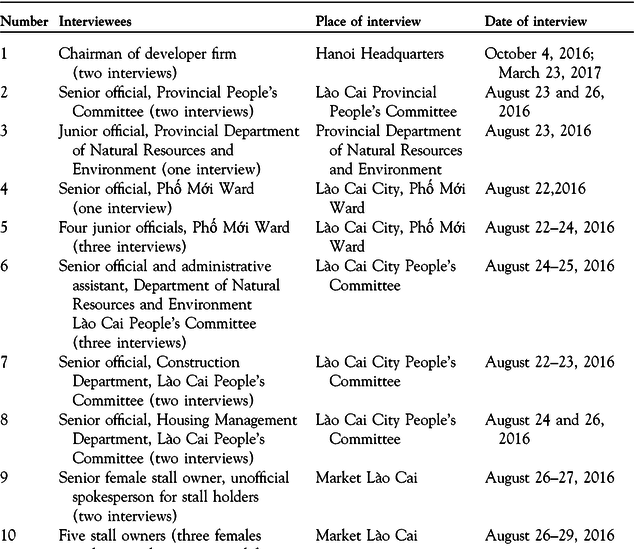
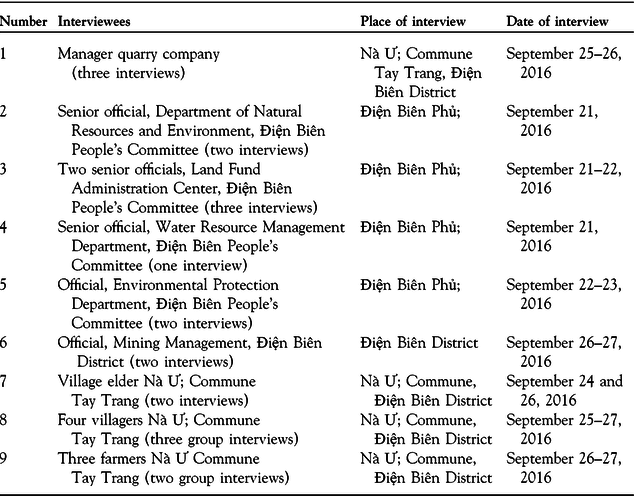
Second, the key stakeholders were interviewed to identify the standards they used to evaluate the PPPs (see the list of interviewees in Appendices 1 and 2). In the Lào Cai study, there were eighteen interviews and four group interviews, whereas in the Điện Biên study, there were fifteen interviews and five group interviews. The respondents were identified using a combination of purposive, niche, and snowball sampling methods (Atkinson and Flint Reference Atkinson, John, Lewis-Beck, Bryman and Liao2011). In-depth interviews were conducted with provincial, district, and commune officials as well as with private developers directly involved in the PPPs. Leaders of people’s committees at the provincial, district, and commune levels provided introductions to the officials who were directly involved with the PPPs. The head office and site managers were approached to arrange interviews with the developers.
In the Lào Cai study, personal introductions were used to select stall owners directly affected by the new market development. Interviews with farmers and villagers in the Điện Biên study led to introductions with the key stakeholders directly affected by the quarry. Additional interviews were conducted with reporters who were familiar with the environmental harm caused by the quarry. Four members of a research team from the National Economic University in Hanoi conducted the interviews in Vietnamese. The interviewees were encouraged to conceptually evaluate the objectives, processes, and ethical practices underlying the PPPs. They were asked open-ended questions, such as “what are the characteristics of a properly managed PPP?” and “to what extent have you and your communities’ expectations regarding the development been realized?” Narratives—the stories that respondents tell each other—were employed to identify norms and cognitive assumptions underlying the publicly determined standards. Narratives function as resources that support, challenge, or undermine conceptions of corruption (Nuijten and Anders Reference Nuijten and Anders2007). They shift our understanding of corruption from a fixed phenomenon caused by interacting variables—a political economy explanation—to a dynamic socially constructed phenomenon. They also suggest that views regarding what constitutes corruption are formed inter-subjectively within social groups (Wedel Reference Wedel2012; Zaloznaya Reference Zaloznaya2014). Narratives direct our attention toward the socially situated interactions where the meaning of corrupt behavior is constructed and performed.
Respondents faced an incentive structure that encouraged them to frame answers that avoided political sensitivities, such as evidence of bribery and regulatory opacity. To minimize preference falsification, follow-up interviews revisited key issues to determine whether respondents changed their stories in any material aspects. Interview data was then cross-checked and augmented with written sources, such as research reports and newspaper articles. Reports in online newspapers including Báo Tài Nguyên Môi Trường, Môi Trờng và Đô Thị, and Báo Tin Tức were used for background information about the case studies. Although useful in supplementing and cross-checking the interviews, these reports described corruption from the standpoint of the party state and rarely considered what citizens thought about malfeasance. Ancillary interviews were conducted with government officials, lawyers, and developers familiar with the PPPs. Most interviews were conducted on the condition of confidentiality.
Despite experiencing difficulties gaining access to sensitive information, the in-depth interviews revealed subtle preferences and dynamic interactions and were sufficiently rich in detail to provide insights into how the key actors conceptualized the appropriate standards that should govern PPPs.
Data Analysis
Data analysis proceeded in two stages. First, interview data were analyzed to identify the main publicly determined standards relating to the PPPs. To assist this process, the standards were disaggregated into the previously discussed public interest categories (that is, economic and environmental outcomes, procedural conformity, and ethical standards). Second, the analysis then examined whether the decision making by the PPPs fundamentally violated the publicly determined standards of behavior. A fundamental violation occurs when the standards followed by the PPPs have decoupled from, and conflicted with, the public standards determined by the stakeholders (Wedel Reference Wedel2012; Zaloznaya Reference Zaloznaya2014). One way of evaluating conflict is to examine normative and cognitive (in)compatibilities between the competing standards. Systems theory posits that fundamentally incompatible standards lack a common normative and cognitive grammar in which to identify common ground and reconcile differences (Hiller Reference Hiller, de Graaf, von Maravic and Wagenaar2010). Normative thinking transforms descriptive narratives about how PPPs are organized into prescriptive narratives about the standards that should regulate PPPs (Granovetter Reference Granovetter, Nee and Swedberg2007; Wedel Reference Wedel2012; Zaloznaya Reference Zaloznaya2014). Normative differences suggest conflicts regarding what constitutes the correct way to accomplish desired goals or allocate state assets.
Cognitive differences point to fundamental and irreconcilable disagreements regarding the appropriate standards governing PPPs. While normative thinking is reflective and thus open to persuasion and change, cognitive thinking is tacit, taken for granted, routinized, and reflexive (De Graaf Reference De Graaf2007; Granovetter Reference Granovetter, Nee and Swedberg2007). It forces external information, such as conflicting standards, into existing mental models, preventing or slowing the adjustment to innovative interpretations and adaptation that might lead to preference convergence (Hiller Reference Hiller, de Graaf, von Maravic and Wagenaar2010). The implication of this research is that public interest corruption occurs when there are normative, and especially cognitive, conflicts between the standards guiding PPPs and publicly determined standards (M. Johnston Reference Johnston1996; Wedel Reference Wedel2012; Zaloznaya Reference Zaloznaya2014).
CASE STUDY: MARKET RENOVATION IN LÀO CAI
Background
This study explored the redevelopment of a traditional market in Lào Cai, a regional city on the Chinese border. The original nineteenth-century market was destroyed during the war between China and Vietnam in 1979 (Endres Reference Endres, Kirsten and Leshkowich2018). It was rebuilt in 1996 and extended in 2004, with the market benefiting from the cross-border trade that flourished after China and Vietnam normalized their relationship during the late 1980s. In 2013, the Lào Cai Provincial People’s Committee decided the market was unsafe and needed redevelopment. The proposed redesign significantly increased the size of the existing market. To raise the investment capital (468 billion VND, approximately twenty-one million US dollars) and oversee the project, the People’s Committee established a Local Development Investment Fund (LDIF) to act as an investor (chủ đầu tư). The LDIF functioned similarly to a PPP in drawing together officials from the Market Management Board (Ban Quản Lý Chợ) and the People’s Committee, on the one side, and private investors, on the other. It took investors many years to convince the People’s Committee to transfer the market, which was a public asset, to the LDIF. As one member of the LDIF recalled, “getting a BOO [Build Operate and Own] license is not easy. It is usually difficult to get land use right certificates for market land, but this one was ten times harder.” Under the terms of the BOO license, the LDIF gained control over the new market for seventy years. Consistent with developments elsewhere in Vietnam, the PPP in this case was not established under statutory guidelines, such as the Decree no. 5/2015/ND-CP on Public Private Partnerships (Lebbe and Musil Reference Lebbe and Clement2013; Lê Hiệp Reference Lê2019).Footnote 11 Rather, the local government preferred a loosely structured, informal alliance with private investors.
The LDIF could not raise the investment funds entirely from the private sector and turned to the owners of the market stalls for additional capital. In return for a ten-year rent moratorium, stall owners were asked to contribute 190–240 million VND (eight thousand to eleven thousand US dollars). Having secured the finance, the LDIF and the People’s Committee prepared a public tender for the project in 2016. Although information regarding the project and bidding conditions was publicly disclosed, only one bidder—the LDIF—participated. As an official in the Provincial Housing and Land Department later commented, “it is general knowledge that many investors were interested. In fact, the [actual] investor was hiding in the haystack. If you have friends [in government], you can reach an agreement.” The People’s Committee awarded the LDIF a BOO license without the competitive tendering required under article 13 of the 2005 Law on Anti-Corruption.
The LDIF acted like a broker by combining persuasion and coercion to align the stall owners with the interests of the provincial government and the “underground forces” (lực lượng ngầm) who stood behind the project. Discussing the relationship between the government and underground forces, a city official observed: “Most of them [underground forces] are children of big men (con ông to) or relatives of leaders (người lãnh đạo)” (Endres Reference Endres, Kirsten and Leshkowich2018, 34). Interviews with LDIF members confirmed that the underground forces participated during all stages of the market redevelopment, beginning with the planning and tendering processes. They determined who should receive stalls in the new market and used extralegal forces to deter stall owners who complained about the development process. Explaining this mode of operation, a LDIF member recalled: “Governments cannot abuse their power in dealing with stall owners, but the ‘underground forces’ have few constraints.”
To steer the development through the planning and development procedures, the People’s Committee employed a regulatory technique called làm luật (literally, making law) (Endres Reference Endres2014). Interviewees used this term to describe the opaque regulatory practices that rewrote or circumvented the laws and processes that might otherwise have slowed or prevented the development. Officials exercising làm luật used a complex repertoire of bureaucratic processes and documentary practices to give corrupt practices a sheen of formality and legitimacy. In some instances, the People’s Committee used làm luật to approve new regulations and change planning schemes to legalize the transfer of the publicly owned market into private hands. In other situations, the People’s Committee shifted decision-making powers to the LDIF. As an extra bureaucracy, the LDIF operated in an exceptional legal space outside the formal state structures and statutory procedures that constrained state officials. Working together, the People’s Committee and the LDIF exercised a type of variegated legal sovereignty in which exceptions to the land and planning laws that conveyed special economic opportunities to the PPP were unavailable to the general public. State officials used làm luật to disguise their abuse of power for personal gain with a veneer of legality.
Narratives of the Stall Owners: Identifying the Public Interest
Stall owners in the market were the stakeholders most directly affected by the PPP. They advanced three types of public interest objections to the PPP. The first objection concerned the redevelopment goals. Stall owners argued that, unlike most public markets in Vietnam, the design for the new market created sixty-six stalls with street frontage. This arrangement allowed the LDIF to charge a premium for stalls fronting the street, while compromising the commercial viability of stalls located inside the market. As a senior female stall owner quipped, “buyers will buy stuff right there in the street-front market stalls. Those of us trading inside may just be sitting and staring at each other with no customers.” The stall owners also believed the LDIF was exploiting its monopoly by imposing unrealistically high rents for the new market. An elderly male stall owner explained: “Doing business will be harder. With such high rent, how are we to survive?”
Although stall owners were concerned about profits, their main complaint involved the disruption of traditional business practices. They thought the new market design, which resembled a shopping mall, undermined the relational business practices that intertwine personal relationships and commerce. A stall owner described this tension: “There is a conflict between the modern market and targeted customers. In the original market traders worked in open spaces and could cooperate in selling goods. That was both our work and our life. The closed stalls in the new market separate the traders, and break-down our business practices that rely on discussions and tình cảm (empathy or sentiment) between traders and customers.” The stall owners were concerned that, by enclosing the market stalls into individual shops, the new market would inhibit conversations and emotional interactions that connected commerce to personal relationships (MacNeil Reference MacNeil2000; Granovetter Reference Granovetter, Nee and Swedberg2007).
The second public interest objection concerned the lack of public participation in planning the new market. An elderly male stall owner recalled: “Nobody has asked us, they just proceed with their plan. They will hold meetings and announce their decisions by loudspeaker, that is how we will learn the news” (Endres Reference Endres, Kirsten and Leshkowich2018, 31). A senior official from Phố Mới Ward outlined the problems caused by this lack of consultation: “The problem with making a design that recognizes the needs of the people, but also fits modern trends is very difficult. Without consultation the business will serve the needs of a few individuals, this means that the land is privatized and becomes a form of personal property. The land then becomes half state, and half private.” Feelings of exclusion from the decision-making process fostered a perception among stall owners that the approval processes were unethical. This third public interest objection to the PPP surfaced in narratives concerning anomalies in allocating stalls in the new market. Plans approved by the People’s Committee only permitted stall owners in the original market to gain access to stalls in the new market. Stall owners claimed that the LDIF members had abused their official powers by selling “ghost spaces” (không gian ma) to anyone who wanted a stall in the new market (Endres Reference Endres, Kirsten and Leshkowich2018). Expressing this belief, a female stall owner sardonically speculated: “Poles became traders, fire hydrants also became traders and were named as business owners.”
Stall owners staged a protest to demand more input into the design of the new market and press the People’s Committee to investigate the officials who abused their powers by selling “ghost spaces.” In response, the LDIF increased the rent-reduction period from ten to twelve years but refused to change the market design. Although the People’s Committee reassigned some LDIF members to new positions in the government, no criminal charges for abuse of power under the 2005 Law on Anti-Corruption were laid over the sale of “ghost spaces.” Further reinforcing the perception that the PPP acted against the public interest and was not genuinely interested in improving public infrastructure, the LDIF converted its legal status from a company to a cooperative. While this change did not affect the market development, it enabled the LDIF to claim a land tax waiver of thirty-two billion VND (approximately 1.4 million US dollars).
This case study is instructive in showing how local government officials, together with private investors, used làm luật to camouflage abuses of power as lawful procedures. Rather than framing their objections as transgressions under the 2005 Law on Anti-Corruption, the stall owners opposed the PPP because it did not reflect public welfare and violated community standards of ethical behavior.
CASE STUDY: QUARRYING IN ĐIỆN BIÊN PROVINCE
Background
The PPP in this case study operated a quarry in Điện Biên, a poor mountainous province in northwestern Vietnam. To encourage sand and gravel quarries to supply the construction industry, a local government authority joined with a privately owned mining company to establish a loosely configured PPP (Nhân Dân Reference Nhân2017; Hà Thuận Reference Thuận2018). Local authorities used làm luật to “smooth” (thấy êm) the regulatory path for the company, bending licensing requirements and creating new processes to fast-track mining and environmental approvals.
Before quarrying could commence, the local government guided the company through the complex mining license application process. A senior manager in the mining company explained the procedure: “There are fourteen state agencies involved, including seven steps, ten submissions, passing through forty different hands over three years. It is complex and long enough to knock out the small investors.” An official from the Provincial Department of Natural Resources and Environment added: “Businesses are lost in the labyrinth of legal documents. Many investors stop applying for the mineral exploitation license in the middle of the process.” Several interviewees believed the mining company used “informal payments” (thanh toán không hợp thức), a euphemism for bribes, to induce the local government to fast-track the license approvals and prevent rivals without political connections from entering the quarrying business. An official from the Provincial Department of Construction discussed how approval procedures were used to exclude rivals: “If the tender winner is not the favored one in the first place they are closely controlled to death. For example, we might require the gravel to be round so you [the tender] cannot produce different-shaped stones for construction.” Despite many applications, only two companies in Điện Biên Province were licensed to quarry gravel in 2018 (Hà Thuận Reference Thuận2018).
In addition to subverting the license-approval process, the mining company worked with a consultancy firm connected with the local government to weaken the environmental standards governing the quarry. Under Law no. 55/2014/QH13 on Environmental Protection, mining companies must complete EIAs before commencing operations (Ortman Reference Ortman2017).Footnote 12 In theory, EIAs impose standards that constrain harmful emissions; however, in practice, regulatory authorities in Vietnam often lack the political will and technical skills to establish effective standards and rigorously monitor emissions (Phuong, Thủy, and Dũng Reference Phuong, Thủy and Dũng2013). It is common practice for local government agencies to outsource the management of EIAs to private environmental consultancy agencies (Ortman Reference Ortman2017). Outsourcing has produced a vibrant consultancy industry that blurs the boundaries between state and private responsibilities. Simon Benedikter and Loan Nguyen (Reference Benedikter and Loan2018, 31–32) describe this industry in the following terms: “Behind these putatively external, private consultants we encounter the usual suspects of incumbent and former government officials and their social networks that take advantage of the outsourcing of state functions.”
In this case study, local government officials instructed the mining company to use an environmental consultancy firm with close government connections. A manager from the mining company discussed the process: “The mineral prospecting report was prepared by a firm recommended to us. It was a back-door for government officials.” He went on to say: “The environmental impact evaluation report was prepared by a firm owned by a son of the director of the provincial DONRE. It is selling bao đậu (guaranteed approvals).” The consultancy firm prepared an EIA and development plan for the quarry that, on paper, complied with the national environmental standards. Once the quarry began operating, the interviewees believed the consultancy underreported waste discharge into waterways, dust emissions, and damage to roads caused by overladen trucks carrying gravel (see also Hà Thuận Reference Thuận2018; Mỹ Bình Reference Bình2019).
The consultancy firm also worked with the local government to minimize the royalties paid by the mining company. Decree no. 203/2013/NĐ-CP Regulating the Method of Calculating Fees for Mineral Mining Rights establishes a schedule of royalties based on the estimated mineral reserves and quantities extracted from quarries.Footnote 13 According to the interviewees, the consultancy firm used several tactics to reduce the tax. For instance, they understated the mineral reserves. The mining company was initially licensed to quarry thirty-four hectares containing reserves of twenty-four million cubic meters of rock. When royalties for mineral exploitation were increased in 2015, the consultancy advised the miner to return twenty-two hectares of the reserve to the local government to reduce the tax. With the tacit approval of the local government, the miner continued to quarry the entire reserve. As a provincial official recalled, the miner was told: “You should not apply for a mineral exploitation license! Such a small mine. Just act as an unlicensed miner.” A mine manager maintained that informal payments were made to local government officials: “Calculating payments for the right to exploit minerals involves substantial negotiation. Businesses must bargain with all parties to agree to an appropriate payment.” He concluded: “There is nothing for free. Unofficial payments of five to seven million Đồng were made to staff, leaders of the divisions receive from thirty to fifty million Đồng, and people signing decisions receive from two-hundred to three-hundred million Đồng.”
What emerges from this case study is a loosely structured PPP controlled by the local government, the mining company, and the environmental consultancy firm. Officials practiced a type of entrepreneurialism by constantly searching for ways to leverage relationships and create business opportunities. They developed networks to cultivate political and business circles and formed associations that might yield personal benefits for relatives and business associates. Their self-interested calculations were filtered through and legitimized by regulatory processes such as làm luật that operated beyond the reach of the law-based systems of accountability. The PPP ignored complaints by local stakeholders that the quarry was harming their property and health.
Narratives of the Stakeholders: Identifying the Public Interest
Two groups of stakeholders in the Điện Biên study were directly affected by water and air pollution generated by the PPP. Farmers living downstream from the quarry lost productive farmland, and the health of villagers living near the quarry was compromised by dust emissions. During the interviews, the stakeholders expressed three distinct public interest objections to the PPP. The first objection concerned the goals of the PPP. Farmers opposed the prioritization of short-term economic development over environmental protection and sustainable economic development. In a representative account, farmers downstream from the quarry claimed: “Mining activities are gradually changing the flow of the Nam Rom River, during the rainy season there is increased potential for flash floods to affect houses and crops belonging to households living on both sides of the River” (Mỹ Bình Reference Bình2019). Farmers also argued that “[t]he owners of this business [the PPP] work openly, they can earn high profits, but cause land subsidence, and roads are damaged. Nobody banned them. People only see the immediate benefit, but where can we get our children to live and find productive land?” (TN&MT Reference TN&MT2017). The farmers complained that runoff from the quarry was destroying the farmland that bordered waterways and disrupting the agricultural economy. For example, they claimed that “areas of crops have been eroded by the riverbed, and the water has changed to a muddy color, killing fish” (Mỹ Bình Reference Bình2019; see also Xuân Tư et al. Reference Tư, Tiến and Anh2018).
Villagers living near the quarry were more concerned about harm to the natural environment and personal health than economic loss. As one villager recalled, “[t]he mountain side was shaved to the ground to remove the outer layer of skin … the area is now deserted, stripped of trees, deforming the shape of the ancient mountain, which was once very beautiful” (Mỹ Bình Reference Bình2019). Another villager scornfully observed: “The biggest benefit of this project is environmental destruction.” Most villagers complained about the health risks created by dust from the quarry. One villager mockingly observed: “Our citizens here are very healthy because dust gets into our lungs to make them concrete cover. Now we can drink and smoke freely without harm anymore.” Encapsulating the concern that the PPP privileged development over community health, another villager said: “We recognize that quarrying is important for local development, but why do we nearby residents have to suffer?”
The second type of public interest objection concerned the regulatory processes governing the quarry. Stakeholders believed that the mining company bribed local government officials to bend the rules (làm luật) to ensure the quarry received official approval. Information regarding bribery came to the stakeholders through word of mouth from different sources. As a villager explained, “the officials would never disclose such information because they did not want to “take off their shirt to show others their back” (vạch áo cho người xem lưng).” In contrast to the opaqueness surrounding bribery, abuses of public power were more evident. For example, when the miner applied for a mineral exploitation license, local officials ensured that the correct procedures were followed, and details of the bid conditions were publicly disclosed. This outward adherence to formal processes masked the careful adjustment of bidding procedures to favor the miner. As the mine manager explained, “there is no regulatory problem at all. Public officials can adjust mineral exploitation plans. The real issue is how you behave with public officials.” Further, villagers criticized the lack of public participation in the approval processes. For example, one villager said: “We citizens here complained a lot. But then who would hear us out? The young officials now are trained to be cold-blooded. They don’t care about what citizens say, just about their jobs.” Referring to attempts to negotiate with the PPP, a villager recalled: “They [the miner] just wanted to seal our mouths with token money rather than basing it on any discussion about actual environmental damages.” Stakeholders considered the mining approval processes unfair because they lacked transparency and prevented public participation.
In the third public interest objection, the stakeholders argued that the local government and miner violated community standards of ethical behavior. Rather than focusing on the deviations from laws and procedures, the stakeholders objected to the impact on their familial and social relationships. Land in rural Vietnam is embedded in family lineages and community networks (Malarney Reference Malarney1997). Property rights are treated as social relationships that flow from the membership of close-knit communities (Gillespie Reference Gillespie2017; Sikor et al. Reference Sikor, Dorondel, Stahl and Xuan To2017). The quarry violated community-based ethical standards by disrupting the social and ethical ties that bound the local communities together. Reflecting these concerns, a male farmer observed: “We have lost ‘materially’ and ‘spiritually.’ The loss of farmland made my wife ill. While I’m angry and will fight to stop harm to our land and familial relationships (chung gia đìn).” The stakeholders in this case came to regard the quarry operation as corrupt when they were no longer willing to accept the violations of community standards that resulted in financial, environmental, and physical harm.
ANALYSIS
These findings suggest the need for a conceptual framework that assesses corruption against standards that officials cannot easily bend or circumvent. Public interest corruption offers such a framework (M. Johnston Reference Johnston1996; De Graaf Reference De Graaf2007). It directs our attention to acts of appropriation or exchange that subvert or violate collectively determined standards of behavior (Wedel Reference Wedel2012; Zaloznaya Reference Zaloznaya2014). The first step in applying the public interest framework was to compare the behavior of the PPPs against the three public interest standards (that is, objectives, processes, and ethics). In the second step, the analysis searched for normative and cognitive conflicts that might suggest fundamental and irreconcilable violations of public standards that indicate public interest corruption.
Comparing Behavior in PPPs with Public Interest Standards
Public Interest Objectives
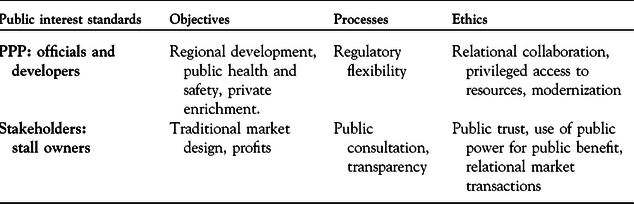
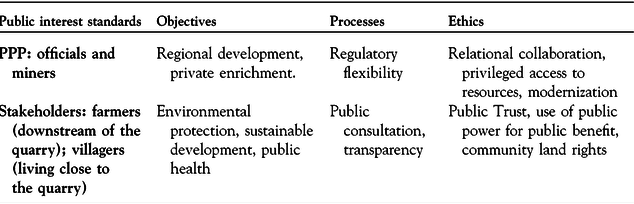
The stakeholders in both case studies opposed the modernizing objectives of the PPPs. The stall owners in the Lào Cai case study rejected the modern shopping mall that was designed to bring “urban civilization” (văn minh dô thi) to a remote provincial city. They prioritized relational forms of business transactions that privileged personal/familial connections over the impersonal, arms-length commerce encouraged by the PPP (MacNeil Reference MacNeil2000) (see Table 1). Also opposing modernization, the stakeholders in the Điện Biên case study objected to quarrying that advanced economic development at the expense of community ties, personal health, and the environment (see Table 2). Underlying these conflicts were different standards regarding the appropriate balance between national development and personal and collective rights. The officials described themselves as modernizers—a mindset encouraged by party state ideology (Benedikter and Nguyen Reference Benedikter and Loan2018). Modernization ideology developed under the socialist command economy (1954–86) to legitimize the subordination of private and community interests to national development (Gillespie Reference Gillespie2017; Le Hong Hiep 2019). Although the state incrementally recognized private and community interests following renewal reforms (đổi mới) in the late 1980s (Gillespie Reference Gillespie2017; Fu et al. Reference Fu, Gillespie, Nicholson and Partlett2018), modernization through industrial development remains the paramount state objective (Le Hong Hiep 2012; Lebbe and Musil Reference Lebbe and Clement2013).
Lào Cai Study

Điện Biên Study

The belief by the stakeholders that the officials should have taken public objectives into account reflects the growing public expectation that governments are accountable to performance legitimacy (Le Hong Hiep 2012; Nguyen Reference Nguyen2016). The stakeholders argued for a rebalancing between government development objectives and community-based standards, such as relational transactions in the Lào Cai case and “property rights as social relations” in the Điện Biên case (Singer Reference Singer, Geisler and Daneker2000, 4). Their socially embedded standards were influenced by local customs and identities grounded in strong emotional and collective (cognitive) attachments to land and place (Nuijten and Anders Reference Nuijten and Anders2007; Sikor et al. Reference Sikor, Dorondel, Stahl and Xuan To2017). The preference by the government for economic development violated community standards of well-being.
Public Interest Processes
The stakeholders formed a normative objection to the opportunistic application of laws and procedures (làm luật) that enabled government officials and private developers to divert public assets for private purposes (see Tables 1 and 2). Rather than framing their objections in legalistic terms as violations of legal rules and processes, their main objection concerned the lack of meaningful public consultation. The stakeholders believed they were unjustly excluded from the decision-making process. As Tom Tyler (Reference Tyler2006) has observed, when governments apply procedures unevenly or preferentially advantage certain groups, the perception that the procedures are unfair is likely to arise.
Although the stakeholders thought the approval processes were unfair, they did not conclude that strict procedural compliance would have changed the outcomes in their favor. They viewed with dismay the ease with which officials flexibly applied the law and procedures to avoid accountably for abuses of power under the 2005 Law on Anti-Corruption—forming a well-founded skepticism about the capacity of the legal system to protect their interests. Articles 32 and 43 of the 2013 Vietnam Constitution guarantee a broad range of private legal rights, including rights to land, health, and a clean environment; in practice, however, constitutional guarantees are qualified by administrative regulations and are nonjusticiable (Gillespie Reference Gillespie2017; Fu et al. Reference Fu, Gillespie, Nicholson and Partlett2018). Only 6 percent of respondents in a recent survey said that they understood their constitutional rights, while less than 10 percent of respondents believed the courts would protect private and community rights against the state (Vietnam Lawyers Association and UNDP 2016). Reflecting these low levels of legal consciousness, the stakeholders in the present study challenged the PPPs without formulating their opposition as an infringement of private legal rights or processes.
Further reinforcing their skepticism about rules-based anti-corruption programs, the stakeholders did not fully accept the Weberian notion that state officials should act non-patrimonially and impersonally (Ang Reference Ang2016). For example, the stakeholders did not object to the personal networks that infiltrated the state apparatus, and they were as indifferent to transgressions of legal boundaries as the officials. Their sense of injustice arose from their exclusion from decision-making networks rather than from the abuse of legal standards and processes.
Public Interest Ethics
The stakeholders based their ethical objections to the PPPs more on the outcome of group processes and collective identities than on individual ethical choices. They looked to local traditions, customs, and collective identities for their ethical beliefs rather than to the standards stipulated in state laws and bureaucratic processes (see Tables 1 and 2). More specifically, their ethical standards arose from emotional and spiritual (cognitive) attachments to land and community. These standards of public welfare conflicted with the use of public power by the PPPs, which aimed to confer exclusive legal entitlements on private investors. When measured against community ethical standards, the stakeholders judged the officials governing the PPPs untrustworthy. This belief that governments should be trustworthy arises from the public interest expectation that officials should act with prestige, morality, and honor (uy tín) (Fforde and Homutova Reference Fforde and Lada2017). The stakeholders expected officials to deliver on their promises and do what was right for the people they served by promoting policies that truly benefited public welfare. This expectation reflects regulatory traditions based on rule through virtue (Vasavakul Reference Vasavakul and Alagappa1995; Malarney Reference Malarney1997). For decades, state officials have legitimated their right to govern based on a presumed moral superiority over the public. As virtuous rulers, state officials—especially at local government levels—are expected to show empathy (tình cảm) with the people and act in their interest (Endres Reference Endres2014). Over time, this expectation has gradually conflated with broader performance expectations regarding the delivery of social goods and administrative competence (Vasavakul Reference Vasavakul and Alagappa1995; Le Hong Hiep 2012).
The stakeholders considered officials untrustworthy not because they violated legal rules and processes but, rather, because they violated public standards of distributive justice. They assessed trustworthiness by determining whether officials advanced the public welfare and were morally competent. The stakeholders expected the officials to use state powers impartially and not privilege narrow special interest groups over the broader community. Based on this standard of trustworthiness, the officials acted unethically in disregarding public welfare. These findings suggest reasons why rules-based approaches to corruption struggle to identify, much less check, corruption in PPPs. Officials understand that an effective way to conceal corruption in PPPs is to make the abuse of power closely mimic legally acceptable practices. They use state power to flexibly adjust state rules and processes to reduce the discernible difference between legitimate and corrupt acts. For rules-based corruption to function effectively, there must be an identifiable difference between corrupt and legitimate acts. The local government officials disguised this difference by redefining corrupt behavior in the PPPs as legitimate behavior. The stakeholders were not misled by this regulatory dissembling because it was not the rule breaking itself to which they objected. Rather than using rules-based standards, which they did not value, the stakeholders turned to publicly determined standards to ascertain corrupt behavior. They conceptualized corruption as public acts of appropriation that violated collectively agreed on standards for non-collective ends and purposes.
Identifying Public Interest Corruption
Public interest corruption occurs where PPPs operate in fundamental opposition to publicly determined standards (Wedel Reference Wedel2012; Zaloznaya Reference Zaloznaya2014; J. Johnston Reference Johnston2016). Normative, and especially cognitive, conflicts between PPPs and public standards signify the irreconcilable and fundamental disagreements that constitute acts of public interest corruption (Hiller Reference Hiller, de Graaf, von Maravic and Wagenaar2010). The officials and stakeholders fundamentally disagreed about the appropriate normative processes that should govern PPPs. The officials used làm luật, a type of secretive, relational regulation that blurred public and private boundaries. In contrast, the stakeholders advocated procedural transparency and public participation in official decision making. This normative objection did not arise from a legalistic concern with the abuse of rules-based structures but, rather, from the injustice of being excluded from decision-making networks.
The officials and stakeholders also clashed over the ideological settings that balanced state modernization with private and communal rights and environmental protection. Reconciling these competing cognitive assumptions is challenging because neither recognizes the other. Socialist modernization ideology regards moral and community rights as a cultural residue that progressive socialism should sweep aside (Gillespie Reference Gillespie2017; Fu et al. Reference Fu, Gillespie, Nicholson and Partlett2018). Further complicating reconciliation, the stakeholders lacked a conceptual grammar by which to engage with state ideology. Moral and community rights are reinforced by collective identities that insulate stakeholders from alternative patterns of thought (Nuijten and Anders Reference Nuijten and Anders2007) and entrench their perception that the PPPs are unethical and corrupt. Collective identities create boundary narratives that distinguish the honest and trustworthy insiders from the immoral and untrustworthy outsiders (Owens, Robinson, and Smith-Lovin Reference Owens, Robinson and Smith-Lovin2010). This social partitioning promotes reflexive thinking that prevents flexible adaptation and the negotiation of consensus about the appropriate standards for PPPs.
A related cognitive conflict concerns the trustworthiness of officials. The stakeholders formed the view that the officials were untrustworthy because they substituted private interests for public welfare. This perception was amplified by feelings of anger and betrayal (Dunn and Schweitzer Reference Dunn and Maurice2005; Levi, Sacks, and Tyler Reference Levi, Sacks and Tyler2009). Trust has an emotional dimension because it involves a “willingness to accept vulnerability based upon positive expectations about another’s behavior” (Dunn and Schweitzer Reference Dunn and Maurice2005, 736). The stakeholders in both case studies initially trusted the officials to act in the public interest. After witnessing the officials disregard public objections to the PPPs, the stakeholders felt betrayed and concluded that the officials were untrustworthy and corrupt.
Normative and, especially, cognitive disagreements point to irreconcilable differences and public interest corruption. Some normative and cognitive disagreements might have been resolved if the stakeholders were given a voice during the planning and development of the PPPs. Once the disputes progressed, anger and betrayal crystalized into the perception that the officials were untrustworthy and irredeemably corrupt (Dunn and Schweitzer Reference Dunn and Maurice2005).
CONCLUSION
Rules-based approaches to corruption are no match for state-orchestrated corruption. The PPPs in the present study used state power to deliberately blur public-private boundaries for private gain. There was a regulatory logic in circumventing these boundaries. In conferring the PPPs with state legitimacy, public power allowed officials to camouflage private relational transactions with the trappings of legality. Rules-based approaches to corruption are conceptually unable to recognize these abuses of state power that redefine corrupt behavior as legitimate behavior.
The stakeholders did not regard the abuse of rules and processes—rules-based corruption—as constituting intrinsically corrupt behavior because they did not value legal rules. Instead, they equated corrupt behavior with socially experienced injustice. It was their exclusion from the decision-making process that they considered unjust, and thus corrupt, behavior.
The stakeholders turned to an extralegal conceptualization of corruption to support their inclusion in the decision making processes.Footnote 14 Public interest corruption recasts state-orchestrated corruption as a bureaucratic elite colluding with private sector developers to advance objectives that betray the public trust. It shifts the analytical focus from the transgressions of public-private boundaries to an examination of public inclusion and exclusion from decision making. It substitutes law-based standards that are unable to see corruption in PPPs with publicly determined standards of ethical behavior.
Another conceptual shortcoming with rules-based corruption is its narrow focus on individual behavior. It is predicated on rational choice theory, which embodies human agency in individuals (De Graaf Reference De Graaf2007; Granovetter Reference Granovetter, Nee and Swedberg2007). Offering an alternative explanation, the findings in this study show that state-orchestrated corruption occurs in an ecology of intertwined relational networks (De Jong, Tu, and van Ees Reference De Jong, Anh Tu and van Ees2015), suggesting that ethical decision making is a distributed phenomenon that cannot be captured in the individual mind. In targeting individual choices, rules-based corruption misses the relational networks that shape ethical thinking. To explore state-orchestrated corruption, we need to reimagine ethical responsibility in ways that do not reduce agency to individual human consciousness, without entirely displacing individual responsibility. Public interest corruption moves us in this direction because it uses publicly determined standards to expose the relational networks and epistemologies underlying and promoting state-orchestrated corruption.
So far, the discussion has treated public interest corruption as an analytical framework, but it is also worth considering as a policy instrument for holding officials accountable. Although the interviewees in the present study did not discuss whether or how public interest corruption might become operationalized, it is not an entirely speculative inquiry. Whether corruption is seen from a top-down (rules-based) approach or a bottom-up (public interest) perspective is often informed by the available remedies (De Graaf Reference De Graaf2007; Gong and Scott Reference Gong and Ian2017). Rules-based corruption is attractive because it can draw on a well-developed set of responses that enlist state power to target individual culpabilities. However, as the present study has shown, it sometimes targets the wrong behavior and thus misses corrupt conduct in PPPs.
Public interest corruption shines more light on corruption in PPPs, but, as a policy instrument, it faces difficulties in authoritarian polities such as Vietnam. Governments in socialist Asia are reflexively authoritarian and unlikely to support policy instruments that enable citizens to organize and develop regulatory agendas independent of the party state (Birney Reference Birney2017; Gillespie and Nguyen Reference Gillespie and Hung2019). They tightly control the formation of member-directed organizations that could convey oppositional ideas to state officials and developers (Stromseth, Malesky, and Gueorguiev Reference Stromseth, Malesky and Gueorguiev2017). For example, although Vietnam has acceded to the UNCAC, it does not comply with article 13, which requires member states to promote the “active participation of individuals and groups outside the public sector, such as civil society, non-governmental organizations and community-based organizations, in the prevention of and the fight against corruption.”
Despite tight government control over the public space, previous studies have shown that officials sometimes listen to public campaigns (Kerkvliet Reference Kerkvliet2019). For example, studies have shown how citizens in Vietnam can mobilize the public interest to oppose urban development programs (Gillespie and Nguyen Reference Gillespie and Hung2019), environmentally harmful industries (Kerkvliet Reference Kerkvliet2019), and land development projects (Gillespie Reference Gillespie2017). Consistent with these findings, the stakeholders in the present study overcame government restrictions and developed coherent sets of standards that critically evaluated the PPPs. They organized at a community level without relying on civil society organizations that are easily co-opted by the state.
Although more research is required, some promising statutory mechanisms give citizens in authoritarian polities a means of conveying the public interest to state officials. Oxfam (2013), for example, proposed a statutory voting system in Vietnam that would compel PPPs undertaking public land development to consider the public interest. It recommended giving stakeholders a veto over the compulsorily acquisition of land and the development of environmentally damaging industries. This proposal set an 80 percent majority vote as the precondition for PPP land developments. Statutory voting systems encourage officials to consider the public interest because they provide stakeholders with an opportunity to signal a fundamental disconnection between public mores and the objectives of government-backed development projects.
Chinese experiments in deliberative design offer stakeholders a platform to convey more nuanced publicly determined standards to PPPs (Hayllar and Wettenhall Reference Hayllar and Roger2010; Chen and Hubbard Reference Chen and Michael2012). They have allowed stakeholders to overcome tight government restrictions to formulate public standards and have created opportunities through sustained dialogue with policy makers to inject the public interest into PPPs. Deliberative design projects represent an advance over statutory voting systems, as they give members of the public a means of holding officials accountable to a wide range of publicly determined standards. Statutory participation systems disrupt public interest corruption by expanding the policy-making circle and compelling officials to consider the interests of those most affected by the proposed developments. In the process, they offer a means of strengthening the transparency and public participation components of rules-based approaches to corruption. For example, public interest approaches to corruption suggest ways the Vietnamese government might fulfill commitments under article 13 of the UNCAC and give the public a voice in combating corruption. Public interest corruption offers an additional layer of accountably on top of rules-based approaches to corruption, without creating conflicts and redundancies.
Even without statutory backing, public interest corruption gives stakeholders a means of conveying community grievances to PPPs. Public interest corruption legitimizes stakeholder opposition to PPPs by challenging the legitimacy claims made by state officials. It gives stakeholders a dialogical framework in which to hold officials accountable in a society where public participation in decision making is discouraged. However, there is more to public interest corruption than a narrow focus on holding officials accountable. There is an additional value in authoritarian polities to creating dialogic forums since they provide opportunities for public participation and bottom-up decision making. Stakeholders can invest public interest corruption with many meanings and enlist this discourse as an imaginary and a catalyst for change.
Interview List for the Lào Cai Case Study

Interview List for the Điện Biên Case Study