Implications
Regulation of angiogenesis secures the advent and removal of blood supply during the development and demise of the corpus luteum (CL). These processes are known to be controlled by vascular endothelial growth factor (VEGF). However, the relationship of angiogenic and antiangiogenic ligands and receptors with opposing actions, rather than their absolute VEGF quantities, determines the fate of the capillary network. The present study shows that the angiogenic and antiangiogenic members of VEGF system have a proangiogenic milieu during CL development, and that this milieu is inverted to antiangiogenic at the time of luteolysis.
Introduction
The corpus luteum (CL) is formed after luteinization of the granulosa and theca cells. It receives the highest blood flow per unit of tissue in the organism, and thus requires an extensive vascular network (Fraser and Wulff, Reference Fraser and Wulff2003). During CL formation, around 80% of proliferating cells are endothelial cells (Tamanini and De Ambrogi, Reference Tamanini and Ambrogi De2004) and the support of this extensive angiogenesis is necessary for CL development (Shirasuna et al., Reference Shirasuna, Nitta, Sineenard, Shimizu, Bollwein and Miyamoto2012). It is known that vascular density of the mature CL exceeds the vascular network of most tumours (Shirasuna et al., Reference Shirasuna, Nitta, Sineenard, Shimizu, Bollwein and Miyamoto2012). If pregnancy does not occur, luteolysis is accompanied by a dramatic loss of angiogenesis and apoptosis of the endothelial cells (Fraser and Wulff, Reference Fraser and Wulff2003).
As with other tissues, the process of angiogenesis, essential for maintenance and development of the CL, is controlled by the vascular endothelial growth factor-A (VEGF-A). The VEGF-protein family also includes VEGF-B, VEGF-C, VEGF-D, VEGF-E, VEGF-F and PLGF, however, angiogenesis is mainly controlled by VEGF-A, further referred to as VEGF (Ferrara, Reference Ferrara2004). The action of VEGF is mediated by its membrane receptors, VEGFR1 and VEGFR2. These receptors have an intracellular tyrosine kinase domain, a transmembrane domain and an extracellular domain. Binding of VEGF to the extracellular domain causes dimerization of the receptors and phosphorylation of the tyrosine kinase domain. The receptors have isoforms not bound to the cell membrane that putatively act as circulating VEGF-binding proteins: sVEGFR1 and sVEGFR2. The soluble forms of the receptors lack the intracellular and transmembrane domains but conserve the ligand-binding domains, for which they are considered negative regulators of VEGF function (Kaczmarek et al., Reference Kaczmarek, Schams and Ziecik2005). All the former, as a whole, comprise the VEGF system.
In sows and cows, expression of total VEGF and VEGFR2 is higher during the development of the CL, and decreases in the late luteal phase, approaching luteolysis (Berisha et al., Reference Berisha, Schams, Kosmann, Amselgruber and Einspanier2000; Boonyaprakob et al., Reference Boonyaprakob, Gadsby, Hedgpeth, Routh and Almond2003). Treatment with a VEGF antagonist during the luteal phase, in Macacus and titi monkeys, reduces progesterone secretion (Fraser et al., Reference Fraser, Wilson, Morris, Swanston and Wiegand2005), the ovarian weight and volume, and increases caspase-3 activity, as compared with untreated individuals (Fraser et al., Reference Fraser, Wilson, Wulff, Rudge and Wiegand2006).
The VEGF gene contains eight exons, which are alternatively spliced to give rise to different VEGF isoforms, named according to the number of amino acids in each isoform (Harper and Bates, Reference Harper and Bates2008). In addition, two different VEGF families of isoforms are generated by alternative splicing of the terminal exon 8; proximal splice-site selection in exon 8 (exon 8a) results in proangiogenic VEGFxxxa isoforms (xxx being the number of amino acids of a particular isoform), whereas distal splice-site selection (exon 8b) results in antiangiogenic VEGFxxxb isoforms (Nowak et al., Reference Nowak, Woolard, Amin, Konopatskaya, Saleem, Churchill, Ladomery, Harper and Bates2008). At least six isoforms with angiogenic activity (VEGF120a, VEGF144a, VEGF164a, VEGF182a, VEGF189a and VEGF205a) and five isoforms with antiangiogenic activity (VEGF120b, VEGF144b, VEGF164b, VEGF182b and VEGF189b) have been reported (Harper and Bates, Reference Harper and Bates2008). The VEGF164b binds the receptor and induces reduced tyrosine phosphorylation of VEGFR1 and VEGFR2 (Nowak et al., Reference Nowak, Woolard, Amin, Konopatskaya, Saleem, Churchill, Ladomery, Harper and Bates2008). The antiangiogenic mechanism of action of VEGF164b is probably shared by the other type-b isoforms.
The antiangiogenic members of the VEGF system (VEGFxxxb isoforms and soluble receptors) have been implicated in ovarian function. Overexpression of VEGF164b mRNA in mice ovaries reduced fertility and increased the number of atretic follicles (Qiu et al., Reference Qiu, Seager, Osman, Castle-Miller, Bevan, Tortonese, Murphy, Harper, Fraser, Donaldson and Bates2012). In the pig, very low expression of VEGF164b mRNA has been detected, which has been suggested to counteract the actions of the highly expressed proangiogenic VEGF164a (Ribeiro et al., Reference Ribeiro, Bacci, Seren, Tamanini and Forni2007). Regarding the soluble receptors, a reduction in the expression of sVEGFR1 occurs in the CL of pregnant sows as early as day 12 postcoitum. This downregulation may facilitate the activity of luteotrophic factors and contribute to the maintenance of the CL (Kaczmarek et al., Reference Kaczmarek, Kiewisz, Schams and Ziecik2009). In bovine follicles, sVEGFR1 mRNA expression was high at the time of follicle selection and decreased after the loss of follicle dominance (day 9), whereas for sVEGFR2 mRNA the opposite pattern was observed (Macias et al., Reference Macias, Pinzón, Fierro, Vergara, Martínez, Rosado, Gutiérrez and Rosales-Torres2012). All these results suggest that the balance between angiogenic and antiangiogenic VEGF system components determines the fate and prevalence of the CL. On the basis of this hypothesis, here we study the relationship between the mRNA expression of angiogenic and putatively antiangiogenic members of the VEGF system in the CL throughout the luteal phase of the bovine oestrous cycle.
Material and methods
Animals, treatments and collection of corpora lutea
Animal procedures were approved by the Ethics and Animal Welfare Committee of the Universidad Autónoma Metropolitana-Xochimilco. Animals were maintained in the same barn with food and water ad libitum. The oestrous cycle of 18 mature and cycling F1 (Bos taurus×Bos indicus) cows was synchronized using a progesterone intravaginal-releasing device (CIDR from DEC Manufacturing, Hamilton, New Zealand) for 10 days and a 25 mg prostaglandin F2α (PGF2α Pfizer, Distrito Federal, México) injection on day 8. On oestrous (day 0), cows received 100 mg of GnRH (Intervet/Schering-Plough Animal Health, Estado de México, México). Ovulation was verified by ultrasonography, and the ovary with a CL was collected by transvaginal ovariectomy under epidural anaesthesia on days 4 (n=3), 6 (n=3), 9 (n=3), 12 (n=3), 15 (n=3) and 18 (n=3) of the oestrous cycle. The ovaries were rinsed in PBS containing 0.1% DEPC, and the CL was removed and cut in four equal parts, which were kept at −70°C until RNA extraction.
RNA extraction and synthesis of cDNA
Total RNA from the CL was extracted by phenol/guanidine isothiocyanate method (Chomczynski and Sacchi, Reference Chomczynski and Sacchi1987), with the TRIZOL® reagent (Invitrogen Life Technologies, NY, USA). The RNA was quantified by spectrophotometry and checked for integrity by electrophoresis in 2% agarose gels. Synthesis of cDNA was performed with the SuperScrip III First-Strand Kit (Invitrogen Life Technologies, NY, USA), using 3 µg of total RNA from each sample and 1 µM poly-dT oligonucleotides in reactions of 50 min at 50°C. The reactions were stopped by incubation at 85°C for 5 min. RNA remnants were eliminated with RNAse H (2 U/reaction) treatment.
Expression analysis of VEGF isoforms and VEGF receptors
CL transcript concentrations for VEGF isoforms and their receptors were analysed by quantitative real-time PCR (qPCR) using primers and TaqMan probes specifically designed for each isoform (Supplementary Table S1). VEGFR2 primers amplified both the membrane-bound and the soluble isoforms, whereas sVEGFR2 primers were specific. Thus, the amount of VEGFR2 was calculated subtracting the sVEGFR2 mRNA copies from that of the total number of VEGFR2 mRNA copies. The qPCR was carried out mixing 9 µl of a 1 : 10 dilution of the corresponding cDNA sample, 10 µl of TaqMan Universal PCR Master Mix (Applied Biosystems, Distrito Federal, México; cat number 4324018) and 1 µl of the primers/probe mixture in a 100 µl PCR tube. The reactions for each gene were run in duplicate and in a single assay in a Corbett Research RG-6000 thermocycler (Corbett life science, Sydney, Australia) using the following conditions: 50°C for 2 min, 95°C for 10 min, and then 40 cycles with 95°C for 15 s and 60°C for 45 s.
The number of copies for each specific mRNA isoform was estimated by absolute quantification, interpolating the C t of the sample in a standard curve obtained with serial dilutions of cDNA corresponding to that particular isoform (Rangel et al., Reference Rangel, Rodríguez, Rojas, Sharp and Gutierrez2009). The amplified cDNA of each isoform was visualized after gel electrophoresis in a 2% agarose gel, and purified with the QIAquick Gel Extration Kit (Qiagen, Philadelphia, USA). Then the amount of the cDNA fragment was quantified by spectrophotometry, from which we calculated the number of copies of the fragment per microlitre, as described by Tricarico et al. (Reference Tricarico, Pinzani, Bianchi, Paglierani, Distante, Pazzagli, Bustin and Orlando2002). The standard curves were prepared using dilutions of the specific cDNA fragments at a range of 1×10³ to 1×10¹⁰ copies. As the number of mRNA copies is estimated from known amounts of cDNA complementary to the transcript of interest and with identical amplification efficiencies, there is no need for normalization against a constitutive gene.
DNA sequencing
The purified cDNA for isoform VEGF164b (see the ‘Expression analysis of VEGF isoforms and VEGF receptors’ section) was sequenced using the primers Forward: 5'-GCAAGGCAAGAAAATCCCTGT-3' and Reverse: 5'-TCCTGGTGAGACGTCTGCAA-3' (Supplementary Table S1), in an ABI-Prism 3100 Avant Genetic Analyzer (Applied Biosystems, NJ, USA). Results were analysed with the DNAstar Lasergene software (7.1.0 DNASTAR).
Statistical analyses
The ratios of mRNA copies encoding for the angiogenic and antiangiogenic isoforms for the same VEGF system component (VEGF120a/VEGF120b, VEGFR1/sVEGFR1, VEGFR2/sVEGFR2) or for VEGFR1/VEGFoR2 were estimated and their changes in time analysed by regression against the day of the oestrous cycle. In all cases, we tested for the linear and quadratic effects of the cycle day. In addition, the mean number of mRNA copies encountered for all ligand and receptor genes were analysed by one-way ANOVA using the day of the cycle as independent variable. Before analysis, the dependent variables (VEGF120a, VEGF120b, VEGF160a, VEGFR1, sVEGFR1, VEGFR2 and sVEGFR2) were tested for normality and the appropriate transformation applied if necessary. Data for VEGFR1 and VEGFR2 were transformed to the square root, and data for sVEGFR2 were transformed to the natural logarithm. Results are presented as mean±s.e.m.
Results
CL VEGF isoform mRNA expression
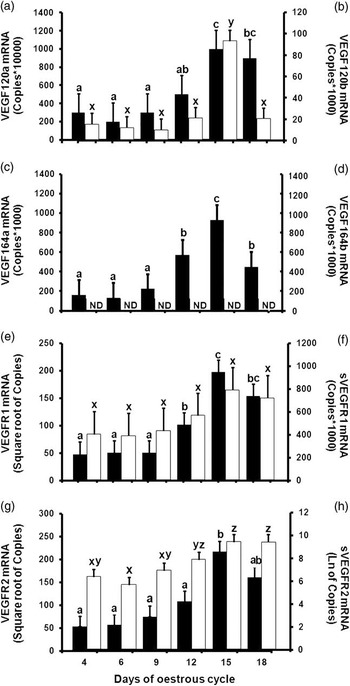
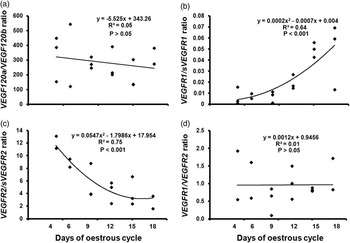
Expression of mRNA for VEGF isoforms increased during the later stage of the luteal phase. In general, VEGF expression was low and did not differ among the first 9 to 12 days of the oestrous cycle. However, VEGF mRNA expression increased (P<0.05) on day 12 (VEGF164a) or 15 (VEGF120a and VEGF120b) of the cycle (Figure 1a, b and c). The highest number of mRNA copies were found on day 15 and while the mRNA for VEGF120a remained high on day 18, it decreased for the VEGF164a and VEGF120b isoforms. Regardless of the changes observed in the expression of mRNA for VEGF120, the ratio between isoforms a and b was not altered by the day of the cycle (P>0.05; Figure 2a). In contrast, VEGF164b mRNA expression was undetectable in the CL throughout the cycle (Figure 1d). To corroborate that the primers designed to amplify VEGF164b worked adequately, we sequenced the cDNA fragment amplified in the standard curve (see the ‘Material and methods’ section). The sequence confirmed that the amplified cDNA corresponded to the VEGF164b isoform.
Changes in the expression of (a) VEGF120a, (b) VEGF120b, (c) VEGF164a, (d) VEGF164b, (e) VEGFR1, (f) sVEGFR1, (g) VEGFR2 and (h) sVEGFR2 in bovine corpus luteum (CL) collected during the luteal phase of the oestrous cycle. a,b,cIndicate differences in the expression of VEGF angiogenic factors between days (left y-axis). x,y,zindicate differences in the expression of VEGF antiangiogenic factors between days (right y-axis). n=3 for all days of CL collection, with the exception of day 6 where one cow was excluded from the study as it did not respond to the oestrous synchronization. VEGF=vascular endothelial growth factor.

Changes in the ratio of mRNA expression for angiogenic (VEGF120a, VEGFR1 and VEGFR2) and antiangiogenic (VEGF120b, sVEGFR1 and sVEGFR2) VEGF system components in the corpus luteum during the oestrous cycle. VEGF=vascular endothelial growth factor.

CL VEGF receptor mRNA expression
Similar to the mRNA expression of the ligands, expression of VEGF receptors increased at the later stage of the luteal phase. Expression of VEGFR1 increased (P<0.05) on days 12 to 18 of the oestrous cycle, reaching its peak on day 15. A similar pattern of expression was shown for VEGFR2. The soluble isoforms of the receptors were found in CL tissue at all days of the cycle. The expression of sVEGFR1 on days 4 to 18 was in excess of 100 times than those observed for the membrane-anchored receptor 1 (Figure 2b). The expression of sVEGFR1 did not change during the oestrous cycle (Figure 1f). Nonetheless, as VEGFR1 increased, the relationship between the soluble and membrane receptor changed (P<0.01; Figure 2b).
Contrasting with the results for VEGFR1 and its soluble isoform, the expression of VEGFR2 was higher than that of its soluble isoform for all days studied. The sVEGFR2 showed a 10-fold increase between days 4 and 15 of the cycle (P<0.01; Figure 1h), and despite the increased expression of VEGFR2, the ratio between the membrane-bound and its soluble counterpart decreased continuously throughout the cycle (P<0.01; Figure 2c). In contrast, the ratio of mRNA expression for VEGFR1/VEGFR2 remained constant throughout the cycle (Figure 2d).
Discussion
CL expression of VEGF ligand mRNA isoforms VEGF120a, VEGF120b and VEGF164a, and the full-length and short-soluble forms of the VEGF receptors increased during the second half of the oestrous cycle in cows. The relationship between full-length and soluble forms of the VEGFR1 mRNA (VEGFR1/sVEGFR1) increased as the cycle advanced. In contrast, the ratio between VEGFR2/sVEGFR2 mRNA decreased. These acute changes in the ratio of full-length to soluble forms of the receptors through the luteal phase of the oestrous cycle may be involved in the regulation of CL function and angiogenesis.
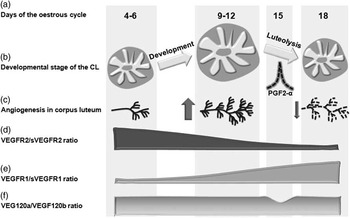
During CL formation, development of an extensive vascular network is paramount to ensure its function (Fraser and Wulff, Reference Fraser and Wulff2003), while inhibition of angiogenesis may impair luteal function (Fraser et al., Reference Fraser, Wilson, Morris, Swanston and Wiegand2005) and regulate luteolysis (Shirasuna et al., Reference Shirasuna, Nitta, Sineenard, Shimizu, Bollwein and Miyamoto2012). Phosphorylation of VEGFR2 in response to VEGF promotes endothelial cell proliferation and migration to form blood vessels (Harper and Bates, Reference Harper and Bates2008), whereas changes in expression of VEGFR2 regulate blood vessel formation and regression in the CL (Berisha et al., Reference Berisha, Schams, Kosmann, Amselgruber and Einspanier2000; Boonyaprakob et al., Reference Boonyaprakob, Gadsby, Hedgpeth, Routh and Almond2003; Fraser et al., Reference Fraser, Wilson, Morris, Swanston and Wiegand2005). The soluble forms of the VEGF receptors bind to the ligand and block their angiogenic action (Kaczmarek et al., Reference Kaczmarek, Schams and Ziecik2005). Cancer therapy studies have shown that an increase in the expression of sVEGFR1 (Owen et al., Reference Owen, Uehara, Cahoon, Huang, Simonis and Ambati2012) or sVEGFR2 (Wang et al., Reference Wang, Zhang, Wang, Chen, Tian, Yang, Hu, Peng, Yang, He, Zhang, Jiang, Deng, Wen, Li, Zhao and Wei2006; Szentirmai et al., Reference Szentirmai, Baker, Bullain, Lin, Takahashi, Folkman, Mulligan and Carter2008) reduce tumour cell proliferation and increase apoptosis (Szentirmai et al., Reference Szentirmai, Baker, Bullain, Lin, Takahashi, Folkman, Mulligan and Carter2008), which is associated with a reduction in blood flow to the tumour tissues. In the present study, mRNA expression of VEGFR2 on days 4 and 6 (CL formation) of the cycle was at least eightfold higher than that of sVEGFR2. In contrast, on day 15 (expected PGF2α release; Ginther et al., Reference Ginther, Shrestha, Fuenzalida, Shahiduzzaman, Hannan and Beg2010) the expression of VEGFR2 decreased with respect to the sVEGFR2 and at day 18 (CL in regression) the ratio VEGFR2/sVEGFR2 was reduced to only twofold. Based on previous results and on the results presented in this study, it is likely that the higher expression of VEGFR2 with respect to sVEGFR2 observed on days 4 and 6 may permit VEGF angiogenic effects to support CL formation. In contrast, the reduction in VEGFR2/sVEGFR2 ratio on days 15 and 18 may suppress VEGF action, causing a decrease in angiogenesis and regression of the CL (see Figure 3).
Schematic summary of the dynamics of angiogenic and antiangiogenic members of the VEGF system, mRNA expression during the development and regression of the corpus luteum (CL) in cows. The higher expression of VEGFR2 with respect to sVEGFR2 during the development of the CL permits VEGF angiogenesis in the CL. In contrast, during CL regression the reduction in the VEGFR2/sVEGFR2 ratio after the PGF2α surge suppresses VEGF action, decreasing angiogenesis (D). Similarly, the increase in VEGFR1/sVEGFR1 ratio (E) and the reduction in VEGFR120a/VEGF120b ratio (F) in the late dioestrous, attenuates VEGF action and contribute to angiogenic disruption. VEGF=vascular endothelial growth factor; PGF2α=prostaglandin F2α.

The results presented here show VEGFR2 mRNA expression throughout the oestrous cycle, reaching its highest concentration on day 15 of the cycle. Previous reports on VEGFR2 mRNA expression show the highest mRNA concentration in the CL from early- and mid-luteal phase in cows (Berisha et al., Reference Berisha, Schams, Kosmann, Amselgruber and Einspanier2000) and sows (Boonyaprakob et al., Reference Boonyaprakob, Gadsby, Hedgpeth, Routh and Almond2003). The differences in VEGFR2 expression observed between studies are likely owing to the design of the primers used. While our study differentiated between membrane-bound and soluble isoforms, both Berisha et al. (Reference Berisha, Schams, Kosmann, Amselgruber and Einspanier2000) and Boonyaprakob et al. (Reference Boonyaprakob, Gadsby, Hedgpeth, Routh and Almond2003) used primers that amplified both isoform types and reported them as a single isoform type.
In this study, VEGFR1 mRNA expression was highest in the late luteal phase. In situ hybridization and real-time PCR of porcine CL showed that VEGFR1 mRNA expression is low in the early luteal phase and reached its highest level of expression on day 15 of the oestrous cycle (Boonyaprakob et al., Reference Boonyaprakob, Gadsby, Hedgpeth, Routh and Almond2003). VEGF binds to VEGFR1 with higher affinity (K d of 10 pM) than to VEGFR2 (K d 400 to 900 pM; Waltenberger et al., Reference Waltenberger, Claesson-Welsh, Siegbahn, Shibuya and Heldin1994). However, VEGFR1 has a poor phosphorylation in response to the ligand (Waltenberger et al., Reference Waltenberger, Claesson-Welsh, Siegbahn, Shibuya and Heldin1994). Further, cultured endothelial cells proliferated less as the ratio of VEGFR1 to VEGFR2 increased from 0.2 to 1 (Zeng et al., Reference Zeng, Dvorak and Mukhopadhyay2001). Based on these results, Boonyaprakob et al. (Reference Boonyaprakob, Gadsby, Hedgpeth, Routh and Almond2003) suggested that the increase of VEGFR1 mRNA expression in the late luteal phase may attenuate VEGF-mediated actions on angiogenesis and vascular maintenance during luteolysis (see Figure 3). We did not observe changes in sVEGFR1 mRNA expression in the CL during the cycle. Similar results were observed by Kaczmarek et al. (Reference Kaczmarek, Kiewisz, Schams and Ziecik2009), hence it is likely that sVEGFR1 does not play a major role in vascular dynamics during CL formation and regression in both the nonpregnant sow and cow.
In cows (Berisha et al., Reference Berisha, Schams, Kosmann, Amselgruber and Einspanier2000), sheep (Redmer et al., Reference Redmer, Dai, Li, Charnock-Jones, Smith, Reynolds and Moor1996) and pigs (Boonyaprakob et al., Reference Boonyaprakob, Gadsby, Hedgpeth, Routh and Almond2003; Ribeiro et al., Reference Ribeiro, Bacci, Seren, Tamanini and Forni2007), the expression of total VEGF mRNA or its VEGF120 and VEGF164 isoforms was found in CL throughout the luteal phase. In the present study, the CL mRNA expression for VEGF120a was greater on days 15 and 18 of the cycle and on day 15 for VEGF164a (Figure 1). Image analysis of in situ hybridization for total VEGF mRNA did not show changes from days 4 to 18 of the pig oestrous cycle in the study of Boonyaprakob et al. (Reference Boonyaprakob, Gadsby, Hedgpeth, Routh and Almond2003), however, qPCR analysis for VEGF120 and VEGF164 showed a linear reduction in their expression from days 1 to 17 after ovulation in the study of Ribeiro et al. (Reference Ribeiro, Bacci, Seren, Tamanini and Forni2007). Similarly, in cows and sheep (Redmer et al., Reference Redmer, Dai, Li, Charnock-Jones, Smith, Reynolds and Moor1996; Berisha et al., Reference Berisha, Schams, Kosmann, Amselgruber and Einspanier2000) total VEGF mRNA was expressed at its maximum level during metoestrous and decreased during the mid- and late luteal phase (days 8 to 18). Hence, there are contrasting differences between our results and those previously published. However, the primers used for DNA amplification were designed to differentiate between VEGF isoforms both in size and putative angiogenic action (VEGF120a and VEGF160a), which may partially explain the differences with previous reports.
We also looked at the expression of putative antiangiogenic VEGFb isoforms. We found a higher expression of VEGF120b in the CL before the expected initiation of luteolysis (day 15 of the cycle). Isoforms VEGF120b and VEGF164b interact with the VEGFR2, halting its rotation, phosphorylation of its tyrosine residues and hence causing poor mitogenic migration and survival signal transduction (Harper and Bates, Reference Harper and Bates2008). In human umbilical vein endothelial cells, VEGF121b reduced the migration stimuli of VEGF164a and VEGF121a in vitro (Rennel et al., Reference Rennel, Varey, Churchill, Wheatley, Stewart, Mather, Bates and Harper2009). In addition, colon cancer cells, overexpressing VEGF120b when implanted into mice colon tumours, reduce its growth associated with a decline in its vascular density (Rennel et al., Reference Rennel, Varey, Churchill, Wheatley, Stewart, Mather, Bates and Harper2009). Consequently, the increase in VEGF120b at the end of the oestrous cycle seems to be involved in the decline of the vascular network that accompanies luteolysis (Fraser and Wulff, Reference Fraser and Wulff2003).
As for VEGF164b, it was recently reported that transgenic mice overexpressing VEGF165b had smaller litter size (3.3±0.4) than wild-type female mice (5.9±0.7), linked to a lower vascularization and reduced number of ovarian follicles (Qiu et al., Reference Qiu, Seager, Osman, Castle-Miller, Bevan, Tortonese, Murphy, Harper, Fraser, Donaldson and Bates2012). However, we did not detect expression of VEGF164b in the CL at any day studied. Whether VEGF164b expression is below the detection limit (103 DNA copies) was not determined, but expression levels lower than those shown for less common isoforms (VEGF144 and VEGF182) was also found in the porcine CL (Ribeiro et al., Reference Ribeiro, Bacci, Seren, Tamanini and Forni2007).
The pattern of VEGF mRNA ligand expression in the CL differs to what has been reported previously. First, in this study, mRNA expression is reported as the absolute number of mRNA copies present in the CL. Quantifying mRNA copies allowed us to study the relationship between the expression of different genes and their isoforms simultaneously and the effect of the day of the oestrous cycle by standard parametric statistical methods. Second, as we used primers that differentiate between isoforms that differ in their size and angiogenic properties, our study is not comparable with previous reports. Nonetheless, our results are in physiological agreement with the events that occur at luteolysis. In the ovine CL, PGF2α produced an increase in total VEGF mRNA expression 4 and 8 h after its injection, however, 24 h after PGF2α injection the expression of VEGF was below that of CLs collected before treatment (Vonnahme et al., Reference Vonnahme, Redmer, Borowczyk, Bilski, Luther, Johnson, Reynolds and Grazul-Bilska2006). PGF2α is released by the endometrium from days 15 to 19 of the bovine oestrous cycle (Ginther et al., Reference Ginther, Shrestha, Fuenzalida, Shahiduzzaman, Hannan and Beg2010). PGF2α caused a reduction in blood and oxygen flow to the CL (Nett et al., Reference Nett, McClellan and Niswender1976). Bovine luteal cells when cultured under low oxygen (3%) conditions produce higher amounts of hypoxia-inducible factor I (HIF-I) protein and of total VEGF mRNA and protein (Nishimura and Okuda, Reference Nishimura and Okuda2010). Hypoxia has been shown to induce expression of HIF-I mRNA and transduction of its protein in other cell types and tissues as rat embryonic neural stem cells (Crossin, Reference Crossin2012), and HIF-I is a key regulator of VEGF synthesis (Ferrara, Reference Ferrara2004). In addition, human endometrial cells cultured with low oxygen (0.5%) show an increase in total VEGF mRNA expression when compared with cells cultured at 21% oxygen (Maybin et al., Reference Maybin, Hirani, Brown, Jabbour and Critchley2011). Furthermore, PGF2α directly induced mRNA expression for total VEGF in endometrial cells (Maybin et al., Reference Maybin, Hirani, Brown, Jabbour and Critchley2011). Therefore, endometrial PGF2α release on day 15 of the cycle could induce hypoxia in the CL and an increase in the angiogenic forms of VEGF120a and VEGF164a.
In general, the VEGF receptors and their soluble isoforms show a similar pattern of expression as the VEGF ligands, that is, increasing towards the end of the oestrous cycle. The increase in VEGF membrane-bound and soluble type-2 receptor mRNA may be explained by the observation that VEGF increase VEGFR1 and VEGFR2 mRNA expression (Wang et al., Reference Wang, Donner and Warren2000), and hypoxia stimulates the expression of membrane-bound (Kremer et al., Reference Kremer, Breier, Risau and Plate1997) and soluble-receptor isoforms (Roda et al., Reference Roda, Sumner, Evans, Phillips, Marsh and Eubank2011). However, while the mRNA expression for VEGFR1 is maintained, expression of VEGFR2 declines on day 18 of the cycle. Similarly, Vonnahme et al. (Reference Vonnahme, Redmer, Borowczyk, Bilski, Luther, Johnson, Reynolds and Grazul-Bilska2006) show VEGFR1 mRNA expression unchanged 12 h after PGF2α injection, whereas VEGFR2 was reduced 4 h after treatment.
In conclusion, our results suggest that during CL development, the expression of VEGFR2 stimulates VEGF-promoted angiogenesis and that in the late luteal phase the reduction in the VEGFR2/sVEGFR2 expression ratio reduces the ligand action and contributes to CL regression. However, more comprehensive studies, looking at the numerous isoforms of both the ligands and receptors, are needed to allow us to build a working model for the role of the VEGF system in corpora lutea development and demise.
Acknowledgement
This research was supported by CONACYT (grant number CB 34410952).
Conflicts of Interest
The authors declare that there is no conflict of interest that could be perceived as prejudicing the impartiality of the research reported.
Supplementary material
To view supplementary material for this article, please visit http://dx.doi.org/10.1017/S1751731114002274