





1 Introduction
In this paper, we discuss the solvability of the p-k-Hessian inequality
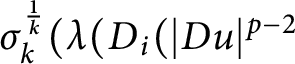
 $$ \begin{align} \sigma_{k}^{\frac1k} \left( \lambda \left( D_{i} (|Du|^{p-2}D_{j}u )\right) \right) \geq f(u) ~~\text{in}~~ \mathbb{R}^{n} , \end{align} $$
where
 $p>1$
, f is a continuous function defined on
 $(0, +\infty )$
, and
 $$ \begin{align*}\sigma_{k}(\lambda)~=\sum_{1\le i_{1}<\cdots<i_{k} \le n}\lambda_{i_{1}},\ldots,\lambda_{i_{k}},~~~~ \lambda=(\lambda_{1}, \lambda_{2}, \ldots, \lambda_{n}) \in \mathbb{R}^{n}, ~~~~k=1, 2, \ldots, n,\end{align*} $$
denotes the kth elementary symmetric function. For any
 $n \times n$
real symmetric matrix A,
 $\lambda (A) $
denotes the eigenvalues of A.
The p-k-Hessian operator
 $\sigma _{k} \left ( \lambda \left ( D_{i} (|Du|^{p-2}D_{j}u )\right ) \right )$
, introduced by Trudinger and Wang in [Reference Trudinger and Wang14] (see also [Reference Wang16]), is an important class of fully nonlinear elliptic operator. It is a generalization of Laplacian, p-Laplacian, and k-Hessian. When
 $p=2$
, it is a k-Hessian operator. In particular, it is the Laplacian operator if
 $k=1$
, whereas it is the Monge–Ampère operator if
 $k=n$
. When
 $k=1$
, it is a p-Laplacian operator.
This paper mainly concerns the solvability of the p-k-Hessian inequality (1.1) and provides a necessary and sufficient condition, which can be regarded as a generalized Keller–Osserman condition. Similar studies of Laplacian inequality, p-Laplacian inequality, and k-Hessian inequality have been done before.
In 1944, Wittich [Reference Wittich17] found that the Laplacian equation
 $$ \begin{align} \Delta u =f(u) ~~\text{in}~~ \mathbb{R}^{2} \end{align} $$
has no solution if
 $f(u)$
satisfies some conditions. In 1951, Haviland [Reference Haviland7] proved that the Laplacian equation has no solution for
 $\mathbb {R}^{3}$
if and only if
 $$ \begin{align*} \int^{\infty} \left(\int_{0}^{t} f(s)ds \right)^{-\frac12}~dt < \infty. \end{align*} $$
Here and after, we omit the lower limit to admit an arbitrary positive number. Then Walter [Reference Walter15] got the general results for n dimension case in 1955. In 1957, a celebrated theorem of Keller [Reference Keller10] and Osserman [Reference Osserman12] was concerned with the case
 $k=1,p=2$
of (1.1), i.e.,
 $$ \begin{align} \Delta u \geq f(u) ~~\text{in}~~ \mathbb{R}^{n}. \end{align} $$
They obtained that the Laplacian inequality (1.3) has a positive solution
 $u\in C^{2}(\mathbb {R}^{n})$
if and only if f satisfies the Keller–Osserman condition
 $$ \begin{align} \int^{\infty} \left(\int_{0}^{t} f(s)ds \right)^{-\frac12}~dt=\infty. \end{align} $$
In 1997, Naito and Usami [Reference Naito and Usami11] extended the above result from
 $p=2$
to any
 $p>1$
for
 $k=1$
, i.e., the quasilinear form
 $$ \begin{align} \text{div}(|Du|^{p-2} Du) \geq f(u) ~~\text{in}~~ \mathbb{R}^{n}. \end{align} $$
They proved that the p-Laplacian inequality (1.5) has a positive solution
 $u \in C^{1}(\mathbb {R}^{n})$
with
 $|Du|^{p-2}Du \in C^{1}(\mathbb {R}^{n})$
if and only if
 $$ \begin{align} \int^{\infty}\left(\int_{0}^{t} f(s) ds \right)^{-\frac{1}{p}} dt= \infty. \end{align} $$
In 2010, Filippucci, Pucci, and Rigoli [Reference Filippucci, Pucci and Rigoli4] showed a better regularity of the solution.
In [Reference Jin, Li and Xu9], Jin, Li, and Xu generalized the above results to the fully nonlinear case. They proved that
 $$ \begin{align}\sigma_{k}^{\frac1k}\left( \lambda(D^{2}u) \right) \geq u^{\gamma} ~~\text{in} ~~\mathbb{R}^{n} \end{align} $$
has no positive solution for any
 $\gamma>1$
. In 2010, Ji and the first-named author [Reference Ji and Bao8] made an important contribution. A function u is k-convex if
 $\lambda (D^{2}u) \in \Gamma _{k}$
in
 $\mathbb {R}^{n}$
, and let
 $\Phi ^{k}(\mathbb {R}^{n})$
denote the class of k-convex solutions, i.e.,
 $$ \begin{align*} \Phi^{k}(\mathbb{R}^{n}):=\{u \in C^{2}(\mathbb{R}^{n}) : \lambda\left(D^{2}u(x)\right)\in \Gamma_{k}, \forall x\in \mathbb{R}^{n} \}, \end{align*} $$
where
 $$ \begin{align*} \Gamma_{k}:=\{\lambda \in \mathbb{R}^{n} : \sigma_{l}(\lambda)>0, l=1,2,\ldots,k\}. \end{align*} $$
They found that the k-Hessian inequality
 $$ \begin{align} \sigma_{k}^{\frac1k}\left( \lambda(D^{2}u) \right) \geq f(u) ~~\text{in} ~~\mathbb{R}^{n} \end{align} $$
has a positive solution
 $u\in \Phi ^{k}(\mathbb {R}^{n})$
if and only if
 $$ \begin{align} \int^{\infty}\left(\int_{0}^{t} f^{k}(s) d s\right)^{-\frac{1}{k+1}} dt= \infty. \end{align} $$
By this result, the inequality (1.7) has a positive solution if and only if
 $0< \gamma \leq 1$
can be obtained immediately, which verified that the condition
 $\gamma>1$
in [Reference Jin, Li and Xu9] is optimal.
This paper is concerned with the p-k-Hessian inequality (1.1). The technique we use is developed by Ji and the first-named author in [Reference Ji and Bao8] (see also [Reference Bao, Ji and Li1]). To state our results, define
 $$ \begin{align*} \Phi^{p,k}(\mathbb{R}^{n}):= \left \{ u \in W^{2,nq}_{loc}(\mathbb{R}^{n}) : |Du|^{p-2}Du \in C^{1}(\mathbb{R}^{n}), \lambda \left( D_{i} (|Du|^{p-2}D_{j}u )\right) \in \Gamma_{k} ~~\text{in}~~ \mathbb{R}^{n} \right \}\hspace{-3pt}, \end{align*} $$
where
 $1<q<\frac {p-1}{p-2}$
. A function is called a p-k-convex strong solution of inequality (1.1) if it belongs to
 $\Phi ^{p,k}(\mathbb {R}^{n})$
and satisfies the inequality (1.1). By a classical theorem of Calderón and Zygmund [Reference Calderón and Zygmund3], functions in
 $ W^{2,nq}_{loc}(\mathbb {R}^{n})$
,
 $q>1$
, are pointwise twice differentiable almost everywhere (see also [Reference Caffarelli, Crandall, Kocan and Świech2]).
Our main theorem is:
Theorem 1.1 If
 $f(t)$
is a continuous function and satisfies
 $$ \begin{align} f(t)>0 ~\text{is monotonically nondecreasing in}~ (0,+\infty), \end{align} $$
then the inequality (1.1) has a positive p-k-convex strong solution
 $u \in C^{2}(\mathbb {R}^{n} \backslash \{0\}) \cap \Phi ^{p,k}(\mathbb {R}^{n})$
if and only if
 $$ \begin{align} \int^{\infty}\left(\int_{0}^{t} f^{k}(s) d s\right)^{-\frac{1}{(p-1)k+1}} dt= \infty. \end{align} $$
We can see that when
 $k=1$
or
 $p=2$
, condition (1.11) becomes (1.4), (1.6), and (1.9), respectively. Especially, taking
 $k=1$
, by the embedding theorem in [Reference Gilbarg and Trudinger6], for
 $q>1$
, we have
 $W^{2,nq}_{loc}(\mathbb {R}^{n}) \hookrightarrow C^{1,\alpha }(\mathbb {R}^{n})$
for some
 $\alpha \in (0,1)$
. Hence, by Theorem 1.1, we can get a better regularity of solution than that in [Reference Naito and Usami11]
 $u \in C^{1}(\mathbb {R}^{n})$
with
 $|Du|^{p-2}Du \in C^{1}(\mathbb {R}^{n})$
.
As seen in Section 2, the radial positive p-k-convex strong solution of inequality (1.1)
 $u(x) \notin W^{2,n \frac {p-1}{p-2}}_{loc}(\mathbb {R}^{n})$
. Hence, the regularity of solution we obtain in Theorem 1.1 is optimal.
By the main theorem, we can easily get the following corollary.
Corollary 1.2 If the constant
 $\gamma $
is positive, the inequality
 $$ \begin{align} \sigma_{k}^{\frac1k} \left( \lambda \left( D_{i} (|Du|^{p-2}D_{j}u )\right) \right) \geq u^{\gamma} ~~\text{in}~~ \mathbb{R}^{n} \end{align} $$
has a positive p-k-convex strong solution
 $u\in C^{2}(\mathbb {R}^{n} \backslash \{0\}) \cap \Phi ^{p,k}(\mathbb {R}^{n})$
if and only if
 $ \gamma \leq p-1$
.
If we strengthen the requirement of f from
 $f>0 ~\text {in}~ (0,+\infty )$
to
 $f>0 ~\text {in}~ \mathbb {R}$
, then we have the following theorem.
Theorem 1.3 If
 $f(t)$
is a continuous function and satisfies
 $$ \begin{align*}f(t)>0 ~\text{is monotonically nondecreasing in}~ \mathbb{R},\end{align*} $$
then the inequality (1.1) has a p-k-convex strong solution
 $u \in C^{2}(\mathbb {R}^{n} \backslash \{0\}) \cap \Phi ^{p,k}(\mathbb {R}^{n})$
if and only if (1.11) holds.
By Theorem 1.3, we get the following corollary.
Corollary 1.4 The inequality
 $$ \begin{align} \sigma_{k}^{\frac1k} \left( \lambda \left( D_{i} (|Du|^{p-2}D_{j}u )\right) \right) \geq e^{u},~~x \in \mathbb{R}^{n}, \end{align} $$
has no p-k-convex strong solution in
 $ C^{2}(\mathbb {R}^{n} \backslash \{0\}) \cap \Phi ^{p,k}(\mathbb {R}^{n})$
.
The rest of our paper is organized as follows. In Section 2, we introduce some results on radial solutions as preliminaries. In Section 3, we prove Theorems 1.1 and 1.3.
2 Preliminary results on radial solutions
We need some properties of radial functions in the proof of the main theorem. For
 $R>0$
, let
 $B_{R}:=\{x \in \mathbb {R}^{n}:|x|<R \}$
.
Lemma 2.1 For any positive number a, assume
 $\varphi (r) \in C^{0}[0,R) \cap C^{1}(0,R)$
is a positive solution of the Cauchy problem
 $$ \begin{align} \begin{cases} \varphi^{\prime}(r)&=\left( \displaystyle{ \frac{r^{k-n}}{C_{0}} \int_{0}^{r} s^{n-1}f^{k} \left( \varphi(s) \right)ds} \right)^{\frac{1}{(p-1)k} },~~r>0,\\ \varphi(0)&=a, \end{cases} \end{align} $$
where
 $C_{0}= \displaystyle { \frac {(n-1)!}{k!(n-k)!} } $
. Then
 $\varphi (r) \in C^{2}(0,R) \cap W^{2,q}(0,R)$
, and it satisfies
 $\varphi ^{\prime }(0)=0$
,
 $\varphi ^{\prime }(r)>0$
in
 $(0,R)$
, and the ordinary differential equation (ODE)
 $$ \begin{align} \begin{aligned} &\begin{pmatrix} n-1\\k-1\end{pmatrix}\left((\varphi^{\prime}(r))^{p-1} \right)^{\prime} \left( \frac{(\varphi^{\prime}(r))^{p-1}}{r} \right)^{k-1}\\ &~~+\begin{pmatrix} n-1\\k\end{pmatrix} \left(\frac{(\varphi^{\prime}(r))^{p-1}}{r} \right)^{k} =f^{k} \left(\varphi(r)\right), ~~r \in (0,R). \end{aligned} \end{align} $$
Proof It is easy to see that
 $\varphi (r) \in C^{2}(0,R)$
and
 $\varphi ^{\prime }(r)>0$
in
 $(0,R)$
.
 $$ \begin{align*} \lim {}_{r \rightarrow 0} \frac{\varphi(r)-\varphi(0)}{r-0} =\lim {}_{r \rightarrow 0} \varphi^{\prime}(\xi) =\lim {}_{\xi \rightarrow 0}\left( \frac{\xi^{k-n}}{C_{0}} \int_{0}^{\xi} s^{n-1}f^{k} \left(\varphi(s) \right)ds\right)^{\frac{1}{(p-1)k}} =0, \end{align*} $$
where
 $\xi =\xi (r) \in (0,r)$
. Hence,
 $\varphi ^{\prime }(0)=0$
and
 $\varphi (r) \in C^{1}[0,R)$
.
For
 $r>0$
, derivating (2.1) on both sides with respect to r, we have
 $$ \begin{align} \begin{aligned} \varphi^{\prime\prime}(r) =&\bar C \left(r^{k-n}\int_{0}^{r} s^{n-1}f^{k}(\varphi(s))ds\right)^{\frac{1+k-pk}{pk-k}} \\ &\cdot \left[(k-n)r^{k-n-1}\int_{0}^{r} s^{n-1}f^{k}(\varphi(s))ds + r^{k-1} f^{k}(\varphi(r))\right], \end{aligned} \end{align} $$
where
 $\bar C = \displaystyle { \frac {1}{(p-1)k} } C_{0}^{-\frac {1}{(p-1)k}} $
. By (2.3) and L’Hospital’s rule, we can calculate
 $$ \begin{align} \lim_{r \to 0} \displaystyle{ \frac{\varphi^{\prime\prime}(r)}{r^{-\frac{p-2}{p-1}}} } = \bar C k n^{-\frac{1}{pk-k}} f^{\frac{1}{p-1}}(a). \end{align} $$
By
 $$ \begin{align*} \frac{p-2}{p-1}q < 1, \end{align*} $$
we have
 $\varphi (r)\in W^{2,q}(0,R)$
. Consequently,
 $\varphi (r) \in C^{2}(0,R) \cap W^{2,q}(0,R)$
.
A direct calculation using (2.1) leads to
 $$ \begin{align*} \left(\varphi^{\prime}(r)\right)^{(p-1)k}= \frac{r^{k-n}}{C_{0}} \int_{0}^{r} s^{n-1}f^{k} \left(\varphi(s)\right)ds, \end{align*} $$
which comes to
 $$ \begin{align*}\begin{pmatrix} n-1\\k-1\end{pmatrix}\left((\varphi^{\prime}(r))^{p-1} \right)^{\prime} \left(\frac{(\varphi^{\prime}(r))^{p-1}}{r}\right)^{k-1} +\begin{pmatrix} n-1\\k\end{pmatrix} \left(\frac{(\varphi^{\prime}(r))^{p-1}}{r}\right)^{k} =f^{k} \left(\varphi(r)\right),~r\in (0,R),\end{align*} $$
which is exactly the ODE (2.2).
Corollary 2.2 For any positive number a, assume
 $\varphi (r) \in C^{0}[0,R) \cap C^{1}(0,R)$
is a positive solution of the Cauchy problem (2.1). Then, for
 $v(x)=\varphi (r)$
, where
 $r=|x|<R$
, we have that
 $$ \begin{align} \begin{aligned} &\lambda\left(D_{i}(|Dv|^{p-2}D_{j} v)\right)\\ &~~~=\left( \left( \left(\varphi^{\prime}(r)\right)^{p-1} \right)^{\prime} , \frac{\left(\varphi^{\prime}(r)\right)^{p-1}}{r}, \ldots, \frac{\left(\varphi^{\prime}(r)\right)^{p-1}}{r} \right) \in \Gamma_{k}, ~~r \in (0,R), \end{aligned} \end{align} $$
 $$ \begin{align} \begin{aligned} \sigma_{k} \left(\lambda \left(D_{i}(|Dv|^{p-2}D_{j} v) \right)\right) =&\begin{pmatrix} n-1\\k-1\end{pmatrix} \left(\left(\varphi^{\prime}(r)\right)^{p-1} \right)^{\prime} \left(\frac{\left(\varphi^{\prime}(r)\right)^{p-1}}{r}\right)^{k-1}\\ &+\begin{pmatrix} n-1\\k\end{pmatrix} \left(\frac{\left(\varphi^{\prime}(r)\right)^{p-1}}{r}\right)^{k},~~~~r \in (0,R), \end{aligned} \end{align} $$
and
 $v(x)\in C^{2}(B_{R} \backslash \{0\}) \cap W^{2,nq}(B_{R}) $
with
 $ |Dv|^{p-2}Dv \in C^{1}(B_{R})$
is a strong solution of
 $$ \begin{align} \sigma_{k} \left(\lambda \left(D_{i}(|Dv|^{p-2}D_{j} v) \right)\right) = f(v),~x \in B_{R}. \end{align} $$
Proof By Lemma 2.1, we can get
 $\varphi (r) \in C^{2}(0,R) \cap W^{2,q}(0,R)$
and
 $\varphi ^{\prime }(r)>0$
for
 $r \in (0,R)$
. For
 $v(x)=\varphi (r)$
, where
 $r=|x|\in (0,R)$
,
 $ i,j=1,\ldots ,n$
, we have
 $$ \begin{align} \frac{\partial v}{\partial x_{i}}(x)=\varphi^{\prime}(r)\frac{x_{i}}{r}, \end{align} $$
 $$ \begin{align*} |Dv|= \left| \varphi^{\prime}(r) \frac{x}{r} \right|= \varphi^{\prime}(r),\end{align*} $$
 $$ \begin{align} \frac{\partial^{2} v}{\partial x_{i} \partial x_{j}}(x)= \varphi^{\prime \prime}(r)\frac{x_{i}x_{j}}{r^{2}} +\varphi^{\prime}(r)\frac{\delta_{ij}}{r} -\varphi^{\prime}(r)\frac{x_{i} x_{j}}{r^{3}}. \end{align} $$
By
 $\varphi ^{\prime }(0)=0$
, we know that
 $$ \begin{align*} 0 \leq \left| \frac{\partial v}{\partial x_{i}}(x) \right| \leq \varphi^{\prime}(r) \rightarrow 0,~~ r \rightarrow 0, \end{align*} $$
which means
 $$ \begin{align*} \lim_{x\rightarrow 0}\frac{\partial v}{\partial x_{i}}(x)=0. \end{align*} $$
Define
 $ Dv(0)=0, $
then it is straightforward to see that
 $v(x) \in C^{1}(B_{R}) \cap C^{2}(B_{R} \backslash \{0\})$
.
By (2.1) and L’Hospital’s rule, we can calculate
 $$ \begin{align} \lim_{r \to 0}\frac{\varphi^{\prime}(r)}{r^{\frac{1}{p-1}}} =\lim_{r \to 0} \frac{ \left( \displaystyle{ \frac{r^{k-n}}{C_{0}} \int_{0}^{r} s^{n-1}f^{k}\left(\varphi(s)\right)ds } \right)^{\frac{1}{(p-1)k}}} {r^{\frac{1}{p-1}}} =\left(\frac{f^{k}(a)}{n C_{0}}\right)^{\frac{1}{(p-1)k}}. \end{align} $$
Then by (2.4), (2.9), (2.10), and
 $\left | \displaystyle { \frac {x_{i} x_{j}}{r^{2}} } \right | \leq 1$
, we have
 $$ \begin{align*} \limsup\limits_{r \to 0} \frac {\left| \displaystyle{ \frac{\partial^{2} v}{\partial x_{i} \partial x_{j}}(x) } \right|} {r^{-\frac{p-2}{p-1}}} \leq \lim_{r \to 0} \frac{ \left| \varphi^{\prime \prime}(r) \right| + \left| \displaystyle{ \frac{\varphi^{\prime}(r)}{r} } \right| + \left| \displaystyle{ \frac{\varphi^{\prime}(r)}{r} } \right|} {r^{-\frac{p-2}{p-1}}} = C_{1} , \end{align*} $$
where
 $C_{1}$
is a constant. Since
 $$ \begin{align*}\frac{p-2}{p-1}q <1,\end{align*} $$
we have
 $D^{2}v(x)\in L^{nq}(B_{R})$
. Then it is straightforward to see that
 $v(x)\in W^{2,nq}(B_{R})$
.
It is easy to see that
 $|Dv|^{p-2}D_{j} v \in C^{1}(B_{R}\backslash \{0\})$
. In order to prove
 $|Dv|^{p-2}D_{j} v \in C^{1}(B_{R})$
, we only need to prove that the derivative of
 $|Dv|^{p-2}D_{j} v$
is continuous at
 $x=0$
. For
 $x=0, \forall i,j=1,2, \ldots , n$
,
 $$ \begin{align*} \begin{aligned} & D_{i} \left(|Dv(0)|^{p-2}D_{j} v(0) \right) \\ =& \lim_{x_{i} \rightarrow 0} \frac{|Dv(0, \ldots, x_{i} , \ldots, 0)|^{p-2} D_{j} v(0, \ldots, x_{i} , \ldots, 0) - |Dv(0)|^{p-2} D_{j} v(0) }{x_{i}-0}\\ =&\left(\frac{f^{k}(a)}{nC_{0}}\right)^{\frac{1}{k}} \delta_{ij}. \end{aligned} \end{align*} $$
For
 $x \in B_{R}\backslash \{0\}$
,
 $$ \begin{align} D_{i}(|Dv|^{p-2}D_{j} v) =\left( \left( \left( \varphi^{\prime}\left( r \right) \right)^{p-1} \right)^{\prime} -\frac{\left(\varphi^{\prime} \left(r\right) \right)^{p-1}}{r} \right) \frac{x_{i} x_{j}}{r^{2}} + \frac{\left(\varphi^{\prime}\left(r\right) \right)^{p-1} }{r} \delta_{ij}. \end{align} $$
By (2.4) and (2.10), we can calculate
 $$ \begin{align} \lim_{x \rightarrow 0} \left( \left( \left( \varphi^{\prime}\left( r \right) \right)^{p-1} \right)^{\prime} -\frac{\left(\varphi^{\prime} \left(r\right) \right)^{p-1} }{r} \right) = 0, \end{align} $$
and
 $$ \begin{align} \lim_{x \rightarrow 0} \frac{\left(\varphi^{\prime}(r) \right)^{p-1} }{r} =\left(\frac{f^{k}(a)}{nC_{0}}\right)^{\frac{1}{k}}. \end{align} $$
 $$ \begin{align*} \lim_{x \rightarrow 0} D_{i}(|Dv|^{p-2}D_{j} v) =\left(\frac{f^{k}(a)}{nC_{0}}\right)^{\frac{1}{k}} \delta_{ij} =D_{i} \left(|Dv(0)|^{p-2}D_{j} v(0) \right). \end{align*} $$
Hence, we have
 $|Dv|^{p-2}D_{j} v \in C^{1}(B_{R})$
. Similarly, we can get
 $|Dv|^{p-2}D v \in C^{1}(B_{R})$
. In conclusion,
 $v(x)\in C^{2}(B_{R} \backslash \{0\}) \cap W^{2,nq}(B_{R}) $
with
 $ |Dv|^{p-2}Dv \in C^{1}(B_{R})$
.
For
 $r \in (0,R)$
, let
 $$ \begin{align*} a=\frac{\left( \left(\varphi^{\prime}(r \right) \right)^{p-1} )^{\prime}}{r^{2}} -\frac{\left(\varphi^{\prime}\left(r \right) \right)^{p-1} }{r^{3}}, ~~~~~~ b= \frac{\left(\varphi^{\prime}\left(r \right) \right)^{p-1} }{r}, \end{align*} $$
and I denote the unit matrix; then
 $$ \begin{align} D_{i} \left(|Dv|^{p-2}D_{j} v \right) = a x^{T} x + bI. \end{align} $$
By calculations of linear algebra, we know that the eigenvalues of a matrix, such as (2.14), is
 $(ar^{2}+b, b, \ldots , b)$
. Hence,
 $$ \begin{align*} \lambda\left(D_{i}(|Dv|^{p-2}D_{j} v)\right) =\left( \left(\left(\varphi^{\prime}(r)\right)^{p-1} \right)^{\prime} , \frac{\left(\varphi^{\prime}(r)\right)^{p-1}}{r}, \ldots, \frac{\left(\varphi^{\prime}(r)\right)^{p-1}}{r} \right), \end{align*} $$
and equation (2.6) can thus be obtained easily from the definition of
 $\sigma _{k}$
.
Since f and
 $\varphi $
are both monotonically nondecreasing, for
 $r \in (0, R)$
,
 $$ \begin{align*}\varphi(r)>\varphi(0)=a>0,\end{align*} $$
and then
 $$ \begin{align*} f(\varphi(r)) \geq f(a)>0.\end{align*} $$
Hence, for
 $r \in (0,R)$
, we know that
 $ \displaystyle { \frac {\left ( \varphi ^{\prime }(r) \right )^{p-1}}{r} } \geq 0$
and
 $$ \begin{align*}\begin{aligned} &\sigma_{k} \left(\lambda \left(D_{i}(|Dv|^{p-2}D_{j} v) \right)\right)\\ =& \begin{pmatrix} n-1\\k-1\end{pmatrix} \left(\frac{\left(\varphi^{\prime}(r)\right)^{p-1}}{r}\right)^{k-1} \left[\left(\left(\varphi^{\prime}(r)\right)^{p-1} \right)^{\prime} +\frac{n-k}{k} \frac{\left(\varphi^{\prime}(r)\right)^{p-1}}{r} \right] =f^{k} \left( \varphi(r) \right)>0, \end{aligned} \end{align*} $$
which means
 $$ \begin{align*} \left((\varphi^{\prime}(r))^{p-1} \right)^{\prime} +\frac{n-k}{k} \frac{(\varphi^{\prime}(r))^{p-1}}{r}>0, \end{align*} $$
and then for
 $ 1 \leq l \leq k$
,
 $$ \begin{align*}\begin{aligned} \sigma_{l} \left(\lambda \left(D_{i}(|Dv|^{p-2}D_{j} v) \right)\right) =& \begin{pmatrix} n-1\\ l-1\end{pmatrix} \left(\frac{\left(\varphi^{\prime}(r)\right)^{p-1}}{r}\right)^{l-1} \left[\left(\left(\varphi^{\prime}(r)\right)^{p-1} \right)^{\prime} +\frac{n-l}{l} \frac{\left(\varphi^{\prime}(r)\right)^{p-1}}{r} \right]\\ \geq & \begin{pmatrix} n-1\\ l-1\end{pmatrix} \left(\frac{\left(\varphi^{\prime}(r)\right)^{p-1}}{r}\right)^{l-1} \left[\left(\left(\varphi^{\prime}(r)\right)^{p-1} \right)^{\prime} +\frac{n-k}{k} \frac{\left(\varphi^{\prime}(r)\right)^{p-1}}{r} \right]\\ \geq & 0. \end{aligned} \end{align*} $$
This implies that (2.5) is proved.
For
 $v(x)=\varphi (r)$
, by (2.6), we can see that
 $v(x)\in C^{2}(B_{R} \backslash \{0\}) \cap W^{2,nq}(B_{R}) $
with
 $ |Dv|^{p-2}Dv \in C^{1}(B_{R})$
is a strong solution of equation (2.7) if and only if
 $\varphi (r) \in C^{2}(0,R) \cap W^{2,q}(0,R)$
is a strong solution of the ODE (2.2).
Finally, we need to give a proof of the local existence of (2.1) near
 $r=0$
. The equipment we use is Euler’s break line, and the process is similar to the proof of the classic ODE existence theorem (see [Reference Francis and Kenneth5, Reference Philip13]).
Lemma 2.3 For any positive number a, there exist a positive number R such that the Cauchy problem (2.1) has a solution in
 $[0,R]$
.
Proof Define a functional
 $F[\cdot ,\cdot ]$
on
 $$ \begin{align*} \mathcal{R}:=[0, l] \times\{\varphi \in C^{0}[0, l]: a\leq \varphi<2a\}, \end{align*} $$
as
 $$ \begin{align*} F[r,\varphi]:= \left( \frac{r^{k-n}}{C_{0}} \int_{0}^{r} s^{n-1}f^{k}\left(\varphi(s)\right)ds\right)^{\frac{1}{(p-1)k}}, \end{align*} $$
where l is a small enough positive constant. Then (2.1) can be rewritten as
 $$ \begin{align*} \varphi^{\prime}(r)=F[r,\varphi]. \end{align*} $$
It is easy to see
 $F>0$
for
 $r>0$
.
We defined an Euler’s break line on
 $[0,l]$
as
 $$ \begin{align} \left\{\begin{array}{l} \psi(r)=a, ~~0\leq r \leq r_{1}, \\ \psi(r)=\psi\left(r_{i-1}\right)+F\left[r_{i-1}, \psi\right]\left(r-r_{i-1}\right), ~~r_{i-1}<r \leq r_{i},~i=2,3,\ldots,m, \end{array}\right. \end{align} $$
where
 $0=r_{0}<r_{1}<\cdots <r_{m}=l$
and
 $m \in \mathbb {N}$
.
Step 1: We want to make sure that
 $a \leq \psi (r)<2a$
for all
 $r\in [0,l]$
.
In fact, it is obvious that
 $\psi (r)\geq a$
. Since
 $$ \begin{align} F[r_{i-1}, \psi] =\left( \frac{r^{k-n}}{C_{0}} \int_{0}^{r} s^{n-1}f^{k}\left(\psi(s)\right)ds\right)^{\frac{1}{(p-1)k}} \leq C_{1} {l^{\frac{1}{p-1}}} f^{\frac{1}{p-1}}\left(\psi(l)\right), \end{align} $$
where
 $C_{1}= C_{0} {}^{-\frac {1}{(p-1)k}}$
is a constant. Hence, for the break line
 $(r,\psi )$
, we have
 $$ \begin{align*} a \leq \psi(r) \leq a+ C_{1} l^{\frac{1}{p-1}} f^{\frac{1}{p-1}}(\psi(l))r \leq a + C_{1} l^{\frac{p}{p-1}} f^{\frac{1}{p-1}}(\psi(l)). \end{align*} $$
Therefore, we can choose l sufficiently small to make sure that
 $\psi (r)<2a$
.
Step 2: We will prove that Euler’s break line
 $\psi $
is an
 $\varepsilon $
-approximation solution of (2.1). To do this, we only need to prove that for any small
 $\varepsilon>0$
, there are appropriate points
 $\{r_{i}\}_{i=1,\ldots ,m}$
to make the break line satisfy
 $$ \begin{align} \left| \frac{d\psi(r)}{dr}-F[r,\psi] \right| < \varepsilon,~~r\in [0,l]. \end{align} $$
By (2.15),
 $\psi (r)$
has continuous derivatives in
 $[0,l]$
expect for a few points. There are unilateral derivatives at these individual points. If the derivative does not exist, we consider the right derivative.
As a matter of fact, by (2.16), it is easy to see that
 $$ \begin{align*}\lim_{r \rightarrow 0} F[r,\varphi] =0\end{align*} $$
is valid uniformly for any
 $(r,\varphi )\in \mathcal {R}$
. Then, for each
 $\varepsilon>0$
, take
 $\overline r= C_{0}^{\frac {1}{k}} \varepsilon ^{p-1} / f(2a) \in (0,l)$
such that for
 $0\leq r < \overline r$
, we have
 $$ \begin{align*} F[r,\psi]< \varepsilon. \end{align*} $$
Assume that
 $r_{1}=\overline r$
, then
 $$ \begin{align*} \left| \frac{d\psi(r)}{dr}-F[r,\psi] \right| =\left| F[r,\psi] \right|<\varepsilon,~~ 0<r<r_{1}. \end{align*} $$
For
 $\overline r \leq r \leq l$
, let
 $ r_{i-1} < r \leq r_{i}$
, without loss of generality, we have
 $$ \begin{align} \begin{aligned} & \left| \frac{d \psi(r)}{d r}-F[r, \psi] \right| \\ & \leq C_{0}^{-\frac{1}{(p-1)k}} \left( \left|r_{i-1}^{k-n}-r^{k-n} \right| l^{n} f^{k}(2a)+\bar{r}^{k-n}\left(r^{n}-r_{i-1}^{n}\right) f^{k}(2a)\right)^{\frac{1}{(p-1)k}}. \end{aligned} \end{align} $$
Since function
 $r^{k-n}$
and
 $r^{n}$
are both continuous on
 $[\overline r ,l]$
, for the above
 $\varepsilon $
, we can take any
 $$ \begin{align*} 0<\delta<\min\left\{\frac{C_{0}^{\frac{n+1}{k}}\varepsilon^{(n+1)(p-1)}}{2(n-k)l^{n}f^{n+1}(2a)}, \frac{C_{0}^{\frac nk}\varepsilon^{n(p-1)}}{2nl^{n-1}f^{n}(2a)}\right\},\end{align*} $$
such that
 $$ \begin{align} \begin{aligned} \left|r^{\prime k-n}-r^{\prime \prime k-n}\right|<\left(2 l^{n} f^{k}(2a)\right)^{-1} C_{0} \varepsilon^{(p-1)k},\\ \left|r^{\prime n}-r^{\prime \prime n}\right|<\left(2\bar{r}^{k-n} f^{k}(2a)\right)^{-1}C_{0} \varepsilon^{(p-1)k}, \end{aligned} \end{align} $$
where
 $r^{\prime },r^{\prime \prime } \in [\overline r,l]$
and
 $|r^{\prime }-r^{\prime \prime }|<\delta $
.
Assume that
 $$ \begin{align*} \max_{2\leq i\leq m} \left| r_{i-1}-r_{i} \right|<\delta, \end{align*} $$
then we get (2.17). Thus, Euler’s break line
 $\psi $
is an
 $\varepsilon $
-approximation solution of (2.1).
Step 3: The next step is to find a solution of (2.1) by the Euler break line we defined. Assume that
 $\{\varepsilon _{j}\}_{j=1}^{\infty }$
is a positive constant sequence converging to 0. For each
 $\varepsilon _{j}$
, there is an
 $\varepsilon _{j}$
-approximation solution
 $\psi _{j}$
on
 $[0,l]$
, defined as above. It is easy to know that
 $$ \begin{align*} \left| \psi_{j}(r^{\prime})-\psi_{j}(r^{\prime\prime}) \right| \leq M \left|r^{\prime}-r^{\prime\prime} \right|, \end{align*} $$
where
 $r^{\prime }, r^{\prime \prime } \in [0,l]$
. That is to say,
 $\{\psi _{j}\}$
is equicontinuous and uniformaly bounded. Then, by the Ascoli–Arzela lemma, we can find a uniformly convergent subsequence, still denoted as
 $\{\psi _{j}\}$
, without loss of generality.
Assume that
 $\lim _{j \to \infty }\psi _{j}=\varphi $
. Since
 $\psi _{j}$
is continuous in
 $[0,l]$
, we know that
 $\varphi $
is continuous in
 $[0,l]$
. By
 $\psi _{j}(0)=a$
, we have
 $\varphi (0)=a$
.
Since
 $\psi _{j}$
is an
 $\varepsilon _{j}$
-approximation solution, we have
 $$ \begin{align} \frac{d\psi_{j}(r)}{dr}=F[r,\psi_{j}]+\Delta_{j}(r), \end{align} $$
where
 $|\Delta _{j}(r)|<\varepsilon _{j}$
, for
 $r\in [0,l]$
. Integrating (2.20) from
 $0$
to
 $r(\leq l)$
, we have
 $$ \begin{align*} \psi_{j}(r) =a+ \left(\int_{0}^{r} F\left[s, \psi_{j}\right] d s+\int_{0}^{r} \Delta_{j}(s) d s\right). \end{align*} $$
Let
 $j\to \infty ~,$
 $$ \begin{align} \varphi(r) =a+\lim {}_{j \rightarrow \infty}\left[\int_{0}^{r} F\left[s, \psi_{j}\right] d s+\int_{0}^{r} \Delta_{j}(s) d s\right] =a+\int_{0}^{r} F[s, \varphi] d s. \end{align} $$
Since
 $\varphi $
is continuous, by (2.21),
 $\varphi $
is continuously differentiable in
 $(0,l]$
. Differentiating (2.21), we have
 $$ \begin{align*}\varphi^{\prime}(r)=\left( \frac{r^{k-n}}{C_{0}} \int_{0}^{r} s^{n-1}f^{k}(\varphi(s))ds\right)^{\frac{1}{(p-1)k}},~r>0.\end{align*} $$
Hence, we can see that
 $\varphi $
satisfies (2.1) in
 $[0,l]$
.
In fact, a local solution also exists for any real number a if we do not consider only the positive ones. Once a is positive, it is easy to know that the solution
 $\varphi $
is positive, too.
3 Proof of the main results
We will prove the main theorem by the following three lemmas.
Lemma 3.1 Let
 $\varphi (r)\in C^{2}(0,R) \cap W^{2,q}(0,R)$
satisfying (2.2) for
 $r\in (0,R)$
, with
 $\varphi ^{\prime }(0)=0$
and
 $\varphi (r)\to \infty $
as
 $r\to R$
. Then, if
 $u(x)\in C^{2}(\mathbb {R}^{n} \backslash \{0\}) \cap \Phi ^{p,k}(\mathbb {R}^{n} )$
is a positive p-k-convex strong solution of (1.1), we have
 $u(x)\leq \varphi (|x|)$
at each point in
 $B_{R}$
.
Proof Let
 $v(x)=\varphi (r)$
, and then by Corollary 2.2, we know that
 $v(x)\in C^{2}(B_{R} \backslash \{0\}) \cap \Phi ^{p,k}(B_{R})$
is a p-k-convex strong solution of (2.7).
Let
 $L[w]=\sigma _{k}^{\frac 1k}(\lambda (D^{2}w))-f(w)$
. If
 $u>v$
somewhere, then there is some constant
 $ a>0$
such that
 $u-a$
touches v from below, which means
 $u-a-v\leq 0$
in
 $B_{R}$
. Suppose that
 $u-a$
touches v at some interior point
 $x_{0}$
in
 $B_{R}$
. Then there is
 $ R^{\prime }\in (0,R)$
such that
 $ x_{0} \in B_{R^{\prime }}$
. Since
 $v(x)=\varphi (|x|)\to \infty $
as
 $x\to \partial B_{R}$
and u is bounded in
 $B_{R}$
, we can assume that
 $ \sup _{\partial B_{R^{\prime }}}(u-a-v)<0.$
It follows from (1.10) that in
 $B_{R}^{\prime }$
,
 $$ \begin{align*} \begin{aligned} L[u-a] &=\sigma_{k}^{\frac1k} \left( \lambda \left (D_{i}\left(|D(u-a)|^{p-2}D_{j}(u-a) \right) \right)\right)-f(u-a) \\ &=\left(\sigma_{k}^{\frac1k} \left(\lambda \left(D_{i} \left(|Du|^{p-2}D_{j} u \right) \right) \right)-f(u)\right) +\left(f(u)-f \left( u-a \right)\right) \\ & \geq 0=L[v]. \end{aligned} \end{align*} $$
Now,
 $u-a$
is a subsolution and v is a solution (with respect to L). By the maximum principle,
 $$ \begin{align*} 0=\sup_{B_{R^{\prime}}}(u-a-v)=\sup_{\partial B_{R^{\prime}}}(u-a-v)<0, \end{align*} $$
which is impossible.
Lemma 3.2 The inequality (1.1) has a positive p-k-convex strong solution
 $u\in C^{2}(\mathbb {R}^{n} \backslash \{0\}) \cap \Phi ^{p,k}(\mathbb {R}^{n}) $
if and only if for any
 $ \tilde {R}>0$
, the Cauchy problem (2.1) has a positive strong solution
 $\varphi (r)\in C^{2}(0,\tilde {R}) \cap W^{2,q}(0,\tilde {R})$
for some positive number a.
Proof First, the sufficient condition is obvious. For any
 $\tilde {R}>0$
, if there exists such a solution
 $\varphi (r)$
of (2.1), let
 $v(x)=\varphi (|x|)$
. By (2.6) and Lemma 2.1,
 $\sigma _{k}^{\frac 1k} ( \lambda ( D_{i} (|Dv|^{p-2}$
 $ D_{j}v ) ) ) \geq f(v)$
for
 $x\in \mathbb {R}^{n} \backslash \{0\} $
. Then, by Corollary 2.2,
 $v\in C^{2}(\mathbb {R}^{n} \backslash \{0\}) \cap \Phi ^{p,k}(\mathbb {R}^{n}) $
is a required p-k-convex strong solution of inequality (1.1).
Next, we will prove the necessary condition. On the contrary, suppose that no such function
 $\varphi (r)$
exists globally. By Lemma 2.3, for any positive number a, the Cauchy problem (2.1) has a positive solution
 $\varphi (r)$
on some interval which cannot be a global solution. Hence, we assume that
 $[0,R)$
is the maximal interval in which the solution exists. Since
 $\varphi ^{\prime }(r)>0$
for
 $r>0$
, we know that
 $\varphi (r) \to \infty $
as
 $r \to R$
. Then
 $\varphi (|x|)$
satisfies (2.2) by Lemma 2.1. By Lemma 3.1, for any
 $ \tilde {R}>0$
,
 $\varphi (r)\in C^{2}(0,\tilde {R}) \cap W^{2,q}(0,\tilde {R})$
of (2.7) would satisfy
 $u(x) \leq \varphi (|x|)$
for
 $x \in B_{R}$
. In particular, we have
 $u(0) \leq \varphi (0)=a$
. However, since a is arbitrary, we take
 $a= u(0)/ 2 $
and obtain a contradiction, which means that the necessary condition holds.
Lemma 3.3 For any
 $\tilde {R}>0$
, the Cauchy problem (2.1) has a positive solution
 $\varphi (r) \in C^{2}(0,\tilde {R}) \cap W^{2,q}(0,\tilde {R})$
for some positive number a if and only if (1.11) holds.
Proof First, we will prove the sufficient condition. Suppose that no such solution of (2.1) exists. As in the proof of Lemma 3.2, the problem has a solution
 $\varphi (r)$
with
 $a=1$
, valid on the maximal existence interval
 $[0,R)$
, and
 $\varphi (r)\to \infty $
as
 $r\to R$
. By Lemma 2.1, we know that
 $\varphi (r)$
satisfies equation (2.2).
For
 $0<r<R$
, by (2.2) and
 $\varphi ^{\prime }(r)>0$
, we have
 $$ \begin{align*} \begin{pmatrix} n-1\\k-1\end{pmatrix} (p-1)(\varphi^{\prime}(r))^{p-1} \varphi^{\prime\prime}(r) (\varphi^{\prime}(r))^{(p-1)(k-1)} < r^{k-1} f^{k}(\varphi(r)) \varphi^{\prime}(r), \end{align*} $$
i.e.,
 $$ \begin{align} (\varphi^{\prime}(r))^{(p-1)k} \varphi^{\prime\prime}(r) < \begin{pmatrix} n-1\\k-1\end{pmatrix}^{-1} \frac{1}{p-1} R^{k-1} f^{k}(\varphi(r)) \varphi^{\prime}(r). \end{align} $$
Integrating (3.1) from
 $0$
to r and using
 $\varphi ^{\prime }(0)=0$
and
 $\varphi (0)=1$
, we get
 $$ \begin{align*} \left(\varphi^{\prime}(r)\right)^{(p-1)k+1} < \begin{pmatrix} n-1\\k-1\end{pmatrix}^{-1} \frac{(p-1)k+1}{p-1} R^{k-1} \int_{1}^{\varphi(r)} f^{k}(s) d s, \end{align*} $$
i.e.,
 $$ \begin{align} \left( \int_{1}^{\varphi(r)} f^{k}(s) d s \right)^{-\frac{1}{(p-1)k+1}} \varphi^{\prime}(r) < \left( \begin{pmatrix}n-1\\k-1\end{pmatrix}^{-1} \frac{(p-1)k+1}{p-1} \right)^{{\frac{1}{(p-1)k+1}}} R^{\frac{k-1}{(p-1)k+1}}. \end{align} $$
Integrating (3.2) on r from
 $0$
to R and using the fact that
 $\varphi (0)=1$
and
 $\varphi (R)=\infty $
, we have
 $$ \begin{align*} \int_{1}^{\infty}\left(\int_{1}^{t} f^{k}(s) d s \right)^{-\frac{1}{(p-1)k+1}} dt <\left( \begin{pmatrix}n-1\\k-1\end{pmatrix}^{-1} \frac{(p-1)k+1}{p-1} \right)^{\frac{1}{(p-1)k+1}} R^{\frac{pk}{(p-1)k+1}} < \infty. \end{align*} $$
This contradicts (1.11).
Second, we will prove the necessary condition. On the contrary, suppose that
 $$ \begin{align} \int^{\infty}\left(\int_{0}^{t} f^{k}(s) d s\right)^{-\frac{1}{(p-1)k+1}} dt < \infty. \end{align} $$
Set
 $$ \begin{align*} g(t)=\left(\int_{0}^{t} f^{k}(s) d s\right)^{-\frac{1}{(p-1)k+1}}. \end{align*} $$
Since
 $ \displaystyle { \int ^{\infty } g(t) dt } <\infty $
, we have
 $ \displaystyle { \int _{s}^{\infty } g(t) dt } \to 0$
as
 $ s\to \infty $
. Observe furthermore that g is decreasing in
 $(0,\infty )$
. Therefore,
 $$ \begin{align*} tg(t) \leq 2\int_{\frac t2}^{t} g(s)ds <2\int_{\frac t2}^{\infty} g(s)ds \to 0, \end{align*} $$
as
 $t\to \infty $
. Thus, as
 $t\to \infty $
, we have
 $$ \begin{align} t^{-[(p-1)k+1]}\int_{0}^{t} f^{k}(s)ds \to \infty. \end{align} $$
Since f is nondecreasing in
 $(0,\infty )$
,
 $$ \begin{align} t^{-[(p-1)k+1]}\int_{0}^{t} f^{k}(s)ds \leq \frac{f^{k}(t)}{t^{pk-k}}. \end{align} $$
 $$ \begin{align} \frac{f(t)}{t^{p-1}}\to \infty,~~t\to \infty. \end{align} $$
Hence, there exists
 $t_{1}>a$
, such that
 $$ \begin{align} f(t)>t^{p-1}>(t-a)^{p-1},~~t>t_{1}. \end{align} $$
Since
 $\varphi (r)>\varphi (0)=a$
, f is positive and nondecreasing in
 $(0,\infty )$
, and
 $\varphi $
satisfies equation (2.2), we have
 $$ \begin{align*} \left( C_{0} \left(\varphi^{\prime}(r)\right)^{(p-1)k} r^{n-k}\right)^{\prime} = r^{n-1} f^{k}(\varphi(r)) \geq r^{n-1} f^{k}(a). \end{align*} $$
After integrating, we have
 $$ \begin{align*} \left(\varphi^{\prime}(r)\right)^{(p-1)k} r^{n-k}> \frac{f^{k}(a)}{nC_{0}} r^{n}, \end{align*} $$
i.e.,
 $$ \begin{align*} \varphi^{\prime}(r)>\left( \frac{f(a)}{n^{k} C_{0}^{k}}\right)^{\frac{1}{p-1}} r^{\frac{1}{p-1}}. \end{align*} $$
Integrating from
 $0$
to r, we have
 $$ \begin{align*} \varphi(r)> \left( \frac{f(a)}{n^{k} C_{0}^{k}}\right)^{\frac{1}{p-1}} r^{\frac{p}{p-1}}+a. \end{align*} $$
There exists
 $r_{1}>0$
such that
 $\varphi (r)>t_{1}$
for
 $r>r_{1}$
. Therefore, for
 $r>r_{1}$
, by (3.7), we have
 $$ \begin{align} f(\varphi(r))>\left( \varphi(r)-a \right)^{p-1}. \end{align} $$
Then, by (2.2), for
 $r>r_{1}$
,
 $$ \begin{align*}\begin{pmatrix} n-1\\k-1\end{pmatrix} (p-1)(\varphi^{\prime}(r))^{(p-1)k} \varphi^{\prime\prime}(r) < r^{k-1}f^{k}(\varphi(r)) \varphi^{\prime}(r), \end{align*} $$
i.e.,
 $$ \begin{align*}\begin{pmatrix} n-1\\k-1\end{pmatrix} \frac{p-1}{(p-1)k+1} \left( (\varphi^{\prime}(r))^{(p-1)k+1} \right)^{\prime} <r^{k-1}f^{k}(\varphi(r)) \varphi^{\prime}(r). \end{align*} $$
After integrating, by (3.8), we have
 $$ \begin{align*} \begin{pmatrix} n-1\\k-1\end{pmatrix}\frac{p-1}{(p-1)k+1} (\varphi^{\prime}(r))^{(p-1)k+1} < r^{k-1} f^{\frac{(p-1)k+1}{p-1}} (\varphi(r)). \end{align*} $$
Then
 $$ \begin{align*} \varphi^{\prime}(r) < \left( \begin{pmatrix} n-1\\k-1\end{pmatrix}^{-1} \frac{(p-1)k+1}{p-1} r^{k-1} \right)^{\frac{1}{pk-k+1}} f^{\frac{1}{p-1}}(\varphi(r)). \end{align*} $$
Hence,
 $$ \begin{align*} \begin{pmatrix} n-1\\k\end{pmatrix} \left( \frac{(\varphi^{\prime}(r))^{p-1}}{r} \right)^{k} < \begin{pmatrix} n-1\\k\end{pmatrix} \left( \begin{pmatrix} n-1\\k-1\end{pmatrix}^{-1} \frac{(p-1)k+1}{p-1} \right)^{\frac{(p-1)k}{pk-k+1}} r^{\frac{-pk}{pk-k+1}} f^{k}(\varphi(r)). \end{align*} $$
Therefore, there exists
 $ r_{2}> \max \{r_{1}, 1\}$
such that for
 $r>r_{2}$
, we have
 $$ \begin{align} \begin{pmatrix} n-1\\k\end{pmatrix} \left( \frac{(\varphi^{\prime}(r))^{p-1}}{r} \right)^{k} < \frac12 f^{k}(\varphi(r)). \end{align} $$
 $$ \begin{align*} \begin{pmatrix} n-1\\k-1\end{pmatrix}\left((\varphi^{\prime}(r))^{p-1} \right)^{\prime} \Bigg(\frac{(\varphi^{\prime}(r))^{p-1}}{r}\Bigg)^{k-1}> \frac12 f^{k}(\varphi(r)). \end{align*} $$
Since
 $$ \begin{align*} \begin{pmatrix} n-1\\k-1\end{pmatrix} (p-1)(\varphi^{\prime}(r))^{(p-1)k} \varphi^{\prime\prime}(r)> \frac12 f^{k}(\varphi(r)) \varphi^{\prime}(r),\end{align*} $$
it is easy to know that
 $$ \begin{align*} (\varphi^{\prime}(r))^{(p-1)k+1}>\begin{pmatrix} n-1\\k-1\end{pmatrix}^{-1} \frac{(p-1)k+1}{2(p-1)} \int_{a}^{\varphi(r)} f^{k}(s) ds, \end{align*} $$
which is equivalent to
 $$ \begin{align*} \left(\int_{a}^{\varphi(r)} f^{k}(s) ds \right)^{-\frac{1}{(p-1)k+1}} \varphi^{\prime}(r)> \begin{pmatrix} n-1\\k-1\end{pmatrix}^{-1} \frac{(p-1)k+1}{2(p-1)}. \end{align*} $$
Hence, we have
 $$ \begin{align} \int_{\varphi(r_{2})}^{\infty} \left(\int_{a}^{t} f^{k}(s) ds \right)^{-\frac{1}{(p-1)k+1}} dt \geq \int_{\varphi(r_{2})}^{\varphi(r)} \left(\int_{a}^{t} f^{k}(s) ds\right)^{-\frac{1}{(p-1)k+1}} dt> C(r-r_{2}), \end{align} $$
where
 $ C=\begin {pmatrix} n-1\\k-1\end {pmatrix}^{-1} \displaystyle { \frac {(p-1)k+1}{2(p-1)} } $
. For
 $t>2a$
, we have
 $$ \begin{align*} \int_{0}^{a} f^{k}(s) d s \leq a f^{k}(a)<\frac{t}{2} f^{k}(\frac{t}{2}) \leq \int_{\frac{t}{2}}^{t} f^{k}(s) d s. \end{align*} $$
Then
 $$ \begin{align} \int_{0}^{\frac t2} f^{k}(s) d s<\int_{a}^{t} f^{k}(s) d s. \end{align} $$
 $$ \begin{align} C\left(r-r_{2}\right) <2 \int_{\frac{\varphi\left(r_{2}\right)}{2}}^{\infty}\left(\int_{0}^{t} f^{k}(s) d s\right)^{-\frac{1}{(p-1)k+1}} d t. \end{align} $$
Since r can be arbitrarily large, we get a contradiction between (3.3) and (3.12), which completes the proof.
Combining these lemmas and corollaries, we prove our results.
Proof
If
 $f(t)$
is a continuous function defined on
 $\mathbb {R}$
and satisfies (1.10), then by Lemma 3.2, the inequality (1.1) has a positive p-k-convex strong solution
 $u \in C^{2}(\mathbb {R}^{n} \backslash \{0\}) \cap \Phi ^{p,k}(\mathbb {R}^{n})$
if and only if, for any
 $ \tilde {R}>0$
, the Cauchy problem (2.1) has a positive solution
 $\varphi (r)\in C^{2}(0,\tilde {R}) \cap W^{2,q}(0,\tilde {R})$
for some positive number a, which is equivalent to condition (1.11) by Lemma 3.3.▪
Proof
By Theorem 1.1, the inequality (1.12) has a positive p-k-convex strong solution
 $u\in C^{2}(\mathbb {R}^{n} \backslash \{0\}) \cap \Phi ^{p,k}(\mathbb {R}^{n})$
if and only if
 $$ \begin{align*} \int^{\infty}\left(\frac{ t^{\gamma k+1}}{\gamma k+1}\right)^{-\frac{1}{(p-1)k+1}} dt= \infty, \end{align*} $$
which is equal to
 $ \gamma \leq p-1$
.▪
Proof
The proof of Theorem 1.3 is quite similar to that of Theorem 1.1. Most of the properties we need are almost the same as we have discussed. Since f is now a positive, continuous, and monotone nondecreasing function defined on
 $\mathbb {R}$
, we do not need a to be positive in Lemmas 2.1, 2.3, and 3.2 to get the similar conclusions.▪
As the proof of Corollary 1.2, Corollary 1.4 can be easily proved by Theorem 1.3.



