Introduction
The paraphyletic family Goniadidae Kinberg, 1866 comprises errant polychaetes that occur in a range of marine environments, from intertidal to abyssal depths. This family is currently recognised to include 8 genera and 90 species (Martin et al., Reference Martin, Aguado, Fernandez Alamo, Britayev, Böggemann, Capa, Faulwetter, Veronesi Fukuda, Helm, Varella Petti, Ravara and Teixeira2021; Read and Fauchald, Reference Read and Fauchald2018; WoRMS, 2024). Goniadids are burrowing and predatory worms and are considered to have a cosmopolitan distribution (Böggemann, Reference Böggemann2005; Böggemann and Purschke, Reference Böggemann and Purschke2006). Species belonging to this family are characterised by a body that is typically divided into two regions: the anterior region, which is equipped with uniramous parapodia, and the posterior region, where are present sub-biramous parapodia. The prostomium is conical and annulated and is characterised by the presence of two pairs of terminal appendages. The eversible pharynx is densely covered with papillae and is armed with macro- and micrognaths arranged in a dorsal and ventral arc. In addition, two lateral rows of horizontal V-shaped chevrons can be present near the base of the proboscis (Böggemann, Reference Böggemann2005; Böggemann and Purschke, Reference Böggemann and Purschke2006).
In the European waters, 15 species belonging to 5 genera have been reported: Bathyglycinde Fauchald, 1972, Glycinde Müller, 1858, Goniada Audouin & H Milne Edwards, 1833, Goniadella Hartman, 1950, and Progoniada Hartman, 1965 (Costello et al., Reference Costello, Emblow and White2001). To date, three genera and five species have been recorded for the Italian coasts (Castelli et al., Reference Castelli, Bianchi, Cantone, Çinar, Gambi, Giangrande, Iraci Sareri, Lanera, Licciano, Musco, Sanfilippo and Simonini2008; Mancini et al., Reference Mancini, Tiralongo, Ventura and Bonifazi2019): Glycinde nordmanni (Malmgren, 1866), Goniada emerita Audouin & H Milne Edwards, 1833, Goniada maculata Örsted, 1843 and Goniada norvegica Örsted, 1845 and Goniadella bobrezkii (Annenkova, Reference Annenkova1929) which was first reported in 2018 in association with shallow water Posidonia oceanica meadows located in the Tyrrhenian Sea (Mancini et al., Reference Mancini, Tiralongo, Ventura and Bonifazi2019). In addition, the occurrence of specimens belonging to a hitherto undescribed species of the genus Progoniada has been documented in the South Adriatic Sea (Gambi and Giangrande, Reference Gambi and Giangrande1988). However, Rizzo and Amaral (Reference Rizzo and Amaral2004) suggested that the observed specimen might represent a younger stage of Goniada sp., in which the sub-biramous chaetigers might still be in the process of development.
The genus Goniadella is represented by small species that can be identified by a series of anatomical features, including the presence of uniramous anterior parapodia, which are followed by a region of sub-biramous parapodia. Additionally, the notochaetae are acicular in shape, while the neurochaetae comprise a combination of falcigers and spinigers across all parapodia (Böggemann, Reference Böggemann2005; Faulwetter et al., Reference Faulwetter, Simboura, Katsiaras, Chatzigeorgiou and Arvanitidis2017). The genus currently comprises seven species and Costello et al (Reference Costello, Emblow and White2001) reported four of these species for European waters: G. bobrezkii (Annenkova, Reference Annenkova1929), G. galaica (Rioja, Reference Rioja1923), G. gracilis (Verrill, Reference Verrill1873), and G. unicirra Aguirrezabalaga, 1980. However, it is important to emphasise that to date, G. unicirra is considered a synonym of G. gracilis while G. galaica is considered a nomen dubium (Böggemann, Reference Böggemann2005; WoRMS, 2024).
Goniadella gracilis, first described in the Northeastern coasts of the United States as Eone gracilis (Verrill, Reference Verrill1873), is a small worm with amphi-Atlantic distribution and it is recorded in East Atlantic, southwestern Indian Ocean, and Mediterranean Sea (Böggemann, Reference Böggemann2005; Moreira and Parapar, Reference Moreira, Parapar, Parapar, Moreira, Núňez, Barnich, Brito, Del C, Fiege, Capaccioni-Azzati and El-Haddad2015). G. gracilis can be identified by its notochaetae arising at the level of the dorsal cirri and by the number of anterior uniramous chaetigers (26–30) (Böggemann, Reference Böggemann2005; Moreira and Parapar, Reference Moreira, Parapar, Parapar, Moreira, Núňez, Barnich, Brito, Del C, Fiege, Capaccioni-Azzati and El-Haddad2015). The body of this species can be up to 31 mm long and have up to 135 chaetigers. In the context of European waters, the majority of records for this species are from the North Sea, with reports from England, Norway, Denmark, and Spain as G. unicirra (Aguirrezabalaga, Reference Aguirrezabalaga1984). In the Mediterranean Sea, G. gracilis has been reported from Greece in general ecological works (Bogdanos and Satsmadjis, Reference Bogdanos and Satsmadjis1983, Reference Bogdanos and Satsmadjis1987), and its presence has been confirmed for Israel (Böggemann, Reference Böggemann2005). Finally, recent monitoring activities highlighted the presence of this species along the French Mediterranean coast (REBENT network, 2019).
The objective of this study is twofold: firstly, to document the first report of G. gracilis in Italian waters and, secondly, to provide the detailed morphological description of Mediterranean individuals. Moreover, in order to ascertain the identity of Mediterranean individuals of G. gracilis with eastern Atlantic specimens, we provide new molecular data from Mediterranean specimens.
Methods
Study sites
The following study is based on soft-bottom sediment samples collected in different sites (Figure 1) in the context of different research activities. Outside the port of Livorno (Northern Tyrrhenian Sea), samples were collected annually over a 4-year monitoring period (October 2020–September 2023) from a site situated at 8 m depth, on a detritic bottom mixed with coarse sand and gravel. Off Capo Passero, Sicilian coast of the Ionian Sea, samples were collected at a site located 84 m depth, on a detritic bottom mixed with sand, during a monitoring campaign on July 2020. Samples off Cagliari and Elba Island were sampled on detritic bottoms and dead Posidonia oceanica matte at 35–55 m depth in the context of environmental monitoring programmes in winter–spring 2022.
Geographic location for the Mediterranean records of Goniadella gracilis. Filled circles are numbered in chronological order of the records. 1: Bogdanos and Satsmadjis (Reference Bogdanos and Satsmadjis1983); 2: Bogdanos and Satsmadjis (Reference Bogdanos and Satsmadjis1987); 3: Böggemann (Reference Böggemann2005); 4: REBENT network (2019).

At each sampling time, two sediment samples were collected off Livorno port and Capo Passero and three sediment samples were collected off Cagliari and Elba Island. All the sediment samples were collected with a Van Veen grab (sampling area 0.1 m2), washed through a 0.5 mm mesh sieve, and the retained fraction fixed in 10% aqueous formaldehyde solution. In the laboratory, all organisms were sorted, identified under a stereomicroscope to the highest taxonomic level available, i.e. species, counted, and then preserved in 80% ethanol, except for two individuals from the Elba Island, which were sorted alive and preserved in 96% ethanol. The number of individuals per unit area (i.e. density) of the macrofaunal species was obtained by multiplying the counts in each sample by a factor of 10. The morphological characteristics and the diagnostic features of the specimens of G. gracilis were studied according to Verrill (Reference Verrill1873) and Böggemann (Reference Böggemann2005) under a Leica S8-Apo 50X stereoscope. The characterisation of the micrognaths follows Böggemann (Reference Böggemann2005): compound micrognaths consist of a larger piece with two (H-shaped), three (W-shaped), or four distal cuspids (VV-shaped), two basal stems, and a jointed smaller piece with two (v-shaped), three (w-shaped), or four distal cuspids (vv-shaped). Therefore, the compound micrognaths are H + v-shaped, H + w-shaped, H + vv-shaped, W or VV + v/w/vv-shaped. Morphometric measurements were made on all specimens using a camera Olympus SC180 mounted on an Olympus SZX-16 stereomicroscope and a compound microscope Leica DM2000LED to take digital photographs, and ImageJ 1.53 software was used for measurements. Photographs of relevant morphological features were taken to illustrate the descriptions.
The specimens of G. gracilis from the Port of Livorno and Sicily were deposited in the Marine Benthos Collection (ISPRA-CBM) of the Institute for Environmental Protection and Research (Rome, Italy), while all the individuals collected off Elba Island and Cagliari were deposited in the marine invertebrate collection of the Museum of Marine Biology ‘Pietro Parenzan’ of the University of Salento (Porto Cesareo, Italy).
Total genomic DNA was extracted from a couple of posterior chaetigers of two individuals from Elba Island, using the GenElute™ Mammalian Genomic DNA Miniprep Kit distributed by Sigma-Aldrich, following the manufacturer’s instructions. We amplified a fragment of the mitochondrial region coding for the subunit I of the cytochrome c oxidase (COI) using the annelid-specific primers POLYLCO (5ʹ-GAYTATWTTCAACAAATCATAAAGATATTGG-3ʹ) and POLYHCO (5ʹ-TAMACTTCWGGGTGACCAAARAATCA-3ʹ) (Carr et al., Reference Carr, Hardy, Brown, Macdonald and Hebert2011) and a fragment of the nuclear region coding for 18S rRNA using the universal primers for eukaryotes F9 (5ʹ-CTGGTTGATCCTGCCAG-3ʹ) and R1513 (5ʹ-TGATCCTTCYGCAGGTTC-3ʹ) (Nitla et al., Reference Nitla, Serra, Fokin, Modeo, Verni, Sandeep, Kalavati and Petroni2019). Polymerase chain reaction (PCR) amplifications were carried out in 20 μL solutions using 1.5 mM of MgCl2, 0.2 mM of each dNTP, 0.1 μM of each primer, 1 U of DreamTaq DNA polymerase (Thermo Scientific), and ∼2.5 ng of template DNA. For COI, the PCR profile was set as follows: initial denaturing step at 94°C for 3 min; 40 cycles of denaturing at 94°C for 45 s, annealing at 45°C for 1 min, and extension at 72°C for 1 min, and a final extension step at 72°C for 7 min. A negative control was included in each reaction. For 18S rDNA, PCRs were carried out in 45 μL using a protocol with low ramp speed, and annealing temperature set at 50°C (Lorenz, Reference Lorenz2012). PCR products were precipitated with sodium acetate and absolute ethanol and sent to Eurofins for sequencing.
For species identification and phylogenetic reconstruction, all COI and 18S sequences assigned to Goniadella, as well as a representative sample of those assigned to Progoniada, were downloaded from GenBank and BOLD; Goniada brunnea Treadwell, 1906 was used to root the tree (Table 1). Gene sequences were aligned with ClustalX v. 2.1 (Larkin et al., Reference Larkin, Blackshields, Brown, Chenna, McGettigan, McWilliam, Valentin, Wallace, Wilm, Lopez, Thompson, Gibson and Higgins2007), and alignments were edited using the program BIOEDIT v. 7.2.5 (Hall, Reference Hall1999). The program jModelTest 2.1.6 (Darriba et al., Reference Darriba, Taboada, Doallo and Posada2012; Guindon and Gascuel, Reference Guindon and Gascuel2003) was used to assess the best model of evolution for the sequences under the Akaike information criterion (Akaike, Reference Akaike1974). For both markers, the most suitable substitution model was the generalised time reversible (Tavaré, Reference Tavaré1986) + I + G. Sequences were concatenated using SequenceMatrix v. 1.8 (Vaidya et al., Reference Vaidya, Lohman and Meier2010). Bayesian consensus phylogenetic trees based on the concatenated markers were constructed using MrBayes 3.2 (Ronquist et al., Reference Ronquist, Teslenko, van der Mark, Ayres, Darling, Höhna, Larget, Liu, Suchard and Huelsenbeck2012). Four replicate runs were carried out with three Markov chains per run for 1 × 10⁶ generations. The chain was sampled every 1,000 generations to obtain 2,000 sampled trees. The first 500 sampled trees (25%) were discarded as burn-in, with the remaining 1,500 trees used to estimate the Bayesian consensus, posterior probability of tree nodes. The convergence of Bayesian analyses was checked through the standard deviation of split frequencies, which should reach a value <0.01 at the end of the analysis (Ronquist et al., Reference Ronquist, Teslenko, van der Mark, Ayres, Darling, Höhna, Larget, Liu, Suchard and Huelsenbeck2012).
Molecular dataset used for species identification and phylogenetic analyses. Accession number in italics refers to sequences obtained from BOLD systems. Newly deposited sequences in bold

Results
Material examined
Italy: Livorno Port (Tuscany): St. D2 (43.5582° N, 10.2841° E, 9 m depth), organogenic detritic material mixed with coarse sand and gravels, 06 October 2020, 1 specimen (ISPRA-CBM-Pol-0059); 13 October 2021, 1 specimen (ISPRA-CBM-Pol-0060); 10 September 2022, 2 specimens (ISPRA-CBM-Pol-0062), 07 September 2023, 1 specimen (ISPRA-CBM-Pol-0063). Capo Passero (Sicily): St. IS19 (36.5506° N, 15.3512° E, 85 m), organogenic detritic material mixed with sand, 16 July 2020, 1 specimen (ISPRA-CBM-Pol-0061). Elba Island (Tuscany) St. 11B (42.8945° N, 10.4419° E, 55 m), coarse sand, 2 May 2022, 2 specimens (PCZL GO.GL.1.1); St. 12A (42.8923° N, 10.4661° E, 44 m), coarse sand, 2 May 2022, 2 specimens (PCZL GO.GL.1.2); St. 12C (42.8953° N, 10.4664°, 45 m), coarse sand, 2 May 2022, 1 specimen (PCZL GO.GL.1.3); St. 13B (42.8932° N, 10.4907° E, 35 m), coarse sand on dead Posidonia root mat, 2 May 2022, 1 specimen (PCZL GO.GL.1.4); St. 14C (42.8878° N, 10.5139° E, 35 m), coarse sand on dead Posidonia root mat, 2 May 2022, 1 specimen. Cagliari Gulf (Sardinia) St.14 (39.1075° N, 9.1571° E, 46 m), January 2022, 1 specimen (PCZL GO.GL.1.5).
Identification
All the specimens analysed were assigned to the genus Goniadella based on the presence of the following morphological traits: prostomium with eight annulations; two pairs of biarticulate appendages at the apex of the prostomium; eversible pharynx covered by few different types of papillae; pharynx equipped with macrognaths and dorsal and ventral arcs of micrognaths; first segment with a pair of small lateral cirri; anterior chaetigers with uniramous parapodia, midbody and posterior chaetigers with biramous or sub-biramous parapodia; notochaetae acicular in the anterior to posterior parapodia, neurochaetae characterised by the presence of falcigers and spinigers in all parapodia (Böggemann, Reference Böggemann2005). The specimens were subsequently identified as G. gracilis based on the number of uniramous anterior parapodia (26–30) and of the position of the posterior acicular notochaetae arising at the level of the dorsal cirri (Böggemann, Reference Böggemann2005; Moreira and Parapar, Reference Moreira, Parapar, Parapar, Moreira, Núňez, Barnich, Brito, Del C, Fiege, Capaccioni-Azzati and El-Haddad2015; Verrill, Reference Verrill1873).
Description
The 14 collected specimens (nr. 5 from Port of Livorno, 7 from Elba Island, 1 from Cagliari, Tyrrhenian Sea; 1 from Capo Passero, Ionian Sea) were 11.2–25.5 mm long with 84–125 chaetigers (Figure 2A). Conical prostomium with eight rings and with two pairs of bi-articulate terminal appendages on terminal annulus (Figure 2B). Two basal subdermal eyes and a pair of subdistal eyes between 4th and 5th ring (Figure 2B). Proboscis armed with two distinct types of papillae, arranged in rows. Dorsal papillae heart-shaped, with a peduncle, whereas the ventral papillae bifid, smaller and without a peduncle. 18–25 chevrons on each side of proboscis (Figure 3B). Macrognaths tridentate (Figure 3A). Micrognaths compound, 12–13 H + v dorsally and 3 H + w ventrally (Figure 3A). First segment achaetous and apodous bearing only a pair of small lateral cirri. Uniramous parapodia on the first 27–28 chaetigers (Figure 4A) followed by sub-biramous parapodia (Figure 4B). Parapodia exhibit an increase in size from approximately midbody (26th to 27th parapodium). Sub-biramous parapodia without notopodial lobe, neuropodium with small and conical prechaetal lobe and rounded postchaetal lobe (Figure 4B). Terminal parapodia elongate and digitiform (Figure 4C). Dorsal anterior cirri pointed and conical, equal in length to the neuropodial postchaetal lobe (Figure 4A). Dorsal cirri of sub-biramous parapodia triangular and shorter than postchaetal lobe (Figure 4B). Ventral cirri in anterior and middle chaetigers conical, pointed, slightly shorter than neuropodial postchaetal lobe (Figure 4A). Ventral cirri of posterior chaetigers digitiform and equal length to the neuropodial prechaetal lobe (Figure 4B). Neurochaetae compound, upper and lowermost falcigers with short blades, and four to five intermediate spinigers with long blades (Figure 4D). Two to three straights acicular notochaetae arising at the level of the dorsal cirri, the upper one with a slightly curved apex (Figure 4E). No natatory chaetae were observed. In the larger specimens, even after preservation in ethanol, the body exhibits two distinct colour patterns (Figure 2A). The anterior chaetigers (1–26) display patches of brown spots that are more pronounced at the attachment point of the parapodia. In contrast, the middle chaetigers (27–58) are characterised by the presence of two to three dorsal bands of dark pigment. Additionally, two large, darker, more pronounced spots are present on the lateral side of these segments. In the last 25–30 segments, these bands tend to fade. Biarticulate segments that appear triarticulate in the central part of the body, coinciding with the development of pigmentation bands. All parapodia with a dark central band (Figure 4C, D). Smaller specimens showed a less pronounced or absent pigmentation pattern.
Goniadella gracilis: (A) dorsal view of the whole animal; (B) dorsal view of anterior region.

Goniadella gracilis: (A) rings of macrognaths and micrognaths; (B) chevrons.

Goniadella gracilis: (A) anterior parapodium; (B) median parapodium; (C) terminal parapodium; (D) compound chaetae; (E) acicular notochaetae.

Molecular data and phylogenetic reconstruction
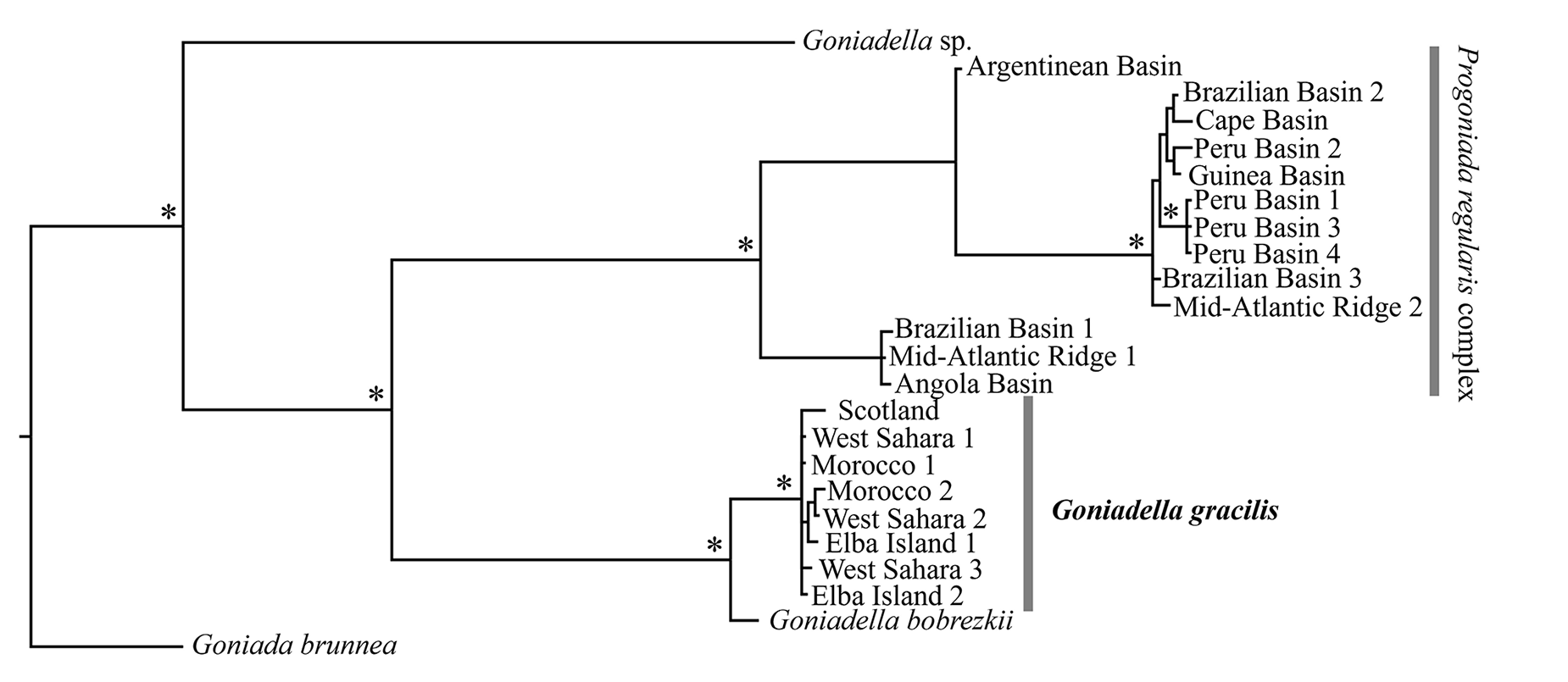
The two 595 bp COI sequences obtained from the individuals from Elba Island gave a >99% identity with sequences of G. gracilis from the Eastern Atlantic Ocean (from Scotland to West Sahara) deposited in BOLD (Figure 5), confirming that they belong to the same species. Unfortunately, neither COI sequences of G. gracilis from the Western Atlantic Ocean nor COI sequences of G. bobrezkii were available. The two 18S sequences obtained from the individuals from Elba Island (respectively, 1721 and 1812 bp long) gave a 99.7% identity with G. bobrezkii and a 99.2–99.3% identity with Progoniada regularis Hartman, 1965; sequence identity with other Goniadidae was distinctly lower, between 95 and 98%. The Bayesian phylogenetic reconstruction highlighted a close relationship between G. gracilis and G. bobrezkii, which together formed the sister group to the Progoniada regularis species complex. A COI sequence identified as Goniadella sp. from India turned out to be only distantly related to G. gracilis and might either represent a clue of a polyphyletic status of Goniadella, or a misidentification of a different genus of Goniadidae (Figure 5).
Bayesian phylogenetic tree of Goniadidae belonging to the genera Goniadella and Progoniada based on concatenated COI and 18S sequences. Goniada brunnea is used as outgroup. Stars represent nodes with a >95% Bayesian posterior probability.

Ecology
Our individuals of G. gracilis were sampled on predominantly coarse sand and detritic substrates with a small fraction of mud, often characterised by coarser component such as gravels, shell fragments, or Posidonia oceanica root mats. In particular, in the port of Livorno, G. gracilis was found during 4 consecutive years of monitoring with low densities (6.25 ind. m−2, average density over 4 years) in stations where the macrozoobenthic community was numerically dominated by the polychaetes Sphaerosyllis taylori Perkins, 1981 (600 ind. m−2), Hesionura coineaui (Laubier, 1962) (352 ind. m−2), and Ophelia roscoffensis Augener, 1910 (206 ind. m−2). Other macrozoobenthic species associated with G. gracilis were the polychaetes Eunice vittata (Delle Chiaje, 1828) and Polygordius neapolitanus Fraipont, 1887, and to a lesser extent the polychaetes Glycera lapidum Quatrefages, 1866, Glycera unicornis Lamarck, 1818, Odontosyllis gibba Claparède, 1863, Paradoneis ilvana Catelli 1985, Eulalia sp., Protodorvillea kefersteini (McIntosh, 1869), the bivalve Cardites antiquatus (Linnaeus, 1758), and the amphipod Nototropis vedlomensis (Spence Bate & Westwood, 1862).
Discussion
This study represents the first record of G. gracilis (as well as the second record of the genus Goniadella) in Italian coastal waters and adds further records of this species in the Mediterranean waters, together with the first detailed description and molecular data for Mediterranean specimens. The morphological characteristics of the analysed specimens agree well with the detailed descriptions of this species by Hartman (Reference Hartman1950), Walker (Reference Walker1972), Aguirrezabalaga (Reference Aguirrezabalaga1984), Böggemann (Reference Böggemann2005), and Moreira and Parapar (Reference Moreira, Parapar, Parapar, Moreira, Núňez, Barnich, Brito, Del C, Fiege, Capaccioni-Azzati and El-Haddad2015). The present authors conducted a comprehensive analysis of both topotipical specimens and individuals from a range of other geographical areas, including European waters and the Mediterranean basin. A difference can be found in the number of uniramous chaetigers, which is 27–28 in our specimens compared to 30–31 in those described from Massachusetts (Hartman, 1950). However, considering the values reported in literature for specimens from different geographical areas (Böggemann, Reference Böggemann2005), this difference seems to be within the range of variability of the species. A more remarkable difference between some of our Tyrrhenian specimens and the descriptions available in the literature is the pigmentation pattern, which to our knowledge has never been reported before. It remains to be seen whether this is a distinctive trait of Tyrrhenian individuals or a feature that has been overlooked in specimens from other geographical regions. G. gracilis shows some morphological similarities with the congeneric species G. bobrezkii, recently reported on the continental Tyrrhenian coast, in Posidonia oceanica beds, at 7 m depth (Mancini et al., Reference Mancini, Tiralongo, Ventura and Bonifazi2019). However, G. gracilis can be readily distinguished from its congener by the number of uniramous parapodia (21–24 in G. bobrezkii) and by the position of acicular notochaetae (both dorsal to dorsal cirrus in G. bobrezkii, one dorsal and one ventral to dorsal cirrus in G. gracilis).
In this study, the specimens were collected at a minimum depth of 9 m in the Central Tyrrhenian area and a maximum of about 85 m in the Southern Ionian area, in rather similar habitats characterised by coarse organogenic detritus mixed with sandy sediment. In other studies from the Mediterranean basin, the bathymetric range of G. gracilis was between 29 and 45 m (Böggemann, Reference Böggemann2005; REBENT network, 2019), while in the Eastern Atlantic the species was found at depths of up to 132 m (Moreira and Parapar, Reference Moreira, Parapar, Parapar, Moreira, Núňez, Barnich, Brito, Del C, Fiege, Capaccioni-Azzati and El-Haddad2015).
The density of G. gracilis was low in all the investigated sites, in line with other studies carried out in the Mediterranean area (Bogdanos and Satsmadjis, Reference Bogdanos and Satsmadjis1983, Reference Bogdanos and Satsmadjis1987; REBENT network, 2019). The macrozoobenthic assemblage of the studied sites is represented both by species typical of coarse sediments with a high abundance of shell fragments, such as the polychaete Polygordius neapolitanus (Ramey-Balci et al., Reference Ramey-Balci, Fiege, Purschke, Westheide and Purschke2020), and by opportunistic species indicative of high organic enrichment such as Protodorvillea kefersteini (Bianchi et al., Reference Bianchi, Ceppodomo, Galli, Sgorbini, Dell’Amico, Morri, Ferretti, Immordino and Damiani1993) together with more generalist species, such as Paradoneis ilvana (Castelli, Reference Castelli1985).
Outside the Mediterranean basin, after the first record in Liverpool Bay by Walker (1972), G. gracilis is currently considered as an established non-indigenous species in the British Isles and the North Sea (Tsiamis et al., Reference Tsiamis, Palialexis, Stefanova, Gladan, Skejić, Despalatović, Cvitković, Dragičević, Dulčić, Vidjak, Bojanić, Žuliević, Aplikioti, Argyrou, Josephides, Michailidis, Jakobsen, Staehr, Ojaveer, Lehtiniemi, Massé, Zenetos, Castriota, Livi, Mazziotti, Schembri, Evans, Bartolo, Kabuta, Smolders, Knegtering, Gittenberger, Gruszka, Kraśniewski, Bartilotti, Tuaty-Guerra, Canning-Clode, Costa, Parente, Botelho, Micael, Miodonski, Carreira, Lopes, Chainho, Barberá, Naddafi, Florin, Barry, Stebbing and Cardoso2019). In recent decades, a number of records added up along the coasts of Northern Europe, the Celtic Sea (Blanchet et al., Reference Blanchet, Chevalier, Gaffet and Hamon2004) and the Bay of Biscay (Martins et al., Reference Martins, Sampaio, Rodrigues and Quintino2013), often reporting high densities of this species. The molecular data from our study show a high degree of similarity between specimens from the eastern Atlantic (from Scotland to West Sahara) and those found in the Tyrrhenian Sea, suggesting a common origin for these populations. On the other hand, the lack of sequences from the type locality or from the Western Atlantic area does not allow us to investigate the existing relationships between the North American populations and the European and North African pools. In addition, the larval reproduction of Goniadidae is generally represented by lecithotrophic and short-lived planktonic larvae (Böggemann, Reference Böggemann2005), which are generally poorly compatible with anthropic transport. For these reasons, in the absence of reliable data, and also considering the limited knowledge and distribution of G. gracilis in the Mediterranean Sea, it is not possible to assess whether G. gracilis is non-indigenous in this region, or it may represent an eastern Atlantic vicariant (in which case G. unicirra would be a valid taxon). Considering these uncertainties, we suggest to consider the species as a questionable non-indigenous species in the Mediterranean. The term ‘questionable non-indigenous species’ is defined as encompassing species in relation to which there is an absence of adequate information, species for which the verification of new entry or new records is lacking in the opinion of experts, and species for which the taxonomic status remains unresolved (Langeneck et al., Reference Langeneck, Bertasi, Grossi, Lefons, Vani, Verni, Musco and Castelli2024; Tsiamis et al., Reference Tsiamis, Zenetos, Deriu, Gervasini and Cardoso2018).
The scarcity of records for the species coupled with its low abundance, and the limited knowledge of the genus in the Mediterranean area, leads us to hypothesise that G. gracilis may have been overlooked or misidentified with juveniles of other Goniadidae. On the other hand, also the scarcity of records for the congener G. bobrezkii seems to confirm the limited taxonomic knowledge for the whole genus in the Mediterranean. This work increases the knowledge about the distribution and ecology of G. gracilis, adding new phenological characters and molecular data. A more complete analysis of the available material, including specimens from the type locality, is needed in order to better clarify the relationships between the different populations and to define the status of this species in the Mediterranean basin.
Data availability statement
The authors confirm that the data supporting the findings of this study are available within the article.
Acknowledgements
Authors are indebted to Paola Gennaro for the samples collection in the Port of Livorno, to Monica Tragusi for the management of the monitoring activities, and to Paolo Tomassetti, Loretta Lattanzi, Veronica Marusso, Salvatore Porrello, Monica Targusi, Danilo Vani for the aid in the processing of all the macrozoobenthic samples. Thanks also to Chiara Maggi for the organisation of the field campaigns in the Ionian Sea in the context of the monitoring for the Marine Strategy Framework Directive. Data from REBENT Network were obtained through SeaDataNet Pan-European infrastructure for ocean and marine data management (https://www.seadatanet.org). Emanuele Mancini is funded by the National Recovery and Resilience Plan (NRRP), Mission 4 Component 2 Investment 1.4 – Call for tender No. 3138 of 16 December 2021, rectified by Decree n.3175 of 18 December 2021 of Italian Ministry of University and Research funded by the European Union – Next Generation EU; Project code CN_00000033, Concession Decree No. 1034 of 17 June 2022 adopted by the Italian Ministry of University and Research, CUP D33C22000960007, Project title ‘National Biodiversity Future Center - NBFC’.
Author contributions
Fabio Bertasi: formulation of the research idea, morphological analysis of specimens, preparation of figures, writing of the article. Laura Grossi: analysis of the community data, writing of the article. Emanuele Mancini: coordination of the workflow of the article, morphological analysis of specimens, preparation of figures, writing of the article. Joachim Langeneck: analysis of the molecular (18S and COI) data, interpretation of the findings, preparation of the tables, writing of the article.
Funding
This research received no specific grant from any funding agency, commercial or not-for-profit sectors.
Competing interests
The authors have no conflict of interests to declare.
Ethical standards
Authors declare not applicable.