Approximately 90% of infants with CHD are now expected to reach adulthood.Reference Moons, Bovijn, Budts, Belmans and Gewillig 1 The adult CHD population is thus expanding and ageing.Reference Marelli, Ionescu-Ittu, Mackie, Guo, Dendukuri and Kaouache 2 Despite increasing survival rates, adults with CHD remain at increased risk for arrhythmia, heart failure, re-operation, and premature death.Reference Warnes 3 – Reference Verheugt, Uiterwaal and van der Velde 7 This population, particularly those with complex disease, is known to have a higher hospitalisation rate and longer hospital length of stay compared with the general adult population.Reference Verheugt, Uiterwaal and van der Velde 4 , Reference Mackie, Pilote, Ionescu-Ittu, Rahme and Marelli 8 – Reference Cedars, Benjamin and Vyhmeister 10 Higher healthcare resource utilisation has been described among elderly adults with CHD.Reference Tutarel, Kempny and Alonso-Gonzalez 11 Guidelines recommend that patients with complex and moderate defects be followed-up in specialised adult CHD centres.Reference Silversides, Marelli and Beauchesne 12 – Reference Baumgartner, Bonhoeffer and De Groot 14
A thorough description of the institutional resource utilisation for non-elective hospitalisations of adults with CHD in a North American tertiary-care centre has not been reported. We undertook an extensive review of consecutive non-elective inpatient admissions to describe inpatient care in terms of patient demographics, diagnostic and treatment history, reason for hospital admission, resource utilisation, and length of stay as well as identify factors associated with longer length of stay.
Methods
Sample and design
Admissions were included in this retrospective study if they met the following inclusion criteria: patient aged 18 years or older, patient with documented CHD, non-elective admission, including overnight stay, to our tertiary-care centre located in Canada in a 12-month period, and patient managed by the adult CHD service. Exclusion criteria were as follows: admission for elective procedures and admission for medical reason for which care did not involve the adult CHD service. A thorough review of multiple cross-referenced sources was undertaken to generate an accurate list of inpatients meeting inclusion/exclusion criteria and to abstract the data. Data from the first admission within the study period were used to describe the socio-demographic characteristics and medical history of patients with more than one admission. The study was approved by the institutional Research Ethics Board.
Data abstraction
Socio-demographic characteristics
The following data were abstracted: age at admission, sex, marital status, whether patients had children, driving time from hospital, which was determined using an online map service, employment status, documented cognitive/developmental, or psychological disorders, known current tobacco use, and documented alcohol problem or illegal drug use.
Diagnostic and treatment history
CHD were categorised as follows: simple, for example, small atrial septal defect; moderate, for example, tetralogy of Fallot and coarctation of the aorta; or complex, for example, Fontan repair, transposition of the great arteries, and double-outlet ventricle.Reference Warnes, Williams and Bashore 13 Operative history was categorised as follows: unoperated, no previous procedure; palliated, one or more previous palliative procedures but no reparative intervention; repaired, haemodynamic and/or anatomic repair; or re-operated, additional operative procedure(s) following the initial repair.Reference Gatzoulis, Hechter, Siu and Webb 15 Details regarding subaortic ventricular morphology – right or left – and interventional history were noted. Any history of sustained arrhythmia, heart failure, stroke, or transient ischaemic attack, infective endocarditis, myocardial infarction, or transplant assessment was also documented.
Hospital admission
The following data were abstracted for each admission: the source of admission, day of admission – weekend versus weekday – and reason for admission – arrhythmia, heart failure, other cardiovascular, or other non-cardiovascular reasons. With regard to resource utilisation, the following were documented for each admission: location(s) of stay, non-adult CHD medical consultations, diagnostic investigations, main procedures and treatments, mechanical ventilation, blood transfusion, and mortality. Discharge destination and recommended outpatient clinic follow-up plan were also recorded.
Statistical analyses
Results are presented as frequencies and percentages or as means and standard deviations as appropriate. When associating variables with length of stay, we excluded four outliers for length of stay (z-scores >2). We conducted Student t-tests and correlations to investigate which factors were associated with longer length of stay. Owing to the exploratory nature of this study, a p-value of <0.05 was considered significant for all analyses. Data analyses were performed using SPSS for Windows, version 22.0 (SPSS Inc., Chicago, Illinois, United States of America, 2013).
Results
Sample and socio-demographic characteristics
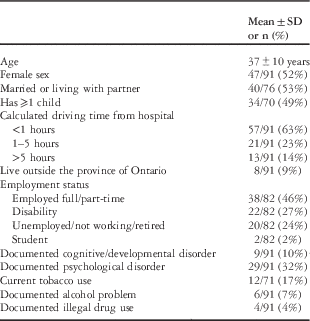
In the 12-month period of study, 91 patients were under the care of the adult CHD service for a total of 103 admissions. The socio-demographic characteristics for the 91 unique patients (52% female, mean age=37±10 years) are displayed in Table 1. The varying denominators in this table reflect the fact that all socio-demographic data were not available for all patients.
Socio-demographic characteristics.

Denominators reflect the number of patients for whom data were available
Diagnostic and treatment history
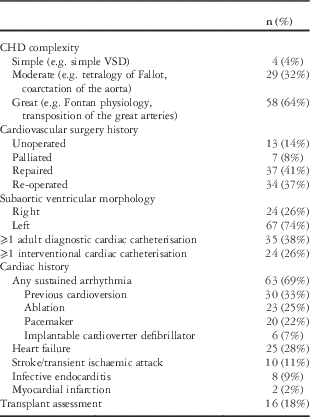
As presented in Table 2, 87/91 patients (96%) had moderate or complex forms of CHD. The most prevalent heart defects were univentricular anatomy/Fontan circulation (n=21; 23%), repaired transposition of the great arteries/atrial or arterial switch procedure (n=11; 12%), repaired tetralogy of Fallot (n=10; 11%), and cyanotic CHD or Eisenmenger syndrome (n=10; 11%). A total of 63 patients (69%) had a history of sustained arrhythmia, 25 patients (28%) had a history of heart failure, and 16 (18%) had previously undergone evaluation for heart and/or lung transplantation, although none had undergone transplantation.
Diagnostic and treatment history (n=91).

Hospital admission
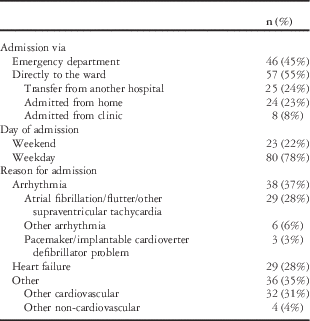
As displayed in Table 3, of 103 hospitalisations, patients were most often admitted through the emergency department (n=46; 45%) and on weekdays (n=80; 78%). The most common reasons for admission were arrhythmia (n=38; 37%) and heart failure (n=29; 28%). Other cardiovascular reasons for admission included evaluation of cardiovascular symptoms (n=9), haemoptysis (n=4), and infective endocarditis (n=4).
Hospital admission characteristics (n=103).

Resource utilisation
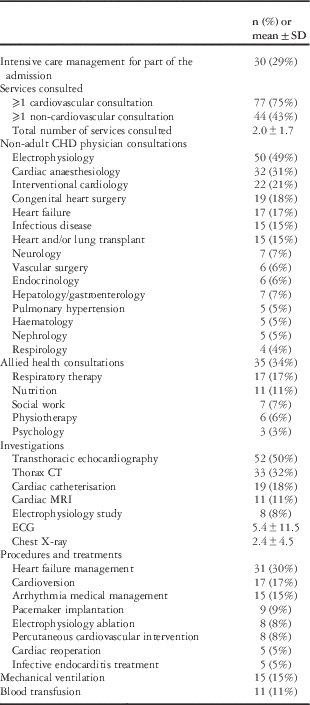
Table 4 presents the resource utilisation for all 103 admissions. During the study period, intensive care management occurred in 30 admissions (29%) and transplant assessment occurred during 15 (15%) admissions. The occurrence of intensive care management did not differ by sex, age, or defect complexity, moderate versus complex, or primary reason for admission. The mean number of consultations with other services was 2.0±1.7. Electrophysiology was the service consulted most often (n=50; 49%). A non-cardiovascular consultation occurred in 44 (43%) admissions. The mean number of consultations did not differ by sex, age, or defect complexity, moderate versus complex; however, there were more consultations for patients admitted for heart failure versus arrhythmia or other reasons (2.8±2.1 versus 1.5±1.0 versus 1.9±1.8, respectively; p=0.009).
Resource utilisation (n=103).

Length of stay
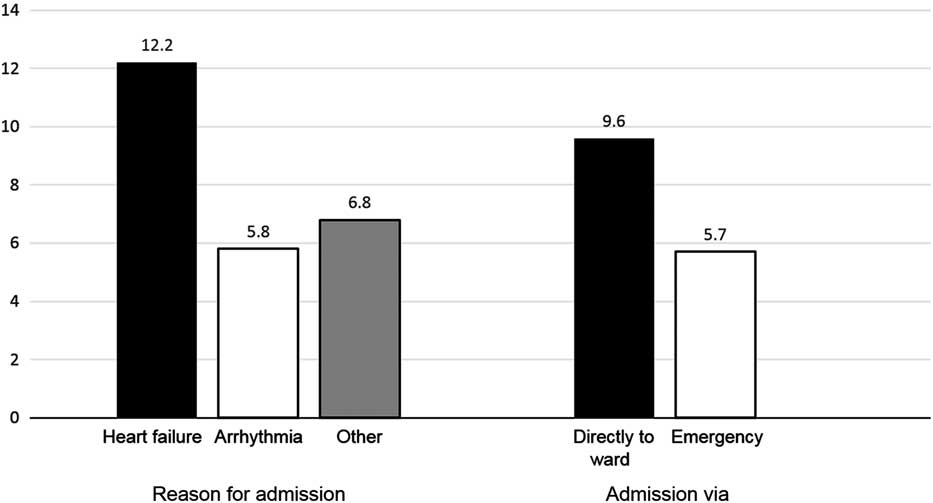
The mean length of stay across the 103 admissions was 12.0±23.2 days (with a range from 1 to 168) for a total of 1243 days; thus, a mean of 3.4 hospitalised patients per day were managed by the adult CHD service. We removed four outliers with lengths of stay ranging from 70 to 168 days, two of whom were admitted for heart failure. In the resulting sample size of 99, the mean length of stay was 7.9±7.4 days, with a median of 5 days. Among these 99 admissions, the length of stay did not vary by demographic variables, sex and age, moderate versus complex defect complexity, previous cardiovascular surgery, or documented psychological disorder. Length of stay also did not differ significantly between the four most common diagnoses – Fontan circulation, repaired transposition of the great arteries, repaired tetralogy of Fallot, and cyanotic CHD/Eisenmenger syndrome. Length of stay was longer for patients admitted for heart failure versus arrhythmia or other reasons (12.2±10.3 versus 5.8±4.4 versus 6.8±6.1, respectively; p=0.001). Length of stay was also longer when patients were admitted directly to the ward versus via the emergency department (9.6±8.9 versus 5.7±4.0; p=0.009). Follow-up analyses revealed that patients admitted directly to the ward versus emergency department did not differ with regard to age, sex, defect complexity, primary reason for admission, or NYHA class (all p-values >0.05) (Fig 1).
Length of stay (days).

Discharge planning
There were seven deaths across the 103 hospitalisations, and therefore information regarding discharge planning was available for 96 admissions. The majority of patients were discharged back to their homes (n=93; 97%). Only two patients were transferred to other hospitals, and one was transferred to a rehabilitation facility; we do not have data regarding the length of stay at these other facilities. Among the 75 discharged patients with known planned outpatient clinic follow-up, appointments were on average scheduled for 7.4±8.2 weeks and occurred at a mean of 9.3±11.9 weeks after discharge.
Discussion
Complex medical management
The adult CHD population, which is increasing in numbers, morbidity, and complexity, will continue to challenge allocated inpatient and outpatient resources in any adult CHD centre.Reference Marelli, Ionescu-Ittu, Mackie, Guo, Dendukuri and Kaouache 2 , Reference O’Leary, Siddiqi, de Ferranti, Landzberg and Opotowsky 16 , Reference Islam, Yasui, Kaul, Marelli and Mackie 17 This study highlights the fact that complex patients require complex management.
Approximately 3000 patients were followed-up in the outpatient clinic the year of data collection; thus, we estimate a 3% rate of non-elective hospitalisation among patients followed-up at our clinic. Among non-elective hospitalisations at our tertiary-care centre, most inpatients had moderate or complex CHD; Fontan circulation, repaired transposition of the great arteries, and repaired tetralogy of Fallot were most common. Arrhythmia and heart failure are common CHD complications known to be associated with emergency hospital admissionsReference Kaemmerer, Bauer and Pensl 18 – Reference Koh, Yap and Le Tan 20 and our study further documented these as the two most common reasons for non-elective admissions. Arrhythmias and heart failure manifest especially complex behaviour within this population and require unique expertise to understand their presentation and treatment.Reference Khairy, Van Hare and Balaji 21 As supraventricular arrhythmias are common following Fontan and atrial switch procedures,Reference Warnes 22 – Reference Aboulhosn, Williams and Shivkumar 24 it is not surprising that half of the patients in this study had consultations from the electrophysiology service. With regard to heart failure, this represents a different process in single-ventricle physiology or in a patient after atrial switch procedure with a subaortic right ventricle compared with that which occurs in heart failure associated with acquired heart disease.Reference Warnes 22 , Reference Horer, Herrmann and Schreiber 25 , Reference Cedars, Joseph and Ludbrook 26
The care of adults with complex CHD admitted to hospital under an adult CHD service demands consultation and collaboration with a variety of healthcare providers as previously shown.Reference Kaemmerer, Bauer and Pensl 18 Almost half of the admissions required consultation with non-cardiovascular medical specialties, and approximately one-third included allied health consultations. We found that approximately half of non-elective admissions began in the emergency department, and that one-third of patients in this study were managed in an ICU for a portion of their hospitalisation. The observation that cardiac anaesthesiology was actively involved in one-third of the hospital admissions underscores the importance of collaboration with cardiac anaesthetists with expertise in complex CHD anatomy and pathophysiology and the fragile pathophysiology of CHD patients.
Length of stay considerations
After removing outliers, the mean length of stay in this study was 8 days, with a median of 5 days, and was significantly longer in patients admitted with heart failure. A focus on length of stay is certainly not unique to the CHD community. Within the acquired heart disease population, heart failure is the most frequent admitting diagnosis and also associated with longer length of stay.Reference Albert, Sherman and Backus 27 The 29 patients in our study who were admitted for heart failure had an average length of stay of 12 days, which is longer than that reported for all acute hospitalisations due to heart failure in Canada (9.2 days). 28 They also had a higher number of consultations during their hospitalisations. Longer length of stay among heart failure patients has been associated with greater co-morbidities and disease severity,Reference Whellan, Zhao and Hernandez 29 although the ability to risk stratify remains limited.Reference Whellan, Zhao and Hernandez 29 The adult CHD community might wish to draw upon strategies targeting length of stay within the general heart failure population, such as the provision of post-discharge ambulatory care.Reference Dusemund, Steiner and Vuilliomenet 30 Close outpatient follow-up can facilitate earlier identification of cardiac destabilisation and planned weekday admissions. Advanced practice nurses play a key role in the acquired heart disease population as well as the adult CHD population by identifying patient care needs, providing ongoing tailored education, maintaining regular telephone follow-up while promoting self-care capacity and coordinating care with all concerned care providers.Reference Carrington and Stewart 31 – Reference Moons, De Geest and Budts 33
Although length of stay was longer among patients admitted directly to the ward versus via the emergency department, we did not detect any other significant differences between the two groups. We hypothesise, based on our clinical experiences, that patients admitted directly to the ward might have had more challenging healthcare needs not captured by disease complexity or the NYHA class because they were either transferred from another hospital, which did not have the resources to provide complex adult CHD treatment, or were admitted from home or the clinic, in which case we would have tried to optimise treatment on an outpatient basis if possible.
Unique psychosocial considerations
Our observation that one-third of inpatients had a known history of psychological problems is consistent with research conducted in outpatient clinics.Reference Kovacs, Saidi and Kuhl 34 , Reference Bromberg, Beasley, D’Angelo, Landzberg and DeMaso 35 As very few inpatients in this study received inpatient mental health services, it is important to determine optimal strategies to assess and provide treatment when appropriate. Indeed, hospitalisations can present additional psychosocial challenges for adults with CHD. Adults admitted to hospitals with acquired heart disease are typically in their seventh or eighth decades of life, whereas in our study the mean age of adult CHD inpatients was 37 years. Most hospitalised adults with CHD are thus at a very different stage in their lives than patients hospitalised with acquired heart disease; in our study, almost half of them were employed and had, presumably younger, children.
Further, unlike general cardiovascular patients for whom appropriate medical care is more readily available, adult CHD programmes are typically housed within tertiary-care centres that are often located at a significant distance from the patient’s home,Reference Beauchesne, Therrien and Alvarez 36 thereby increasing the risk of social isolation during hospitalisation. Indeed, one in seven patients in this study lived over 5 hours’ driving distance from the hospital; therefore, when caring for hospitalised adults with CHD, it is important to be mindful of potential psychosocial challenges and to develop strategies to optimise overall health care.
Study limitations
This study overcame some of the challenges of administrative databases and national registries, which may include inaccuracies and incomplete data;Reference Welke, Karamlou and Diggs 37 , Reference Zomer, Uiterwaal and van der Velde 38 however, the study sample was limited to non-elective hospitalisations in a single, large, Canadian supraregional centre, and therefore the results may not be easily generalisable to community hospitals or hospitals without a dedicated adult CHD inpatient service. Results of this study are also most generalisable to other tertiary-care centres in Canada or other countries with universal health care. We were unable to determine the extent to which insurance coverage might impact non-elective hospitalisations. In addition, our focus was care provided by the adult CHD service at a tertiary care hospital. We do not have overall length of stay data on the three patients who were transferred to other hospitals or a rehabilitation facility. We also do not have data from our institution regarding resource use and length of stay of non-CHD patients or CHD patients admitted to other services. Further, data were analysed for a 1-year period only. We did not analyse changes in admissions over time, and therefore we do not know whether rates are increasing.
Conclusions
The population of adults with complex CHD continues to expand and remains at high risk for cardiovascular morbidity and mortality, thus requiring specialised care in both outpatient and inpatient settings. This is the first study to provide a thorough description of the nature of non-elective inpatient care for adults with CHD, and revealed heart failure and arrhythmia as the most common reasons for admission. The involvement of many subspecialists confirms CHD as a complex, multisystem disease that calls for interdisciplinary collaboration. Length of stay was longest for patients admitted with heart failure, and future studies should investigate whether it might be possible to reduce unnecessary length of stay while concurrently maintaining high-quality clinical care. Researchers may wish to draw upon strategies with proven effectiveness among adults with heart failure due to acquired heart disease. Finally, a comprehensive approach to inpatient management entails acknowledging complexities in both medical and psychosocial aspects of care.
Acknowledgements
The authors acknowledge the assistance provided by Nathan Ing and Vincent Maquin.
Financial Support
The authors acknowledge the French Federation of Cardiology for supporting the first author, Dr Alexandra Soufi, and the University Health Network Allied Health Research Committee for providing additional support for this study.
Conflicts of Interest
None.
Ethical Standards
The authors assert that all procedures contributing to this study comply with the ethical standards of the relevant national guidelines on human experimentation and with the Helsinki Declaration of 1975, as revised in 2008, and has been approved by the University Health Network Research Ethics Board.