Introduction
Four species of dwarf carpenter bees, Ceratina Latreille (Hymenoptera: Apidae: Xylocopinae), occur in the Niagara Region of southern Ontario. Ceratina calcarata Robertson and members of the C. dupla Say species group are very common, whereas C. strenua Smith is extremely rare (Richards et al. Reference Richards, Vickruck and Rehan2011). Ceratina dupla represent a species complex (Sheffield et al. Reference Sheffield, Hebert, Kevan and Packer2009), represented in Niagara by C. dupla and C. mikmaqi Rehan and Sheffield (Rehan and Sheffield Reference Rehan and Sheffield2011). Ceratina calcarata and the C. dupla species group are phylogenetically closely related (Rehan et al. Reference Rehan, Chapman, Craigie, Richards, Cooper and Schwarz2010), are morphologically very similar (Rehan and Richards Reference Rehan and Richards2008; Rehan and Sheffield Reference Rehan and Sheffield2011), and have nearly identical geographical ranges (Daly Reference Daly1973). They also are polylectic (Rutgers–Kelly Reference Rutgers-Kelly2003) and nest in the exposed pith of twigs and stems (Comstock Reference Comstock1911; Kislow Reference Kislow1976). This ecological similarity suggests that C. calcarata and the C. dupla species group may be an interesting group for studies of competition for important resources (e.g., nest sites and pollen) and of subtle niche differences between closely related species.
Little is known of the nesting biology of C. dupla and C. mikmaqi (but see Comstock Reference Comstock1911; Grothaus Reference Packer, Gravel and Lebuhn1962), and only C. calcarata has been previously studied (Rau Reference Rau1928; Grothaus Reference Packer, Gravel and Lebuhn1962; Kislow Reference Kislow1976; Johnson Reference Johnson1988, Reference Johnson1990; Rehan and Richards Reference Rehan and Richards2010). Ceratina calcarata is univoltine, is mass-provisioning, and commonly nests in exposed pithy stems of sumac (Rhus L., Anacardiaceae), raspberry (Rubus L., Rosaceae), and cultivated rose (Rosa L., Rosaceae). Mothers are devoted, long-lived, and remain with their broods at least until adult emergence. Brood sex ratios are often male-biased, and the innermost brood cell usually produces a small daughter (Kislow Reference Kislow1976; Johnson Reference Johnson1988; Rehan and Richards Reference Rehan and Richards2010). As in other species of Ceratina (Sakagami and Maeta Reference Sakagami and Maeta1977; Michener Reference Michener1985), this daughter may aid her mother in feeding younger brood as adults. Though females are usually solitary in nature, there is one account of coerced multi-female nesting in captivity (Chandler Reference Chandler1975).
This study had two objectives. The major objective was to describe the nesting biology of C. dupla and C. mikmaqi in the Niagara Region and to compare it with that of C. calcarata, with the goal of identifying interspecific differences that might represent evidence of niche differentiation. Because C. mikmaqi has only recently been identified and described (Rehan and Sheffield Reference Rehan and Sheffield2011), a secondary objective was to use DNA barcode analysis to confirm and delineate the presence of C. dupla and C. mikmaqi in southern Ontario. To address these objectives, specimens of C. calcarata, C. dupla, and C. mikmaqi were collected with their nests or by using pan traps over the course of the 2008 nesting season. Investigating these three species in the same season allowed us to compare their nesting biology without confounding environmentally based variation that might occur between breeding seasons.
Methods
Study sites
Ceratina nests were collected at three locations in St. Catharines, Ontario: around the Brock University campus (43°119′N, 79°249′W), at the Glenridge Quarry Naturalization Site (GQNS) (43°122′N, 79°237′W), and in an old field on Glendale Avenue (43°147′N, 79°180′W). Pan-trap collections took place on the Brock University campus and at GQNS.
Collection of foraging Ceratina
Foraging Ceratina bees were collected in pan traps at five sites on the Brock University campus and at GQNS to help determine flight phenology of each species (Packer et al. Reference Packer, Gravel and Lebuhn2007; Richards et al. Reference Richards, Vickruck and Rehan2010). The pan-trapping protocol was based on the Bee Inventory Plot (LeBuhn et al. Reference LeBuhn, Droege, Griswold, Minckley, Roulston and Cane2003). At each site, two 50 m long transects were established at 90° to one another, forming an X pattern. Fifteen pans (plastic bowls, SOLO PS6-0099) filled with soapy water were equally spaced along each transect, for a total of 30 pans (10 white, 10 yellow, and 10 blue) per site. Each site was sampled weekly in random order from 14 April to 28 September 2008; a few samples were missed because of inclement weather. Pans were set out at each site by 0900 and brought in after 1500. Insects were strained from the pans using a small sieve, after which they were rinsed with water and stored in 70% ethanol.
Nest collections
At least 15 Ceratina nests were collected weekly in early morning, prior to the initiation of foraging, from 14 April to 16 September 2008 at each of the three field sites. Nests were chilled in a refrigerator to cold-anesthetise the occupants, then carefully split open longitudinally to expose nest contents, leaving brood-cell partitions intact. Nest contents were recorded, including the number and sex of adults, the developmental stage and number of immatures, and the presence of parasites.
Based on their contents, nests were classified into one of five categories modified from Daly (Reference Daly1966). “Hibernacula” contained adults and varying levels of debris but no brood cells, pollen balls, or larval faeces; occasionally lines left from old cell partitions were visible. “Founding nests” had clean walls (no old cell lines visible) and no pollen balls, eggs, or cell partitions. “Active brood nests” contained at least one pollen ball and egg. In “full-brood nests”, either the brood cells filled the nest, leaving only enough space for the mother to guard the entrance, or the brood cell nearest to the entrance contained a juvenile that had reached the small larva stage or older (Daly Reference Daly1966), indicating that at least 5 days had elapsed since an egg had been laid. “Mature brood” nests contained newly eclosed adults, immatures, and usually a foundress (very worn female). Clutch size was calculated as the total number of provisioned brood cells per nest.
All immatures (eggs, larvae, and pupae) were reared to adulthood or death in the laboratory at room temperature (approximately 21°C). Each immature was observed daily to assess developmental stage and day of adult emergence. Immatures were classified into 1 of 18 developmental stages following Daly (Reference Daly1966). Developmental rates were calculated by dividing the number of stages completed by the number of days taken to complete those stages. Individuals collected during the egg and prepupal stages were not included in development-time analysis because these stages are considerably longer than the others (Rehan and Richards Reference Rehan and Richards2010) and we could not be certain how far through the stage each newly collected individual had progressed when first collected. Some juveniles died in the laboratory as a result of handling; others died before adulthood, through natural causes, including parasitism and apparent developmental failures. Numbers of brood that died as a result of handling and those that reached adulthood were combined to provide the total number of surviving brood per nest.
Descriptions of adult bees
To compare average body sizes among the three species, the head widths of adult females collected in nests were measured across the widest portion of the face, including the compound eyes, at 40× magnification using a dissecting microscope fitted with an eyepiece micrometer. Wing wear was examined to assess flight activity (Cartar Reference Cartar1992) and scored from 0 to 6, where 0 indicated undamaged wings containing no nicks or tears along the wing margin, 5 indicated obliterated wing margins, and 6 indicated no visible wing margin and damage extending to wing veins and cells.
Specimen identification and DNA sequencing
Specimens were identified morphologically as C. calcarata, C. dupla, and C. mikmaqi using Rehan and Sheffield (Reference Rehan and Sheffield2011). To confirm and test identifications we also sequenced 654 base pairs of the mitochondrial gene cytochrome oxidase 1 (COI, the DNA barcode region) from 84 and 9 individuals morphologically identified as C. mikmaqi and C. dupla, respectively. Sequencing was performed at the Canadian Centre for DNA Barcoding at Guelph University (Guelph, Ontario). DNA was extracted from a single leg of each specimen using automated extraction protocols for 96-well plates (Ivanova et al. Reference Ivanova, deWaard and Hebert2006). One set of primer pairs (LepF1 and LepR1) was used to amplify the DNA barcode region Hebert et al. Reference Hebert, Stoeckle, Zemlak and Francis2004). Polymerase chain reaction (PCR) and sequencing reactions followed standard protocols (Hajibabaei et al. Reference Hajibabaei, deWaard, Ivanova, Ratnasingham, Dooh and Kirk2005). Sequences were edited using BIOEDIT (Hall Reference Hall1999) and aligned using CLUSTAL (Thompson et al. Reference Thompson, Higgins and Gibson1994) using default settings with the exception of gap open penalties increased to 50. Analysis of molecular variance (AMOVA), as implemented in Arlequin 3.11 (Excoffier et al. Reference Excoffier, Laval and Schneider2005), was used to compare levels of genetic variation within and between C. dupla and C. mikmaqi, based on the hypothesis that these groups are reproductively isolated. COI sequences for all 93 specimens are available at GenBank (accession numbers GU707555−GU707648).
Data analysis
Statistical analyses were carried out using SAS (SAS Institute Inc. 2004). Almost all variables were normally distributed and had equal variances and were analyzed with parametric statistical functions with post hoc Tukey's tests where appropriate. The variable wing wear was not normally distributed and changes over the course of the season were investigated using Spearman's rank correlations. Data are presented as means ± standard deviations.
Results
Ceratina diversity in Niagara
We collected 336 Ceratina females and 201 males in pan traps in 2008. Based on females, the Ceratina community was 49% C. mikmaqi (n = 164), 49% C. calcarata (n = 165), and 2% C. dupla (n = 7). Based on males, the community was 79% C. mikmaqi (n = 158), 16% C. calcarata (n = 33), and 5% C. dupla (n = 10). No C. strenua were collected in 2008.
Patterns of COI sequence divergence confirmed that C. dupla and C. mikmaqi are genetically distinct. Sequences fell cleanly into two groups, distinguished by five fixed nucleotide differences between the two species. AMOVA indicated significantly greater sequence divergence between than within species (AMOVA: F ST = 0.8812, df = 1,92; P < 0.00001). The mean pairwise difference between C. mikmaqi and C. dupla was 1.86%. Within C. mikmaqi average divergence was only 0.42% for the six haplotypes among the 84 specimens. All 9 specimens of C. dupla shared a single haplotype.
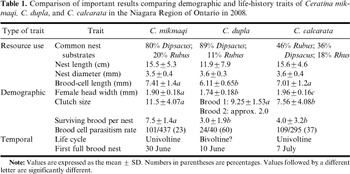
Adult female body size was distinct for each species (F 2,337 = 11.05, P < 0.0001; Table 1). Ceratina calcarata females were the largest, C. mikmaqi females were intermediate, and C. dupla females were the smallest.

Note: Values are expressed as the mean ± SD. Numbers in parentheses are percentages. Values followed by a different letter are significantly different.
Phenology based on pan-trap samples
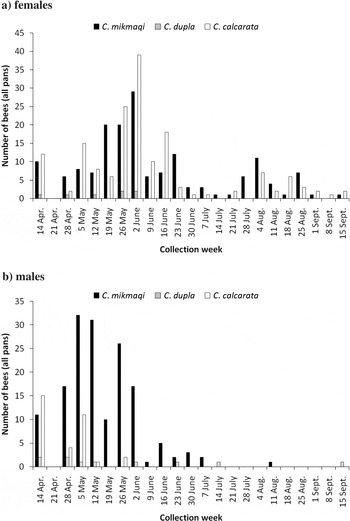
Flight and foraging phenology were inferred from bee abundance in weekly pan-trap samples. Ceratina mikmaqi females began to emerge from hibernation during the week of 14 April 2008 (Fig. 1a). The number of females collected peaked during the week of 2 June, then declined, and was followed by a period of few catches in mid-July. Females again became more abundant from late July to early August. Female wing wear increased over the course of the season (Spearman's ρ = 0.46, n = 165, P < 0.001). Seven females with wing-wear scores of 0 or 1 were collected in pan traps in July and August and were likely newly emerged adults of that year. In spring, most C. mikmaqi males emerged earlier than females, with captures peaking during the week of 5 May and declining steadily thereafter (Fig. 1b). Males collected during the week of 14 April had low wing-wear scores (mean 0.91 ± 1.04), but wing wear increased significantly over the course of the season (Spearman's ρ = 0.52, n = 158, P < 0.0001). One unworn male was captured during the week of 11 August and was probably newly emerged.

Only seven C. dupla females were caught in pan traps, providing limited data on their flight phenology. All seven were caught by the week of 2 June (Fig. 1a). Their wing-wear scores did not change significantly over this period (Spearman's ρ = −0.49, n = 7, ns). Ceratina dupla males were caught at low frequencies until mid-July, after which none were collected until the week of 15 September. As in females, wing wear did not increase significantly over the course of the season (Spearman's ρ = 0.46, n = 10, ns).
Ceratina calcarata females showed pan-trap abundance and wing-wear patterns similar to those of C. mikmaqi. Females were first caught the during week of 14 April and had peak abundance the week of 2 June. Unworn (newly emerged) C. calcarata females were collected in pan traps in August and September; however, wing wear did increase over the course of the season (Spearman's ρ = 0.39, n = 165, P < 0.0001; Fig. 1a). Ceratina calcarata males had the highest abundance in pan traps during the week of 14 April. Wing wear was low but did increase over the season (Spearman's ρ = 0.37, n = 33, P = 0.03). Unlike C. mikmaqi and C. dupla, newly emerged males were not caught in August or September.
Nesting biology
We collected 401 Ceratina nests (including hibernacula), comprising 178 (44%) C. mikmaqi, 9 (2%) C. dupla, 207 (52%) C. calcarata, and 7 (2%) hibernacula that contained at least one C. calcarata together with either C. mikmaqi or C. dupla. Nesting females of C. mikmaqi and C. dupla were collected most frequently in Fuller's teasel (Dipsacus fullonum L., Dipsacaceae; hereinafter teasel) twigs (C. mikmaqi (80%), C. dupla (89%)), less often in raspberry (20% and 11%, respectively), and never from sumac. Nesting C. calcarata were commonly collected from raspberry (46% of nests) or teasel (36%), and were relatively common in sumac (18%).
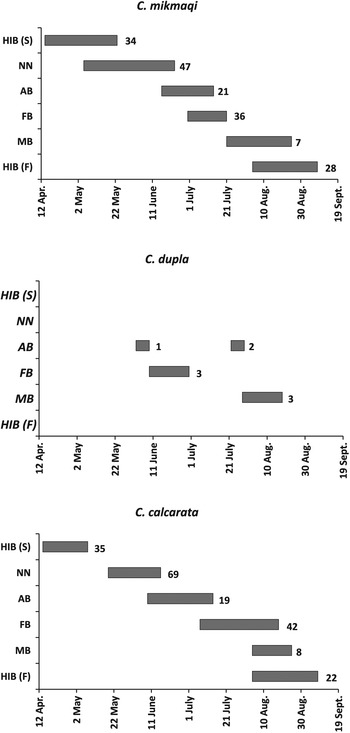
Nesting phenology was similar in C. mikmaqi and C. calcarata (Fig. 2). Both species exhibited a univoltine colony cycle, progressing sequentially from spring hibernacula, through new nests, active broods, full broods, mature broods, and lastly fall hibernacula. Ceratina dupla exhibited a different colony cycle. The first active brood nest was collected on 2 June and the first full brood nest 8 days later, on 10 June. Two active brood nests were subsequently collected on 25 July and 1 August, each containing a foundress with a wing-wear score of 6. This indicates that C. dupla is bivoltine, producing a spring brood earlier than either C. mikmaqi or C. calcarata, followed by a second brood in late summer.

Nest architecture was similar among the species (Table 1). Ceratina dupla nests had significantly shorter brood cells (i.e., the distance between cell partitions) than those of the other species (ANOVA: F 2,87 = 5.37, P = 0.006), reflecting the smaller body size of their occupants. Tunnel length and diameter did not differ among the species (ANOVA: F 2,70 = 1.16, ns, and F 2,75 = 0.37, ns, respectively; Table 1). Hibernacula were never reused as brood-rearing nests by any species. Rather, all nests that contained brood were newly constructed by females digging linear tunnels in the exposed pith of twigs.
Ceratina calcarata clutch sizes were significantly smaller than those of C. mikmaqi and the first brood of C. dupla (ANOVA: F 2,77 = 9.21, P < 0.001; Table 1). Two C. dupla nests collected late in the season were inferred to contain second broods; however, neither was complete. If C. dupla females are iteroparous, then average annual brood size for this species in the Niagara Region would be about 11.25.
Brood parasitism occurred at different rates among Ceratina species, with C. dupla being the most heavily parasitized (χ2 = 32.23, df = 2, P < 0.0001; Table 1). Ceratina calcarata and C. mikmaqi were parasitized by several species of Hymenoptera, including Axima zabriskiei Howard (Eurytomidae), Baryscapus americanus (Ashmead) (Eulophidae), Eurytoma sp. near apiculae Bugbee (Eurytomidae), a species of Coelopencyrtus Timberlake (Encyrtidae), Hoplocryptus zoesmairi (Dalla Torre) (Ichneumonidae), Eupelmus vesicularis (Retzius) (Eupelmidae), and a species of Pyemotes Amerling (Acari: Pyemotidae). In our samples, C. dupla was only parasitized by an unidentified species of Baryscapus Förster. The average number of surviving brood differed significantly among all three Ceratina species (ANOVA: F (2,77) = 9.40, P < 0.0002; Table 1).
Discussion
DNA barcodes and biological data both indicate that there are three Ceratina species in the Niagara Region. Pan-trap abundances and nest frequencies suggest that the rarest species is C. dupla (2%–5% of the total); C. calcarata and C. mikmaqi comprise the remainder of the community. The relative abundance of the latter two is unclear because abundances of pan-trapped females and nests suggest that the species are about equally frequent, whereas abundances of pan-trapped males suggest that C. mikmaqi is much more common.
In the Niagara Region the three species occur sympatrically and each exhibits unique aspects in its nesting biology, suggesting that each occupies a slightly different niche in the local bee community. Ceratina mikmaqi and C. calcarata are univoltine, whereas C. dupla is probably bivoltine. Comstock (Reference Comstock1911) and Grothaus (Reference Packer, Gravel and Lebuhn1962) also reported that C. dupla females sometimes provisioned two nests per season, which implies a mix of univoltine and bivoltine nesting strategies within populations. Although intraspecific variation in life-history pattern cannot be ruled out, Comstock (Reference Comstock1911) and Grothaus (Reference Packer, Gravel and Lebuhn1962) may have been observing interspecific variation between C. dupla and C. mikmaqi. The low level of DNA sequence divergence between C. mikmaqi and C. dupla suggests that they may have diverged relatively recently. Recently diverged species that live sympatrically often may be more strongly temporally isolated from one another than older, more distantly diverged species, and temporal isolation is likely crucial to the speciation process (Rice Reference Rice1987; Quinn et al. Reference Quinn, Unwin and Kinnison2000; Friesen et al. Reference Friesen, Smith, Gomez-Diaz, Bolton, Furness, Gonzalez-Solis and Monteiro2007). The divergent life-history strategies of C. mikmaqi and C. dupla suggest that temporal isolation may be involved in niche differentiation between these two morphologically similar species, based on the timing of important events such as nest founding and brood provisioning.
In addition to phenological differences, there were marked differences in nesting-substrate preferences among species. Ceratina mikmaqi and C. dupla were collected most often from nests in teasel and sometimes in raspberry, and Grothaus (Reference Packer, Gravel and Lebuhn1962) noted that C. dupla nested in sumac, rose, and bramble (Rubus spp.). Ceratina calcarata was collected most commonly in raspberry, was fairly common in teasel, and was the only species found nesting in sumac. Kislow (Reference Kislow1976) and Rehan and Richards (Reference Rehan and Richards2010) reported collecting C. calcarata in raspberry and sumac; Johnson (Reference Johnson1988) reported collecting C. calcarata from cultivated roses. Nesting in teasel has not previously been reported for any Ceratina. Although teasel nesting was frequent in our study, it may be rare overall in North America because teasel is a relatively recent introduction to the Nearctic Region (Rector et al. Reference Rector, Harizanova, Sforza, Widmer and Wiedenmann2006).
Ceratina mikmaqi and C. dupla have similar clutch sizes that are significantly larger than those of C. calcarata. Average clutch size for C. calcarata observed by us in 2008 was 7.6, similar to the size (6.9) reported in the Niagara Region in 2006 (Rehan and Richards Reference Rehan and Richards2010). Clutch size may be influenced by nest location, because proximity to larval food resources is positively correlated with the number of brood cells bees can produce (Peterson and Roitberg Reference Peterson and Roitberg2006a, Reference Peterson and Roitberg2006b; Zurbuchen et al. Reference Zurbuchen, Cheesman, Klaiber, Mueller, Hein and Dorn2010). Teasel grows in open fields, often in close proximity to wildflower pollen sources, whereas raspberry tends to grow at shady, forest edges, where pollen sources may not be as plentiful. The observed differences in clutch size may be a result of the nesting-substrate preferences of the three species.
Although the three species are morphologically similar and nest in the exposed pith of twigs and stems, there are subtle but significant genetic and behavioural differences between them. DNA barcode analysis indicates that C. mikmaqi and C. dupla are genetically distinct, and our field observations indicate interspecific differences in phenology and nesting behaviour. These differences suggest that, at least in the Niagara Region, C. mikmaqi, C. calcarata, and C. dupla occupy slightly different niches and that competition among them is lowered by temporal isolation (differences in phenology) and resource partitioning (differences in nesting-substrate usage). Further studies on resource use, especially nest sites, would be useful to understand how species of Ceratina interact within the bee community in the Niagara Region.
Acknowledgements
We thank Kelly Martin for help setting pan traps over the summer of 2008. The comments of two anonymous reviewers greatly improved the manuscript. This research was supported by a Brock University Deans' Graduate Fellowship to J.L.V., a Natural Sciences and Engineering Research Council of Canada (NSERC) scholarship to S.M.R., and a NSERC Discovery Grant to M.H.R. Specimens contributed from York University were barcoded at the Biodiversity Institute of Ontario, supported through funding to the Canadian Barcode of Life Network from Genome Canada (through the Ontario Genomics Institute), NSERC, and other sponsors listed at www.BOLNET.ca.