Introduction
During the transition from late childhood to mid-adolescence there is a shift from similar rates of depression in pre-adolescent boys and girls to approximately twice as many females than males with depression (Hankin et al. Reference Hankin, Abramson, Moffitt, Silva, McGee and Angell1998). There is evidence that pubertal status (level of maturation at a single time-point) better predicts the emergence of this gender difference than chronological age (Angold et al. Reference Angold, Costello and Worthman1998). Girls have increased levels of depression after mid-puberty whereas boys experience less depression (Angold et al. Reference Angold, Costello and Worthman1998). Studies have reported that more mature pubertal status in girls is associated with increased depression (Conley & Rudolph, Reference Conley and Rudolph2009) and depressive symptoms (Richardson et al. Reference Richardson, Garrison, Drangsholt, Mancl and LeResche2006; Davison et al. Reference Davison, Werder, Trost, Baker and Birch2007; Patton et al. Reference Patton, Olsson, Bond, Toumbourou, Carlin, Hemphill and Catalano2008), but this finding is not consistent (Laitinen-Krispijn et al. Reference Laitinen-Krispijn, van der Ende and Verhulst1999; Negriff et al. Reference Negriff, Fung and Trickett2008; Ge et al. Reference Ge, Conger and Elder2001). One study (Laitinen-Krispijn et al. Reference Laitinen-Krispijn, van der Ende and Verhulst1999), however, examined the rate of progression through puberty (rather than pubertal status per se) and another (Negriff et al. Reference Negriff, Fung and Trickett2008) was a case–control study with two-thirds of the sample being maltreated children.
Although earlier research has revealed valuable findings with regard to the link between pubertal development and depression in girls, certain limitations need to be addressed to advance understanding. An unresolved issue concerns the relative importance of pubertal status and pubertal timing (level of pubertal maturation relative to same-age peers) in determining risk for depressive symptoms. There is evidence that earlier timing of menarche is associated with increased levels of depressive symptoms and depression (Caspi & Moffitt, Reference Caspi and Moffitt1991; Rierdan & Koff, Reference Rierdan and Koff1991; Ge et al. Reference Ge, Conger and Elder1996; Hayward et al. Reference Hayward, Gotlib, Schraedley and Litt1999; Stice et al. Reference Stice, Presnell and Bearman2001; Kaltiala-Heino et al. Reference Kaltiala-Heino, Marttunen, Rantanen and Rimpelä2003; Joinson et al. Reference Joinson, Heron, Lewis, Croudace and Araya2011). During adolescence, however, pubertal timing and status are confounded (Hayward, Reference Hayward and Hayward2003). At a particular point during puberty, girls who began puberty earlier will be more advanced in pubertal status than those who began later. To test the relative contributions of pubertal status and timing in determining risk for depressive symptoms, it is necessary to use multivariable models to take account of the confounding. Only one earlier study that examined the emergence of depressive symptoms from 12 to 15 years included measures of pubertal status and timing in the same model (Ge et al. Reference Ge, Conger and Elder2001). The study reported that pubertal status at age 12 years and early onset of menarche, but not pubertal status at later time-points, predicted later depressive symptoms.
Another limitation of earlier research is the use of composite measures of pubertal status. The majority of the aforementioned studies used measures of pubertal status comprising more than one indicator (Angold et al. Reference Angold, Costello and Worthman1998; Ge et al. Reference Ge, Conger and Elder2001; Richardson et al. Reference Richardson, Garrison, Drangsholt, Mancl and LeResche2006; Patton et al. Reference Patton, Olsson, Bond, Toumbourou, Carlin, Hemphill and Catalano2008; Conley & Rudolph, Reference Conley and Rudolph2009). This was derived from either the Tanner staging system or the Pubertal Development Scale (Petersen et al. Reference Petersen, Crockett, Richards and Boxer1998). The use of a composite measure may have masked differential associations between depression or depressive symptoms and different aspects of pubertal development. Puberty is a complex multifaceted process involving changes in various physiological and hormonal systems. Although different aspects of pubertal development (e.g. breast and pubic hair development) may be correlated, breast development is estrogen dependent whereas pubic hair growth is androgen dependent. These hormones may have a different impact on depression and depressive symptoms. For instance, there is evidence for differential effects of estrogen and testosterone on levels of depression in adolescent girls (Angold et al. Reference Angold, Costello, Erkanli and Worthman1999). Combining indicators of pubertal status is therefore not recommended (Dorn & Biro, Reference Dorn and Biro2011).
Other limitations of earlier research include small sample size (Davison et al. Reference Davison, Werder, Trost, Baker and Birch2007; Conley & Rudolph, Reference Conley and Rudolph2009), cross-sectional design (Richardson et al. Reference Richardson, Garrison, Drangsholt, Mancl and LeResche2006; Negriff et al. Reference Negriff, Fung and Trickett2008) and restricted follow-up period (Laitinen-Krispijn et al. Reference Laitinen-Krispijn, van der Ende and Verhulst1999; Davison et al. Reference Davison, Werder, Trost, Baker and Birch2007). Furthermore, the majority of studies have not adjusted for potential confounders, including socio-economic disadvantage and parental separation (Angold et al. Reference Angold, Costello, Erkanli and Worthman1999; Laitinen-Krispijn et al. Reference Laitinen-Krispijn, van der Ende and Verhulst1999; Ge et al. Reference Ge, Conger and Elder2001; Richardson et al. Reference Richardson, Garrison, Drangsholt, Mancl and LeResche2006; Negriff et al. Reference Negriff, Fung and Trickett2008; Conley & Rudolph, Reference Conley and Rudolph2009).
The current study, based on a large contemporary birth cohort, examined whether more mature pubertal status is associated with an increased level of depressive symptoms in girls from late childhood into mid-adolescence. The study builds on earlier research by examining the relative contributions of pubertal status and timing in accounting for increases in level of depressive symptoms and by using separate indicators of pubertal status.
Method
Participants
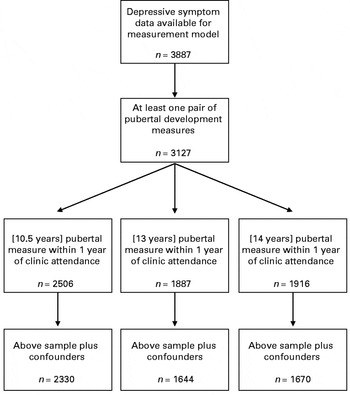
The sample comprised participants from the Avon Longitudinal Study of Parents and Children (ALSPAC: www.alspac.bris.ac.uk; Golding et al. Reference Golding, Pembrey and Jones2001). The ALSPAC is an ongoing population-based study investigating a wide range of influences on the health and development of children. Ethical approval for the study was obtained from the ALSPAC Law and Ethics Committee and the Local Research Ethics Committees. Pregnant women resident in the former Avon Health Authority in southwest England, having an estimated date of delivery between 1 April 1991 and 31 December 1992, were invited to take part, resulting in a cohort of 14 541 pregnancies and 13 988 children (including 6764 girls) alive at 12 months of age. When the oldest children were aged 7 years, an attempt was made to increase the size of the initial sample with eligible cases that did not join the cohort at the outset. The number of active new cases that are represented in the data resource is 542 (294 females). Hence, the starting sample for the current study was n = 7054 (6764 + 294), of whom n = 3887 girls provided at least one measure of depressive symptoms. Fig. 1 shows how the various samples considered in this study were obtained from the starting sample.
Flowchart depicting sample derivation.

Measures
Depressive symptoms
The Short Mood and Feelings Questionnaire (SMFQ; Angold et al. Reference Angold, Costello, Messer, Pickles, Winder and Silver1995) is a brief (13-item) questionnaire enquiring about the occurrence of depressive symptoms over the past 2 weeks. The internal construct validity of a single continuum of severity of depressive symptoms has been supported in a UK community sample in which the items were subjected to unidimensional item response modeling after simple binary recoding (Sharp et al. Reference Sharp, Goodyer and Croudace2006). Study children completed the SMFQ at research clinics at three time-points (10.5, 13 and 14 years). Mean ages at attendance were 10.65 (s.d. = 0.27), 12.81 (s.d. = 0.23) and 13.84 (s.d. = 0.21) years. Ideally the sample should have been the same age when they attended each research clinic; however, variability in age at attendance was not related to level of depressive symptoms.
Pubertal status and timing
A series of six postal questionnaires pertaining to pubertal development were administered approximately annually from the time the study child was 8 years old (at 8 years 1 month, 9 years 7 months, 10 years 8 months, 11 years 8 months, 13 years 1 month, and 14 years 7 months). Earlier questionnaires were completed mainly by the study mother (e.g. 84% at age 8 years), but once the study children reached their teens, around half of questionnaires were completed by the study child or study child/mother together. The questionnaires contained schematic drawings and verbal descriptions of secondary sexual characteristics (breasts, pubic hair) based on the Tanner staging system. Such assessments of pubertal status correlate well with hormonal markers of maturation (Angold et al. Reference Angold, Costello, Erkanli and Worthman1999) and with ratings based on physical examination (Dorn et al. Reference Dorn, Susman, Nottelmann, Inoff-Germain and Chrousos1990). The pubertal development questionnaires also asked whether menstruation had begun and, if so, at what age (in years and months). The first-reported age at onset of menarche was used, as these data should be the most accurate and least affected by recall bias. Our primary interest was in early onset, which we define as before the age of 11 years 6 months (1 s.d. below the mean age of 12.5 years; Joinson et al. Reference Joinson, Heron, Lewis, Croudace and Araya2011). A late-onset group was derived in a similar manner, and the remaining group was defined as normative onset and used as a reference group.
Confounders
The results were adjusted for indicators of socio-economic disadvantage derived from questionnaires given to mothers during the first 5 years of the study child's life. Social class was assessed based on the lower of the mother or partner's occupational social class using the 1991 British Office of Population and Census Statistics (OPCS) classification and dichotomizing into social class I–IV (professional, managerial or skilled professions) and V–VI (partly or unskilled occupations); home ownership status (living in owner occupier or privately rented accommodation versus subsidized housing during the child's first 5 years of life); maternal education (high-school qualification or above versus no qualifications); and major financial problems experienced in the first 5 years of the child's life versus no financial problems. The results were also adjusted for parental separation during the first 5 years of the study child's life versus no separation. Previous studies have shown that socio-economic disadvantage and parental separation are associated with increased prevalence of depressive symptoms in adolescence (Lewinsohn et al. Reference Lewinsohn, Roberts, Seeley, Rohde, Gotlib and Hops1994) and earlier pubertal maturation in girls (Belsky et al. Reference Belsky, Steinberg, Houts, Friedman, DeHart, Cauffman, Roisman, Halpern-Felsher and Susman2007).
Statistical analysis
A confirmatory factor analysis (CFA) measurement model, described previously in Joinson et al. (Reference Joinson, Heron, Lewis, Croudace and Araya2011), was used to derive three correlated latent traits of depressive symptoms using the individual item responses from the SMFQ at 10.5, 13 and 14 years. Estimation incorporated all females providing data at one or more time-points (n = 3887). The item ‘I was very restless’ was omitted from the SMFQ because preliminary work suggested that some individuals in the study sample were uncertain about the meaning.
The advantage of a CFA approach over methods using responses directly (e.g. sum scores) is that measurement invariance can be established. Failure to establish a degree of measurement invariance across a set of repeated measures has the potential to provide misleading results as changes in the rates of item endorsement may reflect a bias in response rather than true changes in underlying depressive symptoms. An acceptable model was achieved by constraining repeated items to have equal loadings and thresholds through time and permitting residuals for repeated items to correlate. This yielded fit values of: comparative fit index (CFI) = 0.980, Tucker–Lewis index (TLI) = 0.992 and root mean square error of approximation (RMSEA) = 0.024 (Joinson et al. Reference Joinson, Heron, Lewis, Croudace and Araya2011). By fixing the factor mean/variance to zero/one for the first time-point and freely estimating these values at times 2 and 3, this enabled the derivation of a stable measure in the metric of the 10.5-year data and justified comparison of factor means across time-points, while allowing the model to capture any changes in the level and spread of depressive symptoms across time. Consequently, the magnitude of subsequent regression estimates can be compared across time-points and can be interpreted as differences in terms of standard deviations of depressive symptoms.
A two-stage modeling approach was used for the analyses. Traditionally, the fitting of a CFA model would be followed by the estimation of factor scores, which predict the value for each respondent on each latent variable. These factors scores are then usually imported into a second statistical package and treated as an observed variable. For the current analysis the alternative approach of ‘plausible values’ was used to derive the data needed for the second-stage models. This approach, which uses Markov chain Monte Carlo (MCMC) Bayesian estimation to derive values for each latent variable, has been shown to be better at preserving the latent-variable covariance matrix than the factor scores approach (Asparouhov & Muthén, Reference Asparouhov and Muthén2010). Furthermore, this method produces multiple estimates for each individual's depressive symptom score, thus it is possible to maintain the uncertainty in the true values of these latent measures.
It was also necessary to switch from the weighted least squares means and variance adjusted (WLSMV) estimation to the Bayesian estimation and to remove the residual correlations described above. Neither of these actions had a substantial effect on the results from the previously published model. As with other imputation techniques it was necessary to incorporate any additional data that would be needed in the post-imputation multivariable modeling. We imputed 100 datasets using the plausible value method and combined the output in Stata v. 12 (StataCorp., USA) for multivariable analysis using Rubin's (Reference Rubin1987) rules to pool regression estimates. The ‘imputation’ was restricted to the estimation of the latent variables.
The linear association between pubertal status and depressive symptoms was assessed using a series of six models, one for each of the two measures of pubertal status at each of the three time-points (10.5, 13, 14 years). We first examined Tanner stages as categorical variables to determine whether a linear relationship was adequate to explain the association with depressive symptoms. We then used multivariable regression models containing pubertal status (Tanner breast stage) and timing of menarche to assess the relative contributions of pubertal status and timing in accounting for increases in depressive symptoms at 14 years. Finally, as a sensitivity analysis, key models were refitted using the SMFQ sum scores.
Adjustments for age discrepancies
As participants completed postal questionnaires on pubertal development, whereas depressive symptoms were assessed at research clinics, this resulted in a time delay between assessments. To address this, we restricted the analysis to those who completed the puberty questionnaires within 1 year either side of their assessment of depressive symptoms. The percentage of girls completing the SMFQ before the puberty questionnaire was 54% at 10.5 years, 59.5% at 13 years, and 32% at 14 years. Age discrepancy was defined as the difference in age (in weeks) between completion of the puberty questionnaire and attendance at the research clinic. The mean temporal mismatch in weeks was −1.05 (s.e. = 0.378, n = 2506) at age 10 years, −11.35 (s.e. = 0.462, n = 1887) at age 13 years, and 10.82 (s.e. = 0.756, n = 1916) at age 14 years. The variable was collapsed into quarter-year chunks to improve the shape of the distribution and used to restrict the analysis to those who provided depressive symptom data within 1 year of puberty assessment.
Results
The sample statistics for the three estimated depressive symptom factors are as follows: mean at 10.5 years = − 0.003, s.d. = 0.99; mean at 13 years = 0.088, s.d. = 1.065; mean at 14 years = 0.399, s.d. = 1.119. These results show that there is little change in the mean score between ages 10.5 and 13 years, but an increase in depressive symptoms between ages 13 and 14 years. As shown in Fig. 1, the size of the samples used for the analysis was lower than that of the starting sample (n = 3887). A trio of t tests found no evidence of differences in factor means between the excluded data and those used in the regression analysis.
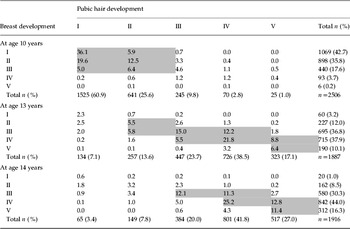
Table 1 shows the prevalence of girls within each Tanner breast and pubic hair stage at each time-point. At age 10 years, the majority of girls were in Tanner stage I or II for breast and pubic hair development, and by age 14 most were in stages IV or V.
Percentage of girls within each Tanner stage of breast and pubic hair development at age 10, 13 and 14 years

Shaded cells contain more than 5% of the sample.
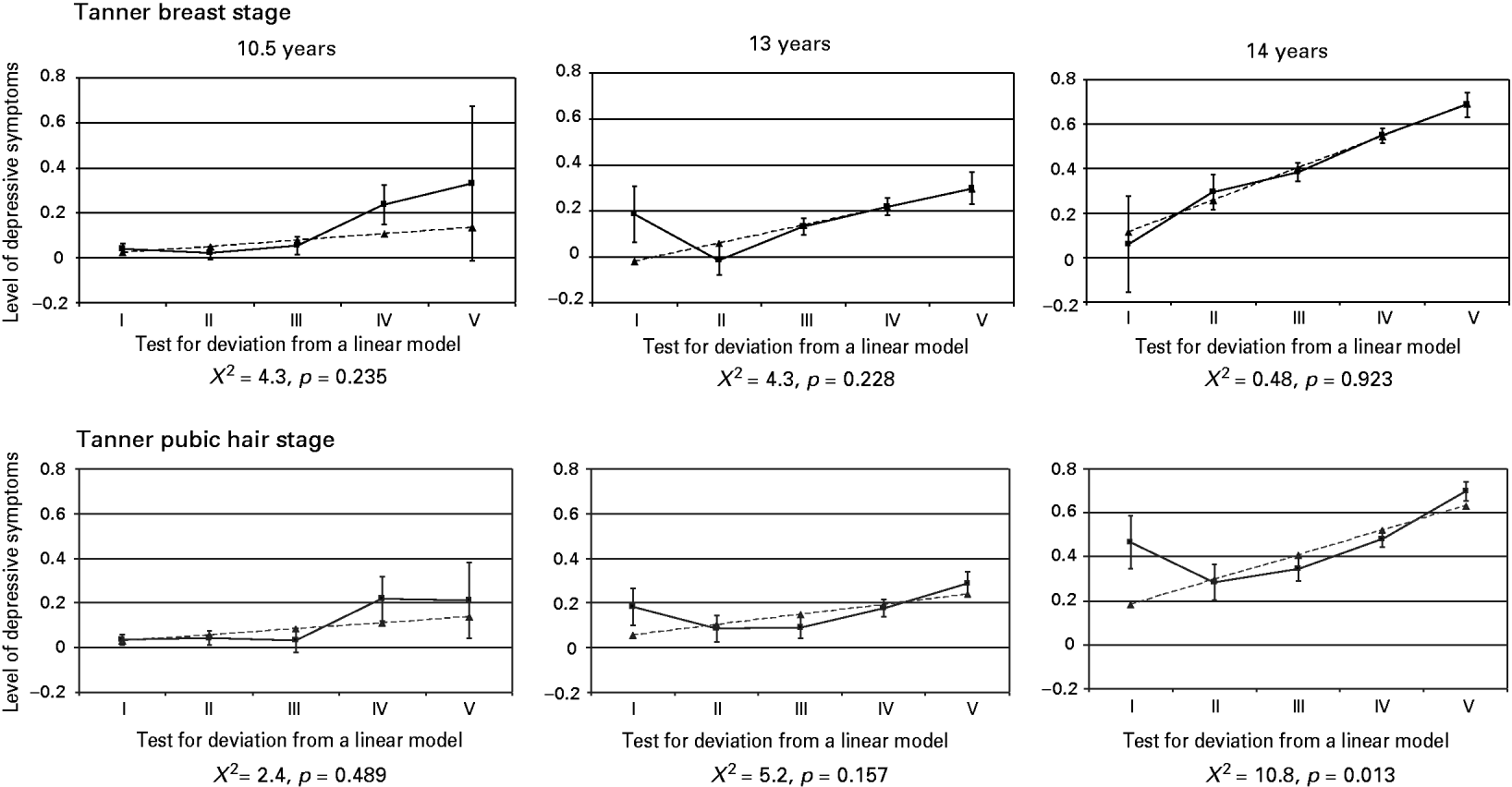
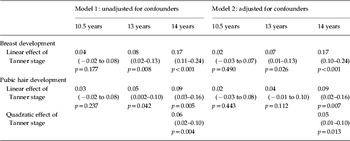
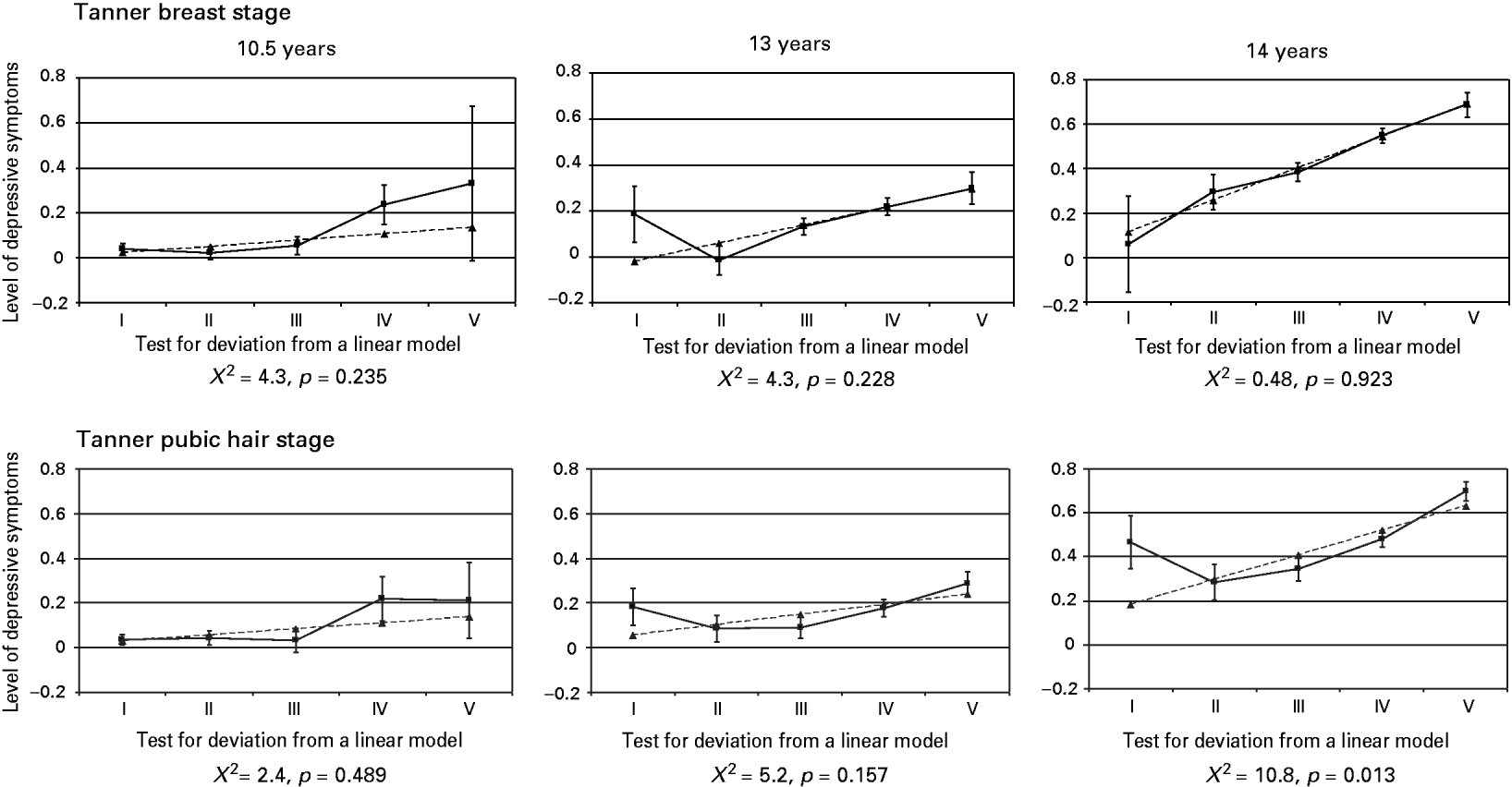
The results using CFA show little evidence of a relationship between depressive symptoms at 10.5 years and current breast development (Fig. 2), with an estimated increase in symptom level of 0.02 s.d. (adjusted estimate) for each additional Tanner stage. Table 2 shows the estimates for testing the linear effect of Tanner breast stage on level of depressive symptoms. With increasing age, the association between breast development and depressive symptoms strengthened. By age 14 years, there was evidence of a strong linear association between depressive symptoms and Tanner breast status at age 14 years (Fig. 2). Advancement of each Tanner breast stage represented an increase in 0.17 s.d. of depressive symptoms (adjusted model). There was no evidence to suggest any deviation from a linear relationship between Tanner breast stage and levels of depressive symptoms at each of the three time-points (this is shown by the χ2 statistics in Fig. 2).
Association between Tanner breast and pubic hair stages and level of depressive symptoms at three time-points. Estimated differences in means of the continuous latent trait measures of depressive symptoms according to Tanner stages of breast and pubic hair development. Reference category = Tanner stage III, error bars indicate 1 s.e. Models were adjusted for the difference between the age at completion of the pubertal development questionnaires and the age at attendance at each of the research clinics where depressive symptoms were assessed.
Regression coefficients for levels of depressive symptoms according to pubertal status at each of the three time-points

Model 1: adjusted for the time discrepancy between the age at assessment of pubertal development and depressive symptoms.
Model 2: further adjusted for the confounding variables: parental separation and the indicators of socio-economic status (social class, home ownership status, maternal education, major financial problems).
For pubic hair development, there was little evidence of a relationship with depressive symptoms at ages 10.5 and 13 years (Table 2). There was no evidence for deviation from a linear relationship at ages 10.5 and 13 years, but by age 14 there was evidence of a deviation from a linear relationship, with a raised level of depressive symptoms among those girls remaining at Tanner stage I compared to those at stage III (Fig. 2).
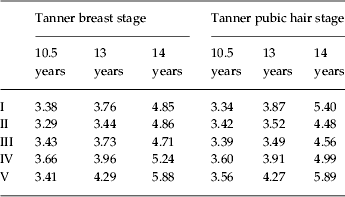
When we compared the depressive symptom sum scores at each of the three time-points across groups defined by Tanner breast and pubic hair status using a simple ANOVA, the results were consistent with the CFA model. There was no evidence for differences in level of depressive symptoms by Tanner breast stage at 10.5 years (F = 0.45, p = 0.770). The association strengthened with age: 13 years (F = 2.30, p = 0.057); 14 years (F = 4.04, p = 0.003). For pubic hair development, there was no evidence for an association at 10.5 years (F = 0.27, p = 0.899), but the association again strengthened with age: 13 years (F = 3.14, p = 0.014); 14 years (F = 6.78, p < 0.001). Table 3 shows the mean SMFQ scores by Tanner breast and pubic hair stage at each time-point.
Mean SMFQ scores by Tanner breast and pubic hair stage at each time-point
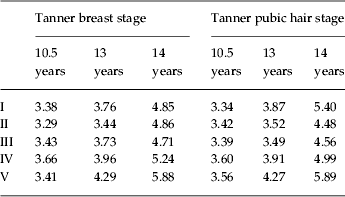
SMFQ, Short Mood and Feelings Questionnaire.
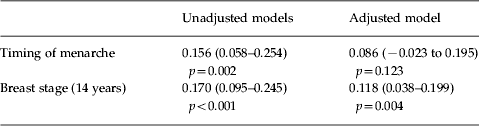
We then examined the independence of the association between pubertal status (Tanner breast stage at 14 years) and timing of menarche with depressive symptoms at age 14 years. The unadjusted models (Table 4) separately examined the association of depressive symptoms at 14 years with Tanner breast stage and timing of menarche. There was evidence for a linear association between level of depressive symptoms and both breast stage and timing of menarche. The adjusted model (Table 4) contains breast stage and timing of menarche together. The timing effect attenuated considerably whereas the association with breast stage remained. At any given level of timing of menarche, therefore, there is an association between current breast stage and depressive symptoms at age 14 years.
Regression coefficients for depressive symptoms at 14 years according to pubertal status (Tanner breast stage at 14 years) and timing of menarche
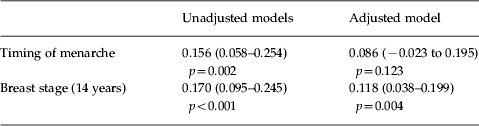
Sample comprises n = 1643 with complete data on Tanner breast development, timing of menarche and depressive symptoms. Adjusted model shows estimates for Tanner breast stage (14 years) and timing of menarche when both variables are included in the same model. Adjusted for the time discrepancy between the age at completion of the 14-year pubertal development questionnaire and age at assessment of depressive symptoms. Figures indicate the increase in depressive symptoms per 1-unit increase in the exposure (breast status or timing of menarche).
Discussion
We found evidence that more advanced breast development is associated with increased depressive symptoms in adolescence. The relationship between breast development and level of depressive symptoms strengthened between the ages of 10.5 and 14 years. At 14 years there was strong evidence for a linear association between current breast development and depressive symptoms and this association explained the observed relationship between timing of puberty and depressive symptoms. There was evidence that the relationship between pubic hair development and depressive symptoms deviated from a linear association. Increased levels of depressive symptoms in mid-adolescence were associated with the least advanced (I) and the most advanced stages (IV, V) of pubic hair growth.
Strengths and limitations
The current study has several strengths, including a longitudinal multiwave design in which the same girls were followed up at the same ages, a large community-based sample, repeated measures of self-reported depressive symptoms and pubertal development, and adjustment for confounders. The availability of data from late childhood to mid-adolescence allowed us to examine the emergence of depressive symptoms as the pubertal transition unfolds, something that few previous studies have achieved. We have built on earlier research by examining the relative contributions of pubertal status and timing in accounting for increases in depressive symptoms in mid-adolescence.
We used separate indicators of pubertal status rather than a composite measure. Attention to differentiating pubertal indicators is largely ignored in earlier studies (Angold et al. Reference Angold, Costello and Worthman1998; Ge et al. Reference Ge, Conger and Elder2001; Richardson et al. Reference Richardson, Garrison, Drangsholt, Mancl and LeResche2006; Patton et al. Reference Patton, Olsson, Bond, Toumbourou, Carlin, Hemphill and Catalano2008; Conley & Rudolph, Reference Conley and Rudolph2009). When Angold et al. (Reference Angold, Costello and Worthman1998) used a composite measure of pubertal status (breast and pubic hair), they reported a non-linear relationship between pubertal status and depression (the transition to Tanner stage III was associated with a sharp increase in rates of depression among girls). By contrast, we find strong evidence for a linear association between breast development and depressive symptoms. It is notable that when Angold and colleagues subsequently examined pubertal changes in hormone levels in girls, they found evidence for a ‘reasonably linear’ (Angold et al. Reference Angold, Costello, Erkanli and Worthman1999, p. 1049) association between rising estradiol levels and increased depression.
In contrast to the linear association we found between breast development and depressive symptoms at 14 years, there was evidence for non-linearity in the relationship between pubic hair development and depressive symptoms. A non-linear association between Tanner pubic hair stage and depressive symptoms has not been reported previously. Differential associations between depressive symptoms and different aspects of pubertal development may have been masked in previous studies using composite measures of pubertal status. It has been suggested that depression in women might be raised by too low or too high levels of androgen hormones (Rohr, Reference Rohr2002). However, the findings of studies of the association between androgen hormones and depression/depressive symptoms in adolescent girls are inconsistent. For instance, Angold et al. (Reference Angold, Costello, Erkanli and Worthman1999) reported evidence for non-linearity in the association between serum/plasma levels of testosterone and depression, with effects on depression observed only above a threshold level. In fact, the effect of testosterone reported by these authors was even larger than that of estradiol. High testosterone levels have also been reported to be associated with sad affect (Susman et al. Reference Susman, Dorn and Chrousos1991). By contrast, low testosterone levels were related to depressive symptoms in adolescent girls who had poor relationships with their fathers (Booth et al. Reference Booth, Johnson, Granger, Crouter and McHale2003). There is also evidence that low levels of the adrenal androgen dehydroepiandrosterone (DHEA) are associated with increased depression (Goodyer et al. Reference Goodyer, Herbert, Altham, Pearson, Secher and Shiers1996). Further examination with other samples is needed to shed light on whether the non-linear association we find between pubic hair development and depressive symptoms is due to chance, bias in measurement or a real effect.
In terms of generalizability, a limitation relates to sample attrition and this has important implications for the internal validity of this study. Sample attrition in the ALSPAC is strongly associated with socio-economic disadvantage. The sample used in the current study comprised individuals who were less disadvantaged in comparison to individuals who were lost to follow-up (a table is available on request from the corresponding author showing the distribution of indicators of socio-economic disadvantage in subsamples depicted in Fig. 1 compared to the baseline measures in the whole ALSPAC sample). It is reassuring, however, that when we compared results over different samples in an earlier study (that examined the association between timing of menarche and depressive symptoms), the conclusions were robust despite a differential drop-out (Joinson et al. Reference Joinson, Heron, Lewis, Croudace and Araya2011).
Another limitation relates to the time delay between assessment of pubertal development and depressive symptoms. However, we have no reason to suspect that potential misclassification of girls into either a lower or higher pubertal status group was differential and this should not, therefore, have biased the findings. In particular, there was no evidence that depressed youth were less likely to attend the research clinics. Restricting the sample to those who completed the puberty questionnaire within 1 year either side of their depressive symptom assessment should have helped to minimize any effects of this time difference. Although we decided on a 12-month discrepancy between assessments of depressive symptoms and pubertal development, the majority of girls completed the depressive symptoms and puberty assessments within 9 months of one another (89.3% at 10.5 years, 92.3% at 13 years and 75.3% at 14 years). However, restricting the discrepancy to narrower ranges resulted in a reduction in sample size (e.g. there were data for only around 700 cases when we restricted to a discrepancy of 6 months). We repeated the analysis with narrower and wider age discrepancies, but there was little difference in the findings (results available on request).
Possible explanations for the link between pubertal status and depressive symptoms
High correlations between self-reported Tanner stages and levels of pubertal hormones have been reported previously (Angold et al. Reference Angold, Costello, Erkanli and Worthman1999; Rapkin et al. Reference Rapkin, Tsao, Turk, Anderson and Zeltzer2006). Angold et al. (Reference Angold, Costello, Erkanli and Worthman1999) found that hormonal measures (testosterone, estradiol) explained the effect of Tanner stages when using multivariable methods and argued that this provides evidence that the female rise in depression during adolescence can be explained by a pubertal effect (changes in androgen and estrogen levels), rather than an effect that is psychosocially mediated by morphological development. It is thought that pubertal hormones might have a direct effect on mood through their involvement in the reorganization of neural circuits in the adolescent brain (Sisk & Zehr, Reference Sisk and Zehr2005). Estrogen and androgens could influence depressive symptom levels by acting on central nervous system structures that are important for affect (e.g. the hypothalamus, amygdala, hippocampus), through their modulatory influence on dopaminergic and serotonergic pathways (Angold & Costello, Reference Angold and Costello2006). In addition to direct effects of pubertal hormones on the adolescent brain, it is possible that hormones have an indirect influence by altering social interactions, increasing self-consciousness and changing expectations for cognitive development and behavior (Schultz et al. Reference Schultz, Molenda-Figueira and Sisk2009).
There is evidence from the current results that the effects of more advanced pubertal status on levels of depressive symptoms take several years to manifest. We found little evidence of a relationship between current breast development and depressive symptoms at 10.5 years. There was a small effect of Tanner breast stage on level of depressive symptoms at 13 years, but the largest effect was found at age 14 years. This could imply that depressive symptoms increase in girls progressing through puberty as estrogen exposure increases. At puberty, gonadarche is established gradually, with increasing ovarian follicle growth and rising levels of circulating estrogen hormones (Chrousos et al. Reference Chrousos, Torpy and Gold1998). Ovulatory menstrual cycles establish within the next 2 to 3 years and, during this time, the stress system receives increasing intermittent positive input from estradiol (Chrousos et al. Reference Chrousos, Torpy and Gold1998). It has been suggested that estrogen amplifies the stress response in the prefrontal cortex and that alterations in stress sensitivity in adolescence may mediate the link between pubertal hormones and depressive affect (Arnsten & Shansky, Reference Arnsten and Shansky2004). Rising levels of estrogen through puberty could lead to increased susceptibility to stress and this, in turn, could lead to increased vulnerability to depressive symptoms. By mid-adolescence, girls who had more advanced breast development at age 10 years would have been exposed to rising estrogen levels for longer and this could explain the apparent effects of timing of puberty reported in earlier studies.
Conclusions
The current results provide evidence that risk for depressive symptoms at 14 years is strongly associated with breast development and this explained the association with timing of menarche. This finding is consistent with the hypothesis that the female rise in depression during adolescence is related to rising estrogen levels and might explain why the gender difference in rates of depression emerges at this stage. These results might also explain earlier findings of an association between earlier menarche and increased depressive symptoms because onset of menarche is associated with rising estrogen levels. However, studies with data on pubertal hormone levels are required to test these hypotheses. Although we found an association between pubertal status and depressive symptoms at age 14 years, pubertal changes alone are not sufficient to explain variability in depressive symptoms. Individual and social factors may explain more of the variance in adolescent depression than hormones alone (Brooks-Gunn & Warren, Reference Brooks-Gunn and Warren1989). The pubertal transition is experienced within the context of a unique pattern of risk and protective factors. Interpersonal conflicts, body dissatisfaction and changes in self-concept become particularly salient during adolescence and may contribute to the development of depression, whereas higher self-esteem and greater social support from parents and peers may increase resilience to the effects of pubertal change. Future research should be aimed at identifying the mechanism of action of pubertal change, including direct effects of pubertal hormones on the brain and indirect effects mediated by psychosocial factors.
Acknowledgments
We are grateful to all the families who took part in this study, the midwives for their help in recruitment, and the whole ALSPAC team, which includes interviewers, computer and laboratory technicians, clerical workers, research scientists, volunteers, managers, receptionists and nurses. The UK Medical Research Council (Grant ref. 74 882), the Wellcome Trust (Grant ref. 076467) and the University of Bristol provide core support for the ALSPAC. This research project was funded by the Economic and Social Research Council (Grant ref. RES-000-22-2509). This publication is the work of the authors and they will serve as guarantors for its contents. Dr T. Croudace is supported by a Career Scientist Award in Public Mental Health from the UK Department of Health and by the National Institute for Health Research (NIHR) Collaboration for Leadership in Applied Health Research and Care (CLARHC) for Cambridgeshire and Peterborough.
Declaration of Interest
None.