Acinetobacter baumannii can be transmitted within or between hospital wards, especially within intensive care units (ICUs), primarily though respiratory transmission.Reference Thatrimontrichai, Techato and Dissaneevate1–Reference Apisarnthanarak and Warren4 Neonates with carbapenem-resistant A. baumannii (CRAB) bacteremia, meningitis, and ventilator-associated pneumonia (VAP) have higher rates of morbidity and mortality than noninfected neonates.Reference Thatrimontrichai, Techato and Dissaneevate1,Reference Thatrimontrichai, Apisarnthanarak, Chanvitan, Janjindamai, Dissaneevate and Maneenil5,Reference Thatrimontrichai, Kittivisuit, Janjindamai, Dissaneevate and Maneenil6 Rates of VAP do not significantly differ between the use of heat and moisture exchangers (HMEs) and conventional heated humidifiers in adults.Reference Menegueti, Auxiliadora-Martins and Nunes7 However, ventilated neonates have a high risk of condensate aspiration because of the use of uncuffed endotracheal tubes along with a high volume of condensate resulting from different temperatures between the inside and outside of their incubator.
Studies have suggested that CRAB can be detected on the hands of ICU staff (94%) as well as on environmental samples (55%).Reference Tajeddin, Rashidan and Razaghi8 Environmental cleaning in hospitals has been associated with reductions in the rates of multidrug-resistant (MDR) A. baumannii infections in adult populations.Reference Apisarnthanarak, Ratz and Khawcharoenporn9,Reference Teerawattanapong, Kengkla, Dilokthornsakul, Saokaew, Apisarnthanarak and Chaiyakunapruk10 Environmental cleaning combined with disinfection using 1:100 sodium hypochlorite (NaOCl) bleach solution has been shown to reduce extremely drug-resistantReference Apisarnthanarak, Pinitchai, Warachan, Warren, Khawcharoenporn and Hayden11,Reference Lin, Lu and Siu12 and pandrug-resistantReference Apisarnthanarak, Pinitchai and Thongphubeth13A. baumannii colonization and infection rates in adult ICUs. We performed a 7-year, quasi-experimental study in the neonatal ICU (NICU). The study consisted of a 3-year preintervention period (2011−2013) followed by a 12-month intervention period (2014) and a 3-year postintervention period (2015−2017). We compared the incidence rates of CRAB sepsis, CRAB colonization, and broad-spectrum antimicrobial use before and after the intervention period of environmental decontamination using disposable HMEs with NaOCl cleaning.
Methods
Setting and care practice
This quasi-experimental study was conducted at the NICU of Songklanagarind Hospital in Songkhla Province, Thailand. This NICU is a 15-bed, level IV, multibed, open ward in a university-affiliated teaching hospital that is the major tertiary-care and referral center in southern Thailand. Annually, ~3,000−3,500 live births take place at the hospital, with ~500 neonates (inborn or transferred) admitted to the NICU.
General infection control and prevention strategies were similar over the 3 study periods, and they included strict adherence to hand hygiene protocol before and after patient care in addition to the donning of gowns and gloves before commencing patient care. Education on hand hygiene protocols was conducted during periods 1 and 2 but not period 3. In our institution, there were no changes in the infection control practices for central-line care over the entire study period. The patient-to-nurse ratio was 1–2:1 and remained constant during the study period. We perform routine surveillance of CRAB rates, and we attempt to identify any potential point-source outbreak when CRAB rates significantly increased above our endemic rates. There was no evidence of an outbreak during the entire study period. For this study, care practice was divided into 3 periods: period 1, a 3-year preintervention period (January 1, 2011, to December 31, 2013); period 2, a 12-month intervention period (January 1, 2014, to December 31, 2014); and period 3, a 3-year postintervention period (January 1, 2015, to December 31, 2017).
During period 1, neonatal respiratory support comprised pasteurization cleaning of a reused ventilator circuit, with heated humidifiers and a heated wire in the inspiratory limb only, utilizing a water trap in the expiratory limb. The walls and rails of the NICU environment were exposed daily to a 30-second cleaning using 0.5% NaOCl (10% NaOCl dilution with tap water, 1:19 and equal to 5,000 ppm).
During period 2, the intervention included (1) the use of disposable HMEs with dual heated wires in both the inspiratory and expiratory limbs using the permeable microcell technique and without a water trap (RT 265, Evaqua2 Infant Breathing Circuits, Fisher & Paykel Healthcare, Aukland, New Zealand) and the use of HME equipment for all ventilated neonates; (2) the use of 0.5% NaOCl daily to clean the NICU environment and the bottom of vacuum-suction secretions, and the use of 0.05% NaOCl (10% NaOCl dilution with tap water, 1:199 equal to 500 ppm) daily for a 30-second cleaning of the neonatal environment (inside and outside the incubator as well as the radiant warmer, which was followed by clean, dry linens). Ongoing education regarding the use of HME and NaOCl in the NICU was provided to healthcare workers every 3 months.
During period 3 (the follow-up period), HME protocol and environmental cleaning were identical to period 2, but no additional educational training was provided to healthcare workers.
Patients and data collection
Data on all admitted neonates in the NICU were collected from the hospital’s medical record database as well as the NICU database. Neonates who contracted CRAB sepsis or colonization at any time during admission to the NICU from January 2011 to December 2017 were included in the study. We collected the following data: days of device use, length of stay, and consumption of antimicrobials. The volumes of antiseptics (ie, liters of 70% alcohol-based hand-rub moisturizer and 10% NaOCl) were used as surrogate markers for hand hygiene compliance, and environmental cleaning. The study was approved by the Ethics Committee of the Faculty of Medicine, Prince of Songkla University. The primary outcomes of the study included the trend in incidence density of CRAB sepsis or colonization before and after the intervention. Secondary outcomes included the trend of antimicrobial and antiseptic use.
Microbiological methods
CRAB sepsis was defined by CRAB bacteremia, meningitis, or both. Blood-culture specimens were obtained under sterile conditions and were processed in an automatic blood-culture machine (BacT/Alert, Organon Teknika, Durham, NC). All isolated bacterial organisms were identified using standard laboratory methods. No changes in the laboratory methods for bacterial detections were implemented during the study. Susceptibility testing of each patient was performed according to the last updated Clinical and Laboratory Standards Institute guidelines upon the discovery of any positive culture.14 Carbapenem resistance was detected using the Kirby–Bauer disk-diffusion method on Mueller-Hinton plates (Oxoid, UK) using meropenem (10 µg) and imipenem (10 µg) and E-test (BioMérieux, Sweden).
Data analyses and statistics
R version 3.5.1 statistical software (R Foundation for Statistical Computing, Vienna, Austria), encompassing Epicalc, stats, lmtest, and MASS packages, was used for statistical analyses. Categorical variables are presented as absolute values, and percentages were compared using the χ2 or the Fisher exact test, as appropriate. The number of unique patients rather than the number of positive cultures was used to calculate the incidence of CRAB sepsis and endotracheal colonization. Incidence density (ID) was calculated as new events per 1,000 patient days (PD) or ventilator days (VD). The time series model was developed to analyze the trend of variables over 7 years. Trend analysis was performed to evaluate the overall pattern of changes in outcomes of interest over time using interrupted time-series analysis with segmented regression. All P values were 2-tailed, with P < .05 indicating statistical significance.
Results
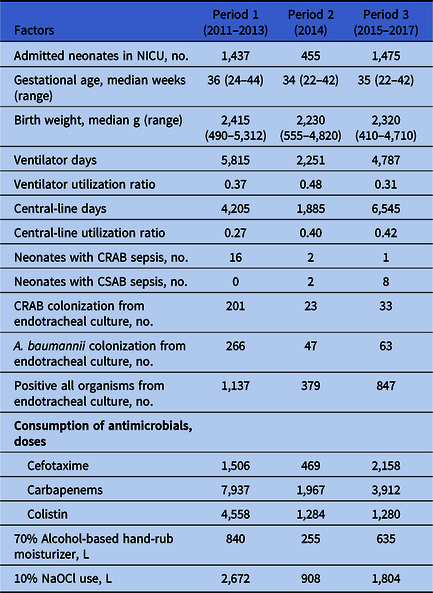
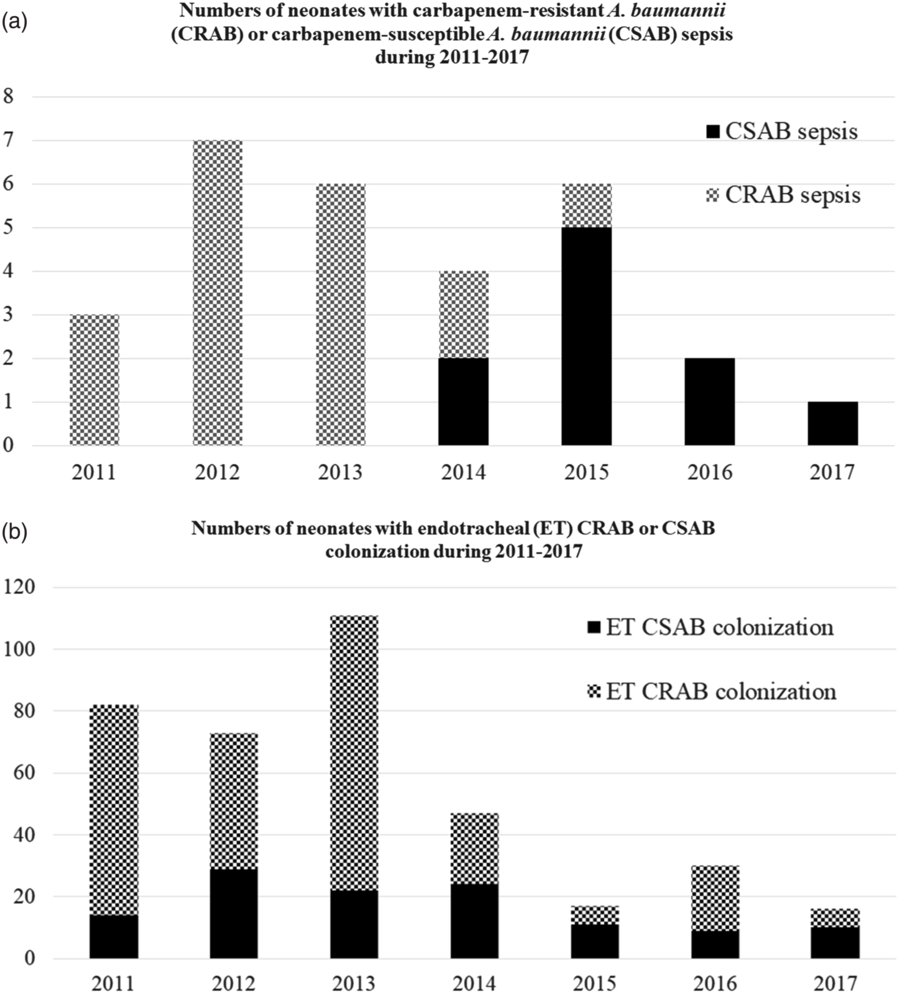
Over the 7-year study period, 3,367 neonates were admitted to our NICU (Table 1). Median gestational age was 35 weeks (range, 22–44 weeks) and median birth weight was 2,349 g (range, 410–5,312 g); both decreased over time (annually decreases of 0.2 weeks median gestational age and 25 g median birth weight; both P < .001). During the entire study period, both the ventilator utilization ratio and the central-line utilization ratio were 0.36. All neonates (100%) with A. baumanii sepsis during period 1 were infected with a carbapenem-resistant strain, which decreased to only 1 case of CRAB sepsis (11.1%) early in period 3 (Fig. 1). The prevalence rate of CRAB sepsis was 0.5 per 1,000 PD, and the prevalence rate of endotracheal CRAB colonization was 19.4 per 1,000 VD. There were 19 cases of CRAB among all 29 cases of A. baumannii sepsis (66%). There were 257 cases of CRAB among 376 cases of endotracheal colonization (68%). Of 512 total specimens, 334 were CRAB positive in our NICU over the entire study period (65%). Overall, approximately two-thirds of all samples collected were positive for CRAB.
Carbapenem-Resistant and Carbapenem-Susceptible A. baumannii (CRAB and CSAB) Colonization and Sepsis, Device Used, and Antimicrobial and Antiseptic Use in a Neonatal Intensive Care Unit (NICU) Over 7 Years

Number of neonates with carbapenem-resistant A. baumannii (CRAB) or carbapenem-susceptible A. baumannii (CSAB) sepsis (1A) and endotracheal (ET) CRAB or CSAB colonization (1B) during 2011–2017.

Comparing the 3-year periods before and after the intervention in which we introduced HMEs and daily 0.05% NaOCl cleaning (period 1 vs period 3), we observed a significant decrease in the percentage of CRAB of A. baumannii sepsis: 16 of 16 (100%) in period 1 versus 1 of 9 (11%) in period 3 (P < .001). We observed a significant decrease in the percentage of endotracheal CRAB colonizations among all A. baumannii colonizations: 201 of 266 (76%) in period 1 versus 33 of 63 (52%) in period 3 (odds ratio, 0.36; 95% confidence interval [CI], 0.19−0.66; P < .001). Furthermore, we observed a significant decrease in the percentage of endotracheal A. baumannii colonization among all colonization: 266 of 1,137 (23.4%) in period 1 versus 63 of 847 (7.4%) in period 3 (odds ratio, 0.26; 95% CI, 0.19−0.35; P < .001).
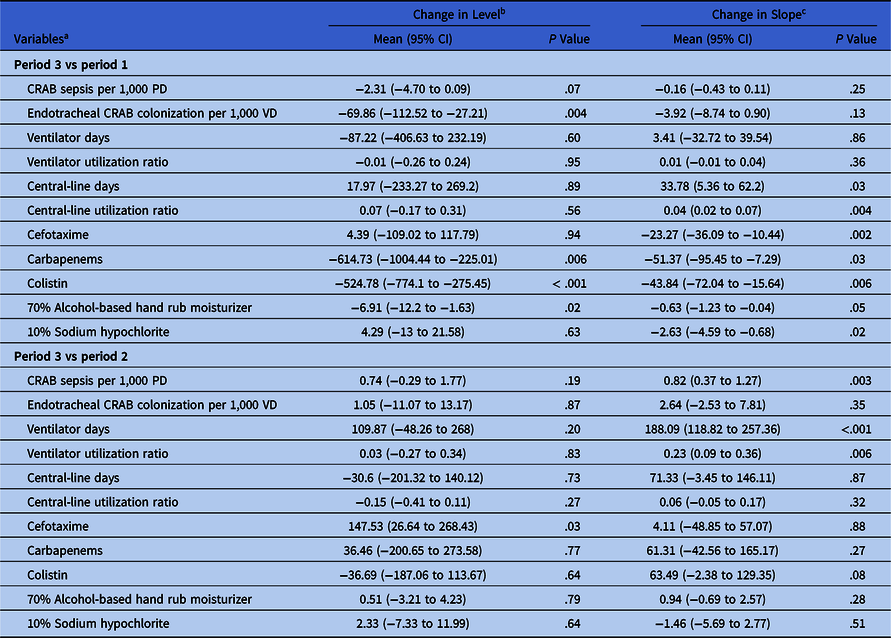
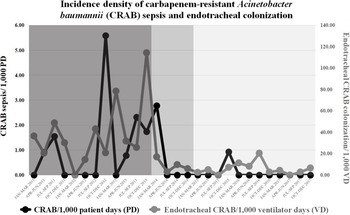
In period 3, compared with period 1, segmented regression analysis showed statistically significant immediate reductions (change in level) in endotracheal CRAB colonization per 1,000 VD (Table 2 and Fig. 2) as well as both carbapenem and colistin use (ie, changes in both level and slope). Additionally, the volume of antiseptic use was significantly reduced over time (ie, alcohol-based hand rub changed in level and NaOCl changed in slope). We observed a reduction of CRAB sepsis per 1,000 PD; however, no significant changes in either immediate or slope over time were detected.
Interrupted Time Series Analysis of Incidence Density of Carbapenem-Resistant Acinetobacter baumannii (CRAB) Sepsis or Endotracheal Colonization, Antiseptic Consumption, and Antimicrobial Use in Period 3, Compared With Period 1 or 2

Note. CI, confidence interval; PD, patient days; VD, ventilator days.
a No variables reached significant difference between periods 2 and 1.
b The calculation of the sudden change in level (immediate change) was based on the difference between the intercept of the last point in the preintervention (period 1 or 2) regression line and the first point in the postintervention (period 3) line.
c The calculation of the change in the slope was based on the magnitude of change from the preintervention (period 1 or 2) slope to the postintervention (period 3) slope.
Trend of incidence density of neonatal carbapenem-resistant A. baumannii (CRAB) sepsis and endotracheal colonization.

In period 3, compared with period 2, cefotaxime use decreased in a statistically significant immediate increment (change in level, Table 2). The ventilator utilization ratio and the central-line utilization ratio significantly increased (change in slope) in period 3, compared with periods 2 and 1, respectively. We detected no significant change of incidence density of CRAB, consumption of antimicrobials, volume of antiseptic use, or device utilization ratios in level or slope in period 2, compared with period 1.
Discussion
The results of our study have some clinical implications. The combination of interventions (ie, disposable HMEs and NaOCl cleaning of the neonatal environment) decreased the prevalences of CRAB per case of A. baumannii sepsis, endotracheal CRAB, and A. baumannii colonization in period 3, compared with period 1, as well as endotracheal CRAB colonization per 1,000 VD over time in our NICU. We implemented environmental decontamination procedures together with HME and NaOCl, to prevent neonatal CRAB sepsis and colonization in a highly endemic MDR area. Colonization occurs easily in either water or moist reservoirs, which includes respiratory devices. It is generally believed that HMEs can eliminate CRAB or A. baumannii colonization in the endotracheal tubes and circuit. In a recent meta-analysis, however, no differences were detected between HMEs and heated humidifiers in the primary outcomes of airway blockages, pneumonia, and mortality in either adults or children.Reference Gillies, Todd, Foster and Batuwitage15 Although we cannot definitely conclude that the decrease in the CRAB sepsis rate was due to the change to HME product type or change from multiple use to single use, we believe that both interventions contributed to this success. Notably, this device contains a hygroscopic condenser that absorbs water vapor during expiration and releases it during inspiration. HMEs may reduce condensate in neonatal patients and in the circuits when put in incubators, leading to a decreased bacterial reservoir. Disposable HMEs may be better than reused heated humidifiers because small cracks that develop during autoclaving may serve as a bacterial shelter that escapes cleaning.
Our results also confirm the effectiveness of environmental cleaning with NaOCl in NICU populations, which has been reported in adult populations.Reference Apisarnthanarak, Pinitchai, Warachan, Warren, Khawcharoenporn and Hayden11–Reference Apisarnthanarak, Pinitchai and Thongphubeth13 Also, NaOCl at concentrations of 0.5% and 0.05% were effective as an antiseptic for the NICU and neonatal environment, respectively. Moreover, consumption of broad-spectrum antimicrobials (carbapenems and colistin) was significantly reduced, with a switch to increased utilization of a more narrow-spectrum antimicrobials (cefotaxime). Our strategies were associated with a near eradication of CRAB sepsis and significantly reduced CRAB colonization, which resulted in less necessity for empirical broad-spectrum antimicrobial use in period 3.
Acute-care hospitals in Asia recognize the need for judicious use of carbapenems, with the goal of reducing carbapenem-resistant gram-negative bacteria.Reference Apisarnthanarak, Kwa and Chiu16 However, it is difficult to implement an antibiotic stewardship program in an area with high MDR rates (like ours in period 1), especially in the NICU with fragile neonates with high mortality and burden of infection.Reference Thatrimontrichai, Premprat, Janjindamai, Dissaneevate and Maneenil17 MDR pathogens along with CRAB emerged frequently in our NICU with crowded device utilization.Reference Thatrimontrichai, Janjindamai, Dissaneevate, Maneenil and Kritsaneepaiboon18,Reference Thatrimontrichai, Janjindamai, Dissaneevate and Maneenil19 The overall ventilator utilization ratio (0.36) and the overall central-line utilization ratio (0.36) in our NICU were higher than the pooled means given by the International Nosocomial Infection Control Consortium (0.26 and 0.35)Reference Rosenthal, Al-Abdely and El-Kholy20 and National Health and Safety Network (0.15 and 0.22).Reference Dudeck, Edwards and Allen-Bridson21 Because of extremely high CRAB sepsis rates in periods 1 and 2, we had to administer combinations of extremely broad-spectrum antimicrobials (carbapenems and colistin) for late-onset sepsis, which resulted in a vicious cycle from colonization pressure. Despite all care being taken with younger neonates (lower gestational age and birthweight in periods 2 and 3) with a higher ventilator utilization ratio and a higher central-line utilization ratio in period 3, our intervention was associated with a significant reduction in CRAB bacteremia and endotracheal colonization.
Furthermore, we aggressively enforced strict adherence to hand hygiene in periods 1 and 2, which resulted in higher volumes of alcohol-based hand rub being used. Requirements for hand hygiene adherence in the ICU are high, and hand hygiene requires continuous education and feedback, which can add to parent and personnel psychological distress. In addition, the long-term results of alcohol-based hand rub and NaOCl exposure in preterm and term neonates (systemic intoxication by skin absorption or inhalation) remains unclear. After the intervention (ie, period 3), the attending staff recognized the dramatic decline in CRAB sepsis and colonization, which resulted in the simultaneously reduction of broad-spectrum antimicrobials and antiseptics, perhaps as a result of the Hawthorne effect. However, despite the decreased volume of alcohol-based hand rub and NaOCl use, colonization with MDR organisms was reduced and controlled over time.
This study has several limitations. First, this was a quasi-experimental study without a control group and, thus, may have been subject to bias. Second, our findings do not imply causal association or a cause–effect relationship; thus, care must be taken in their interpretation due to the possibility of an ecological fallacy. Third, despite the implementation of all bundle elements used to successfully control the outbreaks caused by CRAB infections in the NICU, we did not measure adherence to the policy components, nor did we audit compliance to environmental measures. Finally, although we performed routine surveillance for CRAB rates, with attempts to identify any potential point-source outbreaks, we may have missed some outbreaks that may have occurred during our study.
In conclusion, our intervention of disposable HMEs and cleaning of the neonatal environment with 0.05% NaOCl helped to nearly eradicate CRAB sepsis and colonization in the NICU of a hospital in a middle-income country. Once CRAB or MDR infections have been controlled, clinicians have more confidence to implement and adhere to an antibiotic stewardship program.
Acknowledgments
The authors thank the Office of International Affairs, Faculty of Medicine, Prince of Songkla University, Thailand for editing the English.
Financial support
No financial support was provided relevant to this article.
Conflicts of interest
All authors report no conflicts of interest relevant to this article.