Introduction
Flynn (Reference Flynn1996) estimated that at least 1000 billion tons of organic carbon have reached the surface of Mars from space over the past 4 billion years, mainly through meteorite impacts. Steininger et al. (Reference Steininger, Goesmann and Goetz2012) calculated that this would result in an average concentration of organic C of 60 ppm in the upper 100 m of the Martian surface, assuming a well-mixed regolith. Accordingly, finding organics at the Martian surface should be easy. However, numerous attempts, with highly sophisticated instruments have shown that this is not the case. In previous missions, the detection of organic molecules resulted from the presence of these compounds in the liquids that were used for the cleaning of the analytical systems and MBTSTFA brought for derivatization experiments (e.g. Biemann et al., Reference Biemann1977, Sutter et al., Reference Sutter2017).
In this review, we will revisit the results reported based on the Viking lander investigations and discuss them in light of recent findings with a focus on oxidants (e.g. Zent and McKay, Reference Zent and McKay1994; Sutter et al., Reference Sutter, Ming, Boynton, Niles, Hoffman, Lauer and Golden2009; Steininger et al., Reference Steininger, Goesmann and Goetz2012; Bak et al., Reference Bak, Zafirov, Merrison, Jensen, Nørnberg, Gunnlaugsson and Finster2017a) and organic compounds (Steele et al., Reference Steele2012; Sutter et al., Reference Sutter2017; Eigenbrode et al., Reference Eigenbrode2018) in the Martian regolith. Our discussion will also include questions addressing Mars habitability and the risk of forward contamination. Rather than focusing on radiation as the energy source to produce oxidants and to destroy organics directly, we will focus on the role of abrasion caused by meteoric impacts (e.g. Hurowitz et al., Reference Hurowitz, Tosca, McLennan and Schoonen2007) or wind-driven erosion (e.g. Bak et al., Reference Bak, Zafirov, Merrison, Jensen, Nørnberg, Gunnlaugsson and Finster2017a). These abrasion processes can lead to triboelectric charging of surfaces that can ionize gases (Thøgersen et al., Reference Thøgersen, Bak, Finster, Nørnberg, Jakobsen and Jensen2019) and thereby produce reactive oxygen species (ROS) and/or produce reactive surfaces by cleavage of the mineral matrix that upon contact with water produce ROS (Bak et al., Reference Bak, Zafirov, Merrison, Jensen, Nørnberg, Gunnlaugsson and Finster2017a), which can oxidize and ultimately degrade organics and cells (Bak et al., Reference Bak, Larsen, Moeller, Nissen, Jensen, Nørnberg, Jensen and Finster2017b, Reference Bak, Larsen, Jensen, Nørnberg, Moeller and Finster2019).
Revisiting the outcome of the Viking experiments in light of Martian regolith reactivity
The Viking mission included two identical spacecraft, each comprised of an orbiter and a lander. The orbiters were mainly mapping the surface while the landers were analysing the chemical composition of the atmosphere and the regolith and searched for evidence for life (Soffen and Young, Reference Soffen and Young1972). Thus, the Viking Biological Experiments were designed to detect a broad range of metabolisms while incubating Martian regolith samples under relatively warm and humid conditions (Klein et al., Reference Klein, Lederberg, Rich, Horowitz, Oyama and Levin1976). They encompassed three different experiments to detect chemotrophic- (the Gas Exchange Experiment, GEex), photoautotrophic- (the Pyrolytic Release Experiment, PRex) and chemoorganotrophic life the Labelled Release Experiment (LRex), respectively (Klein et al., Reference Klein, Lederberg, Rich, Horowitz, Oyama and Levin1976). Additionally, the presence of organic compounds was investigated by combined gas chromatography and mass spectrometry (GC-MS) (Oyama and Berdahl, Reference Oyama and Berdahl1977). The Viking Lander 1 (VL-1) landed in Chryse Planitia and the second Viking Lander (VL-2) landed on Utopia Planitia. Technical constraints defined the choice of the landing sites.
The gas exchange experiments
The Gas Exchange Experiment (GEex) was designed to monitor changes in gas composition above a regolith sample after the addition of water vapour or a liquid growth medium, assuming that the metabolic activity of an indigenous microbial community could be boosted by increased water availability (Oyama et al., Reference Oyama, Berdahl, Carle, Lehwalt and Ginoza1976). At each landing site, two surface samples were analysed where one of each was heated to 145 °C for 3.5 h before analysis, to create a sterile control sample. In addition, a sample from underneath a rock was analysed by VL-2. When the soil samples were exposed to water-vapour containing M4 medium (Oyama et al., Reference Oyama, Berdahl, Carle, Lehwalt and Ginoza1976; composed of 18 racemic amino acids, glycine, 17 vitamins, five generally easily biologically combustible carbon sources, six miscellaneous organic substances which include four nucleic acid bases, putrescine and a monooleate sorbitan as a fatty acid source, 13 elemental sources in ionic form, and EDTA to support the solubility of divalent cations; pH 7.2), the concomitant release of N2, O2 and CO2 was observed during the first 2 days of incubation. Subsequently, an aqueous M4 medium was added directly to the sample, stimulating a further release of N2 and CO2. In contrast to the first part of the incubation, it resulted in a decrease in the O2 concentration (Oyama et al., Reference Oyama, Berdahl and Carle1977; Klein, Reference Klein1978). It was suggested that the release of N2 and CO2 was due to desorption of the compounds from the mineral matrix, while the uptake of oxygen was explained by reactions with ascorbic acid in the M4 medium (Klein, Reference Klein1978).
The humidified regolith samples released between 70 and 790 nmol of O2 per cm3, which is orders of magnitude higher than what was expected from the desorption of atmospheric gases. A sample that was collected from underneath a rock released 2–3 times less O2 than the surface sample from the exposed site. The heat-treated surface sample that was analysed by VL-1 released half the amount of O2 that was released from the corresponding untreated sample. In contrast, the heat-treated sample that was analysed by VL-2, did not release O2 in detectable amounts. However, during heating of the sample by VL-2, the chamber was not flushed due to a malfunctioning valve, which allowed water vapour to react with the regolith. As the heating in combination with flushing did not completely inhibit O2 release a physicochemical rather than biological explanation of the O2 release is favoured (Oyama et al., Reference Oyama, Berdahl and Carle1977). Especially superoxide and peroxides were in focus as compounds that could explain the O2 release (Zent and McKay, Reference Zent and McKay1994). Quinn et al. (Reference Quinn, Martucci, Miller, Bryson, Grunthaner and Grunthaner2013) suggested that the O2 detected in the reaction chamber of the Viking lander could stem from perchlorates that were irradiated with gamma rays. Superoxide disproportionation was proposed as the most likely source of oxygen, because it decomposes into O2 in contact with water and tolerates heating to 145 °C (Oyama et al., Reference Oyama, Berdahl and Carle1977; Ballou et al., Reference Ballou, Wood, Wydeven, Lehwalt and Mack1978). Likewise, H2O2 can disproportionate into O2 and H2O through reactions catalysed by transition metals (Fe and Cu) present in the Martian regolith (Apak, Reference Apak2008). H2O2 per se should not be degraded by heating to 145 °C (Levin and Straat, Reference Levin and Straat1979), but if H2O2 is produced only after the addition of water, then the production of O2 would depend on the heat stability of the H2O2 precursor rather than on the heat stability of H2O2 itself. Since the discovery of oxychlorine phases like chlorate and perchlorate in the Martian regolith during the Phoenix mission (Hecht et al., Reference Hecht2009), the thermal decomposition of these compounds is considered a major source of O2, as shown in experiments carried out by the Curiosity rover (Sutter et al., Reference Sutter2017 and references therein). These investigations also showed that the amount of oxygen that is released, depends on the geological history of the sample and is therefore highly variable. This variability may also explain why, apart from technical issues, the amount of released O2 differed between VL1 and VL2.
The pyrolytic release experiments
In the Pyrolytic Release Experiments (PRex), which was designed to measure the activity of photosynthetically active organisms, samples were incubated in a 14CO2 and 14CO enriched atmosphere and were either kept in the dark or exposed to light. After incubation, 14CO2 and 14CO were removed from the incubation chamber by flushing, and the radiolabelled organic compounds that could have been produced during the incubation were oxidized over CuO at 640 °C. The produced 14CO2 was determined with a radioactivity detector (Horowitz et al., Reference Horowitz, Hobby and Hubbard1977). The PRex showed a significant release of 14CO2 when heating of flushed samples. However, as preheating of a sample to 175 °C for 3 h only decreased the incorporation of 14CO2 and 14CO by about 88%, and as heating to 90 °C for 2 h had no inhibitory effect, the results were not in agreement with the response expected from autotrophic life. Instead, adsorption of 14CO2 and 14CO to regolith dust was the favoured explanation (Horowitz et al., Reference Horowitz, Hobby and Hubbard1977; Klein, Reference Klein1978), indicating that the regolith has a large absorption capacity for gasses, a property that was not reduced by the heat-treatments. It was not possible to determine if exposure to light, and the addition of water significantly affected the adsorption, as the different samples showed high variability, even when treated in similar ways. The adsorption mechanism for 14CO2 and 14CO has not been determined yet.
The labelled release experiments
In the LRex a medium containing 14C-labelled organic compounds was mixed with Martian regolith and the radioactivity in the gas phase was monitored (Levin and Straat, Reference Levin and Straat1976). The samples were collected from the same sites as the samples used in GEex and PRex. Two untreated samples were analysed by the Viking Landers. Both showed an initially fast release of 14CO2 followed by a slower but continuous-release (Levin and Straat, Reference Levin and Straat1977a, Reference Levin and Straat1977b, Reference Levin and Straat1979, Reference Levin and Straat2016). The total 14CO2 released after 2 days corresponded to approximately 10% of the organic material in the medium, which is equivalent to about 33 nmol cm−3 of organic material (Klein, Reference Klein1978). The sample that was collected from underneath a rock gave rise to a CO2 release comparable to the rise of CO2 observed when studying the uncovered surface samples. Regolith samples stored for 2–4 months at 10 °C and regolith samples heated to 160 °C for 3 h showed no significant release of 14CO2 after they were mixed with the medium. Heating the sample to 50 °C reduced the release of 14CO2 by roughly 65% (Levin and Straat, Reference Levin and Straat1977a, Reference Levin and Straat1977b; Klein, Reference Klein1979). All the results were consistent with the activity of chemoorganotrophic life. However, a supply of additional medium, when the 14CO2-release started to level off, did not further stimulate the release of 14CO2, as otherwise expected if the oxidation was substrate-limited. The second addition of the medium resulted in a decrease in gas-phase radioactivity, likely due to the uptake of 14CO2 by the medium (Levin and Straat, Reference Levin and Straat1981). As for the GEex experiments, it has been proposed that the production of 14CO2 was due to chemical oxidation by ROS present in the Martian regolith (Klein, Reference Klein1977, Yen et al., Reference Yen, Kim, Hecht, Frant and Murray2000). In a follow-up experiment, Oyama and Berdahl (Reference Oyama and Berdahl1979) showed that formate is oxidized by H2O2 in the presence of γ-Fe2O3 in a manner that is comparable to what was observed in the LRex. In an experimental reply to this study, Levin and Straat (Reference Levin and Straat1981, Reference Levin and Straat2016) showed, that unrealistically high concentrations of H2O2 (150 mM) were necessary to stimulate the oxidation of the organic compounds used in LRex.
It has been argued that different chemicals were responsible for the oxidation of the organic compounds in the GEex and the LRex due to the discrepancy between the heating effect in both experiments (Klein, Reference Klein1978). However, the chamber was not flushed during heating of the samples in the LRex (Levin and Straat, Reference Levin and Straat1979), which allowed released water to react with the regolith, comparable to the malfunctioned GEex heating experiments by VL-2.
Interpretation of the Viking results in relation to the observed oxidizing capability of the samples
Not all results from the Viking Biological Experiments are well understood yet and it is important to keep in mind that only very few analyses were repeated, which makes it difficult to conclusively determine the effects of the various variables (Levin and Straat, Reference Levin and Straat2016). However, there is a consensus that the results do not speak in favour of life as their genuine cause, but rather point towards the presence of strongly oxidizing chemical compounds as causes for the observations (Klein, Reference Klein1977; Zent and McKay, Reference Zent and McKay1994; ten Kate, Reference ten Kate2010). A chemistry-founded interpretation was also favoured by results obtained by GC-MS measurements, which did not detect any organic compound in the regolith (Biemann et al., Reference Biemann1977). The conclusions drawn from the outcome of the GC-MS measurements have been challenged by theoretical considerations published by Benner et al. (Reference Benner, Devine, Matveeva and Powell2000), by follow-up studies of Navarro-Gonzalez et al. (Reference Navarro-Gonzalez, Vargas, de la Rosa, Raga and McKay2010), as well as by results reported by the Curiosity team (summarized in Sutter et al., Reference Sutter2017). Benner et al. (Reference Benner, Devine, Matveeva and Powell2000) carefully revised established degradation pathways of organic compounds that are commonly found in meteorites, including alkanes, toluene and kerogens, involving hydroxyl radicals that can be derived from H2O2. They argue that these pathways can produce intermediates such as benzene-carboxylates, oxalates and acetate that would not have been detectable by the Viking Landers, given the instruments that were available at the time. Benner et al. (Reference Benner, Devine, Matveeva and Powell2000) concluded that ‘the failure of the Viking 1976 experiments to find organics should not, therefore, be taken as a strong argument against the presence of all organic substances on Mars’. Based on experimental work, Navarro-Gonzalez et al. (Reference Navarro-Gonzalez, Vargas, de la Rosa, Raga and McKay2010) suggested that the rapid release of O2 in the GEex, and the subsequent detection of large quantities of perchlorates in the surface regolith, provided compelling evidence for the release of 14CO2 observed in the LRex being caused by chemical oxidation.
A chemistry-founded interpretation of the results is also supported by the detection of ROS that can serve as sources of O2 as well as oxidants of organic compounds, which would lead to the production of CO2 (Ponnamperuma et al., Reference Ponnamperuma, Shimoyama, Yamada, Hobo and Pal1977; Oyama and Berdahl, Reference Oyama and Berdahl1979; Quinn and Zent, Reference Quinn and Zent1999; Apak, Reference Apak2008). However, as ROS are unstable in the presence of metal ions such as Fe2+ or Fe3+, that both are present in the Martian regolith, and as H2O2 would be degraded by exposure to UV radiation, it is most likely that the oxidants are produced from precursors that are present on mineral surfaces (Zent and McKay, Reference Zent and McKay1994), either as primary products (Bak et al., Reference Bak, Zafirov, Merrison, Jensen, Nørnberg, Gunnlaugsson and Finster2017a) or through secondary processes (Quinn and Zent, Reference Quinn and Zent1999). These precursors could also have been destroyed during the storage of the samples in one of the Viking experimental chambers before analysis. We suggest that destruction of the precursors rather than killing-off of the Martian microbiota as suggested by Levin and Straat (Reference Levin and Straat2016) could explain the reduced release of 14CO2 after the 3-h heat treatment of the regolith samples.
In the following paragraphs, we present and discuss mechanisms that provide testable explanations of the Viking results. They may inspire future experiments both in terrestrial laboratories as well as on Mars.
Organic compounds in the Martian regolith
Interpretation of the Viking lander results in light of perchlorate detected in later missions
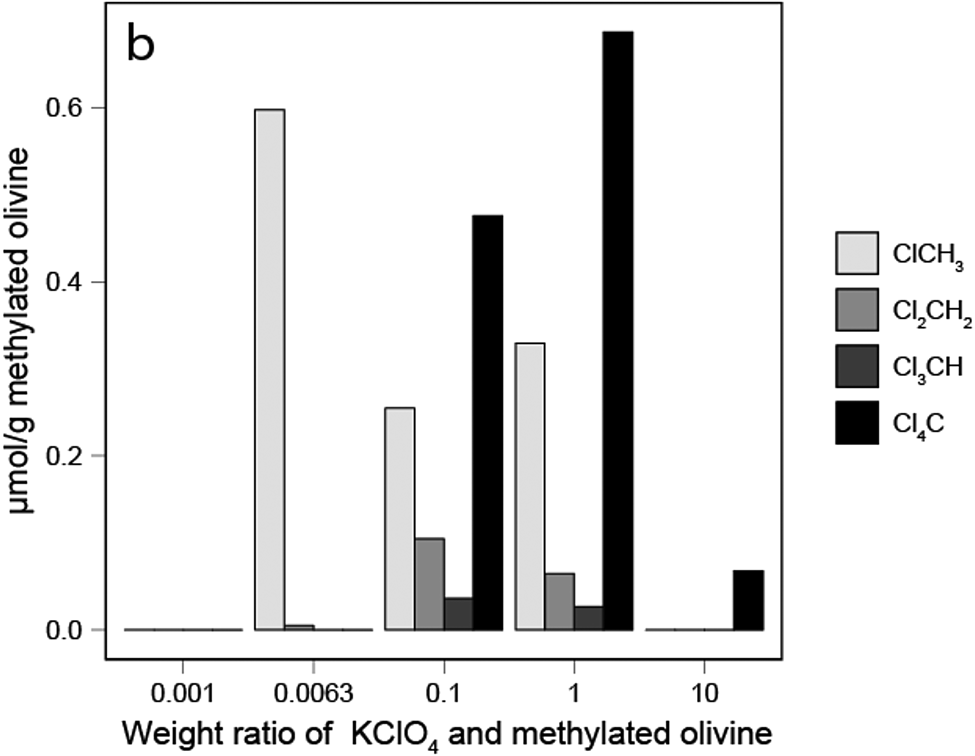
Surface and subsurface regolith samples from both Chryse and Utopia were analysed by thermal volatilization at increasing temperatures up to 500 °C followed by gas chromatography-mass spectrometry (GC-MS) of the evaporates. VL-1 detected 0.3 nmol ClCH3 g−1 of regolith in the subsurface sample, but ClCH3 was also detected during instrument tests on Earth. The release of ClCH3 was initially ascribed to reactions between absorbed methanol and HCl that stemmed from the cleaning procedures (Biemann et al., Reference Biemann1977). The GC-MS system of VL-2 was contaminated with acetone, freon and methyl fluoro-siloxane as evident by their presence in the blank analysis. VL-2 detected Cl2CH2 in both samples, but as Cl2CH2 also had been used for the cleaning procedures before launch, the presence of Cl2CH2 was ascribed to terrestrial contamination (Biemann et al., Reference Biemann1977). Thus, it was concluded that no organic compounds were present in the analysed samples with a detection limit in the ppb range for most compounds (Biemann et al., Reference Biemann1977). The later discovery of considerable amounts of perchlorate (ClO4−, approximately 0.5 wt%) in the Martian regolith by the Phoenix lander (Hecht et al., Reference Hecht2009), however, meant that these conclusions had to be reevaluated. The Curiosity rover, that landed in Gale Crater in 2012, found similar concentrations of perchlorate in the sand patch, Rocknest. Together with the finding of oxy-chlorine phases by both Viking landers, the Pathfinder mission, the MER spacecraft and the Mars Odyssey orbiter that detected on average 0.49 wt% chlorine (Keller et al., Reference Keller2006), it can be concluded that perchlorates are common in the Martian surface regolith (Glavin et al., Reference Glavin2013a, Reference Glavin2013b, Clark and Kounaves, Reference Clark and Kounaves2016). Perchlorates are not reactive at the low temperatures found on Mars. However, at elevated temperatures e.g. during thermal volatilization, perchlorates decompose and release O2 and reactive chloride species (Glasner and Weidenfeld, Reference Glasner and Weidenfeld1952) that can oxidize organic compounds to CO2 and produce small quantities of chlorinated methane e.g. ClCH3 and Cl2CH2 (Navarro-Gonzalez et al., Reference Navarro-Gonzalez, Vargas, de la Rosa, Raga and McKay2010; Steininger et al., Reference Steininger, Goesmann and Goetz2012; Glavin et al., Reference Glavin2013a, Reference Glavin2013b; Bak et al., Reference Bak, Jensen, Nørnberg and Finster2016). Traces of chloroalkanes, produced by the reaction between perchlorates and organics, could indicate that organic compounds were present in the regolith samples before analysis. Based on numerical simulations of thermal volatilization of methane and perchlorate, Navarro-Gonzalez et al. (Reference Navarro-Gonzalez, Vargas, de la Rosa, Raga and McKay2010) proposed that the chlorinated methane detected by the Viking Landers was indicative of a few ppm of organic carbon in the samples. Results of numerical simulations by Navarro-Gonzalez et al. (Reference Navarro-Gonzalez, Vargas, de la Rosa, Raga and McKay2010) are comparable to results from laboratory studies reported in Bak et al. (Reference Bak, Jensen, Nørnberg and Finster2016). They studied silicates with ≡Si-CH3 bonds formed during simulated saltation (Jensen et al., Reference Jensen2014), and showed that ≡Si-CH3 can be a precursor for ClCH3 and Cl2CH2 when heated in the presence of perchlorates at concentrations similar to those found on Mars. Bak et al. (Reference Bak, Jensen, Nørnberg and Finster2016) reproduced the conditions of the Curiosity chemistry lab and detected a series of methylchlorides (Fig. 1). The study demonstrated that ClCH3, Cl2CH2, Cl3CH and Cl4C that have been observed both by Viking and Curiosity can be produced upon heating from methylated silicates and perchlorates. The relative concentrations of the 4 methylated compounds depended on the ratio between perchlorates and methylated silicates. At the highest perchlorates mixing ratios, only Cl4C was observed. The experiment also demonstrated the influence that perchlorates may have on the detection and identification of organics on Mars.
The production of ClxCHy from heating KClO4 and methylated olivine at different ratios in an inert atmosphere (12.2 mM helium) to 500 °C for 1 h. From Bak et al. (Reference Bak, Jensen, Nørnberg and Finster2016) with permission from Elsevier.

Based on these results, Bak et al. (Reference Bak, Jensen, Nørnberg and Finster2016) proposed that the methyl chlorides can be produced from a methyl-groups associate with silicates and chlorine released from perchlorate when heated. They concluded that it is difficult to determine the source of the ClCH3 detected by VL-1 as the only blank analysis was carried out with a different sample oven than the other measurements (Biemann et al., Reference Biemann1977; Bak et al., Reference Bak, Jensen, Nørnberg and Finster2016). Furthermore, during the blank run of the Viking chemistry lab, water was released, which caused the system to close the MS valve during the time where ClCH3 would have eluted (Biemann and Bada, Reference Biemann and Bada2011). This may be the reason why the detection of Cl2CH2 without a concomitant detection of ClCH3 by VL-2 differ from the results reported by Bak et al. (Reference Bak, Jensen, Nørnberg and Finster2016) as well as the laboratory study by Navarro-Gonzalez et al. (Reference Navarro-Gonzalez, Vargas, de la Rosa, Raga and McKay2010) or the results from the analysis of the Rocknest or the John Klein and the Cumberland samples (Glavin et al., Reference Glavin2013a, Reference Glavin2013b; Ming et al., Reference Ming2014). Thus, it is unlikely that the Cl2CH2 detected by VL-2 was produced during thermal volatilization. Instead, it is more likely that it was a residual from cleaning liquid used to rinse the system before launch (Biemann and Bada, Reference Biemann and Bada2011). However, it cannot be excluded that the discrepancies were caused by differences in the experimental setups and thus, that the chlorinated methane originated from chlorination of a terrestrial contaminant and/or indigenous organic compounds during the analysis.
Sutter et al. (Reference Sutter2017) published a detailed report of Curiosity results summarizing the release of gases that can be related to the presence of e.g. organics, oxychlorine phases, water as well as reduced conditions. These observations document both the patchiness of the sediments on a relatively small space-scale as well as the diversity of the sources of e.g. CO2 and O2, as it depends on the thermal treatment of the samples. They interpret the results based on laboratory studies, simulating the conditions in the Sample Analysis at Mars (SAM) instrument, and ultimately concluded that some of the samples contained sufficient amounts of organics to sustain populations of microbes comparable to those found in the very oligotrophic South Pacific Gyre (D'Hondt et al., Reference D'Hondt2015). The results of Sutter et al. (Reference Sutter2017) show that all ingredients are present in several of the Gale Crater samples for life to being sustained.
Still, there is a long and winding road from appropriate conditions for life to the presence of living things, even those of microscopic size.
Search for organics by the Phoenix lander and the Curiosity rover
After the inconclusive results of the Viking mission, it took three decades before an instrument capable of detecting organic compounds was sent to Mars again, this time on board the Phoenix lander. The Phoenix lander was equipped with the Thermal and Evolved Gas Analyzer (TEGA) that heated regolith samples up to 1000 °C and analysed the evaporates with mass spectrometry for the determination of the organic content (Boynton et al., Reference Boynton2001). In the five samples that were analysed in detail, not a single organic compound was detected (Sutter et al., Reference Sutter, Ming, Boynton, Niles, Hoffman, Lauer and Golden2009), not even a contaminant.
The main purpose of the ongoing Curiosity mission is to determine Mars' habitability with a focus on the environmental conditions that could support microbial life. Its main instrument is the SAM Instrument Suite that uses thermal volatilization combined with either direct MS measurements during heating or trapping of organic compounds on adsorbent materials followed by a release for GC-MS analysis to detect organic matter (Grotzinger et al., Reference Grotzinger2012). Results have been reported for regolith samples from (i): the sand patch, Rocknest, (ii): the mudstone drill samples from John Klein and Cumberland sites and (iii): drill samples from Confidence Hills (Freissinet et al., Reference Freissinet2015a, Reference Freissinet2015b). Analysis of the Rocknest samples revealed the presence of a range of chlorinated hydrocarbons including up to 70 nmol g−1 of chlorinated methane species (ClCH3, Cl2CH2 and Cl3CH) likely produced during heating by reactions of organic compounds and perchlorates (Glavin et al., Reference Glavin2013a, Reference Glavin2013b; Leshin et al., Reference Leshin2013; Bak et al., Reference Bak, Jensen, Nørnberg and Finster2016). However, it was shown that the GC-MS instrument was contaminated by N-methyl-N-(tert-butyldimethylsilyl)-trifluoroacetamide (MBTSTFA) that had leaked from the Wet Chemistry Experiments. Therefore, the origin of the organics is somewhat dubious. Glavin et al. (Reference Glavin2013a, Reference Glavin2013b) demonstrated that MTBSTFA in the presence of Mg(ClO4)2 or Ca(ClO4)2 on either quartz or olivine sand produces chlorinated methane as well as four-carbon compounds. However, the ratio of the one-carbon to the four-carbon products in the MTBSTFA laboratory experiments was much lower than the ratios obtained with the Rocknest samples during the SAM analyses. This discrepancy could be due to differences in the experimental setup. Alternatively, it could indicate that MTBSTFA only accounted for a fraction of the organic carbon, and that indigenous organic carbon gave rise to the relatively large release of one-carbon products. Navarro-Gonzalez et al. (Reference Navarro-Gonzalez, Vargas, de la Rosa, Raga and McKay2010) demonstrated that chlorinated methyl compounds were produced in thermal volatilization experiments with samples from the Atacama desert that were enriched with Mg(ClO4)2. The results showed that a complex mixture of organic compounds as they are present in the Atacama samples, and which on Mars could originate from e.g. indigenous organic compound synthesis or micrometeorites, can account for the relatively large amounts of one-carbon products found when analysing the Rocknest samples. If methylated silicates were present in the Rocknest material, they could also have given rise to the range of chlorinated methane compounds as demonstrated by Jensen et al. (Reference Jensen2014) and Bak et al. (Reference Bak, Jensen, Nørnberg and Finster2016). Estimates of the initial concentration of organic compounds in the Rocknest material that were based on the production of chlorinated compounds relative to the initial concentration of reduced carbon in laboratory simulation (Bak et al., Reference Bak, Jensen, Nørnberg and Finster2016) are, however, within the range of estimated terrestrial contamination in the Rocknest blank (Freissinet et al., Reference Freissinet2015a, Reference Freissinet2015b). To evaluate the effect of the presence of minerals or perchlorate during pyrolysis, as it is conducted in SAM, and to improve our ability to interpret the SAM in situ results Lewis et al. (Reference Lewis2021) carried out laboratory studies with oxalate and acetate salts. They concluded that the presence of a silica matrix altered the relative abundance of the pyrolysis products, while the presence of perchlorates significantly enhanced the conversion of organic salts into CO2. Thus, the mineral matrix as well as the presence of perchlorates need to be included in the interpretation of the SAM results as they both influence the composition of the released organics as well as their quantities. This also indicates that there is a strong need for using non-destructive analytical methods to get a proper picture of the types of organic matter as well as their quantities.
During the analysis of material from the Cumberland drill hole in the Sheep-bed mudstone at Yellowknife Bay, 1,2 dichloropropane and chlorobenzene were released. This could not be attributed to known terrestrial sources (Freissinet et al., Reference Freissinet2015a, Reference Freissinet2015b; Szopa et al., Reference Szopa2020). The compounds are most likely produced during thermal volatilization, and as it is not a terrestrial contaminant, it is considered the first unambiguous indication of organic compounds in Martian surface material. Preliminary investigations of the presence of more complex organic compounds in the Cumberland material by derivatization with MTBSTFA already present in the system, due to the leak, followed by GCMS, pointed towards the presence of a range of aromatic compounds (Freissinet et al., Reference Freissinet2015a, Reference Freissinet2015b). In a follow-up study, Szopa et al. (Reference Szopa2020) could show that the detected chlorohydrocarbons are not due to contamination of the SAM instrument. They were most likely produced during sample processing and analysis in the SAM instrument due to the presence of oxy-chlorines in the sample, thus supporting the findings reported in Navarro-Gonzalez et al. (Reference Navarro-Gonzalez, Vargas, de la Rosa, Raga and McKay2010) and Bak et al. (Reference Bak, Jensen, Nørnberg and Finster2016).
Eigenbrode et al. (Reference Eigenbrode2018) investigated the 3.5-billion-year-old mudstone from the Murray formation at Pahrump in Gale Crater with the SAM instrument, and found simple and complex sulphur-containing organic compounds including mercaptans and thiophenes. They suggest that the sulphur most likely was added to the organic molecules in a process termed sulphurization, and that this process is responsible for the preservation of the organic material relatively close to the surface over 3.5 billion years. However, they cannot exclude that sulphur was already a part of the organic matter when it was deposited, indicating the sources could be many, including geological, meteoritic or even biological sources. This highlights a general problem when it comes to unambiguously identify the source(s) of the detected organic compounds. In addition to the small quantities of the organic material, it represents a great challenge identifying whether a compound remained unaltered since it was deposited/synthesized or whether it is the product of subsequent physical and/or chemical alteration processes.
Sources of oxidants in the Martian regolith
Several sources for oxidants could be responsible for the high oxidation potential of the Martian regolith. Reactions involving these chemical oxidants rather than biological processes are by most scientists hold accountable for the general scarcity of organics in the Martian surface regolith as well as for the results of the GEex and LRex conducted by the Viking landers (e.g. Navarro-Gonzalez et al., Reference Navarro-Gonzalez, Vargas, de la Rosa, Raga and McKay2010; Bak et al., Reference Bak, Zafirov, Merrison, Jensen, Nørnberg, Gunnlaugsson and Finster2017a; Fox et al., Reference Fox, Eigenbrode and Freeman2019; Lewis et al., Reference Lewis2021). Processes that produce the respective oxidants are (1) radiation-induced chemical processes involving surface minerals, (2) photochemical processes in the atmosphere, (3) triboelectric charging of dust while suspended in the atmosphere (4) fractioning of minerals caused by meteorite impacts and (5) wind-driven abrasion of silicates.
Production of oxidants by radiation-induced chemical processes involving surface minerals
The average influx of solar irradiation on Mars is about 43% of the irradiation on Earth. While the integrated flux of UV light in the 200–400 nm range on present-day Earth and Mars is equal, the flux of UVC on Mars is significantly higher than on Earth (e.g. Cockell et al., Reference Cockell, Catling, Davis, Snook, Kepner, Lee and McKay2000). This is due to the thin almost oxygen-free Martian atmosphere, and in particular due to the low concentration of ozone (Lefevre et al., Reference Lefevre2008) allowing UV-C radiation to reach the surface almost unhindered (Cockell et al., Reference Cockell, Catling, Davis, Snook, Kepner, Lee and McKay2000). Siliceous minerals like plagioclase feldspar constitute about 40% of the Martian regolith (Blake et al., Reference Blake2013). Yen et al. (Reference Yen, Kim, Hecht, Frant and Murray2000) demonstrated that exposure of the plagioclase feldspar labradorite to UV radiation in a low-pressure O2 atmosphere leads to the production of surface-bound O2 that is partly resistant to heating to 200 °C. The authors estimated that UV radiation, equivalent to a few months on the Martian surface, would be sufficient to produce surface-bound O2 in quantities that could account for the O2 release in the GEex (Yen et al., Reference Yen, Kim, Hecht, Frant and Murray2000). Interestingly, a similar treatment of the plagioclase feldspar albite by Zent et al. (Reference Zent, Ichimura, Quinn and Harding2008) did not lead to a production of heat-stable O2. The resemblance between the results obtained when analysing a surface sample and a sample collected from underneath a rock in the GEex and LRex by VL-2 implies that reactive compounds are not only present in the top layer of the regolith that got exposed to UV radiation, but also in regolith that was protected against UV radiation (Thomson and Schultz, Reference Thomson and Schultz2007). Keppler et al. (Reference Keppler, Vigano, McLeod, Ott, Fruchtl and Rockmann2012) demonstrated that UV radiation is absorbed in the top 130 nm, and thus, the surface-bound O2 would either have to be stable over geological time or would have to be able to diffuse deeper into the regolith to reach regolith that is e.g. covered by a rock. We are not aware of studies that investigated the long-time stability of surface-bound O2. While diffusion constants of O2 across mineral surfaces have been determined, the diffusion speed across grain boundaries is unknown (Yen et al., Reference Yen, Kim, Hecht, Frant and Murray2000).
The flux of ionizing radiation from the sun and of galactic cosmic radiation that reaches the Martian surface is high because of Mars' thin atmosphere and the lack of a global magnetic field. Both types of radiation may provide the energy for chemical transformations in the regolith. Quinn et al. (Reference Quinn, Martucci, Miller, Bryson, Grunthaner and Grunthaner2013) demonstrated that an aqueous solution of Ca(ClO4)2 in a 7.5 mbar CO2 atmosphere and mixed with water released hypochlorite (ClO−), chlorine dioxide (ClO2) and O2 when exposed to γ-radiation. Oxygen produced during irradiation is trapped by the material and released after the addition of water. Hypochlorite (ClO−) could be responsible for the Viking LEx results. It could have reacted spontaneously with e.g. alanine and glycine that was present in the M4 medium used for the LRex, and resulted in the release of CO2. Based on these results, Quinn et al. (Reference Quinn, Martucci, Miller, Bryson, Grunthaner and Grunthaner2013) proposed that ClO− produced by ionizing radiation of perchlorates could explain the results of the GEex and LRex as an alternative to processes that would involve either peroxides or superoxides. Quinn et al. (Reference Quinn, Martucci, Miller, Bryson, Grunthaner and Grunthaner2013) demonstrated that hypochlorite decomposes when heated to 160 °C for 3 h while the amount of trapped O2 was almost unaffected, which agrees with the results from GEex and LRex. Hassler et al. (Reference Hassler2014) showed that ionizing radiation can have a considerable impact on chemical processes at the Martian surface even down to a depth of 2–3 m. This would explain why, in the Viking GEex and LRex experiments, samples taken from underneath a rock showed similar results as the radiation-exposed surface samples. The radiation dose used in the experiment by Hassler et al. (Reference Hassler2014) equals a time period of 1–10 Myr of exposure on the Martian surface. This raises the question of the lifetime of the reactive compounds and thus the conclusions that can be drawn from simulation experiments in which doses are dramatically increased compared to the natural situation, in order to obtain detectable effects in time-limited laboratory simulations.
Fox et al. (Reference Fox, Eigenbrode and Freeman2019) studied the effect of 200-MeV protons with a penetration depth of 4–5 cm into the regolith, thus simulating galactic cosmic rays and solar winds. They prepared a mixture of complex (e.g. phytane and stigmasterol) and simple organic molecules (e.g. alanine and glycine) and mixed these molecules into a mineral matrix including silica, olivine sand and nontronite, thus mimicking the composition of the Martian regolith. The applied doses were equivalent to 1–7 Myr of radiation. They demonstrated that high energy radiation equivalent to UV radiation produces hydroxyl radicals that degrade organic matter and that the degradation products are in all cases organic acids, independent of the organic precursor. The authors conclude that a reconstruction of the composition of organic matter is not possible after they were irradiated on geological time scales and therefore suggest that samples need to be collected at regolith depths unaffected by radiation.
Production of oxidants by photochemical processes in the Martian atmosphere
The only direct observation of H2O2 on Mars stems from investigations of the Martian atmosphere with Earth-based telescopes. H2O2 concentrations of up to 30 ppb have been measured (Clancy et al., Reference Clancy, Sandor and Moriarty-Schieven2004; Encrenaz et al., Reference Encrenaz2008). Encrenaz et al. (Reference Encrenaz, Greathouse, Lefevre and Atreya2012) suggested that atmospheric H2O2 is produced by the photochemical splitting of water in a series of coupled reactions (1–4):


In agreement with the observation by Clancy et al. (Reference Clancy, Sandor and Moriarty-Schieven2004), models of the Martian atmosphere predict that H2O2 concentrations vary seasonally between 10 and 50 ppb (Lefevre et al., Reference Lefevre2008). Even though models and direct Earth-based measurements predict that there is H2O2 present in the Martian atmosphere, the concentration of oxidants in the Martian regolith is insignificant, as the lifetime of H2O2 in the atmosphere is one order of magnitude too short compared to the time it would take for H2O2 to reach the surface (Atreya et al., Reference Atreya2006).
Production of oxidants by triboelectric charging
Triboelectric charging produces charged particles when particles suspended in the atmosphere interact with each other. Wind-induced mobilization of particles leads to the separation of charge (Merrison et al., Reference Merrison2012). Thus, electrostatic fields build up between particles and the ground (Kok and Renno, Reference Kok and Renno2009) during e.g. saltation, and in dust devils between the larger particles near the ground and the smaller particles that were lifted higher up into the atmosphere (Delory et al., Reference Delory2006).
Early in the exploration of Mars, triboelectric charging and concomitant electrical discharge were proposed to play an important role in chemical processes in the Martian atmosphere, and in defining Mars' surface conditions (Eden and Vonnegut, Reference Eden and Vonnegut1973; Mills, Reference Mills1977). Eden and Vonnegut (Reference Eden and Vonnegut1973) carried out laboratory experiments where the sand was shaken in sealed glass containers in a CO2 atmosphere with a pressure of 13.3 mbar. They observed glow discharge and measured a build-up of electric potentials of up to 500 V. Following up on the results reported by the Viking Lander team, Mills (Reference Mills1977) proposed that triboelectric charging and glow discharge could lead to the production of a range of reactive compounds which may be the cause of the absence of organic compounds in the Martian regolith as well as of the reported reactivity of the regolith in the Viking Biological Experiments. Mills' ideas are supported by a range of numerical simulations of triboelectric charging in Martian dust storms and dust devils (Melnik and Parrot, Reference Melnik and Parrot1998; Atreya et al., Reference Atreya2006; Delory et al., Reference Delory2006; Farrell et al., Reference Farrell, Delory and Atreya2006; Zhai et al., Reference Zhai, Cummer and Farrell2006). Electrons in electrostatic fields can, in the low-pressure atmosphere of Mars (5–8 mbar, Withers (Reference Withers2012)), attain a drift velocity that is sufficiently high to dissociate atmospheric CO2 and H2O (Delory et al., Reference Delory2006).


The release of CO and ⋅OH can further lead to a production of H2O2, as suggested in reactions 2–4. Using numerical models, Atreya et al. (Reference Atreya2006) could show that H2O2 production by triboelectric charging can locally exceed H2O2 production by photochemical reactions and produce H2O2 at concentrations that are sufficiently high to condense, and deposit on the surface where H2O2 can form stable compounds with e.g. TiO2 minerals in the regolith (Quinn and Zent, Reference Quinn and Zent1999). The disassociation efficiency of H2O and CO2 and the later production of H2O2 depend on the strength of the electrostatic field (Delory et al., Reference Delory2006). The production of ions and the concomitant enhanced conductivity of the atmosphere (reactions 5 and 6) act as negative feedback (Kok and Renno, Reference Kok and Renno2009). However, in recent laboratory experiments, Farrell et al. (Reference Farrell, McLain, Collier, Keller, Jackson and Delory2015) showed that the negative feedback is weaker than anticipated and that glow discharges can occur. Bak et al. (Reference Bak, Zafirov, Merrison, Jensen, Nørnberg, Gunnlaugsson and Finster2017a) demonstrated in laboratory simulations of saltation of silicates in Mars-like atmospheres that saltation can give rise to H2O2 upon exposure to water. The amount of H2O2 produced by this process exceeded the amount of O2 that was present in the atmosphere. This suggests that not only gas-phase reactions 2–5 were at play, but also reactions involving abraded silicate surfaces (Bak et al., Reference Bak, Zafirov, Merrison, Jensen, Nørnberg, Gunnlaugsson and Finster2017a), including adsorbed water. If the H2O2 production is dominated by triboelectric charging in dust devils as suggested by Atreya et al. (Reference Atreya2006), triboelectric charging should significantly increase the atmospheric H2O2 concentration on local scales. Currently, it would be difficult to detect such local events due to the low resolution and sensitivity of ground-based methods (Encrenaz et al., Reference Encrenaz, Greathouse, Lefevre and Atreya2012). However, the Mars Atmospheric Trace Molecule Occultation Spectrometer (MATMOS) on the ExoMars Trace Gas Orbiter (TGO) launched in 2016 should be able to measure the atmospheric H2O2 concentration with higher resolution (Encrenaz et al., Reference Encrenaz, Greathouse, Lefevre and Atreya2012). While measurements addressing methane (Korablev et al., Reference Korablev2019) and water (Vandaele et al., Reference Vandaele2019) in the Martian atmosphere have been published, measurements addressing atmospheric concentrations of H2O2 and its distribution are still pending.
Production of oxidants by abrasion of silicates
Hurowitz et al. (Reference Hurowitz, Tosca, McLennan and Schoonen2007) simulated meteor impacts by milling a range of silicate minerals. They found that the crushing of silicates produced H2O2 when the crushed material was suspended in water. They proposed that abrasion of surface silicates by meteor impacts on Mars could be a source of precursors for H2O2 in the Martian regolith. They argue that the production of H2O2 is dependent on the presence of radicals on the newly formed silicate surfaces, and suggest that this could explain the toxicity of dust produced in e.g. the mining industry (Fubini and Hubbard, Reference Fubini and Hubbard2003). Bak et al. (Reference Bak, Zafirov, Merrison, Jensen, Nørnberg, Gunnlaugsson and Finster2017a) simulated abrasion be wind-driven saltation, and could demonstrate that H2O2 is produced from comminuted silicates. They showed that the production of H2O2 from abraded quartz was stimulated by increasing amounts of O2 and inhibited by increasing amounts of CO2 in the atmosphere, except for low-pressure samples, which also were affected by glow discharge (Bak et al., Reference Bak, Zafirov, Merrison, Jensen, Nørnberg, Gunnlaugsson and Finster2017a) (Fig. 2).
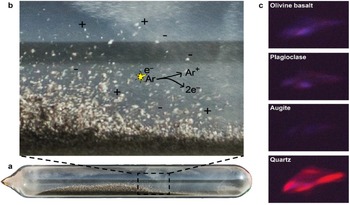
Simulation of saltation in a Martian environment. (a) The quartz 20 cm long and 2 cm (inner diameter) wide ampoule containing 10 g of olivine basalt and a Martian atmosphere analogue is shaken to simulate wind-mediated saltation. (b) Close-up of the inside of the ampoule (indicated by the dashed square in a). + and – signs illustrate that the triboelectric effect has charged some of the grains thus creating a charge separation. The yellow star indicates a location where the charge separation has become so high that an electron is removed from Ar thus creating Ar+. (c) Photos of the saltation-induced glow from four minerals in a Martian atmosphere analog at a pressure of 8 mbar. From Thøgersen et al. (Reference Thøgersen, Bak, Finster, Nørnberg, Jakobsen and Jensen2019) with permission from Elsevier (https://doi.org/10.1016/j.icarus.2019.06.025).

According to their results, the low O2/CO2-ratio of the Martian atmosphere (Mahaffy et al., Reference Mahaffy2013) should inhibit the production of H2O2 by comminuted silicates. It is not clear yet if the reactivity induced by abrasion due to repeated low-energy impacts (Bak et al., Reference Bak, Zafirov, Merrison, Jensen, Nørnberg, Gunnlaugsson and Finster2017a) is governed by the same mechanisms as the reactivity found with milled silicates (Hurowitz et al., Reference Hurowitz, Tosca, McLennan and Schoonen2007). However, as the role of the atmospheric composition, as demonstrated by Bak et al. (Reference Bak, Zafirov, Merrison, Jensen, Nørnberg, Gunnlaugsson and Finster2017a), was not considered in the study by Hurowitz et al. (Reference Hurowitz, Tosca, McLennan and Schoonen2007), no valid conclusion can be drawn as to whether abrasion by meteor impacts is a significant source of H2O2 on Mars. Quartz abraded by simulated saltation in a Mars-like atmosphere gave rise to H2O2 and ⋅OH, which implies that saltation enhances the reactivity of the Martian regolith (Bak et al., Reference Bak, Zafirov, Merrison, Jensen, Nørnberg, Gunnlaugsson and Finster2017a). The authors suggested that a combined effect of abrasion and glow discharge is responsible for the production of H2O2 and ⋅OH, but the mechanism remains to be established. The effects of abrasion and glow discharge would primarily affect saltating particles, suspended particles and the surface. Thus, it does not directly account for the reactivity of the sample collected from underneath a rock by VL 2, unless, as discussed for UV radiated minerals, the surface species are stable for Ma or even Ga, or that the ROS precursors can diffuse into the regolith.
Mobilization of oxidants from the dry phase
None of the mechanisms proposed to explain the results of the GEex and the LRex have been confirmed by in situ measurements. Also, it is possible that the results obtained by the Viking Landers were produced by a combination of different types of ROS. New lander missions focusing on the reactivity of the Martian regolith, as e.g. the Biological Oxidant and Life Detection (BOLD) mission proposed by Schulze-Makuch et al. (Reference Schulze-Makuch2012), may close that gap. Common for the proposed mechanisms is that they mainly aim at explaining the production of ROS in relation to the Viking Experiments and consequently by reactions taking place in an aqueous solution. It is not clear if – and how – such ROS precursors can interact with organic compounds in the dry state. However, Kereszturi and Appere (Reference Kereszturi and Appere2014) suggested that ROS could be mobilized when thin films of water formed annually at the northern water ice annulus, and Martin-Torres et al. (Reference Martin-Torres2015) suggested that transient liquid brines caused by the uptake of water vapour by deliquescent salts (e.g. perchlorates) in the regolith could form more frequently during night-time. Thus, oxidants or ROS precursors could build up in dry seasons and would get mobilized to oxidize organic compounds when water is available (Kereszturi and Gobi, Reference Kereszturi and Gobi2014).
The role of the Martian regolith reactivity for the dynamics of atmospheric methane
While the majority of the Mars missions, including the Viking missions, focused on the search of organics and signs of life in the regolith, the discovery of methane in the Martian atmosphere attracted great attention, as it may hold an important key to finding extant or extinct life on Mars. Methane is considered a potential biosignature gas (Yung et al., Reference Yung2018) because on Earth more than 90% of all methane is produced by a specialized group of microorganisms (Conrad, Reference Conrad2009), the so-called methanogenic archaea. Methane can, however, also be produced chemically by processes that are energized by (1) volcanic activity, (2) impacting meteorites and comets (Atreya et al., Reference Atreya, Mahaffy and Wong2007) and/or (3) serpentinization of olivine combined with Fischer-Tropsch and Sabatier reactions (Bradley and Summons, Reference Bradley and Summons2010; Yung et al., Reference Yung2018). Moreover, CH4 may be released from methane-clathrates that were produced earlier in Mars history by an extinct microbiota (Chastain and Chevrier, Reference Chastain and Chevrier2007). Currently, the source(s) behind the observed CH4 plumes have not been identified.
Until now methane is the only organic compound that has been detected in the Martian atmosphere (Villanueva et al., Reference Villanueva2013). Its presence was reported for the first time by Formisano et al. (Reference Formisano, Atreya, Encrenaz, Ignatiev and Giuranna2004), and has been confirmed by several independent measurements thereafter (Lefevre and Forget, Reference Lefevre and Forget2009; Mumma et al., Reference Mumma2009). The latest observation was published by the Curiosity rover team (Webster et al., Reference Webster2015) reporting significant seasonal variation in background methane concentrations in the Gale crater. The team measured concentrations that were lower than what is predicted by a model of UV radiation-induced CH4 release from interplanetary dust particles (Schuerger et al., Reference Schuerger, Moores, Clausen, Barlow and Britt2012). However, regional plumes of methane resulting in local atmospheric concentrations of up to 33 ppb were reported by Mumma et al. (Reference Mumma2009). These changes in atmospheric methane concentrations can best be explained by the presence of active sources and sinks for CH4 on present-day Mars (Formisano et al., Reference Formisano, Atreya, Encrenaz, Ignatiev and Giuranna2004; Lefevre and Forget, Reference Lefevre and Forget2009; Mumma et al., Reference Mumma2009; Webster et al., Reference Webster2015).
Once in the atmosphere, methane is decomposed by UV radiation, but with a predicted lifetime of 340 years (Krashnopolsky et al., Reference Krashnopolsky, Maillard and Owen2004) based on the mechanism known to dominate on Earth. The UV based mechanism cannot explain the observed temporal and spatial variation with lifetimes of only 0.6–4 years (Mumma et al., Reference Mumma2009; Hu et al., Reference Hu, Bloom, Gao, Miller and Yung2016; Korablev et al., Reference Korablev2019). Korablev et al. (Reference Korablev2019) reported extensive ExoMars orbiter measurements of methane and observed different concentrations of methane in the upper atmosphere relative to the Gale crater. Their observations are best explained by a very rapid turnover of methane, for which they currently have no explanation. Therefore, they suggested that an unknown mechanism is responsible for the rapid removal or sequestration of methane from the lower atmosphere before it spreads globally. Although glow discharge can effectively decompose CH4, it is uncertain whether it has a sufficiently strong effect on the overall lifetime of CH4 as the breakdown products likely will recombine and form new CH4 (Farrell et al., Reference Farrell, Delory and Atreya2006). Mumma et al. (Reference Mumma2009) proposed that oxidants in the regolith and dust may effectively oxidize CH4 as suspended particles easily get in contact with CH4. This could not be confirmed by laboratory experiments with chemisorbed H2O2 (Gough et al., Reference Gough2011) but may be valid for other ROS or ROS precursors possibly present in the regolith. In line with this idea, atmospheric CH4 may be sequestered or depleted by wind-abraded silicates, as demonstrated by recent laboratory simulations (Jensen et al., Reference Jensen2014; Thøgersen et al., Reference Thøgersen, Bak, Finster, Nørnberg, Jakobsen and Jensen2019). In a laboratory experiment simulating saltation of quartz sand in a methane atmosphere, Jensen et al. (Reference Jensen2014) demonstrated that methane reacts with Si-atoms in the mineral forming ≡Si-CH3 bonds. In a follow-up study, Thøgersen et al. (Reference Thøgersen, Bak, Finster, Nørnberg, Jakobsen and Jensen2019) analysed the spectrum of light emitted during saltation, and could demonstrate that argon is getting ionized due to triboelectric charging in a dry, low-pressure atmosphere. The authors suggest that the observation of Ar+ being formed lends support to the hypothesis that glow discharge generated by friction would also lead to the ionization of methane that would further react with abraded silicates. In combination, these processes may scavenge methane from the Martian atmosphere or be at least part of the explanation of the rapid drop in methane concentrations reported by the Curiosity science team and discussed in Korablev et al. (Reference Korablev2019). The methylated silicates could act as a precursor of the measured methylchlorides that were detected by Viking and following missions including Curiosity (for details see paragraph section ‘Interpretation of the Viking lander results in light of perchlorate detected in later missions’).
The effect of Martian soil reactivity on the fate of organics and cells from spacecrafts – forward contamination
As the results of the Viking experiments could be explained by the metabolic activity of an autochthonous microbiota it is important to elucidate whether the chemical reactivity of the Martian would affect not only organics but also intact organisms, and as a consequence would prevent forward contamination. This is relevant for questions about the habitability of Mars, and concerning the risk of forward contamination by terrestrial microbiota reaching Mars as the bioburden of spacecraft.
Planetary protection in light of Martian soil reactivity
During construction and assembly, contamination of a spacecraft with terrestrial microorganisms cannot be avoided. The unintended carryover of microorganisms and organic material from Earth to Mars may corrupt the identification of Martian life and/or organics by contaminating the pristine samples with terrestrial material. This may lead to wrong conclusions on the presence and types of organics and microbes in the Martian regolith. In a larger perspective, the contaminated spacecraft may seed potentially habitable environments on Mars with terrestrial microbes, with, in the worst case, severe negative consequences for indigenous life forms, should they be present. Thus, cleaning and sterilization of spacecraft are crucial for preserving Mars pristine environments, and large efforts are made to clean and sterilize landers and rovers using chemical and heat sterilization, and assembling of the spacecraft in clean rooms (Puleo et al., Reference Puleo, Fields, Bergstrom, Oxborrow, Stabekis and Koukol1977; Stieglmeier et al., Reference Stieglmeier, Rettberg, Barczyk, Bohmeier, Pukal, Wirt and Moissl-Eichinger2012; Benardini et al., Reference Benardini, La Duc, Beaudet and Koukol2014). In addition, the composition of the microbial communities present in the clean rooms is monitored to provide a reference database of the most likely contaminants (Puleo et al., Reference Puleo, Fields, Bergstrom, Oxborrow, Stabekis and Koukol1977; La Duc et al., Reference La Duc, Osman, Vaishampayan, Piceno, Andersen, Spry and Venkateswaran2009; Moissl-Eichinger et al., Reference Moissl-Eichinger, Rettberg and Pukall2012). These studies have demonstrated that it is impossible to obtain sterility of the spacecraft, and space agencies have agreed that a certain level of contamination is acceptable depending on the purpose and the type of mission. The regulations are implemented by the COSPAR Planetary Protection Policy (2002) and by NASA's Office of Planetary Protection. Thus, a maximum of 5 × 10⁵ spores is acceptable for the MSL mission (Benardini et al., Reference Benardini, La Duc, Beaudet and Koukol2014). This bio-burden is derived from the so-called Coleman-Sagan equation P c = N 0 R P s P t P R P g (Sagan and Coleman, Reference Sagan and Coleman1965) (N 0 is the initial number of microbes that it could be present on the spacecraft; R is the first reduction in the proportion, which depends on parameters such as the conditions to which the spacecraft was exposed before and after launch; P s is the probability that microorganisms on the spacecraft reach the surface of the planet; P t is the probability that the spacecraft will hit the planet; P R is the probability of the microbe being released in the environment when on the ground (usually set to 1 for a crashlanding) and P g is the probability of growth), which gives the maximum initial bioburden based on a defined acceptable risk of contaminating Mars (<10−4 for the Curiosity mission (Benardini et al., Reference Benardini, La Duc, Beaudet and Koukol2014)) and estimates of relevant factors including the probability of microbes to survive and proliferate on the surface of Mars. Thus, to assess the risk of forward contamination it is essential to possess in-depth knowledge about the physicochemical environment on the Martian surface, and on how and to what extent oxidants in the regolith would affect the survival of terrestrial contaminants as well as the persistence of possible biosignatures such as the organics that constitute cells.
The effect of regolith reactivity on the survival and structural persistence of terrestrial contaminants
The Martian surface environment has low water activity (Martin-Torres et al., Reference Martin-Torres2015), large temperature fluctuations (Audourd et al., Reference Audourd, Piqueux, Poulet, Vincendon, Arvidson and Rogers2015), low pressure (Withers, Reference Withers2012) and intense flux of radiation (Cockell et al., Reference Cockell, Catling, Davis, Snook, Kepner, Lee and McKay2000). The surface temperature can vary between −150 °C and 20 °C on a daily basis and the surface pressure ranges typically between 5 and 8 mbar (Withers, Reference Withers2012). In addition, the Martian surface is extremely dry and the water activity is too low to the support growth of terrestrial organisms (Martin-Torres et al., Reference Martin-Torres2015; Ojha et al., Reference Ojha2015). A range of experiments has been conducted to investigate the response of microorganisms to simulated Martian conditions (e.g. Hansen, Reference Hansen, Walker and Fletcher2007). The overall conclusion from these studies is that the effects of dry, cold and low-pressure conditions often are not detrimental for dormant cells and spores, while repeated freeze-thaw cycles decrease their viability. It is found that the primary stress factor at the Martian surface is UV radiation as exemplified by the sterilization of the otherwise multi-resistant B. subtilis spores by just 15 min of exposure to Mars-like UV radiation (Schuerger et al., Reference Schuerger, Mancinelli, Kern, Rothschild and McKay2003). The effect of UV radiation is, however, reduced dramatically when the cells are shielded by a thin dust layer or a few layers of dead cells (Mancinelli and Klovstad, Reference Mancinelli and Klovstad2000; Diaz and Schulze-Makuch, Reference Diaz and Schulze-Makuch2006; de La Vega et al., Reference de La Vega, Rettberg and Reitz2007; Paulino-Lima et al., Reference Paulino-Lima, Pilling, Janot-Pacheco, de Brito, Barbosa, Leitao and Lage2010). In contrast, Hansen et al. (Reference Hansen, Jensen, Kristoffersen, Mikkelsen, Merrison, Finster and Lomstein2009) showed that culturable cells could only be found at 1.5 cm depth in a homogenized soil core. They exposed homogenized, freeze-dried permafrost soil to a Martian UVC flux equivalent to 80 Mars days, and showed that not UVC radiation but freeze-thaw cycles were responsible for the reduction in the number of culturable cells in the deeper strata. Monitoring the temperature as a function of depth, they saw that freeze-thaw cycles were detectable down to a depth of 1.5 cm. While the total number of cells counted by DAPI stain was affected down to a depth of 9 mm, cells could only be cultured from sediment samples obtained from a depth of 15 mm and below. They also observed that different biomarkers were affected differently. While they observed a reduction in the concentration of amino-acids that were present in the form of peptides and proteins, only in the top 1.5 mm of the core, a significant reduction in DNA concentration was observed down to a depth of 3 mm. They calculated half-lives for amino-acids, DNA and cells in the top 1.5 mm of the core. Glycin had the longest half-life of 178 days, while the half-live of DNA was only 78 days. The half-live of dead cells, determined by Life/Dead staining, was 33 days while the half-live of life cells was 45 days. The shortest half-life was calculated for the culturable fraction of the cells. The half-life of these cells was 21 days. The results reported by Hansen et al. (Reference Hansen, Jensen, Kristoffersen, Mikkelsen, Merrison, Finster and Lomstein2009) show that biological contaminants will survive for different periods of time when deposited on the Martian surface, and that protection from radiation is needed to preserve a specific biomarker. Viable cells are the most short-lived as long as they remain on or very close to the surface.
Ionizing radiation from the sun only poses a small stress effect, and the level of cover that protects against UV radiation, would also shield from the charged particles in the solar wind (Tuleta et al., Reference Tuleta, Gabla and Szkarlat2005; Paulino-Lima et al., Reference Paulino-Lima2011). Protection against X-rays and high-energy particles in galactic cosmic rays requires much thicker shielding, but the low flux of galactic cosmic rays on Mars would have little effect on the half-live of e.g. B. subtilis spores, which is in the order of thousands of years (Moeller et al., Reference Moeller, Reitz, Berger, Okayasu, Nicholson and Horneck2010; Hassler et al., Reference Hassler2014). This appears long on a human time scale but is short on a geological time-scale, the only time-scale that is relevant when it comes to the search for life and its remains on Mars. Although spores can withstand radiation for thousands of years, they are very susceptible to mechanical forces. E.g. Bak et al. (Reference Bak, Larsen, Jensen, Nørnberg, Moeller and Finster2019) have shown that about 50% of spores that were deposited on basalt grains were destroyed within 1 min of abrasion. Consequently, spores that are very resistant to UVC and other types of radiation, could be rapidly destroyed when subjected to mechanical stress and concomitant glow discharge (Bak et al., Reference Bak, Larsen, Jensen, Nørnberg, Moeller and Finster2019).
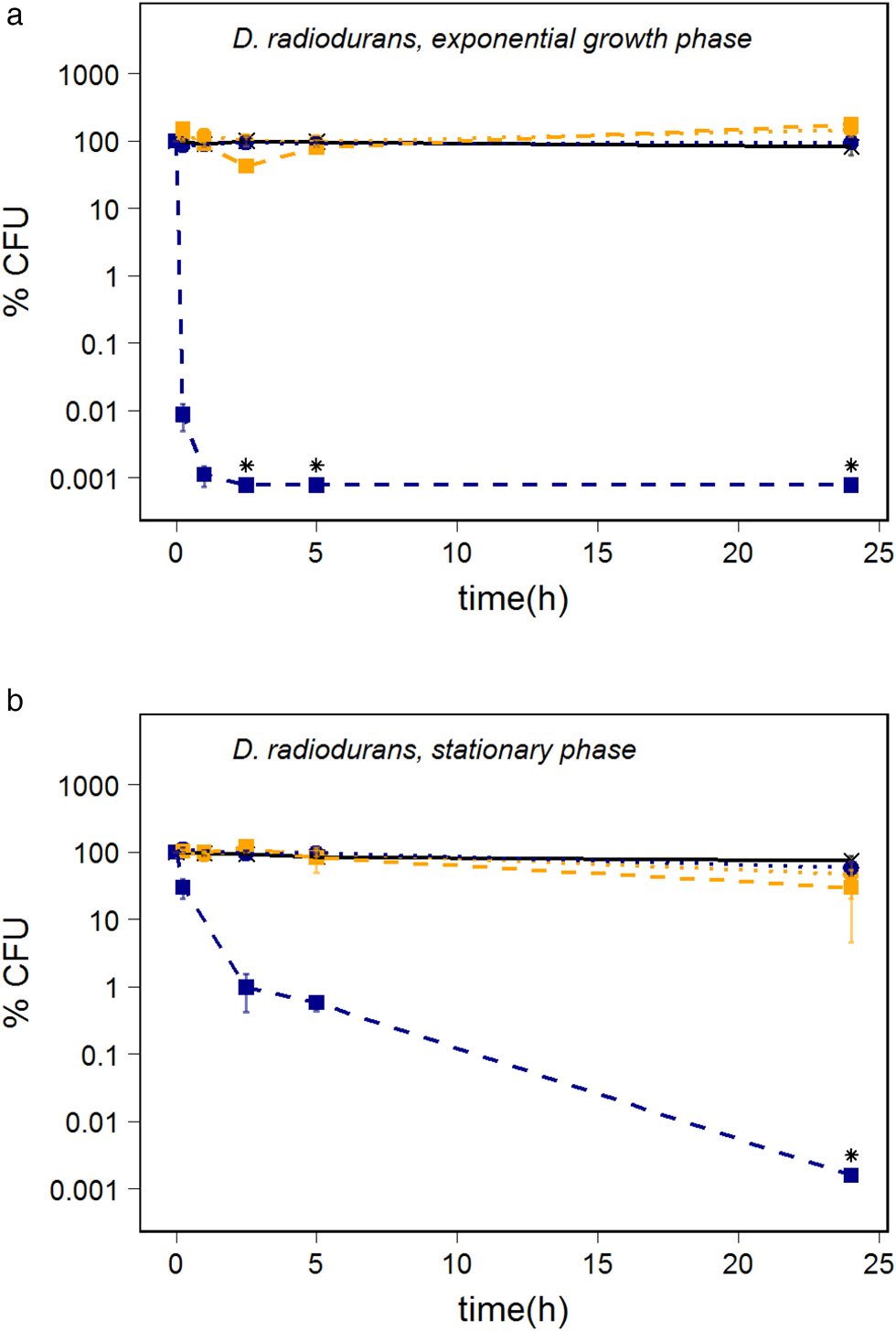
In addition to these factors, the presence of oxidants in the Martian regolith may pose a challenge for terrestrial microorganisms of terrestrial origin. Hydrogen peroxide and superoxide can damage bacteria by e.g. direct oxidation of [4SFe-4S]-clusters in enzymes (Flint et al., Reference Flint, Tuminello and Emptage1993; Jang and Imlay, Reference Jang and Imlay2007) and mononuclear iron enzymes (Anjem and Imlay, Reference Anjem and Imlay2012) or through the production of ⋅OH by reactions with transition metal ions through Fenton or Fenton-like reactions (e.g. H2O2 + Fe2+ → OH− + OH + Fe3+ (Prousek, Reference Prousek2007; Bak et al., Reference Bak, Zafirov, Merrison, Jensen, Nørnberg, Gunnlaugsson and Finster2017a)). Hydroxyl radicals are highly reactive and react with organic compounds at near diffusion limited rates (Buxton et al., Reference Buxton, Greenstock, Helman and Ross1988) leading to e.g. lipid peroxidation (Buege and Aust, Reference Buege and Aust1978) and DNA damage (Bjelland and Seeberg, Reference Bjelland and Seeberg2003). Oxidative stress is always present to some degree in oxic environments, and ROS are produced intracellularly by adventitious reduction of molecular oxygen by reduced redox enzymes (Seaver and Imlay, Reference Seaver and Imlay2004; Korshunov and Imlay, Reference Korshunov and Imlay2010). Specific defence mechanisms allow organisms to cope with oxidative stress. These include enzymes such as superoxides dismutases, catalases and peroxidases that directly target H2O2 and O2 (Inaoka et al., Reference Inaoka, Matsumura and Tsuchido1999; Slade and Radman, Reference Slade and Radman2011; Kim and Park, Reference Kim and Park2014). Furthermore, some bacteria accumulate manganese and manganese complexes that protect against protein damage by direct scavenging of O2 and H2O2 (Inaoka et al., Reference Inaoka, Matsumura and Tsuchido1999; Horsburgh et al., Reference Horsburgh, Wharton, Karavolos and Foster2002; Daly et al., Reference Daly, Gaidamakova and Matrosova2010; Banh et al., Reference Banh2013) and by replacing iron in mononuclear enzymes (Anjem et al., Reference Anjem, Varghese and Imlay2009), which counteracts Fenton-like reactions (Anjem and Imlay, Reference Anjem and Imlay2012). Pigmented cells are protected by the direct absorption of radiation at certain wavelengths, and by their ROS scavenging properties of e.g. carotenoids (Tian et al., Reference Tian, Xu, Sun, Lin and Hua2007). The damage that cells inevitably will acquire, despite this array of defence mechanisms, can partly be counteracted by DNA repair mechanisms (Slade and Radman, Reference Slade and Radman2011; Lenhart et al., Reference Lenhart, Schroeder, Walsh and Simmons2012; Mielecki et al., Reference Mielecki2013). As a consequence of these defence mechanisms, the viability of many organisms is unaffected by exposure of up to even mM concentrations of H2O2 (Hartford and Dowds, Reference Hartford and Dowds1994; Klotz and Anderson, Reference Klotz and Anderson1994; Watts et al., Reference Watts, Washington, Howsawkeng, Loge and Teel2003; Tian et al., Reference Tian, Xu, Sun, Lin and Hua2007). Endospores of B. subtilis resist up to 5% of H2O2 (Melly et al., Reference Melly, Cowan and Setlow2002) due to the combined effect of shielding by the spore-coat (Riesenman and Nicholson, Reference Riesenman and Nicholson2000), low permeability of the compact inner membrane (Cortezzo and Setlow, Reference Cortezzo and Setlow2005), stabilization of DNA by α/β-type small acid-soluble spore proteins (Setlow and Setlow, Reference Setlow and Setlow1993) and the presence of dipicolininc acid (Setlow et al., Reference Setlow, Atluri, Kitchel, Koziol-Dube and Setlow2006). Thus, the relatively low concentration of oxidants that might have been present in the regolith samples that were used in the Viking GEex (≤790 nmol O2 release per cm3) and the LRex (~33 nmol 14CO2 released per cm3) would not have negatively affected the viability of terrestrial contaminants. Most of the proposed sources of ROS on Mars have not been investigated concerning their potential cytotoxic effect. However, it was recently reported that basalt sand exposed to simulated saltation in a Mars-like atmosphere had a strong negative effect on the viability of vegetative cells of Ps. putida, B. subtilis and D. radiodurans (Fig. 3).
The survival of D. radiodurans harvested in the exponential growth phase (a) and in the stationary phase (b) in the PBS control (― ―) and after addition of abraded quartz (⋅⋅●⋅⋅) and basalt (- -■- -) relative to the starting concentration of ~106 colony forming units (CFU) per ml. The survival of D. radiodurans is shown for experiments with inactivated silicates (orange) and abraded silicates kept anoxic (blue). The error bars show the standard error of the mean, and the asterisks indicate that the number of CFU was below the level of detection. With permission from Frontiers in Microbiology https://doi.org/10.3389/fmicb.2017.01709.

The observation that cells of the poly-extremophile D. radiodurans were killed within one day of exposure to abraded basalt was surprising, as these cells are very tolerant to radiation and desiccation (e.g. Moseley and Mattingly, Reference Moseley and Mattingly1971; Mattimore and Battista, Reference Mattimore and Battista1996). In both cases, the extraordinary ability of D. radiodurans cells to detoxify ROS is suggested to be the cause of their resistance. This ability does not secure their survival upon contact with abraded basalt. Bak et al. (Reference Bak, Larsen, Moeller, Nissen, Jensen, Nørnberg, Jensen and Finster2017b) suggested that the negative effect of abraded basalt on the survival of D. radiodurans cells is due to enhanced production of ⋅OH through Fenton and Fenton-like reactions facilitated by transition metal ions released from the basalt. The radicals could peroxidize membrane lipids, but also essential proteins and/or the DNA could be detrimentally affected, which independently or combined could lead to cell death. The same experiments were performed with vegetative cells and spores of Bacillus subtilis. While the vegetative cells of Bacillus subtilis like the D. radiodurans cells were killed within 24 h, Bacillus spores were not affected at all. Apparently, the spore-coat provided sufficient protection against the toxicity of the abraded minerals. Bak et al. (Reference Bak, Zafirov, Merrison, Jensen, Nørnberg, Gunnlaugsson and Finster2017a) used both quartz and basalt with a composition that is very close to the composition of Martian basalt. They only saw an effect when abrading basalt. This indicates that the metals that are present in the basalt are essential for its toxicity and not solely the production of reactive sites due to abrasion.
In a previous study, Wadsworth and Cockell (Reference Wadsworth and Cockell2017) showed that iron oxides such as hematite, which is very common in the Martian surface, have negative and positive effects on the survival of vegetative Bacillus subtilis cells. They demonstrated that iron oxide can protect cells from UVC radiation and thereby increase their survivability but can also serve as catalysts in a heterogenous Photo-Fenton type of reaction producing ROS and thereby decrease cell survivability.
The outcome of these studies showed that while the effect of radiation on organic matter transformation and the survivability of cells has been studied intensively, much needs to be learned about the role of minerals and metal oxides before a comprehensive mechanistic picture of the processes that affect organic matter preservation and transformation and the survival of cells in the Martian regolith can be drawn. This, however, is essential when it comes to the interpretation of data obtained by the ongoing and planned mission to Mars. The still ongoing discussion of the inconclusive Viking results perfectly exemplifies this need.
Open questions and next steps in the search for life on Mars
The exploration of Mars is still in its youth and despite the tremendous advancement of our understanding of its geological history and the processes that govern its current state of the planet, there are still many fundamental questions left unanswered. The missions, starting with Viking, in combination with accompanying and complementing laboratory studies have clearly demonstrated that finding life and/or its remains at the Martian surface are highly unlikely and that future missions should focus on exploring the subsurface.
We have compelling evidence that the reactivity of the Martian regolith is due to the presence of oxidizing compounds, which are the most likely candidates to explain the results obtained by the Viking landers. Understanding the processes behind regolith reactivity is essential for the interpretation of the data collected during previous and ongoing investigations of the presence of organic compounds as well as the preservation of organics, the habitability of the surface and the risk of forward contamination. Most of the mechanisms proposed for the production of ROS are related to surface processes, which in combination with the high UV radiation fluxes imply that the surface environment is much more hostile to life than the subsurface. Considering that cosmic ray irradiation reaches down to at least 2 m depth (Kminek and Bada, Reference Kminek and Bada2006), where it still is powerful enough to destroy organic compounds, upcoming missions should drill below that depth (Fox et al., Reference Fox, Eigenbrode and Freeman2019) or take samples from sites that have been excavated to a greater depth by i.e. recent impacts (Pavlov et al., Reference Pavlov, Vasilyev, Ostryakov, Pavlov and Mahaffy2012; Farley et al., Reference Farley2014) to obtain material that is as pristine as possible. The ExoMars rover, planned to be launched in 2022, will carry a drill with a reach of down to two metres, and can collect samples for processing in the Mars Organic Molecule Analyzer (MOMA) MS (Brinckerhoff et al., Reference Brinckerhoff2013; Goetz et al., Reference Goetz2016). MOMA can analyse samples by thermal volatilization and chemical derivatization GCMS, as well as by laser desorption MS, which should circumvent the problem of oxidation of organic compounds by perchlorate or ROS. Based on these considerations, the 20 cm long cores collected by the Perseverance rover for later analysis on Earth may be suboptimal concerning the preservation of organic matter composition and concentrations and ultimately life so close to the surface.
In addition to drilling at least 2 m into the subsurface or as an alternative to drilling, the exploration of lava caves should be in the focus of future missions. Like on Earth, Martian lava caves are well-protected environments with a unique micro-climate that could be favourable to life and/or the preservation of its remains. Already 20 years ago, Boston et al. (Reference Boston2001) suggested to include lava caves in the search for life and its signatures.
Observations of patterns that were interpreted as local, periodic occurrences of liquid water, the so-called, and controversially discussed, recurring slope lineae (Martin-Torres et al., Reference Martin-Torres2015; Ojha et al., Reference Ojha2015; Stillman, Reference Stillman, Soare, Conway and Clifford2018) indicate that the Martian surface despite its overall dryness may have a temporal oasis, which may offer habitable niches. These sites should also be high on the list of targets for future missions in the search for life. As it is NASA's motto to ‘Follow the Water’ when searching for life in the universe in general and on Mars in particular, it would be completely in line with this motto to visit sites – the so-called special regions – where there was water present in the past and even better where water is present – even if only periodically – at present. The fact that these are sites of high sensitivity because they are environments where Martian life still may prevail, creates a dilemma; on the one hand side these are the most obvious places to look for Martian life, and on the other hand side Martian life may get in contact with terrestrial life that hitches a ride on a spacecraft. In the worst-case terrestrial life may outcompete Martian life, in the best case, it would only risk blurring the unambiguous identification of Martian life. However, we think that space agencies need to take the risk and visit the special regions in order to advance our knowledge about possible life on Mars. It is also urgent to visit these regions with robots/androids before astronauts visit Mars, because with humans present, the imposed terrestrial bioburden risks getting astronomically high, and the identification for Martian life may only be possible if it would be significantly different from terrestrial life such as using a different genetic code or an opposite chirality.
The Viking landers are still the yardstick of the search for life in the solar system in terms of technical skills, ambition and courage. Thus, the spirit of the scientists and engineers that designed the experiments and built the spacecraft is akin to the spirit of Columbus, Humboldt and Amundsen. Even though, the results are ambiguous and none of them demonstrated the presence of life in the Martian surface regolith, they paved the way for our understanding of Mars' geological history and clearly demonstrated how challenging it is to distinguish whether an obtained result is due to a chemical or biological process/mechanism. This distinction is even more challenging when it comes to exploring extrasolar planets for the presence of life. Therefore, it is crucial to back-up missions with detailed laboratory experiments and computer simulations to determine the possible origin of a reported experimental result or observation.
Acknowledgements
The critical comments of Walter Goetz helped improving the manuscript.
Author contributions
The manuscript was written by E. N. B. and K. F. with input from S. J. K. J., J. T. and P. N.
Financial support
The research was financially supported by the Danish Council for Independent Research, Natural Sciences (ref. 09-066733) and the Villum Foundation (Villum Experiment grant No. 36213). Funding for the Stellar Astrophysics Centre is provided by The Danish National Research Foundation (Grant agreement no.: DNRF106).
Conflict of interest
There is no conflict of interest.