


Introduction
Several reviews demonstrate significant evidence for the use of cognitive behavioural therapy (CBT) for people with medically unexplained symptoms (MUS) (Nezu et al. Reference Nezu, Nezu and Lombardo2001; Kroenke, Reference Kroenke2007; Allen & Woolfolk, Reference Allen and Woolfolk2010). This evidence includes a number of randomized controlled trials (RCTs), carried out in a range of primary- and secondary-care settings. Kroenke & Swindle (Reference Kroenke and Swindle2000) suggest primary care is the most appropriate setting, as this is where most of these patients are exclusively cared for. Primary care may also be more acceptable to patients with non-psychological attributions for their symptoms, who may be unwilling to accept a psychiatric or psychological referral elsewhere.
The Department of Health (DoH) has recently published an action plan, to extend the scope of the Improving Access to Psychological Therapies (IAPT) services from 2011 to 2014 (DoH, 2011). One new domain will be people with long-term conditions and MUS. The plan states that existing IAPT therapists will now be trained to work with long-term conditions, but highlights that the issues of treating MUS ‘are complex, and need to be carefully considered’ (DoH, 2011, p. 20). Treating MUS is considered a ‘clinically, conceptually and emotionally difficult area’ (Hatcher & Arroll, Reference Hatcher and Arroll2008, p. 1124). General practitioners can perceive people with MUS as dominating their day (Wileman et al. Reference Wileman, May and Chew-Graham2002) and being hard to treat (Reid et al. Reference Reid, Whooley, Crayford and Hotopf2001). Rief (Reference Rief2007) describes people with MUS as ‘one of the most challenging groups for primary-care practitioners’ (p. 704).
Compared to the literature for CBT for other common problems, such as depression and anxiety, the guidance for therapists working with this client group is sparse. While there are NICE guidelines for irritable bowel syndrome and chronic fatigue syndrome, there are no NICE guidelines for the wider MUS group. Many of the published RCTs give only brief descriptions of the techniques used (e.g. Speckens et al. Reference Speckens, van Hemert, Spinhoven, Hawton, Bolk and Rooijmans1995; Sumathipala et al. Reference Sumathipala, Siribaddana, Abeysingha, De Silva, Dewey, Prince and Mann2008). Rarely is the treatment manual published. As Tazaki & Landlaw (Reference Tazaki and Landlaw2006, p. 72) state, ‘no standardized treatment methods are established; therefore it would be difficult for any clinicians to apply them in a clinical setting’.
No studies have examined whether primary-care CBT therapists feel confident to treat patients with MUS. The main aim of this research project therefore is to explore and gain an understanding of primary-care therapists’ perceived competence in providing CBT to people with MUS. If the therapists described low confidence in treating this client group, then training could be provided locally. Therapists and clients could benefit from defining and raising competence levels.
Method
Participants
The sampling frame was qualified CBT therapists working in the primary mental healthcare trust in a northern British city. Ethical approval was gained, before all 19 therapists working in the primary-care trust were contacted by letter and email, inviting them to participate. The inclusion criteria were that they had completed their CBT training (to postgraduate diploma level) and had some contact (however minimal) with clients with MUS, in order to be able to discuss the client group: a purposive sample (Silverman, Reference Silverman2005).
The study aimed to interview a maximum of eight participants, due to the restriction of the time-frame for this study. Nine therapists responded, and the first eight to respond were selected, to reduce bias.
Data collection and analysis
Data was collected through the process of semi-structured interviews. To ensure the credibility of the questions used in the interviews, pilot interviews were conducted with two primary-care practitioners. This process led to slight changes to the questions, as some original questions were experienced by these practitioners as overly directive. The interviews were audio-recorded, and transcribed, and the transcripts checked against the recordings to ensure accuracy.
The interview data were analysed using the Framework approach (Ritchie & Spencer, Reference Ritchie, Spencer, Bryman and Burgess1994). This approach has a visible, systematic process, and enables the researcher to generate themes and subthemes from the data. The data were also analysed by another researcher, who independently generated their own themes. Differences were discussed, and the original themes were then amended accordingly. Such peer debriefing can enhance a study's credibility (Creswell, Reference Creswell1998). To improve the validity of the themes generated, member checking was used in order to ensure the themes accurately reflected their experiences. Regular research supervision was also utilized.
Results
Of the eight participants, five were female and three were male. The age of the participants ranged from 30 to 60 years, with a mean age of 43.5 (s.d. = 9.04) years. The participants had between 9 and 21 years’ experience in mental healthcare. Seven of the participants had gained a postgraduate diploma in CBT through the IAPT training schemes, qualifying within 3 years prior to interview. The other participant gained their CBT diploma 10 years ago.
Themes
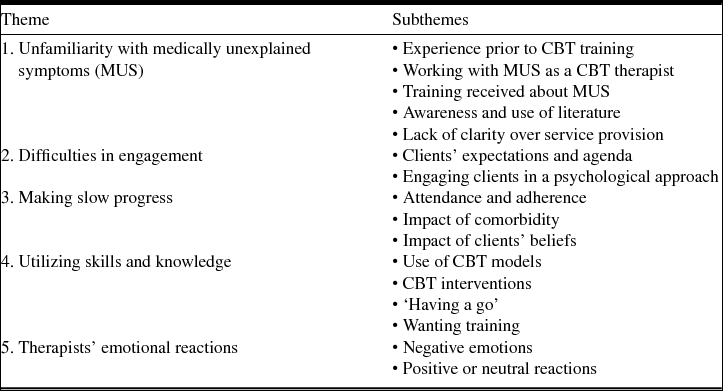
Five major themes emerged during data analysis. These themes were interconnected, and are listed in Table 1. Each of the main themes had a number of subthemes.
Themes and subthemes

1. Unfamiliarity with MUS
Most therapists described feeling somewhat unfamiliar with MUS as a presenting problem for therapy. This was in comparison to common mental health problems, such as depression or anxiety, and could lead to some uncertainty:
Am I doing the right thing here? Are you doing, you know, is there something I'm missing here? Because of my lack of experience or lack of knowledge about this problem area.
The participants had mixed experiences, prior to CBT training. Four participants identified they had some level of training in treating physical health problems (for example, two participants had trained in general nursing), which helped them to work with clients with MUS.
Participants had varied amounts of experience in working with MUS as a CBT therapist. However, most stated that they had only worked with a small number of clients.
The participants had received very little training about MUS. All but one of the participants identified that MUS was not covered on their CBT training course, with the other participant unsure. Two participants had attended brief local training about chronic fatigue syndrome, but the rest had received no training at all about this client group.
The therapists’ awareness and use of literature about this client group was limited. One reason given for this was that they had not seen many clients with MUS, so there was little need. However, those participants who had searched for literature identified that it had not been easy to find information that was helpful:
It seems all quite vague and woolly . . . I just didn't find the research very useful at all, it just kind of said ‘we tried this and it worked’. But they didn't give you a protocol; it didn't break it down what they actually did.
Participants described a lack of clarity about service provision for these clients, and that this may have influenced referral rates.
2. Difficulties in engagement
Some therapists had concerns about the client's expectations and agenda for coming to therapy. Some therapists reported seeing clients with a different agenda to themselves:
She wasn't open to the fact that it might be able to help her achieve a better quality of life and things. She saw that she engaged in a therapy to maybe confirm some of her beliefs about what was happening.
However, therapists identified that this is not always the case, and that clients with MUS can sometimes be motivated to engage in therapy:
Usually people have had quite a lot of contact with medical services and found it to be really unhelpful. So they're pretty much willing to try anything by that point.
All but one participant talked about their experiences of then attempting to engage clients in a psychological approach. Engagement could be difficult if the clients had strong ideas about what was causing their symptoms, and perceived their problem to be purely a physical one:
You have to convince people there is a psychological element, whereas with other client groups people are coming here explicitly for psychological therapy.
3. Making slow progress
Participants identified that some clients with MUS had difficulties with attendance and adherence to the therapy sessions. They recognized that the clients’ physical problems made it hard to get to appointments. Many therapists noted the impact of comorbidity on therapy:
You have more to work with, so it just takes longer, because maybe you're not only challenging the meaning about the mental health symptoms, like the anxiety, you're challenging the meanings about the physical problem as well.
It was also evident for some therapists that this comorbidity had an impact on how the therapist then felt about therapy:
It just felt a bit much, all of it really.
Many participants also recognized the impact of clients’ beliefs on the progress of therapy. Clients could hold beliefs that increasing activity (for example) was not possible, or helpful for their symptoms. These beliefs could prove difficult:
You can discuss with GPs, and they can say ‘there's no reason why they can't do that’ [engage in activity] but the person is convinced that they can't, then it's really hard getting that middle ground.
However, it was also the strength of these beliefs that these participants commented upon. Some described clients’ beliefs as ‘fixed’ and ‘entrenched’.
4. Utilizing skills and knowledge
The participants did not use any models specifically designed for MUS. Instead, they used other models that they judged might be helpful. For example, one therapist used a social phobia model to address a client's comorbid social anxiety. None of the therapists described knowledge of a model specifically designed for MUS:
CBT models for unexplained symptoms? I have absolutely no knowledge of that whatsoever . . . I am still struggling to be perfectly honest to consolidate all the stuff we had to learn in an incredibly short space of time.
The main CBT interventions described were behavioural ones. The therapists recognized that often it might be helpful if the clients could increase their activity levels. When carrying out these interventions, some participants identified that they were ‘having a go’ when it came to clients with MUS, rather than feeling very sure of their approach:
I feel generally OK about having a go. . . but I don't feel like I'm trying to work in a systematic way, it starts to feel a bit ad hoc, that feels quite uncomfortable
When asked if they wanted training, all participants agreed they wanted this. They wanted to learn more about the conditions and symptoms that come under the umbrella of MUS. Several participants identified that they would like to know about specific CBT models for MUS, particularly treatment protocols.
Several participants identified that training alone would not be enough to facilitate effective treatment for people with MUS in primary mental healthcare and that more would be needed, such as specialist supervision:
A combination of some kind of initial theory and training, followed by some supervision, yeah. Which would be specialist supervision . . . it's probably more about supervision. For me, than getting a load of knowledge.
5. Therapists’ emotional reactions
Many of the emotional reactions described were in response to the themes noted above, particularly unfamiliarity with MUS, and the rate of progress:
It's more difficult if you don't know what you are doing with people. A bit of anxiety, thinking ‘oh, am I doing the right thing’. More self-doubts.
it can sometimes feel like walking in quicksand . . . impatience that things don't move as quickly as I'd like.
Feelings of pessimism were described by a number of participants. Two therapists described this as ‘heart sink’:
When you get the information [referral] your heart sinks a bit [laughs] . . . you feel a bit ‘oh dear’ if someone comes through with those sorts of conditions.
It is important to note that not all reactions to this client group were negative. Some were positive or neutral reactions:
It can be difficult, but ultimately as well it can be really rewarding . . . There can be that moment, you know the light bulb moment, where people kind of realize ‘actually this isn't as bad as I was making it, or how it has to be’.
Discussion
Unfamiliarity with MUS was a key theme in this study. None of the therapists could clearly recall MUS being covered on their training courses, again reflecting the scope of IAPT at the time they were trained (mostly around 2009). Some participants had tried to seek out more literature on CBT for MUS, but none described finding this easy. The therapists’ experience in this area echoes Tazaki & Landlaw's (Reference Tazaki and Landlaw2006) assertion that it would be difficult for clinicians to apply the existing research in practice.
The majority of the therapists interviewed had not treated many people with MUS as they had not received many referrals for people with these types of problem. However, MUS is very common in primary-care practice (Khan et al. Reference Khan, Khan, Harezlak, Tu and Kroenke2003). Although IAPT guidelines state that MUS could be treated by IAPT services (IAPT, 2008), this does not appear to have led to many referrals to these therapists. This low referral rate for clients with MUS possibly reflects the initial scope of IAPT, which was to treat common anxiety and mood disorders. Recent developments to extend the scope of IAPT are in the initial stages. There are currently 15 long-term conditions/MUS ‘pathfinder’ sites, tasked with identifying stepped care pathways and core therapy competencies (University of Surrey, 2013). However, no pilot work has begun in this locality.
Some participants had positive experiences of engaging these clients in therapy. However, many identified that engagement could be difficult, particularly in relation to the client's expectations of therapy and beliefs about their symptoms. Many participants identified that the process of engagement was particularly important for this group, and this is in agreement with existing literature (Brown, Reference Brown and Tarrier2006; Kent & Macmillan, Reference Kent and Macmillan2009). These authors suggest spending extra time on engagement is crucial. While many of the therapists in this study described that they needed to focus strongly on engagement, they did not identify spending more time on it. These therapists are working in services where there is often a limit on the number of sessions, and it is possible that this may have had an influence.
The therapists described a number of behavioural interventions, including grading and pacing of activities, and reducing safety behaviours. Some therapists did also include cognitive techniques (mainly tackling beliefs about symptoms). Key authors in this field recommend that cognitive restructuring be part of CBT treatment (Brown, Reference Brown and Tarrier2006; Tazaki & Landlaw, Reference Tazaki and Landlaw2006; Woolfolk & Allen, Reference Woolfolk and Allen2007). A number of the therapists did mention they had used some behavioural experiments. They did not always explicitly state the purpose of the experiments, but they could have tested beliefs about symptoms. However, overall, most therapists did not explicitly describe that cognitive restructuring played a big part in therapy. It is possible that as they had described the clients as having entrenched beliefs, they were not sure if cognitive restructuring was achievable. Taking a different approach, two therapists mentioned the use of mindfulness techniques with this client group. This is an area of practice that has received increased research attention recently with this client group (e.g. Fjorback et al. Reference Fjorback, Arendt, Ornbol, Walach, Rehfeld, Schroder and Fink2013).
Participants did not discuss the use of psychoeducation (as advocated by Brown, Reference Brown and Tarrier2006; Woolfolk & Allen, Reference Woolfolk and Allen2007). Psychoeducation can be aimed at increasing clients’ awareness of the physiological consequences of stress, and the physiological impact of inactivity. If the participants are not well-versed in this physiology, such psychoeducation could be difficult. Some participants highlighted that some clients they had seen with MUS were well-versed in theories and ideas about their symptoms. This experience is also highlighted in the literature; that clients can provide ‘highly elaborate medical-sounding explanations for their symptoms that may or may not be accurate’ (Woolfolk & Allen, Reference Woolfolk and Allen2007). The participants identified that these clients presented for CBT having failed to receive answers or explanations for their symptoms elsewhere, so it would be useful to establish whether a well-informed therapist helps engagement with this group.
The therapists’ reactions to the client group had only a few similarities to those examined in other professional groups. For example, two participants described a feeling of ‘heart sink’ in relation to these clients. Professionals have used this term in the past to describe this client group – ‘heart-sink patients’ (Wileman et al. Reference Wileman, May and Chew-Graham2002). However, the therapists who used this term were purely referring to their own reaction to some of these clients, and not using it as a label – in fact they seemed unaware of this term having being used as a label. Despite some difficulties at times in engagement, none of the therapists labelled the clients’ behaviour in a negative way. For example, there was no labelling of the clients as difficult or irritable (as in Pridmore et al. Reference Pridmore, Skerritt and Ahmadi2004), or as manipulative (as in Ahern et al. Reference Ahern, Stone and Sharpe2009).
All therapists stated they would be interested in receiving training about working with the client group; particularly about specific treatment interventions for MUS, and treatment protocols. Seven of the eight participants were trained via the IAPT programme, and would have received training in a number of evidence-based protocols for depression and anxiety. It is understandable that they would then wish to approach treating MUS in the same way. Unfortunately, as already highlighted, the evidence base of CBT for MUS is not as advanced as for depression and anxiety. If training about MUS was offered to primary-care therapists, it may therefore not match their experiences of training for other conditions, or meet their expectations.
This study has a number of limitations. The small number of participants limits the transferability of the findings. The sample was taken from one city, where a large Liaison Psychiatry service operates. The presence of this service may have influenced referrals for people with MUS to the primary mental healthcare team, and therefore contributed to the therapists’ unfamiliarity with MUS. Therapists working in primary care with partner organizations were not included in the study.
The use of face-face interviews, while overall considered preferable for this study, may have impacted on the participants’ openness. The therapists were being asked to discuss their competence with another CBT therapist, and it is possible that they did not feel able to do so. The therapists did not express negative attitudes towards people with MUS, but it is possible that they chose not to do so in the interview for similar reasons. Qualitative studies are particularly open to researcher bias (Silverman, Reference Silverman2005) and therefore robust procedures were used to limit this. These procedures included a review of the themes by an independent researcher, the use of research supervision and the checking of themes with members. However, it is possible that all bias has not been eliminated.
Summary of main points
This study aimed to explore primary-care therapists’ perceived competence in treating people with MUS. The therapists described mixed perceptions of competence. A significant factor in therapists’ perceived competence appeared to be unfamiliarity with MUS. The therapists were not as familiar with MUS as they were with common mental health problems.
Participants identified some difficulties in treatment, but most did not see this group as being more complex to treat. Most participants described using more general CBT skills to treat this group, rather than MUS-specific models and approaches. All participants were keen to have training in MUS, recommending this included education about MUS, key interventions and treatment protocols.
Acknowledgements
The author thanks Lai Chan, and the Leeds Liaison Psychiatry Department for their assistance with this project.
Declaration of Interest
None.
(1) To understand the issues experienced by primary-care CBT therapists when treating clients with MUS, including engagement, unfamiliarity with MUS and lack of knowledge of specific CBT treatments.
(2) To recognize how these issues compare with the existing literature and recommendations for treating MUS.
(3) To increase awareness of these therapists’ training needs regarding treating MUS.



Comments
No Comments have been published for this article.