



1 Introduction and summary
It is standard knowledge that a category
 $\mathcal {M}$
in which we would like to define the notion of an associative algebra A should be monoidal. Once we have a monoidal product
 $\otimes $
on
 $\mathcal {M}$
with monoidal unit
 $I\in \mathcal {M}$
, we can define an associative algebra as an object
 $A\in \mathcal {M}$
equipped with a morphism
 $\mu : A \otimes A \longrightarrow A$
called multiplication and a morphism
 $\eta : I \longrightarrow A$
called unit satisfying associativity and unitality conditions with respect to the monoidal structure of
 $\mathcal {M}$
; more precisely, the associators and unitors of
 $\otimes $
tell us how to define associativity and unitality, respectively, in this context. A monoidal category is nothing else but an associative algebra in the symmetric monoidal
 $(2,1)$
-category
 $\mathsf {Cat}$
of categories, where it is crucial that an associative algebra in
 $\mathsf {Cat}$
is understood up to coherent homotopy. As a consequence, an algebra A in
 $\mathcal {M}$
can be seen as a nested structure: A is an associative algebra inside an associative algebra
 $\mathcal {M}$
, but these two algebras live on different categorical levels. This is by no means an accident, but rather an instance of a profound principle of categorical algebra, the Baez–Dolan microcosm principle [Reference Baez and DolanBD98, Section 4.3] that says that an algebraic object A of a certain flavor can be defined in a category
 $\mathcal {M}$
that carries the same algebraic structure, but one categorical level higher. In other words,
 $\mathcal {M}$
is equipped with a categorified version of the same algebraic structure. One calls A the microcosm and
 $\mathcal {M}$
the macrocosm. An algebraic object “of a certain flavor” refers in the context of [Reference Baez and DolanBD98] to an algebraic structure that can be described by an operad, an algebraic gadget describing structures featuring operations with multiple inputs and one output. The above-mentioned notion of an algebra in a monoidal category is then obtained by applying the microcosm principle to the associative operad
 $\mathsf {As}$
: An associative algebra A in a monoidal category
 $\mathcal {M}$
is an
 $\mathsf {As}$
-algebra inside a homotopy coherent
 $\mathsf {As}$
-algebra in
 $\mathsf {Cat}$
.
Getzler and Kapranov introduced two important types of operads with extra structure, namely, cyclic operads [Reference Getzler, Kapranov, Bott and YauGK95], which allow us to cyclically permute the inputs with the output, and modular operads [Reference Getzler and KapranovGK98], which come additionally with a self-composition of operations. A dense but self-contained introduction to cyclic and modular operads that needs basically no prior knowledge of ordinary operads is included in Section 2. In this article, we extend the microcosm principle to cyclic and modular operads and derive, as the main result (Theorem 6.1), a relation between the cyclic and the modular microcosm principle that has far-reaching applications in quantum algebra and quantum topology.
In more detail, we take as a starting point the notion of a cyclic or modular operad in a symmetric monoidal bicategory
 $\mathcal {S}$
, where these notions are always understood up to coherent homotopy. This notion comes out of Costello’s definition of cyclic and modular operads [Reference CostelloCos04] using graph categories; in [Reference Müller and WoikeMW23a], this is adapted to the bicategorical case. Relative to this framework, the cyclic and modular microcosm principle is set up (Section 5): Let
 $\mathcal {O}$
be a category-valued cyclic or modular operad and
 $\mathcal {A}$
a cyclic or modular
 $\mathcal {O}$
-algebra inside a symmetric monoidal bicategory
 $\mathcal {S}$
; as usual, everything is defined up to coherent homotopy. For specificity, let us think of
 $\mathcal {S}$
as a symmetric monoidal bicategory of (finite) linear categories and left exact functors with the Deligne product
 $\boxtimes $
as in [Reference Etingof and OstrikEO04, Reference Etingof, Gelaki, Nikshych and OstrikEGNO15] (see [Reference Fuchs, Schaumann and SchweigertFSS20, Section 2] for an condensed introduction. The data of a cyclic or modular
 $\mathcal {O}$
-algebra on
 $\mathcal {A}$
includes a non-degenerate symmetric pairing
 $\kappa : \mathcal {A}\boxtimes \mathcal {A}\longrightarrow I$
. We now consider a self-dual object X in
 $\mathcal {A}$
, i.e., an object in
 $\mathcal {A}$
equipped with a non-degenerate symmetric pairing with respect to the pairing of
 $\mathcal {A}$
(Definition 4.5). Then, by inserting X into the algebra
 $\mathcal {A}$
we obtain a flat vector bundle
 $\mathbb {V}_X^{\mathcal {A}}$
over a moduli space of the operations of
 $\mathcal {O}$
(the detailed statement is Proposition 4.7). More precisely, for any operation o of total arity n, the algebra
 $\mathcal {A}$
gives us a left exact functor
 $\mathcal {A}_o: \mathcal {A}^{\boxtimes n}\longrightarrow \mathsf {vect}$
to the category
 $\mathsf {vect}$
of finite-dimensional vector spaces over k. The fiber of the flat vector bundle
 $\mathbb {V}_X^{\mathcal {A}}$
over o is the vector space
 $\mathcal {A}_o(X,\dots ,X)$
, where X is inserted into all n slots of
 $\mathcal {A}_o$
. A cyclic or modular
 $\mathcal {O}$
-algebra structure on X inside
 $\mathcal {A}$
is defined as a parallel section
 $\xi $
of this flat vector bundle; it consists, therefore, of vectors
 $$ \begin{align} \xi_o \in \mathcal{A}_o(X,\dots,X)\quad \text{for all operations } o. \end{align} $$
Setting up this framework is tedious, but straightforward.
We then put the cyclic microcosm principle to the test: Cyclic associative algebras in the symmetric monoidal bicategory
 $\mathsf {Lex}^{\mathsf {f}}$
of finite categories in the sense of [Reference Etingof and OstrikEO04, Reference Etingof, Gelaki, Nikshych and OstrikEGNO15], left exact functors and linear natural transformations are thanks to [Reference Müller and WoikeMW23a, Theorem 4.12] equivalent to pivotal Grothendieck–Verdier categories in
 $\mathsf {Lex}^{\mathsf {f}}$
as defined by Boyarchenko–Drinfeld in [Reference Boyarchenko and DrinfeldBD13]. These are monoidal categories
 $\mathcal {A}$
with a weak, not necessarily rigid type of duality
 $D:\mathcal {A}\longrightarrow \mathcal {A}^{\mathrm {op}}$
, the Grothendieck–Verdier duality, whose square comes with a monoidal trivialization to the identity. We give the full definition in Section 7, but already mention here that, if the Grothendieck–Verdier duality is rigid and if the category has a simple monoidal unit, one obtains exactly the pivotal finite tensor categories in the sense of [Reference Etingof and OstrikEO04, Reference Etingof, Gelaki, Nikshych and OstrikEGNO15]. By calculating the cyclic associative algebras inside such a
 $\mathsf {Lex}^{\mathsf {f}}$
-valued cyclic associative algebra, we find – as we should! – an algebraic structure that in the rigid case specializes to the notion of a symmetric Frobenius algebra(see, e.g., [Reference Fuchs and StignerFS08]), and that, beyond the rigid case, recovers the recently introduced notion of a symmetric Frobenius algebra in a pivotal Grothendieck–Verdier category from [Reference Fuchs, Schaumann, Schweigert and WoodFSSW24, Section 4.2], see Example 7.5 for sources of symmetric Frobenius algebras.
From a categorical and operadic point of view, it is certainly satisfying to prove what the notion of symmetric Frobenius algebra – according to the microcosm principle – needs to be, and it is worth noting that, even in the rigid case, it requires seeing the rigid duality as a Grothendieck–Verdier duality. Nonetheless, one could argue that one can just guess the notion by making a reasonable ansatz that one then just turns into a definition. Hence, the main question is what one gains from the proof that this notion of symmetric Frobenius algebra inside a pivotal Grothendieck–Verdier category is compliant with the cyclic microcosm principle. Indeed, this article focuses on the algebro-topological ramifications of the interplay between the cyclic and the modular microcosm principle: Costello [Reference CostelloCos04] defines for a
 $\mathsf {Cat}$
-valued cyclic operad
 $\mathcal {O}$
a modular operad
 $\mathsf {U}_{\!\!\tiny \int } \mathcal {O}$
by freely completing
 $\mathcal {O}$
to a modular operad in a homotopy coherent way. The construction is adapted to the bicategorical situation in [Reference Müller and WoikeMW23a, Section 7.1]. The operad
 $\mathsf {U}_{\!\!\tiny \int } \mathcal {O}$
is called the modular envelope of
 $\mathcal {O}$
. By taking the nerve B, geometric realization
 $|-|$
and fundamental groupoid
 , we obtain a
 $\mathsf {Grpd}$
-valued operad
 (the operad obtained by localizing
 $\mathsf {U}_{\!\!\tiny \int } \mathcal {O}$
at all morphisms). A cyclic
 $\mathcal {O}$
-algebra in a symmetric monoidal bicategory
 $\mathcal {S}$
extends uniquely to a modular
 -algebra in
 $\mathcal {S}$
that we call the modular extension
 $\widehat {\mathcal {A}}$
of
 $\mathcal {A}$
(see [Reference Müller and WoikeMW23a, Proposition 7.1] and [Reference Müller and WoikeMW24b, Theorem 4.2]). Section 6 gives a concise summary of these previous results. Let us now state the central result relating the cyclic and the modular version of the microcosm principle.
Theorem 6.1 (Microcosmic version of modular extension)
For a
 $\mathsf {Cat}$
-valued cyclic operad
 $\mathcal {O}$
and a cyclic
 $\mathcal {O}$
-algebra
 $\mathcal {A}$
in a symmetric monoidal bicategory
 $\mathcal {S}$
, there is a canonical pair of inverse equivalences

between cyclic
 $\mathcal {O}$
-algebras in
 $\mathcal {A}$
and modular
 -algebras in the modular extension
 $\widehat {\mathcal {A}}$
.
The proof of this result is given in Section 6, once the framework for two layers of cyclic and modular algebras is set up correctly, with the suitable notion of non-degenerate symmetric pairing relative to a higher categorical non-degenerate symmetric pairing. The main contribution of this article is to derive results from several special cases of Theorem 6.1 relevant in quantum topology. These are cases in which all of the quantities appearing in the result can actually be calculated. More precisely, Theorem 6.1 will be used for concrete applications in the following way:
-
• Choose for
 $\mathcal {O}$
a cyclic operad relevant in quantum algebra or topology, such as the associative operad or the framed
$E_2$
-operad. These operads are “small” in the sense that we have well-known small presentations in terms of generators and relations. The inclusion of the cyclic structure into this presentation is a little more subtle, but doable using [Reference Müller and WoikeMW23a, Section 3]. This will then allow us to describe
$\mathsf {CycAlg}(\mathcal {O};\mathcal {A})$
explicitly through short lists of generating algebraic operations and their relations.
-
• Calculate (or rather: look up)
. For the above-mentioned examples of
$\mathcal {O}$
, this will produce an interesting operad whose modular algebras are hard to calculate directly. We then use Theorem 6.1 to describe via
$\mathsf {CycAlg}(\mathcal {O};\mathcal {A})$
.



 . For the above-mentioned examples of

 via

Correlators for open conformal field theories via “integration” of Frobenius algebras over surfaces. Theorem 6.1 can be used to classify correlators for open conformal field theories in purely algebraic terms. Since this article is mostly written from the perspective of algebra and topology, the mathematical physics background will just serve as an extremely important motivation, but no knowledge of conformal field theory (other than the very little background given in the text) will be needed. A modern introduction to the notion of a correlator in conformal field theory is [Reference Fuchs, Runkel and SchweigertFRS10, Section 4.2] or the recent encyclopedia entry [Reference Fuchs, Schweigert, Wood, Yang, Szabo and BojowaldFSWY25]. For an open conformal field theory, the monodromy data is described by a modular algebra over the open surface operad
 $\mathsf {O}$
(built from compact oriented surfaces with at least one boundary component per connected component and a collection of boundary intervals embedded in their boundary, see Section 8); in the context of this article, it takes values in
 $\mathsf {Lex}^{\mathsf {f}}$
. A modular
 $\mathsf {O}$
-algebra is called a categorified open topological field theory in [Reference Müller and WoikeMW24a]. This is the open version of what is known as a modular functor [Reference SegalSeg88, Reference Moore and SeibergMS89, Reference TuraevTur94, Reference TillmannTil98, Reference Bakalov and KirillovBK01] and describes for us the monodromy data of an open conformal field theory, see in addition the texts [Reference LazaroiuLaz01, Reference Moore and SegalMS06, Reference Lauda and PfeifferLP08] on open(-closed) field theory. The reader should be warned that not all definitions of modular functors that abound in the literature agree. In this text, an open modular functor is by definition a modular algebra over the open surface operad following [Reference Müller and WoikeMW24a]; it thereby fits into the framework set up for modular functors in [Reference Brochier and WoikeBW22] and open-closed modular functors in [Reference Müller, Schweigert, Woike and YangMSWY23]. In more detail, an open modular functor
 $\mathfrak {B}$
assigns to a surface
 with n intervals embedded in its boundary labeled with objects
 $X_1,\dots ,X_n$
in the underlying category
 $\mathcal {A}\in \mathsf {Lex}^{\mathsf {f}}$
of the modular algebra a vector space
 , called space of conformal blocks, carrying a representation of the mapping class group
 of
 ; schematically:

Here, the parametrized boundary intervals are printed in blue. Some boundary components may have no parametrized boundary intervals; they are called free boundary circles. A consistent system of correlators for the open modular functor is a modular
 $\mathsf {O}$
-algebra with coefficients in
 $\mathfrak {B}$
. In other words, we use the modular microcosm principle for the definition. With the description (1.1) as a parallel section, this means that such a system of correlators amounts to a self-dual object
 $F\in \mathcal {A}$
and vectors

in the spaces of conformal blocks  for the boundary label F (also called boundary field) that are fixed by the mapping class group action and compatible with the gluing along boundary intervals (one then says that they solve the sewing constraints).
It should be made clear that this does not change or re-invent existing notions of correlators: This definition is in line with the definitions e.g. in [Reference Fjelstad, Fuchs, Runkel and SchweigertFFRS08, Reference Fuchs and SchweigertFS17], even though we restrict to the open case here and allow more general monodromy data. In the rigid case, the fact that the Frobenius structures describing correlators should be interpreted as a shadow of the duality on
 $\mathcal {A}$
under the microcosm principle is briefly commented on in [Reference Fuchs, Schweigert, Jurčo, Sämann, Schreiber and WolfFS19, Section 4.2].
Equipped with the full description (1.2) of correlators through the microcosm principle using the language of cyclic and modular operads at two categorical levels, we can now profit from this new approach. This will be achieved by using the available description of open conformal field theories through [Reference Müller and WoikeMW24a] that builds on the results of [Reference GiansiracusaGia11] that in turn rely on the ribbon graph description for moduli spaces of surfaces [Reference HarerHar86, Reference PennerPen87, Reference KontsevichKon92, Reference Kontsevich, Joseph, Mignot, Murat, Prum and RentschlerKon94, Reference CostelloCos04, Reference CostelloCos07a, Reference CostelloCos07b] (see also [Reference Wahl and WesterlandWW16, Reference Egas Santander and KuperESK24]). More precisely, we apply Theorem 6.1 to the associative operad and a cyclic associative algebra in
 $\mathsf {Lex}^{\mathsf {f}}$
, i.e., a pivotal Grothendieck–Verdier category
 $\mathcal {A}$
. We denote its modular extension to the modular operad
 by
 $\mathcal {A}_{\text { !}}$
(we do not use the notation
 $\widehat {\mathcal {A}}$
because we reserve it for the modular extension of ribbon Grothendieck–Verdier categories and want to avoid confusion). The modular operad
 is equivalent [Reference GiansiracusaGia11, Reference Müller and WoikeMW24a], to the groupoid-valued modular open surface operad
 $\mathsf {O}$
. Therefore,
 $\mathcal {A}_{\text { !}}$
is an open modular functor, and all open modular functors are of this form [Reference Müller and WoikeMW24a].
Theorem 6.1 tells us that any cyclic associative algebra F in
 $\mathcal {A}$
(which, as we had seen, is a symmetric Frobenius algebra) extends to a modular algebra
 $F_{\text { !}}$
over the open surface operad inside
 $\mathcal {A}_{\text { !}}$
. Therefore, it gives us a consistent system of correlators for the open conformal field theory with monodromy data
 $\mathcal {A}$
, and all such systems are of this form. The precise statement is the following.
Theorem 8.3 (Classification of open correlators)
Given an open modular functor
 $\mathfrak {B}$
in
 $\mathsf {Lex}^{\mathsf {f}}$
, let
 $\mathcal {A}$
be the pivotal Grothendieck–Verdier category obtained by evaluation of
 $\mathfrak {B}$
on disks with intervals embedded in its boundary. Then, the consistent systems of open correlators for
 $\mathfrak {B}$
are exactly symmetric Frobenius algebras in
 $\mathcal {A}$
. More explicitly, the open correlator
 $\xi ^F$
associated with a symmetric Frobenius algebra F in
 $\mathcal {A}$
amounts to vectors
 in the spaces of conformal blocks associated with surfaces
 with F appearing n times as the boundary label. These vectors are mapping class group invariant and solve the constraints for sewing along intervals.
In the rigid and semisimple case, the classification of consistent systems of correlators through different flavors of Frobenius algebras in the tensor categories describing the monodromy data is developed in detail in the works [Reference Fuchs, Runkel and SchweigertFRS02, Reference Fuchs, Runkel and SchweigertFRS04a, Reference Fuchs, Runkel and SchweigertFRS04b, Reference Fuchs, Runkel and SchweigertFRS05, Reference Fjelstad, Fuchs, Runkel and SchweigertFFRS06a]. More precisely, the correlators for an open-closed conformal field theory whose monodromy data is described by a modular fusion category are produced via the three-dimensional Reshetikhin–Turaev topological field theory [Reference Reshetikhin and TuraevRT90, Reference Reshetikhin and TuraevRT91, Reference TuraevTur94]. The fact that one may obtain from a consistent system of open correlators a symmetric Frobenius algebra (one direction of Theorem 8.3) can be deduced from the results in [Reference Fjelstad, Fuchs, Runkel and SchweigertFFRS08] if
 $\mathcal {A}$
is a pivotal fusion category. Some considerations in the non-semisimple rigid case are made in [Reference Fuchs and SchweigertFS21]. The converse and the extension beyond the semisimple case in full generality seems to be new. In Section 9, we spell out the construction explicitly and discuss briefly the Hopf-algebraic special case. It should also be noted that Theorem 8.3 generalizes, albeit implicitly, the open part of the string-net construction of correlators for rational conformal field theories [Reference Fuchs, Schweigert and YangFSY22] beyond the rational case (Remark 9.2).
Ansular correlators. In Section 10, we apply the cyclic and the modular microcosm principle to the cyclic framed
 $E_2$
-operad (the cyclic operad of oriented genus zero surfaces). By [Reference Müller and WoikeMW23a, Theorem 5.13] cyclic framed
 $E_2$
-algebras in
 $\mathsf {Lex}^{\mathsf {f}}$
are ribbon Grothendieck–Verdier categories in
 $\mathsf {Lex}^{\mathsf {f}}$
in the sense of [Reference Boyarchenko and DrinfeldBD13], i.e., braided monoidal categories
 $(\mathcal {A},\otimes ,c)$
in
 $\mathsf {Lex}^{\mathsf {f}}$
with a natural automorphism
 $\theta _X : X \longrightarrow X$
, called balancing, satisfying
 $\theta _I=\mathrm {id}_I$
,
 $\theta _{X\otimes Y}=c_{Y,X}c_{X,Y}(\theta _X\otimes \theta _Y),$
and
 $D\theta _X = \theta _{DX}$
for all
 $X,Y\in \mathcal {A}$
. Cyclic framed
 $E_2$
-algebras in a ribbon Grothendieck–Verdier category are symmetric Frobenius algebras in
 $\mathcal {A}$
that are also braided commutative (Proposition 10.2, see Example 10.8 for sources of such algebraic objects). After modular extension, any ribbon Grothendieck–Verdier category
 $\mathcal {A}$
extends to a modular
 $\mathsf {Lex}^{\mathsf {f}}$
-valued algebra over the modular operad
 $\mathsf {Hbdy}$
of three-dimensional compact oriented handlebodies [Reference Müller and WoikeMW24b], a so-called ansular functor
 $\widehat {\mathcal {A}}$
that provides for us a consistent system of representations
 $\widehat {\mathcal {A}}(H;X_1,\dots ,X_n)$
of mapping class groups of handlebodies H, with labels
 $X_1,\dots ,X_n$
in
 $\mathcal {A}$
attached to disks embedded in the boundary surface of H. The mapping class groups of handlebodies are the so-called handlebody groups, see [Reference Hensel, Ji, Papadopoulos and YauHen20] for an introduction. The vector spaces
 $\widehat {\mathcal {A}}(H;X_1,\dots ,X_n)$
are again referred to as spaces of conformal blocks for
 $\mathcal {A}$
. A modular handlebody algebra relative to an ansular functor selects invariant vectors in these representations that are compatible with gluing. In other words, this structure is a handlebody version of the concept of a correlator; for this reason, we refer to it as ansular correlator. With Theorem 6.1, these can be classified.
Theorem 10.6 (Classification of ansular correlators)
The consistent systems of ansular correlators for an ansular functor are exactly symmetric commutative Frobenius algebras
 $F\in \mathcal {A}$
in the ribbon Grothendieck–Verdier category
 $\mathcal {A}$
obtained from the ansular functor by genus zero restriction. More explicitly, the ansular correlator
 $\xi ^F$
associated to a symmetric commutative Frobenius algebra F in
 $\mathcal {A}$
amounts to vectors
 $\xi _H^F \in \widehat {\mathcal {A}}(H;F,\dots ,F)$
in the spaces of conformal blocks associated to handlebodies H that are handlebody group invariant and solve the constraints for sewing along disks embedded in the boundary surface of the handlebodies.
Since ansular correlators are exactly genus zero correlators (Remark 10.7), one may read Theorem 10.6 as a correspondence between full genus zero two-dimensional conformal field theory and a three-dimensional version of skein theory. We expand on this viewpoint in Remark 10.14.
Let us turn to the rigid case and suppose that the ribbon Grothendieck–Verdier category
 $\mathcal {A}$
is actually a finite ribbon category, i.e., in particular rigid. Then, symmetric commutative Frobenius algebras in
 $\mathcal {A}$
are exactly the consistent systems of genus zero correlators from [Reference Fuchs and SchweigertFS17, Proposition 4.7]. Theorem 10.6 tells us that these genus zero correlators extend uniquely to handlebodies and, therefore, have a substantially larger symmetry group. The application to the monoidal unit as symmetric commutative algebra in a ribbon category yields.
Corollary 10.11 Let
 $\mathcal {A}$
be a finite ribbon category. Then, the spaces of conformal blocks
 $\widehat {\mathcal {A}}(H)$
of the ansular functor for
 $\mathcal {A}$
evaluated on handlebodies H without embedded disks come with a distinguished
 $\mathsf {Map}(H)$
-invariant non-zero vector
 $\xi _H \in \widehat {\mathcal {A}}(H)$
.
The vectors
 $\xi _H$
can be seen as a non-semisimple analog of the empty skein (Remark 10.12). Phrased geometrically, Corollary 10.11 says that the flat vector bundle
 $H \longmapsto {\mathcal {A}}(H)$
over the moduli space of handlebodies has a trivial line bundle that sits canonically inside.
In the case that the ribbon category is unimodular, i.e., its distinguished invertible object [Reference Etingof, Nikshych and OstrikENO04]
 $\alpha \in \mathcal {A}$
controlling the quadruple dual via
 $-^{\vee \vee \vee \vee }\cong \alpha \otimes - \otimes \alpha ^{-1}$
is isomorphic to the monoidal unit, we prove the following result.
Theorem 11.9 Let
 $\mathcal {A}$
be a unimodular finite ribbon category. If
 $\mathcal {A}\neq \mathsf {vect}$
and H is a handlebody without embedded disks and genus
 $g\ge 1$
, then the
 $\mathsf {Map}(H)$
-representation
 $\widehat {\mathcal {A}}(H)$
is not irreducible.
This tells us that the handlebody group representation on spaces of conformal blocks behave fundamentally differently from the corresponding representations for mapping class group of surfaces: They are, with some exceptions in trivial cases, not irreducible, while for the quantum representations of mapping class groups of surfaces, there are criteria [Reference Andersen and FjelstadAF10] for the irreducibility. Irreducible examples are known, such as those coming from modular fusion categories of Ising type [Reference Jian, Ludwig, Luo, Sun and WangJLL+20]. The proofs of Corollary 10.11 and Theorem 11.9 use multiplicative structures on spaces of conformal blocks built in Section 11 that partially extend work of Juhász [Reference JuhászJuh18, Section 5.2].
As a closing comment for this introduction, let us summarize the rationale behind Theorems 8.3 and 10.6: The study of spaces of conformal blocks belongs to the realm of chiral conformal field theory while the construction of consistent systems of correlators allows to pass to full conformal field theory (see, e.g., the overview in the introduction of [Reference Fuchs, Schweigert, Wood, Yang, Szabo and BojowaldFSWY25] for further reading). This means that Theorems 8.3 and 10.6 are instances of the following correspondence:
 $$ \begin{align}\left\{ \begin{array}{rcl} \text{macrocosm} & \longleftrightarrow &\text{chiral conformal theory of a certain flavor} \\ && \text{(open, closed, genus zero, open-closed, ansular,} \dots), \\ \text{microcosm} & \longleftrightarrow& \text{full conformal field theory of the same flavor.}\end{array}\right\} \end{align} $$
As already mentioned, some of the correspondences (1.3) are implicit in the articles [Reference Fuchs, Runkel and SchweigertFRS02, Reference Fuchs, Runkel and SchweigertFRS04a, Reference Fuchs, Runkel and SchweigertFRS04b, Reference Fuchs, Runkel and SchweigertFRS05, Reference Fjelstad, Fuchs, Runkel and SchweigertFFRS06a, Reference Fjelstad, Fuchs, Runkel and SchweigertFFRS08, Reference Fuchs and SchweigertFS17, Reference Fuchs, Schweigert, Jurčo, Sämann, Schreiber and WolfFS19], even though they are not conceptualized in the language of cyclic and modular operads. The key point of this article lies in the treatment of the macrocosmic and the microcosmic level on the same algebraic footing, meaning that they are both described by the same cyclic or modular operad, but on different categorical levels. This inevitably needs Grothendieck–Verdier dualities for the description of the cyclic structure with respect to which the Frobenius algebras need to be considered.
Structure of the article. The article is split into two parts:
-
(A) Set-up of the operadic framework for the cyclic and modular microcosm principle, without any particular emphasis on applications, except for the last section in which we discuss the cyclic associative case in detail. Readers who are interested in categorical foundations for cyclic and modular operads or Grothendieck–Verdier duality may want to read just part A as a short independent article.
-
(B) Specialization of the general results to operads relevant in quantum topology, with an eye towards applications in conformal field theory. This part depends logically on part A because of the necessary formalization of field-theoretic notions through the microcosm principle. Nonetheless, after reading the introduction, one should still be able to start just with part B. The operadic intricacies are often hidden in the proofs, so one might just take note of the results and then selectively circle back to part A for technical details.
A The operadic framework
2 Reminder on cyclic and modular operads
Operads were defined by Boardman–Vogt and May [Reference Boardman and VogtBV68, Reference MayMay72, Reference Boardman and VogtBV73] to describe algebraic structures featuring operations with multiple inputs and one output. For an operad
 $\mathcal {O}$
with values in a (higher) symmetric monoidal category
 $\mathcal {S}$
and
 $n\ge 0$
, we denote by
 $\mathcal {O}(n)\in \mathcal {S}$
the object of n-ary operations, i.e., operations with n inputs and one output. Through the permutation of the n inputs, the permutation group on n letters acts on
 $\mathcal {O}(n)$
. There is also an operadic composition
 $\circ _i : \mathcal {O}(n) \otimes \mathcal {O}(m) \longrightarrow \mathcal {O}(n+m-1)$
inserting an operation of arity m into the i-th slot of an n-ary operation, where
 $1\le i\le n$
, and an operadic unit in
 $\mathcal {O}(1)$
acting neutrally with respect to operadic composition. We will not discuss the compatibility of all this data and instead refer e.g., to [Reference FresseFre17, Chapters 1–3].
An operad that will be of particular relevance in this article is the operad
 $\mathsf {f}E_2$
of framed little disks whose space
 $\mathsf {f}E_2(n)$
of arity n operations is given by the space of embeddings of n two-dimensional disks into a disk that are composed of translations, rescalings, and rotations. This operad can be defined for disks of any dimension and is an example of an operad that largely motivated the invention of operads in [Reference Boardman and VogtBV68, Reference MayMay72, Reference Boardman and VogtBV73]. Each space
 $\mathsf {f}E_2(n)$
is aspherical; more precisely, it is the classifying space of the framed braid group on n strands. This implies that we may see
 $\mathsf {f}E_2$
as a groupoid-valued operad. This statement and an explicit model is discussed in [Reference WahlWah01, Reference Salvatore and WahlSW03].
The
 $\mathsf {f}E_2$
-operad is an example of a cyclic operad in the sense of Getzler and Kapranov [Reference Getzler, Kapranov, Bott and YauGK95]. This means that it comes with additional structure that allows us to permute the inputs with the output. Seen differently, this means that the distinction between inputs and the output is erased in a consistent way. The cyclic operad
 $\mathsf {f}E_2$
-operad is equivalent to the operad of oriented genus zero surfaces.
When considering surfaces of all genus, we see that another operadic structure is present, namely, a self-composition of operations that glues two boundary components of a connected surface together. This gives us on the surface operad the structure of a modular operad in the sense of [Reference Getzler and KapranovGK98]. For the surface operad, we will content ourselves throughout with its groupoid-version because we will restrict later to bicategorical algebras. The surface operad
 $\mathsf {Surf}$
has as its groupoid
 $\mathsf {Surf}(n)$
of arity n operations the groupoid of surfaces (in this article, these are always compact, oriented, smooth) that are connected and have
 $n+1$
parametrized boundary components, with the morphisms being isotopy classes of diffeomorphisms preserving the orientation and the boundary parametrizations. Phrased differently, morphisms are mapping classes between surfaces, see [Reference Farb and MargalitFM12] for an introduction to mapping class groups. The gluing of surfaces gives us the operadic composition.
We will now turn to a precise description of cyclic and modular operads, in the context that is needed for this article. To this end, we will use the description from [Reference CostelloCos04] based on categories of graphs. A graph is a set H of half edges, a set V of vertices, a source map
 $s : H \longrightarrow V$
sending a half edge to the vertex that it is attached to, and a
 $\mathbb {Z}_2$
-action on H sending a half edge to the half edge that it is glued to. One calls the
 $\mathbb {Z}_2$
-orbits edges. An orbit with two elements is called internal edge; an orbit with one element is called (external) leg. One defines now the category
 $\mathsf {Graphs}$
: Objects are finite disjoint unions of corollas, i.e., graphs with one vertex and a finite, possibly empty set of legs glued to it. The morphisms
 $T\longrightarrow T'$
are equivalence classes of finite graphs
 (graphs that have finitely many vertices and half edges) with an identification
 of T with the graph
 obtained by cutting open all internal edges of
 and an identification
 between
 $T'$
and the graphs constructed by contracting all internal edges of
 . Here, an identification between graphs is a bijection between the sets of half edges and vertices commuting with the source maps and the
 $\mathbb {Z}_2$
-actions. Two such triples
 and
 are considered equivalent if there is an identification
 $T\cong T'$
compatible with
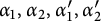 $\alpha _1,\alpha _2,\alpha _1',\alpha _2'$
. We refer to [Reference CostelloCos04] for the definition of the composition (roughly, it is given by the insertion of graphs into each other). Disjoint union gives us a symmetric monoidal structure.
Inside
 $\mathsf {Graphs}$
, there is the symmetric monoidal subcategory
 $\mathsf {Forests}$
with the same objects, but with only those morphisms coming from graphs that are forests, i.e., graphs all of whose connected components are contractible. Now a cyclic operad with values in a symmetric monoidal bicategory
 $\mathcal {S}$
is defined as a symmetric monoidal functor
 $\mathcal {O}:\mathsf {Forests} \longrightarrow \mathcal {S}$
while a modular operad with values in
 $\mathcal {S}$
is defined as a symmetric monoidal functor
 $\mathcal {O}:\mathsf {Graphs}\longrightarrow \mathcal {S}$
. Here, we understand “symmetric monoidal functor between symmetric monoidal bicategories” (
 $\mathsf {Graphs}$
is a 1-category, but can be seen as bicategory) always in the weak sense, i.e., up to coherent homotopy, see [Reference Schommer-PriesSP09, Section 2] for the appropriate framework. The details of bicategorical operads up to coherent homotopy are developed in [Reference Müller and WoikeMW23a, Section 2.1].
The connection to the more traditional description is as follows: Let
 $\mathcal {O}$
be an
 $\mathcal {S}$
-valued cyclic or modular operad and T a corolla with
 $n\ge 0$
legs. Then,
 $\mathcal {O}(T)\in \mathcal {S}$
is the object of operations of arity
 $n-1$
(which means
 $n-1$
inputs and one output; we speak in this case of total arity n). The permutation action on the n legs of T induces a homotopy coherent action of the permutation group on n letters on
 $\mathcal {O}(T)$
. Since modular operads, as opposed to cyclic ones, are defined on
 $\mathsf {Graphs}$
, we can evaluate on non-contractible morphisms; this gives us exactly the self-composition of operations.
Note that neither for cyclic nor modular operads, the distinction between inputs and outputs is made; in order to make such a choice, one would have to introduce for each corolla a preferred leg called root. This gives us the category
 $\mathsf {RForests}$
of rooted forests. A non-cyclic operad is a symmetric monoidal functor
 $\mathsf {RForests} \longrightarrow \mathcal {S}$
.
With the definition of cyclic and modular operads given so far, operadic identities (operations of total arity two behaving neutrally with respect to composition) are not yet included, but they can be defined directly [Reference Müller and WoikeMW23a, Definition 2.3], and we assume throughout the article that operads (non-cyclic, cyclic or modular) come with operadic identities.
3 Flat vector bundles over moduli spaces: a description using modular operads
For any cyclic or modular operad, we will define in this section the notion of a flat vector bundle over the “moduli space of operations of the operad”. Basically, this amounts to setting up a categorical or rather operadic version of the Riemann–Hilbert correspondence to bridge between the description of spaces of conformal blocks in [Reference Müller and WoikeMW23a, Reference Müller and WoikeMW24b, Reference Brochier and WoikeBW22], the description of correlators in [Reference Fuchs and SchweigertFS17] and the microcosm principle [Reference Baez and DolanBD95].
To this end, recall e.g., from [Reference Mac Lane and MoerdijkMLM92, Section I.5] that for a functor
 $F:\mathcal {C}\longrightarrow \mathsf {Cat}$
the Grothendieck construction is the category
 $\int F$
of pairs
 $(c,x)$
with
 $c\in \mathcal {C}$
and
 $x \in F(c)$
. A morphism
 $(c,x)\longrightarrow (c',x')$
is a pair
 $(f,\alpha )$
of a morphism
 $f:c \longrightarrow c'$
and a morphism
 $\alpha : F(f)x \longrightarrow x'$
. We will also apply the Grothendieck construction to homotopy coherent functors
 $F:\mathcal {C}\longrightarrow \mathsf {Cat}$
(here
 $\mathcal {C}$
is still a 1-category, but seen as a bicategory;
 $\mathsf {Cat}$
is seen as a bicategory). Note that, in that case, their coherence data will enter into the composition of
 $\int F$
.
Definition 3.1 Let
 $\mathcal {O}:\mathsf {Graphs} \longrightarrow \mathsf {Cat}$
be a modular operad. Denote by
 $\int \mathcal {O} \in \mathsf {Cat}$
the Grothendieck construction of the symmetric monoidal functor
 $\mathcal {O}:\mathsf {Graphs} \longrightarrow \mathsf {Cat}$
equipped with the symmetric monoidal structure induced by the symmetric monoidal structure of
 $\mathsf {Graphs}$
and
 $\mathcal {O}$
. We define an operad over
 $\mathcal {O}$
or, for short,
 $\mathcal {O}$
-operad with values in a symmetric monoidal category
 $\mathcal {K}$
as a symmetric monoidal functor
 $\int \mathcal {O}\longrightarrow \mathcal {K}$
.
This definition is made analogously for cyclic and ordinary operads instead of modular ones by replacing
 $\mathsf {Graphs}$
with
 $\mathsf {Forests}$
and
 $\mathsf {RForests}$
, respectively.
Definition 3.2 (The trivial operad over a modular operad)
For a
 $\mathsf {Cat}$
-valued modular operad
 $\mathcal {O}$
(or a cyclic or ordinary operad) and any symmetric monoidal category
 $\mathcal {K}$
, we define the trivial
 $\mathcal {O}$
-operad with values in the symmetric monoidal category
 $\mathcal {K}$
as the symmetric monoidal functor
 $$ \begin{align*} \star : \int\mathcal{O}\longrightarrow \mathcal{K} \end{align*} $$
sending a pair
 $(T,o)$
of a corolla T and an operation
 $o\in \mathcal {O}(T)$
to the monoidal unit
 $I\in \mathcal {K}$
and any morphism to the identity of I.
Formally,
 $\star $
depends on
 $\mathcal {O}$
and
 $\mathcal {K}$
, but we suppress this in the notation because it will always be clear from the context.
In the sequel, we denote by
 $\mathsf {vect}$
the symmetric monoidal category of finite-dimensional vector spaces over our fixed ground field k.
Definition 3.3 (Flat vector bundle over an operad)
For a
 $\mathsf {Cat}$
-valued modular operad
 $\mathcal {O}$
, we define a flat vector bundle over
 $\mathcal {O}$
as a
 $\mathsf {vect}$
-valued
 $\mathcal {O}$
-operad, i.e., a symmetric monoidal functor
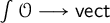 $\int \mathcal {O}\longrightarrow \mathsf {vect}$
. If all values are one-dimensional vector spaces, we call the flat vector bundle over
 $\mathcal {O}$
a flat line bundle over
 $\mathcal {O}$
. The flat line bundle
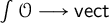 $\int \mathcal {O}\longrightarrow \mathsf {vect}$
that is the trivial
 $\mathcal {O}$
-operad
 $\star $
in the sense of Definition 3.2 will be referred to as the trivial line bundle over
 $\mathcal {O}$
and for brevity just denoted by k (the ground field k is the monoidal unit of
 $\mathsf {vect}$
).
Remark 3.4 (Vector bundles over the moduli space of surfaces or handlebodies)
Seeing
 $\mathsf {vect}$
-valued functors on groupoids (or even more generally categories), such the ones in Definition 3.3, as flat vector bundles is rather a question of perspective and also language; it is the viewpoint taken e.g., in [Reference WillertonWil08]. Let us explain, why Definition 3.3 describes really a flat vector bundle in the traditional sense over a moduli space built from the operations of
 $\mathcal {O}$
, with additional structure taking the gluing operations into account. To illustrate this, we choose for
 $\mathcal {O}$
the modular operad
 $\mathsf {Surf}$
of surfaces (see Section 2). Then, by Definition 3.1 a flat vector bundle over
 $\mathsf {Surf}$
is a symmetric monoidal functor
 $V:\int \mathsf {Surf} \longrightarrow \mathsf {vect}$
. Consider a connected surface
 of genus g with
 $n\ge 0$
boundary components. Then,
 , where
 $T_{n-1}$
is the corolla with n legs. The object
 is sent by V to a vector space
 . A mapping class
 acts by a linear automorphism of
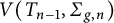 . By functoriality, this endows
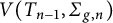 with an action of
 . The mapping class group
 is exactly the fundamental group of a suitable moduli space
 $\mathcal {M}_{g,n}$
of surfaces of genus g with n boundary components (or rather moduli stack), see, e.g., the introduction of [Reference Egas Santander and KuperESK24] for this classical fact, and also [Reference Bakalov and KirillovBK01, Chapter 6]. Therefore, it follows from the Riemann–Hilbert correspondence that the
 -action on
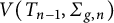 amounts precisely to a flat vector bundle on
 $\mathcal {M}_{g,n}$
with typical fiber
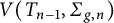 that we denote simply by
 $V_{g,n}$
. The
 $\mathsf {vect}$
-valued
 $\mathsf {Surf}$
-operad V provides such a flat vector bundle for each g and each n, but it actually comes with gluing operations as well: Let
 be an arbitrary morphism in
 $\mathsf {Graphs}$
; we can without loss of generality assume that
 $T'$
is a corolla (because V is symmetric monoidal). We decompose T into corollas via
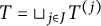 $T=\sqcup _{j\in J} T^{(j)}$
, where J is a finite set. With
 $n_j := |\mathsf {Legs}(T^{(j)})|$
, an operation in
 $\mathsf {Surf}(T)$
is a family of surfaces
 , with
 $g_j$
denoting the genus and
 $n_j$
the number of boundary components. The functor V sends T and these surfaces
 to the tensor product bundle
 $\bigotimes _{j\in J} V_{g_j,n_j}$
over
 $\prod _{j\in J} \mathcal {M}_{g_j,n_j}$
. The morphism
 prescribes an operation applied to the surface
 that glues several pairs of boundary components together or acts by permutation on the boundary parametrizations. Let us denote the result of this operation by
 (we know that this is a connected surface because
 $T'$
is a corolla; therefore, it will have some genus g and some number n of boundary components). The gluing induces a map
 $\gamma : \prod _{j\in J} \mathcal {M}_{g_j,n_j} \longrightarrow \mathcal {M}_{g,n}$
. The morphism
 in
 $\int \mathsf {Surf}$
is sent by V to a map of flat vector bundles
 $\bigotimes _{j\in J} V_{g_j,n_j}\longrightarrow \gamma ^* V_{g,n}$
over
 $\prod _{j\in J} \mathcal {M}_{g_j,n_j}$
, a gluing map (
 $\gamma ^*$
denotes the pullback along
 $\gamma $
). By the functoriality of
 $V,$
these gluing maps are compatible with the composition of gluings. The same considerations can be made for the modular handlebody operad
 $\mathsf {Hbdy}$
instead of the surface operad. More generally, for any modular operad
 $\mathcal {O}$
, this suggest that we should think of a symmetric monoidal functor
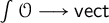 $\int \mathcal {O}\longrightarrow \mathsf {vect}$
as a flat vector bundle over the moduli space of operations of
 $\mathcal {O}$
.
4 Self-dual objects
In this section, we will use self-dual objects inside modular (and cyclic) algebras to construct flat vector bundles over modular (and cyclic) operads. This definition will need, for any symmetric monoidal bicategory
 $\mathcal {S}$
, the concept of an
 $\mathcal {S}$
-valued algebra over a cyclic or modular operad
 $\mathcal {O}$
with values in the category
 $\mathsf {Cat}$
of categories. The detailed definition is given in [Reference Müller and WoikeMW23a, Section 2.2-2.4]. We recall here the main points: For a non-cyclic operad
 $\mathcal {O}$
, an algebra structure on some object is a map from
 $\mathcal {O}$
to the endomorphism operad on that object. For cyclic or modular operads, the endomorphism operad needs to be made cyclic or modular, respectively, by means of a non-degenerate symmetric pairing on the underlying object. For an object
 $\mathcal {A} \in \mathcal {S}$
in a symmetric monoidal bicategory
 $\mathcal {S}$
, a non-degenerate symmetric pairing is a map
 $\kappa : \mathcal {A}\boxtimes \mathcal {A}\longrightarrow I$
(here
 $\boxtimes $
is the monoidal product of
 $\mathcal {S}$
, and I is the monoidal unit) that exhibits
 $\mathcal {A}$
as its own dual in the homotopy category of
 $\mathcal {S}$
(this is the non-degeneracy) and is equipped with the structure of a homotopy fixed point with respect to the
 $\mathbb {Z}_2$
-action on
 $\kappa $
via the symmetric braiding (this is the symmetry). Thanks to non-degeneracy, there exists an essentially unique map
 $\Delta : I \longrightarrow \mathcal {A}\boxtimes \mathcal {A}$
, the coevaluation map, that together with
 $\kappa $
satisfies the zigzag identities up to isomorphism. This allows us to define a symmetric monoidal functor
 $ \mathsf {End}_\kappa ^{\mathcal {A}}: \mathsf {Graphs} \longrightarrow \mathsf {Cat}$
via
 $\mathsf {End}_\kappa ^{\mathcal {A}}(T):= \mathcal {S}( \mathcal {A}^{\boxtimes \mathsf {Legs}(T)} , I)$
for any corolla T, the endomorphism operad of
 $(\mathcal {A},\kappa )$
, a
 $\mathsf {Cat}$
-valued modular operad that can be seen as cyclic operad if needed. Here,
 $\mathcal {A}^{\boxtimes \mathsf {Legs}(T)}$
is the unordered monoidal product of
 $\mathcal {A}$
with index set
 $\mathsf {Legs}(T)$
. The definition of
 $\mathsf {End}_\kappa ^{\mathcal {A}}$
on morphisms uses the coevaluation. We may now define the structure of a cyclic or modular
 $\mathcal {O}$
-algebra on
 $\mathcal {A}\in \mathcal {S}$
as the choice of a non-degenerate symmetric pairing
 $\kappa $
on
 $\mathcal {A}$
and a map
 $\mathcal {O}\longrightarrow \mathsf {End}_\kappa ^{\mathcal {A}}$
of
 $\mathsf {Cat}$
-valued cyclic or modular operads. We note that bicategorical cyclic or modular algebras over a cyclic or modular operad form a 2-groupoid [Reference Müller and WoikeMW23a, Proposition 2.18].
Our main example for the symmetric monoidal bicategory
 $\mathcal {S}$
is the symmetric monoidal bicategory
 $\mathsf {Lex}^{\mathsf {f}}$
of finite linear categories (or just finite categories) over our algebraically closed field k that we fix throughout:
-
• The objects are finite k-linear categories [Reference Etingof and OstrikEO04, Reference Etingof, Gelaki, Nikshych and OstrikEGNO15], i.e., linear abelian categories with finite-dimensional morphism spaces, finitely many isomorphism classes of simple objects, enough projective objects and finite length for every object.
-
• The 1-morphisms are left exact functors, i.e., functors preserving finite limits.
-
• The 2-morphisms are natural linear transformations.
The monoidal product of
 $\mathsf {Lex}^{\mathsf {f}}$
is the Deligne product with monoidal unit
 $\mathsf {vect}$
, the category of finite-dimensional vector spaces over our fixed algebraically closed field k.
If
 $\mathcal {O}$
is a
 $\mathsf {Cat}$
-valued modular operad, a
 $\mathsf {Lex}^{\mathsf {f}}$
-valued modular
 $\mathcal {O}$
-algebra has an underlying finite category
 $\mathcal {A} \in \mathsf {Lex}^{\mathsf {f}}$
with a non-degenerate symmetric pairing
 $\kappa : \mathcal {A}\boxtimes \mathcal {A} \longrightarrow \mathsf {vect}$
. Since
 $\kappa $
is left exact, it induces an equivalence
 $D:\mathcal {A} \longrightarrow \mathcal {A}^{\mathrm {op}}$
determined by
 $\kappa (X,Y)\cong \mathcal {A}(DX,Y)$
. The equivalence D, also referred to as duality functor, comes with an isomorphism
 $D^2 \cong \mathrm {id}_{\mathcal {A}}$
thanks to the symmetry of
 $\kappa $
. The coevaluation
 $\Delta : \mathsf {vect} \longrightarrow \mathcal {A}\boxtimes \mathcal {A}$
can be identified with an object in
 $\mathcal {A}\boxtimes \mathcal {A}$
, namely, the coend
 $\Delta = \int ^{X \in \mathcal {A}} DX \boxtimes X$
. For an introduction to coends in finite categories, we refer to [Reference Fuchs, Schaumann and SchweigertFSS20]. For each operation
 $o\in \mathcal {O}(T)$
for a corolla T, the map of modular operads from
 $\mathcal {O}$
to the endomorphism operad of
 $(\mathcal {A},\kappa )$
gives us a left exact functor
 $\mathcal {A}_o :\mathcal {A}^{\boxtimes \mathsf {Legs}(T)}\longrightarrow \mathsf {vect}$
. We will not spell out here the compatibility with gluing and instead refer to [Reference Müller and WoikeMW23a, Section 2].
We will now prepare the definition of a self-dual object. First, recall that, for a symmetric monoidal bicategory
 $\mathcal {S}$
and
 $\mathcal {A}\in \mathcal {S}$
, a (generalized) object in
 $\mathcal {A}$
is a 1-morphism
 $X:I\longrightarrow \mathcal {A}$
. A generalized object in a finite category
 $\mathcal {A}\in \mathsf {Lex}^{\mathsf {f}}$
is a left exact functor
 $X:\mathsf {vect} \longrightarrow \mathcal {A}$
. By additivity, this functor is determined by its value
 $X(k)$
on the ground field k. Therefore, it amounts to an object in
 $\mathcal {A}$
in the usual sense.
Definition 4.1 (Symmetric morphism)
Let
 $\mathcal {S}$
be a symmetric monoidal bicategory. For any object
 $\mathcal {A} \in \mathcal {S}$
, a symmetric 1-morphism
 $F: I \longrightarrow \mathcal {A}\boxtimes \mathcal {A}$
, or symmetric map for short, is a 1-morphism in
 $\mathcal {S}$
(it is, therefore, an object in
 $\mathcal {A}\boxtimes \mathcal {A}$
) equipped with the structure of a homotopy fixed point with respect to the
 $\mathbb {Z}_2$
-action on
 $\mathcal {S}(I,\mathcal {A}\boxtimes \mathcal {A})$
via the symmetric braiding of
 $\mathcal {S}$
. A morphism of symmetric 1-morphisms is a 2-morphism that is a map of homotopy fixed points.
Example 4.2 For an object
 $X:I\longrightarrow \mathcal {A}$
in
 $\mathcal {A}$
, the 1-morphism
 $X\boxtimes X : I \simeq I\boxtimes I \longrightarrow \mathcal {A}\boxtimes \mathcal {A}$
comes with the structure of a symmetric 1-morphism, and we will always equip it with this structure.
Example 4.3 It follows from [Reference Müller and WoikeMW23a, Remark 2.11] that the coevaluation object
 $\Delta :I\longrightarrow \mathcal {A}\boxtimes \mathcal {A}$
of a non-degenerate symmetric pairing
 $\kappa : \mathcal {A}\boxtimes \mathcal {A}\longrightarrow I$
on
 $\mathcal {A}$
comes with the structure of a symmetric object in
 $\mathcal {A}\boxtimes \mathcal {A}$
.
Definition 4.4 (Symmetric 2-pairing)
Let
 $\mathcal {S}$
be a symmetric monoidal bicategory. Let
 $\mathcal {A} \in \mathcal {S}$
be an object with non-degenerate symmetric pairing
 $\kappa : \mathcal {A}\boxtimes \mathcal {A} \longrightarrow I$
. A symmetric 2-pairing on an object
 $X:I \longrightarrow \mathcal {A}$
in
 $\mathcal {A}$
is a symmetric map
 $\beta : X \boxtimes X \longrightarrow \Delta $
, where
 $\Delta : I \longrightarrow \mathcal {A}\boxtimes \mathcal {A}$
is the coevaluation associated to
 $\kappa $
(the symmetry property of
 $\beta $
is with respect to the symmetric structures established on
 $X\boxtimes X$
and
 $\Delta $
in the Examples 4.2 and 4.3, respectively).
Definition 4.5 (Self-dual object)
Let
 $\mathcal {A}$
be an object in
 $\mathcal {S}$
with a non-degenerate symmetric pairing by
 $\kappa : \mathcal {A}\boxtimes \mathcal {A}\longrightarrow I$
and coevaluation
 $\Delta : I\longrightarrow \mathcal {A}\boxtimes \mathcal {A}$
. A self-dual object in
 $\mathcal {A}$
is an object
 $X:I\longrightarrow \mathcal {A}$
together with a symmetric 2-pairing
 $\beta : X\boxtimes X \longrightarrow \Delta $
that is non-degenerate in the sense that there exists a map
 $\delta : \mathrm {id}_I \longrightarrow \kappa \circ (X\boxtimes X)$
, called symmetric 2-copairing, such that
 $$ \begin{align*} X \xrightarrow{\ \delta \boxtimes X \ } \kappa (X\boxtimes X) \boxtimes X \xrightarrow{\ X \boxtimes \beta \ } (\kappa \boxtimes \mathrm{id}) (X \boxtimes \Delta) \cong X \end{align*} $$
and
 $$ \begin{align*} X \xrightarrow{\ X \boxtimes \delta \ } X \boxtimes \kappa (X \boxtimes X) \xrightarrow{\ \beta \boxtimes X \ } (\mathrm{id}\boxtimes \kappa) (\Delta \boxtimes X) \cong X \end{align*} $$
are the identity of X.
Remark 4.6 If a symmetric 2-pairing is non-degenerate, then the 2-copairing, whose existence is required in the above definition, is unique. One could have equivalently dualized the definition: Then, the symmetric 2-copairing would be structure and subject to the non-degeneracy condition that an associated symmetric 2-pairing satisfying the above equations exists. This symmetric 2-pairing is then unique.
The main result of this section is that self-dual objects produce flat vector bundles.
Proposition 4.7 Let
 $\mathcal {O}$
be a category-valued modular operad and
 $\mathcal {A}$
a modular
 $\mathcal {O}$
-algebra in a symmetric monoidal bicategory
 $\mathcal {S}$
. Moreover, let
 $X:I\longrightarrow \mathcal {A}$
be a self-dual object and
 $\beta : X \boxtimes X \longrightarrow \Delta $
its symmetric 2-pairing, where
 $\Delta $
is the coevaluation object for
 $\mathcal {A}$
. Then,
 $$ \begin{align} \mathbb{V}_X^{\mathcal{A}} : \int \mathcal{O} \longrightarrow \mathcal{S}(I,I) \ , \quad (T,o) \longmapsto \mathcal{A}_o\circ X^{\boxtimes \mathsf{Legs}(T)} \quad \text{for a corolla}\ T \end{align} $$
is a symmetric monoidal functor, i.e., an
 $\mathcal {O}$
-operad with values in
 $\mathcal {S}(I,I)$
.
If
 $\mathcal {S}=\mathsf {Lex}^{\mathsf {f}}$
, then
 $\mathcal {S}(I,I)=\mathsf {vect}$
, so the construction produces flat vector bundles over
 $\mathcal {O}$
in that case. The functor
 $\mathbb {V}_X^{\mathcal {A}}$
depends on
 $\beta $
, but this is suppressed in the notation because we see the pairing as part of the self-dual object X.
Remark 4.8 An analogous statement holds for cyclic instead of modular operads.
The proof of Proposition 4.7 will make use of the calculus construction from [Reference Müller and WoikeMW23a, Section 6] that we briefly recall now; for details, we refer to the original article: For the non-degenerate symmetric pairing
 $\kappa : \mathcal {A} \boxtimes \mathcal {A}\longrightarrow I$
of
 $\mathcal {A}$
, there is a category
 $\mathcal {E}_\kappa ^{\mathcal {A}}$
of pairs of
 $T=\sqcup _{j\in J} T^{(j)} \in \mathsf {Graphs}$
(J is a finite set, and the
 $T^{(j)}$
are corollas) and families
 $(Z_j)_{j\in J}$
of 1-morphisms
 $Z_j : I \longrightarrow \mathcal {A}^{\boxtimes \mathsf {Legs} \left ( T^{(j)}\right )}$
. A morphism

is a morphism  in
 $\mathsf {Graphs}$
and for any
 $j\in J$
a 2-morphism
 between 1-morphisms
 $I \longrightarrow \boxtimes _{\ell \in L_j} \mathcal {A}^{\boxtimes \mathsf {Legs} \left (S^{(\ell )}\right )}$
, where
 $L_j$
is the preimage of j under the map
 $L \longrightarrow J$
induced by
 , and
 is defined via

The category
 $\mathcal {E}_\kappa ^{\mathcal {A}}$
comes with a projection
 $\mathcal {E}_\kappa ^{\mathcal {A}}\longrightarrow \mathsf {Graphs}$
. The pullback
 $\left (\int \mathcal {O}\right )\times _{\mathsf {Graphs}} \mathcal {E}_\kappa ^{\mathcal {A}}$
(it is also a homotopy pullback because
 $\int \mathcal {O}\longrightarrow \mathsf {Graphs}$
is a Grothendieck fibration) is symmetric monoidal and comes with a symmetric monoidal functor
 $$ \begin{align} \mathsf{Calc} _{\mathcal{A}}: \left(\int \mathcal{O}\right)\times_{\mathsf{Graphs}} \mathcal{E}_\kappa^{\mathcal{A}} \longrightarrow \mathcal{S}(I,I)\ , \end{align} $$
the so-called calculus functor sending
 $$ \begin{align*}(T,O,Z)=\left( \sqcup_{j\in J} T^{(j)}, \left(o_j \in \mathcal{O}(T^{(j)})\right)_{j\in J} , (Z_j)_{j\in J} \right)\in \left(\int \mathcal{O}\right)\times_{\mathsf{Graphs}} \mathcal{E}_\kappa^{\mathcal{A}} \end{align*} $$
to
 $$ \begin{align*} \mathsf{Calc} _{\mathcal{A}}(T,O,Z)= \bigotimes_{j\in J} \mathcal{A}_{o_j} \circ Z_j . \end{align*} $$
Proof of Proposition 4.7
First let us define a symmetric monoidal functor
 $K: \int \mathcal {O} \longrightarrow \mathcal {E}_\kappa ^{\mathcal {A}}$
. It sends a corolla T and
 $o\in \mathcal {O}(T)$
to
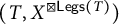 $(T, X^{\boxtimes \mathsf {Legs}(T)})$
. Let now

be a morphism in
 $\int \mathcal {O}$
(we can without loss of generality assume that T is a corolla). We define
 to be the morphism
 in
 $\mathsf {Graphs}$
together with a 2-morphism (to be specified) running from
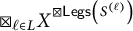 $ \boxtimes _{\ell \in L} X^{\boxtimes \mathsf {Legs} \left (S^{(\ell )}\right )}$
to the same object but with each copy of
 $X\boxtimes X$
belonging to a pair of edges collapsed by
 being replaced with
 $\Delta $
. Therefore, we can use
 $\beta : X \boxtimes X \longrightarrow \Delta $
to define K on morphisms. It is a straightforward verification that K is in fact a symmetric monoidal functor.
Now by the universal property of the (homotopy) pullback
 $\left (\int \mathcal {O}\right )\times _{\mathsf {Graphs}} \mathcal {E}_\kappa ^{\mathcal {A}}$
the functors
 $K: \int \mathcal {O}\longrightarrow \mathcal {E}_\kappa ^{\mathcal {A}}$
and
 $\mathrm {id}:\int \mathcal {O}\longrightarrow \int \mathcal {O}$
induce a functor
 $\int \mathcal {O}\longrightarrow \left (\int \mathcal {O}\right )\times _{\mathsf {Graphs}} \mathcal {E}_\kappa ^{\mathcal {A}}$
that is also symmetric monoidal. We restrict the calculus functor (4.2) along this functor and find the desired symmetric monoidal functor (4.1).
Remark 4.9 The proof of Proposition 4.7 does not need the non-degeneracy of
 $\beta $
. We require it nonetheless because otherwise we lose the possibility to make, if needed, a distinction between inputs and outputs, see the comments after [Reference Müller and WoikeMW23a, Proposition 2.12].
Remark 4.10 If
 $\mathcal {O}$
is the surface operad, then
 $\mathbb {V}_X^{\mathcal {A}}$
is a cyclic analog of the pinned block functor from [Reference Fuchs and SchweigertFS17, Section 3.3]. The crucial technical difference is that
 $\mathbb {V}_X^{\mathcal {A}}$
, as opposed to the pinned block functor, contains also the self-duality information of X – which is of course the main point about
 $\mathbb {V}_X^{\mathcal {A}}$
.
We finish this section by characterizing self-dual objects in a finite category explicitly.
Lemma 4.11 Let
 $\mathcal {A} \in \mathsf {Lex}^{\mathsf {f}}$
be a finite category with non-degenerate symmetric pairing
 $\kappa $
, moreover
 $D:\mathcal {A}\longrightarrow \mathcal {A}^{\mathrm {op}}$
the equivalence defined via
 $\kappa (X,Y)\cong \mathcal {A}(DX,Y)$
for all
 $X,Y \in \mathcal {A}$
which comes with a natural isomorphism
 $\omega : \mathrm {id}_{\mathcal {A}}\longrightarrow D^2$
induced by the symmetry isomorphisms of
 $\kappa $
. Then, the structure of a self-dual object on
 $X\in \mathcal {A}$
is an isomorphism
 $\psi : X \longrightarrow DX$
identifying X with its dual
 $DX$
such that
 $$ \begin{align*} X \xrightarrow{\ \omega_X \ } D^2 X \xrightarrow{\ D\psi \ } DX \end{align*} $$
coincides with
 $\psi $
.
Proof If we describe the self-duality of X via a symmetric 2-copairing
 $k\longrightarrow \kappa (X,X)\cong \mathcal {A}(DX,X)$
, see Remark 4.6, we observe that it gives us exactly a morphism
 $DX \longrightarrow X$
. The non-degeneracy entails that this morphism is an isomorphism. The symmetry amounts exactly to the remaining condition mentioned in the Lemma.
5 The cyclic and modular microcosm principle
The microcosm principle developed by Baez–Dolan [Reference Baez and DolanBD98, Section 4.3] says, roughly, that in order to be able to define an algebra A over an operad
 $\mathcal {O}$
inside a category
 $\mathcal {A}$
, the category
 $\mathcal {A}$
needs to be itself an algebra over
 $\mathcal {O}$
. In this situation,
 $\mathcal {A}$
is called the macrocosm in which the microcosm A lives. For instance, in the case
 $\mathcal {O}=\mathsf {As}$
, this tells us that in order to define what an associative algebra A in a category
 $\mathcal {A}$
should be, we need to equip
 $\mathcal {A}$
with a monoidal structure. Then, we can define what it means for
 $A \in \mathcal {A}$
to be an associative algebra relative to the monoidal structure of
 $\mathcal {A}$
.
The following precise definition of the microcosm principle builds on the original definition of Baez–Dolan, but includes cyclic and modular operads into the picture using the framework developed for the latter in [Reference CostelloCos04, Reference Müller and WoikeMW23a] and, of course, self-dual objects and their flat vector bundles. Recall that in order to define categorical algebras over cyclic and modular operads, we needed a non-degenerate symmetric pairing to make the endomorphism operad cyclic. In other words, the macrocosm needs a non-degenerate symmetric pairing. It will not come as surprise that also on the microcosmic level we will need a non-degenerate symmetric pairing relative to the macrocosmic pairing.
Definition 5.1 (Modular
$\mathcal {O}$
-algebra with coefficients — Modular Microcosm Principle)

Let
 $\mathcal {O}$
be a
 $\mathsf {Cat}$
-valued modular operad and
 $\mathcal {A}$
an
 $\mathcal {S}$
-valued modular
 $\mathcal {O}$
-algebra. A modular
 $\mathcal {O}$
-algebra (with coefficients) in
 $\mathcal {A}$
(or relative to
 $\mathcal {A}$
) is
-
• a self-dual object
$X:I\longrightarrow \mathcal {A}$
in
$\mathcal {A}$
(Definition 4.5), -
• together with a monoidal transformation,


satisfying the unitality condition that the component
 $$ \begin{align*} \xi_{(T_1,1_{\mathcal{O}})} : \star \longrightarrow \mathbb{V}_X^{\mathcal{A}} (1_{\mathcal{O}}) = \mathcal{A}_{1_{\mathcal{O}}} \circ (X\boxtimes X) \cong \kappa \circ (X\boxtimes X) \end{align*} $$
selects the 2-copairing of the self-dual object; here
 $1_{\mathcal {O}}$
is the operadic identity, and the isomorphism
 $\mathcal {A}_{1_{\mathcal {O}}}\cong \kappa $
is part of the data of
 $\mathcal {A}$
[Reference Müller and WoikeMW23a, Definition 2.13].
Remark 5.2 In this formulation of the microcosm principle, the modular algebra with coefficients in a higher categorical modular algebra is defined as a monoidal transformation from
 $\star $
(for appropriate choices of the underlying operad to be understood as the “trivial field theory”) to a symmetric monoidal functor built from the coefficients. Similar concepts appear sometimes under the name of twisted or relative field theory [Reference Stolz, Teichner, Sati and SchreiberST11, Reference Freed and TelemanFT14, Reference Johnson-Freyd and ScheimbauerJFS17]. It is also an abstraction of the definition of correlators in [Reference Fuchs and SchweigertFS17], as we explain in Section 8.
Remark 5.3 Modular algebras with fixed coefficients naturally form a category: A morphism
 $(X,\xi ) \longrightarrow (Y,\xi ')$
between modular
 $\mathcal {O}$
-algebras with coefficients in
 $\mathcal {A}$
is a 2-morphism
 $f:X \longrightarrow Y$
between the 1-morphisms
 $X,Y : I \longrightarrow \mathcal {A}$
in
 $\mathcal {S}$
such that:
-
• The 2-pairing
$\beta :X \boxtimes X \longrightarrow \Delta $
of X and the 2-pairing
$\gamma : Y \boxtimes Y \longrightarrow \Delta $
of Y satisfy
$\beta = \gamma \circ (f\boxtimes f)$
. -
• The monoidal transformation
$f_* : \mathbb {V}_X^{\mathcal {A}}\longrightarrow \mathbb {V}_Y^{\mathcal {A}}$
induced by f satisfies
$f_*\circ \xi = \xi '$
.





We denote the category of modular
 $\mathcal {O}$
-algebras in
 $\mathcal {A}$
by
 $\mathsf {ModAlg}(\mathcal {O};\mathcal {A})$
. As one would expect, any morphism between self-dual objects that is compatible with the respective non-degenerate 2-pairings is invertible. This is essentially the argument from [Reference Müller and WoikeMW23a, Proposition 2.18], but one categorical level lower. Hence, the category
 $\mathsf {ModAlg}(\mathcal {O};\mathcal {A})$
is a groupoid.
Remark 5.4 For any
 $o\in \mathcal {O}(T)$
, any morphism
 in
 $\mathsf {Graphs}$
induces a morphism
 in
 $\int \mathcal {O}$
that we just denote by
 again. For an
 $\mathcal {O}$
-algebra
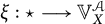 $\xi :\star \longrightarrow \mathbb {V}_X^{\mathcal {A}}$
with coefficients in
 $\mathcal {A}$
, the naturality of
 $\xi $
implies that the diagram

on
 $\mathcal {S}(I,I)$
commutes. This implies that
 $\xi $
is already determined by those components
 $\xi _{(T,o)}$
on operations
 $o\in \mathcal {O}(T)$
that generate the operations of
 $\mathcal {O}$
under operadic composition. In fact, we can further reduce this to the case where T is not an arbitrary object in
 $\mathsf {Graphs}$
, but a corolla. This is because of the monoidality of
 $\xi $
.
Remark 5.5 (Cyclic microcosm principle)
Definition 5.1 has a cyclic analog. We then get the notion of a cyclic algebra with coefficients in a cyclic algebra over a cyclic operad via the cyclic microcosm principle. Remarks 5.3 and 5.4 remain correct after some straightforward changes.
Remark 5.6 We should mention that there is a connection between cyclic operads and the microcosm principle that is entirely different from the objective of this text and covered in [Reference ObradovićObr17]. Let us explain this: Operads themselves can be defined as monoids with respect to Day convolution inside a certain symmetric monoidal category, so they can be defined through the microcosm principle. In [Reference ObradovićObr17] this description is extended to cyclic operads. This is not our objective: We fix a cyclic or modular operad
 $\mathcal {O}$
, while being agnostic to how the notion of cyclic or modular operad is defined (whether this is again an instance of the microcosm principle is irrelevant to us), and a cyclic or modular algebra
 $\mathcal {A}$
over
 $\mathcal {O}$
. We then consider cyclic or modular
 $\mathcal {O}$
-algebras inside
 $\mathcal {A}$
.
6 Microcosmic modular extension
In the subsequent sections, our goal will be to apply the modular microcosm principle in relevant cases. This means that, for a given modular operad
 $\mathcal {O}$
of interest and a modular algebra
 $\mathcal {A}$
over it, we would like to classify all modular
 $\mathcal {O}$
-algebras in
 $\mathcal {A}$
. This is a rather non-trivial task for which we need to establish an important technical result in this section.
First, recall that for a
 $\mathsf {Cat}$
-valued cyclic operad
 $\mathcal {O}:\mathsf {Forests} \longrightarrow \mathsf {Cat}$
, one can define following [Reference CostelloCos04] the modular envelope of
 $\mathcal {O}$
, a modular operad
 $\mathsf {U}_{\!\!\tiny \int } \mathcal {O}:\mathsf {Graphs} \longrightarrow \mathsf {Cat}$
sending
 $T\in \mathsf {Graphs}$
to the Grothendieck construction
 $$ \begin{align*} \mathsf{U}_{\!\!\tiny\int} \mathcal{O}(T):= \int \left( \mathsf{Forests} / T \longrightarrow \mathsf{Forests} \xrightarrow{\ \mathcal{O} \ } \mathsf{Cat} \right), \end{align*} $$
where
 $\mathsf {Forests} / T$
is the slice category of the inclusion
 $\mathsf {Forests} \longrightarrow \mathsf {Graphs}$
over T, and
 $\mathsf {Forests} / T \longrightarrow \mathsf {Forests}$
is the forgetful functor. Intuitively,
 $\mathsf {U}_{\!\!\tiny \int } \mathcal {O}$
is the modular operad obtained by completing the cyclic operad
 $\mathcal {O}$
, in a homotopically correct way, to a modular operad. The version of the modular envelope used here, while still largely following [Reference CostelloCos04], is slightly adapted to
 $\mathsf {Cat}$
-valued operads and their bicategorical algebras (see [Reference Müller and WoikeMW23a, Section 7.1]. In particular, the construction is made such that a cyclic
 $\mathcal {O}$
-algebra gives rise to a modular
 $\mathsf {U}_{\!\!\tiny \int } \mathcal {O}$
-algebra
 $\widehat {\mathcal {A}}$
that is called the modular extension of
 $\mathcal {A}$
. On an operation
 , it is given by image of
 $\mathcal {A}_o \in \prod _{\ell \in L} \mathcal {S}\left (\mathcal {A}^{ \boxtimes \mathsf {Legs} \left ( \widetilde T^{(\ell )} \right ) },I\right )$
under the functor

obtained by the evaluation of the endomorphism operad for
 $\mathcal {A}$
on
 .
The following is the main technical result of this article:
Theorem 6.1 (Microcosmic version of modular extension)
For a
 $\mathsf {Cat}$
-valued cyclic operad
 $\mathcal {O}$
and a cyclic
 $\mathcal {O}$
-algebra
 $\mathcal {A}$
in a symmetric monoidal bicategory
 $\mathcal {S}$
, there is a canonical pair of inverse equivalences

between cyclic
 $\mathcal {O}$
-algebras in
 $\mathcal {A}$
and modular
 -algebras in the modular extension
 $\widehat {\mathcal {A}}$
.
Here,
 $B:\mathsf {Cat} \longrightarrow \mathsf {sSet}$
is the nerve,
 $|-|:\mathsf {sSet} \longrightarrow \mathsf {Top}$
the geometric realization and
 the fundamental groupoid.
Remark 6.2 The modular extension
 $\widehat {\mathcal {A}}$
of
 $\mathcal {A}$
is a modular
 $\mathsf {U}_{\!\!\tiny \int } \mathcal {O}$
-algebra sending all morphisms in the categories of operations to isomorphisms (see [Reference Müller and WoikeMW23a, Remark 7.2]. Therefore, it can be seen as a modular algebra over
 (the localization of
 $\mathsf {U}_{\!\!\tiny \int } \mathcal {O}$
at all morphisms in the categories of operations). This however does not influence the notion of a modular algebra with coefficients in
 $\widehat {\mathcal {A}}$
. In other words,
 , so that we can rephrase Theorem 6.1 equivalently as an equivalence

Proof of Theorem 6.1
By Remark 6.2 we can equivalently prove the equivalence (6.1).
We start by explaining, why there is a restriction functor
 $\mathsf {ModAlg}( \mathsf {U}_{\!\!\tiny \int } \mathcal {O}; \widehat {\mathcal {A}}) \longrightarrow \mathsf {CycAlg}(\mathcal {O};\mathcal {A})$
: First, we observe that being a self-dual object
 $X: I \longrightarrow \mathcal {A}$
in
 $\mathcal {A}$
is the same as being a self-dual object
 $X:I\longrightarrow \widehat {\mathcal {A}}$
in
 $\widehat {\mathcal {A}}$
because
 $\mathcal {A}$
and its modular extension
 $\widehat {\mathcal {A}}$
have the same underlying object in
 $\mathcal {S}$
and the same non-degenerate symmetric pairing. Moreover, there is a symmetric monoidal functor
 $J: \int \mathcal {O} \longrightarrow \int \mathsf {U}_{\!\!\tiny \int } \mathcal {O}$
sending
 $(T,o)$
with
 $o\in \mathcal {O}(T)$
to
 $(T,\mathrm {id}_T,o) \in \int \mathsf {U}_{\!\!\tiny \int } \mathcal {O}$
. Clearly, for the flat vector bundles from Proposition 4.7
 $$ \begin{align} \mathbb{V}_X^{\widehat{\mathcal{A}}} \circ J=\mathbb{V}_X^{\mathcal{A}} . \end{align} $$
The restriction functor
 $$ \begin{align} J^*: \mathsf{ModAlg}\left( \mathsf{U}_{\!\!\tiny\int} \mathcal{O}; \widehat{\mathcal{A}}\right) \longrightarrow \mathsf{CycAlg}(\mathcal{O} ;\mathcal{A}) \end{align} $$
takes an object
 $\xi \in \mathsf {ModAlg}( \mathsf {U}_{\!\!\tiny \int } \mathcal {O}; \widehat {\mathcal {A}})$
, i.e., a monoidal transformation
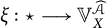 $\xi : \star \longrightarrow \mathbb {V}_X^{\widehat {\mathcal {A}}}$
for some self-dual object X in
 $\widehat {\mathcal {A}}$
, and restricts along J. Since
 $\star \circ J=\star $
and (6.2), this produces a monoidal transformation
 $\star \longrightarrow \mathbb {V}_X^{\mathcal {A}}$
. After the straightforward verification that this restriction preserves the unitality condition from Definition 5.1, we obtain an object in
 $\mathsf {CycAlg}(\mathcal {O};\mathcal {A})$
. This establishes the restriction functor (6.3).
Now, suppose that we are given a cyclic algebra
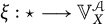 $\xi : \star \longrightarrow \mathbb {V}_X^{\mathcal {A}}$
with coefficients in
 $\mathcal {A}$
. An operation in
 $\mathsf {U}_{\!\!\tiny \int } \mathcal {O}(T')$
, where
 $T'$
is without loss of generality a corolla, is a morphism
 for some
 $T\in \mathsf {Graphs}$
and an operation
 $o\in \mathcal {O}(T)$
. We decompose T into corollas,
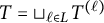 $T = \sqcup _{\ell \in L} T^{(\ell )}$
, so that o corresponds to a family
 $(o_\ell )_{\ell \in L} \in \prod _{\ell \in L} \mathcal {O}\left (T^{(\ell )}\right ) \simeq \mathcal {O}(T)$
of operations. The graph
 provides a morphism
 in
 $\int \mathsf {U}_{\!\!\tiny \int } \mathcal {O}$
, again denoted by
 by slight abuse of notation. We now define
 $\widehat \xi : \star \longrightarrow \mathbb {V}_X^{\widehat {\mathcal {A}}}$
as the transformation whose component at
 is given by the commutativity of the diagram

This makes
 $\widehat \xi $
natural, and we extend it monoidally. Moreover,
 $\widehat \xi $
clearly extends
 $\xi $
, i.e.,
 $J^* \widehat \xi = \xi $
. In fact, any extension of
 $\xi $
to a monoidal natural transformation
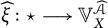 $\widehat \xi : \star \longrightarrow \mathbb {V}_X^{\widehat {\mathcal {A}}}$
must make the triangle (6.4) commute as follows from Remark 5.4; in other words,
 $\widehat \xi $
is the unique extension. If we now define an extension functor
 $E: \mathsf {CycAlg}(\mathcal {O};\mathcal {A}) \longrightarrow \mathsf {ModAlg}( \mathsf {U}_{\!\!\tiny \int } \mathcal {O}; \widehat {\mathcal {A}}) $
by
 $E \xi := \widehat \xi $
(the definition clearly extends to morphisms), then
 $J^* \circ E \cong \mathrm {id}_{ \mathsf {CycAlg}(\mathcal {O};\mathcal {A}) }$
because E provides, as just discussed, an extension, and
 $E \circ J^* \cong \mathrm {id}_{ \mathsf {ModAlg}( \mathsf {U}_{\!\!\tiny \int } \mathcal {O}; \widehat {\mathcal {A}}) }$
because this extension is unique.
7 Cyclic associative algebras
In this section, we apply the cyclic microcosm principle to the associative operad, the cyclic
 $\mathsf {Set}$
-valued operad
 $\mathsf {As}$
sending a corolla T to the set of cyclic orders on
 $\mathsf {Legs}(T)$
. If T has
 $n+1$
legs,
 $\mathsf {As}(T)$
can be non-canonically identified with the permutation group on n letters. Of course, we can see
 $\mathsf {As}$
as
 $\mathsf {Cat}$
-valued cyclic operad. The reader will not see any surprises in this section because cyclic associative algebras will have to amount to symmetric Frobenius algebras, with the right definition of symmetric Frobenius algebra that we will give below in Definition 7.2. In that regard, this section is rather a sanity check for the cyclic microcosm principle set up above.
By [Reference Müller and WoikeMW23a, Theorem 4.12] cyclic
 $\mathsf {As}$
-algebras in
 $\mathsf {Lex}^{\mathsf {f}}$
are pivotal Grothendieck–Verdier categories in
 $\mathsf {Lex}^{\mathsf {f}}$
, as defined by Boyarchenko–Drinfeld in [Reference Boyarchenko and DrinfeldBD13], using the notion of
 $\star $
-autonomous categories [Reference BarrBar79]. A Grothendieck–Verdier category in
 $\mathsf {Lex}^{\mathsf {f}}$
(note that our conventions are dual to the ones in [Reference Boyarchenko and DrinfeldBD13]) is a monoidal category
 $\mathcal {A}$
in
 $\mathsf {Lex}^{\mathsf {f}}$
with monoidal product
 $\otimes :\mathcal {A}\boxtimes \mathcal {A}\longrightarrow \mathcal {A}$
(this is exactly a non-cyclic associative algebra structure) together with an object
 $K\in \mathcal {A}$
, the dualizing object, such that the functors
 $\mathcal {A}(K,X\otimes -)$
become representable via
 $\mathcal {A}(K,X\otimes -)\cong \mathcal {A}(DX,-)$
with
 $D:\mathcal {A}\longrightarrow \mathcal {A}^{\mathrm {op}}$
being an equivalence. The functor D is called Grothendieck–Verdier duality; it sends the monoidal unit
 $I\in \mathcal {A}$
to K. Moreover, there are canonical isomorphisms
 $D^2I\cong I$
and
 $D^2 K\cong K$
. A pivotal structure on a Grothendieck–Verdier category is a monoidal isomorphism
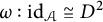 $\omega :\mathrm {id}_{\mathcal {A}}\cong D^2$
whose component at K is the canonical isomorphism
 $D^2 K\cong K$
. Under the equivalence from pivotal Grothendieck–Verdier categories in
 $\mathsf {Lex}^{\mathsf {f}}$
with cyclic
 $\mathsf {As}$
-algebras in
 $\mathsf {Lex}^{\mathsf {f}}$
, a pivotal Grothendieck–Verdier category
 $\mathcal {A}$
needs to be equipped with a non-degenerate pairing. This pairing is
 $\kappa (-,-)=\mathcal {A}(D-,-)$
with its symmetry isomorphism coming from the pivotal structure. A pivotal structure can be equivalently described through isomorphisms
 $\psi _{X,Y}:\mathcal {A}(K,X \otimes Y)\cong \mathcal {A}(K,Y\otimes X)$
squaring to the identity and subject to a cocycle condition [Reference Boyarchenko and DrinfeldBD13, Section 6].
We should point out that the Grothendieck–Verdier duality can be, but need not be a rigid duality. In the case of a rigid duality, D sends
 $X \in \mathcal {A}$
to an object
 $X^\vee $
for which we can find a morphism
 $d:X^\vee \otimes X \longrightarrow I$
as well as a morphism
 $b: I\longrightarrow X\otimes X^\vee $
such that the zigzag identities are satisfied. If the Grothendieck–Verdier duality of a pivotal Grothendieck–Verdier category in
 $\mathsf {Lex}^{\mathsf {f}}$
is rigid and if its unit is simple, it is a pivotal finite tensor category in the sense of [Reference Etingof and OstrikEO04, Reference Etingof, Gelaki, Nikshych and OstrikEGNO15]. Note that in principle, one can define two different versions of a rigid duality, a left, and a right one. For pivotal finite tensor categories, these canonically agree, so we refrain from making this distinction. It should be noted that, even in Grothendieck–Verdier categories, generalizations of the evaluation and coevaluation exist, but these satisfy substantially weaker properties (see [Reference Cockett and SeelyCS97, Theorem 4.5] and [Reference Fuchs, Schaumann, Schweigert and WoodFSSW24, Definition 3.33]).
By [Reference Boyarchenko and DrinfeldBD13, Section 3.1] a Grothendieck–Verdier category
 $\mathcal {A}$
has a second monoidal product defined via
 $$ \begin{align} X \odot Y := D^{-1}(DY \otimes DX) \end{align} $$
for all
 $X,Y \in \mathcal {A}$
. This is not necessarily a monoidal product in
 $\mathsf {Lex}^{\mathsf {f}}$
, but it is right exact. If D is rigid, then
 $\odot \cong \otimes $
.
With this second monoidal product, we can characterize self-dual objects in a cyclic associative algebra in
 $\mathsf {Lex}^{\mathsf {f}}$
. We find a structure that is dual to the notion of a Grothendieck–Verdier pairing in [Reference Fuchs, Schaumann, Schweigert and WoodFSSW24, Definition 4.7].
Lemma 7.1 (Characterization of self-dual objects with coefficients in a cyclic associative algebra / pivotal Grothendieck–Verdier category)
Let
 $\mathcal {A}$
be a pivotal Grothendieck–Verdier category in
 $\mathsf {Lex}^{\mathsf {f}}$
. The structure of a self-dual object on some
 $X\in \mathcal {A}$
amounts exactly to morphisms
 $\beta : X \odot X \longrightarrow I$
and
 $\delta : K \longrightarrow X \otimes X$
such that
 $\delta $
is a fixed point of the
 $\mathbb {Z}_2$
-action on
 $\mathcal {A}(K,X\otimes X)$
via the pivotal structure and such that
 $$ \begin{align*} \mathcal{A}(K,X \otimes X)\otimes \mathcal{A}(X\odot X,I)\cong \mathcal{A}(DX,X)\otimes \mathcal{A}(X,DX) \xrightarrow{\ \circ_X \ } \mathcal{A}(DX,DX) \end{align*} $$
sends
 $\delta \otimes \beta $
to
 $\mathrm {id}_{DX}$
while
 $$ \begin{align*} \mathcal{A}(X\odot X,I) \otimes \mathcal{A}(K,X \otimes X)\cong \mathcal{A}(X,DX) \otimes \mathcal{A}(DX,X) \xrightarrow{\ \circ_{DX} \ } \mathcal{A}(X,X) \end{align*} $$
sends
 $\beta \otimes \delta $
to
 $\mathrm {id}_X$
.
Justified by this result, we will refer to a map
 $\beta : X \odot X \longrightarrow I$
as in Lemma 7.1 as a non-degenerate symmetric pairing on X; we call
 $\delta : K \longrightarrow X \otimes X$
the associated non-degenerate symmetric copairing.
Proof We have
 $\kappa (X,X)\cong \mathcal {A}(K,X \otimes X)$
, and the symmetry isomorphism of
 $\kappa $
amounts to the
 $\mathbb {Z}_2$
-action on
 $\mathcal {A}(K,X \otimes X)$
by the pivotal structure of D. Similarly,
 $$ \begin{align*} (\mathcal{A}\boxtimes \mathcal{A})(X \boxtimes X,\Delta)&=\mathcal{A}(X,\Delta')\otimes\mathcal{A}(X,\Delta") \qquad \text{with Sweedler notation } \Delta = \Delta' \boxtimes\Delta"\\& \cong \kappa(DX,\Delta')\otimes\kappa(DX,\Delta")\\ &\cong \kappa(DX,DX)\qquad [{MW23a},\ \mathrm{Remark}\ 2.25]\\ &\cong \mathcal{A}(D^2X,DX)\\ &\cong \mathcal{A}(K,DX \otimes DX)\\ & \cong \mathcal{A}(D(DX\otimes DX),I) \\ &\cong \mathcal{A}(X\odot X,I) . \end{align*} $$
From this, we can deduce that the description given in Definition 4.5 is equivalent the one given in the Lemma.
With Lemma 7.1, we are in the position to characterize cyclic associative algebras relative to cyclic associative algebras in
 $\mathsf {Lex}^{\mathsf {f}}$
, i.e., cyclic associative algebras in pivotal Grothendieck–Verdier categories. Needless to say, we expect some sort of Frobenius algebras, but we should highlight that the fact that these are the type of algebras that the cyclic microcosm principle produces is a statement that requires a proof. Viewed differently, it is of course also a test that the cyclic microcosm principle in this article is set up the way it should be.
Symmetric Frobenius algebras can be defined in pivotal rigid monoidal categories [Reference Fuchs and StignerFS08]; the fact that they can be defined through the microcosm principle in
 $\star $
-autonomous categories is mentioned in [nLa17, Section 2] (see, however, the warning in Remark 7.4 below). The notion also appears in [Reference EggerEgg10, Definition 2.3.2] and [Reference Fuchs, Schaumann, Schweigert and WoodFSSW24, Section 4.1]. For us, the following notion will turn out to be the “correct” one (where “correct” has the precise meaning that Proposition 7.3, that we will state afterwards, holds).
Definition 7.2 A symmetric Frobenius algebra in a pivotal Grothendieck–Verdier category
 $\mathcal {A}$
in
 $\mathsf {Lex}^{\mathsf {f}}$
is an object
 $F \in \mathcal {A}$
together with
-
(M) a multiplication
$\mu : F \odot F \longrightarrow F$
that is associative with respect to the associators of
$(\mathcal {A},\odot )$
, -
(U) a unit
$\eta : K \longrightarrow F$
for
$\mu $
with respect to the unitors of
$(\mathcal {A},\odot )$
(the domain of the unit is the dualizing object which is the monoidal unit of
$\odot $
), -
(P) a non-degenerate symmetric pairing
$\beta : F \odot F \longrightarrow I$
as in Lemma 7.1, -
(I) subject to the invariance condition on
$\beta $
that
$\beta (\eta ,\mu )=\beta $
as maps
$F \odot F \longrightarrow I$
.






Proposition 7.3 Cyclic associative algebras in cyclic associative algebras in
 $\mathsf {Lex}^{\mathsf {f}}$
are equivalent to symmetric Frobenius algebras in pivotal Grothendieck–Verdier categories in
 $\mathsf {Lex}^{\mathsf {f}}$
.
Proof A cyclic associative algebra with coefficients in a pivotal Grothendieck–Verdier category
 $\mathcal {A}$
has an underlying self-dual object
 $F \in \mathcal {A}$
. This self-duality amounts to a symmetric non-degenerate pairing
 $\beta : F \odot F \longrightarrow I$
, see Lemma 7.1; this is point (P) in Definition 7.2. We now need to read off what a cyclic associative structure on F with coefficients in
 $\mathcal {A}$
, i.e. a monoidal natural transformation
 $k \longrightarrow \mathbb {V}_F^{\mathcal {A}}$
, amounts to. From Remark 5.4 (or rather its cyclic version, see also Remark 5.5), it follows that this can be extracted from a presentation of the cyclic associative operad of
 $\mathsf {As}$
in terms of generators and relations in the sense of [Reference Müller and WoikeMW23a, Section 3.2 for the notion & Theorem 4.2 for the case of
 $\mathsf{As}$
]. After spelling this out, we obtain:
-
• An operation on F for every generating operation of
$\mathsf {As}$
. The generating operations are the binary product and the unit. For the binary product, we get by definition a linear map from k to (7.2)i.e., a vector in
$$ \begin{align} \kappa(F,F\otimes F)\cong \mathcal{A}(DF,F\otimes F)\cong \mathcal{A}(D(F\otimes F),F)\cong \mathcal{A}(DF\odot DF,F)\cong \mathcal{A}(F \odot F,F), \end{align} $$
$\mathcal {A}(F \odot F,F)$
, which is a map
$\mu :F \odot F \longrightarrow F$
(point (M)). For the unit, we obtain a map
$\eta :K\longrightarrow F$
(point (U)).
-
• A relation for each of the generating isomorphisms (associator, unitor, and the isomorphism
$\gamma :\kappa (I,-\otimes -)\cong \kappa $
— the “invarianciator” for the pairing [Reference Müller and WoikeMW23a, Definition 4.1 (Z)]). The relation coming from the associator is associativity of
$\mu $
with respect to the associators of
$(\mathcal {A},\odot )$
while the unitor gives us unitality of
$\mu $
with unit
$\eta $
with respect to the unitors of
$(\mathcal {A},\odot )$
. Finally, the invarianciator
$\gamma $
gives us point (I).


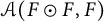





In summary, a cyclic associative algebra with coefficients in a
 $\mathsf {Lex}^{\mathsf {f}}$
-valued cyclic associative algebra amounts precisely to the structure and relations listed in Definition 7.2 for a symmetric Frobenius algebra.
Remark 7.4 In [Reference StreetStr04, Proposition 3.2] Grothendieck–Verdier categories (not necessarily linear ones) are described as Frobenius pseudo-monoids, so one might think that Proposition 7.3 (at least without the symmetry) can be seen as the result of applying the microcosm principle along the lines of [nLa17, Section 2] to Grothendieck–Verdier categories. As plausible as this may sound, this is not the case! The notion of Frobenius pseudo-monoid in [Reference StreetStr04] does not agree with the notion of a cyclic associative algebra in every symmetric monoidal bicategory. Most importantly, it is wrong that cyclic associative algebras in
 $\mathsf {Cat}$
are pivotal Grothendieck–Verdier categories.
Example 7.5 Let
 $\mathcal {C}$
be a pivotal finite tensor category (this entails in particular a rigid duality), then a source for symmetric Frobenius algebras are pivotal module categories [Reference ShimizuShi23, Section 3.6]: A pivotal module category
 $\mathcal {M}$
over
 $\mathcal {C}$
is a certain kind of module category whose internal hom
 $\underline {\mathsf {Hom}} (-,-):\mathcal {M}^{\mathrm {op}} \boxtimes \mathcal {M}\longrightarrow \mathcal {C}$
comes equipped with isomorphisms
 $\underline {\mathsf {Hom}}(m,n)^\vee \cong \underline {\mathsf {Hom}}(n,m)$
for all
 $m,n \in \mathcal {M}$
subject to further conditions. Then, the internal endomorphism algebra
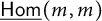 $\underline {\mathsf {Hom}}(m,m)$
for any
 $m\in \mathcal {M}$
is a symmetric Frobenius algebra in
 $\mathcal {C}$
[Reference ShimizuShi23, Theorem 3.14]. A generalization of this type of construction procedure of Frobenius algebras beyond the rigid case is given in [Reference Fuchs, Schaumann, Schweigert and WoodFSSW24, Theorem 5.20].
B Applications in quantum topology and conformal field theory
8 Classification of open correlators
We now turn to the applications in open conformal field theory. We denote by
 $\mathsf {O}$
the modular open surface operad, a groupoid-valued operad whose groupoid of operations of arity n (to be thought of as n inputs and one output) has as objects connected compact oriented surfaces with at least one boundary component and
 $n+1$
parametrized intervals embedded in its boundary. Morphisms of
 $\mathsf {O}(n)$
are mapping classes of diffeomorphisms between these surfaces preserving the orientation and the boundary parametrization. References for a more detailed definition of
 $\mathsf {O}$
include [Reference CostelloCos07b, Reference GiansiracusaGia11]; here we follow the definitions in [Reference Müller, Schweigert, Woike and YangMSWY23, Section 3], where the open-closed case is considered, and also [Reference Müller and WoikeMW24a].
Definition 8.1 Let
 $\mathfrak {B}$
be a
 $\mathsf {Lex}^{\mathsf {f}}$
-valued modular
 $\mathsf {O}$
-algebra, i.e., an open modular functor with values in
 $\mathsf {Lex}^{\mathsf {f}}$
, also known as categorified open topological field theory [Reference Müller and WoikeMW24a, Section 2] (this is the monodromy data of an open conformal field theory). A consistent system of open correlators for
 $\mathfrak {B}$
is a modular
 $\mathsf {O}$
-algebra with coefficients in
 $\mathfrak {B}$
.
This is in line with the notion of consistent systems of correlators in [Reference Fuchs and SchweigertFS17, Reference Fuchs, Schweigert, Jurčo, Sämann, Schreiber and WolfFS19] (that are also defined via monoidal natural transformations – so the connection is not surprising), but here we consider the open version. Let us unpack the data: Denote by
 $\mathcal {A}$
the underlying category for the open modular functor
 $\mathfrak {B}$
(one might call this the category of boundary labels). For a corolla T,
 and
 $X_i \in \mathcal {A}$
for
 $1\le i\le n:=|\mathsf {Legs}(T)|$
, the vector space
 is the space of conformal blocks for the surface
 and boundary labels
 $X_1,\dots ,X_n$
. A consistent system of open correlators
 $\xi \in \mathsf {ModAlg}(\mathsf {O};\mathfrak {B})$
has an underlying object
 $F\in \mathcal {A}$
and vectors
 in the spaces of conformal blocks that are invariant under the mapping class group actions and compatible with sewing along boundary intervals.
Corollary 8.2 For any cyclic associative algebra
 $\mathcal {A}$
in
 $\mathcal {S}$
, there is an equivalence

where
 $\mathcal {A}_{\text { !}}$
denotes the modular extension of the cyclic
 $\mathsf {As}$
-algebra
 $\mathcal {A}$
.
Proof This follows directly from Theorem 6.1 if we additionally use the equivalence 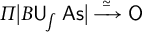 from [Reference Müller and WoikeMW24a, Equation (2.1)].
Theorem 8.3 (Classification of open correlators)
Given an open modular functor
 $\mathfrak {B}$
in
 $\mathsf {Lex}^{\mathsf {f}}$
, let
 $\mathcal {A}$
be the pivotal Grothendieck–Verdier category obtained by evaluation of
 $\mathfrak {B}$
on disks with intervals embedded in its boundary. Then, the consistent systems of open correlators for
 $\mathfrak {B}$
are exactly symmetric Frobenius algebras in
 $\mathcal {A}$
. More explicitly, the open correlator
 $\xi ^F$
associated to a symmetric Frobenius algebra F in
 $\mathcal {A}$
amounts to vectors
 in the spaces of conformal blocks associated to surfaces
 with F appearing n times as the boundary label. These vectors are mapping class group invariant and solve the constraints for sewing along intervals.
Proof Every open modular functor
 $\mathfrak {B}$
is equivalent to the modular extension of its restriction to disks with marked intervals, which is a cyclic
 $\mathsf {As}$
-algebra
 $\mathcal {A}$
, i.e., a pivotal Grothendieck–Verdier category (see [Reference Müller and WoikeMW24a, Theorem 2.2]. This implies that the consistent systems of open correlators for
 $\mathfrak {B}$
are described by the category
 $\mathsf {ModAlg}\left ( \mathsf {O}; \mathcal {A}_{\text { !}}\right )$
. Now the statement follows from
 $$ \begin{align*} \mathsf{ModAlg}\left( \mathsf{O}; \mathcal{A}_{\text{ !}}\right) \stackrel{\text{Corollary {8.2}}}{\simeq}\mathsf{CycAlg}\left( \mathsf{As}; \mathcal{A}\right) \stackrel{\text{Proposition~{7.3}}}{\simeq} \mathsf{symmetric\ Frobenius\ algebras\ in} \ \mathcal{A} . \end{align*} $$
9 A calculation recipe for open correlators
In this section, we demonstrate how the open correlators from Theorem 8.3 can be calculated explicitly. Suppose that
 $\mathfrak {B}$
is an open modular functor and
 $\mathcal {A}$
its underlying pivotal Grothendieck–Verdier category, i.e., the restriction to disks
 $\mathbb {D}^2_n$
with intervals
 $n\ge 1$
in its boundary. By [Reference Müller and WoikeMW24a, Theorem 2.2],
 $\mathfrak {B}$
is, up to a canonical equivalence, the modular extension of
 $\mathcal {A}$
, i.e.,
 $\mathfrak {B}\simeq \mathcal {A}_{\text { !}}$
as open modular functors (
 $\simeq $
is an equivalence of modular algebras over the open surface operad). For this reason, we know [Reference Müller and WoikeMW23a, Example 7.3]
 $$ \begin{align} \mathfrak{B}( \mathbb{D}^2_n; X_1,\dots,X_n ) \cong \mathcal{A}(K,X_1\otimes \dots \otimes X_1) \end{align} $$
for
 $X_1,\dots ,X_n \in \mathcal {A}$
. Let us now describe in more detail the consistent system of open correlators for a symmetric Frobenius algebra F in
 $\mathcal {A}$
:
-
• The multiplication, the unit and the pairing: For
$n=3$
and since F is self-dual
$$ \begin{align*} \mathfrak{B}( \mathbb{D}^2_3; F , F, F ) \cong \mathcal{A}(K, F \otimes F \otimes F) \cong \kappa(F,F\otimes F) \stackrel{{\scriptsize 7.2}}{\cong} \mathcal{A}(F \odot F, F) . \end{align*} $$
The consistent system of open correlator
$\xi ^F$
associated to a symmetric Frobenius algebra gives us a vector
$\xi _{\mathbb {D}^2_3}^F \in \mathfrak {B}( \mathbb {D}^2_3; F , F, F )$
, and by definition this is the multiplication
$\mu : F \odot F \longrightarrow F$
. Pictorially, this means that the disk with three intervals in its boundary, each labeled with F, is “decorated” with the multiplication operation:
(9.2)The boundary intervals are drawn in blue. The decoration is the red graph whose legs are colored with F; the multiplication operation should be imagined as sitting at the trivalent vertex. Note, however, that the legs are not incoming or outgoing. It is the advantage of working with cyclic operads and their algebras that we do not (and should not) make such distinctions. For
$n=1$
,
$\mathfrak {B}( \mathbb {D}^2_1; F )\cong \mathcal {A}(K,F)$
, and the distinguished vector is the unit
$K\longrightarrow F$
. For
$n=2$
,
$\mathfrak {B}( \mathbb {D}^2_2; F ,F )\cong \mathcal {A}(K,F\otimes F)$
, and the distinguished vector is the copairing
$\delta : K \longrightarrow F \otimes F$
by the unitality requirement in Definition 5.1. Since this copairing is part of a self-duality, it is by construction non-degenerate. This is simply because the non-degeneracy of the pairing on the microcosmic level needs to match the non-degeneracy of the macrocosmic one. In [Reference Fjelstad, Fuchs, Runkel and SchweigertFFRS08, Section 4.5], the non-degeneracy is an extra assumption called non-degeneracy of the disk two-point function.Thanks to the self-duality of F, we can see
$D\eta $
as a morphism
$F\longrightarrow I$
, the counit of F. Its evaluation on the unit
$K\longrightarrow F$
is the distinguished vector in the space of conformal blocks
$\mathfrak {B}(\mathbb {D}^2_0)\cong \mathcal {A}(K,I)$
for the disk without marked intervals. -
• A graphical presentation via Poincaré duality: We can draw (9.2) as a triangle, with the embedded intervals as segments on the edges. The decoration with the multiplication then describes a partition of the triangle that is Poincaré dual to the original one:
(9.3)In other words, we recover the labeling principle underlying the constructions in [Reference Fuchs, Runkel and SchweigertFRS02, Reference Fuchs, Runkel and SchweigertFRS04a, Reference Fuchs, Runkel and SchweigertFRS04b, Reference Fuchs, Runkel and SchweigertFRS05, Reference Fjelstad, Fuchs, Runkel and SchweigertFFRS06a].
-
• Disks with more boundary intervals: For
$n\ge 4$
, the vector
$\xi _{\mathbb {D}^2_n}^F$
is obtained by gluing disks with three intervals on their boundary together; pictorially:
(9.4)The gluing is along the gray dashed lines. Under the isomorphism
the vector
$$ \begin{align*} \mathcal{A}(K,F ^{\otimes n})\cong \mathcal{A}(DF,F^{\otimes (n-1)})\cong \mathcal{A}((DF)^{\odot (n-1)},F)\cong \mathcal{A}(F^{\odot (n-1)},F), \end{align*} $$
$\xi _{\mathbb {D}^2_5}^F$
is the arity
$n-1$
multiplication
$F^{\odot (n-1)}\longrightarrow F$
that multiplies elements together from left to right. If we think of this surface as obtained by gluing three triangles (9.3) together, the decoration is again obtained by passing to the Poincaré dual.
-
• More complicated surfaces: Beyond disks with marked intervals,
$\xi $
is completely determined by the fact that
$\mathcal {A}_{\text { !}}$
is a modular algebra. The detailed treatment is in [Reference Müller and WoikeMW23a, Example 7.3] (see also [Reference Müller and WoikeMW24a, Equation (4.1)]; we discuss here an example: Suppose that we glue in (9.4) the two rightmost boundary intervals together, thereby creating an annulus with three intervals embedded in its outer boundary circle:
(9.5)


















 with three intervals embedded in its outer boundary circle:

The fact that
 $\mathcal {A}_{\text { !}}$
is a modular algebra, in particular, the first square in [Reference Müller and WoikeMW23a, Definition 2.13], tells us how to obtain
 from this triangulation of
 : We need to fill the coevaluation object
 $\Delta =\int ^{X \in \mathcal {A}} DX \boxtimes X \in \mathcal {A}\boxtimes \mathcal {A}$
into the arguments of the functor
 $\mathcal {A}_{\text { !}}(\mathbb {D}_5^2; -)$
in which the gluing occurs. This gives us

With (9.1), we arrive at

Since the consistent system of open correlators
 $\xi ^F$
solves the sewing constraints for gluing along intervals,
 is the image of
 $\xi _{\mathbb {D}_5^2}^F$
under

where the third map is induced by the map
 $$ \begin{align} DF \otimes F \longrightarrow \mathbb{F}\end{align} $$
obtained by applying
 $\otimes $
to the structure map
 $DF \boxtimes F \longrightarrow \int ^{X \in \mathcal {A}} DX\boxtimes X$
of the coend. Note that by definition the map
 $F \boxtimes F \longrightarrow \int ^{X \in \mathcal {A}}DX\boxtimes X$
obtained from the self-duality
 $DF\cong F$
and structure map of the coend is exactly the symmetric 2-pairing (this is how we defined self-duality in the first place, see Definition 4.5). We can symbolically represent this vector through the red graph in (9.5). The two arrows landing on the dashed cut symbolize how the two copies of F are mapped to the coend through the structure map and the self-duality.
Example 9.1 As we have seen above, the open correlators can be calculated directly from the operations of the symmetric Frobenius algebra
 $F\in \mathcal {A}$
and the map (9.6) “sorting
 $F \otimes F$
into the coend”. In Hopf-algebraic examples, the latter part can be made more explicit: Suppose that H is a pivotal finite-dimensional Hopf algebra, and
 $\mathcal {A}$
the category of finite-dimensional H-modules. Then,
 $\mathbb {F}=\int ^{X \in \mathcal {A}} X^\vee \otimes X$
(because
 $\otimes $
is exact), and we can make the following further statements that follow from [Reference Kerler and LyubashenkoKL01, Theorem 7.4.13]: The object
 $\mathbb {F}$
is given by the coadjoint representation
 $H^*_{\text {coadj}}$
, which is the dual of the adjoint H-action on itself given by
 $h.x := h'x S(h")$
, where we have used the Sweedler notation for the coproduct of H. For a symmetric Frobenius algebra F in H-modules, the map
 $F\otimes F \longrightarrow H_{\text {coadj}}^*$
from (9.6) is given by
 $$ \begin{align*} F \otimes F \ni x \otimes y \longmapsto \left( H\ni h \longmapsto \psi(x)(h.y) \right), \end{align*} $$
with the self-duality
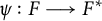 $\psi :F \longrightarrow F^*$
.
Remark 9.2 (Relation to the string-net construction of correlators in rational conformal field theory)
Let
 $\mathcal {C}$
be a pivotal finite tensor category. Then, there is a string-net model
 $\mathsf {SN}_{\mathcal {C}}$
for the open-closed modular functor for the Drinfeld center
 $Z(\mathcal {C})$
[Reference Müller, Schweigert, Woike and YangMSWY23]. The open part of
 $\mathsf {SN}_{\mathcal {C}}$
is equivalent to
 $\widehat {\mathcal {C}}$
[Reference Müller and WoikeMW24a, Theorem 4.2]. If
 $\mathcal {C}$
is a modular fusion category, consistent systems of correlators for the modular functor
 $Z(\mathcal {C})$
have been constructed in [Reference Fuchs, Schweigert and YangFSY22] from special symmetric Frobenius algebras in
 $\mathcal {C}$
using string-net techniques. Theorem 8.3 can be seen as a non-semisimple generalization of the open part of this construction (which does not need specialness because we have not discussed yet extensions beyond the open sector). Nonetheless, we should highlight that even though Theorem 8.3, at least for pivotal finite tensor categories, should admit a string-net interpretation through the abstract comparison result [Reference Müller and WoikeMW24a, Theorem 4.2], it is largely unclear how this string-net picture for the open correlators in the non-semisimple situation would look like. One might see this as a selling point for the modular microcosm principle because it shows that it allows for constructions that otherwise are not available in this generality. On the other hand, we lose, in comparison to the semisimple string-net techniques in [Reference Fuchs, Schweigert and YangFSY22] quite a bit of explicitness in the calculations because powerful ribbon graph techniques enter as a “black box”.
10 Classification of ansular correlators
By [Reference Müller and WoikeMW23a, Theorem 5.13],
 $\mathsf {Lex}$
-valued cyclic algebras over the
 $\mathsf {f}E_2$
-operad are equivalent to ribbon Grothendieck–Verdier categories as defined in [Reference Boyarchenko and DrinfeldBD13], i.e., braided Grothendieck–Verdier categories
 $\mathcal {A}$
equipped with a natural automorphism
 $\theta _X:X\longrightarrow X$
called balancing such that
 $\theta _I=\mathrm {id}_I$
,
 $\theta _{X \otimes Y}=c_{Y,X}c_{X,Y}(\theta _X \otimes \theta _Y)$
for
 $X,Y \in \mathcal {A}$
, with
 $c_{X,Y}:X\otimes Y \xrightarrow {\ \cong \ } Y \otimes X$
being the braiding, such that additionally the compatibility
 $D\theta _X=\theta _{DX}$
with the Grothendieck–Verdier duality holds. As explained in [Reference Boyarchenko and DrinfeldBD13], any ribbon Grothendieck–Verdier category has an underlying pivotal Grothendieck–Verdier category, i.e., it is an enhancement of the structure discussed in the previous two sections. If the Grothendieck–Verdier duality is rigid and the unit simple, we obtain the notion of a finite ribbon category [Reference Etingof, Gelaki, Nikshych and OstrikEGNO15].
Definition 10.1 Let
 $\mathcal {A}$
be a ribbon Grothendieck–Verdier category in
 $\mathsf {Lex}^{\mathsf {f}}$
. We define a symmetric commutative Frobenius algebra in
 $\mathcal {A}$
as a symmetric Frobenius algebra in the underlying pivotal Grothendieck–Verdier category which is also commutative with respect to the braiding.
Proposition 10.2 Cyclic framed
 $E_2$
-algebras in cyclic framed
 $E_2$
-algebras in
 $\mathsf {Lex}^{\mathsf {f}}$
are equivalent to symmetric commutative Frobenius algebras in ribbon Grothendieck–Verdier categories.
Proof Cyclic framed
 $E_2$
-algebras in
 $\mathsf {Lex}^{\mathsf {f}}$
are ribbon Grothendieck–Verdier categories in
 $\mathsf {Lex}^{\mathsf {f}}$
by [Reference Müller and WoikeMW23a, Theorem 5.13]. This means that in comparison to the situation of Proposition 7.3 we have an additional generating isomorphism, namely, the braiding. This gives us one additional relation for cyclic framed
 $E_2$
-algebras in a ribbon Grothendieck–Verdier category, namely the braided commutativity in Definition 10.1. A priori, we have another generating isomorphism, namely, the balancing, but a ribbon Grothendieck–Verdier category can be described as a braided Grothendieck–Verdier category with pivotal structure that is subject to a property (this is [Reference Boyarchenko and DrinfeldBD13, Corollary 8.3], see also [Reference Müller and WoikeMW23a, Lemma 5.10]). Therefore, there is no additional relation through the balancing.
Remark 10.3 Even though it was implicitly part of the proof of Proposition 10.2, let us mention explicitly: For a symmetric commutative Frobenius algebra F in a ribbon Grothendieck–Verdier category, the triviality of the balancing (
 $\theta _F=\mathrm {id}_F$
) is automatic. This is a generalization of [Reference Fröhlich, Fuchs, Runkel and SchweigertFFRS06b, Proposition 2.25].
By replacing in the definition of the surface operad all surfaces with three-dimensional handlebodies (as always compact oriented; instead of boundary components, we consider disks embedded in the boundary surface of the handlebody), one obtains the modular operad
 $\mathsf {Hbdy}$
of handlebodies (see [Reference GiansiracusaGia11, Section 4.3] and [Reference Müller and WoikeMW23a, Section 7.2] for more details. A (
 $\mathsf {Lex}^{\mathsf {f}}$
-valued)
 $\mathsf {Hbdy}$
-algebra is called ansular functor, and by the main result of [Reference Müller and WoikeMW24b] building on [Reference GiansiracusaGia11, Reference Müller and WoikeMW23a, Reference Müller and WoikeMW23c] the restriction to genus zero produces an equivalence to cyclic framed
 $E_2$
-algebras:

Definition 10.4 (Ansular correlator)
Let
 $\mathfrak {B}$
be an ansular functor with values in
 $\mathsf {Lex}^{\mathsf {f}}$
. A consistent system of ansular correlators for
 $\mathfrak {B}$
is a modular
 $\mathsf {Hbdy}$
-algebra with coefficients in the ansular functor
 $\mathfrak {B}$
.
Corollary 10.5 For any cyclic framed
 $E_2$
-algebra
 $\mathcal {A}$
in
 $\mathcal {S}$
, there is an equivalence

Proof The equivalence (10.1) follows from Theorem 6.1 about micrcosmic extension if we additionally use  from [Reference Müller and WoikeMW24b, Theorem 5.2] (building as mentioned on [Reference GiansiracusaGia11, Reference Müller and WoikeMW23a, Reference Müller and WoikeMW23c]).
Theorem 10.6 (Classification of ansular correlators)
The consistent systems of ansular correlators for an ansular functor are exactly symmetric commutative Frobenius algebras
 $F\in \mathcal {A}$
in the ribbon Grothendieck–Verdier category
 $\mathcal {A}$
obtained from the ansular functor by genus zero restriction. More explicitly, the ansular correlator
 $\xi ^F$
associated with a symmetric commutative Frobenius algebra F in
 $\mathcal {A}$
amounts to vectors
 $\xi _H^F \in \widehat {\mathcal {A}}(H;F,\dots ,F)$
in the spaces of conformal blocks associated to handlebodies H that are handlebody group invariant and solve the constraints for sewing along disks embedded in the boundary surface of the handlebodies.
Proof The proof is by assembly of the results that we have already proven and completely analogous to the proof of Theorem 8.3, but this time we apply the microcosmic extension to the situation in Corollary 10.5 and Proposition 10.2 instead.
Remark 10.7 The cyclic framed
 $E_2$
-operad is equivalent to the cyclic genus zero surface operad (or equivalently the cyclic genus zero handlebody operad). This is implicit in [Reference Salvatore and WahlSW03, Reference GiansiracusaGia11] (see [Reference Müller and WoikeMW23a, Proposition 5.3] for an explicit statement for the groupoid-valued version. With the connection to correlators explained in the introduction (but this time just applied to genus zero), this means that for a cyclic framed
 $E_2$
-algebra
 $\mathcal {A}$
in a symmetric monoidal bicategory, the cyclic framed
 $E_2$
-algebras in
 $\mathcal {A}$
are exactly genus zero correlators for
 $\mathcal {A}$
in the sense [Reference Fuchs and SchweigertFS17, Section 4.2]. Theorem 10.6 now tells us that, for any cyclic framed
 $E_2$
-algebra
 $\mathcal {A}$
, genus zero correlators for
 $\mathcal {A}$
and ansular correlators for
 $\widehat {\mathcal {A}}$
are equivalent.
Example 10.8 If
 $\mathcal {A}$
is a unimodular finite ribbon category, then
 $B=\int ^{X \in \mathcal {A}} X^\vee \boxtimes X$
can be equipped with the structure of a symmetric commutative Frobenius algebra in
 $\bar {\mathcal {A}}\boxtimes \mathcal {A}$
, where
 $\bar {\mathcal {A}}$
is
 $\mathcal {A}$
with the same monoidal product, but with braiding and balancing inverted (see [Reference Fuchs, Schweigert and StignerFSS13, Proposition 2.3] and [Reference Fuchs, Gannon, Schaumann and SchweigertFGSS18, Section 2]. Via the braided monoidal functor
 $\bar {\mathcal {A}}\boxtimes \mathcal {A} \longrightarrow Z(\mathcal {A})$
to the Drinfeld center of
 $\mathcal {A}$
[Reference Etingof, Nikshych and OstrikENO04, Section 4], we can turn B into a symmetric commutative Frobenius algebra
 $\mathbb {F}=\int ^{X \in \mathcal {A}} X^\vee \otimes X$
in
 $Z(\mathcal {A})$
. The underlying algebra structure was already described in [Reference LyubashenkoLyu95b, Section 2]. The braided commutative algebra in
 $Z(\mathcal {A})$
appears in [Reference Neuchl and SchauenburgNS98, Definition 4 & Proposition 5]. The construction of symmetric commutative Frobenius algebras in Drinfeld centers can be vastly generalized using the theory of pivotal module categories and internal endotransformations [Reference Fuchs and SchweigertFS23, Corollary 39].
Example 10.9 Suppose that
 $\mathcal {A}$
is a modular category. Then, the end
 $\mathbb {A}=\int _{X \in \mathcal {A}} X^\vee \otimes X$
becomes an algebra in
 $\mathcal {A}$
by applying component-wise the evaluations, even a Frobenius algebra (see [Reference Davydov, Müger, Nikshych and OstrikDMNO13, Lemma 3.5] and [Reference ShimizuShi17, Theorem 6.1 (4)]. But generally, no structure of an ansular correlator on
 $\mathbb {A}$
exists. Indeed, if
 $\mathcal {A}$
is the category of finite-dimensional modules over the small quantum group
 $\bar U_q (\mathfrak {sl}_2)$
, where
 $q = \exp (2\pi \text {i}/r)$
with odd integer
 $r\ge 3$
, it is shown in [Reference Müller and WoikeMW23b, Example 6.5] using the results of [Reference De Renzi, Gainutdinov, Geer, Patureau-Mirand and RunkelDRGG+22, Section 5.2] that the balancing
 $\theta _{\mathbb {A}}$
is not the identity because the action of some elements in the Johnson kernel on the spaces of conformal blocks for closed surfaces is not trivial. This implies thanks to Remark 10.3 that
 $\mathbb {A}$
cannot give rise to an ansular correlator.
If
 $\mathcal {A}$
is a finite ribbon category, consistent systems of ansular correlators in genus zero agree exactly with the consistent systems of genus zero correlators that are being classified by symmetric commutative Frobenius algebras in [Reference Fuchs and SchweigertFS17, Proposition 4.7]. Therefore, Theorem 10.6 immediately implies.
Corollary 10.10 Each consistent system of genus zero correlators for a finite ribbon category in the sense of Fuchs–Schweigert extends uniquely to a consistent system of ansular correlators.
Let us briefly highlight why this is actually a non-obvious statement: For a handlebody
 $H_g$
of genus g, [Reference Fuchs and SchweigertFS17, Proposition 4.7] easily gives us the invariance under Dehn twists. But unlike for mapping class group of surfaces, handlebody groups are not generated by Dehn twists. Instead, the Dehn twists generate a normal subgroup
 $\mathsf {Tw}(H_g)\subset \mathsf {Map}(H_g)$
, the twist group, that fits into a short exact sequence
 $$ \begin{align} 1 \longrightarrow \mathsf{Tw}(H_g)\longrightarrow\mathsf{Map}(H_g)\longrightarrow\mathsf{Out}(F_g)\longrightarrow 1, \end{align} $$
where
 $\mathsf {Out}(F_g)$
is the group of outer automorphisms of the free group
 $F_g$
on g generators (see [Reference LuftLuf78]). In other words,
 $\mathsf {Map}(H_g)$
is much larger than
 $\mathsf {Tw}(H_g)$
.
In a finite ribbon category
 $\mathcal {A}$
, the monoidal unit I is obviously a symmetric commutative Frobenius algebra. Theorem 10.6 then implies.
Corollary 10.11 Let
 $\mathcal {A}$
be a finite ribbon category. Then, the spaces of conformal blocks
 $\widehat {\mathcal {A}}(H)$
of the ansular functor for
 $\mathcal {A}$
evaluated on handlebodies H without embedded disks come with a distinguished
 $\mathsf {Map}(H)$
-invariant non-zero vector
 $\xi _H \in \widehat {\mathcal {A}}(H)$
.
Proof We apply Theorem 10.6 to the symmetric commutative Frobenius algebra
 $I \in \mathcal {A}$
(this needs rigidity). The fact that the vectors
 $\xi _H$
are non-zero is not obvious. We prove this in Proposition 11.7 below.
Remark 10.12 (Relation to skein theory and the empty skein)
If
 $\mathcal {A}$
is a ribbon fusion category, in particular semisimple, then
 $\widehat {\mathcal {A}}(H)$
can be seen as the classical handlebody skein module [Reference RobertsRob94, Reference Masbaum and RobertsMR95] (see [Reference Brochier and WoikeBW22, Section 1.7] for the connection. Then,
 $\xi _H$
corresponds to the empty skein. From this perspective, Corollary 10.11 produces a non-semisimple analog of the empty skein, purely from the microcosm principle. It should be pointed out that this construction of the non-semisimple version of the “empty skein” is really non-trivial. For the moment, there is no skein-theoretic description of
 $\widehat {\mathcal {A}}(H)$
available. In work in progress, we will make a connection to the admissible skeins in [Reference Costantino, Geer and Patureau-MirandCGPM23] (see [Reference Brown and HaïounBH24] for the connection to factorization homology. But even then, the skein-theoretic methods would just be applied to the tensor ideal of projective objects (to which the monoidal unit does not belong in the non-semisimple case), therefore, making the notion of an empty skein still somewhat tricky.
Remark 10.13 The invariance property of the vectors in Corollary 10.11 under
 $\mathsf {Map}(H)$
can generally not be extended to an invariance under the mapping class group
 $\mathsf {Map}(\partial H)$
(of which
 $\mathsf {Map}(H)$
is a subgroup): If
 $\mathcal {A}$
is modular, the handlebody group action on
 $\widehat {\mathcal {A}}(H)$
extends to a projective action of the mapping class group of the surface
 $\partial H$
through the construction of [Reference LyubashenkoLyu95a, Reference LyubashenkoLyu95b, Reference LyubashenkoLyu96] (see [Reference Müller and WoikeMW23a, Reference Brochier and WoikeBW22] for the relation to ansular functors. But unless
 $\mathcal {A}\simeq \mathsf {vect}$
, the consistent systems of ansular correlators from Corollary 10.11 will not have the invariance property for the action of the mapping class groups of
 $\partial H$
. This is a consequence of [Reference Fuchs and SchweigertFS17, Remark 4.12 (i)].
Remark 10.14 (The correspondence between two-dimensional full conformal field theory in genus zero and three-dimensional skein theory)
One of the main ideas of the works [Reference Fuchs, Runkel and SchweigertFRS02, Reference Fuchs, Runkel and SchweigertFRS04a, Reference Fuchs, Runkel and SchweigertFRS04b, Reference Fuchs, Runkel and SchweigertFRS05, Reference Fjelstad, Fuchs, Runkel and SchweigertFFRS06a] is to solve problems in two-dimensional rational conformal field theory through three-dimensional topological field theory. One then needs to deal with a higher-dimensional field theory that however behaves in a much simpler way. The attentive reader might have noticed that Theorem 10.6 goes into a somewhat similar direction even though the three-dimensional topological structure that we encounter is much weaker (but in exchange applies to vastly more general situations). Let us make this precise: Suppose that we are given a conformal field theory in genus zero, namely, monodromy data
 $\mathcal {A}$
(a ribbon Grothendieck–Verdier category) plus a consistent system of correlators F (a symmetric commutative Frobenius algebra in
 $\mathcal {A}$
). Corollary 10.5 and Theorem 10.6 imply that F extends uniquely to a modular
 $\mathsf {Hbdy}$
-algebra with coefficients in the ansular functor
 $\widehat {\mathcal {A}}$
, thereby producing vectors in the spaces on conformal blocks
 $\widehat {\mathcal {A}}(H;F,\dots ,F)$
associated with handlebodies H. But the
 $\widehat {\mathcal {A}}(H;-)$
are by [Reference Brochier and WoikeBW22, Section 4.3] exactly the generalized skein modules on which the skein algebra defined in terms of factorization homology [Reference Gunningham, Jordan and SafronovGJS23, Definition 2.6] acts. Phrased differently, the genus zero conformal field theory
 $(\mathcal {A},F)$
might not admit a description in terms of three-dimensional topological field theory, but there is always – for purely topological reasons – a description in terms of three-dimensional handlebody skein modules defined in terms of factorization homology.
11 A multiplicative invariant for modular algebras
The corolla
 $T_1$
with two legs is sent by any
 $\mathsf {Grpd}$
-valued modular operad
 $\mathcal {O}:\mathsf {Graphs} \longrightarrow \mathsf {Cat}$
to the groupoid
 $\mathcal {O}(T_1)$
of unary operations. The line with two vertices on it gives us a morphism
 $T_1 \sqcup T_1 \longrightarrow T_1$
endowing
 $\mathcal {O}(T_1)$
with the structure of a
 $\mathsf {Grpd}$
-valued algebra (that can be seen as a topological algebra if needed), the algebra
 $\mathfrak {A}_{\mathcal {O}}$
of unary operations [Reference Müller and WoikeMW24b, Definition 3.5]. Its unit is the operadic identity. The
 $\mathbb {Z}_2$
-action coming from the cyclic symmetry endows
 $\mathfrak {A}_{\mathcal {O}}$
with an anti involution of algebras. We denote the multiplication in
 $\mathfrak {A}_{\mathcal {O}}$
by
 $\star $
. It makes
 $\mathfrak {A}_{\mathcal {O}}$
into a monoidal category.
Theorem 11.1 Let
 $\mathcal {B}$
be an
 $\mathcal {S}$
-valued modular
 $\mathcal {O}$
-algebra. Then, for any self-dual object F in
 $\mathcal {B}$
,
 $$ \begin{align*} R: \mathfrak{A}_{\mathcal{O}} \longrightarrow \mathcal{S}(I,I) \ , \quad o \longmapsto R_o := \mathcal{B}_o (F,F) \end{align*} $$
is a lax symmetric monoidal functor. This means in particular:
-
(i) We have products
graded over unary operations, associative and unital relative to the associators and unitors of
$$ \begin{align*} \star : R_o \otimes R_{o'} \longrightarrow R_{o\star o'} \end{align*} $$
$\mathfrak {A}_{\mathcal {O}}$
and
$\mathcal {S}(I,I)$
, and natural in
$o, o' \in \mathfrak {A}_{\mathcal {O}}$
.
-
(ii) Every
$R_o$
is an
$R_1$
-module, where
$1 \in \mathfrak {A}_{\mathcal {O}}$
is the unit, and the
$\operatorname {Aut}(o)$
-action on
$R_o$
is through
$R_1$
-module maps. -
(iii) The operations
$R_o \otimes R_{o'} \longrightarrow R_{o\star o'}$
are
$\mathsf {Map}(o) \times \mathsf {Map}(o')$
-equivariant.



Proof The functor
 $J: \mathfrak {A}_o \longrightarrow \int \mathcal {O}$
sending
 $o \in \mathfrak {A}_o$
to
 $(T_1 , o )$
is lax symmetric monoidal because the gluing morphism
 $g:T_1 \sqcup T_1 \longrightarrow T_1$
gives us the structure maps
 $$ \begin{align*} J(o) \sqcup J(o') =(T_1,o)\sqcup (T_1,o') \xrightarrow{\ ( g,\mathrm{id} ) \ } (T_1,o\star o')=J(o\star o') . \end{align*} $$
The functor R is just the composition
 $$ \begin{align} \mathfrak{A}_{\mathcal{O}} \xrightarrow{\ J \ } \int \mathcal{O} \xrightarrow{\ \mathbb{V}_F^{\mathcal{B}} \ }\mathcal{S}(I,I) \end{align} $$
of the lax symmetric monoidal functor J with the symmetric monoidal functor
 $\mathbb {V}_F^{\mathcal {B}}$
from Proposition 4.7. The statements (i)–(iii) just partially spell out what the lax symmetric monoidality of R entails.
Corollary 11.2 Let in Theorem 11.1 additionally a modular
 $\mathcal {O}$
-algebra structure
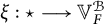 $\xi : \star \longrightarrow \mathbb {V}_F^{\mathcal {B}}$
on F with coefficients in
 $\mathcal {B}$
be given. Then, for
 $o,o' \in \mathfrak {A}_{\mathcal {O}}$
,
 $$ \begin{align} \xi_o \star \xi_{o'} = \xi_{o\star o'} . \end{align} $$
Proof The transformation
 $\xi \circ J$
from the lax monoidal functor
 $\star : \mathfrak {A}_{\mathcal {O}}\longrightarrow \mathcal {S}(I,I)$
to
 $\mathbb {V}_F^{\mathcal {B}} \circ J =R$
(this is how R was defined, see (11.1)) is monoidal because J is lax symmetric monoidal and
 $\xi $
is by assumption monoidal. This implies (11.2).
The following gives us a far-reaching generalization of the multiplicative structures built in [Reference JuhászJuh18, Section 5.2] on the state spaces of a three-dimensional topological field theory:
Corollary 11.3 Let
 $\mathcal {B}$
be a
 $\mathsf {Lex}^{\mathsf {f}}$
-valued ansular functor such that the ribbon Grothendieck–Verdier category obtained by evaluation on the circle comes with a self-dual unit. Then, there are natural unital and associative product maps
 $$ \begin{align*} \star : \mathcal{B}(H) \otimes \mathcal{B}(H') \longrightarrow \mathcal{B}(H \# H') \end{align*} $$
for handlebodies without embedded disks, where
 $\#$
is the connected sum.
The spaces of conformal blocks appearing here are for handlebodies without embedded disks in their boundary, but in order to have the operation
 $\star $
, one still needs to fix disks at which the connected sum is taken. The equivariance of the
 $\star $
-operation in the sense of Theorem 11.1 (iii) is for the handlebodies groups of the handlebodies with these disks.
Proof of Corollary 11.3
This follows if we apply Theorem 11.1 to the self-dual object I and by noting that
 $\mathcal {B}(H)\cong \mathcal {B}(H_2;I,I)$
for every handlebody H without embedded disks, where
 $H_2$
is the same handlebody with two disks embedded in its boundary.
For the direct sum
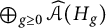 $\bigoplus _{g\ge 0} \widehat {\mathcal {A}}(H_g)$
, this implies the following consequence.
Corollary 11.4 For any ribbon Grothendieck–Verdier category
 $\mathcal {A}$
in
 $\mathsf {Lex}^{\mathsf {f}}$
with self-dual monoidal unit, the direct sum of the spaces of conformal blocks at all genera (without boundary components) is naturally an algebra graded over the genus. By equipping the spaces of conformal blocks for all handlebodies H with this multiplicative structure, we obtain a strictly finer invariant of the ansular functor than just the representations on all handlebodies H without embedded disks.
Proof The first part follows directly from Corollary 11.3. The second part will be a consequence of Example 11.5.
Example 11.5 We thank Ingo Runkel and Christoph Schweigert for bringing this example to our attention. Let F be a finite-dimensional commutative algebra and
 $\mathcal {A}$
the category of finite-dimensional F-modules equipped with the symmetric monoidal product
 $\odot $
defined by
 $X \odot Y := (Y^* \otimes _F X^*) ^*$
for F-modules X and Y, where
 $-^* : \mathcal {A}\longrightarrow \mathcal {A}^{\mathrm {op}}$
takes the contragredient F-module, namely, the linear dual, seen as right F-module and then also left F-module by commutativity. Now
 $(\mathcal {A},\odot ,*)$
is a Grothendieck–Verdier category in
 $\mathsf {Lex}^{\mathsf {f}}$
(with
 $\otimes _F$
,
 $\mathcal {A}$
would be a Grothendieck–Verdier category in
 $\mathsf {Rex}^{\mathsf {f}}$
; the second monoidal product
 $\odot $
obtained by conjugation with the duality as in [Reference Boyarchenko and DrinfeldBD13] (see also (7.1) above) is then left exact). The product
 $\odot $
is symmetric. With the trivial braiding and the trivial balancing,
 $\mathcal {A}$
becomes a ribbon Grothendieck–Verdier category in
 $\mathsf {Lex}^{\mathsf {f}}$
. By seeing F as a vertex operator algebra, this can be viewed as a special case of the construction of the ribbon Grothendieck–Verdier structure on categories of modules of vertex operator algebras [Reference Allen, Lentner, Schweigert and WoodALSW25, Theorem 2.12]. With the Peter–Weyl Theorem in the form of [Reference Fuchs, Schaumann and SchweigertFSS20, Corollary 2.9], we find
 $\int ^{X \in \mathcal {A}} X^* \boxtimes X \cong F^*$
as objects in
 $\mathcal {A}\boxtimes \mathcal {A}$
, i.e., as F-bimodules. Let us now assume that F is even a Frobenius algebra, so that
 $F^* \cong F$
as F-bimodules. Then, we find
 $\mathbb {F} = \odot \left ( \int ^{X \in \mathcal {A}} X^* \boxtimes X \right )\cong F$
. In other words, the canonical coend is the monoidal unit
 $F \in \mathcal {A}$
. This entails that the space of conformal blocks for the handlebody
 $H_g$
of genus g without embedded disks is given by
 $\widehat {\mathcal {A}}(H_g)\cong \mathcal {A}(I,\mathbb {F}^{\otimes g})=\mathrm {Hom}_F(F,F)\cong F$
thanks to [Reference Müller and WoikeMW23a, Theorem 7.8]; the handlebody group representation is trivial. In fact,
 $\mathcal {A}$
produces not only an ansular, but a modular functor, even though
 $\mathcal {A}$
is generally not rigid. The spaces of conformal blocks
 $\widehat {\mathcal {A}}(H_g)$
are the same as for the ribbon Grothendieck–Verdier category
 $\mathsf {vect}^{\oplus n}$
with
 $n:=\mathrm {dim} \, F$
, but the multiplicative structure on
 $\bigoplus _{g\ge 0} \widehat {\mathcal {A}}(H_g)$
, which is induced by the multiplication of F, is different from the corresponding one for
 $\mathsf {vect}^{\oplus n}$
if F is not semisimple. Note also that if F is not semisimple,
 $\mathcal {A}$
and
 $\mathsf {vect}^{\oplus n}$
give us an easy example of two ribbon Grothendieck–Verdier categories that produce non-equivalent modular functors whose mapping class group representations of closed surfaces, however, agree at all genera. This is, in a rather generalized sense, another instance of the fact that “modular data” is generally insufficient for the description of modular functors [Reference Mignard and SchauenburgMS21].
Proposition 11.6 Let
 $\mathcal {A}$
be a finite ribbon category. Then, the products
 $$ \begin{align} \star : \widehat{\mathcal{A}}(H) \otimes \widehat{\mathcal{A}}(H') \longrightarrow \widehat{\mathcal{A}}(H\# H') \end{align} $$
are injective.
Without the hypotheses that
 $\mathcal {A}$
is finite ribbon, this is generally wrong: In the Example 11.5, the products (11.3) are given by the multiplication operation
 $F \otimes F \longrightarrow F$
of the commutative Frobenius algebra F. Clearly, this map is not injective if
 $\mathrm {dim}\, F \ge 2$
.
Proof of Proposition 11.6
We use [Reference Müller and WoikeMW23a, Theorem 7.8] to see that, after choosing a cut system for H with genus g and
 $H'$
with genus
 $g'$
, the map
 $\star $
is given by the map

Here,
 $\oint $
is the left exact coend [Reference LyubashenkoLyu96] (see [Reference Müller and WoikeMW23a, Theorem 6.4] for the connection to the gluing of modular algebras. From this, we deduce that the multiplication map
 $\star $
 $$ \begin{align} \mathcal{A}(I,\mathbb{F}^{\otimes g}) \otimes \mathcal{A}(I,\mathbb{F}^{\otimes g'})\longrightarrow \mathcal{A}(I,\mathbb{F}^{\otimes (g+g')}) \end{align} $$
is just the map induced by
 $\otimes $
. Since I is simple, this map is injective by [Reference Müller and WoikeMW23b, Lemma 4.6].
Note that the multiplicative structure can, after choosing a cut system, be written down directly via (11.4). With this purely algebraic description, the independence of the cut system and the equivariance with respect to the mapping class group actions that is a part of Corollary 11.3 seem hard to see. The question whether there are products on spaces of conformal blocks with respect to the connected sum – a structure that is not part of the axioms of ansular or modular functors – was posed to us by Simon Lentner and Christoph Schweigert. The results of this section, in particular Corollary 11.3, provide a purely topological construction of these operations.
Proposition 11.7 For a finite ribbon category
 $\mathcal {A}$
, the distinguished
 $\mathsf {Map}(H)$
-invariant vectors
 $\xi _H \in \widehat {\mathcal {A}}(H)$
are non-zero for all handlebodies and satisfy
 $$ \begin{align} \xi_H \star \xi_{H'} = \xi_{H \# H'}. \end{align} $$
One might first think that
 $\mathcal {A}=0$
has to be excluded, but the trivial linear monoidal category is not a finite ribbon category because
 $\mathsf {End}_{\mathcal {A}}(I)\neq k$
in that case.
Proof First we observe that Corollary 11.2 gives us (11.5).
Let us now prove
 $\xi _H \neq 0$
: By construction
 $\xi _{\mathbb {B}^3} \in \mathcal {A}(I,I)$
is
 $\mathrm {id}_I \neq 0$
and
 $\xi _{\mathbb {D}^2 \times \mathbb {S}^1} \in \mathcal {A}(I,\mathbb {F})$
is the map
 $I\cong I^\vee \otimes I \longrightarrow \int ^{X\in \mathcal {A}}X^\vee \otimes X$
which is unit of Lyubashenko’s algebra structure on
 $\mathbb {F}$
[Reference LyubashenkoLyu95b, Section 2] and hence non-zero. If H has genus g, then
 $\xi _H=\xi _{\mathbb {D}^2 \times \mathbb {S}^1}^{\star g}$
by (11.5). This is non-zero by Proposition 11.6 since we have just seen
 $\xi _{\mathbb {D}^2 \times \mathbb {S}^1}\neq 0$
.
Lemma 11.8 Let
 $\mathcal {A}$
be a unimodular finite ribbon category. If for any handlebody H with genus g
 $$ \begin{align*} \mathrm{dim}\, \widehat{\mathcal{A}}(H)< 2^g \end{align*} $$
for the space of conformal blocks, then
 $\mathcal {A}\simeq \mathsf {vect}$
.
Proof We show
 $\mathrm {dim}\, \widehat {\mathcal {A}}(H)\ge 2^g $
if
 $\mathcal {A} \neq \mathsf {vect}$
. In fact, thanks to
 $\mathrm {dim}\, \widehat {\mathcal {A}}(H) \cdot \mathrm {dim}\, \widehat {\mathcal {A}}(H) \le \mathrm {dim}\, \widehat {\mathcal {A}}(H \# H')$
(see Proposition 11.6), it suffices to prove
 $\mathrm {dim}\, \widehat {\mathcal {A}}(\mathbb {D}^2 \times \mathbb {S}^1)\ge 2$
. By [Reference Müller and WoikeMW23a, Theorem 7.8]
 $\widehat {\mathcal {A}}(\mathbb {D}^2 \times \mathbb {S}^1)\cong \mathcal {A}(I,\mathbb {F})$
, which is at least two-dimensional by [Reference ShimizuShi19, Lemma 5.7] if
 $\mathcal {A}\neq \mathsf {vect}$
.
Theorem 11.9 Let
 $\mathcal {A}$
be a unimodular finite ribbon category. If
 $\mathcal {A}\neq \mathsf {vect}$
and H is a handlebody without embedded disks and genus
 $g\ge 1$
, then the
 $\mathsf {Map}(H)$
-representation
 $\widehat {\mathcal {A}}(H)$
is not irreducible.
Clearly, if
 $\mathcal {A}=\mathsf {vect}$
or
 $H=\mathbb {B}^3$
, the representation would be k with trivial action and hence irreducible.
Proof of Theorem 11.9
The
 $\mathsf {Map}(H)$
-representation
 $\widehat {\mathcal {A}}(H)$
contains the non-zero subrepresentation
 $k \cdot \xi _H$
(with trivial
 $\mathsf {Map}(H)$
-action) by Proposition 11.7. Thanks to
 $\mathcal {A}\neq \mathsf {vect}$
, this is a proper subrepresentation by Lemma 11.8.
Example 11.10 (Symmetric categories)
Let
 $\mathcal {A}$
be a finite ribbon category. By Proposition 11.6 we have an injective map
 $$ \begin{align*} \star : \widehat{\mathcal{A}}(H_1) ^{\otimes g} \longrightarrow \widehat{\mathcal{A}}(H_g) . \end{align*} $$
Let us think of the handlebody
 $H_g$
as embedded in
 $\mathbb {R}^3$
. The map
 $\star $
becomes
 $\mathbb {Z}_g$
-equivariant if we let the generator
 $1 \in \mathbb {Z}_g$
act on
 $\widehat {\mathcal {A}}(H_1) ^{\otimes g}$
by
 $v_1 \otimes v_2 \otimes \dots \otimes v_g \longmapsto v_g \otimes v_1 \otimes \dots \otimes v_{g-1}$
(cyclic permutation), and act on
 $\widehat {\mathcal {A}}(H_g)$
by a rotation of
 $H_g$
by
 $2\pi /g$
as indicated in the following picture (see also [Reference Farb and MargalitFM12, Section 13.2.1]):

Here, the numbering of the copies of
 $H_1$
and the sense of the rotation have to be chosen accordingly of course. If
 $\mathcal {A}$
is not
 $\mathsf {vect}$
, then the
 $\mathbb {Z}_g$
-action on
 $\widehat {\mathcal {A}}(H_1) ^{\otimes g}$
is faithful thanks to Lemma 11.8. By injectivity of
 $\star ,$
the same is true for the rotation action on
 $ \widehat {\mathcal {A}}(H_g)$
.
Suppose now that our finite ribbon category
 $\mathcal {A}$
is symmetric, and we choose the identity as ribbon structure. By what we have just seen the handlebody group action on
 $\widehat {\mathcal {A}}(H_g)$
cannot be trivial unless
 $\mathcal {A}=\mathsf {vect}$
. Clearly, all elements in the twist group (see (10.2)) act trivially, but the action of
 $\mathsf {Out}(F_g)$
can still be non-trivial! If the action on
 $\widehat {\mathcal {A}}(H_g)$
extended to the mapping class group of
 $\partial H_g$
, then this could only be a trivial action because
 $\mathsf {Map}(\partial H_g)$
is generated by Dehn twists, and all of these act trivially [Reference Müller and WoikeMW23b, Theorem 4.8] – a contradiction. We conclude that a finite symmetric tensor category that is not
 $\mathsf {vect}$
does not extend to a modular functor. This might be a little bit surprising because a first naïve intuition might tell us that we can just build a modular functor with trivial mapping class group actions. Note that by Example 11.5, there are actually symmetric ribbon Grothendieck–Verdier categories that extend to a modular functor, but rigid ones with simple unit do not, unless they are
 $\mathsf {vect}$
!
12 A moduli space for open conformal field theories
In this last section, we explain how the modular microcosm principle can be used to construct and study moduli spaces of conformal field theories. This will be worked out here for open conformal field theories; extensions to other situations will be considered elsewhere. An idea developed most notably in [Reference Fuchs, Runkel and SchweigertFRS02, Reference Fuchs, Runkel and SchweigertFRS04a, Reference Fuchs, Runkel and SchweigertFRS04b, Reference Fuchs, Runkel and SchweigertFRS05, Reference Fjelstad, Fuchs, Runkel and SchweigertFFRS06a] is that conformal field theories are described as a pair of a category encoding the monodromy data (this can be for example a tensor category coming from a vertex operator algebra) and a consistent system of correlators (that takes the form of some sort of Frobenius algebra). These pairs can be organized in a moduli space as follows (we consider the open case): By sending an open modular functor
 $\mathfrak {B}$
to the modular algebras with coefficients in
 $\mathfrak {B}$
, we obtain a functor
 $\mathsf {ModAlg}(\mathsf {O};-):\mathsf {ModAlg}(\mathsf {O}) \longrightarrow \mathsf {Cat}$
. This allows us to define a moduli space of open conformal field theories (in
 $\mathsf {Lex}^{\mathsf {f}}$
) by taking the nerve and realization of the Grothendieck construction of this functor
 $$ \begin{align*} \mathsf{OpenCFT} := \left|B\int \left( \mathsf{ModAlg}(\mathsf{O};-):\mathsf{ModAlg}(\mathsf{O}) \longrightarrow \mathsf{Cat} \right)\right| . \end{align*} $$
By its definition and Theorem 8.3,
 $\mathsf {OpenCFT}$
is a space whose points are pairs
 $C=(\mathcal {A},F)$
of the monodromy data of the open conformal field theory (which is a pivotal Grothendieck–Verdier category
 $\mathcal {A}$
) and a consistent system of open correlators (which is a symmetric Frobenius algebra F in
 $\mathcal {A}$
). We denote by
 $\mathsf {OpenCFT}|_{\mathcal {A}} \subset \mathsf {OpenCFT}$
the subspace of
 $\mathsf {OpenCFT}$
consisting of those open conformal field theories whose monodromy data is (equivalent to)
 $\mathcal {A}$
.
Theorem 12.1 Let
 $C=(\mathcal {A},F)$
be an open conformal field theory given by its monodromy data, namely, a pivotal Grothendieck–Verdier category
 $\mathcal {A}$
in
 $\mathsf {Lex}^{\mathsf {f}}$
and a symmetric Frobenius algebra F in
 $\mathcal {A}$
. Then, there is the following seven-term exact sequence

in which the last two non-trivial terms are pointed sets.
We will prove this result by realizing that this seven-term exact sequence is the long exact sequence of homotopy groups for the following fiber sequence.
Proposition 12.2 For any pivotal Grothendieck–Verdier category
 $\mathcal {A}$
in
 $\mathsf {Lex}^{\mathsf {f}}$
, there is a homotopy fiber sequence
 $$ \begin{align*} |B\mathsf{SymFrobAlg}(\mathcal{A})|\longrightarrow \mathsf{OpenCFT}|_{\mathcal{A}} \longrightarrow |B \mathsf{AUT}(\mathcal{A})| \end{align*} $$
Proof Thanks to [Reference ThomasonTho79, Theorem 1.2], there is a homotopy equivalence
 $$ \begin{align*} \mathsf{OpenCFT} \simeq \underset{\mathfrak{B} \in \mathsf{ModAlg}(\mathsf{O}) }{\operatorname{hocolim}}\, |B\mathsf{ModAlg}(\mathsf{O};\mathfrak{B})| . \end{align*} $$
From Theorem 8.3, we can now conclude that
 $\mathsf {OpenCFT}|_{\mathcal {A}}$
is homotopy equivalent to the homotopy quotient
 $|B\mathsf {SymFrobAlg}(\mathcal {A})| // \mathsf {AUT}(\mathcal {A})$
of the the space
 $|B\mathsf {SymFrobAlg}(\mathcal {A})|$
by the 2-group
 $\mathsf {AUT}(\mathcal {A})$
. This gives us the desired homotopy fiber sequence.
Example 12.3 Let
 $\mathcal {A}$
be a pivotal finite tensor category. Consider the symmetric Frobenius algebra
 $I\in \mathcal {A}$
, and the open conformal field theory
 $C=(\mathcal {A},I)$
. Then,
 $\mathsf {Aut}_{\text {sym Frob. alg.}}(I)=1$
, which implies that
 $\pi _2(\mathsf {OpenCFT},C)$
is the group of cyclic automorphisms of
 $\mathrm {id}_{\mathcal {A}}$
, i.e. monoidal automorphisms
 $\lambda _X:X\longrightarrow X$
with
 $\lambda _X^\vee = \lambda _{X^\vee }$
for all
 $X\in \mathcal {A}$
. Since all cyclic automorphisms of
 $\mathcal {A}$
preserve the symmetric Frobenius algebra I,
 $\pi _1(\mathsf {OpenCFT},C)$
is the group of cyclic automorphisms of
 $\mathcal {A}$
up to isomorphism.
Acknowledgements
I would like to thank Christoph Schweigert for extremely valuable discussions and explanations regarding correlators, helpful comments on Example 11.5 and for sharing with me an early draft of [Reference Fuchs, Schaumann, Schweigert and WoodFSSW24]. The algebraic foundations for Frobenius structures in Grothendieck–Verdier categories developed therein have allowed to write a substantial part of this article in a much more concise way. Moreover, I would like to thank Adrien Brochier, Aaron Hofer, Lukas Müller, Yang Yang, and Deniz Yeral for helpful discussions and comments related to this project, and Ingo Runkel for helpful remarks with respect to Example 11.5. Finally, I would like to thank the anonymous referee whose comments have helped improve the manuscript.



