Wandering spleen is an uncommon clinical entity in which the spleen moves freely in the abdominal cavity due to a congenital defect or dysplasia of the splenic anchoring ligament or weakening of the supporting tissue due to hormonal changes or external traction. The clinical presentation of wandering spleen varies; however, the most dangerous complication is splenic torsion. Reference Brown, Virgilio and Vazquez1
Although there have been several reports of torsion of wandering spleen in children, Reference Taylor and Howard-Claudio2 to our knowledge, there have been only three reports of cases associated with situs inversus. Reference Bienkowski and Bienkowski3–Reference Matsushita, Inoue and Kusunoki5
Here, we report the case of a 6-year-old girl with a single right ventricle and complete situs inversus who developed wandering spleen torsion after the Fontan surgery and underwent splenectomy.
Case
A 6-year-old girl who had undergone Fontan operation for double-inlet right ventricle, pulmonary atresia, and situs inversus presented to our hospital with symptoms of vomiting and abdominal pain.
The patient had undergone gastric fixation and appendectomy for gastric volvulus at the age of 1 year and 3 months. After the surgery, the patient had occasional gastric dilatation and vomiting; hence, detailed abdominal examination including ultrasonography was performed repeatedly, but did not lead to the diagnosis of wandering spleen.
At the age of 3 years and 3 months, she underwent Fontan operation. After the procedure, similar symptoms were occasionally observed; however, they resolved spontaneously.
At the age of 3 years and 6 months, during a regular visit after the Fontan operation, a mass without abdominal pain was palpated in the lower abdominal midline and diagnosed as wandering spleen by CT. The size of the spleen was larger than in the CT before the Fontan operation. Moreover, the risk of torsion was considered; however, due to the young age of the patient, conservative follow-up was decided.
Abdominal ultrasonography performed at the time of the emergency visit due to abdominal pain and vomiting showed an enlarged spleen in the midline, and absence of splenic torsion was confirmed in colour Doppler.
However, her abdominal pain worsened after admission, and a contrast-enhanced CT revealed disruption of blood flow to the spleen and splenic torsion, requiring emergency surgery.
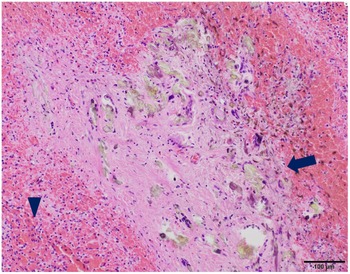
Intraoperatively, the splenic surface appeared congested. The splenic artery and vein were contained within a single structure and rotated clockwise. The spleen was easily removed because the ligament had become vulnerable. The spleen was enlarged to 8.5 × 7.5 × 6.0 cm and weighed 450 g. Histopathology revealed mixed state of acute and chronic congestion (Fig 1).
Microscopic image of the spleen, stained with haematoxylin and eosin (×100). Splenic sinus and cord are filled with red blood cells, with haemorrhage(arrowhead). Additionally, deposition of haemosiderin, thickening fibrosis of splenic cords, and Gamna-Gandy nodules (arrow) are present.

The patient was extubated the day after surgery. Oral intake was started on post-operative day 2. On post-operative day 14, the patient was inoculated with a 23-valent pneumococcal vaccine and discharged on prophylactic antibacterial medication.
Discussion
Torsion of wandering spleen is a rare condition, accounting for <0.2% of splenectomy. Reference Taylor and Howard-Claudio2 In particular, situs inversus and single ventricle with wandering spleen are extremely rare. Reference Bienkowski and Bienkowski3–Reference Matsushita, Inoue and Kusunoki5
In contrast, gastric volvulus has been reported more frequently in patients with situs inversus and single ventricle. Reference Koga, Yamada, Kobayashi, Lane and Miyano6 In patients with situs inversus and gastric volvulus, weakness of the gastrosplenic ligament may occur, which may facilitate splenic migration. Concomitant with this pathophysiology, in single ventricle patients, post-operative haemodynamics of the Fontan procedure may lead to high central venous pressure and portal hypertension due to hepatic congestion, resulting in splenomegaly. The progression of splenomegaly may lead to further splenic migration.
In the present case, there was a history of gastric volvulus, and the wandering spleen appeared after the Fontan operation, suggesting these possible mechanisms.
Torsion of the spleen is a rare but life-threatening condition that requires emergency surgery. Predicting the onset of the disease is very crucial.
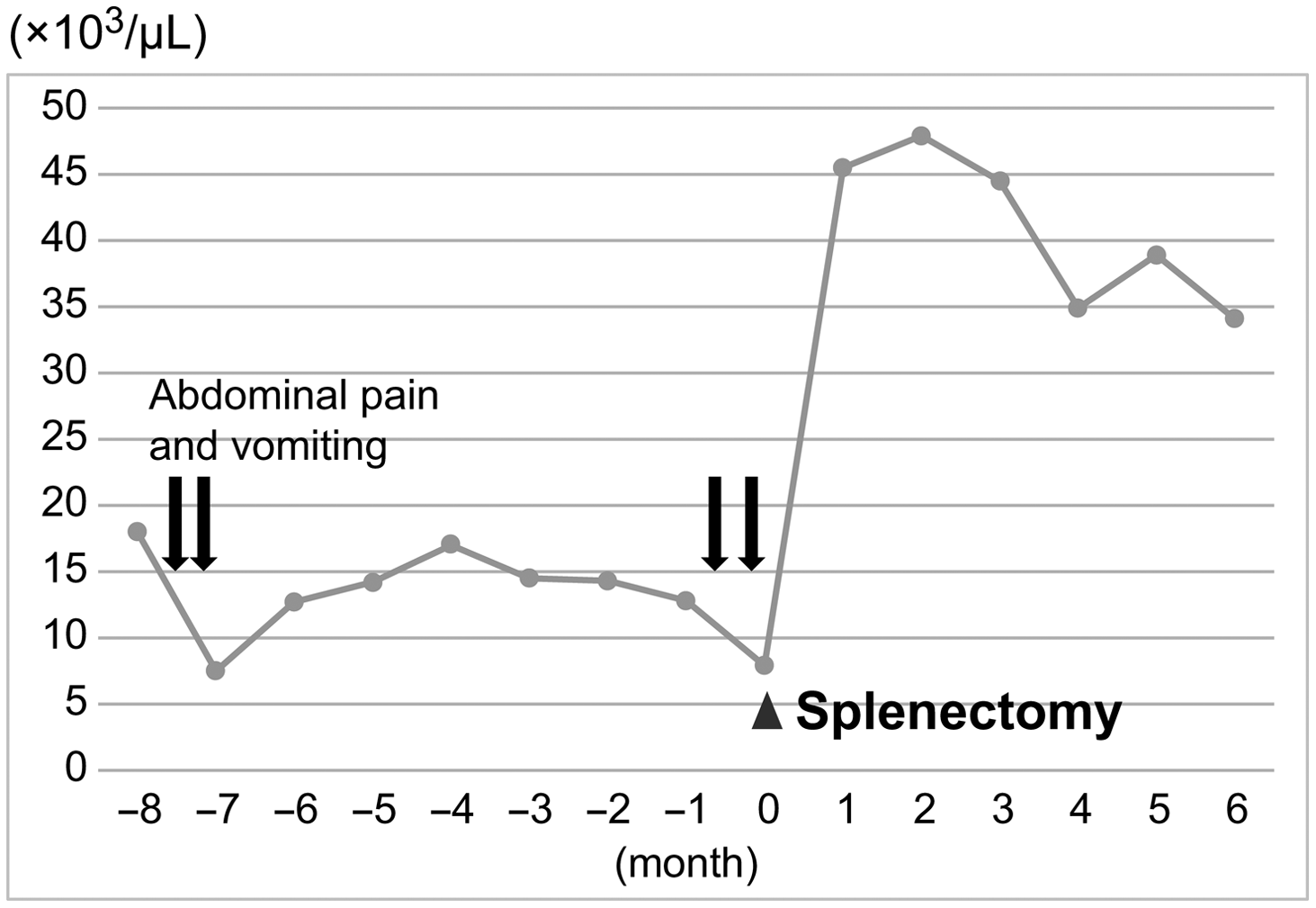
In view of the scattered reports of thrombocytopenia due to wandering spleen Reference Magowska7 and thrombocytopenia due to splenomegaly after Fontan surgery, Reference Rathgeber, Guttman and Lee8 we investigated the platelet count of the patient retrospectively and found that the platelet count decreased when the frequency of vomiting and abdominal pain increased (Fig 2). Furthermore, histopathology revealed the presence of chronic venous obstruction, occurring due to repeated mild torsion.
Graph shows that the platelet count was generally low before splenectomy; however, the platelet count decreased even further and became 100,000/µL at that time of worsening abdominal pain and vomiting.

We hypothesised that the impaired venous return caused by the torsion of the spleen led to splenic congestion, resulting in a transient state of hypersplenism. This suggests that platelet count is a good predictor of whether or not torsion develops.
To clarify this hypothesis, it would be desirable to evaluate the size of spleen concurrently with platelet count. The presented case is extremely rare that data from similar cases need to be collected and analysed to formulate an appropriate management strategy for complicated wandering spleen after the Fontan operation.
Conclusion
In patients with situs inversus and single ventricle, especially when gastric torsion occurs, it is necessary to be aware of the development of wandering spleen due to splenomegaly after the Fontan operation in addition to gastrosplenic ligament weakness.
Since wandering splenic torsion is a serious life-threatening condition, it is critical to predict the risk of torsion, and platelet count may be useful in predicting torsion.
Acknowledgements
We would like to thank Editage (www.editage.com) for English language editing.
Financial support
This research received no specific grant from any funding agency, commercial, or not-for-profit sectors.
Conflict of interest
None.
Ethical standards
The authors declare that they comply with appropriate institutional and international guidelines for ethical guidelines. Informed consent was obtained from the patient to publish this case report.