Scabies is a contagious parasitic dermatosis caused by the mite Sarcoptes scabiei variety hominis, affecting annually 300 million individuals worldwide.Reference Diaz 1 The parasitic burden in classical scabies is low (10–15 mites) and person-to-person transmission requires close skin contact.Reference Del Borgo, Belvisi, Tieghi and Mastroianni 2 By contrast, mites can number in the millions in crusted scabies (Norwegian), a highly contagious hyperkeratotic diffuse skin disease similar to psoriasis with less intense or no itching, which is commonly seen in immunodeficient individuals.Reference Diaz 1 – Reference Khan, O’Grady and Muller 3 Scabies outbreaks have been reported in various healthcare settings, frequently following the admission of a patient with unrecognized crusted scabies.Reference Lettau 4 , Reference Vorou, Remoudaki and Maltezou 5 These outbreaks are generally difficult to control and are associated with prolonged hospitalization, possible ward closure, and economic burden.Reference Khan, O’Grady and Muller 3
This article describes a large outbreak associated with a crusted scabies case in an immunocompromised patient following treatment with tumor necrosis factor (TNF)-α inhibitor (adalimumab) for psoriatic arthritis. The index case underwent 2 consecutive hospital admissions over a 2-week period and was admitted to different hospital areas without any specific precautions before the diagnosis of this highly contagious form of scabies was established.
METHODS
The study was carried out in the 400-bed tertiary acute care hospital SM Goretti in Latina town near Rome. An outbreak control team composed of physicians specialized in infectious diseases, dermatologists, public health and nursing staff was activated. Case definitions were adopted according to the current clinical practice guidelines.Reference Diaz 1 – Reference Khan, O’Grady and Muller 3
All subjects who manifested pruritus and dermatological signs were defined as secondary scabies cases and were treated with 2 doses of 5% permethrin with a 1-week interval. The outbreak control team divided contacts in 2 groups: (1) index case contacts who had substantial contact with the crusted scabies environment (higher transmission risk) and (2) classic scabies contacts who had household contact, prolonged skin to skin contact (at least 10–15 minutes), or handled infested clothing or bed linen (lower transmission risk).
All contacts were traced, including contacts of secondary cases, and were visited by trained healthcare professionals and were treated. A 24-hour phone line was set up to provide medical advice. Strict contact control measures were implemented in the hospital. Active surveillance with clinical evaluation of exposed persons was performed for 4 weeks after the last case was identified. Contacts were administered prophylactically with 1 topical dose of 5% permethrin cream that was rinsed off after 12 hours.
RESULTS
Clinical Case
A 65-year-old immunocompromised female, with psoriatic arthritis treated with the TNF-α inhibitor adalimumab, was admitted to the Emergency Department following a bone fracture. After fracture stabilization in the orthopaedic ward, she was transferred to a general medicine ward and was discharged 1 week later. A diffuse rash was observed and was considered to be psoriasis. Due to her worsening clinical condition, she was readmitted to a general medicine ward 4 days later; she was subsequently transferred to the infectious diseases ward. This patient had an unusual hyperemic rash on the surface of her entire body with no itching. Crusted scabies was clinically diagnosed and confirmed by detection of mites at scraping. She was treated with repeated permethrin 5% cream topical administration, parenteral rehydration, and a course of systemic antibiotics.
Outbreak Investigation
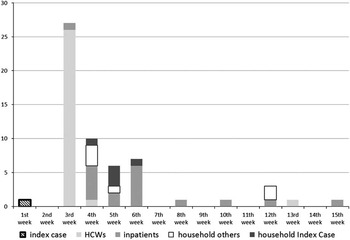
The outbreak involved 57 cases with classical scabies: 28 (49.1%) healthcare workers (HCWs), 18 (31.6%) inpatients, and 11 (19.3%) household secondary cases, 5 of whom were relatives of the index patient. HCWs affected by classical scabies were 24 nurses, 1 nursing student, 1 physician, 1 radiology technician, and 1 laundry worker. The outbreak involved 8 hospital areas: the internal medicine ward (23 HCWs, 10 patients), the orthopedic ward (4 patients), the emergency department (3 patients), the ophthalmology ward (1 patient), the radiology unit (1 HCW), the cardiology unit (1 HCW), an ambulance (1 patient), and the laundry facility (1 worker). The epidemic lasted 12 weeks (Figure 1).
Weekly epidemic curve of 57 classic scabies cases, originating from an index case with crusted scabies in the tertiary acute care hospital Santa Maria Goretti in Latina.

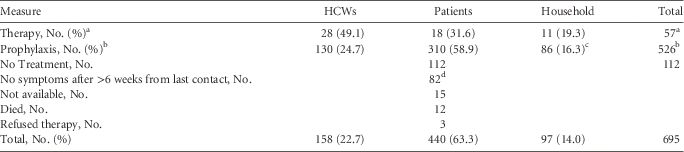
Overall, 695 people were included on the contact list; all were recalled for active surveillance, screened, and evaluated for treatment or prophylaxis (Table 1). The overall attack rate was 8.2% (57 of 695), which was higher among HCWs (17.7%), followed by secondary case house-members (11.3%), and other inpatients (4.1%). Among inpatients, the attack rate was very high in the small group that shared the same room with the index case for at least 24 hours (17.6%). Similarly, index-case house members had a 100.0% attack rate (5 of 5), whereas all other secondary household contacts showed only a 6.5% attack rate. In total, 20 of 57 secondary cases (35.1%) were diagnosed by active contact tracing and occurred before they were reached for prophylaxis.
Summary of Treatment Measures Adopted in Scabies Cases and Contacts

a Two administrations of 5% permethrin cream.
b One administrations of 5% permethrin cream.
c Among contacts of secondary non-crusted scabies cases, only strict contacts were evaluated and all underwent prophylaxis.
d Human incubation period from initial infestation to symptoms development is 3–6 weeks.
All HCWs without signs of disease at clinical evaluation underwent prophylaxis and none developed scabies. Only household contacts of secondary cases were recalled and evaluated for permethrin pre-emptive treatment. Overall, 583 (84%) subjects were administered 5% permethrin, and the 112 who did not receive any specific prophylactic treatment were all inpatients (Table 1).
Approximately 700 examinations were conducted by 8 physicians, and ~640 individual topical therapies were performed, at an estimated cost of €30,000 (US ~$32,500). A galenic preparation of 5% permethrin cream was prepared by the hospital pharmacy at a direct treatment-related cost of ~€5,000 (US ~$5,400). Finally, the outbreak caused a 20-bed ward closure for 48 hours, with an estimated loss of €16,000 (US ~$17,300).
DISCUSSION
We report a scabies outbreak associated with an index patient who had Norwegian scabies and who had been treated with the TNF-α inhibitor adalimumab. In recent years, TNF-α inhibitors have provided an important armamentarium in the treatment of various chronic immune-mediated diseases. However, these patients are at increased risk for serious infections, such as active tuberculosis and invasive bacterial, viral, and fungal infections. Skin is the second most frequently involved site, accounting for 22%–35% of severe infections.Reference Singh, Cameron and Noorbaloochi 6 , Reference Regnier-Rosencher, Farhi, Lebrun, Salliot, Dougados and Dupin 7 Other case reports of crusted scabies have been associated with the use of TNF-α inhibitors (infliximab and etanercept) but not with large nosocomial outbreaks.Reference Pipitone, Adams, Sheth and Graham 8 , Reference Saillard and Darrieux 9
In 2 reviews on nosocomial scabies,Reference Regnier-Rosencher, Farhi, Lebrun, Salliot, Dougados and Dupin 7 , Reference Pipitone, Adams, Sheth and Graham 8 almost all index patients responsible for hospital transmission had crusted scabies. These patients harbor a greater number of parasites and are thus more contagious than people with classic scabies. The atypical presentation of crusted scabies is a major cause of delayed diagnosis. Especially in immunocompromised patients, itching may be minimal or sometimes even absent.Reference Diaz 1 , Reference Del Borgo, Belvisi, Tieghi and Mastroianni 2 In agreement with other studies,Reference Buehlmann, Beltraminelli and Strub 10 the highest attack rate in this outbreak (17.7%) was observed among HCWs.
Meticulous contact tracing was of paramount importance in controlling this outbreak; without it, a large number of cases would have been missed, allowing continued transmission.
Our observation confirms efficacy of permethrin prophylaxis; no cases were observed after the administration of permethrin to exposed persons.
The overall impact of the outbreak in terms of time and resources for the healthcare setting was significant, and controlling it presented enormous challenges. The hospital scabies outbreak caused a wave of negative publicity with loss of patients and initiation of malpractice suits. The management protocol of this present outbreak underlines the importance of promptly identifying crusted scabies, tracing rapidly all possible contacts, adopting mass prophylactic treatment, and developing an effective internal communication strategy designed to encourage staff to report symptoms while minimizing the anxiety provoked by scabies outbreaks.
The increasing number of patients treated with TNF-α inhibitors should cause clinicians to consider this serious parasitic infection when evaluating individuals who have skin rashes and who are receiving biologic therapies.
ACKNOWLEDGMENTS
The authors would like to acknowledge Hospital Health Direction, medical, and nursing staff for their work. The authors wish to also acknowledge Dr. Luisa Di Macio (Occupational Medicine) and Dr. Alessandra Mingarelli and her staff (Department of Pharmacy, Latina) for their great collaboration.
Financial support: No financial support was provided relevant to this article.
Potential conflicts of interest: All authors report no conflicts of interest relevant to this article.