The International Criminal Court (ICC) emerged with an unprecedented mandate to develop and enforce international criminal law after decades of planning, diplomacy, statute drafting, and experience with ad hoc courts. It prosecutes primary perpetrators, planners, and conspirators for crimes common to modern warfare and repression, with personal jurisdiction over state party nationals and those on state party territory. It constrains member states’ sovereignty by prosecuting at will (proprio motu), excluding customary immunities, and having competence to override the primary jurisdiction of national courts—a principle magnified in the Rome Statute to limit the ne bis in idem rights of persons under its jurisdiction.Footnote 1 Its parties relinquish their rights to discontinue the court's exercise of jurisdiction when exiting the Rome Statute, and they may exit only at long delay. The treaty's nonreservability, nonderogability, and supermajoritarain amendment rules create an unusual uniformity and inflexibility in states’ obligations to the court.
The puzzle is that leaders of 123 states nevertheless accepted the court's jurisdiction between 1998 and 2017, a period in which 44 percent of them were autocratic and 28 percent experienced civil conflict. The gravity of obligations to the ICC exceeds that undertaken by the few leaders who accept the compulsory jurisdiction of the International Court of Justice. The ICC and previous international criminal tribunals have been quite active—prosecuting hundreds of high-ranking state officials, including incumbent leaders, one of whom consented to the court's jurisdiction years earlier.Footnote 2 Yet the leaders of Burundi and the Philippines are alone in seeking to formally exit the treaty, decisions they made after becoming likely targets of investigation.Footnote 3
In this article I develop the argument that a primary motive for autocrats to accept the ICC's jurisdiction is to marginalize political competitors. Autocrats trade off the ICC's potential to harm their own careers in unwanted prosecutions against the similar threat that the court poses to contenders for office and the foreign patrons of the state's domestic enemies. The court's power to harm political careers stems from its ability to credibly communicate personal guilt for atrocities. This may trigger economic punishment by wealthy democracies that prefer to keep atrocity doers out of office. Leaders may exploit their control over inculpatory evidence to preemptively sabotage investigations and prosecutions—to a degree determined by the institutionalization of electoral turnover. But the court's discoveries of guilt result from evidence made credible by the court's relative legitimacy, resourcefulness, and judicial integrity. Incumbents’ reliance on publicly financed foreign capital to gain and keep office is crucial to explaining the deterrent capacity of prosecutions resting on broad criminal-liability theories. The risk of losing foreign capital raises the opportunity cost to domestic elites and foreign patrons of internal enemies of involving themselves with antiregime violence.
I document patterns consistent with this argument with 788 leaders of 171 states between 1998 and 2017.Footnote 4 Publicly financed capital disbursed by democracies makes autocrats—who are relatively better at obstructing ICC prosecutions—more likely to accept the court's jurisdiction. This money has no effect on the choices of democrats, who face greater exposure to prosecution. The ICC's jurisdiction also reduces civil conflict in autocracies and enhances the political survival of autocrats.
Theorizing Consent
At least five theories might explain why certain leaders accept the ICC's jurisdiction. The cultural theory explains why consolidated and newer democracies rapidly accepted jurisdiction, arguing that domestic political and legal cultures make states accept or reject the liberal and legal character of a court like the ICC. One variant claims that the liberal democratic and legalistic cultures of democracies determine the identities of their citizens and statesmen, who place high value on defending human rights and lawfully enforcing international rules.Footnote 5 A second variant views the court's design (1994–1998) as an international coordination game whose outcome determined expected legal costs under jurisdiction. The outcome left a set of likely losers and likely winners—states with European legal traditions. Winners would consent to jurisdiction.Footnote 6
The empty-promises theory would argue that illiberal states have consented to jurisdiction in search of praise for endorsing the symbolic values of modernity—costless genuflections to a court powerless to punish the guilty.Footnote 7 The diffuse-reciprocity theory proposes that states made reciprocal forward payments to states with influence over them by emulating their positions toward the court.Footnote 8 The persuasion theory proposes that international nongovernmental organizations persuaded states to see existence under a strong ICC as complementary to their interests.Footnote 9 The civil-peace theory proposes that stability-seeking states see the court as a surrogate for domestic institutions failing to credibly commit governments to internationally lawful governance over internal enemies. Hands tied against repression and amnesties generate peaceful submission to the status quo.Footnote 10
This understanding of the court's expanding jurisdiction can be improved in two ways. First, these theories rely on the idea that the court intends to enforce compliance with international law through prosecution. Only one proposes how. The source of such compliance is an interdisciplinary focus that deserves close examination across substantive issues.Footnote 11 Moving this direction, civil-peace theorists substantiated the claim that leaders tied hands in accepting the court's jurisdiction by showing that the exercise reduced anticivilian violence.Footnote 12 Yet, as I argue, the court's uneven enforcement capacity may also explain why states capable of evading its reach have accepted its jurisdiction, and why their territories might be subsequently more peaceful.
Second, none of the theories except the empty-promises theory implies a sovereign abuse of rights. States are not theorized to have undertaken bad-faith commitments incompatible with the ICC's object and purpose—to end impunity for international crimes. They are not suspected of having engaged the court's jurisdiction, prosecutor, and chambers for repressive ends. This presumption of benign or good intentions contrasts with important facts. François Bozizé, Joseph Kabila, Yoweri Museveni, and Alassane Ouattara preside over states accused of serious crimes. They accepted the court's jurisdiction and referred investigations to it about internal enemies.Footnote 13 The court acquitted Bozizé's foe in a decision citing a litany of deficiencies in the case against him.Footnote 14 Ouattara arranged for his predecessor's indictment and surrender immediately upon entering office. Nine years later the court's appeals chamber found the evidence against the defendant “exceptionally weak” and acquitted him in advance of defense pleadings.Footnote 15 The majority of the court's list of indictees are politicians, militants, or their operatives engaged in violent challenges against states.Footnote 16 The court has indicted only four incumbents.Footnote 17 These facts better fit theories where states abuse rights, law, and process for purposes of coercion and oppression.Footnote 18
A Theory of Security and Exposure
Why ICC Prosecutions Create Information Harmful to Politicians’ Careers
Domestic elites—governors, military officials, landowners, business people, and intermediaries who deliver votes—demand payment in exchange for putting politicians in leadership posts and keeping them there. Regardless of how they buy this support, and whether or not they are elected, leaders must build reputations of resourcefulness to remain politically competitive. Foreign capital has proven a valuable source of funding in these efforts. Aid provided by fewer than thirty wealthy democracies is known to prolong leaders’ tenure.Footnote 19 The donors make disbursements contingent on recipients’ behavior, and may enforce the deal with the threat of leader-specific punishment as they do in other contexts.Footnote 20 They also disburse nonconcessional loans multilaterally, with explicit policy conditionality and preferential treatment for major aid recipients.Footnote 21 By leveraging their wealth, democracies subtly influence politics and political survival globally.
Objections to Funding Foreign Misrule
Citizens in wealthy donor democracies may not object to the use of aid and loans as a tool of statecraft. Yet a reasonable conjecture is that they object when such funds help ostensibly evil leaders stay in power. Pivotal groups of citizens are likely to object to funding states led by people guilty of grave international crimes that have held sway in the public imagination since the end of colonialism, totalitarianism, and decolonization. The reasons are moral and economic. The moral reason is that many citizens support aid and lending to improve the welfare of foreigners.Footnote 22 Financing misrule and outright evil harms is contrary to the interests of the foreign public. The economic reason is that democracies finance the disbursements by taxation. Credible and public proof of a foreign leader's guilt of atrocities may prompt democracies to leverage disbursements toward deposing the leader. Promises of generosity can be used as a carrot when domestic interests favor continued disbursements. Threats of austerity can be used as a stick otherwise.Footnote 23
The problem is that few citizens in wealthy democracies understand when foreign authorities have committed atrocities. This requires the ability to engage in complex legal reasoning about the definitions, elements, standards of proof, and liability theories that are the purview of international criminal law. Facts are elusive too. Building compelling cases is not easy, and there is a history of expert counsel and judges bungling them.Footnote 24 A key difficulty is that planners delegate atrocities to subordinates and rarely document orders and states of mind. Proving key objective, subjective, and contextual elements is impeded by conceptual and inferential challenges. Sovereign immunities render state organs disinterested in solving these challenges. International and nongovernmental organizations are unequipped for them. Cases surely exist where educated observers can be nearly certain who is responsible for atrocities, even in a fairly precise legal sense. State-organized massacres in Libya and Syria since 2011 are examples.Footnote 25 There, key pieces of broadcast evidence established proof of criminal elements and additional evidence could be quickly accessed by investigators. But these are exceptions to the rule. It is typically far harder to prove criminal liability for atrocities.
Credibility of ICC Prosecutions
For three reasons, the ICC has a relative advantage in credibly communicating that its indictees and convicts are a posteriori more likely to be guilty of the crimes charged.
First, publics in advanced democracies view legal institutions as more or less legitimate, depending on whether they originated in processes accepted as “correct.” Subjectivity and flexibility are inherent in defining crimes, liability theories, and evidentiary standards, as well as choosing procedural rules of trial. This legitimacy is thought to generate a “compliance pull”: a belief that rules should be respected if they are legitimate, and that judicial reasoning is credible if it comes from the application of legitimate rules to facts ascertained by a legitimate process.Footnote 26 While the subjects of this theory of legitimacy are typically state officials determining whether to comply with a rule, citizens of a society with a strong rule-of-law tradition—the publics of advanced democracies, for example—are likely to reason similarly.
Turning to the ICC: its constitutive law and judgments tend to result from “correct” processes. States are largely responsible for developing its material, personal, and temporal jurisdiction; its procedure; and its liability theories. Deliberation on these topics began in the International Law Commission's 1949 and 1950 summer sessions, traversed numerous committees of the General Assembly thereafter, drew upon the jurisprudence of the ad hoc tribunals, and culminated in the multilateral Rome Conference of 1998. The settled law of treaties and international organizations governs states’ rights and obligations vis-à-vis the court. Even the Rome Statute's troubling ambiguitiesFootnote 27 reflect the accepted, consensual process by which equally sovereign states create and apply public international law. No other entity seeking to determine guilt for atrocities can point to such a pedigree.
Second, the ICC has an unrivaled ability to invest in collecting evidence, interpreting international criminal law, and evaluating questions of jurisdiction and case merits. Its budget has exceeded USD 100 million annually since 2009, and was proposed at nearly USD 170 million for 2019.Footnote 28 The court's investment does two things. It lowers both the rate of mistaken non-indictments and nonconvictions (false negatives) and the rate of mistaken indictments and convictions (false positives). It also sends a costly signal to observers that the court has in fact taken steps to lower false-inference rates. The court may reach an inflexible lower bound on the probability of a false negative ruling as a result of inadequate evidence and judicial disagreement on inchoate or poorly defined rules. But its investments help it push the probability of false positive rulings toward zero. Other interested actors are unlikely to concentrate such resources on particular individuals. Their active commitments are more numerous and spread more broadly. Their research expenditures rarely exceed the ICC's.Footnote 29
Third, ICC judges stake their reputations in the legal community for professional competence—for writing decisions and opinions of high quality and with a low rate of false positives. This reputation for expertise, in turn, influences their chances of reselection for judgeships, lucrative appointments to arbitral tribunals, and seats in universities and international organizations. Whether ICC judges reason through facts and law impartially, independently, and entirely competently is known to them alone.Footnote 30 But their desire to acquire reputations for producing high-quality reasoning is the overriding concern. By contrast, judges prosecuting the rivals and enemies of their political masters do not care about cultivating reputations for high-quality reasoning, or for writing judgments and opinions with longevity. Outside of consolidated democracies, leaders often use judges and courts as instruments to coordinate and legitimize repression, building cases against regime enemies through flawed uses of law and fact.Footnote 31 Finally, there is little reason to believe that fact finders working for international NGOs would seek reputations for judicial credibility. The competitive marketplace for nonprofit funding has been found to pull them toward dramatic results at the expense of credibility.Footnote 32 Insofar as democratic publics hold beliefs to this effect, they ought to assign greater relative credibility to ICC prosecutions.
In summary, the ICC's power to damage politicians’ careers arises from the interplay of clientelism, the growth of international flows of publicly financed capital, and the credibility of the court's information. The court's public disclosures of politicians’ behavior can disqualify them from the fruits of foreign capital, closing off their futures as viable candidates for leadership. Likewise, aspirant incumbents in autocracies should be affected by these disclosures, an implication important for understanding the expansion of the court's jurisdiction.
Why Autocrats Accept ICC Jurisdiction
Beyond consolidated democracies where institutionalized mechanisms of peaceful leadership turnover operate, leaders face a variety of violent threats to their political tenure. Political rivals from within and outside the regime aspire to oust them, undermine their campaigns to expand executive power, and organize antiregime violence in the form of coups, rebellions, riots, and protests. Terrorists and organized criminals undermine their rule indirectly by burdening the state's coffers and revealing the regime's incompetence. Meddlesome foreign incumbents patronize these actors, supplying them with ideological motives, sanctuary, money, labor, weapons, and intelligence. Autocrats may co-opt or repress these threats—each option a double-edged sword. Co-opting is costly and may prove impossible, while relying on security forces for repression increases their power to induce leadership turnover.Footnote 33 The ICC's jurisdiction presents autocrats with a modest alternative. The key consideration they consider when deciding whether to accept its jurisdiction is the trade-off between a security effect and an exposure effect. The former arises because jurisdiction protects leaders from those who threaten their rule, while the latter arises because jurisdiction exposes leaders and their protegés to prosecution. Leaders accept jurisdiction under a favorable trade-off.
Security Effect
The court's jurisdiction provides leaders with domestic security via two mechanisms. Jurisdiction deters their direct political rivals from cooperating with domestic elites to challenge the regime. It also deters foreign patrons of rivals and domestic enemies from continuing to support their clients.
Autocrats wishing to marginalize direct rivals for office exploit three facts. First, rivals must credibly promise a future flow of resources to domestic elites whose support rivals need to enter and remain in office. Bilateral and multilateral sovereign finance is a significant source of this money. Second, leaders have unique control over the supply of evidence that could inculpate enemies engaged in antiregime violence by virtue of control over state security and intelligence agencies. Leaders have exercised their capacity to prepare such evidence for the ICC. Third, the promise's credibility comes into question if the court has jurisdiction to prosecute strategies of violence arising from conflict between loyalists and dissentients. Leaders, rivals, and elites understand that foreign donor democracies view ICC prosecutorial action as a credible signal of guilt and may act upon them with leader-specific punishment. Rivals and elites take this into account ex ante when deciding whether to conspire against incumbents. The court's jurisdiction thus protects leaders from rivals by raising the opportunity cost to elites of organizing antiregime action—and therefore, it limits the resources available to highly resolved challengers.
The security effect's second mechanism enters when leaders face threats from terrorist, irredentist, or criminal organizations. Organizers of these internal threats are unlikely to care about international prosecutions and their effect on donor democracies’ foreign policy. But they typically rely on foreign patrons in positions of state authority who do care. Leaders can exploit their fear of ICC prosecutions, accepting jurisdiction to deter patron-client relationships.
By the mid-1990s, leaders or their counsel would have recognized this security effect—in relation to both low-ranking and high-ranking enemies. By then, jurists had abandoned the “major-criminal” admissibility rule written in the 1945 Nuremburg Charter in favor of the “gravity” requirement focused on the crime's seriousness. The 1993–1994 statutes of the ICTY and ICTR, and the Rome Statute itself speak of “gravity” and “seriousness” rather than “major offenders.” Tribunal practice confirmed this evolution with immediacy. The ICC's appeals chamber all but closed the door on the “major-criminal” rule in 2006, reversing the pre-trial chamber's attempt to apply a “central-figure” rule.Footnote 34
Exposure Effect: Legal Pursuit of Foreign Patrons
International criminal courts have pursued foreign patrons using several accepted theories of liability: individual criminal responsibility, individual criminal responsibility in the context of a co-perpetration or a joint criminal enterprise, and command responsibility. The Rome Statute considers a defendant liable for crimes as either a principal or secondary co-perpetrator under the theory of individual criminal responsibility if they organize, mastermind, control, order, solicit, induce, aid, abet, or similarly assist in the commission of the crime with the intention of doing so.Footnote 35 Famously, international criminal courts impute forms of “guilt by association” when defendants partook in plans to commit crimes or activities having predictable consequences of criminal effect. The ICC employs the narrow version of this theory, known as co-perpetration. The broader customary theory known as joint criminal enterprise was excluded from the Rome Statute at the drafting stage. The degree to which it nevertheless influences ICC judges’ reasoning is a point of debate.Footnote 36 Defendants may also be held separately liable for the actions of subordinates under the theory of command responsibility. Here, a superior-subordinate relationship need not be military, hierarchical, or lawful. The crucial elements of proof are the existence of a person's “effective control” over primary perpetrators lending him power to prevent or punish their behavior, and his knowledge of—or negligent ignorance of—the primary perpetrators’ actions.Footnote 37
The precise elements of theories of liability are still to be resolved by interpretation of Rome Statute.Footnote 38 But the ICC and other tribunals have used some combination of these theories to prosecute foreign patrons.Footnote 39 For example, the Special Court for Sierra Leone indicted Charles Taylor, alleging that the former Liberian president was individually responsible for atrocities committed by three rebel groups fighting in Sierra Leone (1996–2002). ICTY prosecutors argued that Slobodan Milošević partook in a joint criminal enterprise with Serbian paramilitaries to commit atrocities in Croatia and in Bosnia and Herzegovina (1991–1995). The ICC's case against Bemba Gombo applied the command-responsibility theory to his alleged interaction with subordinates operating in the Central African Republic. The court has thus far not applied the theory of co-perpetration to a foreign patron, but it will be an option in cases concerning Georgia and, potentially, Ukraine.
Exposure Effect
Accepting the court's jurisdiction exposes leaders and protegés to the court's proprio motu discretion, of course. Insiders, foreign spies, and civil society may give the court prima facie evidence leading to undesired indictments and impaired political survival. The aftermath of interethnic violence surrounding Kenya's 2007–2008 election illustrates this danger. Kenya's national commission to investigate atrocities had given Kofi Annan, the African Union mediator, a list of suspected perpetrators and a box of evidence soon after the crisis. When the Kenyan parliament struck down legislation for a hybrid special tribunal to Annan's dissatisfaction, he gave evidence to the ICC. The court promptly indicted Kenyan officials with deep ties to the president, Mwai Kibaki. It also indicted Kibaki's ally, Uhuru Kenyatta, for funding gangs to perform discriminatory violence. When Kenyatta emerged as the front-runner of Kenya's 2013 general election, the United States and other Kenyan donors warned that there would be consequences if Kenyatta took office under indictment.Footnote 40
Autocratic Obstructionism
To a greater or lesser extent, however, leaders can engage in obstructionism to shield themselves and their allies in government from prosecution. The ICC's ability to build a credible case for indictment or conviction is so dependent on state cooperation that part 9 of the Rome Statute contains seventeen articles concerning it. Leaders may be happy to submit evidence against their enemies, but will seek ways to suppress evidence inculpating them or their allies. Autocrats can use security forces or other agents to destroy or hide physical evidence—documents, weapons debris, graves—and to co-opt, intimidate, or kill witnesses. They may invoke the ICC's complementarity principle, which grants able-and-willing national courts priority to prosecute atrocities, to justify restraining ICC investigators from working in situ.
Histories of international criminal tribunals and the ICC reveal grand obstructions of justice. It is well known that states often bury and rebury the massacred in secrecy to hide evidence of atrocity crimes. Serbian and Syrian security forces have been caught in the act.Footnote 41 Remote sensing techniques offer some hope of finding mass graves. But mere evidence of a mass grave's existence is thin evidence in an international criminal prosecution. Only the downfall of a regime reveals unambiguous evidence of the scope of the killings, the identities of the dead, and their manner of death.Footnote 42 Documentation and memory of a plan for atrocities, when it exists, is easier to erase. The most striking example may be Japan's subterfuge between its 1945 surrender and the start of the Allied occupation and International Military Tribunal for the Far East. Gary Bass reminds us that “even in the best of circumstances, it is hard to prevent war criminals from destroying the evidence … Japanese militarists set off bonfires, destroying records of the secret police and military, transcripts of imperial conferences, cabinet deliberations, and records on prisoners of war and on campaigns in China.”Footnote 43 The dissents of tribunal judges Bernard V.A. Röling, Heri Bernard, and Radhabinod Pal on the evidentiary and procedural defects of the trials, and Pal's insistence on mass acquittal, must be viewed in light of this organized obfuscation.
With or without physical evidence, international criminal prosecutions rely crucially on witness testimony to prove the mental elements of atrocity crimes. Herein lies a serious weakness. Political authorities co-opt, intimidate, and murder witnesses and their families. Court officials may be able to weed out false allegations against high-level indictees in cross-examination, but they can do little with witnesses who remain silent, make plausible denials, give inconsistent testimony, or refuse to take the stand. Surveys completed near the start of three ICC situations suggested a lack of confidence in the court's ability to protect its collaborators. Just 21 percent of Kenyan respondents thought that people cooperating with the court in April 2010 were “very safe,” while 37 percent thought that cooperators were “unsafe.” In Uganda just 2 percent admitted knowing how to contact the court in 2007. In Democratic Republic of the Congo, only 12 percent admitted knowing how to contact the court in 2008.Footnote 44 Prior to vacating charges against high-ranking Kenyans—including the president—because of Kenya's obstructionism, the ICC tried to safeguard witnesses by helping them flee the country, offering them lifetime protection, and condemning sources of intimidation.Footnote 45 Yet witness-protection programs at international criminal courts face are imperfect, as the Kenyan situation proves.Footnote 46
Finally, international criminal courts have engaged in battles over questions of jurisdiction and admissibility with openly uncooperative states, delaying investigations and trials for years in some cases. Serbia, Croatia, Lebanon, Rwanda, Democratic Republic of the Congo, and Uganda have refused to arrest or surrender suspects and witnesses, granting them domestic trials or amnesties instead. So has Libya, invoking the principle of complementarity in regard to revolution-related crimes and the ICC warrant for Saif al-Islam Gaddafi, and going as far as detaining ICC investigators seeking interviews with Libyans.Footnote 47 The court faces similar problems with Uganda, which created a special branch of its judiciary to shield state authorities from prosecution, and with Kenya, which foreshadowed its present denial of an official hand in obstructionism with the view that the ICC should defer to Kenyan courts, tribunals, and commissions.Footnote 48 These deadlocks matter. Stalling prosecutions does not merely postpone indictments and convictions. It may prevent them from ever occurring. The evidence sought by the international criminal courts decays. Potential targets of investigation gain time to destroy residual physical evidence, and the credibility of witness testimony erodes as time passes.Footnote 49
Electoral Turnover and Exposure
Obstruction of international criminal investigations is not always possible or sustainable. Leaders likely to be replaced in elections by competitors who are not political allies will be unable to insulate themselves and their accomplices for long.Footnote 50 The exposure effect of accepting the court's jurisdiction should be greater in states with institutionalized and peaceful electoral turnover between competing factions at the highest level of office for two reasons. First, an arbitrary set of voters and civil society organizations will always prefer to unseat obstructionists. Obstructionism perpetuates the grievances of multiple groups: those aggrieved by atrocities, those aggrieved because they value the rule of law, and those aggrieved because they prefer their government to comply with international law. If these groups are large and influential, and if the political opposition can convert support into election victory, then obstructionism will quickly come to an end. Second, exogenous factors matter. Errors of policy, term limits, recessions, and scandals are more likely to force an incumbent from office in a state that at minimum operates as an electoral democracy than elsewhere. Regardless of whether obstructionism itself causes their downfall, obstructionist leaders should be more prone to exit office in such states. When they do exit, they lose control of the effective means of obstruction—and thus, an insurance policy on their viability as future heads of state.
Lessons of Obstructionism and Electoral Turnover in Serbia
The downfall of Vojislav Koštunica illustrates how democratic turnover can expose a leader's protegés to international prosecution.Footnote 51 As Serbia's president and then its prime minister, Koštunica fought jurisdictional battles with the ICTY, a court whose need for state cooperation and vulnerability to obstructionism matches the ICC's, but which Security Council Resolution 827 made inescapable for Serbia.Footnote 52 He also cooperated with the military to hide several high-level indictees with intimate knowledge of who in Serbia had organized brutal massacres in Croatia and Bosnia and Herzegovina. The most prominent of these figures were Radovan Karadžić, Ratko Mladić, and Goran Hadžić.
Koštunica suffered a series of setbacks beginning in 2006. First, the European Union (EU) halted accession talks in frustration with Serbia's obstructionism. The Serbian Justice Ministry also prosecuted eleven of Mladić's handlers, who publicly revealed where they took their orders from. Second, Koštunica made a fateful decision to oppose Europe's support for Kosovo's independence, vowing to withdraw Serbia's bid for EU membership and develop closer relations with Russia instead.
These developments precipitated a crisis in 2008. Serbia's president, Boris Tadić, and his pro-EU Democratic Party dissolved a governing coalition with Koštunica's Democratic Party of Serbia and scheduled a parliamentary election. Koštunica's party lost thirteen seats in the election but its alliance with the Serbian Radical Party meant that a second alliance with the pivotal Socialist Party could give the coalition a parliamentary majority. The socialists had abandoned their party's initial hostility toward the ICTY and Europe by the middle of the decade. They sided with Tadić after his party won the plurality of seats with nearly 39 percent of the popular vote. This put Koštunica's party and the radicals in the minority, and Koštunica out of a job.
Koštunica thus alienated the EU for multiple reasons—some related to his government's obstruction of justice, some arguably not—destroying the coalition that kept him in office. His career in high office ended amid the growing demand by centrist and leftist Serbian politicians for compliance with the ICTY, which Europe had made a prerequisite for cooperation on trade and immigration. Serbia's new government began dismantling the state's obstructionist agenda upon entering office. It rapidly captured Karadžić hiding in Belgrade in July of 2008 and surrendered him to the ICTY. It next hunted down Mladić and Hadžić, surrendering them by 2011.
Neither this sequence of events, nor Serbia's prior noncooperation with the tribunal would have gone ignored by incumbent and aspirant leaders between 2000 and 2008—a period spanning the birth and first steps of the ICC. Autocrats would have first noticed that even Serbia's leaders, reliant on re-election, were able to protect the higher echelons of international criminals in its territory for a while. They would have recognized the ease with which they could replicate this. Autocrats and democrats alike would have observed the fragmentation of this practice and delivery of justice as elections replaced the Serbian leadership. They all would have been able to contrast it with the not-so-puzzling protection of regime insiders that Rwanda's Paul Kagame afforded while the Arusha tribunal labored. And they would have seen the focus put by wealthy democracies on cooperation with at least one of the tribunals. It must have been a moment for understanding both the circumstances that can influence personal exposure to an international court, and the concern that democratic states had for punishing international criminals.
Hypotheses
A theory in which leaders trade off the security and exposure effects of the court's jurisdiction when choosing whether to accept it has three straightforward predictions. First, a greater receipt of publicly financed aid and loans from wealthy democracies increases both the security and exposure effects in democracies with effective electoral turnover, where leaders are less likely to be able to obstruct prosecutions. Both effects increase because a potential ICC prosecution is more costly to leaders and their enemies alike when eligibility for foreign money is a prerequisite for gaining and maintaining a position of leadership. Autocrats, by contrast, will be more likely to succeed at obstructing unwanted prosecution. A greater receipt of foreign money will therefore increase the security effect relative to the exposure effect for autocrats, but not for democrats. The implications are that only autocrats should become more likely to accept the court's jurisdiction as disbursements increase, and that the security effect should manifest itself for autocrats but not for democrats in the form of longer tenures and less antiregime violence.Footnote 53
H1 Publicly funded aid and loans from wealthy donor democracies increase the probability that an autocrat accepts ICC jurisdiction but has no such effect on a democrat.
H2 The ICC's jurisdiction reduces the probability that an autocrat loses office but has no such effect on a democrat.
H3 The ICC's jurisdiction reduces the antiregime violence experienced by an autocrat but not by a democrat.
Empirical Analysis
The hypotheses are tested on a panel of 788 leaders in 171 states from 1998 through 2017.Footnote 54 The data set excludes the wealthy donors of the OECD DAC, whose motives in accepting the ICC's jurisdiction are beyond this article's scope. It includes small states sometimes omitted from cross-national studies for lack of data. Missing data on all covariates are multiply imputed.Footnote 55 The online appendix contains overimputation plots demonstrating the model's close fit to the observed data. The inference is that, in this context, imputation will reduce bias and increase precision over listwise deletion, insofar as the pattern of missingness is independent of the values of missing observations. Findings based on listwise deletion are broadly consistent with those based on imputation. Details of the imputation model are described in the appendix.
Variables
Tests of H1 to H3 rely on three dependent variables. The first measures a leader's decision to accept ICC jurisdiction through ratification, accession, or (rarely) indefinite acceptance by declaration (leader accepts). The second indicates whether a leader exits office (leader exits office) in any manner. The third measures antiregime violence. Following other studies of international institutions’ impact on antiregime violence, this is operationalized with the log number of battle deaths resulting from conflicts of a civil nature, and it includes deaths in civil conflicts having an international dimension (battle deaths).Footnote 56
The theory's procedural concept of democracy is operationalized as a dichotomous measure of whether a state has de jure and de facto multiparty elections for its executive and legislative branches, as well as moderately high freedoms of suffrage, association, and expression theorized to make elections meaningful. This binary measure (democracy) codes “closed and electoral autocracies” as 0 in contrast to “electoral and liberal democracies,” relying on the methodology of the V-Dem data set (version 8).Footnote 57
A state's reliance on capital publicly financed by wealthy democracies is measured in four ways: concessional aid disbursed by the democratic members of the DAC and European Commission (dac-ec aid), multilateral concessional aid disbursements (multilateral aid), multilateral nonconcessional debt outstanding and disbursed (multilateral loans) from international banks where they enjoy large voting blocs and de facto influence, and the sum of the above (total aid and loans).Footnote 58 Each measure of capital flows is measured annually, divided by a state's GDP,Footnote 59 and scaled by sinh−1.Footnote 60
Wealthy democracies channel a large sum of development capital bilaterally or through organizations under their exclusive control such as the European Commission. They also channel aid through multilateral agencies where they have majority power: the International Development Agency (IDA) of the World Bank, the Poverty Reduction and Growth Facility (PRGF) of the International Monetary Fund (IMF), and regional entities such as the Council of Europe Development Bank (CEB), Inter-American Development Bank (IaDB), African Development Bank (AfDB), and Asian Development Fund (AsDF). Each agency finances operating costs and disbursements with member-guaranteed bonds and member contributions, which determine voting power.Footnote 61 The sum of gross aid from these sources yields a single measure of aid from banks under the substantial control of wealthy democracies (multilateral aid).Footnote 62
These same states also control a large amount of nonconcessional credits and loans to promote development, structural adjustment, and the resolution of debt and currency crises. The concentration of this function in the Bretton Woods organizations is one of the most recognizable developments of politics since 1945. Loans and credits are publicly financed, like aid. However, they are repayable and typically bear interest in the vicinity of market rates of debt issued by private entities. Multilateral loansFootnote 63 records such “debt outstanding and disbursed” by the IMF and the relevant World Bank vehicles: the IDA and International Bank for Reconstruction and Development (IBRD).Footnote 64
The binary independent variable used to test H2 and H3 is icc jurisdiction, indicating the state's acceptance of ICC jurisdiction.
Possible Confounding
H1: The relationship between publicly financed money and consent to the court's jurisdiction may be confounded in a number of ways. Aid has been channeled to lesser-developed countries since the “McNamara Revolution” of the 1970s,Footnote 65 so controlling for development would be crucial if such states accept the ICC's jurisdiction to tie their hands—a reasonable conclusion given the weakness of courts in poor states. It has also been posited that states with a strong rule of law, a peaceful history in the decade preceding the ICC, and European legal traditions were the quickest to accept the ICC's jurisdiction.Footnote 66 Since the end of the Cold War, however, donors reoriented disbursements toward promoting good governance, including democracy, the rule of law, and postconflict stability.Footnote 67 Donors indeed withhold aid from highly repressive states,Footnote 68 but states are also theorized to select into human rights treaties based on their propensities for repression.Footnote 69
Tests of H1 control for these confounding factors with binary indicators of legal tradition (common, islamic, and mixed), V-Dem's rule of law measure, a dummy indicating a state's participation in an armed civil conflict from 1988 to 1998 resulting in at least twenty-five battle deaths (prior conflict), and a state's mean score on the Political Terror Scale from 1988 to 1998 (prior repression). Two proxies for economic development are used: log GDP and median infant mortality rate, 1945–1998 (prior infant mortality).Footnote 70 Regional and yearly intercepts proxy for unobserved confounds.
H2 and H3: It is possible that autocrats with the greatest expected tenures and capacities to deter antiregime violence (secure autocrats) accept the court's jurisdiction in part to improve their reputations or gain material rewards, knowing that their regime stability limits their exposure to prosecution. To limit possible selection biases, one could control for country-specific fixed effects capturing unobserved sources of a leader's security. This is one approach taken in tests of H2 and H3. Covariates from tests of H1 are also controlled for. These may influence political survival and antiregime violence, and in any event, are causally prior to the establishment of jurisdiction. Variables theorized to influence political survival or antiregime violence are also controlled for, as I discuss.
Turning to H2, we see that leaders who are more secure in office are distinguishable in several ways. The ability to fund public and private goods through a sound macroeconomy and the “unearned income” of resource rents and foreign capital is posited to promote a leader's tenure.Footnote 71 A history of civil conflict and repression may generate grievances and collective action within dissident communities, parties, and the bureaucracy that destabilize leaders.Footnote 72 Ongoing civil and interstate wars, which are costly bargaining failures and risks to regime survival, imperil the survival of autocrats and democrats, albeit in different ways.Footnote 73 The resolution of credible commitment problems involving elites and the public—arguably evident in perceptions of a strong rule of law—are theorized to promote autocratic survival.Footnote 74 In testing Hypothesis 2 a reasonable number of operationalizations of these confounds are controlled for: gdp growth, gdp, prior infant mortality, unemployment, log oil rents, total aid and loans, prior repression, prior conflict, civil conflict, interstate war, and rule of law.Footnote 75
With regard to H3, the relevant literature is framed by the idea that grievances and opportunity fuel antiregime violence. Among the many sources of grievances are poverty, the unhealed wounds and residual mobilization structures of prior repression and civil conflict, insecurity of person and property arising from judicial and bureaucratic corruption, and polarization between ethnic or religious groups.Footnote 76 The opportunities for rebellion depend on the balance of power between the state and its enemies. Major factors influencing this balance are the state's military and economic strength, the ability of rebels to mobilize soldiers and supporters among aggrieved populations, and the suitability of local geography for insurgency.Footnote 77 A reasonable number of operationalizations of these confounds are controlled for in tests of H3: gdp growth, gdp, prior infant mortality, prior conflict, prior repression, rule of law, ethnic polarization, religious polarization, log military expenditures as a percent of GDP, log military personnel as a percent of the labor force, log oil rents, total aid and loans, male youth unemployment, the log refugees in the state, the state's log population, and terrain ruggedness.Footnote 78
Testing H1
H1 is tested by event history logits on the pooled data set of all states. For each state, observations are dropped after leader accepts = 1, approximating Cox regression.Footnote 79
 $${\smallcaps LEADER\;ACCEPTS}\sim {\rm Bernoulli}\lpar {{\rm logi}{\rm t}^{{-}1}\lsqb {\alpha_r + \gamma_y + d_{kt} + X\beta + Z\delta } \rsqb } \rpar $$
A leader's choice to accept ICC jurisdiction in a given quarter is a function of independent variables X, controls Z, and a duration dependence term d kt for t quarters of incumbency in country k since the opening of the Rome Statute, and fixed intercepts for regions (α r) and years (γ y). The term Zδ is a linear additive function of the control variables that I introduced earlier: common, mixed, islamic, rule of law, gdp, prior conflict, prior repression, and prior infant mortality. The term Xβ includes an interaction between democracy and one of four measures of capital receipts from rich democracies. Estimates are corrected for biases arising with rare dependent variables and pooled by rules for imputed data.Footnote 80
The motivation for regional and yearly intercepts is to help account for sources of confounding and violations of the proportional-hazards assumption.Footnote 81 Time-varying regional phenomena such as diplomatic conferences, development programs, economic conditions, and conflicts may produce correlations in leaders’ propensities to accept ICC jurisdiction. So may time-constant global phenomena like the Rome Statute's entry into force, ICC prosecutorial activities, and attitudes of certain states toward the court.
A shared baseline hazard is specified in one set of models, using a smooth function of cubic polynomials.Footnote 82 In the second set of models, the assumption of proportional, cross-country baseline hazards is relaxed by specifying country-specific hazards. Cross-national heterogeneity in domestic and international influences on choices whether to accept jurisdiction may produce apparent temporal variation in the effects of the independent variables on ratification. Such heterogeneity may bias coefficients toward 0 and reduce statistical power when hazards converge over time (the typical case).Footnote 83 Unobserved cross-national variation in leaders’ perceptions of the security and exposure, political and legal cultures, vetoes on ratification or accession, modes of incorporating international law, and the influence of state and nonstate actors with preferences regarding the court may create such heterogeneity.Footnote 84
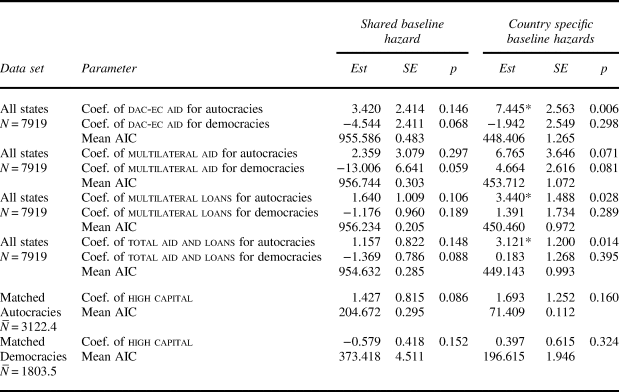
If H1 is correct, then coefficients of variables measuring capital flows should be positive for autocracies, but null for democracies. Rows 1 to 4 of Table 1 display coefficient estimates from Equation 1 using each measure of capital. Country-specific hazards produce substantially better fit, measured by AIC statistics. For democracies, no pattern emerges: estimates are insignificant at the 5 percent level, and the coefficient on total aid and loans is essentially 0 in the model with country-specific hazards. For autocracies, all estimates are in the hypothesized positive direction, and in models with country-specific hazards, they are substantially larger and significant at the 5 percent level for dac-ec aid, multilateral aid and loans, and total aid and loans.
Models of leader accepts: Event history logit with fixed intercepts or matching

Note: *p < .05, two-tailed.
Robustness
Estimates may be model dependent when control variable distributions are imbalanced across treated and untreated observations. One solution to this problem is matching: applying an algorithm to select observations for an increased covariate balance.Footnote 85 Coarsened exact matching (CEM), one such method, exactly matches observations in strata formed by all interactions of the temporarily coarsened control variables.Footnote 86 An advantage of CEM is to improve in-sample (as opposed to in-expectation) balance on control variables as well as their multivariate nonlinearities, interactions, moments, quantiles, and co-moments.
CEM is applied to autocracies and democracies separately, matching on the binary treatment high capital, which equals 1 when total aid and loans exceeds the sample medians of 6.4 and 6.3 percent of GDP for autocracies and democracies, respectively.Footnote 87 Overall balance is dramatically improved, as the appendix shows. Returning to Table 1, the bottom two rows report the results of Equation 1 fit to matched data sets while specifying all control variables plus either shared or country-specific hazards. High capital has small, insignificant effects for democracies. For autocracies, high capital has larger, positive effects, but two-tailed p-values are insignificant at the 5 percent level. Because the matched autocracies are selected from all non-DAC autocracies (1998–2017) a reasonable interpretation of this result is that high capital exerted a positive but noisy effect on whether autocrats accepted the ICC's jurisdiction.
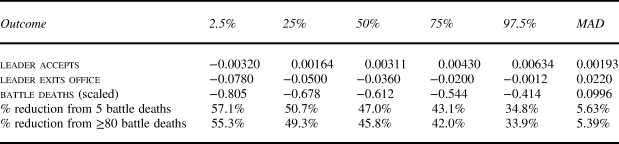
Table 4 characterizes that effect's size with the sample average treatment effect on the treated (SATT) calculated from the model with country-specific hazards and matched data. The SATT distribution has a left-skew overlapping 0, an entirely positive interquartile range, and a positive median. For “treated” autocrats, high capital increased the probability of accepting ICC jurisdiction by an expected 0.00311 per quarter (median absolute deviation, 0.00193). This is a substantial if imprecise effect, given that “treated” autocrats accepted the ICC's jurisdiction at a mean rate of 0.011 (SD = 0.10) per quarter, while all autocrats did so at a mean rate of 0.0059 (SD = 0.077).
I examine robustness further in the appendix. Models in Table 1 are replicated using the unimputed data set with listwise deletion, and using a sample limited to capital-eligible states, omitting four states with exactly zero receipts for the whole period. Findings generally match those reported here.
Testing H2
H2 is tested in samples of autocrats and democrats separately using event history logits of the following form.
 $${{\rm \smallcaps LEADER\;EXITS\;OFFICE}}\sim {\rm Bernoulli}\lpar {{\rm logi}{\rm t}^{{-}1}\lsqb {\alpha_k + \gamma_t + d_{kt} + {\rm {\smallcaps ICC\,JURISDICTION}}\cdot \beta + Z\delta } \rsqb } \rpar $$
Fixed country-specific and yearly intercepts model certain unobserved confounds. The baseline hazard of exit (d kt) is specified as shared in one set of models. In another set of models the hazard is country specific to model additional heterogeneity and possible sources of violations of the proportional-hazards assumption. The term Zδ includes all of the independent and control variables in Equation 1 plus gdp growth, unemployment, oil rents, civil conflict, and interstate war.
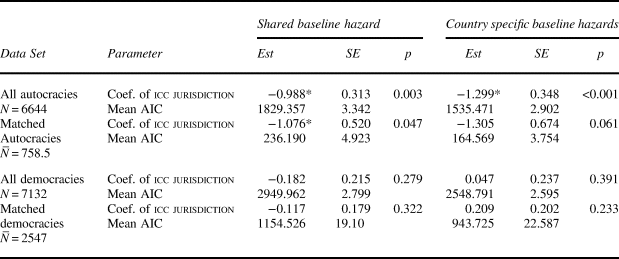
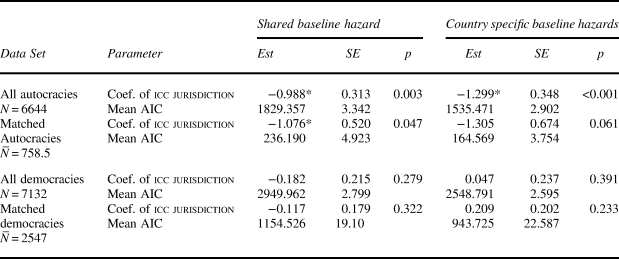
If H2 is correct, then the coefficient on icc jurisdiction should be negative for autocrats but statistically indistinguishable from 0 for democracies. The coefficient estimates of icc jurisdiction in Table 2 are in fact all negative. They are significant at the 10 percent level in all specifications, and at the 5 percent level in all but one. For democrats, estimates are near 0 and statistically insignificant.
Models of leader exits: Event history logit with fixed effects or matching
Note: *p < .05, two-tailed.
Robustness
In assessing robustness to model dependence, Equation 2 is refit to matched autocracies and democracies using CEM, with continuous covariates coarsened at their one-third and two-thirds percentiles. Matching dramatically improves overall balance, as the appendix shows. Coefficient estimates from these models (Table 2) offer additional support for H2. For democrats, icc jurisdiction has a null effect on whether democrats exit office. For autocrats, the effect is negative but is significant at the 5 percent level only for the model specifying a shared baseline hazard.Footnote 88
Nevertheless, Table 4 shows that the 95 percent confidence interval of the SATT estimate calculated from the model with country-specific hazards excludes 0. In expectation the ICC's jurisdiction decreased the probability of treated autocrats under the court's jurisdiction losing office by 0.036 per quarter (median absolute deviation, 0.022). For reference, the mean quarterly rate at which treated autocrats exited office between 1998 and 2017 was 0.037 (SD = 0.19). The analogous rate for all autocrats was 0.034 (SD = 0.18).
The appendix reports analyses using either listwise deletion or confining the sample to capital-eligible states. The findings generally reflect those in Table 2. But when listwise deletion and matching are jointly applied to autocracies, coefficients on icc jurisdiction are all insignificant at the 5 percent level. Here however, 21 percent of autocratic observations are lost to listwise deletion.
Testing H3
The scaled dependent variable in tests of H3 is modeled by OLS as follows.
 $${\rm {\smallcaps BATTLE\;DEATHS}} = \alpha _k + \gamma _t + d_{kt} + {\rm {\smallcaps ICC\,JURISDICTION}}\cdot \beta + Z\delta + \epsilon.$$
Fixed country-specific and annual intercepts capture unobserved confounds. The term d kt is a nonlinear time trend in battle deaths and specified to rule out spurious associations between the ICC's expanding jurisdiction and conflict patterns. Shared and country-specific trends are specified in different sets of models. The term Zδ includes all of the covariates in Equation 1 plus gdp growth, male youth unemployment, oil rents, ethnic polarization, religious polarization, military expenditures, military personnel, refugees, population, and ruggedness. The dependent variable is scaled by sinh−1 to reduce right skew arising from the rarity of civil conflict and the intense warfare in Afghanistan, Syria, Yemen, and Iraq since 2001.Footnote 89
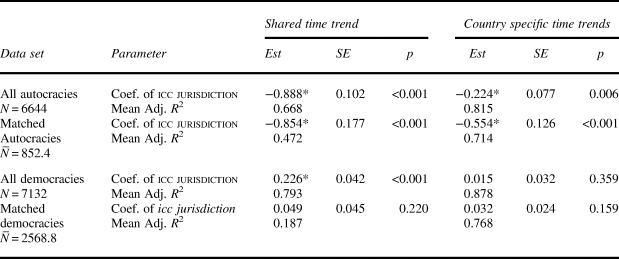
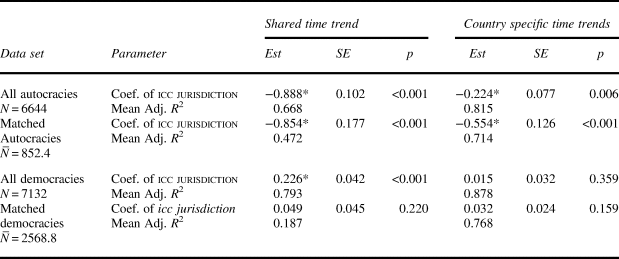
If H3 is correct, then coefficient estimates of icc jurisdiction should be negative for autocrats but null for democracies. Table 3 in fact reports large, negative, significant coefficient estimates for autocracies in all specifications. For democracies, estimates are non-negative and insignificant in three of four specifications.
Models of scaled battle deaths in civil conflict: OLS with fixed effects or matching
Note: *p < .05, two-tailed.
Robustness
Table 3 reports the estimates after applying CEM to autocracies and democracies. Overall balance greatly improves when continuous covariates are coarsened at medians (see the appendix). For autocracies, icc jurisdiction has negative and significant effects.Footnote 90 For democracies, the coefficient estimates are essentially 0 and insignificant.
Moreover, the SATT of icc jurisdiction on scaled annual battle deaths among autocracies is negative, and its 95 percent confidence interval excludes 0 (Table 4). Because the variable battle deaths was scaled by sinh−1, the effect on the unscaled variable declines to a limit as unscaled battle deaths increases. The percent reduction in the unscaled count of battle deaths is calculated as [d – sinh(sinh−1(d)+ SATT)]/d where d is a counterfactual number of deaths under the control scenario where a treated autocracy is not under ICC jurisdiction. Rows 4 and 5 of Table 4 show that icc jurisdiction reduced deaths among treated autocracies by 47 percent when d = 5 and by 45.8 percent when d ≥ 80. For reference, autocracies under the court's jurisdiction between 1998 and 2017 had a mean 384 battle deaths (SD = 1,958). The mean for all autocracies was 445.5 (SD = 3,120.7).
SATT among treated autocrats

Notes: Columns show percentiles and median absolute deviations of quarterly SATT estimates from models fit to matched autocracies using country-specific hazards or trends (Tables 1–3). Treatment variables are high capital (row 1) and icc jurisdiction (rows 2–5). Battle deaths in rows 4–5 are unscaled.
The appendix reports findings from models using listwise deletion and models limiting the sample to capital-eligible states. The findings generally match those reported in Table 3, but the matching estimates of icc jurisdiction are nullified for autocrats under listwise deletion, which causes 66 percent of observations to drop. The SATT estimates reported here are therefore contingent on the application of multiple imputation with CEM.
Conclusion
An underappreciated power of the ICC is the ability to derail political careers. ICC prosecutions credibly communicate personal guilt for atrocities by producing reliable evidence of guilt at great expense through judicial activity. In many cases this information is new, and may trigger leader-specific economic statecraft by capital-disbursing democracies. Accepting jurisdiction thus entails a security effect and an exposure effect. The security effect arises because jurisdiction impairs cooperation between actors who might otherwise organize antiregime violence. The exposure effect arises because jurisdiction gives the court's prosecutor the discretion to target a leader and his protegés. In states where leaders lack overriding ideological motives to accept the ICC's jurisdiction, the trade-off between these two effects will be decisive: leaders will accept jurisdiction when they expect the security effect to outweigh the exposure effect. Two factors determining this trade-off are a reliance on capital publicly financed and disbursed by wealthy democracies, and electoral institutions exposing leaders to prosecution. The former increases both security and exposure, while the latter increases exposure by constraining obstructionism.
I've presented evidence consistent with that theory using statistical tests on leaders from 1998 to 2017. A greater reliance on foreign capital financed by wealthy democracies made autocrats more likely to accept the ICC's jurisdiction, and the court's jurisdiction prevented antiregime violence and prolonged the tenure of autocrats. Democrats were subject to none of these effects.
The empirical findings shed light on alternative theories of sovereign consent to the court's jurisdiction. The negative impact of ICC jurisdiction on antiregime violence in autocracies is consistent with the civil-peace theory, but none of the theories directly predict that the court's jurisdiction lengthens autocratic tenure. The diffuse-reciprocity theory suggests that dependency on the capital of wealthy democracies would make all regime types more likely to accept jurisdiction—but this is unsupported by the evidence. Yet a broader theory might leverage the idea that the disbursing democracies and recipient autocracies know that the court is a back-stop for keeping autocracies compliant with international law. Accordingly, autocrats might accept the court's jurisdiction in the hope of diffuse or specific reciprocity. The conditional effect of foreign aid and loans on state consent to jurisdiction is consistent with that theory. But other evidence is not.
Wealthy democracies have emphasized domestic reform since the end of the Cold War but empirically they neither make disbursements conditional on consent to the major rights agreements of the UN, nor reward consenting states in any way.Footnote 91 A review of OECD DAC, World Bank, and IMF publications from this period fails to reveal a more focused agenda for Rome Statute ratification or accession.Footnote 92 Individual donors have diverse agendas, but the largest (the US) tried to impair the court in its infancy, opposed it from 2001 to 2008, selectively engaged it from 2008 to 2016, and again announced opposition to the court in 2018 after the appointment of John Bolton as US National Security Advisor. It is possible that reciprocal international relations explain at least a fraction of this capital's effect on the acceptance of ICC jurisdiction. But at present the case is weak.
This article has several other implications. First, autocrats may find the ICC useful for precisely the reason that it endangers their careers. The court produces credible, actionable information and has leverage over foreign aid and lending, posing a non-negligible threat even to leaders who expect a low probability of a successful prosecution against themselves and their allies. This contrasts with two extant theories underscoring the limits of international law and institutions in promoting human rights and preventing atrocities. The empty-promises theory argues that international institutions promoting human rights law lack the means to punish noncompliance in the short term, and that leaders make empty promises to respect human rights to win good reputations. Yet another theory advanced by Eric Posner and others argues that the inflexible and ambitious authority of the ICC would prevent many states from accepting it.Footnote 93
Second, when corrupt or weak domestic institutions fail to credibly commit governments to humane governance and obedience to international law, they will also fail to constrain governments from sabotaging oversight by international institutions tasked with monitoring and enforcement. Credible commitment to international agreements requires domestic institutional arrangements that can constrain executive malfeasance. This insight implies scope conditions for the civil-peace theory, which argues that leaders may tie their hands to foster long-run domestic cooperation by delegating oversight to international institutions when domestic institutions are too corrupt or weak.
Third, centralizing the regulation of atrocity law in an international court will unevenly affect compliance. While James Morrow argues that interstate-war belligerents in fact regulate their conduct via decentralized reciprocal enforcement, Kenneth Abbott suggests why civil-war belligerents cannot adopt such a strategy. They lack long-term incentives to protect civilians, and the threat of reciprocal punishment often lacks credibility.Footnote 94 A centralized approach is sometimes seen as a solution to this problem—one that may civilize warfare to some extent. Michael Gilligan, for example, argues that such an approach could deter atrocities ex ante by giving haven states a credible threat to deny sanctuary to deposed leaders whom the court wants to arrest.Footnote 95 John Bolton and Jack Goldsmith, on the other hand, suggest that a centralized approach will fail without the cooperation of major powers—cooperation that is unlikely to materialize because of unacceptable exposures to prosecution.Footnote 96 In this article I argue that international capital flows and a court credibly communicating defendants’ guilt underpin a centralized approach to enforcing atrocity law. This approach will fail in some circumstances—specifically, when a state receives little money from wealthy democracies, or when its rulers can obstruct undesired prosecutions.
Fourth, whether an international court trades off peace in pursuit of justice depends on the nature of the threat that it uses to deter politicians from committing international crimes. If that threat is the court's leverage over foreign money rather than imprisonment, then a mere indictment may provoke a significant increment of economic punishment by wealthy democracies, even though indictment alone reveals far less about leaders than a trial would. This insight contrasts with theories that, if an international court's deterrent threat is imprisonment, then the court's indictees will try to evade capture in ways that prolong conflicts that produce atrocities.Footnote 97 It suggests that targets of prosecution, fearing the political fallout from indictments and convictions, might make public appeals to a justice-versus-peace trade-off when none exists. And it implies a different unanticipated trade-off. The difficulty of timely escape from the court's jurisdiction means that the attention of the court's prosecutor on leaders of unconsolidated democratic parties to the Rome Statute could motivate them to undermine electoral turnover and other institutions posing a check on obstructionism. That may nullify the court's dividends of justice and peace in the long run.
Fifth, this article suggests why leaders of Kenya, Uganda, South Africa, and The Gambia withdrew threats to exit the Rome Statute. Because self-referrals and the Security Council triggered the preponderance of the court's Africa situations, complaints of anti-Africanism at the court were probably pretextual. Likewise, leaders would not have been surprised at how much authority they had granted the court. Each knew that as heads of Rome Statute parties, they could rely on neither customary immunities nor official status to evade the ICC. Each knew that a Security Council decision could render any state, such as Sudan, essentially a party. Each would have inferred that such a decision would suspend their customary obligations to respect any immunities enjoyed by nationals of that state, and that in any event failing to arrest and surrender them would not be costly. The only real ambiguity surrounds an issue never relevant to them: the effect of ICC indictments on immunity obligations owed to nonparties whose nationals stand accused of crimes on a party's territory in situations not referred by the Security Council. The real reason for the reversal of exit threats may be that the leaders in question saw their exposures to prosecution spike as a result of shockwaves from post-2007 economic crises. As those exposures subsided and local logics of executive replacement remained insulative, they would have reassessed the value of being ICC parties.
In historical perspective, perhaps it is unsurprising that the ICC has been a deterrent in the involuntary service of certain autocrats. Throughout the twentieth century, states insisted that international criminality be restricted to natural persons. It was predictable that autocrats bearing the sovereign personality would now effectively preclude criminal responsibility for themselves. As states drafted the Rome Statute in committees and conferences, they consistently agreed on self-referral by states alleging crimes on their territory or by their nationals despite disagreeing on numerous other questions.Footnote 98 For half a century, observers feared that states would abuse the planned court to prosecute enemies.Footnote 99
Nevertheless, there is cause for hedged optimism. The international military tribunals in Germany and Japan were one-sided, focused exclusively on elites, arguably inconsistent with nullum crimen sine lege, and gave thinly reasoned judgments on key questions. Still, they laid the legal foundation for an international criminal jurisdiction. The ICC builds upon that foundation. And though the court's jurisdiction expanded without significantly exposing many autocrats to justice, it has still deterred their enemies from international crime. For ICC parties, the way forward will be to rely on flexible rights to take countermeasures while invoking the responsibility of obstructionist autocracies for violating the Rome Statute's erga omnes partes obligations of cooperation with the court.
Data Availability Statement
Replication files for this article may be found at <https://doi.org/10.7910/DVN/U3ZQYY>.
Supplementary Material
Supplementary material for this article is available at <https://doi.org/10.1017/S0020818320000065>.
Acknowledgments
This article especially benefited from feedback from Dan Reiter, Jeffrey Staton, Eric Reinhard, David Davis, Allan Stam, Clifford Carrubba, Kyle Beardsley, Stephen Chaudoin, Harold Koh, Gudmundur Eiricksson, Michael Gilligan, Peter Rosendorff, David Stasavage, Neal Beck, Shankar Satyanath, George Downs, Michael Laver, Ana Bracic, Jeffrey Timmons, John Coughlin, Jeffrey Lehman, Leonid Peisakhin, Andrew Harris, Kevin W. Gray, Jon Pevehouse, Erik Voeten, and anonymous reviewers at International Organization. I also owe thanks to colleagues and audiences at New York University, NYU Shanghai, NYU Abu Dhabi, Emory University, Tulane University, CIDE, and the University of Strathclyde. Any errors are my own.