Archaeology is all about absences, about writing around what is obstinately not there – which is why archaeology should be poetic.
Julian ThomasFootnote 1
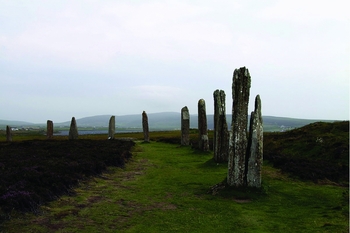
Ring of Brodgar, from Wikimedia Commons, at https://commons.wikimedia.org/wiki/File:Ring_of_Brodgar_in_summer_2012_%283%29.JPG.

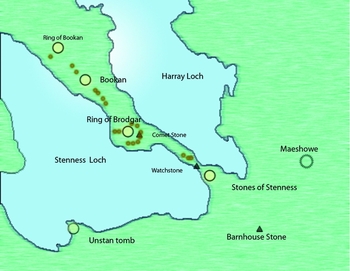
Map of the UNESCO Heart of Neolithic Orkney World Heritage site. © Sigurd Towrie of Orkneyjar.com, reproduced here by kind permission of the author.

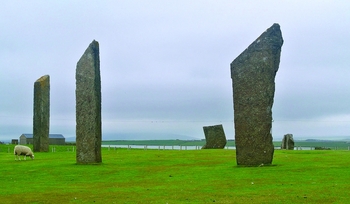
The Ring of Brodgar sits astride Orkney's largest island, named Mainland, which is situated off the north coast of Scotland. The stone circle rests in a natural bowl on a peninsula running from the north-west to the south-west, which separates Loch Stenness on the south-east from Loch Harray on the north-east. Other scattered monoliths run across the Brig of Brodgar land bridge, which joins either end of the two promontories between the lochs. The Brig allows passage from Brodgar to Stenness, where a second stone circle is located. In 1999, the area was designated the Heart of Neolithic Orkney UNESCO World Heritage site. Its location on open peat meadowland, across which visitors contemporary and ancient could see both stone circles as well as the nearby chambered tombs of Maeshowe and Unstan, continues to invest the region with a haunting, otherworldly character.
In 2013, I visited the Heart of Neolithic Orkney, once during the day, and a second time arriving at Brodgar as sunset began. I walked in twilight along the stone-lined path past the Ness of Brodgar and on to the Stones of Stenness. After sighting Maeshowe, I continued around the southern coast of Loch Stenness in the darkness before stopping at Unstan tomb. I have visited numerous British prehistoric monuments, from the Nine Ladies stone circle on Stanton Moor (Derbyshire) through to Waylands Smithy tomb (beside Britain's ‘oldest road’, the Ridgeway, in Oxfordshire). Like many of these sites, Brodgar seemed to me to function as a theatre without actors. The Heart of Neolithic Orkney resembles a gigantic amphitheatre. It is ringed by distant hills whose circularity is echoed in its structure. Wind and birdcalls pass through gaps between the monoliths. In the evening, darkness falls slowly across the isthmus. Visiting Brodgar stirs emotion, reflection and imaginative responses.
Archaeologists contend that rituals of some kind or another were performed at Britain's stone circles. Many of the sites are associated with folk tales about stones which lift up their lichen-encrusted skirts to drink or dance in the moonlight.Footnote 2 To stand at such a site prompts a thought experiment regarding what ancient rituals might have been conducted here, and to ask the stones themselves if they might speak back and resolve these mysteries. And what if they did? The site would perform. I have not witnessed an ancient monolith become unmoored from the ground and enact its own occult choreography, but these sites do ‘speak’ to the viewer. Whilst the performance which might emerge through this exchange between the visitor and the site is localized within the body and psyche of the visitor (and not the site itself), the exchange allows something like a distributed agency to emerge. The site acts upon the visitor.
Using the mise en scène of the UNESCO Heart of Neolithic Orkney site as my case study, I offer a number of characteristics of this site which might elicit from the visitor a performance – here meaning a dynamic psycho-corporeal experience which functions in a manner akin to how a more conventionally understood theatrical experience acts on its audience. Among these characteristics are the following:
-
• sites which are archaeological, or otherwise related to history and memory (what Pierre Nora calls lieux de mémoire);Footnote 3
-
• they are ruined sites which are actual fragments of the past for which they stand, and so function as indexical signifiers;
-
• there is a dialectical oscillation between a sense of presence and one of absence;
-
• the visitor's experience is haunted and hauntological;
-
• the visitor's response to the site is haptic as well as conceptual;
-
• this psycho-corporeal response might be compared to Max Ernst's model of frottage;
-
• distinctions and boundaries within space and time are unclear, interpenetrating and discontinuous;
-
• the site is therefore interpreted as a heterochronic space (Joanne Tompkins) and as potentially ‘limitless’ (Robert Smithson);
-
• these tend to be sites which have a presumed, pre-existing ritual function, evoking a metatheatrical response;
-
• in Gay McAuley's terms, this may result in the sense that there is a ‘co-presence of spiritual and material worlds’, a space of surrealist reverie or dreaming in which ‘The imaginary is that which tends to become real’ (André Breton).
These characteristics of the response to the mise en scène of the site are theatrical in the sense that they evolve out of the visitor's perception of the mise en scène – namely the shifting arrangement of signs associated with space, time, setting, sound and so on, and which strike the viewer as an embodied spectator through vision, tactility, kinesthesia (real and imagined), hearing and smell.Footnote 4
Critical context: surrealism, land art and the mise en scène of the cryptogram
Readings of sites as soliciting something like a dynamic response in the visitor have been proffered by several critics, artists and theorists. A recurrent theme within this criticism is the importance of those gaps, fissures and interstices which exist at the juncture between different representations of space and time. By sliding against each other within the visitor's perception, spatio-temporal drama is generated. This constitutes what Phil Smith describes as the ‘performative text’ of the audience's engagement with a site. In noting the importance of what is visibly not present within a site, the lettrist Ivan Chtcheglov cited the spatially ambiguous mise en scène of surrealist painter Giorgio de Chirico, claiming that the artist was
grappling with the problems of absences and presences in time and space . . . an object . . . can, by its absence . . . provoke an indefinable impression: as a result of this sighting backward in time, the absence of the object becomes a presence one can feel.Footnote 5
Chtcheglov further argues that historical sites solicit in visitors a sense of ‘geological’ or archaeological time, produced by the contradictory and incomplete accumulations of psychic and corporeal history.
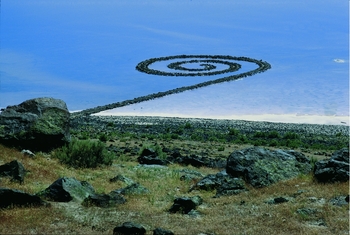
Robert Smithson, Spiral Jetty, 1970. © Holt-Smithson Foundation/Licensed by VAGA, New York. Photo Gianfranco Gorgoni. Courtesy Dia Art Foundation, New York.

Amongst the artworks to which Brodgar might be compared, Robert Smithson's Spiral Jetty (1970) looms large. The piece consists of an eroded, winding stone path projected out from the shores of Utah's Great Salt Lake. As a circular enclosure of marshy water, made from rough boulders and tons of soil, it resembles Brodgar in its material construction. Also, like the stone circle, it is ringed by hills whose shape it is designed to reflect, or as Smithson's collaborator Nancy Holt put it, ‘the jetty is a vortex that draws in everything in the landscape around it’.Footnote 6 Smithson was highly influential both as an artist and as a theoretician of ephemeral practice, and was a founder of the ‘land art’ movement, involving sculptural and often temporary interventions within the landscape.Footnote 7 Smithson theorized that it was the visitor's perception of standing in the presence of the materials left by the artist, combined with an opposing sense that the art object was damaged, incomplete or absent, which structured the visitor's response to his new archaeological sites. Accounts of the vexed search to find Smithson's jetty have indeed emerged as a genre of travel writing equal to that penned by visitors to Brodgar.Footnote 8 In his influential collection of statements about land art practice, Smithson declared, ‘The site is a place where a piece should be but isn't’, contending that it was this lack in the artwork at the site which (to invoke Chtcheglov in this context) the visitor felt and interacted with.Footnote 9 Smithson often worked in landscapes that for him ‘suggest prehistory’, and he framed many of his pieces as evoking or recovering the site's past. Spiral Jetty, for example, was a ‘product of a Devonian industry, a Silurian technology’, revealing those materials (salt, earth, water) which were laid down eons ago.Footnote 10
Julian Thomas sees more conventional acts of archaeological intervention as also confronting an absence at the site, as noted in the epigraph with which I start this article. Bjørnar Olsen concurs, citing Roland Barthes's claim that the scripts of Jean Racine constitute an ‘empty site’, available to endlessly shifting interpretations. Olsen argues that ‘a material site, such as a megalith, is . . . more open, more radically plural, carnivalesque, and out of authorial control, than any literary text’.Footnote 11 For Olsen, stone circles are closer to theatre than to literature. Such a ‘radically plural’ and ‘carnivalesque’ response is solicited within the visitor by the mise en scène of Brodgar's ‘empty’ or incomplete remains. Full synthesis or resolution marks the closure of the dynamism of performance, as far as the site is concerned. At the Heart of Neolithic Orkney, presence and absence – the experience of being directly in the presence of these material traces, versus the sense that the site is strangely empty or lacking – drive potentially endless performative iterations within the visitor. Whilst my own experience of the site at Brodgar informs my interpretation, I offer here a semiotic, art-historical response to the site, drawing on archaeological criticism and other sources.
As Merlin Coverly and Phil Smith have shown, much of the criticism taken up within performance and cultural studies regarding how sites might exert effects on the visitor is drawn from surrealist and lettrist explorations of how urban environments and found objects affect the psyche of the individual.Footnote 12 André Breton's word-and-image novel Nadja (1928), for example, relates Breton's peregrinations and musings amongst the streets of Paris, alongside selected found photographs which act as ambiguous hieroglyphic commentaries on the text within which they sit. Like Breton's words, these images seem to have fallen from the pages of an occult decoding of the urban site, an opaque cipher which Breton evokes without disclosing. ‘Perhaps life’ – with the objects one encounters within it – ‘needs to be deciphered like a cryptogram’, speculates Breton. This concept is readily applicable to the Ring of Brodgar. As Breton pursues his lover Nadja through Paris, it becomes a spatially and psychically indistinct realm wherein the lovers have strange, semi-hallucinatory encounters. Both Nadja and Paris constantly present new faces between the city's walls, in public gardens, and with every corner around which Breton and his lover turn.
Brodgar's mise en scène too is shot through by elements of a shifting occult cryptography because, as even Orkney expert Colin Richards admits, ‘We can never know what specific meanings were embedded in the stones’.Footnote 13 For all of archaeology's association with scientific technologies of dating and stratigraphic analysis, it remains an art of semiological interpretation. Encounters with the Heart of Neolithic Orkney resist closure. In the absence of more definitive archaeological data regarding its use or purpose, Brodgar might be considered a place where, in Breton's terms, ‘The imaginary is that which tends to become real’ for the visitor.Footnote 14 Breton claimed that the imaginative responses to such shifting, ambiguous signs were the result of what he called ‘objective chance’: a determinate encounter between an individual subject and their surrounds, ‘which on each occasion present all the appearances of a signal, without our being able to say . . . of what’.Footnote 15
What Breton's depiction of Paris and the Heart of Neolithic Orkney have in common is that they are both sites in which the mise en scène and its signs are open-ended and hence liable to shift and change as the visitor moves through the encounter; they are sites which ‘signal’ to the visitor, provoking ‘real’ imaginings. Interpretation of the Heart of Neolithic Orkney is driven by a desire for insight or connection comparable to Breton's pursuit of his lover, but this insight is impossible because – as with Nadja and Paris – the visitor's reading of the object of their desire is shifting. The site remains at some level indecipherable. Indeed this indecipherability is part of its appeal. The site constantly morphs within the visitor's perceptions, even as this fluidity drives the individual subject to move through the site in pursuit of the unknowable object of one's desires. Breton is, however, adamant that these responses do not arise out of whim alone. Desire seeks release via predetermined, if ineffable, pathways. My aim here is to sketch some of the characteristics of the Brodgar site which might ‘signal’ in the fashion Breton identifies above.
Archaeological context: a mise en scène of restriction and exclusion
Humans reached Orkney around 3500 BC, finding fertile lands close to rich sea resources.Footnote 16 The scarcity of trees on ancient Orkney contributed to the development of sophisticated stone-working skills which continued to characterize the walls, floors and central hearths within Orkney buildings into the twentieth century. Seasonal ritual or theatrical gatherings at religious centres, such as fairs held on the grounds of Kirkwall Cathedral from medieval times through to the early twentieth century, also echo those ancient patterns of travel, dispersal and settlement which inspired the construction of Brodgar. The monumental scale of the ancient circles means that they would have drawn builders and visitors from far and wide (possibly as far as Wiltshire in south-west England, where related structures exist), much as the better-documented medieval cathedrals did. These well-worn pathways and long-standing relations between bodies and materials are echoed in present-day physical performances and journeys across the islands, with a roadway running through the center of the Heart of Neolithic Orkney site. These continuities have led Orkney expert Colin Renfrew to argue that ‘in Orkney, somehow more markedly than in many other areas, the past has a quality of a present reality’.Footnote 17
The Ring of Brodgar consisted of approximately sixty upright stones arranged within a circular ditch surrounded by a further encircling mound, bringing the total width to over a hundred metres. This structure of a stone circle surrounded by a ditch and mound is known as a double henge and is confined to Britain and Ireland. Archaeologists initially postulated that the distribution of henges from far northern Scotland to south-east England was the result of waves of invasion or colonization from the fertile south of England northwards, but now tend to argue that this could equally have arisen from multi-centred cultural development, trade and overlapping pilgrimage networks. Whatever the case, widely dispersed material remnants such as henges, polished stone axes, grooved-ware pottery and so on demonstrate the existence of considerable cultural and material mobility within the ancient world.Footnote 18
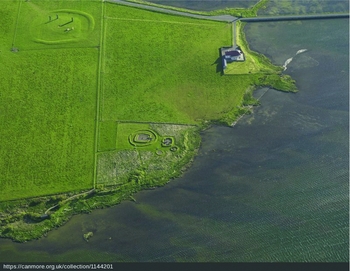
Oblique aerial view centred on the Barnhouse settlement with the Stones of Stenness adjacent, taken from the north-east (12 May 2009). RCAHMS Aerial Photography Digital catalogue no DP 059850, at http://canmore.org.uk/collection/1144201.

The earliest reliable date for human activity on the isthmus is c.3200 BC for the settlement of Barnhouse, which consisted of up to twelve circular stone buildings constructed over several centuries. During occupancy of the site, the nearby Stones of Stenness and Unstan cairn across the waters were erected (the dates are not certain, but after 3000 BC). Barnhouse was abandoned around 2600 BC. This makes the structures in the Heart of Neolithic Orkney earlier than the first pyramids of Egypt (2650 BC) and at least contemporary with, if not older than, similar monuments in southern England. The extraordinary walled enclosure at the Ness of Brodgar also appears to have been in use during this period.Footnote 19 The Ness is located shortly before the crossing from the northern end of the peninsula onto the south. Excavation of the Ness is ongoing and its massive, heavy walled buildings roofed by stone slabs are architecturally unique. It is thought that the Ness acted as a centre for seasonal performances and socialization, linking related sites such as the stone circles into a multi-focal Neolithic cathedral-like complex.
Stones of Stenness, from Wikimedia Commons, at https://commons.wikimedia.org/wiki/File:Standing_Stones_of_Stenness_062015.jpg.

The Stones of Stenness rest close to the south side of Loch Harray, consisting today of four out of a presumed twelve well-dressed planar slabs. Excavations have revealed a central stone-lined pit at Stenness similar to the hearths of Barnhouse and the Ness. Together with skeletal remains, this suggests that mortuary rituals and cremation were carried out at the site. Sometime around 2800 BC, Maeshowe was built under a large circular mound visible from both stone circles as well as from the Ness. Stonework in this cairn is of exceptional precision, with large uprights similar to those at Stenness and the Ness alternating with closely fitted blocks and flags. The uprights are, as Richards puts it, ‘superfluous to structural necessity’ and may be considered built-in standing stones in their own right, possibly indicating that a stone circle was once at the site before being converted into a tomb.Footnote 20 Whatever the case, many of the stones at Maeshowe nestle together so carefully that one cannot insert a knife. Findings at other tombs show that such structures were used for hundreds of individuals over many centuries.Footnote 21 Ancient Orcadians repeatedly opened and resealed the tombs and flesh was removed from the bones before they were reinterred, presumably as a result of outdoor weathering or other now lost ritual practices. The association of human remains with those of animals suggests possible totemic significance or feasting rituals. Extensive collections of untreated and cracked animal bones with marrow removed suggests that feasts also occurred at the Ness. The Ring of Brodgar seems the last addition to the complex, although extended periods of occupation and construction mean that overlap is likely.
Scattered standing stones also lie along the route from the larger stone circle and across the Brig through to Stenness. Other megaliths rest above the shoreline across the waters, such as the Deepdale Stones near the southern shore of Loch Stenness. Several of these groupings stand as paired jambs. These groupings make up what theatre-maker Mike Pearson identifies at other archaeological sites as ‘entrances and exits signalling [impressive or] dramatic thresholds’ through which one might pass.Footnote 22 On the Brig beyond the Ness stands the tall, elegant Watch Stone. Another notable upright, the Odin Stone, once stood nearby. In 1780, visiting naval captain James Kerr recorded that locals believed that the stone had been the site of ritual human sacrifice (there is no evidence to prove or disprove this), whilst Kerr's guide related that ‘about 20 years ago . . . it was customary with Lovers . . . to put their Hands thro’ on opposite Sides and joining them Swear Fidelity to each other’, after which ‘they proceeded to Consummation without further Ceremony’.Footnote 23 The fact that pasture was regularly ‘spoiled by tourists’ led the local tenant farmer to destroy the Odin Stone in 1814.Footnote 24
Citing the architectural similarities between the henges, Barnhouse and Maeshowe, Richards persuasively argues that the complex constitutes a monumental landscape generated by prehistoric architects and associated usage of these sites. He points out that all of the structures are delimited by perforated enclosures of concentric walls, hearths or mounds, each within the other, which echo the manner in which the peninsula is bordered by hills and promontories:
The height of the standing stones, dwarfing the central features, imitates the encompassing topography where the surrounding hills overlook the features, the dwellings and lives of neolithic people. The monoliths are cut from the bed-rock, the stuff of the earth; they are dragged and placed vertically . . . Here the stratigraphy forming the natural world is re-created within a single monument . . . [via] Homology . . .Footnote 25
Moreover, the location of the two stone circles between the lochs means that ‘both monuments have the appearance of being surrounded by water’ between which one passes, much as Smithson reflected of his jetty: ‘Matter collapsing into the lake mirrored in the shape of a spiral’ – or in Brodgar's case a bowl.Footnote 26 The ditches about the henges, which also enclose Maeshowe, would have originally been boggy like the shorelines on either side, whilst lines of sight and of travel connect circles and sites. As Richards and Jane Downes observe, it is an architecture of alternating ‘restriction and exclusion’, of passageways, views and obstacles, which is based upon an apparent ‘strategic concealment and revelation of entities and places’.Footnote 27 These structures work in tandem with each other such that each evokes parallels at nearby sites, whilst also distinguishing the various enclosures. Structures, shapes, materialities – and so the experience of moving amongst them – are interlinked, but discontinuous, each spatial configuration closing itself off from, and then opening onto, others. Elements of this mise en scène remain today, continuing to solicit experiences of enclosure and opening out in the contemporary visitor.
Reaching out to touch across the space of distance
Writing in the 1970s, the influential art critic Rosalind Krauss saw the land art of Smithson and others as part of a broader late twentieth-century development wherein art strove to ‘attain the condition’ of photography. Here the documentation of a process, or of the artists’ physical interactions with a site or object, became the raison d’être of much art of the period.Footnote 28 Smithson's land art involved siting sculptures and material interventions within the landscape as part of an exploratory relationship with locations such as hills and lakes, such that the separation of ‘site’ and the ‘art’ within it becomes confused within the audience's perception, oscillating between perceiving a found object recontextualized by the site it rests within (sculpture in the landscape), and the site rendered itself aesthetic by the construction of an artwork, or view of the site, at the site itself (landscape itself as staged photograph, theatre or sculpture). This split perception of the site is applicable to the Heart of Neolithic Orkney, where Brodgar clearly has an aesthetic dimension, but is not an artwork as such. As a former religious or para-religious temple, Brodgar was presumably defined more by its use than by the aesthetic appreciation of its qualities. It is nevertheless unclear whether these practices were carried out exclusively within its confines, or whether mortuary rituals and other events moved from outside the space and then into or through it, or whether the circle reflected some more formalized relationship between the space within it and the nearby settlements at Barnhouse. If, as Richards contends, the very construction of the site itself is what gave the process significance and meaning, such a distinction is difficult to make.Footnote 29 Like Smithson's work, Brodgar bleeds into its environment and its history, whilst still commenting on and establishing a distinction between spaces within and without.
In Smithson's Spiral Jetty, the dialectical indeterminacy of this relationship resides between the indistinctly bordered site and the work of the art, as well as between the presence of its material construction and its mediated representation via later incomplete traces. A mere two years after the jetty's construction, it disappeared beneath the waters of the lake. Since 1999, it has periodically re-emerged in a much worn condition during times of drought.Footnote 30 It is unclear if the true nature of the artwork lies in the act of building the jetty, walking to its center and photographing it; in the sculptural and architectural form of its initial state; or in its eventual status as a sign of Smithson ‘collaborating with entropy’Footnote 31 to produce the later variable, salt-encrusted and wave-wracked structure. All are effectively the case, because the jetty – like Brodgar today – never emerges in a resolved form. The visitor is left speculating regarding which element or elements of its history become accessible as one approaches it and its boggy, eroded traces. As noted above, Richards has, moreover, argued that Brodgar's ‘stone-quarrying and stone-dragging may be otherwise understood as ritual procession or performance’ – Holt filmed this ritual at Spiral Jetty. Richards continues, ‘Here, prestige and status is accrued through the extravagant and conspicuous consumption of labour’ rather than through any proposed completed form which may or may not have emerged.Footnote 32 There is no evidence that the circles at Stenness or Brodgar were ever finished, or as Richards and Downes put it, given the highly ‘complex and piecemeal process’ of construction, the idea of ‘a “complete” stone circle at the Ring of Brodgar becomes almost illusory’, as with the jetty.Footnote 33
The architectural and sculptural form of both Smithson's work and the structures within the Hearth of Neolithic Orkney exist, therefore, in a constant state of constructive flux and irresolution. As Kaye points out with respect to Smithson, the historical and material indeterminacy of objects at the site prompts within the viewer a ‘rhythm of appearance and disappearance . . . Here the site is neither that which it was, a stable point of origin [or history], nor that which will be, a specific “knowable” point of destination’.Footnote 34 Spiral Jetty and the Heart of Neolithic Orkney allude to something – a putative completed monument or ritual for which the structure was built as a staging ground – which is coincident with the structure in some sense. These interventions in the landscape act as memorials to their very existence. Brodgar is therefore art (or artful), but not itself art, and one cannot determine with certainty if it functioned as an essentially impermeable, bounded site, or as a more entropic, temporally, materially and spatially open nexus.
Although pieces such as Smithson's Spiral Jetty and the Brodgar circle are redolent with a sense of hard, manifest presence, forged as they are out of stone, earth and other weighty materials, Smithson thought of his own work as tending to dematerialize both ‘art’ and ‘the site’ in a way which echoes this confusion between Brodgar and its boundaries. Smithson's works always existed in tandem with documentation of their construction (as with the film of Spiral Jetty). Gallery renderings were matter-of-fact, and insufficient in themselves to convey the weight, force or material situation of the distantly situated work itself, which in many cases had ceased to exist in the condition in which it was designed or photographed.
This uncertain, self-referential quality of the monumental site is what causes Smithson's work to recall a photograph in terms of how it both produces and disturbs the meaning of the site's apparent mise en scène. Rosalind Krauss builds on Roland Barthes and others to claim that the defining feature of photography is its ‘indexical’ character. Even in the wake of digital media, photography continues to occupy a privileged cultural status as the ‘pencil of nature’ (in the words of nineteenth-century photographic pioneer Fox Talbot), a medium whose initial form is directly imprinted upon it by light waves: Footnote 35
As distinct from symbols, indexes establish their meaning along the axis of a physical relationship to their referents. They are the marks or traces of a particular cause, and that cause is the thing to which they refer, the object they signify. Into the category of the index, we would place physical traces (like footprints).Footnote 36
Photographs are indexical in that they refer to the object directly before the camera. As Krauss observes, such indexical identifications ‘short-circuit’ the normal distinctions between the sign and that which it signifies:
Every photograph is the result of a physical imprint transferred by light reflections onto a sensitive surface [photochemical or photoelectric]. The photograph is thus a type of icon, or visual likeness, which bears an indexical relationship to its object. Its separation from true icons is felt through the absoluteness of this physical genesis, one that seems to short-circuit or disallow those processes of schematization or symbolic intervention that operate within the graphic representations of [written language and] . . . paintings.Footnote 37
The Heart of Neolithic Orkney is indexical in just this sense: it is an iconic material trace of historical processes, acts and past conditions, which it visually recalls and resembles even as one's perception of the site as a sign of the past (and not as being the past itself) initiates a schism which distances one from the immediacy of the site. Krauss argues that it is precisely this characteristic that made photography and other indexical representations like Ernst's rubbed imprints of floorboards (frottages) suitable for surrealist aesthetics.Footnote 38 The logic runs here that photographing an object or making a rubbing of it (a) produces a sign, and (b) because this new sign has a direct connection to the object to which it refers, this is a new kind of indexical sign which is also an object itself. Finally, (c) this turns the world itself into what Breton called a ‘forest of signs’.Footnote 39 In short, the objects which make up the world become available for interpretation, driven by the desires and changing psycho-corporeal impulses of the individual subject. Being an index of itself, both the rubbed imprint of a surface and a scratch produced on the hand of the visitor who runs their hand down a monolith are free-floating indexical traces.
Here, too, the oscillation of presence and absence across the space of signification and interpretation is crucial. As Krauss observes,
Though produced by a physical cause, the trace, the impression, the clue, are vestiges of that cause which is itself no longer present in the given sign. Like traces, the works I have been describing represent the building [or the site] through the paradox of being physically present but temporarily remote.Footnote 40
Krauss concurs with Barthes's proposition that indexical representations such as photographs generate ‘a new category of space–time: spatial immediacy and temporal anteriority. Photography produces an illogical conjunction of the here-now and the there-then’, reflecting what Barthes calls ‘the real unreality of the photograph’.Footnote 41 Barthes goes on to argue that this irresolvable fracture of cause and its indexical imprint means that ‘Death is the eidos’ or essential feature of the photographic medium.Footnote 42 The immediate departure of the initial presence from its trace evokes the time of mortality. Drawing on the imagery of neolithic burials, Barthes goes so far as to liken the indexical image to the ‘original relation of the theater and the cult of the Dead: the first actors . . . playing the role of the Dead . . . a body simultaneously living and dead’.Footnote 43 Indexicality thus evokes ‘a kind of primitive theater, a Tableau Vivant’.Footnote 44 Perhaps more significantly, the close physical link between the indexical sign (the ruined Neolithic circle today), and that which it represents (the henge's ancient state) means that indexicality violates the usual separation of sign and signifier in language. Performative sites are indexical in this sense, representing themselves to the visitor even as they are, in Smithson's terminology, unmappable and endlessly deferred; or in Bjørnar Olsen's phrasing, such sites are ‘eternally open to signification’.Footnote 45
I contend, therefore, that far from being particular to photography, this representational conundrum is typical of how one might read the mise en scène of historical and archaeological sites. The uncertainty of the archaeological site as a real/unreal trace of the past generates within the viewer an oscillation between an interpretation of real material effects in the now and the momentary acceptance of the fantasy of actually being in the presence of anterior conditions and phenomena. Here, as Breton observes, the imaginary is staged to the visitor as though it were real.
The implied physical nature of the indexical relationship, generated through a material connection between the original condition of the ancient site and the ruined material signs which come to signify it, highlights the role of touching and of the body within the space of interpretation here. Physically drawn from the environment via an all but occult operation, the photographic eye is nevertheless always an embodied eye.Footnote 46
The haptic quality of the visitor's experience of Brodgar remains a notable feature today. The monuments are distinctive in their palpably hard, rough-to-the-touch construction. Partially dressed slabs of differing sizes – those at Stenness are up to six metres tall – elicit in the visitor a range of corporeal responses. Some dwarf the visitor, whilst others have a more human scale despite their heft and weight. I am not alone in reacting to these sites by reaching out to run my hand down the surface of the rock, as if the satisfyingly painful response produced might generate something more certain and present out of my own bodily perception of these ancient, enigmatic structures. Rebecca Schneider relates a similar temptation upon encountering the Neolithic hand stencils of Pech Merle, France. She claims that both the upraised palms and the rock across which they move seemed to call out to her: ‘I, here, was greeted as other in the space of this hail – time, space, and bodies change places’.Footnote 47 In this encounter, the visitor experiences subjective registers of temporal distance and intersection at ‘first hand’ through ‘a relationship of direct handling – one in which one's own hands are implicated as indicative of presence to [an] event’, or what Schneider calls ‘inter(in)animation’: the animation in the present of that which is ‘no longer live’. Speculative responses thereby become anchored in the sensorial gestures and reactions solicited in the viewer by the site in the present.
Visiting such sites is therefore first and foremost a dialectical embodied experience. In his collaborations with archaeologists Michael Shanks and Julian Thomas, Mike Pearson proposes that performance at a site emerges at the point where the body is actively shaped by sensory inputs from the environment. Theatre-makers and visitors should ‘try ourselves to engage the site, using our contemporary voices as a kind of “experimental archaeology of phenomena”’.Footnote 48 Different sensorial responses move across body and mind: of cold and wet, hard and soft, uneven and smooth, proximate and distant, large and small, loud and quiet, odiferous and unscented, the body becoming the space across which reading and interpretation are played out.
The multi-temporal or heterochronic aspect of this otherwise first-hand engagement is also crucial. Within the apparently direct, singular space of the site itself, the visitor experiences a series of convoluted and mutually incompatible spatio-temporal registers which fracture the immediacy of the response. Archaeological time not only cohabits, but also collides, with the staged experience in the present, such that the very ‘pastness’ of neolithic Orkney becomes forcefully apparent – even as this is intercut by the viewer's imagined and fragmentary perception of these distant formations in the now. Indeed, theatre and performance more generally might be defined as that which arises out of a dialectical weaving of different times and actions, of the narrative and performative past moving out of a state of immanent becoming, reshaping in the present the evolving space of the future and what we now know of the past. Joanne Tompkins justifies this construction of theatrical reception by reference to critic Ruth Lunney, who argues,
The connecting space within its [theatre's] ‘landscapes’ is always potentially refractive, setting repeatedly before the spectators images that challenge or distort the ‘vertical and antithetical balance’ that other elements of staging reflect. These images offer them alternative perspectives on the action, confronting them with the interconnectedness [and multiplicity] of experience.Footnote 49
For Lunney and Tompkins, theatre is a dialectical nexus of predetermined spatial and temporal projections coalescing while the performance unfolds about the mobile point of what can be known within the shifting site of audience. Those dramaturgical oscillations and heterogeneous mnemonic configurations which emerge from across the timeline are particularly active at Brodgar.
Sites with a presumed pre-existing ritual function such as the Heart of Neolithic Orkney are, moreover, especially likely to solicit such contradictory and evolving perceptions of events and narratives, as the visitor imagines those acts which may have occurred here at different times. The Heart of Neolithic Orkney serves as a mnemonic incitement to the contemplation not only of previous human actions and the passing of time, but also of those rituals which were enacted at these sites. Responses to the site are in this sense metatheatrical as well as metahistorical and metatemporal. Here, visitors are encouraged to engage empathetically with fantasized bodies carrying out occult ceremony.
Despite ongoing speculation and the discovery that at least some prehistoric sites are aligned to solar and astrological events (only at the winter solstice does sunlight travel down the entranceway into the chamber of Maeshowe), we are no closer to knowing specifically what religious (or perhaps non-religious) rituals were attached to these sites. Such locales therefore serve as a dynamic site for mnemonic reconfigurations partly because their status is unknowable. Even so, both archaeologists and laypeople continue to piece together those affiliations suggested by the site (mortuary practice, ancient settlements and movements, later folklore such as that associated with the Odin Stone, astroarchaeology, and so on). Brodgar and Pech Merle ‘signal’ these questions to visitors, and we respond through performative speculation (visions of dancing stones, of ancient ancestor veneration and fertility rites, of the mound rising from Maeshowe to reveal an earlier stone circle paired with that at Stenness, and so on).
Brodgar's ambiguous mnemonic status generates something akin to what Derrida described as ‘hauntology’. The term should not be confused with haunting, although hauntological sites typically have a sense of being haunted as well. Rather, hauntology refers to an absolute schism, or an inversion, in the relationship between the sign and that to which it refers.Footnote 50 Haunting refers to a return of that which is known. A convincing effigy of a deceased individual is haunting, since the form of the memorial statue provides a relatively reliable guide to the ghostly subject who is evoked by it. Brodgar is, however, hauntological because its original form and purpose – the referents which lie behind the signs left at the site today – remain unknown and unknowable. Indeed, some of the potential readings of these objects summon up referents which may never have actually existed in the first place – such as the image of the stone circle complete with sixty fully upright monoliths. These readings therefore confuse and violate the normal priority of the referent to its sign. Brodgar and its associated monuments are hauntological because, as Thomas explains, ‘there is no definitive originary meaning’ which can be given to Britain's neolithic sites ‘since what the “original” performance meant will itself have been fragmented, and experienced in many different ways’.Footnote 51 The ancient past in its full diversity and sensorial presence is irrecoverable.
Something like hauntology is engendered by the historical re-creations depicted on signboards erected at some archaeological sites, which are only ever educated guesses since we cannot even know how many stones each circle had, nor indeed if they all stood erect at the same time. In the mind's eye, one places such totalizing reconstructions over extant remains only to see these visions evaporate as one faces the contested, incomplete site. These experiences reflect back upon the viewer, raising the question, who haunts whom, or who actually is ‘the ghost’ here, once time has become so convoluted? In my own case, the sensation of the hard, rough surface of the stones against my hand alternated with moments during which I felt strangely ghostly and dematerialized myself, seeming to move insubstantially across the turf, as if I was hearing my footsteps and the wind from far away. This disembodied silence was punctuated by plosions of solid crunching on the ground, my own experientially ambiguous transit within the ring being marked by both acoustic suppressions and moments of sudden aural intensity, as awareness of my presence broke through the fantasmatic space to reassert itself. Whilst the specific choreography of oscillating perceptions will vary from individual to individual, the dualistic spatio-temporal and semiotic logic which motivates experiences such as that I relate above inheres within the mise en scène of the archaeological site itself.
Richards has, moreover, demonstrated that Brodgar is notable for how its boundaries echo and transgress each other (‘entrances and exits signalling dramatic thresholds’), pulling one simultaneously inward and outward. Adjacent stones invite the visitor to look between them and to pass through these gaps in equal degree to the manner in which they might lead one to walk in a circle within the enclosed space. Smithson calls this ‘a suspended question regarding “limitlessness”’ of the spatio-temporal boundaries of the site, and one's experience of it.Footnote 52 If the prehistoric site offers the fantasmatic possibility of transgressing time and space, then its imaginative and corporeal limits are unclear. It remains an open question whether these spaces are defined in the first instance by the specific qualities of the site itself (Brodgar and its stones), versus its situation (open moorland, the hills and mountains within which they rest, interpenetrating boundaries of water and marshland, the stones’ location on a pathway between the lochs, and so on). Richards has indeed shown that the distinction cannot be made for Brodgar.
The responses solicited by such a complex mise en scène at this site produce something like psycho-corporeal frottage. The surrealist Max Ernst developed the term to describe art made by rubbing a receptive medium over a rough surface such as the floor. Ernst relates how he became
struck by the obsession that showed to my excited gaze the floor-boards . . . I decided then to investigate the symbolism of this obsession . . . to aid my meditative and hallucinatory faculties, I made from the boards a series of drawings by placing on them, at random, sheets of paper which I undertook to rub with black lead. In gazing attentively at the drawings thus obtained . . . I was surprised by the sudden intensification of my visionary capacities and by the hallucinatory succession of contradictory images superimposed, one upon the other, with the persistence and rapidity characteristic of amorous memories . . . There my eyes discovered human heads, animals, a battle that ended with a kiss (the bride of the wind), rocks, the sea and the rain.Footnote 53
Outside art criticism, frottage refers to the rubbing of genitals across clothes, a shoe, a fetish object, or other surface, to excite pleasure. Connection with the object of one's desire is therefore indirect and fantasmatic, occurring through and across the interposed medium (usually clothing). Ernst's contention is that aesthetic frottage and the resultant rubbed impressions generate a similar affective link between the subject and the object as that link which occurs within sexual frottage proper, allowing new fantasies to emerge. Like other surrealists, Ernst suggests that these images and desires do not necessarily arise from him, but from the object which is rubbed. The resultant image is a true hallucination, a place where the imagination of the human – as well as that of the object – has become ‘real’. While I am not claiming that the visitor's experience at Brodgar is necessarily sexual, I would nevertheless suggest that a sense of psychophysical kinship across distance comes into being between individual subjects and the coarse surfaces with which they interact.
The crucial point here is that touching a stone is an act both of immediacy and of distancing, and that in this process of rough interaction, desire comes into play. The fact that our perception of the site remains fragmentary, marked by the explicit presence of discontinuities as well as acts of engagement, is essential in generating a perception of something like frottage. In Ernst's formulation, it is the interposed medium separating the lover from their object of desire which both activates and registers haptic interactions, whilst keeping actor and object forever at a remove. Frottage and the interpretation of the mise en scène at Brodgar are haptic, scratched, tearing practices, breaking and reasserting association even as discontinuities irrupt from and across the surfaces of contact. Such sites of interaction exhibit spatial, temporal and visual discontinuities, such as the irregular interruption of the views across the lochs by the rocks rising out of the ground, or the cracked stone layers which break through the turf from shattered stumps beneath.Footnote 54 It is those sparks leaping across the gaps at these sites of plastic, emotional and sensorial fracture which serve as a nexus for the incitement of performative interaction.
Stump, Ring of Brodgar. Photograph by Jonathan W. Marshall.

The sensation of navigating the representational, temporal and haptic realms engendered by the mise en scène of the Heart of Neolithic Orkney constitutes a vertiginous – perhaps even painful – fall from semiotic legibility, into a space of reverie populated by the forest of signs with which one psycho-corporeally interacts.Footnote 55 One moves into an abstract realm characterized by what Gay McAuley describes as the apparent ‘co-presence of spiritual and material worlds’, akin to that which occurs within ritual itself.Footnote 56 The spatial realms proper to each become conflated as archaeological and cosmological imagining floods in. Occult and occulted knowledge here coexists with archaeological data. Pearson and his colleagues working in site-specific theatre have indeed drawn upon such reactions as the basis of much of their dramaturgy, but at the Heart of Neolithic Orkney at least, the ‘forest of signs’ requires little elaboration to have these effects on the visitor. As with Smithson's constructions, all that is required of the visitor is the desire to attend to what the site itself might be trying to say.