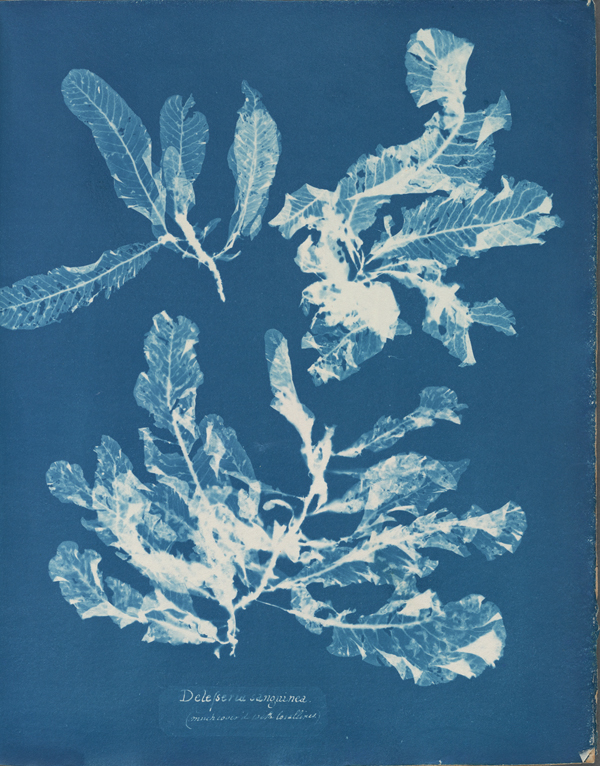
Three ghostly white plants float suspended atop the Prussian-blue background of a 27 x 21 cm print (fig. 1). Their leafy fronds are so exquisitely fine that in some places the blue bleeds through their tissues to expose delicate quiltings of veins and willowy inflorescences. Opaque white patches mottle each of the plants to signal where multiple layers of plant flesh overlap. The interplay of shapes, color, and textures in the image captures an atmospheric effect of alien beauty, nearly incomprehensible. That is, until the small label at the bottom of the print in meticulous penmanship informs us that we are looking at Delessaria sanguinea, a type of red algae commonly known as “Sea Beech.” This is one in the thousand-plus body of images that comprises Anna Atkins's Photographs of British Algae: Cyanotype Impressions. Dedicated to documenting England's native seaweed, ferns, and flowering plants, Atkins's photographic botanical project ranged about a decade (October 1843–53) and resulted in multiple editions she would give to friends and cultural institutions. While she primarily helmed the project herself, she occasionally included her father, zoologist and photography enthusiast John Children. For the last couple albums, she enlisted as a co-creator her “like a sister” Anne Dixon, who collected, arranged, and developed the images alongside Atkins.
Anna Atkins, Delessaria sanguinea, 27 x 21 cm, 1844–45, cyanotype. From the New York Public Library, https://digitalcollections.nypl.org/items/510d47d9-4aff-a3d9-e040-e00a18064a99.

As archivist Hugh A. Taylor contends, every archive possesses an ecosystem that must be carefully managed in order to ensure optimal preservation of its materials.Footnote 1 Instead of a hermetically sealed space, the perfect archive would be more akin to a terrarium carefully monitoring influxes of light, temperature, air quality, humidity, and potentially hungry pests.Footnote 2 The typically unseen archival biome registers through the conditions of its documents and objects, as eventual discoloration, deterioration, and decay impart ephemerality or mutability to materials thought to be inert. That all materials, organic or inorganic, possess generative and agential capabilities is a key premise of material ecocriticism, which is a field of inquiry devoted to bridging the gulf between cultural constructionism and the materiality of bodies and natures. If we are to follow material ecocriticism's postulate and designate all archives to be dynamic materials, then how and from where might we develop best practices of archiving?
I answer this question by mapping out an overlooked nineteenth-century moment in material ecocriticism's intellectual genealogy made visible through Atkins's experimental marine botanical collecting, publishing, and editing activities. Reading Anna Atkins's Photographs of British Algae alongside contemporary material ecocriticisms fleshes out environmentally sensitive documentary practices that resist the deadening, anthropocentric imperatives that have since become associated with Victorian models of archiving. This article charts the material-emotional history of Atkins's Photographs, from its creation as a father-daughter pet project to its seemingly eternal dissemination as a series of unbound manuscripts. Rather than reinforcing human mastery over nature, the extended and divergent life cycles of Atkins's volumes generate lively connective tissues among texts, humans, and environmental agents to envision what a practice of archiving shared by women, vegetal beings, and weather might look like. This reading of Atkins's Photographs works toward establishing a poetics of “eco-archiving” that coils the new materialisms of ecocriticism around the materials of print culture and archival studies to locate nonanthropocentric forms of documentation and archival authorship. The story of Anna Atkins (1799–1871), a historically underrepresented female marine botanist, illuminates how experimental Victorian life-science writings imagine new, more ethical ecologies of archival preservation capable of addressing our own Anthropocene moment.
1. Scientific Catalogs and Archiving
With its investments in the page-bound materialities of Victorian scientific publishing, this article would appear to break ecocriticism's promise to “restore significance to the world beyond the page.”Footnote 3 Controlled by human-generated cataloging systems, archives, in particular, are especially unlikely grounds for provoking ecocritical modes of critical address. But, as Jonathan Senchyne persuasively posits, materialist turns in book history and theoretical discourse, when taken up together, may reveal interrelations among texts, humans, and other objects.Footnote 4
Though estranged now, archives and the earth used to be close companions during the mid-nineteenth century, with biological and geological classification systems supplying the predominant vocabulary for contemporaneous information-management practices.Footnote 5 Lorraine Daston distills this overlap through her “sciences of the archive,” which included botany among others. These sciences engage in practices of “collection, collation, and preservation conceived of as an intrinsically collective undertaking” to explicitly produce volumes with an eye toward future users.Footnote 6 Adding laboratories to libraries, archives, and museums as spaces of knowledge making and preserving, “sciences of the archive” differ from other “intrinsically historical” sciences like paleontology, which technically has its own archives (e.g., fossils), but ones that are naturally occurring instead of products of human labor. The written volumes of “sciences of the archive” found analogues in the comprehensive cataloging projects undertaken by institutions such as the British Library, the British Museum, and the Public Records Office. Beyond similar physical spaces and texts, the underlying structural philosophies of their respective cataloging systems also united life and archival sciences. During the late eighteenth century, botanist Carl Linnaeus clarified that his classification system for plants based on reproduction was not a rational one found in nature but an artificial one that was simple enough to be didactically useful. Bibliographic practices for object collections followed apace. By the mid-nineteenth century, they moved from a rational system of hierarchically arranged subjects to more arbitrary ones based on simpler rudiments, like location, date, or identity, that could better handle complex circumstances, like anonymous authorship or multiple copies.Footnote 7
If botanizing and archiving shared the goal of creating enduring and comprehensive catalogs, Anna Atkins's flickering presence in the historical record initially registers as a failure in information management. In histories of photography, Atkins typically garners brief mentions; her Photographs of British Algae debuted a month before William Henry Fox Talbot's The Pencil of Nature (1844–46) but did not gain widespread exposure since hers was a private endeavor whereas Talbot's was a commercial one. Despite being at the forefront of photochemical experimentation, Atkins's place in histories of science is not so secure. Sometimes her contributions are deemed peripheral—the “botanical helpmate” to her zoologist and chemist father, John Children.Footnote 8 Elsewhere she is prized more for her artistry than scientific contributions—the creator of “quite simply, beautiful images.”Footnote 9 Noting that her father, John Children, was Atkins's letter-writing conduit into the early nineteenth-century scientific elite, Larry Schaaf concludes that “most of the personal papers of Anna Atkins have perished.”Footnote 10 Others have similarly expressed her archival paucity as “no work by her own hand” and “few written records” in her own name.Footnote 11 Atkins's precarious legacy is certainly evidence of the gendered politics of Victorian scientific publishing, but it also belies an unquestioned faith in the written word as the most authoritative transmitter of memory. The human “hand” and “name” serving as synecdoches of Atkins's archival presence endorse an anthropocentric view of historical transmission that fails to recognize the archival labors of nonhuman agents. To make good on ecocriticism's promise to restore value beyond the page, the next section establishes a theoretical framework braiding archival and ecomaterialist studies that allows us to explore how Atkins's projects engender enmeshments between print culture and the environment.
2. Autobotanographies and Eco-Archiving
Since Atkins lacks any personal papers that would round her life out in conventional ways, the most sustained account we have is her Photographs of British Algae. Combining print, handwriting, and photography, Atkins's Cyanotype Impressions has been christened an “autobotanography,” a clever portmanteau with an uncertain past that conjoins autobiography and botanical treatise. Some artists identify Atkins herself as the neologism's creator,Footnote 12 while others, like photography historian Mike Ware, attribute first usage to early twentieth-century British novelist Jocelyn Brooke, who coined the term to describe his Orchid Trilogy, a book that stages a childhood memoir as a botanical field guide.Footnote 13 Rather than a dead end, the shadowy etymology of “autobotanography” articulates a mode of ecological archiving that passes as potentially unknowable because it registers differently in the historical record. In addition to herself, Atkins's “autobotanography” promises two more authors, her surrounding ecosystem and the plants, to help situate her text at the intersection of Victorian scientific autobiography celebrating major scientific discoveries and varied practices of life writing,Footnote 14 like diaries, recollections, or correspondences privately and publicly published.Footnote 15
Though the body of Photographs is a visual tribute to England's native algae, its paratext provides important clues to the social circumstances informing Atkins's work. Each album commences with a dedication page reading “to my dearest father,” who was John Children, keeper of the Department of Zoology at the British Museum and president of the Royal Entomological Society of London. Children's research provided Anna her first venue as an illustrator for his translation of Lamarck's Genera of Shells (1823). He also introduced Anna to early photogram practitioners Talbot and John Herschel, whose calotype and cyanotype processes she would borrow from for her Photographs. Atkins initially intended her cyanotypes to accompany William Harvey's exhaustive 1841 Manual of the British Marine Algae, but then decided to gift her images to family friends as collections of unbound manuscripts that the recipients could arrange to their liking. Atkins bundled each parcel in a double-sided wrapper (usually blue on the outside and white on the inside) with the inside bearing a handwritten inscription. Some traceable recipients include Herschel, photographer Dr. Robert Hunt, and the British Museum's keeper of zoology (after Children), John Edward Gray, who presented the album to the British Museum on her behalf. Appearing in Atkins's own handwriting, these snippets of text form a social repository that performs an autobiographical function of fleshing out the personal relationships which enabled her botanizing. As I will discuss at greater length later, human interrelations were important to Photographs, but recognizing the autobiographical capacities of only her textual insignias demarcates an anthropocentric authorial terrain that undersells the potential environmental agencies at play in the “autobotanography.”
Atkins may have started with the modest ambition to create a single twelve-image album, but the project ballooned into multiple albums totaling nearly one thousand images. Relying on a decade's worth of resources drawn from her native Kent's ecosystems, Atkins's project begs speculation as to its environmental impact. In addition to the soupçon of chemicals her father had at the ready, Atkins depended on a steady supply of water and paper sourced directly from Kent. Water was procured from the well on the family's Halstead property, and her paper choice was also a local one. Mutely testifying to their origins, some of her prints feature watermarks of J. Whatman's Turkey Mill writing paper, a densely woven paper favored by artists and photographers of the period. Located in Kent, Whatman's Turkey Mill was an early emblem of the region's larger-scale manufacturing industry, so the particulate matter of her images narrates an unseen environmental history of the area's shift from an agrarian to a more industrial landscape. While pondering the agency of the natural resources gestures toward a more inclusive set of authorial and preservation practices, the vast number of cyanotypes nevertheless reveals an extractive mind-set in which nature serves as a resource to be harvested and processed in the name of scientific progress.
Dependent on Kent's resources, Atkins's prints bear the unseen imprint of the Anthropocene, a phase in the Earth's history marked by the “central role of mankind in geology and ecology,” which has become a focal point of humanist inquiry.Footnote 16 With its interests in industrial, technological, and population growth, Victorian studies has begun to take up questions of the Anthropocene and literary production through works on population surges,Footnote 17 the first environmentalist George Marsh and Charles Darwin,Footnote 18 energy,Footnote 19 John Ruskin's “green” living,Footnote 20 and Ruskin's dual critiques of political economy and industrial society.Footnote 21 Producing long-term environmental destruction in the form of ocean acidification, climate change, and resource depletion, the Anthropocene is not immediately discernible, as it appears incrementally or much later in time—a phenomenon that finds a material and narratological parallel in the Victorian novel. Jesse Oak Taylor argues that the novel, through its relation to narrative, enables a “cognitive climate model” capable of toggling between the immediate perceptual particularities of weather and the more abstracted patterning imperatives of “meteorology, culture, and discourse.”Footnote 22 Compared to a concurrently published novel like Charles Dickens's Bleak House (1852), famous for its depictions of London's brown fog, Atkins's British Algae exhibits a more elusive relationship to the Anthropocene, if one at all.
The unforthcoming qualities of the cyanotype point to another autobiographical figure Atkins theorizes from the beginning of her project: the plants themselves. Atkins outlines in her albums’ introduction that, unlike engravings that necessitated the human hand, cyanotypes were the materials for receiving “impressions of plants themselves,” suggesting that the vegetal also took up authorial responsibilities. In designating plants as authors, Atkins presages recent interventions in autobiographical studies that stress connections among the literary, environmental, and somatic, like Alexis Harley's autobiology uniting the work of the biologist and biographer and Pramod Nayar's autobiogenography affirming the authorial capacities of genomic sequencing.Footnote 23 Though they may lack the same suspended-narrative imperatives of the novel, cyanotypes possess specialized affordances for recording environmental phenomena that push us to reconsider the human-centered principles at the heart of traditional archival practices. Drawing on ecological rhetoric, psychologist James Gibson defines “affordance” as all the aspects of the environment—including terrain, water, fire, objects, and other animals—that work in service to the human: affordance is defined by “what it offers the animal, what it provides or furnishes.”Footnote 24 In literary studies, Caroline Levine has enlisted affordances to think about how literary forms link to political life, since they help identify what the patterns of different forms are “capable of doing.”Footnote 25 Instead of form, my consideration of affordances arises out of environmental and archival materiality, in particular how material processes of cyanotype-making tap into an emergent ecomaterialist consciousness that characterized mid-nineteenth-century archiving.
Coined by Rosi Braidotti and Manuel DeLanda in the 1990s, “new materialism” breaks through the opposing dualisms at the core of modern thinking, like nature and culture, human and nonhuman, subject and object.Footnote 26 New materialism is multidisciplinary, operating across such fields as feminist, queer, disability, technology, and new media studies as well as economic and political sciences. Committed to dismantling regimes of representationalism and transcendentalist humanism that valorize immaterial phenomena such as consciousness and meaning over the “biological material or the inertia of physical stuff,” new materialist critics seek to reconceptualize matter, materiality, and materialization.Footnote 27 Because of its focus on environmental changes wrought by globalization and technological revolutions, new materialist perspectives have resonated especially with ecocritics who have cultivated “material ecocriticism” as a critical perspective that examines “links between matter and text.”Footnote 28 For material ecocritics, rejuvenating all forms of matter as generative and lively agents offers theoretical rapprochement for decentering human agency and integrating it into broader ecospheres.Footnote 29 Dissolving boundaries between organic and inorganic, living and nonliving, animate and inert, these critics have proffered various terms for stressing the potential agency of all forms of matter, including “vibrant matter,”Footnote 30 “enchanted materialism,”Footnote 31 and “agential realism.”Footnote 32 This acknowledged interconnectivity of corporeal, environmental, and cultural bodies has in turn lent itself to knowledge-making practices that cluster around figures of flora and fauna, like the plant and the tentacle, to exceed strictly positivist interpretation methods.
Anna Lowenhaupt Tsing issues a call for finding new ways of “telling true stories” beyond well-worn metaphysical models that cast nature as a backdrop confirming the moral “intentionality of Man.”Footnote 33 In some ways, like nature, archives too serve as resources for assuring the intellectual intentionality of humans who demonstrate mastery over archival materials through the familiar path of archival research, analysis, and explication. But archival materials can also be tellers of new stories that document the tangled, patchy, and open-ended relations among humans, texts, plants, and the environment. Still a relatively uncharted terrain, nonhuman-centered archiving practices that recognize environmental processes of flowering, decay, and deterioration as forms of memory-making rather than loss have begun to crop up in fields as diverse as queer studies and cultural geography.Footnote 34 These perspectives initiate a collaborative ethic in which “other-than-human agencies” can participate in acts of historical transmission.Footnote 35 This small body of scholarship notwithstanding, the status of archives and archival practice has not yet been examined fully within the context of ecocriticism. The rest of this article moves through the life cycles of Atkins's Photographs to identify the nonanthropocentric affordances that develop a poetics of eco-archiving shared by humans, plants, and the environment.
3. Atkins's Transcorporeal Cataloging
Throughout the late eighteenth and early nineteenth centuries, the prevailing classificatory group for algae was Linnaeus's eclectic “Cryptogamia,” which included lichen, algae, fungi, ferns, and mosses based on their nonseed-bearing qualities.Footnote 36 With Harvey's A Manual of British Marine Algae, phycology, the study of algae, came into its own as a distinct field of inquiry. In addition to texts that appealed to specialist readerships, collections of seaweed also saturated popular scientific markets and domestic albums. Women especially occupy a notable place in the history of phycology as field correspondents gathering samples for the research pursuits of male botanists and as artist-crafters who carefully arranged albums of handpicked, dried seaweed specimens or sealed them in jars with other sea stuffs to create tiny aqua-vivariums. While the ephemera of the “seaweed craze” carved out female-driven modes of scientific representation, the processes of extricating, drying, pinioning, and arranging the algae within the orderly pages of a self-enclosed book for posterity mirrors mid-nineteenth-century information-management practices that exploited scientific language to reinscribe cultural narratives of human mastery over nature through archival catalogs.
A shared goal of library, archives, and museum institutions like the British Library, the Public Records Office, and the British Museum was to produce catalogs that could classify diverse materials into a containable and searchable whole with a human archivist at the helm. In his 1825 Outlines for the Classification of a Library, Thomas Hartwell Horne explicates a process recognizing both the particulate uniqueness of each document and its interrelationship with the whole collection: one must “consider the whole stock of Human Knowledge as divided into large and distinct masses, each having its separate character, and each subdivided into such portions, as may exhaust the whole matter and be at the same time exclusive as each other.”Footnote 37 Horne's system included all the British Museum's religious, jurisprudent, philosophical, artistic, historical, and literary holdings with especially detailed outlines for organizing studies on nonhuman animals, vegetables, and minerals. However, he corrals these subjects into the all-encompassing realm of “Human Knowledge,” and in doing so, his Outline acts as a material site for transforming the earth's varied biota into an easily containable book object. Although he did not traffic in scientific texts, Sir Francis Palgrave, the deputy keeper of records for the Public Records Office, similarly co-opted biological rhetoric to devise a comprehensive system of cataloging for all the “rolls, writs, [and] books.”Footnote 38 Much like Horne's equally granular and synoptic plan, Palgrave's ticket system features a broadly Linnaean vocabulary that specifies “the class, the genus, and the species to which the Record belong[ed].” For his system ensuring “that each particular can be collected without confusion,” Palgrave enlists biological and geological sciences as co-conspirators in human-directed matters of information management.Footnote 39
If these text-based systems endorsed an anthropocentric worldview through their treatment of scientific materials and rhetoric, Atkins and her contemporaries utilized the catalog form to formulate more ecologically minded rejoinders with their photo-technologies. Talbot and Herschel were both working on photogram processes from 1835 to 1840, which were dedicated to developing photographic images without the use of the camera. Grounding his work within a broader ecosystem, Talbot recognizes the “agency of the Light alone” as a co-creator of his calotypes, even going as far to call his images “sun-pictures.”Footnote 40 Not intending to interfere with Talbot's “curious and powerful processes,”Footnote 41 Herschel views his practice as one of revitalization dependent on both inorganic and organic substances: the picture lies “dormant” until it is “revived” through the application of chemicals and sunlight.Footnote 42 Adopting Talbot's and Herschel's photogram-making techniques and the nomenclature from William Harvey's Manual, Atkins's text initially emblematizes the technological and taxonomic processes that systematized phycology, acting as an archivist in her own right. But both her artistic process and products do not necessarily serve as evidence of scientific publishing's ability to transform the drifting bodies of her seaweed into comprehensive, separable collections. Instead, they reveal an ecomaterialist sensibility embedded in nineteenth-century archival practices by using its imbrications of life sciences and information management to initiate contact among texts, humans, and environmental agents.
Atkins recorded her seaweed specimens by harvesting and arranging dried specimens on high-quality print paper coated in a mixture of ferric ammonium citrate and potassium ferricyanide. The paper and plants are then coated in water, sometimes covered with a sheet of glass, and, when left to dry in the sunlight for as little as a few minutes, depending on the temperature and clarity of the sky, the paper turned its characteristic Prussian blue, leaving behind haunting, almost ectoplasmic imprints of her algae. Also called “sunprints,” Atkins's cyanotypes do not isolate the human practitioner but instead initiate an interactive and responsive process among human, text, algae, and weather that participates in an extended genealogy of the intellectual formation that Stacy Alaimo would later name “trans-corporeality.”
Illuminating how humans and their environments matter, “trans-corporeality” is a way of reading that locates interactions and interconnections among “human bodies, nonhuman creatures, ecological systems, chemical agents, and other actors.”Footnote 43 A word Alaimo continually uses to describe the “trans-corporeal” body is “porous”; “like sponges,” these bodies are “permeable down to their most intimate recesses.”Footnote 44 Instead of replicating the desiccating or mimetic imperatives of typical botanizing, Atkins's prints index an algal “livingness” made possible through their porous natures. Like Alaimo's figuring of “trans-corporeality,” key to documenting this “livingness” in the cyanotype process was also the sponge. In his essay on solar rays and photogram processes, Herschel explains that once the paper and specimen have been bathed in the necessary chemicals, water is applied “aided by a soft sponge with a dabbing motion” in order to “fix” the photogram image before it dries.Footnote 45 Removing the active human agent from the process, Herschel's prose confers to the sponge the archival task of “fixing” or preserving a locatable image for posterity. Rather than this taking place through a discursive ticketing system, the cellulose-fiber sponge enacts a materially responsive model of archiving based on an ethics of porous interconnection amongst distinct environmental bodies that decenters the human archivist. If the purpose of the British Museum or Public Record Office's catalogs was to provide a comprehensive guide of materials by differentiating them from one another, the porosity of the cyanotype fixing process proposes a more interconnected set of relations for the materials it catalogs. Exposing the dried algae specimens to chemically treated paper and then dousing them in water, cyanotypes jump-start a reconstitution process that incites textural and elemental changes in the algae which change again when exposed to sunlight. Making the algal imprints relies on processes initiated only through intimate, trans-corporeal contact among seaweed, organic and inorganic substances, cyanotype paper, and weather patterns to enable the porous interconnectivity of different environmental agents. Atkins's process then imagines an alternative archival catalog of plant-life that no longer preserves dried, “dead” specimens but instead documents different stages of plant flesh through an environmental-technological process that dissolves the nature-culture dualism just as the sunlight dissolves the cyanotype liquids. Atkins's lettering practices in Photographs also confirm these permeable human-algae entwinements. She would combine pieces of seaweed and her own handwriting to craft the volume titles, of which she would then create cyanotypes. Her lettering, accented by her own hand and fuzzy algae wisps, engenders human-vegetal-technological chimeras that serve as evidence of the porous trans-corporeal body (fig. 2).
Anna Atkins, title page of British Algae, 27 x 21 cm, 1850, cyanotype. From the New York Public Library, https://digitalcollections.nypl.org/items/510d47d9-4b39-a3d9-e040-e00a18064a99.

Unlike Horne's system of rounding up all of nature under the umbrella of “Human Knowledge,” an ethical practice of ecological archiving depends on recognizing that humans do not have uncontrolled admission to plant-life through human negotiations like nominalizing classification systems. This proposition gets tricky with seaweed, since early texts like Harvey's Manual were dedicated to validating phycology as its own field of study. Atkins's volumes stay true to these environmental scientific allegiances, since her labels are from Harvey. Atkins, however, makes no pretenses to providing a comprehensive or systematic view of her algae. She explains in her introduction that “long gaps” exist in her compendium as she has “intentionally departed from the systematic arrangement that [she] might give specimens of various characters as a sample” because she lacked the actual plants themselves.Footnote 46 As she acquiesced her artistic authority as the scientific illustrator to the sun and plants, she likewise cedes her organizational authority as the scientific collector to the plants. But the plants in this case do not just step in as anthropomorphized archivists in their own right, as the “gaps” come to materialize the life cycles and labor of plant-life not reducible to human-controlled archival practices.
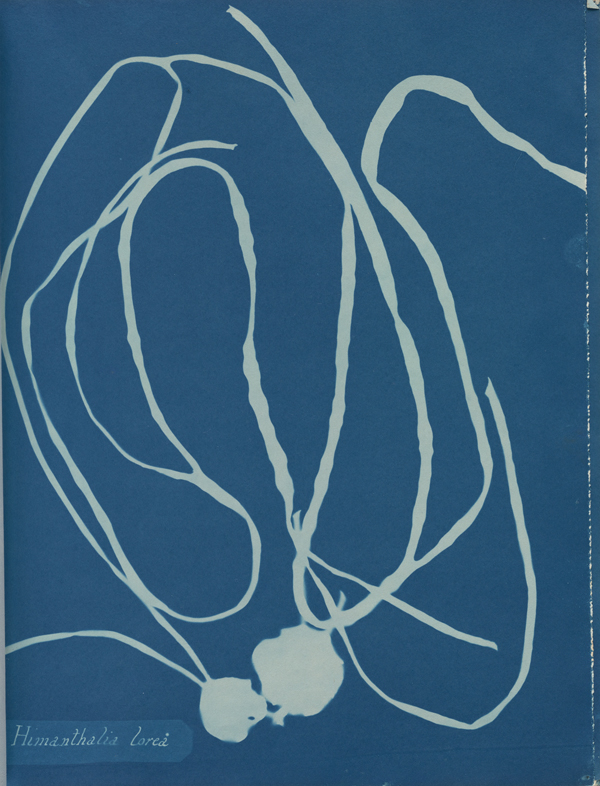
Atkins's Photographs was not the first extensive visual botanical archive. The Enlightenment-era Spanish Empire produced approximately twelve thousand watercolor and tempera illustrations of New World flora, showing visual evidence to be a vital but now-overlooked player in the empire's administrative history.Footnote 47 These visual archives sought to make nature portable and knowable, which was accomplished by developing a shared visual language for all naturalists.Footnote 48 With her cyanotypes, Atkins wanders away from the shared idioms dictating visual botanical languages and, in doing so, provides more elusive finished products that could only be made by recognizing the plants themselves as authors. Atkins's Himanthalia lorea (spaghetti seaweed) cyanotype features twining pieces of brown algae (fig. 3). Two bulbous saucer-shaped thalluses anchor the image as their sprays of thongs scale up the print. The color, an opaque milky white, is consistent throughout the image, lending it a flattened quality, even as the various thongs crisscross one another. Transmogrifying the organic colors and shapes of the algae into two-dimensional blue-and-white prints imparts an alien quality to once-familiar plant materials, only then nominally refamiliarized through the small label at the bottom of the image. Some algae types materialize so foreign as cyanotypes that they incite forms of nonplant identification, like the Vaucheria dichotoma, a yellow-green algae whose verdant coat of filaments evaporates into billowing clouds of smoke (fig. 4). Critics usually address this phenomenon by arguing that the images illuminate the artificiality of representation or demonstrate an interest in the “medium of rendering itself.”Footnote 49 Viewing Atkins's prints and attempting to make sense of them through associative taxonomic activities rehearses this compulsion both to other and make intelligible plant-life through anthropocentric cognitive models. But an ecocritical approach renders a different possible reading that focuses less on the medium itself and more on how the medium negotiates an ethical plant-human relationship based on acknowledging the strangeness of vegetal life.
Anna Atkins, Himanthalia lorea, 27 x 21 cm, 1843, cyanotype. From the New York Public Library, https://digitalcollections.nypl.org/items/510d47d9-4b41-a3d9-e040-e00a18064a99.

Anna Atkins, Vaucheria dichotoma, 27 x 21 cm, 1853, cyanotype. From the New York Public Library, https://digitalcollections.nypl.org/items/e64c47d0-0743-0135-2324-57f9351c974a.

In Plant-Thinking, Michael Marder contends that the ontology of vegetation is undertheorized because plants are “so wholly other and foreign to us” as well as so familiar to us through material instrumentalization practices, like taxonomizing, drying, and placing them in an herbarium.Footnote 50 Marder's plant-human encounters find roots in Victorian botanical texts, like Atkins's Photographs as well as Charles Darwin's 1862 Fertilization of Orchids. Highlighting these cross-historical commensurabilities illuminates how Victorian botanical cataloging and publishing practices accrued around the potentials for plant agency to anticipate the ecomaterialist turn of the late twentieth century. For Victorians, orchids were subjects of both intense admiration and mystery, especially because of their unknown reproductive methods; Darwin's treatment of orchids recognizes and cultivates continuities between plant, animal, and human, thereby recruiting the flowers as co-authors of Darwinian science.Footnote 51 Atkins was experimenting with the possibility of algae co-authorship in the decades before Darwin and his orchids, but in a markedly different medium—the cyanotype instead of the text and engraving—that calls on plants to intervene in scientific authorship in different ways.
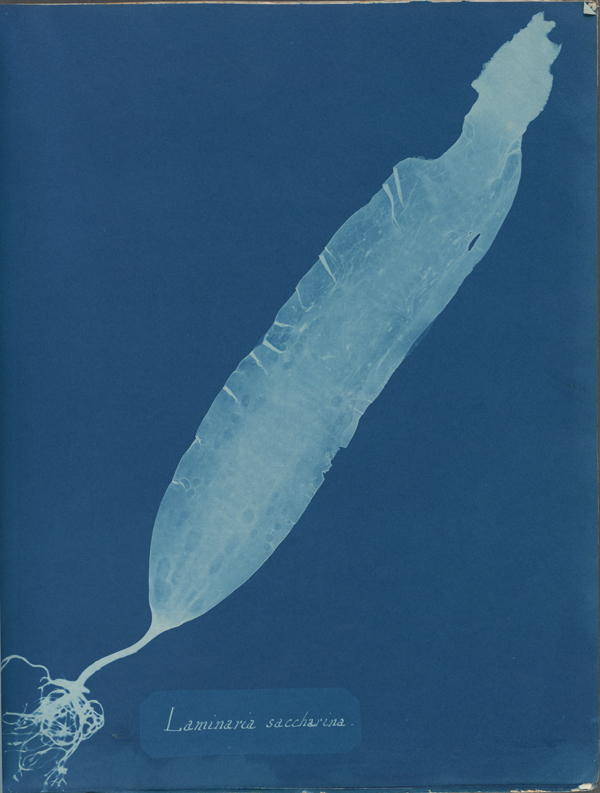
Atkins's Laminaria saccharina, a brown algae known familiarly as “devil's apron,” provides a visual-material counterpart to Marder's philosophical musings that explore how gaps between plants and humans may dwindle if we encounter them ethically (fig. 5.). Marder proposes that when we encounter plants two or more worlds collapse, and an ethical model of doing so requires that we allow plants to “flourish at the edge or at the limit of phenomenality, of visibility, and, in some sense, of ‘the world.’”Footnote 52 While the color palette of blue and white may aesthetically anchor the collection, individual cyanotypes nevertheless exhibit variations in translucence and opacity that lend each alga different textural contours to posit different encounters with plant-life. Unlike the “spaghetti seaweed,” Atkins's “devil's apron” pictures a more delicate porosity between algae and paper that enhances the specimen's texture as living matter. Tears and holes etch into the print, inviting in more light and more hues of blue to suggest that the algae has nearly been soldered to the paper via sunlight, water, and chemicals. As a result, the blade is almost translucent, with varying pockets of blue gleaming through a more muted white only visible through the algae's slightly bumpy texture. Throughout the blade, small, milkier white ripples line the sides of the algae, showing evidence of the pleated folds that formed as Atkins arranged the plant during the sunning process. Throughout the entire piece, the seaweed imprint radiates an ombré effect, as the plant's gnarled nest of stouter rhizoids at the bottom of the image condense into a thicker, more uniform white. Instead of registering an end result of “the universal” or “the typical” sample, Atkins's Laminaria saccharina more accurately captures a unique process of multitissued fusion, as the bodies of the algae, paper, and Atkins meld into and engender a new amalgamative form through the cyanotype.
Anna Atkins, Laminaria saccharina, 27 x 21 cm, 1843, cyanotype. From the New York Public Library, https://digitalcollections.nypl.org/items/510d47d9-4b42-a3d9-e040-e00a18064a99.

4. Atkins's “Blue” Ecology
The Linnaean system for taxonomizing plants according to their reproductive processes was simple enough that it was recommended for men, women, and children alike, poising botany to become a fashionable, even “maternal,” part of informal and formal educations.Footnote 53 For women, botanical activities comprised of drawing, collecting, teaching with, and writing about plants were happy and healthy pursuits, or what botanist John Lindley would euphemize as “polite botany.”Footnote 54 In her 1796 Introduction to Botany, a didactic text disguised as an epistolary novel, Priscilla Wakefield extolls to her acolyte the wholesome advantages of botany: it contributes to “health of body and cheerfulness of disposition, by presenting an inducement to take air and exercise.”Footnote 55 Even though botany's “ornamental” status made it suitable for “ladies and effeminate men,” some plants were not so polite.Footnote 56 Linnaeus's plant classification expressed an analogical relation between plants and humans in which plant stamens and pistils corresponded to male and female reproductive organs. To neutralize the potential scandals of seedy plant sexuality, botany texts often conferred more importance to the male reproductive organs, leaving the female ones as passive receptacles. Based on the unseen, Linnaeus's infamous twenty-fourth class, the “Cryptogamia” or “Clandestine Marriages,” disordered the visible sexual politics of plant taxonomic systems. Suspicious of this motley crew, Wakefield dismisses them as “vegetables which are of the lowest kinds” and “most obnoxious.”Footnote 57 The tides would change for algae by the mid-nineteenth century. Juliana Ewing's “At Home and at Sea—A Ballad,” a poetic paean to her mother and member of the “seaweed sorority,” Margaret Scott Gatty, invites seaweed into the home and celebrates its bizarre gendered and sexed aspects. Evoking a cross-species, indeterminately gendered body, the speaker of the poem asks “O! is it weed or fish or floating hair … / That my raptured eyeballs see?”Footnote 58 Taken together, Wakefield and Ewing concoct a narrative of algae's shifting alliances with femininity. Grounding this trajectory is a poetics of feminine scientific method that recognizes the documentary capability of emotions as a counterpoint to objective exactitude.
Grappling with questions of emotions, gender, and the environment shores up how feminist and material ecocritical studies are vexed but productive critical interlocutors. Material ecocriticism aims to restore critical vibrancy to biological materiality that has paled in comparison to scholarly emphasis on discourse and representationalism in cultural studies.Footnote 59 This poses a potential problem for feminist criticisms since the coupling of women and nature is recognized as a programmatic patriarchal tactic aimed to rob women of cultural, social, and political purchase.Footnote 60 So, how might we then postulate a material coexistence between humans and nature specific to women without replicating the tiresome male/culture, female/nature dualism? To answer this, I turn, perhaps paradoxically so, to the emotional dimensions of Atkins's botanical activities to access a mode of ethically documenting human-nature encounters. The ethos of the mid-nineteenth-century male scientist typically hinged on self-effacement and externalization vis-à-vis his work, which took shape as “objectivity.”Footnote 61 With science as its imprimatur, archiving also fetishized the cool, collected, and disinterested archivist serving as a custodian of collections who undertook “scientific and objective” studies.Footnote 62 However, the emotional tenors described in this section's opening texts identify a competing but contemporaneous narrative strain of female botanical practice that emphasizes the emotional contours of their work. Tapping into the strangeness of cryptogamia, Atkins's Photographs provides insight into a Victorian archival practice capable of cataloging the interplay of material bodies and immaterial affects that resonates with current ecomaterialist perspectives stressing environmental-human amities. Instead of separating the cataloger from the plants, late eighteenth- and nineteenth-century popular botanical literature inspired by Linnaeus promoted entangled plant-human relations that subverted regimes of objectivity.
Scholarship by Monique Allawaert, Theresa Kelley, and Robert Mitchell has explored how literary-botanical imaginings of Linnaeus's taxonomic scheme carve out an ambivalent sexual politics of plant classification that both secured regimes of heteronormative domesticity and proffered a titillating language for nonnormative sexuality.Footnote 63 Yet these divergent sexual perspectives equally shared the conviction that plants provided rich fodder for cultivating allegory. Taking a page from Wakefield's polite botanizing, an 1830s cottage industry of female-directed botanical writings cropped up in the form of “floral biographies.” Charlotte Tonna's Chapters on Flowers (1836) participates in classificatory scheming but with the goal of casting plants as chaste stand-ins for human traits desirable to the modern moralist, like “cheerfulness” and “humility.”Footnote 64 Facilitating human-plant encounters in order to extoll a natural theological point of view that saw the earth as proof of God's grandeur, her book serves as a site for evaporating the vital fluids and dusts of plant sex into anthropomorphic morality tales. Bookending Tonna's rather banal plant platitudes were the works of the Darwins, Erasmus and Charles, who each envisioned more inclusive varieties of plant-animal-human identifications that did not just recruit plants as human analogues. Erasmus Darwin's The Botanic Garden (1791), a two-part poem bolstered by copious scientific footnotes, was a key crossover text between specialist and “polite” botany, even if its contents were racy. The heady poem comprehensively records plant-life through Linnaeus's classification scheme not to isolate specimens but to license a polymorphous bacchanalia of plant-human trysts; Erasmus's analogizing in The Botanic Garden articulates the possibility that plant-life could generate affects and desires similar to those of humans. His grandson Charles later picked up these threads in Fertilization of Orchids (1862) by delineating the orchids’ “interspecies relationships” and “sensitive interaction with their environments” to envisage an inclusive model of cross-species ecological sociality.Footnote 65
The human relations guiding Atkins's project initially relied on an intact nuclear family unit typical of early-Victorian female botanizing. Women with familial connections to male botanists often aided research by collecting, enumerating, and illustrating specimens. Even if they did not have immediate family ties, they would often ship off their collected specimens to male researchers, like Amelia Griffiths, a tireless algae collector who contributed to two landmark phycological compendiums, Dawson Turner's Fuci (1802) and William Harvey's Phycologica Britannica: A History of British Sea-weeds (1847–48). Similarly, the conditions informing the creative inception of Atkins's Photographs confirm botany's ties to the heteronormative family. Work on Photographs commenced when her father joined her at her Kent residence to convalesce, and, as a letter from Children to Talbot suggests, the photogram project was to be a collaboration: “When we return to Kent, my daughter and I shall set to work in good earnest ’till we completely succeed in practicing your invaluable process.”Footnote 66 While the home for Atkins collapsed spheres of “polite botany” and “botanical science,” she nonetheless frames her project primarily through discourses of goodwill and good cheer, as her introduction claims that she has “much pleasure in offering [these volumes] to [her] botanical friends.”Footnote 67
Inviting seaweed into the home could also imperil cozy domestic relations. Popular seaweed-centric texts from authors like George Eliot and Margaret Gatty espoused a surprising ethics of free love among plants, humans, and their environments.Footnote 68 The charms of seaweed were so strong that they incited George Eliot on an 1856 trip to Ilfracombe to declare that “these tide-pools made me quite in love with sea-weeds.”Footnote 69 Moreover, seaweed collecting was a companionate pursuit, as Margaret Gatty recommends in the introduction to her 1872 British Sea-Weeds that interested female collectors should set off to the shores as “a pair of friends.”Footnote 70 Continuing her sketch of seaside collecting, Gatty broadens the locus of intimacy from the two friends to their interactions with various aspects of the marine environs through a series of invitations designed to incite sensual encounters between environmental and human bodies. Gatty instructs her readers to never mind “the few touches from the last gentle waves as they ripple over at your feet,” before she urges them to “Feel all the luxury” of walking in the sand in sturdy leather boots.”Footnote 71 Similarly, as Atkins's project progressed, her different co-authors illuminate how cryptogamic botanizing could dissolve the family unit to generate more expansive networks of intimacy.
Atkins's Photographs serves as an autobiography by charting her own rocky emotional terrain and filtering it into the impressions of the plants themselves, marking a decisive moment in which dominant cultural narratives of botany's cheery emotions shift in kind to the personal emotional investments of its practitioners. Eileen Joy's “blue ecology” reimagines depression and sadness as a “type of weather or atmosphere”; the human “feeling blue” is but one attunement to the world's melancholy, which initiates human-nonhuman enmeshments.Footnote 72 Texts “saturated or charged with lonely, watery, and blue affects” make possible more capacious “ecological entanglements.”Footnote 73 Atkins's project activated these watery, blue affects in 1852 when her father died. Instead of suspending the father-daughter project, Atkins spent the summer in mourning and collecting specimens with her intimate companion Anne Dixon, who had been raised with the Children family after her parents’ death. For the final volumes of Photographs, Anna and Anne instated a collaborative female-centered practice of scientific research and publishing motivated not only by the quest for knowledge or technological experimentation but also by an intricate interplay of negative and desirable affects. Rather than positing botanizing as a salubrious, uplifting practice, the images in these final volumes document Atkins's stormy emotional interiority as much as they do her comparatively serene sea flowers. Their emotionally invested labor gives way to female-female intimacies between these “almost sisters” that both provides an alternative to the objective and impassive male practitioners and reconfigures the familiar heteronormative family that initially drove her botanical practices.
Lest this too-inward focus diminish the more radical eco-archival possibilities of Photographs of British Algae, Joy contends that the relationality promoted by blue ecology's depressive affects performs a “civic erotics” in which collective “acts of feeling weighted down” require us to become “more intimate with our worlding,” as we open ourselves to the weather and its “sea changes.”Footnote 74 The affordances of the cyanotype enable a nonanthropocentric model of amity that stresses intimate interconnections among various affects, environmental materials, and bodies. A rhetoric of intimacy floods John Herschel's description of how potashes, or mined salt compounds, interact with water, heat, seaweed, and paper: “It is no longer an insulated and anomalous affection of certain salts of silver or gold,” but one that “pervades all nature, and connects itself intimately with the mechanism by which chemical composition or decomposition is operated.”Footnote 75 Whereas Gatty's description of interconnectivity concentrated on the human as the beneficiary of and conduit for emotional experiences, Herschel narrates an outwardly rippling process of “affection” realized through cyanotype making that effectively decenters, and even obscures, the trace of the human, suggesting that plants and environmental phenomena are not simply convenient stand-ins for human emotions. Driving various processes of intimate composition and decomposition, the cyanotype is capable of documenting a system of ecological affects that permeate Atkins's finished products, even if evasively so.
Atkins's cyanotypes avoid fully economizing the ecological affects that they document into emotions completely legible to humans. Because Atkins decided to limit her color palette to cyan, rather than all available tints, her cyanotypes balk at photographic pledges to indexicality, instead opting to provide an enveloping viewing experience that liquefies boundaries between sea and object, nonhuman and human.Footnote 76 Developing the prints required dredging them in water to literalize the immersive seas of “blue ecology” that Joy writes of in early modern British seafaring poems. Even though the water has since evaporated, the characteristic dichromatic quality of the cyanotypes still serves as stylized evidence of water and still-wet seaweed. During Atkins's cultural moment, the popular imaginary of the sea encompassed all that was amorphous and abject as well as rational and beautiful, lending it a rich emotional texture that prefigures Joy's watery affects. Within a blue ecological framework, the Wedgewood blue of the cyanotypes take on a hypersaturated sealike quality to materialize collecting and preserving practices that braid together melancholic loss and female intimacy. Instead of human-oriented, the cyanotypes facilitate entangled amities between humans, nonhumans, and their environments. Sifting through hundreds of prints staggeringly similar in their color scheme breeds an immersive experience in which viewers temporarily find themselves awash in Atkins's and the world's briny affects. Although this emotional architecture may not register through traditional empirical means, the possibility of its presence intimates a nonanthropocentric documentary practice shared by humans and plants equally.
5. Atkins's Posthumous Tentacles
The Ptilota plumosa in Atkins's collection is no longer adrift in the ocean, but its print still preserves the amorphous quality of an unmoored object (fig. 6). Though a relatively small alga, its innumerable lithe filaments wind around each other to create a thicket of tentacles that make it nearly impossible to decipher just how many specimens are pictured. In her “Recollections of Ilfracombe,” George Eliot similarly taps into the living qualities of algae when she remarks on “the pale fawn-colored tentacles of an Anthea cereus viciously waving like little serpents in a low tide-pool.”Footnote 77
Anna Atkins, Ptilota plumosa, 27 x 21 cm, 1853, cyanotype. From the New York Public Library, https://digitalcollections.nypl.org/items/cce8d190-0743-0135-f668-00df15e829a0.

Because of its promise to restore significance to extratextual beings, materialist ecocriticism requires new theoretical frameworks for interpreting evidence of a world in which “human exceptionalism and individualism” are unthinkable.Footnote 78 In Staying with the Trouble, Donna Haraway recruits models for this project that operate both theoretically and materially. Haraway's “string figure” functions as a dynamic narrative device capable of constantly “passing and receiving, making and unmaking, picking up threads and dropping them.”Footnote 79 In order to materialize these nonanthropocentric patterning networks of the string figure, Haraway then looks to the tentacle with its “many appendages [that] make string figures.” The tentacular is resolutely material, made up of “matted microbial and fungal tangles,” “fibrous entities,” and “reaching, climbing, tendrilled roots.”Footnote 80 The coordinated inveigling natures of the string figure and the tentacle reorient our understandings of the world from a “self-making” (autopoesis) to a material practice of “making-with” (sympoesis). This closing section reads Haraway's string figure and tentacle alongside the archival afterlife of Atkins's Photographs, using these cognates to coax out the nonanthropocentric possibilities embedded in mid-nineteenth-century archival practices dedicated to generating dynamic, incomplete documentary bodies.
The 1898 Manual for the Description and Arrangement of Archives formalized modern archival theory with its now-famous dictum that an archival collection is an “organism” and “organic whole.”Footnote 81 Not relegated to the late nineteenth century, the organismal trope has since filtered into twentieth-century archival theory. During the 1960s, Theodore Schellenberg introduced the life-cycle model of records management that charts movements of records from the cradle to the grave. Once active records have outlived their use value, they undergo disposition and are removed to the dead-space of the archives. Only within the last twenty years have archival studies scholars, like Frank Upward and Sue McKemmish, proposed an alternative to the life-cycle model with their records continuum model that stresses the transformational qualities of documents. Though less rigid, the records continuum model nevertheless anchors itself in a rhetoric of wholeness, as it seeks to capture the “whole extent of a record's existence.”Footnote 82 So dominant is this narrative current of the whole archival organism within the intellectual history of archiving that it has since obscured mid-nineteenth-century archival practices that produced mutable and incomplete bodies through their cataloging efforts.
A notable feature of mid-nineteenth-century archival classification projects was the recognition that their printed catalogs would be from their origins “incomplete and imperfect” works though they strove for comprehensiveness, since the collections in question consistently received new materials.Footnote 83 Devin Griffiths's work on Antonio Panizzi's 1841 catalog for the British Museum library maps out the classification system that would mold the library into a “more dynamic, open institution.”Footnote 84 The material features of Panizzi's catalog, a printed text with interleaved manuscript slips, produced a document that was “limitless in principle” and subject to “endless revision.”Footnote 85 Atkins was not officially immersed in institutional archival cataloging, but her decision to distribute her prints as unbound manuscripts that could withstand the addition of more images taps into the similarly open-ended imperatives guiding Panizzi's system. The simultaneously patterning and dynamic qualities of these mid-nineteenth-century classification systems help develop a practice of archival cataloging that registers with the dynamic patterning function of Haraway's string figuring.
While both strategically incomplete documents, Panizzi's and Atkins's manuscript systems differ in the ethics of reciprocity at the heart of Photographs of British Algae. Atkins decided to gift her manuscripts as unbound volumes so that the recipients could add more algae prints as she made them. Responsible for arranging their albums as they chose, the recipients too participated in archival cataloging practices alongside Atkins and the plants. During its mid-nineteenth-century life, Atkins's manuscripts construct a narrative of relational, multipartied archiving shared by humans and nonhumans that anticipates the “passing on, receiving, making and unmaking” of Haraway's string figuring.Footnote 86 Because of their former lives as unbound manuscript gifts, existing copies of Atkins's Photographs still follow accessioning patterns that identify more with the string figure than they do with more traditional life-cycle models. For example, a 2004 exhibit, Ocean Flowers: Impressions from Nature, co-hosted by the Drawing Center in New York and the Yale Center for British Art, displayed some of the contents of an album gifted to John Children's assistant, which had since been dispersed to Kelvingrove Art Gallery and the Museum in Glasgow. The album, at one point bound together by Children's assistant, now drifts throughout different archival repositories, transforming from a fixed object to an extended network that initiates different encounters between texts, archivists, curators, and researchers. The expansive body of this album emphasizes its mutability, as it moves, never fully formed, through different repositories and responsively metamorphoses according to different spaces of preservation or methods of display. The indefinitely prolonged lives of this manuscript buck a life-cycle model of management in which being archived equates to being preserved in an unchanging form. Instead, the expansive body of images taps into the implicitly ecomaterialist sensibility structuring mid-nineteenth-century archival cataloging by continuing to generate networks of mutable reciprocity.
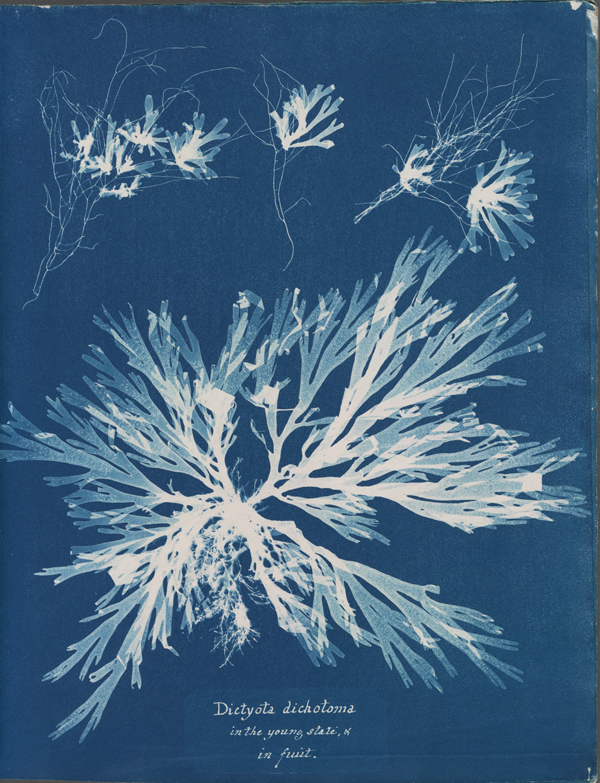
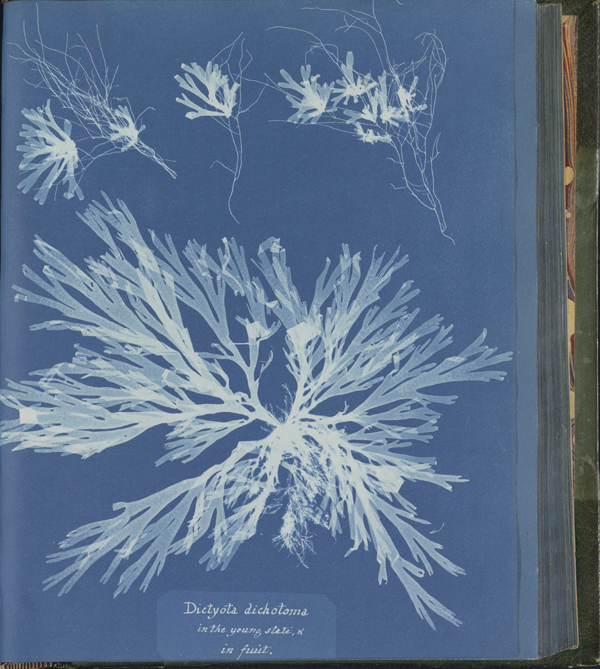
Beyond current archival accessioning patterns, this question of movement is also ingrained within the visuals of the cyanotypes themselves. The tentacle as a material model of world-making is grounded in movement. Of course, tentacled critters like the spider, octopus, and cnidarian all creep, and expectedly so. But for Haraway, so do the tentacles of plants and fungi: these roots and matted tangles are busy “probing,” “swelling,” “reaching,” and “climbing,” as these present participles connote movement in progress.Footnote 87 Each of Atkins's volumes was unique; even if Atkins reprinted certain algae specimens, she would experiment with different arrangements to ensure that no single album was the same. Because Atkins never formally bound her albums, we can retroactively trace these different arrangements across different volumes. For example, at least three different repositories have in their holdings cyanotypes of Dictyota dichotoma, in the young state, and in fruit: Sir John Herschel's album now at the New York Public Library (fig. 7); a copy at the British Library, which was originally presented to the British Museum by John Edward Gray (fig. 8); and a copy recently purchased for the Rijksmuseum in Amsterdam, Netherlands (fig. 9). In each image, the title placard remains stationary, but the plants themselves are more perambulatory. In its watery environs, “Fork Weed” is usually anchored to the ground, lending it only limited and billowing movement; however, Atkins's albums unmoor the algae as the differences among the three imprints depict the same algae specimen dreamily tumbling from one position to the next, the matted little nests of roots relocating each time. Flanking the main specimen from above and below, finer fibrils serenely swivel from one image to the next. Shawn Michelle Smith conceives of a cross-archival reading method in order to explore how cultural meaning is produced within the interstices of different archives.Footnote 88 I would like to adapt this method for ecocritical ends by positing that reading across Atkins's Photographs restores the tentacular movements of her seaweed specimens not necessarily to relocate cultural meaning-making, but rather to redistribute world-making capabilities to both plants and humans. When continually rearranged by Atkins's hand, the crisscrosses of fronds that comprise the main algal specimen orient themselves differently relative to the smaller specimens in each print. Each reconfigured page produces its own unique network of knots and lines, each with different material proximities that could potentially lead to different world-making outcomes. When observed as a triptych, the Dictyota dichotoma images dramatize a seaweed world in the process of formation that calls on both plants and humans as shared agents in a protracted process of sympoesis.
Anna Atkins, Dictyota dichotoma, in the young state, and in fruit, 27 x 21 cm, 1849, cyanotype. From the New York Public Library, https://digitalcollections.nypl.org/items/510d47d9-4adb-a3d9-e040-e00a18064a99.

Anna Atkins, Dictyota dichotoma, in the young state, and in fruit, 26 x 20.3 cm, 1843–53? © The British Library Board.

Anna Atkins, Dictyota dichotoma, in the young state, and in fruit, 25 x 20 cm, 1843–53?. From the Rijksmuseum, Amsterdam, http://hdl.handle.net/10934/RM0001.COLLECT.652085.

6. Coda: Ghosts of the Anthropocene
Four spectrally white bulbs hover over the blackish-brown background of a photogram, a printing method closely related to the cyanotype (fig. 10). The interiors of each empty husk melt into blackness to form lighter splotches that recall spirit photography's ectoplasm. The hardiness of the white stalks glows in bright relief, providing textural counterpoint to the delicate pods and lending resilience to this plant. The interplay of shapes and colors memorialize an aura of spiny beauty, alluring in its evasiveness. The small label at the print's bottom, however, supplies some clues: we are looking at Linum usitatissimum, a plant known as “linseed flax.” It is from the Exclusion Zone in Chernobyl, Ukraine, and its radiation level is 1.7 microsieverts/h. This image is a part of Michael Marder and Anaïs Tondeur's Chernobyl Herbarium: Fragments of an Exploded Consciousness (2016). Commemorating the thirtieth anniversary of the Chernobyl disaster, Chernobyl Herbarium combines personal essays and photograms to document year-by-year the material-environmental impact of Chernobyl's nuclear reactor steam explosion and graphite fires that resulted in widespread radiation exposure beginning in 1986.
Anaïs Tondeur, Linum usitatissimum from The Chernobyl Herbarium: Fragments of an Exploded Consciousness, 2011–16, photogram on rag paper.

Tracing environmental cyanotype or photogram technologies from their nineteenth-century inception to their current iteration lands them in the middle of current conversations in Victorian studies about strategic presentism. Instead of approaching the past as a sequestered object of knowledge, strategic presentism begs us to speculate about how a historical object may “have implications beyond its time.”Footnote 89 In closing, I would like to suggest that cyanotypes share a peculiar relationship to projects of strategic presentism—one that invites us to ponder the durational dimensions of these implications, especially as they relate to documenting the Anthropocene, its connections to the nineteenth century, and the archive's pledge to preserving enduring bodies of knowledge.
As archival materials, cyanotypes are ghostly. They are capable of memorializing the intensities and movements of an ecosystem that bundle together for an intensely specific, and ephemeral, moment in environmental time. The strength of a sun's ray, the pH-level of water, the momentary curl of an algae tentacle coalesce to materialize traces of their former presences through cyanotype technology. The cyanotype's ability to continually reanimate the past through its presentist alliances asserts itself most forcefully in Marder and Tondeur's Chernobyl images, as the radiation-level labels use specific moments in time to build an expansive archive of environmental trauma; but, as Marder writes in the preface, our plant guides push us to imagine “a kind of testimony that respects absolute silence.”Footnote 90 When we read Atkins's cyanotypes within the context of their material processes of production, their cyans, azures, and cobalts briefly blaze with clarifying views of forgotten nineteenth-century archival practices capable of recording the presences of more-than-human ways of being. But, like ghosts, these residues flicker away. With plants as co-creators and authors, Atkins's cyanotypes are resolutely impassive, silent trustees of historical confidences alien to human cognition. Just as moments of transhistorical insight materialize, we are prevented from fully accessing how cyanotypes might matter in our Anthropocene present. Rather than this ghostliness signaling the failure of strategic presentism's promise of resonance, this feature of the cyanotype helps us better understand the transmissional logic of the Anthropocene. The editors of Arts of Living on a Damaged Planet begin by asserting that the Anthropocene nurtures ghosts, the “vestiges and signs of past ways of life still charged in the present” that serve as “traces of more-than-human histories.”Footnote 91 As a potential evidentiary model for documenting the Anthropocene, the cyanotype is one of these ghosts, harboring implications for the present that perhaps remain best as a series of questions, fleeting and haunting in their unanswerability.
So, then, what is it about the cyanotype that makes it a recurring tool for documenting and building archives of our environments? Is it that its processes invite co-creator relationships among environments, nonhumans, and humans? Or might it be the haunting images that cyanotypes produce? As much as they “freeze” nature's specimens for posterity, they also document something more elusive. Their milky-white etchings memorialize evanescent convergences and divergences among plants, environments, and humans that invite encounters at once familiar and alien. Working with cyanotype archives guides us, though elliptically so, in being with plants.