The mollusc Patella ferruginea Gmelin, 1791, endemic to the Mediterranean, is the most endangered invertebrate marine species on the list of the European Council Directive 92/43/EEC and it is presently in serious risk of extinction (Laborel-Deguen & Laborel, Reference Laborel-Deguen, Laborel, Boudouresque, Avon and Gravez1991; Ramos, Reference Ramos1998; Espinosa et al., Reference Espinosa, Guerra-García, Fa and Garcia-Gomez2006). Although its relative abundance in Palaeolithic and Neolithic deposits indicates an extensive former distribution in the western Mediterranean Basin (west coast of Italy, Mediterranean France, Iberian Peninsula, Morocco, Algeria, Tunisia and the western Mediterranean islands: Corsica, Sardinia, Sicily and Balearics), today its Mediterranean range has progressively contracted to a few restricted areas (Cretella et al., Reference Cretella, Scillitani, Toscano, Turella, Picariello and Cataudo1994; Templado et al., Reference Templado, Calvo, Garvía, Luque, Maldonado and Mozo2004) probably due to anthropogenic pressure (Aversano, Reference Aversano1986). The species has presently disappeared in most of its continental European distribution except for Andalusia in southern Spain where hardly 700 specimens are settled along 600 km of Mediterranean shoreline (Moreno & Arroyo, Reference Moreno, Arroyo, Barea-Azcón, Ballesteros-Duperón and Moreno2008). This paper reports on the finding of specimens of P. ferruginea on areas where the species had been considered extinct.
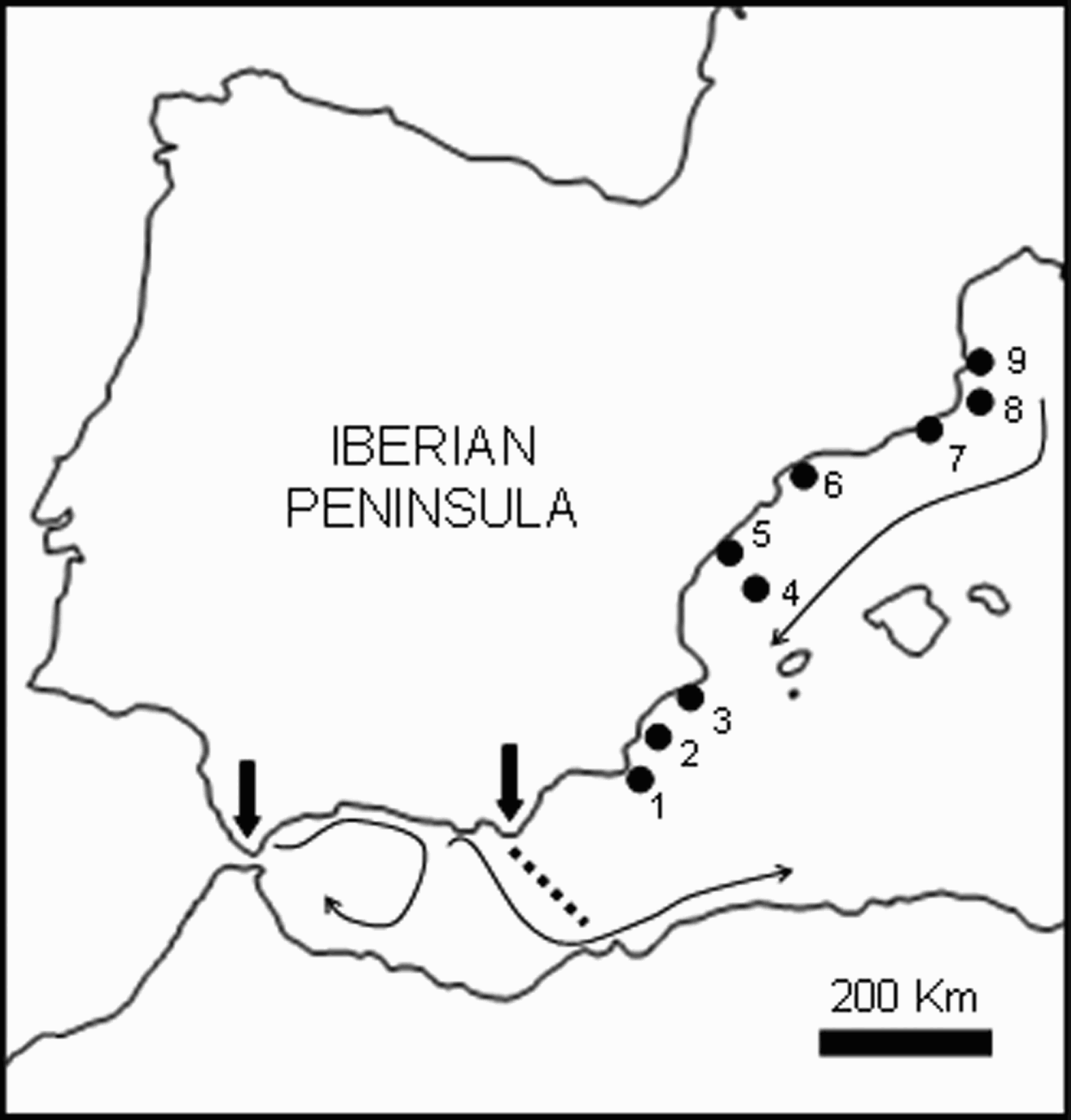
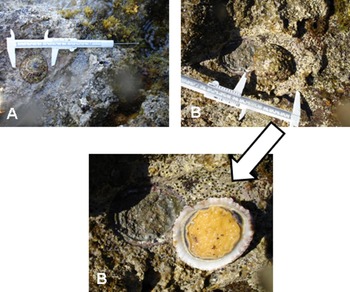
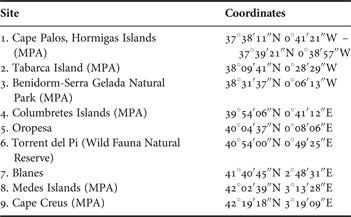
The distribution of P. ferruginea in the Iberian Peninsula (except for Andalusia) is poorly known because specific studies did not exist. The species is sensitive to pollution (Espinosa et al., Reference Espinosa, Guerra-García and García-Gómez2007) and collection (Espinosa et al., Reference Espinosa, Rivera-Ingraham and García-Gómez2008) so the sampling sites were selected mainly in MPAs or at locations with healthy marine communities always on rocky shores (Figure 1; Table 1). At each sampling locality, four transects of 100 m were surveyed except for the Hormigas and Columbretes Islands, where the total perimeter of the main island was sampled on both sites. Only two specimens were detected at Hormigas Islands (Figure 2) whereas the species was absent from the other sites.
Map of Iberian Peninsula indicating the location of sampling sites (black spots, see also Table 1). Dotted line shows the Almeria–Oran oceanographic front and thick arrows show the limit of distribution of Patella ferruginea in the Iberian Peninsula (from the Strait of Gibraltar to Cape of Gata, Andalusian region). Fine arrows indicate surface marine currents (see Robinson et al., Reference Robinson, Leslie, Theocharis and Lascaratos2001).

Specimens of Patella ferruginea located at Hormigas main island. (A) Length: 6.5 cm; height: 2.5 cm; width: 5.3 cm; location: 37°39.331′N 0°38.976′W; (B) length: 7 cm; height: 5.9 cm; width: 3.2 cm; location: 37°39.374′N 0°38.931′W.

Sampling sites and coordinates.

The finding of P. ferruginea far away from Andalusia certainly represents a range extension. The historical range of this species in the Iberian Peninsula did not include any locality outside of Andalusia. In fact, the easternmost limit of the species was located at Cape of Gata (Almeria) where one specimen was recorded in 1992 although it disappeared after a short time (Moreno, Reference Moreno1992). In 2007, there have been detected some specimens in the Almeria area including Cape of Gata (Moreno & Arroyo, Reference Moreno, Arroyo, Barea-Azcón, Ballesteros-Duperón and Moreno2008). However, there was not any record of the species in the Murcia area in spite of the extensive studies on marine communities carried out either in the intertidal or subtidal (see Calvín-Calvo, Reference Calvín-Calvo2003; Ruiz, Reference Ruiz2008). The presence of the species only in the MPA of Hormigas Islands where access is difficult and sampling is strictly forbidden indicates the importance of these tools for the conservation of the species. Additionally, the extension of the distributional range outside of Almeria indicates that the Almeria–Oran oceanographic front would not be a biogeographical barrier for the species and probably the absence of P. ferruginea beyond Murcia to Catalonia could be due to the small size of populations settled in the southern Iberian Peninsula together with the surface marine currents that flow from the north-east to south-west (see Figure 1; Robinson et al., Reference Robinson, Leslie, Theocharis and Lascaratos2001) and could represent a limit for the dispersal of the species.