Introduction
Mood disorders are highly prevalent, distressing and detrimental to daily functioning at any age (WHO, 1993, 2005; APA, 2000). However, they may be especially problematic in old age, as the depressive symptoms add to other diseases and physical disabilities (Gottfries, Reference Gottfries2001; Beekman et al. Reference Beekman, Geerlings, Deeg, Smit, Schoevers, de Beurs, Braam, Penninx and van Tilburg2002; Alexopoulos, Reference Alexopoulos2005).
Older individuals with mood disorders show deficits in a range of cognitive domains (for reviews, see Burt et al. Reference Burt, Zembar and Niederhe1995; Kindermann & Brown, Reference Kindermann and Brown1997; Veiel, Reference Veiel1997; Zakzanis et al. Reference Zakzanis, Leach and Kaplan1998; Hermann et al. Reference Herrmann, Goodwin and Ebmeier2007; Thomas & O'Brien, Reference Thomas and O'Brien2008). Depression-related impairments have been observed in processing speed (Beats et al. Reference Beats, Sahakian and Levy1996; Butters et al. Reference Butters, Whyte, Nebes, Begley, Dew, Mulsant, Zmuda, Bhalla, Meltzer, Pollock, Reynolds and Becker2004; Köhler et al. Reference Köhler, Thomas, Barnett and O'Brien2010), attention (Ganguli et al. Reference Ganguli, Snitz, Vander Bilt and Chang2009; Thomas et al. Reference Thomas, Gallagher, Robinson, Porter, Young, Ferrier and O'Brien2009), working memory (Nebes et al. Reference Nebes, Butters, Mulsant, Pollock, Zmuda, Houck and Reynolds2000; Zakzanis et al. 1998), executive functions (Degl'Innocenti et al. Reference Degl'Innocenti, Agren and Bäckman1998; Sheline et al. Reference Sheline, Barch, Garcia, Gersing, Pieper, Welsh-Bohmer, Steffens and Doraiswamy2006; Elderkin-Thompson et al. Reference Elderkin-Thompson, Mintz, Haroon, Lavretsky and Kumar2007), semantic memory (Zakzanis et al. Reference Zakzanis, Leach and Kaplan1998; Herrmann et al. Reference Herrmann, Goodwin and Ebmeier2007), episodic memory (Bäckman & Forsell, Reference Bäckman and Forsell1994; Bäckman et al. Reference Bäckman, Hill and Forsell1996; Veiel, Reference Veiel1997; Ganguli et al. Reference Ganguli, Snitz, Vander Bilt and Chang2009) and visuospatial function (Bhalla et al. Reference Bhalla, Butters, Mulsant, Begley, Zmuda, Schoderbek, Pollock, Reynolds and Becker2006; Thomas et al. Reference Thomas, Gallagher, Robinson, Porter, Young, Ferrier and O'Brien2009). However, variability in the size of observed depression-related deficits is high, with several studies even failing to find differences between depressed patients and controls (Baune et al. Reference Baune, Suslow, Arolt and Berger2007; Fisher et al. Reference Fischer, Scweizer, Atkins, Bozanovic, Norris, Hermann, Nisenabum and Rourke2008; Krogh et al. Reference Krogh, Videbech, Renvillard, Garde, Jörgensen and Nordentoft2012).
Variability of cognitive deficits in depression may originate from differences across a range of clinical and demographic characteristics. A recent meta-analysis of middle-aged persons with a first episode of major depressive disorder (MDD) documented the effects of five clinical and demographic characteristics on cognitive variability: symptom remission, in-patient status, antidepressant usage, age and education (Lee et al. Reference Lee, Hermens, Porter and Redoblado-Hodge2012). Each of these factors contributed to heterogeneity in effect sizes in at least one cognitive domain. Other characteristics that may affect variability in depression-related cognitive impairment include co-morbid psychiatric diagnoses (e.g. schizophrenia, anxiety disorders), type (e.g. MDD, bipolar disorder) and severity (i.e. mild, moderate, severe). Previous studies have often combined groups that are heterogeneous. For example, some studies mix depressed participants with or without antidepressant medications and psychiatric co-morbidities whereas others do not control for important demographic variables, such as level of education. Hence, studying specific mood disorders while controlling for clinical and demographic characteristics would seem to be crucial in this field of research.
Current knowledge on depression and cognition is largely based on results from clinical samples of individuals with severe depression who have sought treatment in mental health-care settings (Eaton et al. Reference Eaton, Shao, Nestadt, Lee, Bienvenu and Zandi2008). As older depressed persons are less likely to report affective symptoms and more likely to report psychosomatic complaints than their younger counterparts (Gallo et al. Reference Gallo, Rabins, Lyketsos, Tien and Anthony1997; Brodaty et al. Reference Brodaty, Luscombe, Parker, Wilhelm, Hickie, Austin and Mitchell2001), elderly persons with mild depression may not be detected by the health-care system. Thus, large-scale population-based studies may be more suitable to study milder forms of depression. However, knowledge of the associations between depression and cognitive performance from population-based studies is sparse. In addition, most studies are based on the DSM-IV (APA, 2000) whereas ICD-10 (WHO, 1993) may be more suitable in population-based settings, as it also enables identification of persons with mild depression.
The primary aim of the current study was to investigate the effect of unipolar depression on performance in a range of cognitive domains in an elderly population free of dementia and antidepressant pharmacotherapy, while controlling for potential confounders. Additional aims were to assess depression severity and potential interaction effects between age and depression in relation to cognitive performance.
Method
Participants
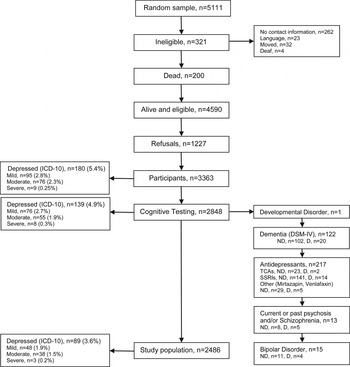
The Swedish National Study on Aging and Care in Kungsholmen (SNAC-K) includes an extensive medical, social and psychological database. SNAC-K has been approved by the ethics committee at the Karolinska Institutet, Stockholm, Sweden, and the ethical guidelines from the Declaration of Helsinki are followed. Participants were selected randomly (based on birth dates, stratified by quarters, for 3 years of baseline data collection) from elderly persons aged ⩾60 years registered as residents in the Kungsholmen municipality in Stockholm, Sweden, belonging to prespecified age cohorts. At baseline, the total number of participants was 3363. Data were collected using clinical examinations, structured interviews and self-report questionnaires, and an extensive cognitive test battery was administered to 2848 participants (see Laukka et al. Reference Laukka, Lövdén, Herlitz, Karlsson, Ferencz, Pantzar, Keller, Graff, Fratiglioni and Bäckman2013 for a thorough description of the sample and test battery administration), of whom 2486 were included in the current study (Fig. 1).
Sample description. ND, Non-depressed; D, depressed; TCA, tricyclic antidepressant; SSRI, selective serotonin reuptake inhibitor.

Depression diagnosis
Depression diagnosis was achieved in a three-step procedure. First, a team of medical doctors, supervised by a senior neurologist with 40 years of clinical experience and a geriatrician, examined all of the participants. The medical examination also aimed to exclude medical conditions potentially mimicking low mood (i.e. thyroid dysfunction). Second, depressive symptoms were assessed based on the answers given to specific items of the Comprehensive Psychopathological Rating Scale (CPRS; Åsberg et al. Reference Åsberg, Montgomery, Perris, Schalling and Sedvall1978) administered by the medical doctors. The CPRS is a rating scale of current psychiatric symptoms such as low mood, reduced interest, lack of initiative, low self-esteem, pessimistic view of the future and thoughts of death. The CPRS is highly reliable and sensitive (Amati et al. Reference Amati, Del Vecchio, Kemali, Perris and Vacca1978; Montgomery et al. Reference Montgomery, Åsberg, Jörnested, Thorén, Träskman, McAuely, Montgomery and Shaw1978; Perris, Reference Perris1979), and has been successfully used in elderly samples (Bäckman et al. Reference Bäckman, Hill and Forsell1996; Berger et al. Reference Berger, Small, Forsell, Winblad and Bäckman1998). Third, a geriatric psychiatrist, external to the data collection, diagnosed mild, moderate and severe depression according to ICD-10 criteria (WHO, 1993). The CPRS assessment was further supported by information from self-report questionnaires and by the examining physician's clinical judgment. In case of disagreement between different sources of information, a senior geriatric psychiatrist was consulted to confirm or reject the initial diagnosis. The psychiatrists were blind to pharmacological treatment, medical and psychiatric history, and to general health status.
At baseline, 180 persons (5.4%) were diagnosed with depression. The prevalence of depression in SNAC-K is in good agreement with another European study using ICD-10 criteria (Spiers et al. Reference Spiers, Brugha, Bebbington, McManus, Jenkins and Meltzer2012). Of the participants with cognitive data, 139 (4.9%) were diagnosed with depression. Depressed persons who did not participate in the cognitive testing (n = 41) were more likely to be older (p < 0.01) and less likely to use antidepressant pharmacotherapy (p < 0.01) than those who were examined cognitively. No differences between these groups were observed for dementia diagnosis, Mini Mental State Examination (MMSE; Folstein et al. Reference Folstein, Folstein and McHugh1975) performance, co-morbid psychiatric diagnoses, educational attainment or depression severity. Participants completing cognitive testing were screened for dementia, antidepressant usage and co-morbid psychiatric disorders leaving a study sample of 2486 participants, of whom 89 (3.6%) were diagnosed with unipolar depression.
Cognitive test battery
Short-term memory
Performance scores on the Wechsler Adult Intelligence Scale-III (WAIS-III) Digit Span subtest (Wechsler, Reference Wechsler1981) were the number of correct repetitions for forward span and backward span respectively.
Processing speed
For pattern comparison (Salthouse & Babcock, Reference Salthouse and Babcock1991), participants were presented with 30 pattern combinations and asked to determine, as quickly as possible, whether or not these patterns were the same. The performance score was the average number of correct responses across two trials, each lasting 30 s. For digit cancellation (Zazzo, Reference Zazzo1974), participants were presented with a paper with 11 rows of random digits (1–9) and asked to cross out the target digit (4) as quickly as possible. The performance score was the total number of correct responses within 30 s.
Attention and executive function
The Trail Making Test (TMT; Lezak, Reference Lezak2004) was used to assess attention (TMT-A) and executive function (TMT-B). Each part consisted of 13 circles with equal distances between circles in the two parts. TMT-A required participants to connect encircled digits in numerical order (1, 2, 3, etc.). For TMT-B, participants were asked to connect encircled digits and letters in alternating order (1–A, 2–B, 3–C, etc.). The performance scores were the completion times for participants with 12 correct connections. The first mistake was corrected by the test administrator and did not result in a lower score (correction time was not included in completion time). Participants were also allowed to make one careless connection (>2 mm outside the circle).
Verbal fluency
Letter fluency (Lezak, Reference Lezak2004) required oral generation of as many words as possible during 60 s beginning with the letters F and A respectively. The same procedure was used for category fluency, with occupations and animal names serving as taxonomic categories. For letter and category fluency, the performance scores were the total number of generated words divided by two.
Episodic memory
Free recall and recognition were assessed with a standard list of 16 unrelated nouns (e.g. carrot, ring, fork; Laukka et al. Reference Laukka, Lövdén, Herlitz, Karlsson, Ferencz, Pantzar, Keller, Graff, Fratiglioni and Bäckman2013). The free recall score was the number of correctly recalled nouns within 2 min. Following recall, 32 nouns were presented (16 targets, 16 lures) and the participants' task was to determine whether or not the words had been presented previously (yes–no recognition). The performance score for the recognition task was the number of hits minus the number of false alarms.
Semantic memory
For the vocabulary task participants were asked to select synonyms for 30 words out of five alternatives (SRB:1; Dureman, Reference Dureman1960; Nilsson et al. Reference Nilsson, Bäckman, Erngrund, Nyberg, Adolfsson, Bucht, Karlsson, Widing and Winblad1997). The performance score was the number of correctly selected synonyms within 7 min. A second semantic memory task consisted of 10 general knowledge questions (e.g. What is the name of the capital of Uruguay?) with two response alternatives, one of which was correct. The performance score was the number of correct answers.
Spatial ability
In mental rotations, a 10-item simplified version of the Shepard–Metzler test (Reference Shepard and Metzler1970) was used (Vandenberg & Kuse, Reference Vandenberg and Kuse1971; Rehnman & Herlitz, Reference Rehnman and Herlitz2006). A target figure was presented and participants' task was to decide, within 45 s, which of three other rotated figures equaled the target. The performance score was the number of correctly selected figures.
Statistical analyses
Separate ANOVAs and χ 2 tests were conducted on the background variables. Differences in cognitive performance between non-depressed, mildly and moderately plus severely depressed persons were assessed with one-way ANCOVAs. Potential interaction effects with age were assessed with two-way (depression status: non-depressed, depressed; age: ‘young–old’, 60–80 years of age, ‘old–old’, > 80 years of age) ANCOVAs. The effects of pharmacological treatments that might affect cognition were also assessed with two-way (depression status: non-depressed, depressed; pharmacological status: yes, no) ANCOVAs. Lastly, participants with preclinical dementia were removed from the sample and we conducted one-way ANCOVAs on depression status (non-depressed, depressed). All analyses included age, education and gender as covariates except for the two-way ANCOVAs with age as a factor, where the covariates were education and gender.
Results
Background variables
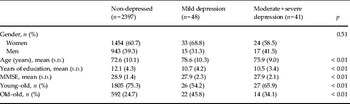
There were differences in background variables between non-depressed and depressed individuals, with the depressed being older, having fewer years of education and lower MMSE scores than the non-depressed (Table 1).
Background characteristics of the study population stratified by depression status

MMSE, Mini Mental State Examination; s.d., standard deviation.
Unipolar depression and cognitive performance
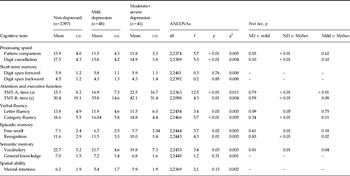
We observed significant overall effects of depression status for all cognitive domains except for short-term memory, general knowledge and spatial ability. Post-hoc tests showed that the moderately and severely depressed group performed at a significantly lower level than the non-depressed in processing speed, attention, executive function, verbal fluency, episodic memory and vocabulary, and were only outperformed by the mildly depressed group on TMT-A, episodic recognition and vocabulary. Mild depression was associated with poorer performance in processing speed (see Table 2).
Cognitive performance in raw scores and descriptive data for ANCOVAs

ND, Non-depressed; MoSev, moderate + severe depression; TMT, Trail Making Test; s.d., standard deviation; df, degrees of freedom.
ANCOVAs with age, education and gender as covariates.
Interaction effects between age and depression
As expected, age was negatively associated with all outcome variables (p's < 0.05, η 2 = 0.04–0.02). An interaction effect between depression and age was observed for pattern comparison (F 1,2374 = 4.067, p < 0.05, η 2 = 0.002), reflecting a larger effect of depression in the young–old than in the old–old.
Interaction effects between medication and depression
Although the sample had been screened for antidepressant usage, the proportion of participants taking other medications that may have a negative effect on cognitive performance (psychotropics including benzodiazepines; opioids; antiepileptics; glucocorticoids; and anticholinergics) was high (total n = 490; non-depressed n = 446, 18.6%; depressed n = 44, 49%), especially in the depressed group. However, we observed no main effects of pharmacological treatment on cognitive performance or any interactions with depression for any of the cognitive outcomes (p's > 0.05).
Screening for preclinical dementia
As depression may be a risk factor or an early preclinical marker for dementia, we removed all participants who had developed dementia during a total of 6 years of follow-up data. The follow-up interval was 3 years for older cohorts (⩾ 78 years of age) and 6 years for younger cohorts (60–72 years of age). In total, 158 participants were diagnosed with dementia at follow-up assessment (DSM-IV criteria), and were thus removed from the sample (non-depressed, n = 139; depressed, n = 19). In general, negative associations between depression and cognitive performance were also observed after removing the preclinical dementia cases (pattern comparison: F 1,2236 = 9.80, p < 0.01, η 2 = 0.004; digit cancellation: F 1,2249 = 5.78, p < 0.05, η 2 = 0.003; TMT-A: F 1,2226 = 4.02, p < 0.05, η 2 = 0.002; TMT-B: F 1,2008 = 5.01, p < 0.05, η 2 = 0.002; letter fluency: F 1,2301 = 6.16, p < 0.05, η 2 = 0.003; category fluency: F 1,2312 = 5.57, p < 0.05, η 2 = 0.002). The exception to this pattern was free recall, where the association with depression was at trend level (F 1,2294 = 2.82, p = 0.093, η 2 = 0.001).
Discussion
The main findings from this study are that cognitive deficits in unipolar old-age depression involve a range of cognitive domains. This pattern was observed in a large-scale study, with participants free of dementia and antidepressant pharmacotherapy. These associations were not due to potential confounders, such as medication with potential negative effects on cognition, impending dementia, age, education or gender.
In accordance with previous research, moderate/severe unipolar depression was associated with poorer performance in processing speed (Beats et al. Reference Beats, Sahakian and Levy1996; Butters et al. Reference Butters, Whyte, Nebes, Begley, Dew, Mulsant, Zmuda, Bhalla, Meltzer, Pollock, Reynolds and Becker2004; Köhler et al. Reference Köhler, Thomas, Barnett and O'Brien2010), attention and executive functioning (Degl'Innocenti et al. Reference Degl'Innocenti, Agren and Bäckman1998; Elderkin-Thompson et al. Reference Elderkin-Thompson, Mintz, Haroon, Lavretsky and Kumar2007; Ganguli et al. Reference Ganguli, Snitz, Vander Bilt and Chang2009; Thomas et al. Reference Thomas, Gallagher, Robinson, Porter, Young, Ferrier and O'Brien2009), verbal fluency (Ganguli et al. Reference Ganguli, Snitz, Vander Bilt and Chang2009), episodic memory (Bäckman & Forsell, Reference Bäckman and Forsell1994; Bäckman et al. Reference Bäckman, Hill and Forsell1996; Veiel, Reference Veiel1997) and vocabulary (Zakzanis et al. Reference Zakzanis, Leach and Kaplan1998).
No association between depression and spatial ability was observed. Some spatial tasks (pattern recognition, complex figures and object assembly) have shown moderate effects of depression (Veiel, Reference Veiel1997; McDermott & Ebmeier, Reference McDermott and Ebmeier2009). One reason for this may be that these tasks engage executive skills (e.g. planning, organization and abstraction), which rely more heavily on prefrontal areas (Lezak, Reference Lezak2004). By contrast, the mental rotation task used in this study has been shown to activate parietal brain areas (Wendt & Risberg, Reference Wendt and Risberg1994; Tagaris et al. Reference Tagaris, Kim, Strupp, Andersen, Ugurbil and Georgopoulos1996), which are less affected in depression relative to frontotemporal regions (Mayberg, Reference Mayberg1997, 2007; Nestler et al. Reference Nestler, Barrot, DiLeone, Eisch, Gold and Monteggia2002). Furthermore, the lack of depression-related associations with short-term memory and general knowledge observed in this study are in agreement with the bulk of related research (e.g. Zakzanis et al. Reference Zakzanis, Leach and Kaplan1998; Hermann et al. Reference Herrmann, Goodwin and Ebmeier2007; McDermott & Ebmeier, Reference McDermott and Ebmeier2009).
Thus, the general pattern of findings suggests that cognitive deficits are present in moderate/severe unipolar depression for a range of cognitive domains, after controlling for several clinical and demographic characteristics. The processing speed deficit observed in mild depression, in combination with few group differences between the mildly and moderately/severely depressed persons, indicates that cognitive deficits in depression follow a continuum, where the more severe the depression is, the more severe are the cognitive deficits.
Studies investigating cognitive performance in mild old-age depression are largely lacking. Nevertheless, deficits in free recall (Elderkin-Thompson et al. Reference Elderkin-Thompson, Mintz, Haroon, Lavretsky and Kumar2007) and executive function (Elderkin-Thompson et al. Reference Elderkin-Thompson, Anand, Bilker, Dunkin, Mintz, Moberg, Mesholam and Gur2003) have been reported in studies on minor depression (DSM-IV criteria). Future research targeting mild and/or minor depression controlling for clinical and demographic variables is warranted.
Only one significant interaction effect between depression and age was observed; younger age was associated with a weaker effect of depression on pattern comparison. This interaction effect was due to lack of depression association in the old–old, where both depressed and non-depressed persons performed at the same low level. Thus, increasing age did not exacerbate the depression-related cognitive deficits in our sample. Similarly, Lockwood et al. (Reference Lockwood, Alexopoulos and van Gorp2002) did not observe an interaction effect between depression and age for cognitive performance in an elderly clinical MDD sample.
No associations of medication with negative effects on cognition were found, and there were no interaction effects with depression. Thus, the present pattern of findings was probably not confounded by pharmacological treatment. However, it should be noted that information regarding medication dosages and treatment intensity were not available, and that these parameters may have differed between the groups.
We have shown that excluding persons in a preclinical dementia phase attenuated, but did not eliminate, the negative associations between depression and processing speed, attention, executive functions and verbal fluency. This is an important finding, as depression may be a marker of impending dementia (e.g. Berger et al. Reference Berger, Fratiglioni, Forsell, Winblad and Bäckman1999; Ownby et al. Reference Ownby, Crocco, Acevedo, Vineeth and Lowenstein2006). The lack of interaction effects between depression and age further supports the view that depression is associated with poorer cognitive performance regardless of future dementia status, given that increasing age is a strong risk factor for dementia (Corder et al. Reference Corder, Lannfelt, Viitanen, Corder, Manton, Winblad and Basun1996; Raber et al. Reference Raber, Huang and Ashford2004). Nevertheless, the association between depression and free recall was only at trend level after excluding persons in a preclinical dementia phase, suggesting that dementia-related pathology among depressed persons may account partly for the association with recall performance. Thus, controlling for impending dementia is important when investigating cognitive performance in old-age depression. This is particularly true in our study where the proportion of depressed persons with impending dementia was high.
Limitations
A limitation of the present study is that data regarding age of onset, along with the number and duration of depressive episodes, were not available. Thus, we were unable to differentiate between early and late-onset depression. Another limitation is the low prevalence of severe depression (0.25%, n = 9), which probably reflects a high initial refusal rate in this group for participation in population-based studies. This might reflect a higher degree of clinically significant distress among persons with severe depression, which reduces the likelihood to commit to multiple assessments over several years. Finally, the diagnosing psychiatrist did not examine all participants (n = 3363) in person.
Origins of cognitive impairment in depression
Cognitive impairment in depression was previously assumed to result from poor effortful processing due to low motivation (e.g. Hasher & Zacks, Reference Hasher and Zacks1979; Weingartner et al. Reference Weingartner, Cohen, Murphy, Martello and Gerdt1981; Roy-Byrne et al. Reference Roy-Byrne, Weingartner, Bierer, Thompson and Post1986), but this assumption has been largely abandoned, as the Kindermann & Brown (Reference Kindermann and Brown1997) meta-analysis revealed no association between effortfulness of different cognitive tasks and effect sizes for depression. More recent theories include hypercortisolemia, which has been suggested to cause hippocampal volume reduction (e.g. Duman et al. Reference Duman, Heninger and Nestler1997; Sapolsky et al. Reference Sapolsky, Romero and Munck2000; McEwan, Reference McEwan2003). This may contribute to the depression-related association observed for episodic memory. Hypercortisolemia is thought to result from ‘stress-reactivity’, causing hypothalamic–pituitary–adrenocortical (HPA) axis hyperactivity. It has further been suggested that functions drawing on the prefrontal cortex may be even more sensitive to elevated levels of corticosteroids relative to episodic memory (Lupien et al. Reference Lupien, Gillin and Hauger1999; Young et al. Reference Young, Sahakian, Robbins and Cowen1999). This account is consistent with the current observation that depression was associated with poorer performance on attention, executive functions, verbal fluency and speed. Furthermore, the vascular depression hypothesis (Alexopoulos, Reference Alexopoulos1997, Reference Alexopoulos2006) is old-age specific, and posits that the presence of cerebrovascular disease and white matter alterations (see Herrmann et al. Reference Herrmann, Le Masurier and Ebmeier2008 for a review) precedes late-onset depression with pronounced executive dysfunction as its hallmark (Alexopoulos et al. Reference Alexopoulos, Meyers, Young, Kalayam, Kakuma, Gabrielle, Sirey and Hull2000; Alexopoulos, Reference Alexopoulos2005).
Implications
The observations of cognitive deficits in unipolar old-age depression have important implications. The deficit in processing speed in mild depression, in combination with numerous non-existent performance differences between mild and moderate/severe depression, underscores the necessity for early detection of depression. This is particularly important in view of the likelihood that 25% of persons with minor depression will develop moderate or severe depression within 2 years if left untreated (Alexopoulos, Reference Alexopoulos2005), and by that time the cognitive deficits will probably have affected several domains. Importantly, cognitive deficits in depression are associated with higher relapse and recurrence (Fossati et al. Reference Fossati, Ergis and Allilaire2002; Majer et al. Reference Majer, Ising, Künsel, Binder, Holsboer, Modell and Zihl2004), along with reduced coping abilities and treatment compliance (Dunkin et al. Reference Dunkin, Leuchter, Cook, Kasl-Godley, Abrams and Rosenberg-Thompson2000), and thus constitute a key factor in the likelihood of remission. Consequently, early interventions targeting cognition in this population are needed. This is especially true given that this population is less likely to report affective symptoms (Gallo et al. Reference Gallo, Rabins, Lyketsos, Tien and Anthony1997; Brodaty et al. Reference Brodaty, Luscombe, Parker, Wilhelm, Hickie, Austin and Mitchell2001), is growing fast in numbers and is likely to suffer from reduced physical function and medical co-morbidities.
Conclusions
This population-based study controlled for several clinical and demographic characteristics that may impact cognitive performance in old-age depression. After screening for dementia, psychiatric co-morbidities and antidepressant pharmacotherapy, and controlling for medication with potentially negative effects on cognition, impending dementia, age, education and gender, we found that moderate/severe unipolar depression was associated with poorer performance in processing speed, attention, executive functions, verbal fluency, episodic memory and vocabulary. Mild depression was associated with deficits in processing speed and, in general, differences between mild and moderate/severe depression were few (TMT-A, episodic recognition, vocabulary), thus indicating that the more severe the depression, the more severe the cognitive deficits, and underscoring the importance of early detection of depression. No depression-related impairments for short-term memory, general knowledge or spatial ability were observed. Furthermore, depression-related deficits were also observed after excluding impending dementia cases, thus indicating that old-age depression is associated with poorer cognitive performance regardless of future dementia status.
Acknowledgments
This research was supported by funding from the Karolinska Institutet (A.P., E.J.L.), the Gamla Tjänarinnor Foundation (A.P.), Osterman's Foundation (E.J.L.), the Swedish Council for Working Life and Social Research (E.J.L., L.B., L.F.), the Swedish Research Council (L.B., L.F.), Swedish Brain Power (L.F., L.B.), an Alexander von Humboldt Research Award (L.B.), and the af Jochnick Foundation (L.B.).
We thank Professor D. De Ronchi, Bologna University, for her expert advice on depression diagnostics, and the SNAC-K nurses, medical doctors and psychologists for their contribution to data collection.
Declaration of Interest
None.