Introduction
Hosts provide essential biological conditions and resources for parasites, with endoparasite dispersal being primarily constrained by host movement and specific transmission pathways (Krasnov et al. Reference Krasnov, Khokhlova, Oguzoglu and Burdelova2002; Patterson and Ruckstuhl Reference Patterson and Ruckstuhl2013; Perlin et al. Reference Perlin, Poulin and de Bekker2025; Poulin Reference Poulin2007). Under the island biogeography framework, host structure and age are key determinants of parasite assemblages (Kuris et al. Reference Kuris, Blaustein and Alio1980). Larger hosts, characterised by increased tissue complexity and greater surface area, offer a wider range of colonisation sites and resources, which promotes niche differentiation and facilitates parasite coexistence (Doña and Johnson Reference Doña and Johnson2023; Fisher et al. Reference Fisher, Shik and Boomsma2020; Kamiya et al. Reference Kamiya, O’Dwyer, Nakagawa and Poulin2014; Oliveira et al. Reference Oliveira, Mascarenhas, Batista-Oliveira, Castro Araújo, Ávila and Borges-Nojosa2022).
Complementing this structural role, body size increases the probability of parasite encounters, either through the entry of monoxenous larvae or the ingestion of heteroxenous species via higher prey consumption (Benesh et al. Reference Benesh, Parker and Chubb2021; Rasmussen and Randhawa Reference Rasmussen and Randhawa2018). Furthermore, older individuals often exhibit higher parasite loads due to cumulative exposure over time (Cunha-Barros et al. Reference Cunha-Barros, Van Sluys, Vrcibradic, Galdino, Hatano and Rocha2003). While these ecological drivers are well-documented, the relative influence of host evolutionary history on these patterns remains a critical area for investigation.
These theoretical predictions find strong empirical support in squamate reptiles. Lizards, in particular, serve as valuable models for studying parasitic systems, with several studies, particularly within the Tropiduridae (Anjos et al. Reference Anjos, Ávila, Ribeiro, Almeida and Silva2012; Silva et al. Reference Silva, Teixeira, Franzini, Mesquita and Brito2023) and Teiidae families (Ramírez-Morales et al. Reference Ramírez-Morales, Lislevand, Retana-Salazar, Solhøy and Roth2012; Ribas et al. Reference Ribas, Rocha, Teixeira-Filho and Vicente1998), demonstrating a positive association between host size and parasite load. Conversely, the limiting role of small body size is evident in various Gymnophthalmidae species (Oliveira et al. Reference Oliveira, Teixeira, Queiroz, Araujo Filho, Teles, Brito and Mesquita2017; Ribeiro et al. Reference Ribeiro, Ferreira, Silva, Vieira and Moura2018; Teixeira et al. Reference Teixeira, Silva, Brito, Teles, Araujo-Filho, Franzini, Santana, Almeida and Mesquita2018b). However, because the ecological traits and phylogenetic relationship patterns of these hosts are often inherited from common ancestors, data from related species cannot be treated as statistically independent (Felsenstein Reference Felsenstein1984; Garamszegi Reference Garamszegi2014). Consequently, the complexity of these host-parasite interactions requires phylogenetic comparative methods to disentangle the contribution of evolutionary and ecological factors, ensuring that observed patterns reflect contemporary processes rather than mere shared ancestry (Brooks and McLennan Reference Brooks and McLennan1991; Harvey and Pagel Reference Harvey and Pagel1991).
Furthermore, the relative influence of these factors may vary according to parasite life-history strategies. While monoxenous parasites are primarily affected by environmental conditions such as temperature and humidity, heteroxenous species depend on the availability of suitable intermediate hosts for transmission (Anderson Reference Anderson2000; Schmid-Hempel Reference Schmid-Hempel2021). Such distinct life cycles suggest that different responses might be expected among parasite groups, further justifying a detailed investigation of these drivers (Martins and Poulin Reference Martins and Poulin2024).
Therefore, we used endoparasite data from lizards collected during field expeditions in the Atlantic Rainforest of northeastern Brazil, representing the ecological and phylogenetic diversity of the local lizard assemblages, to investigate the relative influence of ecological and historical factors on the widely documented relationship between lizard body size and mass and the richness and intensity of infection of endoparasites. Here, historical factors are understood as the combined outcomes of long-term processes that shape and transmit inherited traits among species, while ecological factors represent more recent influences that modify the organisation of host assemblages (Ricklefs and Miller Reference Ricklefs and Miller1999). Considering that host phylogeny directly influences the diversification of parasite life-history strategies, we hypothesise that variation in parasite diversity and load among lizard hosts is shaped by a combination of ecological and phylogenetic relationships, highlighting the importance of phylogenetic approaches to understanding the ecological and evolutionary processes driving these interactions.
Materials and Methods
Dataset
Sampling was conducted in six areas of the Atlantic Rainforest, in the state of Paraíba, Northeast Brazil. For a detailed description of the collection sites, specimen capture methodology, and endoparasite identification process, see Teixeira et al. (Reference Teixeira, Riul, Brito, Araujo Filho, Teles, Almeida and Mesquita2020, Reference Teixeira, Riul, Brito, Teles, Araujo-Filho, Almeida and Mesquita2025). After euthanasia, all lizards had their snout-vent length (SVL, mm) and mass (g) measured. Because these two metrics are widely treated as distinct life-history traits in studies addressing life-history patterns of lizards (Mesquita et al. Reference Mesquita, Costa, Colli, Costa, Shepard, Vitt and Pianka2016a), both were retained for the analyses. We assessed the association between SVL and body mass using Pearson’s product–moment correlation, and these variables were subsequently used in separate sets of models. For all analyses, species-level averages were calculated for each trait.
We recorded parasite abundance (the total number of parasites, regardless of species, in a single infected host) and parasite richness (the total number of parasite species per host specimen) following Bush et al. (Reference Bush, Lafferty, Lotz and Shostak1997). To incorporate this data into phylogenetic comparative analyses, we then calculated the mean intensity of infection (the total number of parasites across all infected hosts, divided by the number of infected hosts) and mean parasite richness (the mean number of parasite species) for each infected lizard species.
Phylogeny and Statistical Analyses
All statistical analyses were conducted using R Statistical Software v4.4.2 (R Core Team 2024). Throughout the text, means are presented as ±1 standard deviation (SD), and the significance level for hypothesis tests was set at 5%. From a time-calibrated tree for Squamata (Title et al. Reference Title, Singhal, Grundler, Costa, Pyron, Colston, Grundler, Prates, Stepanova, Jones, Cavalcante, Colli, Di-Poï, Donnellan, Moritz, Mesquita, Pianka, Smith, Vitt and Rabosky2024), we pruned the branches to ensure that our trees included only the taxa present in the studied assemblage.
We assessed the phylogenetic signal using Bloomberg’s K (Blomberg et al. Reference Blomberg, Garland and Ives2003) and Pagel’s λ (Pagel Reference Pagel1997, Reference Pagel1999) using the phylosig function in the phytools package (Revell Reference Revell2012). All variables were transformed using Log10 (x + 1) prior to analysis. Values of K and λ close to 0 indicate phylogenetic independence, whereas values near 1 suggest that species’ traits follow a Brownian motion model of evolution (Blomberg et al. Reference Blomberg, Garland and Ives2003; Freckleton et al. Reference Freckleton, Harvey and Pagel2002; Losos Reference Losos2008; Pagel Reference Pagel1999). Additionally, K values greater than 1 indicate that closely related species are more similar than expected under a Brownian motion model of trait evolution (Blomberg et al. Reference Blomberg, Garland and Ives2003; Münkemüller et al. Reference Münkemüller, Lavergne, Bzeznik, Dray, Jombart, Schiffers and Thuiller2012). The significance of the phylogenetic signal detected by K was tested using 1,000 randomisations of species names within the phylogeny (Blomberg et al. Reference Blomberg, Garland and Ives2003). For λ, significance was assessed using a likelihood ratio test (Pagel Reference Pagel1999), comparing the likelihood of the observed λ to that of λ = 1. Both metrics were employed to ensure a more robust evaluation, as they offer complementary sensitivities to different evolutionary patterns and phylogenetic tree structures (Münkemüller et al. Reference Münkemüller, Lavergne, Bzeznik, Dray, Jombart, Schiffers and Thuiller2012).
To examine the relationships between host morphology and parasitological indices, we performed Phylogenetic Generalised Least Squares (PGLS) models. Specifically, we evaluated the influence of mean SVL and mean mass on both mean intensity of infection and mean parasite richness. These models were implemented based on the Brownian Motion (BM) model and Pagel’s λ model. The BM model describes the evolution of continuous traits under random drift or adaptive evolution tracking randomly shifting optima for each lineage (Cavalli-Sforza and Edwards Reference Cavalli-Sforza and Edwards1967), whereas Pagel’s λ model adjusts the analysis to account for phylogenetic dependence, ranging from complete independence (λ = 0) to the dependence expected under a constant-variance (Brownian motion) model (λ = 1). The optimal value of λ was estimated using Maximum Likelihood (ML) to ensure the most robust fit for each variable. (Freckleton et al. Reference Freckleton, Harvey and Pagel2002).
In addition, PGLS models were performed independently for heteroxenous or monoxenous parasite taxa to account for potential differences in infection drivers related to parasite life cycles. For variables that did not meet normality assumptions (e.g., mean richness), we exclusively employed Pagel’s λ model estimated via Maximum Likelihood (ML). By using ML estimation, we ensured that the degree of phylogenetic correction (based on the host phylogeny) was tailored to the specific distribution of infection data within each parasite category. This approach provides a more robust assessment of host-parasite associations even under non-normal residual distributions (Freckleton et al. Reference Freckleton, Harvey and Pagel2002; Pagel Reference Pagel1999; Revell Reference Revell2012).
To further investigate the potential influence of ecological and historical factors on endoparasite assemblages, we performed a Phylogenetic Principal Component Analysis (pPCA) using the adephylo package. This multivariate approach assesses phylogenetic autocorrelation (Gittleman and Kot Reference Gittleman and Kot1990) by incorporating two distinct matrices: matrix X, which contained the mean intensity of infection for each parasite taxon (representing the parasitological traits under study), and matrix W, a proximity matrix derived from the host’s phylogenetic distances to account for shared ancestry. The objective was to identify combinations of parasite infection patterns that exhibit significant variance and display either global or local structures. In this context, global structures would indicate that parasite intensity is strongly associated with the host’s deeper evolutionary lineages (high phylogenetic signal) (Winemiller and Pianka Reference Winemiller and Pianka1990), whereas local structures would suggest that differences in parasite load are driven by recent divergences or specific ecological shifts among closely related host species (Jombart et al. Reference Jombart, Pavoine, Devillard and Pontier2010).
In this analysis, global and local structures are reflected by positive and negative eigenvalues, respectively (Jombart et al. Reference Jombart, Pavoine, Devillard and Pontier2010). Finally, to identify the statistically significant variables that most strongly impact both the Global and Local 1st PCs (either positively or negatively), we performed a Monte Carlo test with 1,000 randomisations.
Results
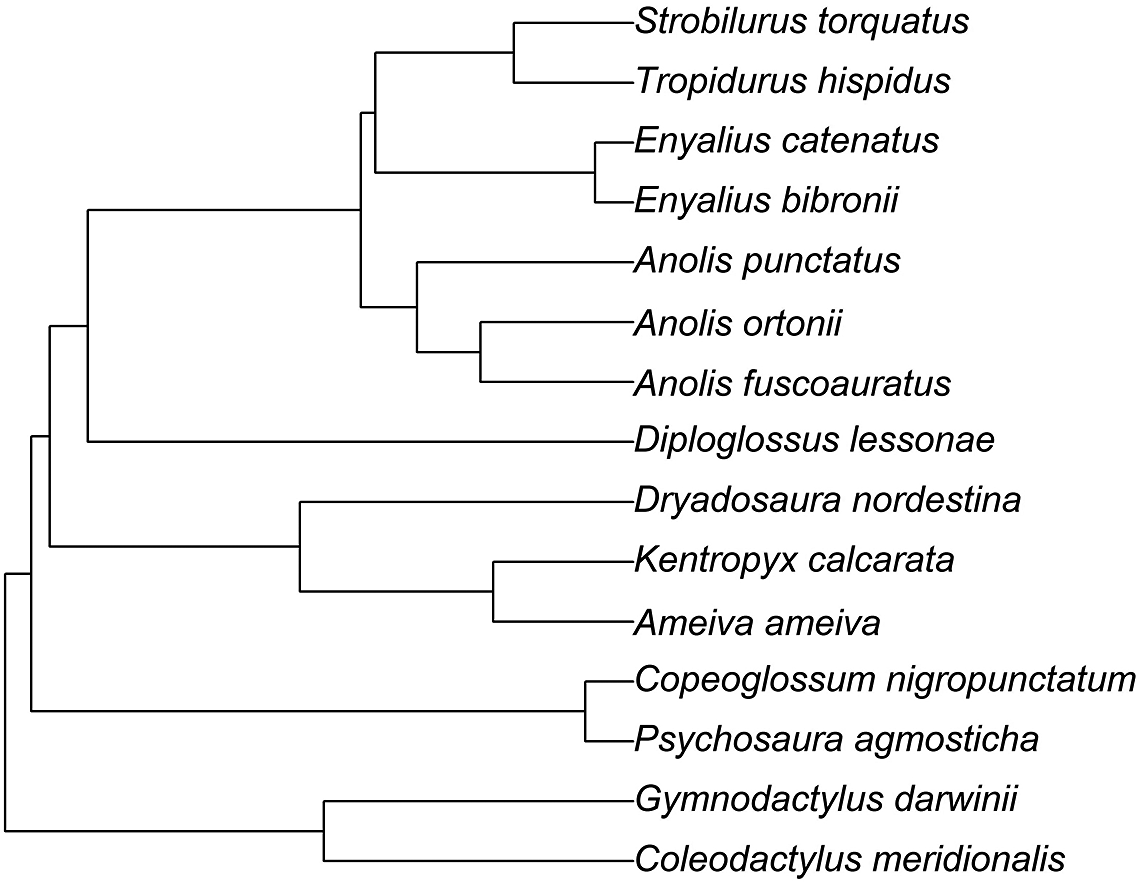
The final study sample comprised 121 parasitised individuals across 15 lizard species (Table 1), following the refinement of the original dataset from Teixeira et al. (Reference Teixeira, Riul, Brito, Araujo Filho, Teles, Almeida and Mesquita2020). These 15 species formed the basis of the phylogenetic reconstruction used in subsequent comparative analyses (Figure 1). A total of 1,338 endoparasites were identified, representing 14 taxa, including 11 nematodes, one trematode, one cestode, and one acanthocephalan (Table 2). Given the focus on parasitised specimens, the resulting data reflects the composition and load within infected hosts rather than population-level prevalence.
Lizards collected in the Atlantic Rainforest, northeastern Neotropical region

N°: number of analysed host; SVL: mean snout-vent length; SD: standard deviation.
Phylogeny obtained from Title et al. (Reference Title, Singhal, Grundler, Costa, Pyron, Colston, Grundler, Prates, Stepanova, Jones, Cavalcante, Colli, Di-Poï, Donnellan, Moritz, Mesquita, Pianka, Smith, Vitt and Rabosky2024), including only the parasitised lizard species from our sampling.

Composition of helminths from the Atlantic Rainforest, infected hosts, mean intensity of infection (MII), and sites of infection (SI)

S: stomach; SI: small intestine, LI: large intestine, L: lungs, CC: celomatic cavity.
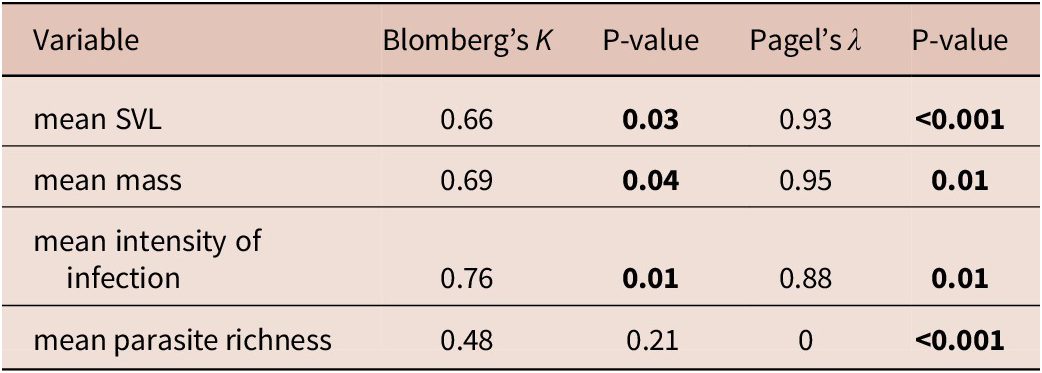
No phylogenetic signal was found for mean parasite richness (Blomberg’s K = 0.48, P = 0.21; Pagel’s λ = 0, P < 0.001). The significant p-value for λ confirms a significant departure from the Brownian Motion model (λ = 1), rather than the presence of phylogenetic dependence. All other parameters showed significant phylogenetic signal for both Blomberg’s K and Pagel’s λ (Table 3). Mean SVL and mean mass were strongly correlated across species (r = 0.974, P < 0.001), and each trait exhibited detectable phylogenetic signal. For this reason, we analysed the traits in parallel but never within the same model.
Estimates of phylogenetic signal in host body size and endoparasite infection parameters for lizard species from the Atlantic Rainforest, Brazil. P-values for Pagel’s λ reflect the likelihood ratio test against the Brownian Motion model (λ = 1)

Regarding the influence of host size (mean SVL) on the mean intensity of infection (the response variable), both models showed a significant negative relationship: BM model (adjusted R2: 0.27; F-statistic: 6.40; b1: –1.42; AIC: 14.14; P-value: 0.02) and Lambda model (adjusted R2: 0.21; F-statistic: 4.87; b1: –1.28; AIC: 14.63; P-value: 0.04). For the relationship between mean mass and mean intensity of infection (the response variable), only the BM model yielded a significant negative relationship (adjusted R2: 0.21; F-statistic: 4.886; b1: –0.42; AIC: 15.36; P-value: 0.04), whereas the Lambda model was not significant (adjusted R2: 0.13; F-statistic: 3.141; b1: –0.35; AIC: 16.16; P-value: 0.09).
No significant relationship was found between mean SVL and mean parasite richness (the response variable) for Lambda model (adjusted R2: –0.063; F-statistic: 0.162; b1: –0.08; AIC: –15.89; P-value: 0.693); or between mean mass and mean parasite richness (the response variable) for Lambda model (adjusted R2: –0.074; F-statistic: 0.034; b1: –0.07; AIC: 34.51; P-value: 0.856). When analysed independently by transmission mode, the influence of mean SVL and mean mass on both mean intensity of infection and mean parasite richness was not significant for either heteroxenous or monoxenous parasites (see Supplementary Material).
Both global and local structures were identified by pPCA in the endoparasite data. However, global structure (phylogenetic relationship) had a stronger influence on infection patterns in lizards, as positive eigenvalues (0.031) were considerably higher than negative eigenvalues (–0.013).
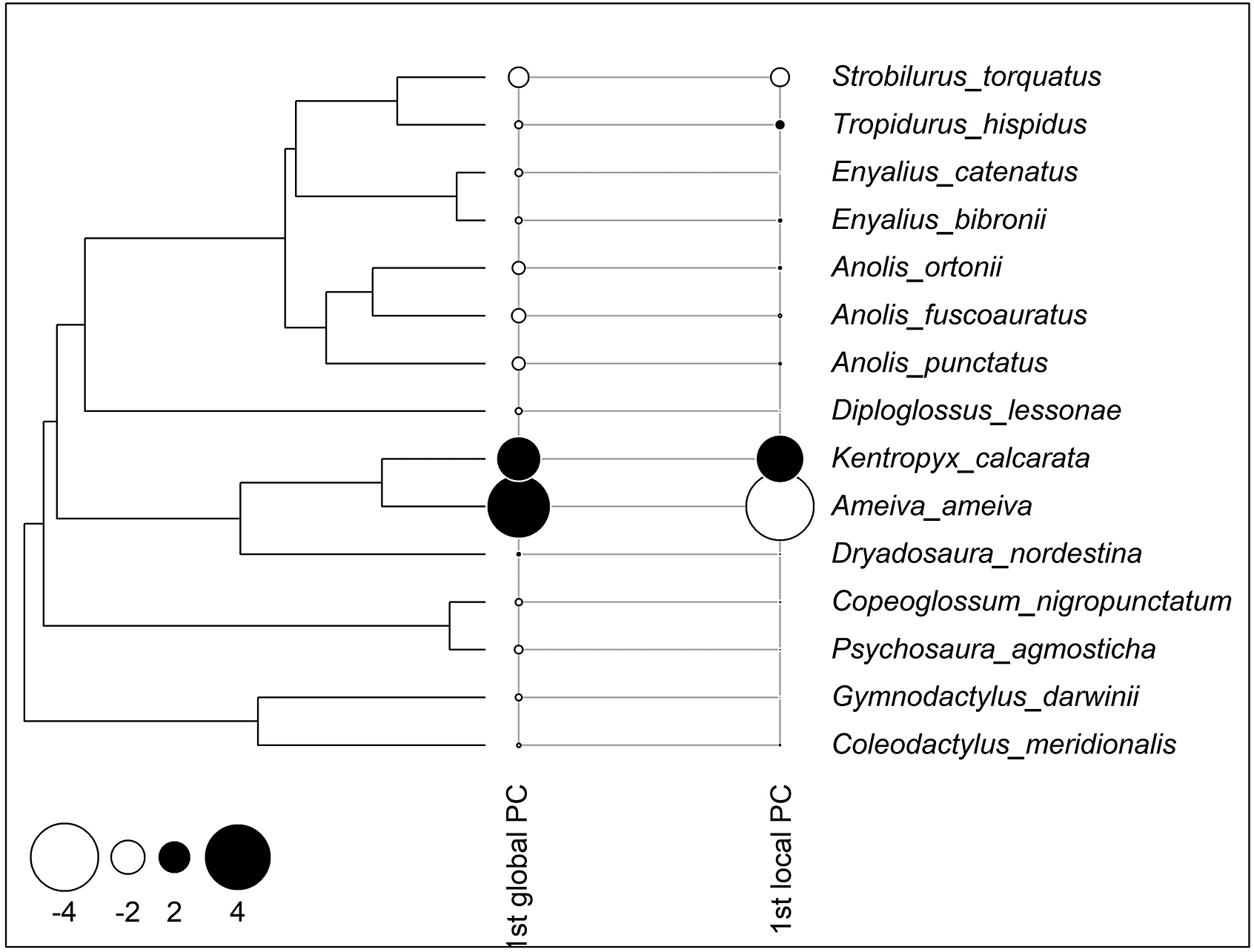
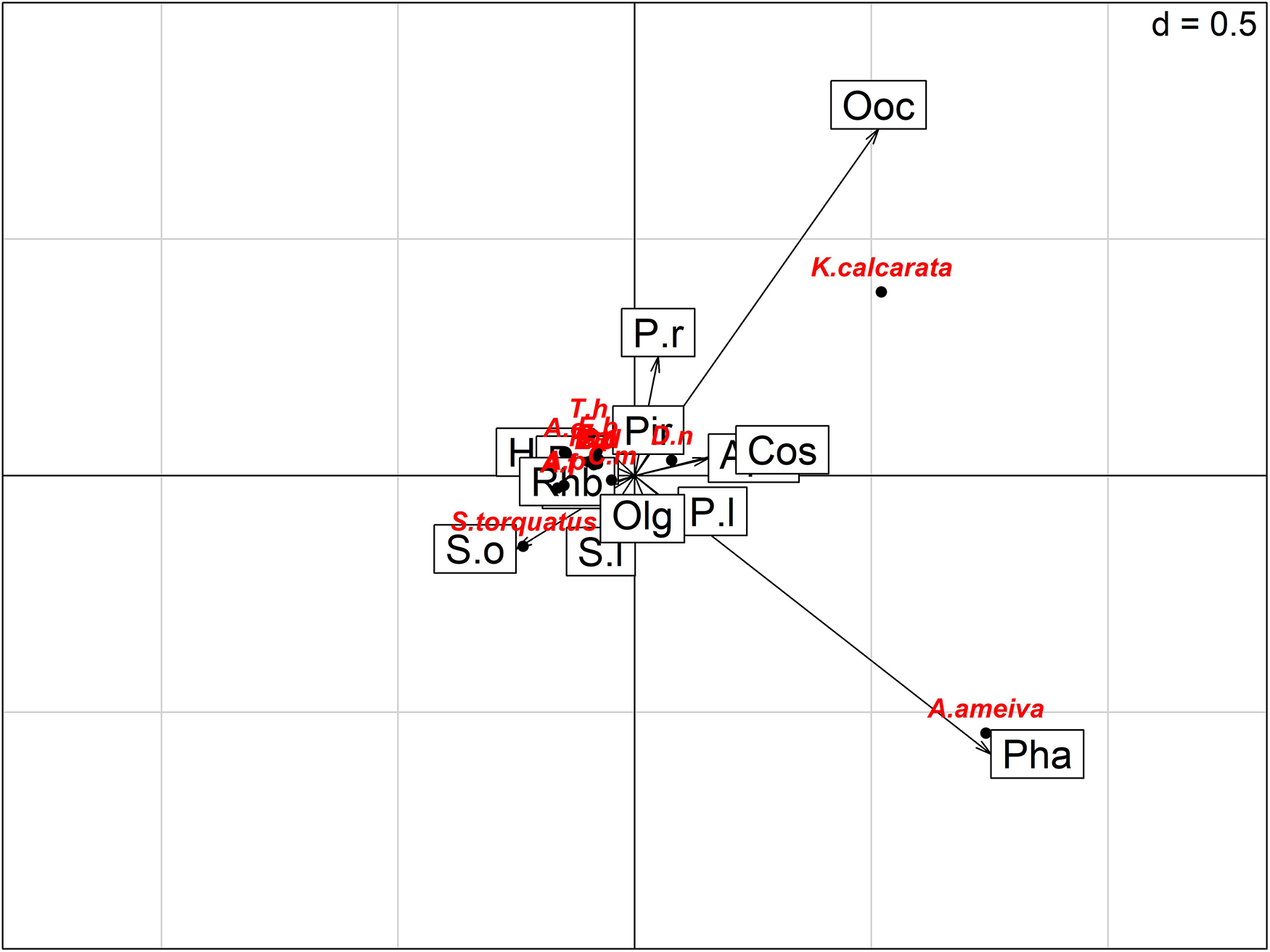
In the first Global component (PC1 Global), the lizard species Ameiva ameiva and Kentropyx calcarata (Teiidae) had the most positive scores, while Strobilurus torquatus had the most negative score (Figure 2). The variables significantly influencing PC1 Global were the nematode Pharyngodon sp. (P-value: 0.026) and the cestode Oochoristica sp. (P-value: 0.037), with the highest positive loadings of 0.75 and 0.51, respectively. The taxa with the most negative loadings were the nematode Strongyluris oscari (–0.25; P-value: 0.20) and the trematode Haplometroides odhneri (–0.11; P-value: 0.87), though these variations were not statistically significant (Figure 3).
Phylogenetic tree and scatter plot of the phylogenetic Principal Component Analysis (pPCA) of the mean intensity of infection in the lizard assemblage from the Atlantic Rainforest, northeastern Brazil. Black circles: positive autocorrelation; white circles: negative autocorrelation in PC1 Global and PC1 Local.

Loadings of mean intensity of infection for each parasite taxon concerning the global axis (horizontal) and local axis (vertical). The lizard species composing the studied assemblage were plotted in the Cartesian plane. Legend: Physaloptera lutzi (P.l); Physaloptera retusa (P.r); Strongyluris oscari (S.o); Spauligodon loboi (S.l); Aplectana sp. (Apc); Haplometroides odhneri (H.o); Skrjabinellazia intermedia (S.i); Cosmocerca sp. (Cos); Parapharyngodon alvarengai (P.a); Oochoristica sp. (Ooc); Rhabdias sp. (Rhb); Oligacanthorhynchus sp. (Olg); Pharyngodon sp. (Pha); Piratuba sp. (Pir).

In the first Local component (PC1 Local), S. torquatus and A. ameiva had the most negative scores, while K. calcarata had the highest positive score (Figure 2). The endoparasites most influencing PC1 Local were Pharyngodon sp. (–0.58; P-value: 0.028) and S. oscari (–0.15; P-value: 0.15), with only Pharyngodon sp. showing a statistically significant variation. Conversely, Physaloptera retusa (0.25; P-value: 0.503) and Oochoristica sp. (0.73; P-value: 0.038) had the highest positive loadings, with only Oochoristica sp. being statistically significant (Figure 3).
Discussion
Quantitative Traits and Phylogenetic Signal
As expected, mean SVL and body mass exhibited a strong phylogenetic signal (Table 3), confirming that body size is a highly conserved trait across the studied lizard lineages (Cavalcanti et al. Reference LB.d.Q, Garda, Costa, Savaugere, Pessoa, Colli, Lion and Mesquita2023; Diaz-Ortega et al. Reference Diaz-Ortega, Pérez-Mendoza, Zúñiga-Vega and Flores-Villela2024; Mesquita et al. Reference Mesquita, Faria, Colli, Vitt and Pianka2016b). This morphological conservatism is relevant to our findings because host body size often dictates the available space and resource diversity for parasite colonisation (Perlin et al. Reference Perlin, Poulin and de Bekker2025). By maintaining predictable physical characteristics over evolutionary time, these host lineages have historically provided stable environments capable of influencing the patterns of intensity observed in this assemblage (Kamiya et al. Reference Kamiya, O’Dwyer, Nakagawa and Poulin2014; Martins et al. Reference Martins, Almeida-Santos, Ávila, Siqueira and Rocha2024).
Beyond host body size, the mean intensity of infection also exhibited a phylogenetic signal close to 1 (Table 3). Rather than reflecting host tolerance alone, this pattern suggests a significant degree of phylogenetic conservatism in host susceptibility or exposure levels within this assemblage. This indicates that closely related lizard species tend to harbour similar parasite loads, a phenomenon that may be linked to shared physiological or behavioural constraints inherited from common ancestors (Perlin et al. Reference Perlin, Poulin and de Bekker2025; Poulin and Mouillot Reference Poulin and Mouillot2005). While ecological factors undeniably trigger infection events, the strong phylogenetic signal suggests that evolutionary history provides a fundamental template that shapes the intensity of these interactions in the studied hosts.
From an ecological standpoint, infection rates can vary among host species due to several factors, such as feeding habits, foraging strategies, seasonal changes, population density, and ecological interactions (Brito et al. Reference Brito, Ferreira, Ribeiro, Anjos, Almeida, Mesquita and Vasconcellos2014b; Teixeira et al. Reference Teixeira, Sampaio, Araujo-Filho, Teles, Almeida, Mesquita and Brito2021). However, our results suggest that an evolutionary perspective is equally essential, as phylogenetic relationships between hosts appear to determine their underlying patterns of susceptibility. Phylogenetically related hosts share physiological barriers and immune profiles that facilitate the transition of related parasites across lineages without requiring major evolutionary leaps (Perlin et al. Reference Perlin, Poulin and de Bekker2025). Furthermore, a parsimonious explanation for these patterns is that closely related hosts often share the same parasite species, as past co-evolutionary history typically dictates which realised interactions are possible. In this context, infection intensity may also be interpreted as a trait of the parasite itself, which remains consistently expressed across phylogenetically similar host environments (Poulin Reference Poulin2010). Conversely, greater phylogenetic distance acts as a robust barrier; more divergent biological responses necessitate larger adaptive jumps for successful colonisation, effectively limiting shared parasite loads across the assemblage (Schmid-Hempel Reference Schmid-Hempel2021).
Unlike other traits, mean parasite richness showed no significant phylogenetic signal, suggesting that, for this variable, contemporary ecological factors may be more influential than historical heritage at the studied scale. This lack of phylogenetic structure may be explained by the ‘encounter filter’ (Combes Reference Combes2001), which is highly sensitive to local environmental conditions. Consequently, the observed richness likely reflects adaptive adjustments to immediate ecological opportunities rather than conserved evolutionary lineages.
In the Atlantic Forest, habitat fragmentation has been shown to alter parasite infection patterns by modifying host diet and prey availability. For instance, larger fragments often support a higher richness of heteroxenous helminths due to greater intermediate host diversity (Teixeira et al. Reference Teixeira, Sampaio, Araujo-Filho, Teles, Almeida, Mesquita and Brito2021). Furthermore, the low prevalence and richness observed in some Atlantic Forest lizard populations highlight how local environmental degradation in fragmented landscapes may influence the stability of parasite-host interactions, potentially leading to lower richness levels than those expected for more preserved tropical ecosystems (Teixeira et al. Reference Teixeira, Franzini, Brito, Almeida and Mesquita2018a). These findings suggest that environmental disturbance may obscure or overlay the ancestral patterns of parasite diversity in this assemblage, potentially making historical signals more difficult to detect.
Relationship Between Morphological Traits and Parasitic Rates
We predicted that the mean intensity of infection would be positively correlated with lizard size and mass. However, most tests revealed significant inverse trends. Larger lizards were expected to host more endoparasites due to their larger body size, greater space, more nutritional resources (Ávila et al. Reference Ávila, Anjos, Gonçalves, Freire, Almeida and Silva2010; Kuris et al. Reference Kuris, Blaustein and Alio1980; Oliveira et al. Reference Oliveira, Teixeira, Queiroz, Araujo Filho, Teles, Brito and Mesquita2017; Teixeira et al. Reference Teixeira, Silva, Brito, Teles, Araujo-Filho, Franzini, Santana, Almeida and Mesquita2018b), and larger body surface area for infection (Rasmussen and Randhawa Reference Rasmussen and Randhawa2018).
This inverse relationship aligns with the findings of George-Nascimento et al. (Reference George-Nascimento, Munoz, Marquet and Poulin2004), who observed that larger vertebrate hosts often exhibit lower mean infection intensities due to metabolic constraints. While smaller hosts may face stronger selection pressures against heavy infections, larger species might ‘dilute’ these rates, potentially reducing the selective pressure per individual parasite. Although such patterns can be driven by parasite traits, such as life-cycle complexity (e.g. monoxenous vs. heteroxenous) (Martins and Poulin Reference Martins and Poulin2024), our separate analyses for these groups yielded no significant results. This suggests that the observed pattern in this assemblage is more likely a reflection of host-specific constraints or a cumulative community-level effect rather than being driven by specific parasite life-history strategies. Nevertheless, the lack of a significant signal for richness suggests that ecological factors still play a role, even if evolutionary history remains a strong predictor for infection intensity.
Diverging from the patterns observed for infection intensity, parasite richness showed no association with SVL or body mass, even when accounting for phylogeny. While parasite richness is often expected to exhibit phylogenetic structuring due to conserved host physiological traits and long-term co-evolutionary dynamics (Kamiya et al. Reference Kamiya, O’Dwyer, Nakagawa and Poulin2014), our results suggest that these evolutionary constraints may be overridden by contemporary ecological drivers in this system. However, it is important to consider that richness metrics can be highly sensitive to sampling bias and the ‘encounter filter’ (Combes Reference Combes2001). Therefore, the lack of a significant signal in our study does not necessarily imply that phylogeny is generally unimportant for parasite accumulation; rather, it suggests that local anthropogenic or environmental changes in the ecosystem may disrupt or obscure expected evolutionary patterns (Malagon and Bernal Reference Malagon and Bernal2018).
This ecological dominance is further supported by studies in the Atlantic Forest, where Teixeira et al. (Reference Teixeira, Franzini, Brito, Almeida and Mesquita2018a) observed remarkably low helminth infection rates in K. calcarata populations. Such patterns likely reflect the severe fragmentation of this ecosystem, which is now reduced to less than 8% of its original cover (Tabarelli and Santos Reference Tabarelli and Santos2004). This environmental degradation profoundly affects invertebrate and plant assemblages (Pimm and Raven Reference Pimm and Raven2000), subsequently disrupting the availability of intermediate hosts. These anthropogenic changes may provide a partial explanation for the lack of phylogenetic signal in parasite richness. Our findings highlight the potential for habitat disturbance to disrupt well-established ecological relationships, including the influence of microhabitat and prey availability on parasite communities (Brito et al. Reference Brito, Corso, Almeida, Ferreira, Almeida, Anjos, Mesquita and Vasconcellos2014a).
Relevance of Ecological and Phylogenetic relationship
Our results indicate that a substantial portion of the variation in the lizard-parasite assemblage is structured by global components, with PC1 Global explaining 42.15% of the variation, while the local component (PC1 Local) accounted for 18.61%. In the pPCA framework, global structures reflect variables with strong phylogenetic autocorrelation, suggesting that certain infection patterns are deeply anchored in the host’s evolutionary lineages. This suggests that the shared ancestry of these lizards provides a consistent template for parasite interactions (Brooks and McLennan Reference Brooks and McLennan1991) reflecting historical co-evolutionary processes within the Atlantic Forest, the signals of which may persist in traits like infection intensity despite contemporary environmental disturbances.
In contrast, the local component represents patterns where closely related species differ more than expected by chance, likely reflecting niche differentiation or opportunistic responses to immediate environmental conditions. Rather than a strict dichotomy between history and ecology, these findings demonstrate that while most life-history traits in this assemblage are phylogenetically conserved, a smaller but relevant portion of the variation is driven by specific ecological adjustments. Following Jombart (Reference Jombart, Pavoine, Devillard and Pontier2010), this integrated approach allows us to identify how evolutionary constraints and ecological plasticity together shape the structural patterns of infection across the lizard assemblage.
Species such as K. calcarata and A. ameiva (Teiidae) exerted a substantial influence on both global and local axes, correlating with the parasites Oochoristica sp. and Pharyngodon sp., respectively. Although both are active foragers, their distinct microhabitat preferences, with the former inhabiting humid forest interiors and the latter restricted to open areas and edges, likely explain their differing dietary breadths and parasite associations (Franzini et al. Reference Franzini, Teixeira, Tavares-Bastos, Vitt and Mesquita2019; Vitt and Colli Reference Vitt and Colli1994). These ecological differences are further reflected in parasite transmission dynamics, as heteroxenous species like Oochoristica sp. are influenced by both global and local factors due to their reliance on intermediate host availability, whereas monoxenous parasites such as Pharyngodon sp. are primarily shaped by environmental conditions like temperature and humidity (Anderson Reference Anderson2000). This variation underscores the intricate interplay between host ecology and parasite life-cycle strategies in determining infection patterns across the assemblage.
In conclusion, our study demonstrates that while host morphology is highly conserved, its influence on helminth communities is complex and trait-dependent. The strong phylogenetic signal observed for infection intensity suggests that evolutionary history provides a fundamental template for host susceptibility, potentially driven by shared physiological constraints or the inheritance of specific parasite lineages. Conversely, the lack of phylogenetic structure in parasite richness highlights the dominance of contemporary ecological filters and habitat disturbance in the Atlantic Forest, which may obscure ancestral patterns of diversity. By integrating phylogenetic and ecological perspectives, these findings provide a more comprehensive understanding of the mechanisms governing host-parasite interactions in changing tropical landscapes.
Supplementary material
The supplementary material for this article can be found at http://doi.org/10.1017/S0022149X26101448.
Acknowledgements
We thank the Fundação Cearense de Apoio ao Desenvolvimento Científico e Tecnológico (FUNCAP) for the research fellowship granted to AAMT (PVS-0215-00125.01.00/23). We also acknowledge the Conselho Nacional de Desenvolvimento Científico e Tecnológico (CNPq) for research fellowships awarded to WOA (PQ-308534/2021-2) and FHY (304502/2022-7 and 174814/2023-2). Additionally, DOM thanks CNPq and FAPESQ-PB for a PRONEX fellowship (Edital 6/2018). We are grateful to all members of the Laboratório de Vertebrados e Paleontologia-DCB (UFPB- Campus II), Núcleo de Ecologia de Serpentes-NES (UFPB-Campus IV), and the Curupira Republic Family. We also acknowledge the assistance of the employees of RPNN-EG and BMBG.
Financial support
None.
Competing interests
None.
Ethical standard
All applicable international, national, and/or institutional guidelines for the care and use of animals were followed. Research was permitted by Biodiversity Authorization and Information System of the Brazilian Institute of Environment and Renewable Natural Resources (no. 54378/3, authentication code 78752298; no. 56863-1, authentication code 47783645), Committee of the Superintendence of Environmental Management (no. 004/2016, process no. 5376/16), and Benjamim Maranhão Botanical Garden-BMBG (no. 003/2016/).