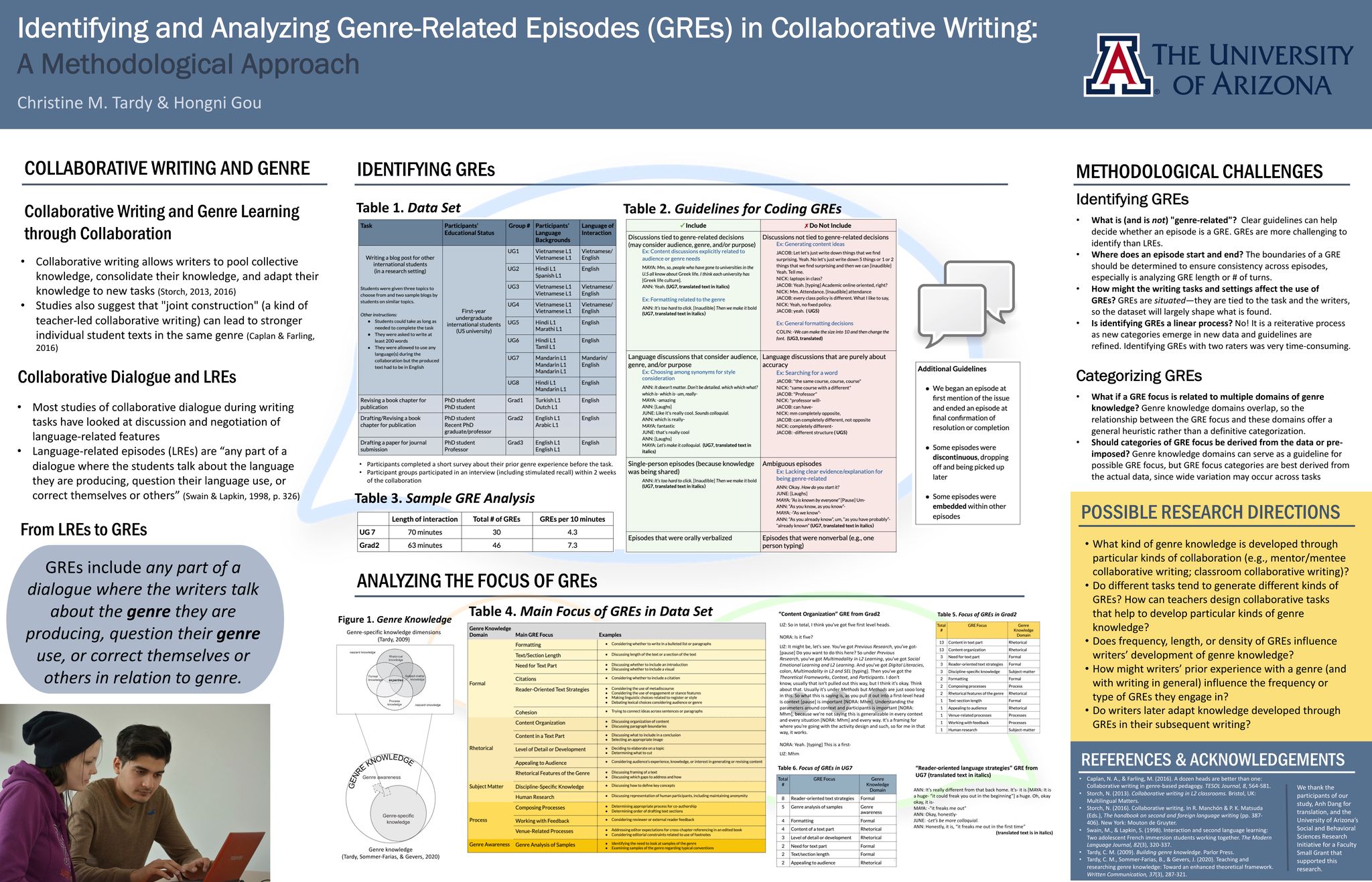



Collaborative writing appears to support second language (L2) acquisition by engaging learners in actively producing language, noticing gaps in their knowledge, and pooling collective linguistic knowledge (Storch, Reference Storch, Manchón and Matsuda2016). Through direct deliberation about writing and language choices, learners also consolidate their knowledge and adapt it to new tasks (Storch, Reference Storch2013). To date, however, studies in this area have focused almost exclusively on language-related deliberations and development, often through language-related episodes, or LREs (Swain & Lapkin, Reference Swain and Lapkin1998), with little attention to broader writing and genre knowledge. Yet, collaborative writing offers a unique opportunity to understand how writers consolidate and adapt their knowledge of genre to new writing tasks—a practice they must engage in every time they write. Studies suggest that collaboration with mentors can support multilingual students’ development of genre knowledge (e.g., Beaufort, Reference Beaufort1999; Parks, Reference Parks2001). Similarly, classroom studies of ‘joint construction’ highlight how teacher-led collaborative writing of a target genre can lead to stronger individual genre texts (e.g., Caplan & Farling, Reference Caplan and Farling2016). Missing are close analyses of genre-related deliberations in small-group collaborative writing.
This poster shares a methodological approach to examining ‘genre-related episodes’ (GREs) in collaborative writing tasks. Following Swales (Reference Swales1990) and Miller (Reference Miller1984), we define genre as a rhetorical category of discourse based on its intended purpose or social action. Because most genres are realized through language, their linguistic and rhetorical features eventually become conventionalized within communities, as users identify typical and preferred ways of ‘getting things done.’ Thus, genres may also be thought of as ‘socially recognised ways of using language’ (Hyland, Reference Hyland2007, p. 149). In defining GREs, we adapt Swain and Lapkin's (Reference Swain and Lapkin1998) definition of LREs: GREs include any part of a dialogue where the writers talk about the genre they are producing, question their genre use, or correct themselves or others in relation to genre. GREs may attend to genre-related content, rhetorical features, form, or composing processes, as well as to the writers’ metacognitive awareness of genre.
To determine whether GREs could be identified in collaborative writing, we examined two data sets of dialogue around collaborative writing. The first dataset was made up of writing sessions by eight groups (seven dyads and one triad) of multilingual undergraduate international students in the United States. The students carried out a collaborative writing task in a research setting, composing a blog post for other international students. They were given a word minimum (200 words), two examples of similar blog posts, and three possible topics to choose from. The writers were allowed to use any language in their deliberations, though their final text had to be written in English. The second dataset included writing sessions by three different pairs of Ph.D. students and faculty collaborating on writing for publication. All 11 interactions were screen-recorded (to capture the changes to the text during the discussion) and transcribed; where necessary, the transcriptions were translated into English. (See Poster for additional details.)
In order to identify GREs, we began by jointly identifying GREs in one undergraduate group transcript. Next, we worked through a process of independently identifying GREs, meeting to compare and discuss our coded GREs, and creating or modifying guidelines for what to include or not include as a genre-related episode. After coding the GREs in all 11 interactions, we returned to earlier transcripts to re-code GREs using the final guidelines. Our initial analysis demonstrated that GREs were very common in these interactions, though the frequency and length of GREs varied, sometimes significantly, by interaction. We also found, as studies of LREs have found (Fortune & Thorp, Reference Fortune and Thorp2011), that some GREs are discontinuous (starting, being temporarily left unresolved, and being picked up later on) and some are embedded within other GREs.
After identifying the GREs in our dataset, we analyzed the GREs’ focus. Because of our interest in linking genre-related talk to the writers’ emerging genre knowledge, we adopted a theoretical model of genre knowledge (Tardy, Reference Tardy2009; Tardy et al., Reference Tardy, Sommer-Farias and Gevers2020) as a basis for analyzing the focus of each GRE. In this model, genre knowledge includes five domains: formal knowledge, rhetorical knowledge, subject matter knowledge, process knowledge, and genre awareness (a type of metacognitive knowledge). Finding these five domains too broad and overlapping for useful analysis, we developed narrower categories of GRE focus that were derived from the data themselves. In a close analysis of two groups’ interactions (one undergraduate triad and one graduate student/professor dyad), we identified 17 focus areas among 76 total GREs. In general, our analysis suggests that the frequency, length, and type of GRE appears to vary by interaction, dependent on, for example, the knowledge and experience of the writers, the genre in which they are writing, and the stage of the writing process.
We mapped these focus areas roughly onto the genre knowledge domains, to help us identify, generally, where these deliberations might be drawing on or contributing to the writers’ genre knowledge (see Poster for details). For instance, this analysis highlighted that the graduate student/professor interaction focused primarily on rhetorical knowledge, as the writers spent much of their discussion deliberating what content to include in different parts of the text and how to structure and organize the paper effectively. In contrast, the undergraduate interaction focused primarily on formal knowledge (as the writers discussed specific word choices that would be suitable for a blog readership) and genre awareness (as the writers looked to the sample blog posts to determine common conventions in the blog post genre).
Based on our preliminary research, we found that GREs appear to be a productive and valuable way to analyze collaborative writing interactions and can provide insight into how writers consolidate and negotiate their emerging genre knowledge. At the same time, it is important to acknowledge that we faced several methodological challenges. Foremost was the difficulty in identifying what is—and is not—‘genre-related’ in writers’ discussions of their written texts. For the purposes of our research, we decided to take a somewhat conservative approach here, including only those discussions that were clearly (and often explicitly) related to genre. Therefore, we did not include deliberations about, for example, general formatting or language accuracy, even though they might have some relation to genre. We only coded language-related discussions as GREs when the discussion was clearly influenced by the genre–for example, if writers debated a word choice or grammar structure in relation to the audience. Researchers choosing to use GREs in their own studies will want to pre-determine how narrowly or broadly they want to operationalize GREs. An additional challenge related to identifying clear boundaries for each GRE. In our analysis, we began each GRE at the first mention of the focal issue and ended it at the final confirmation of resolution (where present). Nevertheless, given the ambiguity around the ‘borders’ of some GREs, we are cautious to analyze our GREs in terms of total number of words, turns, or time length. In sum, it is important to note that the process of identifying GREs was not always straightforward and is likely more time-consuming than identifying LREs. Establishing clear guidelines for coding GREs will facilitate the process for researchers. Furthermore, for some studies, researchers may wish to attend only to certain types of GREs (e.g., GREs related to genre awareness or to knowledge of genre form), allowing for a more focused analysis.
We hope that the concept of GREs might support research in several areas, including the study of collaborative writing and of writers’ emerging genre knowledge. We imagine several productive research threads that could explore questions like the following through GREs:
• What kind of genre knowledge is developed through particular kinds of collaboration (e.g., mentor/mentee collaborative writing; classroom collaborative writing)?
• Do different tasks tend to generate different kinds of GREs? How can teachers design collaborative tasks that help to develop particular kinds of genre knowledge?
• Does frequency, length, or density of GREs influence writers’ development of genre knowledge?
• How might writers’ prior experience with a genre (and with writing in general) influence the frequency or type of GREs they engage in?
• Do writers later adapt knowledge developed through GREs in their subsequent writing?
Additionally, GREs can contribute to scholarship in collaborative writing by offering a unit of analysis for writer dialogue that moves beyond language-related talk and into writers’ deliberation and consolidation of knowledge of broader aspects of written text.
Supplementary material
To view supplementary material for this article, please visit https://doi.org/10.1017/S0261444821000264.
Christine Tardy is Professor of English Applied Linguistics at University of Arizona. She teaches undergraduate and graduate courses in applied linguistics, teaching English to speakers of other languages (TESOL), and writing. Her research focuses on second language writing, genre studies, and English for specific purposes/English for academic purposes (ESP/EAP).
Hongni Gou is a Ph.D. student in Second Language Acquisition and Teaching (SLAT) at University of Arizona. Her research focuses on second language socialization in the study-abroad context and second language writing.