

Introduction
China's resurgence upon the world stage has clearly manifested itself over the past year in a much bolder stance towards Japan. Partly in response to the Japanese state purchase of the Senkaku/Diaoyu islets, a boycott of Japanese goods has swept across China, crippling along the way bilateral economic relations. Quite naturally, much of the Western media's attention throughout this ongoing territorial dispute has been devoted to the official and contemporary dimensions of the boycott. In contrast, this paper will place at centre stage the early twentieth-century popular seam of animosity between the two countries, as well as the efficacy of the boycotts that this seam unleashed at a time when China was much weaker and fragmented, in order to gain a fuller appreciation of the current phase of Sino-Japanese relations.
It is crucial to stress right at the outset that the following passages will pursue the interplay between finance and empire through the prism of overseas bank note circulation figures—a non-metropolitan prism not commonly employed in the pertinent literature. If anything, scholars have so far tended to focus on the impact of Chinese boycotts on Japanese manufacturing firms in the mid-1920s or later. Much less has been published on the fate of Japanese banks in China during that period. Moreover, to my knowledge no study in English, Japanese or Chinese specifically examined how Japanese banks fared in the Chinese market through the famous anti-Japanese boycott that broke out on 4 May 1919, and is commonly known nowadays as the May Fourth (Wusi in Chinese) Movement. It is therefore hoped that this paper—particularly when read in conjunction with recent ground-breaking studies by Smethurst, Metzler, Taira and Schiltz—might lead to a more complete understanding of the monetary mind-set behind Japan's colonial policy.Footnote 2
To anticipate the conclusions: this paper argues that the Wusi boycott dealt a severe blow to the Yokohama Specie Bank's (hereafter YSB) note issue in Shanghai in 1919. However, the longer-term effects of that boycott underscore demand-side pressures that could valuably tell us much more about the rising tide of nationalist sentiments in China than they suggest a ‘mortal’ threat to the bank's overall operations in pre-war East Asia. This is primarily because YSB banknote issuance in China Proper was limited both in terms of its share of total YSB liabilities and in terms of its volume compared with Japanese colonial bank circulation volumes elsewhere. In short, YSB banknotes in China were a means to an end: a ‘managed currency’ initially designed to support more important objectives like the amassing of local silver deposits and the facilitation of trade between Manchuria and China Proper.Footnote 3
The remaining five sections in this paper are organized as follows. The second section will explore the circumstances which led to the establishment of the YSB, and trace its China operations to 1919 with particular emphasis on banknote issuance. The third section will contextualize banknote issuance within more important YSB business ends, placing particular emphasis on the bank's deposit-base as compared with other foreign and local banks operating in China. The fourth section will examine in detail the impact of the Wusi upheaval on the bank's overall operations, and compare its performance during this period with other phases of anti-foreign agitation in China during the 1920s and 1930s. The final section will aim to isolate the net effect of the Wusi boycott from non-political factors that may have also impinged on circulation volumes that year. Finally, the Conclusion will set out what may be the historic significance of YSB's bank note issuance in China Proper against the larger backdrop of Japanese colonial policy, and in the light of what is known about the performance of other foreign banks operating in pre-war China.
The Yokohama Specie Bank before 1919
First envisioned by the renowned Meiji intellectual, Fukuzawa Yukichi, and modelled on the British privately-run Hongkong and Shanghai Banking Corporation (HSBC, established in 1865), the YSB was set up in 1880, two years before the establishment of Japan's lender of last resort, the Bank of Japan. In the 1870s, a large number of Japanese joint-stock banks had been authorized to issue notes domestically, but the Japanese government rejected the YSB's preliminary request to be allowed to issue paper money within Japan itself. Instead, finance minister Matsukata worked to create a central bank, the Bank of Japan, modelled on that of Belgium, a European economic latecomer whose specialized bank of issue (Banque Nationale de Belgique, established in 1850) was strictly state-run.Footnote 4 At the same time, the YSB was tasked with banknote issuance in China, which was then one of a few nominally-sovereign countries where new foreign privately-run banks like HSBC could exercise extra-territorial privileges, and issue bank notes with the approval of their home governments.Footnote 5
To fully appreciate the circumstances in which the YSB was conceived it should be recalled that foreign bank note issuance in China Proper had only taken off in the early twentieth century because of a hitherto deep-seated, popular suspicion of fiduciary money there. Back in the 1870s, when a Japanese overseas bank along the lines of HSBC was first broached, Japan itself was still forced to abide by extra-territoriality which allowed foreign bank note issuance on its very own soil. Yet, unlike imperial China's bureaucrats—who were subjected to similar ‘unequal treaties’ with the West but began opposing foreign bank note issuance only at the turn of the twentieth century—Japan's Meiji reformers sought to curtail foreign banks as early as the 1870s, when foreign (mostly British) note circulation volumes were still negligible.Footnote 6
The British banks, for their part, were not encouraged at first by the low circulation volumes of their fiduciary notes in China and Japan. Because of the sunken printing costs of these notes, and a one-third bullion reserve requirement imposed by the British Treasury against notes outstanding, the future viability of note issuance looked uncertain compared with more profitable business like issuing exchange bills. On 21 October 1875, HSBC's Shanghai branch manager, David McLean, suggested to senior colleague James Greig, for example, that reserve requirements would have to be made malleable if the note issue were to sustain itself:Footnote 7
I should say it is hardly worthwhile continuing the issue of notes at Shanghai—the amount outstanding there is so small it won't pay if you have to keep 33% of the value [as reserve] in your treasury. [It is] a question whether it will pay to continue the issue in Yokohama. If you keep a third of the value then there is no necessity for your keeping so large an amount of your current accounts idle. Suppose Japan and yourself have 25 lacs of notes out, $833,000 would be 1/3 and if you kept 3 or 4 lacs more for current accounts this would be sufficient idle cash, the day has now arrived when you can work more closely being in daily communication by wire with us all and in a position to raise a lac or two when hard pressed. Of course when you happen to be so low in cash you would take care to advise the Branches not to draw large amounts upon you. In addition to drawing by wire I suppose you have always a lot of bills receivable falling due so that I think you run very little risk in working as closely as I suggest.
McLean's prognosis should also be read against the backdrop of early-Meiji Japan's efforts to curb foreign note circulation domestically, whilst envisioning the very same property as part of its own future exchange bank operations. (We know this because of concerns publicly raised within the British expatriate community in China and Japan's treaty-ports.) For example, on 1 July 1876, the British-run Shanghai daily North-China Herald reported apprehensively from Yokohama thatFootnote 8
. . .[T]he Japanese government still pursue their short-sighted policy with respect to foreign bank-notes. In the Imperial Government Telegraph Office an announcement, dated 10th ult., is posted up [to] the effect that from and after that date no foreign bank-notes would be received in payment of telegrams. The Custom House Authorities also refuse to receive foreign notes in payment of duties.
As these measures were put in place, and as foreign note issuance on Japanese soil was diminishing, Japan's own exchange bank was being fleshed out. The YSB was first endowed with a paid-up capital of ¥ 3 million, of which 1 million was in the form of specie forwarded by the Japanese Treasury, and the other ¥ 2 million represented private equity. Thus, it was not a state-run colonial bank in the full sense of the word but, rather, a semi-official bank much like HSBC with a unique stated mission of facilitating Japan's overseas trade. Implicitly, it was expected to play a pivotal role in Japan's longer-term mercantilist exercise: the accumulation of foreign-currency reserves, which eventually allowed Japan in 1897 to move off the silver standard and to re-base the yen on gold. The ability to maintain the yen's convertibility to gold was ultimately achieved in no small measure thanks to the colossal war indemnities Japan had been able to extract from China in 1896, and the flotation of Japanese government bonds at the London stock exchange.Footnote 9
The first China branch of the YSB was opened in Shanghai as early as 1893 but it was not until 1902 that the bank started issuing notes on the Mainland—first in Shanghai, Niuzhuang (Yingkou), and then in Tianjin. The reason behind this time-lag has to do with the fact that Japan greatly depended on London finance for the purchase of Western machinery at the turn of the century, and was therefore cautious not be seen as a competitor of Western financial institutions in China.Footnote 10 It was only later that the YSB also started issuing silver-denominated notes in Beijing (1910), Qingdao (1915), Hankou (1917), Jinan (1920) and Harbin (1921). Overall, the bank issued more than 88 different types of note on Chinese soil primarily in tael and silver-dollar denominations, as well as smaller volumes of gold-yen notes in Dairen, Liaodong peninsula (as of 1913).Footnote 11
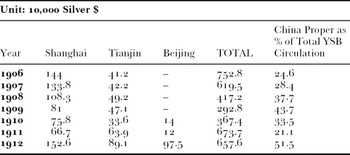
As Table 1 below clearly shows, it was the Qing Dynasty's downfall in 1912 and the attendant financial meltdown in the Chinese-run banking sector that elevated the YSB's circulation volumes in China Proper.Footnote 12 Even so, higher demand for YSB notes in China Proper throughout the early 1910s translated into lower circulation volumes in the Japanese sphere of influence across north-east China. This was partly because the YSB total fiduciary issue at the time was capped by the bank's charter, which was similar to the one that the British Colonial Office had imposed on HSBC.Footnote 13
YSB Note Circulation in China Proper (Excluding Manchuria) versus YSB Total Note Circulation, 1906–1912 Year end

Source: Guo Yuqing, Jindai Riben yinhang zai Hua jinrong huodong: Hengbin zhengjin yinhang, 1894–1919, p. 195, Table 3–18; YSB total circulation figures in gold-yen terms are derived from Yokohama shōkin ginkō zenshi, vol. 6, pp. 399–401. In 1909, the Shanghai branch balance-sheet switched from Tls. totals to local silver $ totals. Yen and local tael figures have been converted to silver dollar terms based on the exchange-rate data in Hsiao Liang-lin, China's Foreign Trade Statistics, 1864–1949 (Cambridge Massachusetts: Harvard University Press, 1974), pp. 190–192; Hosea Ballu Morse, The Trade and Administration of China (New York: Russel and Russell, 1921) [Rep. 1967], pp. 156–173.
In 1908 the YSB's total circulation volume in China Proper amounted to just 1.57 million silver dollars, and notes were yet to be issued in the imperial capital of Beijing. That the YSB note issuance was still a phenomenon confined mainly to the treaty-ports of Shanghai and Tianjin, and relatively distant from China's seat of government, might explain why it had not yet incurred much imperial wrath. As late as 23 May 1908 the North-China Herald reported that the enfeebled Qing dynasty's Treasury (duzhibu) ‘. . .has now come to the conclusion that, as foreign bank-notes are not circulated widely in the interior of the various Provinces, [it] will not interfere with them at the present moment.’Footnote 14
The malaise that struck the Chinese financial market on the eve of the Qing Dynasty downfall was in part due to the fact that it had by then become reliant in no small measure on foreign endorsement. Yet the spike in the YSB Mainland China circulation volumes for 1911–1912 should be placed in a wider context. As late as 21 October 1911, the North-China Herald opined in an editorial that even at that stage, too many Shanghainese refrained from accepting foreign bank notes in lieu of drafts issued by near-insolvent Chinese banks:Footnote 15
[S]teps [by foreign banks] are in contemplation to stop this mad rush, and save the native banks from impending bankruptcy. It need not be told that if the Chinese even had confidence in the foreign banknotes there would be a good deal of relief and the market would have time for readjustment. As it happens, there is a heavy load of short loans and native orders for the native banks to pay, and in spite of the extension of time granted by the foreign banks they do not see their way to meet obligations if the rush continues. . . . It is surprising that the Chinese authorities should have done comparatively little to relieve the ignorant people of their anxiety. We understand that at the instance of the Banker's guild the [Governor] is contemplating a proclamation urging upon the people the value of sobriety at this moment, and making them understand that the notes of the foreign banks and principal Chinese banks are absolutely safe and the rush would not be permitted.
Parallel developments are critical to understanding the spread of YSB notes across Manchuria. After Russia's defeat in its war with Japan in 1905, the YSB was asked to convert into its own notes Japanese military coupons nominally worth 15 million yen that the Japanese Kanto Army had disbursed in the region. In that way, the Japanese government sought to stamp out the use of gold-based Roubles along the South Manchuria Railway. Then, in 1916, when the government of Yuan Shikai suspended the convertibility of Chinese bank notes, the YSB increased its note issue (of both silver and gold denominations) over and above the previous cap, so as to take advantage of the collapse of popular trust in Chinese government-backed banks. Thus, the YSB's total circulation volume, as measured in Japanese gold yen, more than doubled between 1915 and 1916 from ¥ 7 million to ¥ 18 million. Partly in order to allow the YSB to meet the robust demand for its notes through this period, its paid-up capital—as stipulated in the charter—was consistently lifted from ¥ 30 million in 1916 to ¥ 100 million in 1920.Footnote 16
However, in 1917, the YSB's stature as a regional bank of issue suffered a set back by the Terauchi government's decision to nominate the Bank of Chosen as its primary bank of issue in Manchuria with a view towards narrowing Korea's trade deficit with that region, and towards a future monetary unification of Manchuria and Korea. Established in 1907, the Andong [present-day Dandong] branch of the YSB near the Korean border was, for example, closed down at the end of 1917, and its operations were taken over by the Bank of Chosen, which had been present in the city only since 1909. Several other Japanese banks that were ‘mostly commercial’ continued to transact business in Andong too. The YSB's old silver-yen and gold-yen notes subsequently lost legal-tender status in Manchuria, and were progressively ‘redeemed’ in favour of Bank of Chosen new gold-yen notes.Footnote 17 Conversely, demand for its silver-denominated notes in China Proper continued to rise, to the extent that the overall circulation volume remained at around ¥ 20 million until mid 1919.Footnote 18
In the Chinese port city of Dalian [Dairen, occupied by Japan since 1905], 500 km southwest of Andong, it was reported in 1919 that Chinese traditional copper coinage ‘disappeared from circulation entirely’ in favour of modern Chinese and Japanese-issued subsidiary coinage and gold-yen notes. The volume of YSB silver-denominated yen notes circulating there at the time was estimated to be only ¥ 100,000. Like elsewhere in the Northeast, the YSB had been authorized to issue gold-yen notes in Dalian since 1913, and for that reason was described by the British-run Maritime Customs service of China as ‘instrumental in the pursuance of the financial policy of the Japanese Government’. However, as indicated above, a special Japanese government ordinance was issued on 1 December 1917, whereby YSB gold yen notes lost their compulsory circulative power in the Kwantung [Kanto] Leased Territory and Railway Zone in South Manchuria, enveloping Dalian, as well as places like Andong.Footnote 19
The Bank of Chosen note issue cannot be meaningfully discussed here, not least because it was conceptually different to that of the YSB. Not only did the Bank of Chosen not issue convertible silver-denominated notes (be they in dollar or yen units), but also the great bulk of its note circulation remained in Korea. What is more, since Japan suspended the yen's convertibility to gold in the wake of World War I, and temporarily returned to the international gold standard only in January 1930, the Bank of Chosen gold-yen notes were effectively rendered inconvertible during that period, whereas the YSB needed to maintain the convertibility of its silver dollar notes in China Proper because the latter remained on the silver standard until 1935.Footnote 20 Primarily an exchange bank rather than a bank of issue, the YSB was by contrast more concerned with the stability of its notes, rather than its market share. In that sense, YSB notes were fundamentally different to those of the Bank of Chosen or the Bank of Taiwan's (discussed below) because of a different perception of their role within the Chinese economy. Internal documents published by the YSB make clear that its notes were in fact a ‘managed currency’ designed to smooth over seasonal trade flows between Manchuria and China Proper, and that the value of those notes was to be regulated by selling or buying drafts using an exchange fund held in Shanghai.Footnote 21
Beyond banknote issuance
In order to further understand YSB note circulation patterns, the bank's monetary properties should also be placed in the context of more important business ends. After all, as Michael Schiltz has recently shown, the crux of the bank's activity in China Proper, like that of its British competitors, revolved around the finance of intra treaty-port trade and Sino-Japanese trade through the provision of short-term exchange bills, and around the granting of ‘political loans’ to successive Chinese governments.Footnote 22 The bank did attract deposits from Chinese clientele in Tianjin (mainly Qing officials prior to 1912) but—-according to Taira Tomoyuki's important study—-the proceeds of these deposits were mostly allocated to foreign merchants residing in Shanghai. In Taira's view, YSB China branches as a whole ran a net surplus with the Tokyo head-office in those years, in other words, the head-office did not seek to employ all China resources locally but to ‘sacrifice’ the surplus there to fund Japan's substantial imports of machinery from Europe and America.Footnote 23 Ishii Kanji similarly has shown that during the 1910s the YSB relied heavily on deposits by ethnic Chinese and Indians in Shanghai and Bombay, respectively.Footnote 24
Guo Yuqing complements Taira's and Ishii's incisive analyses by showing how the YSB China deposit-base had evolved from the ground up. Guo suggests that, whilst the Shanghai and Tianjin branches accounted for the great bulk of YSB deposits in China Proper (60 per cent on average between 1901 and 1913), well under a fourth of its Shanghai deposit-base had been attributable to ethnic Chinese clients before 1900. Notably, in its pre-1900 phase, the YSB had not yet set up deposit branches in Manchuria. Since the YSB was unable to accept deposits within Japan, the vast majority of its deposits at the time were therefore attributable to European (60.4 per cent), American (27.3 per cent) and Indian (6.4 per cent) branches. Yet, by 1913, over a third of the bank's worldwide deposits were attributable to Greater China (Manchuria alone made up about 9 per cent, and China Proper, 15 per cent), whilst previously significant American deposits were declining sharply. In other words, by the 1910s, China (and in all probability the Chinese clientele) had become much more vital to the bank's worldwide operations, just when popular resentment over Japanese expansionism was building up there.Footnote 25
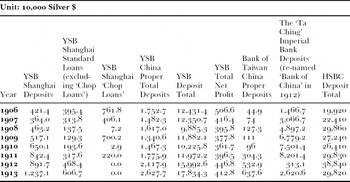
Table 2 shows the findings of previous studies on the regional make-up of YSB deposits.
YSB Deposits and Loans versus Other Banks

Source: Taira Tomoyuki, ‘Nihon teikoku shugi seiritsuki, chūgoku ni okeru Yokohama shōkin gijkō’, p. 69, Table 2, p. 71 Table 3; YSB Deposit Total and Profits—from Yokohama shōkin ginkō zenshi, vol. 6, p. 398, Table I; Bank of Taiwan, Ta Ching and HSBC data—from Guo Yuqing, Jindai Riben yinhang zai Hua jinrong huodong: Hengbin zhengjin yinhang, 1894–1919 p. 190, Table 3–14. Silver $-Yen exchange rate—extracted from Hsiao Liang-lin, China's Foreign Trade Statistics, 1864–1949, pp. 190–192; Hosea Ballu Morse, The Trade and Administration of China, pp. 156–173.
Table 2 clearly shows that the YSB's Shanghai deposit-base considerably exceeded standard loans between 1906 and 1913. However, until 1910 the YSB, like many of the foreign banks in Shanghai, also advanced a substantial amount in unsecured ‘chop loans’ to local moneyshops (then known to the Chinese as qianzhuang 錢莊, and to Westerners as ‘native banks’). For the most part, the combined value of ‘chop’ and standard loans exceeded the value of deposits in the Shanghai branch prior to 1910, the year in which many of the city's moneyshops became insolvent.Footnote 26 The gap between such liabilities and assets was narrowed down—perhaps strategically—by the issue of notes in Shanghai. Note-bearers could, for example, be depositors who had pledged specie over the counter, occasionally withdrawing ‘cash’ from their current accounts in the form of notes. The fiduciary portion of the specie corresponding with the note value, could then be on-lent by the bank at higher interest (the notes themselves did not bear any interest).
Equally important, Table 2 shows that in terms of its ability to attract deposits worldwide, the YSB did not fall much behind HSBC in the early twentieth century, even though the latter had been established earlier, and was formally endorsed by the British colonial establishment in East Asia. Conversely, the Bank of Taiwan, which also attracted deposits in Mainland China (mainly in Xiamen), was no match for the YSB there.
But one of the first Chinese-run modern financial institutions, the Ta Ching Imperial Bank (C. Daqing yinhang 大清銀行, to be re-named the ‘Bank of China’ after 1912) could by 1907 outpace the YSB in terms of deposit mobilization in China. Ta Ching seems to have scraped through the turmoil in Shanghai's domestic financial sector in 1910. However, the result was that much of its deposit-base was later withdrawn as a consequence of its association with the moribund Qing dynasty.Footnote 27
Anti-foreign boycotts
Quite apart from the financial crisis that befell Japan in early 1919, the May Fourth Movement augured trouble for the YSB's note issue in China Proper later that year. Although not the first popular boycott directed against Japanese imports to China, the Wusi boycott of 1919 was certainly the first whereby Japanese bank notes were poignantly targeted, ushering in similar waves of effective agitation throughout the 1920s and 1930s. Even though, nominally, the YSB's China note issue prevailed a few years beyond 1935—the historic juncture at which the Kuomintang government proclaimed its fabi currency as China's sole legal tender—its circulation volumes would never again reach the late-1918 peak. Yet despite its formative role in shaping Chinese socio-political consciousness, economic research into the May Fourth Movement primarily deals with its effects on Sino-Foreign trade, neglecting the boycott's effects on the local operations of foreign-run banks and multinationals.
Western financial institutions operating in China were beset by numerous crises through much of the same period. Upon the outbreak of World War I, the Allies forced the Deutsch-Asiatische Bank branches in China to shut down. These branches were barely able to resume operation in 1918. Crises in the foreign banking sector persisted after the war. The Russo-Asiatic Bank was arguably the first foreign financial institution to be targeted by boycotts. It was nominally a Sino-Russian joint venture, but effectively a French-owned firm that had to be reconstituted in the wake of the Bolshevik Revolution, and which ultimately failed in 1925.Footnote 28
The Asiatic Banking Corporation, a Sino-American joint venture, had come to the brink of failure in 1924, and was eventually sold off to the International Banking Corporation. The Chinese-American Bank of Commerce, another American joint venture, suspended business in 1928. Based in Tianjin, the Sino-Scandinavian Bank (established 1921) suffered a severe run on its notes in 1928 and closed its business shortly thereafter. But, arguably, the failure most inimical to the reputation of foreign financial institutions in China occurred in 1921. This was when the Banque Industrielle de Chine had to suspend the convertibility of its Shanghai notes into silver due to overprinting. At the last moment, Chinese banks came to its rescue and redeemed the notes.Footnote 29
Anti-foreign boycotts proved equally if not more inimical to the interests of British firms operating in China in the mid-1920s, and is probably the reason why the performance of these firms is covered more widely than Japanese firms in pertinent academic literature.Footnote 30 Yet almost all the Chinese popular ire came to bear on Japan in 1919. It is therefore critical to unearth the Japanese perspective on the events unfolding at the time. Takatsuna Hirofumi's recent comprehensive study highlights the extent to which Chinese labourers’ agitation in the Nagai Wata cotton filatures disquieted the Japanese expatriate community in pre-war Shanghai, but it does not address the activities of the YSB at all. Neither does Guo Yuqing's aforementioned study of the YSB go beyond 1919, thereby eliding the implications of the May Fourth Movement.Footnote 31 Similarly, Kikuchi Takaharu briefly mentions in his classic study of Chinese nationalism that Chinese clients had withdrawn deposits from Japanese banks in 1919, but is otherwise much more preoccupied with the May Fourth Movement's effects on the sale of Japanese imported goods.Footnote 32
Japanese intelligence reports from Shanghai do nonetheless attest at length to the sheer anxiety with which expatriate Japanese financiers and bankers—not just industrialists—viewed the mounting agitation against Japan as of 1919. As part of this agitation, not only were Japanese imported goods boycotted in the 1920s, but often Chinese-run moneyshops and modern banks refused to honour IOUs or notes presented by Japanese firms for encashment.Footnote 33
Although there are numerous intelligence reports detailing such events in the mid-1920s, there are also similar primary materials attesting to the incipient alarm that seeped through the Japanese expatriate community during the formative 1919 boycott. For example, the commercial gazette (Tsūshō kōhō 通商公報), which was published by the Japanese Foreign Ministry (Gaimushō), frequently alluded in its 1919 issues to not only a downturn in the sales of Japanese goods like toothpaste or tyres in the Chinese market, but also to runs on the YSB and Bank of Chosen branches in places as far-away from Shanghai as Changchun or Zhifu (Yantai).Footnote 34 Likewise, consular reports now held at the Japan Centre for Asian Historical Records suggest that Japanese colonial policy-makers were concerned about the implications of the 1919 boycott of Japanese banks in places like Qingdao, close to their sphere of influence in the Northeast.Footnote 35
Professor Edmund S. K. Fung has insightfully described the wave of Chinese popular agitation directed against the British during the mid-1920s as the driving force behind the most effective boycott ever carried out by the Chinese against foreigners; this agitation sparked a reaction in comparison with which ‘. . .the anti-Japanese boycott of 1919–1921 pales into insignificance’.Footnote 36 Professor Fung's observation is of value precisely because the May Fourth Movement, unleashed on the heels of the Versailles Peace Conference and Japanese territorial encroachments in Shandong, has commanded far greater attention from cultural and social historians than from economic historians.Footnote 37 Certainly, insofar as the circulation of Japanese banknotes in China is concerned, both periods remain critically under-studied. A closer look at the YSB indices for 1919 might suggest, however, that the impact of the Wusi boycott on Japanese banks was far from trivial.
On 17 May 1919, Shanghai's moneyshop guild announced that its members were to halt the clearing of quasi-foreign notes issued by Japanese banks, even though alternative reliable Chinese paper money was hard to find at the time.Footnote 38 At that moment, however, the epicentre of anti-Japanese agitation had largely been confined to North China. Japanese reports recount that Chinese student activists had campaigned there for the boycott of Japanese goods, particularly in Beijing and Tianjin. However, silver dollar notes issued in Shanghai by the YSB and, to a much lesser extent, the Bank of Taiwan, were a highly visible manifestation of Japanese penetration, and subsequently became one of the most pronounced targets for agitation by mid-May 1919.Footnote 39
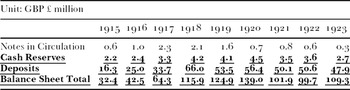
The overall impact of the 1919 boycott of Japanese-issued notes in China Proper can be inferred from YSB balance-sheet totals as shown in Table 3 above in pounds-sterling terms. The unit of account is of importance here because, as indicated above, YSB notes were actually denominated in a raft of fairly arcane local Chinese tael and silver-dollar denominations, as well as in gold yen denominations.
Yokohama Specie Bank Select Midyear Balance-Sheet Entries, 1915–1923

Source: Bankers’ Magazine 1916–1924.
The YSB was conveying this information in English to an international readership beyond East Asia. In other words, this information was purposefully converted into a familiar unit of account, and would have been widely available to political and financial analysts, even though none seem to have publicly acknowledged nationalist sentiments with banknote circulation volumes at the time.
Unlike the Bank of Taiwan or the Bank of Chosen, the YSB was an overseas bank whose note issue at the time was predicated on demand in areas beyond formal Japanese domination: China's Northeast, Tianjin and Shanghai. It is therefore particularly instructive to note that its total circulation volume in pounds-sterling terms had peaked in 1917; it had dropped by no less than 66.6 per cent by mid-1920, and waned further between 1922–1923. The 1919 setback was much less pronounced when confined to YSB total deposits—those fell by just 28 per cent between the 1918 peak and 1923. The anti-Japanese climate in China is still less traceable in balance-sheet totals, which ultimately reflected Japan's trade volume with the rest of the world. Here, an increase of 11 per cent was recorded in fact between 1919–1920. The stark variance between these different balance-sheet entries suggests World War I and the onset of Japan's own financial crisis in early 1919 were not the only factors at play in explaining the YSB's performance.
Crucially, China-based British bank figures are indicative of similar dynamics. As the first foreign financial institutions to set up shop in China in the mid nineteenth century, British banks were also the first to issue banknotes. The comparative reliability of British banks in Shanghai turned them, from the 1870s, into one of the lynchpins of the expatriate community in this increasingly vital treaty-port. British financial institutions in Shanghai were preponderant in the local stock exchange, and stalwarts like the Oriental Bank Corporation, the HSBC and the Chartered Bank not only funnelled a large share of the total foreign investment in the country, but also issued a considerable share of the city's fiduciary-money supply. Ultimately, these banks were indispensible to Britain's informal empire in East Asia, and to catalysing the monetary reform of Imperial China.Footnote 40
Yet anti-British sentiments infused Chinese student agitation in 1925–1926, as a result of grievances against the brutality of the British-run Shanghai Municipal Police. These sentiments adversely affected note circulation volumes more than any other balance-sheet entry; British bank fixed-deposit receipts were only temporarily affected by student activists’ calls on all Chinese to withdraw funds from British banks. It would appear that, in at least one sense, the anti-Japanese student agitation of 1919 produced a longer-term result in the YSB case than in the 1925 British case. After 1919, several contemporary observers noted that the YSB issue in Shanghai had in effect been wiped out by nationalist campaigns.Footnote 41 In contrast, the British-run Chartered Bank's total note circulation volumes in China recovered swiftly after the 1925 setback, whilst HSBC decided to scale down its China note issue despite a resurgent demand in fear of future boycotts.Footnote 42
The difference in the durability of the boycott in either case may have stemmed from the turnaround in British policy after 1927—from confronting to appeasing Chinese nationalists—as opposed to intensifying Japanese aggression and concomitant Chinese mobilization against Japanese banks in Shanghai.Footnote 43 Chinese boycotts proved particularly thorny when directed at one power at a time. Since the early twentieth century, Chinese campaigners had improved their ability to identify cracks in each powers’ China policies. At the height of the 1919 anti-Japanese wave, the Western expatriate community largely distanced itself from the fray. But in 1925, the campaigners so adroitly manoeuvred Britain into the dock that British expatriates in Shanghai came to believe a Bolshevist conspiracy was afoot to single them out from the French and Japanese.Footnote 44
At the same time, student-led anti-foreign campaigns in 1919 and 1925–1926 made the Chinese press turn its attention to foreign bank note issuance as an internationally anomalous monetary phenomenon that must be redressed if China were to rehabilitate the flagging reputation of its financial institutions, and achieve respect amongst the nations of the world. Calls on successive Republican Chinese governments to suspend foreign bank privileges began to be heard from 1919, and articles lamenting the considerable discount which Chinese banknotes incurred in the marketplace were not uncommon.Footnote 45
Because of its macro-level and rather apolitical approach, there is hardly any mention of the effects of these anti-Japanese boycotts on the YSB's China operations in its six-volume official history, released in 1980–1984. Rather, this official history laconically refers to note forgeries as a factor adversely affecting circulation in inland commercial hubs like Hankou in 1922, as well as to local incidents that are deprived a nationwide political context.Footnote 46 Be that as it may, one of these laconic references cites in passing an internal YSB memorandum of 1 March 1936, written shortly after the promulgation of the fabi legal-tender and the roll-back of foreign bank notes in China. This retrospective memorandum confirmed that the YSB Shanghai issue was valued at 2 million silver dollars at its height, or just under 0.5 million higher than the figure available for mid-1912 (see Table 1 above).Footnote 47
Total YSB note circulation for mid-1917 peaked in pounds-sterling terms at ₤ 2.3 million (see Table 3 above), arguably as a result of a growing demand in Shanghai. Considering that, by 1912, over half the YSB's note circulation could be attributed to demand in China Proper—the 9 per cent circulation drop in mid 1918 might merely reflect bullion price fluctuations (recall that YSB notes were disbursed in both gold and silver-denominated units of account whilst the pounds-sterling was purely on gold at the time). On the other hand, the much bigger mid-year drop recorded in 1920 (24 per cent) was, in view of the qualitative evidence presented above, almost certainly related to the surge in anti-Japanese sentiments in China Proper.
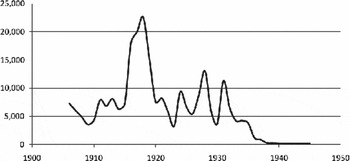
In yen terms, broader trends can be observed based on a different year-end data-set that was compiled ex post (see Figure 1 above). Overall, YSB banknote volumes clearly took off on the eve of the Qing dynasty's downfall in 1912. This take-off, however, dramatically accelerated through the ensuing political instability of the early warlord era in China. At play during this period were perhaps not only popular mistrust of Yuan Shikai's interventionist bank reforms (1916), but also concerns about the solvency of Western banks of issue during World War I.Footnote 48 Circulation volumes had started dropping around 1917–1918, at first probably as a result of YSB's loss of note-issue exclusivity in Manchuria. Thereafter, successive waves of anti-Japanese boycotts in China (1919, 1923, 1925, and 1932) seem to have taken their toll on total circulation volumes with partial recovery in the interim.Footnote 49
YSB Total Note Circulation, 1906–1944 Yearend Unit: ¥ ‘000
Source: Yokohama shōkin ginkō zenshi, [Comprehensive History of the YSB] vol. 6, Appendix Table C1, pp. 398–401.

Notably, there is one difference between the datasets: in yen terms no dip was recorded in December 1917. Rather, circulation peaked in December 1918 (¥ 22,603,000). Whether this mismatch between the yen and the pounds-sterling data-sets is purely a result of exchange-rate vagaries or perhaps a time lag, the long term impact of anti-Japanese boycotts on circulation volumes forcefully emerges from both data-sets. The yen circulation figure for December 1919 (¥ 15,154,000) is no less than 33 per cent lower on the previous year; the December 1920 figure (¥ 7,543,000) is more precipitously lower (67 per cent) compared with December 1918.
Can the boycott effect be isolated?
Unless additional in-house correspondence is discovered, it would be almost impossible to seamlessly disentangle the boycott effect from other factors in play.Footnote 50 Quoted on the Tokyo Stock Exchange, the YSB share price during 1919 can nevertheless serve as a rough guide to the problematic at hand. The 12-month share price average during 1916 was ¥ 231, fairly stably climbing to ¥ 268 by December 1918. By September 1919, the share price peaked at ¥ 360. Prior to 1919 there had been no dramatic price swings recorded between September and October, yet in October 1919 the share price plummeted by 32 per cent, reaching as low as ¥ 220 by November, and then curiously re-bouncing back up to ¥ 304 in December. However, the share was to trade at an average below ¥ 200 until the mid-1920s.Footnote 51 At face value, the drop of nearly 40 per cent in the share price between September and December 1919 would dovetail fairly well with the known progression of the May Fourth Movement, but it would be absolutely wrong to jump to conclusions because of the subsequent protracted trough which suggests other recessionary factors were in play.
The world price of silver, which was in decline after 1919, may have conceivably affected the YSB's Tokyo share price to some extent, as the bank had substantial operations in silver-standard China. But, more fundamentally, the post World War I slump in East Asia is likely to have engendered the share price trough thereafter.Footnote 52 So how big an impact did the 1919 anti-Japanese boycott have in the larger scheme of things? If there was not much impact on YSB deposits, can the May Fourth boycott alone account for the drop in banknote circulation volumes? In the absence of in-house YSB correspondence, part of the answer might rise from the pages of the North-China Herald.
Twenty days after the May Fourth Movement was unleashed in Beijing, the North-China Herald reported from Shanghai that the boycott had been ‘increasing in efficiency’ and that ‘the refusal to accept Japanese notes is now being multiplied in many ways’ with many calling on Japanese bank branches with the purpose of converting notes into silver. Another article in the same issue divulged that ‘. . .[i]n quite a number of shops there now appear notices that Japanese banknotes will not be taken, while even where these notices are not supplied there is an almost unanimous reluctance to accept the notes’.Footnote 53
Anti-Japanese sentiments did not dissipate soon enough, illustrated by the fact that on 31 January 1920 an expatriate North-China Herald reader surnamed Zadoc sent the newspaper a complaint to that effect. Published on 7 February 1920, Zadoc's Shanghai observations read:Footnote 54
. . .[T]he Chinese are using the banknotes of the Hongkong & Shanghai Bank to promote their anti-Japanese propaganda by stamping them on both sides in English and Chinese ‘Boycott Japanese Goods’. If such stamped notes were refused, or only taken at a discount, it would soon put a stop to so impertinent and illegal a proceeding.
Yet these reports should be read with the onset of Japan's 1919–1920 financial crisis and the protracted recession thereafter in mind. In fact, runs on Japanese banks began well before May Fourth. As early as 4 January 1919, the North-China Herald reported on the rumoured imminent failures of Japanese banks milling about in Osaka, precipitating a ‘mild run’ on Japanese banks in Shanghai:Footnote 55
Local Japanese banks experienced runs on Monday, Chinese holders of their notes having become distrustful because of reports of bankruptcy and failure of various firms in Osaka. In the afternoon there was a steady stream of callers at the Bank of Taiwan, [with] holders of small amounts in notes demanding silver. After three o'clock, the usual closing hour, a line was formed on the pavement and the bank continued to pay out until four o'clock. The crowd was not in the least excited and apparently the bank experienced no difficulty in meeting the sudden call for silver, the manager [suggesting] to a representative of this paper that his vaults contained sufficient coin to meet the notes in local circulation. The Yokohama Specie Bank also found an unusual number of notes being handed in for silver coin, and although the amounts exchanged at this bank were individually larger, there were fewer applicants. Appreciating that the nervousness of the Chinese public might well be extended over to the next morning, and that the run might assume large proportions, the Yokohama Specie on Monday evening decided, if the step seemed necessary in order to restore confidence, next morning to place in the hands of all Chinese banks that are members of the bankers’ guild sums of hard coin with instructions to pay out immediately on any Yokohama Specie notes that might be presented.
As indicated above, from 1920 right up to the formal banning of foreign bank notes in China Proper by the Kuomintang government (1935) a series of less pronounced note circulation troughs and peaks could be observed in Shanghai. Total YSB note circulation partially rebounded around 1928 and 1931 but never caught up with the 1918 peak. Though I have not found lateral evidence in the YSB records to prove this beyond doubt, it is reasonable to assume that the 1928 and 1931 partial rebound might also be linked to the concurrent withdrawal of HSBC's China issue, or to the failure of smaller foreign banks during that period, rather than purely as a result of any putative downward demand pressures in the Northeast, where the bank's standing had by then greatly diminished.Footnote 56
It is instructive, at any rate, to use the YSB circulation figures as a bellwether for the geo-politics of the Sino-Foreign encounter, and for the variation in economic conditions across Greater China. But the vitality of this note issue per se to the YSB's worldwide operations in the 1920s should not be grossly overstated. This is because even at its peak in 1918 the total note issue did not make up more than 4.2 per cent of the bank's total deposits, and embodied a smaller fraction of the balance-sheet bottom line. Rather, the diminution in note circulation should be seen as compounding the effects of Japan's domestic recession on its colonial banks in the 1920s. Also, smaller circulation volumes overseas probably meant less ability to offset Japan's current-account deficit at the time with a surplus of silver specie holdings in China.
Conclusions
This paper aimed to provide a detailed analysis of the YSB's banknote issuance, whilst stressing that it was moulded in the image of HSBC, not least regarding the provisions of metallic reserve in its charter. Like HSBC, it was a publically-listed exchange bank, in the first instance, rather than a dedicated colonial bank of issue. Within this framework, three critical developments can be traced over the course of the pre-war era: demand for the bank's notes in China Proper first shot up as a result of the breakdown of the Qing dynastic reign in 1912 and the attendant financial crisis in Shanghai; by 1917, YSB banknotes lost their legal-tender status in Manchuria due to important shifts in Japanese colonial policy, but this development was offset by higher circulation volumes in China Proper until late 1918; the YSB circulation volumes had started to fall from the absolute late-1918 peak with the onset of Japan's post-war recession in early 1919, but more dramatically (and irreversibly) dropped later that year as a result of the Wusi anti-Japanese agitation.
YSB banknotes in China were designed from their inception to support more important business objectives like the amassing of local deposits and the facilitation of trade between Manchuria and China Proper. There is no evidence to suggest that the notes were ever conceived as the future currency of a Japanese-dominated China amongst Tokyo's ‘empire-builders’. Ultimately, therefore, the YSB banknote issuance in China Proper proved to be limited, both in terms of its share of total YSB liabilities and of its volume compared with Chinese, foreign and other Japanese banks that disbursed notes in Greater China. Yet, the available data would suggest that, beginning in mid-1919, the YSB notes came under more sustained pressure on the part of Chinese nationalists than British banks were to experience six years later.
The historic significance of the YSB's bank note issuance in China Proper therefore lies in its amplifying important and concrete permutations in Japanese colonial policy; in its parsing of the degree of Sino-Japanese resistance to Western imperialism in the economic sphere; and in its foregrounding of regulatory commonalities as well as competitive thrusts within the broader sweep of the Sino-Foreign encounter from the era of High Imperialism right through to the Pacific War. In essence, what the YSB was doing in Shanghai until the Japanese invasion of China in 1937 does not look significantly different—at least in terms of banknote issuance—to how recent studies have portrayed the Shanghai operations of the British-run HSBC or Chartered Bank. Put otherwise, this paper underlines an important point for students of modern Japan: we should not let Japan's post-1937 unbridled militarism entirely over-script the nuanced patterns of international monetary rivalry and co-adaptation before the war. By the same token, it remains the job of historians to help elucidate the complex patterns of contemporary Sino-Japanese rivalry with more meaningful pre-war context.