


Modern legislatures delegate policy-making authority to the bureaucracy because bureaucrats possess greater capacity to engineer solutions to complex policy problems than lawmakers (Bawn Reference Bawn1995; Epstein and O'Halloran Reference Epstein and O'Halloran1999; Huber and Shipan Reference Huber and Shipan2002). Scholarship on the lawmaking system in the United States emphasizes that such delegation creates problems for the U.S. Congress when it comes to maintaining control over public policy. In particular, when an agency creates a policy that is different from what a majority of lawmakers in Congress intended when delegating authority, antimajoritarian rules in the U.S. Constitution, as well as antimajoritarian congressional procedures, usually make it impossible for congressional majorities to force agencies to alter the policy (Ferejohn and Shipan Reference Ferejohn and Shipan1990; McCubbins, Noll, and Weingast Reference McCubbins, Noll and Weingast1989). Therefore, Congress is viewed as potentially sacrificing influence over policy to the executive branch in exchange for technical expertise.
Of course, members of Congress pursue strategies to limit the loss of control over policy. Through oversight (Aberbach Reference Aberbach1990), the limitation of discretion (Huber and Shipan Reference Huber and Shipan2002), and the design of the circumstances under which bureaucrats make policy decisions (McCubbins, Noll, and Weingast Reference McCubbins, Noll and Weingast1987; Moe Reference Moe, Chubb and Peterson1989)—especially when there is policy disagreement between Congress and the president (Epstein and O'Halloran Reference Epstein and O'Halloran1999; Lewis Reference Lewis2003; Wood and Bohte Reference Wood and Bohte2004)— lawmaking coalitions attempt to maintain control over the bureaucracy's decisions. Such efforts also extend to parliamentary democracies in which legislative involvement in/review of executive policy making increases when policy disagreement among coalition partners increases (Franchino and Høyland Reference Franchino and Høyland2009; Huber and Shipan Reference Huber and Shipan2002; Martin and Vanberg Reference Martin and Vanberg2005). Nevertheless, the ability of legislatures to influence executive policy making is believed to be limited due to the inability of procedural and structural arrangements to control bureaucratic policy making (e.g., Balla Reference Balla1998; Hamilton and Schroeder Reference Hamilton and Schroeder1994) and because legislative influence through oversight is conditional on the ability of lawmakers to enact new laws (Shipan Reference Shipan2004).
In arriving at this conclusion, however, this perspective does not consider an important component of the appropriations process, limitation riders. Limitation riders are provisions in appropriations bills that forbid agencies from spending money for specific purposes during the next fiscal year. As explored in more detail later, a substantial number of limitation riders are employed annually to influence substantively important policy decisions, and they are effective at preventing bureaucratic policy decisions. That Congress possesses and uses limitation riders to prevent agencies from making decisions appears puzzling given the understanding that delegation leads to a lack of control over policy by Congress. Might it be that the availability of limitation riders provides Congress—and, more specifically, majority lawmaking coalitions within it—more influence over bureaucratic policy decisions than is currently recognized by the literature on the U.S. policy-making system?
In this article, I demonstrate that limitation riders are an effective tool for congressional influence over the bureaucracy. In addition, I develop a theory about why they are employed, stressing that Congress attaches limitation riders to appropriations legislation when agencies attempt to create policies that stray too far from the policy preferences of congressional majorities. To assess this perspective, I test this theory on a data set of all limitation riders offered in bills reported by the House Appropriations Committee from 1993 [fiscal year (FY) 1994] to 2002 (FY 2003) and a data set of all limitation riders forbidding regulatory actions in appropriations laws from 1989 (FY 1990) to 2009 (FY 2010). These analyses support the perspective that limitation riders are employed by Congress when the executive branch makes policy decisions inconsistent with congressional priorities. The implication of these findings is that congressional majorities have more influence over bureaucratic policy making than scholars appreciate, especially when control of government is divided.
LIMITATION RIDERS AS TOOLS TO OVERTURN AGENCY DECISIONS
Limitation riders possess many properties that make them effective and frequently used tools of congressional influence over the bureaucracy. First, they are “in order” in that their placement within appropriations bills is protected by a provision, known as the Holman rule (see Stewart Reference Stewart1989), in House Rule XXI that allows for “retrenchments” of spending. This rule has been elaborated by “scores of House precedents that collectively uphold the position that because the House can refuse to appropriate funds for programs that have been authorized, it also can prohibit the use of funds for any part of a program or activity” (Oleszek Reference Oleszek2004, 53). This interpretation that bureaucratic decisions can be circumscribed by the denial of funding is reflected in the “General Rule” on limitation riders found in Deschler's Precedents, stating that “An amendment prohibiting the use of funds in a general appropriation bill for a certain purpose is in order, although the availability of funds for that purpose is authorized by law” (Chapter 26, Section 4.1).
Importantly, in addition to being in order, the embedment of limitation riders within appropriations bills provides them with privileged legislative status in the U.S. House. Because appropriations bills are referred by the House Appropriations Committee, and because the committee's bills have direct access to the House floor, limitation riders are not subject to the legislative hurdles that most other policy proposals face. In particular, appropriation bills do not require special orders from the House Rules Committee to reach the floor. Therefore, the privileged status of appropriations legislation guarantees that House majorities can consider forbidding bureaucratic agencies from making decisions on an annual basis as long as appropriators include limitation riders in appropriations bills that they report.
The influence of limitation riders is also facilitated because appropriations bills must pass in that, if they do not, the government ceases to operate. Therefore, not passing appropriations legislation and shutting down the government, a decision accompanied by intensive media coverage that scrutinizes the motives behind the positions of both major parties and their leaders, and potentially leads the electorate to attach blame to one or both parties, is costly politically. Even during the 1995 “standoff” over appropriations between President Clinton and the Republican majority in Congress, appropriations were provided for the entire government sooner rather than later, demonstrating the political necessity of funding existing programs and agencies. As such, the legislative delivery vehicle for limitation riders must pass. Therefore, congressional majorities can enact such riders much more easily than if they had to employ the usual legislative process.
Relatedly, the “must pass” nature of limitation riders makes them a particularly effective and enforceable mechanism of congressional influence. Whereas oversight hearings and informal contact between committee staff and bureaucrats allow Congress to suggest or even cajole agencies into making policy decisions consistently with congressional priorities, these techniques lack a real enforcement mechanism. If agencies flout congressional priorities, then they risk sanction—but only if congressional majorities can successfully overcome the institutional hurdles, such as the presidential veto, necessary to reverse agencies’ choices (Ferejohn and Shipan Reference Ferejohn and Shipan1990; Shipan Reference Shipan2004).
Limitation riders, in contrast, are less subject to antimajoritarian lawmaking hurdles. For example, the inclusion of limitation riders within appropriations bills engenders them with a greater measure of protection from presidential vetoes than most policies. As with all legislation, the substance of appropriations bills is subject to congressional–presidential negotiation. However, that appropriations must pass implies that the ability of the president to remove provisions to which he objects through veto bargaining (Cameron Reference Cameron2000) is more limited than is the case with “normal,” or authorizing, legislation. Therefore, even if the president supports, or is the impetus behind, the agency's policy decision, his ability to protect the agency's decision from being overturned by the rider is circumscribed.
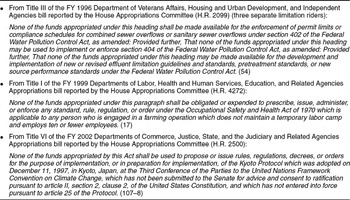
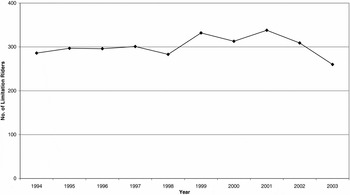
Importantly, limitations riders are not employed sparingly. On the contrary, hundreds of limitations pepper appropriations bills considered and passed annually, as shown in Figure 1. Figure 1 indicates that approximately 300 limitations affecting the policy decisions of agencies annually were written into appropriations bills proposed by the House Appropriations Committee from 1993 (FY 1994) to 2002 (FY 2003).Footnote 1 To provide readers with additional flavor for what limitation riders can accomplish with respect to the circumscription of agency discretion, Table 1 provides three examples of limitations in these bills. The limitations range from forbidding the issuance of regulations (e.g., preventing the Occupational Safety and Health Administration from issuing rules impinging on small farming operations) to curtailment of everyday decisions related to the execution of the law (e.g., preventing sections of the Clean Water Act from being implemented).
Examples of “Limitation Riders” from House Appropriations Committee Passed Legislation, FY 1994–FY 2003

Number of Limitation Riders Affecting Policy in 12 Major House Appropriations Committee Passed Appropriations Bills, FY 1994–FY 2003

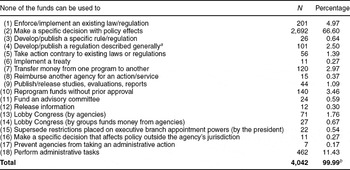
Table 2 provides more detail on the frequency with which different types of limitation riders are found in bills reported by the House Appropriations Committee. Figure 1 charts the number of limitation riders falling into the first six categories (affecting policy) listed in Table 2. From examining Table 2, it is clear that most limitation riders prohibit a specific action bearing on policy. This may leave open the possibility that most limitation riders affect small decisions. However, Table 2 also shows that more than one hundred limitation riders were offered over this 10-year period that forbade regulations by agencies. Regulations provide agencies with the authority to render policy decisions with the force of law, determining how affected entities behave in the future and imposing costs in the hundreds of billions of dollars annually on these entities to pursue economic and social benefits for society (Kerwin Reference Kerwin2003, 113–14). That limitation riders can constrain how agencies use this authority further emphasizes the importance of this tool for influence over the bureaucracy. In addition, Table 2 shows that House appropriators offered more than two hundred limitation riders to prohibit agencies from executing existing laws and regulations during this 10-year span.Footnote 2 This type of limitation rider allows Congress to block past laws/regulations that it would like to overturn with a new law but which it cannot due to antimajoritarian hurdles in the lawmaking process.
Substance of Limitation Riders Offered by House Appropriations Committee, 1993 (FY 1994)–2002 (FY 2003)

Note: The different types of limitation riders are described in more detail in Online Appedix B.
a An example of the prohibition of a regulation described generally is found in Table 1, with the limitation rider forbidding the Occupational Safety and Health Administration from developing a regulation with respect to the type of farms described therein.
b The Percentage column does not add to 100 due to rounding.
Several examples from a richly descriptive Congressional Research Service (CRS) report highlight the effectiveness of limitation riders (Copeland Reference Copeland2008). In 2003, the Animal and Plant Health Inspection Service (APHIS) issued a proposed rule to reduce costs to the federal government of detecting and eliminating animal and plant pests by shifting costs to states and industry. Several interest groups, including the National Cattlemen's Beef Association, objected. Subsequently, a limitation rider was enacted that forbade APHIS from using funds to finalize the proposed rule. The defeated agency withdrew the proposed rule in 2005. A nearly identical story emerged from the U.S. Environmental Protection Agency's attempt to recoup increased costs from industry for pesticide tolerance processing. In response, Congress passed appropriations legislation prohibiting the agency from using funds to finalize the rule. This limitation was enacted in subsequent years until Congress passed a new law requiring the agency to use a new fee system—one that the agency continued to ask Congress (to no avail) to revise in order to increase fees. Here, Congress employed limitation riders to prevent agencies from finalizing policy choices to which Congress objected until it could make the decision for the agencies through new laws. Unrelated to fees, since 2003, Congress has used a limitation rider to prevent the Federal Reserve Board and the Department of the Treasury from using funds to issue a rule allowing banks to engage in real estate brokerage activities under the Gramm-Leach-Bliley Act. In this case, these agencies possessed authority to issue such a rule under the law and moved to do so; however, Congress has stopped the agencies in their tracks year after year with limitation riders (Copeland Reference Copeland2008, 18–20).Footnote 3
To more systematically assess whether limitation riders consistently achieve real effects on policy decisions as opposed to promoting position taking (Mayhew Reference Mayhew1974), I examined a random sample of 108 (3.5%) of the 3,087 limitation riders coded as bearing on policy (charted in Figure 1) using CQ Weekly and LexisNexis databases. I searched the databases using words from the limitation rider language. I considered a limitation to have an effect on policy if it was clear that the agency had been engaging in, or was planning to proceed with, the forbidden activity. Briefly, I could not find specific information for slightly more than half (or 55.56%) of the limitation riders checked in this manner. This should not be surprising given the low-visibility nature of many bureaucratic policy decisions. However, of the 58 limitation riders on which I found information, 48 (or 44.44% of the 108 limitation riders and more than 80% of the limitations on which I found information) amounted to instances in which the limitation rider stopped agencies from proceeding with actions affecting policy. In only 10 instances (9.26%) did it appear that the limitation riders amounted to symbolic position taking. Thus, this check—in combination with the CRS Report's emphasis on the bamboozling of regulatory actions by Congress—emphasizes that limitation riders affect the substance of public policy by preventing agencies from making decisions that agencies would otherwise pursue.Footnote 4
In summary, the volume of limitation riders and the type of activities that limitation riders allow Congress to influence, when considered in light of the effectiveness of limitation riders as a tool of political control (agencies literally cannot spend funds to make policy decisions to which congressional majorities object), makes limitation riders a significant mechanism of congressional influence over bureaucratic policy making. Even though limitation riders cannot force agencies to make the decisions that Congress desires, they allow Congress to halt agencies from making policy decisions, which provides Congress with an annual opportunity to veto bureaucratic policy decisions. Congress does so with alacrity, as evidenced in Figure 1 and Table 2, making limitation riders important and effective tools of political control that are severely unappreciated by scholars.
LIMITATION RIDERS AS PRIVILEGED PROPOSALS TO OVERTURN AGENCY POLICY DECISIONS
That limitation riders block agencies from spending money to make policies emphasizes that they are effective congressional tools that facilitate legislative influence over the bureaucracy. That such riders are used often emphasizes that they are important, and the fact that they are located in “must pass” appropriations legislation highlights that the ability of “pivotal” actors (Howell Reference Howell2003; Krehbiel Reference Krehbiel1998) to stop Congress from using this important tool is limited. Previously, though, I argued that limitation riders help congressional majorities limit agency losses.
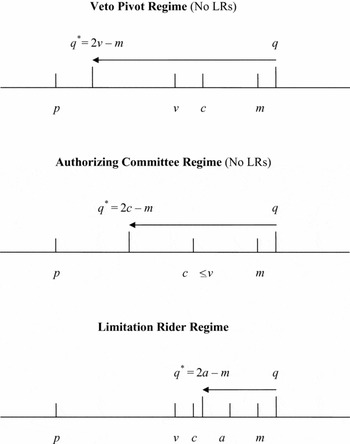
To demonstrate why, I compare the expected policy outcomes from a model of policy making when only the authorizing committee with jurisdiction over an agency can introduce legislation to overturn the agency's decisions to the expected outcome when the appropriations committee can block the agency's decisions from taking effect. To begin, consider Figure 2, which presents the policy priorities of a president, p; a congressional authorizing committee with jurisdiction over an agency, c; a congressional majority that controls whether legislation passes, m; and a legislator who controls whether a presidential veto is overturned, v (in other words, the legislator is a “veto pivot” (Krehbiel Reference Krehbiel1998). The policy priorities of these actors, assumed to be single peaked and symmetric, are displayed along a single policy dimension. The actors respond to the current state of policy, or the status quo, q. The committee has proposal power to introduce a bill to change the status quo, the legislative majority controls whether the bill passes, the president decides whether to veto the bill, and the veto pivot decides whether to override the president's veto. In addition, an agency is empowered under the law to make decisions to move policy from the status quo, q, to any point on the policy dimension.Footnote 5 In making policy, the agency responds to the president, who, as chief executive, is well positioned to influence its decisions (e.g., Howell Reference Howell2003; Huber and Shipan Reference Huber and Shipan2002; Lewis Reference Lewis2003, Reference Lewis2007; Moe Reference Moe1987; Rothenberg Reference Rothenberg1994; Wood and Waterman Reference Wood and Waterman1994).
Agency Losses with and without Limitation Riders (LRs) [Adapted from Ferejohn and Shipan (Reference Ferejohn and Shipan1990).]

Considering the Veto Pivot Regime in Figure 2, q > m and the legislative majority would like to alter policy so that a new policy, q*, equals m. In addition, the authorizing committee would like to move q closer to its ideal policy, c. Following Ferejohn and Shipan (Reference Ferejohn and Shipan1990) and Shipan (Reference Shipan2004), I assume that the majority controls how legislation is considered in the chamber and that it cannot commit to considering legislation except under an open rule allowing for any germane amendment. As a result, if the committee reports a bill to change q, the bill will be amended so that q* = m. Here, the committee chooses to report a bill because |c − m| < |c − q|. Furthermore, because |p − m| < |p − q|, the president also supports the policy change q* = m, leaving no role for the veto pivot. However, even though the president would sign the bill, no bill will be introduced. Instead, before the committee can report a bill, the president preempts the committee, using his influence over the agency to instruct its personnel to create q* = 2v − m. Thereafter, no change can be made to policy. The committee would like to introduce a bill to allow the majority to enact its ideal policy because |c − m| < |c − (2v − m)|. However, if such a bill were proposed by the committee and enacted by the legislative majority, it would be vetoed and the veto would not be overridden. This result emphasizes that congressional influence over agencies, and policy generally, is limited by congressional procedures and constitutional imperatives (Ferejohn and Shipan Reference Ferejohn and Shipan1990; Howell Reference Howell2003; Shipan Reference Shipan2004).Footnote 6
What is more, as Ferejohn and Shipan (Reference Ferejohn and Shipan1990) emphasize, the legislative majority is likely to incur agency losses even when there is no veto threat. This can be seen in the Authorizing Committee Regime in Figure 2, where the veto is irrelevant because p < c ≤ v. Here, the authorizers will propose a bill to move q to m because any bill considered by the legislature under an open rule will be amended to m and because | c − m | < | c − q |. Again, though, no bill will be proposed because the agency, under the president's direction, preempts legislative change by creating a new policy, q* = 2c − m. This policy decision results in agency losses for the congressional majority equal to | m − (2c − m) | because the committee will not introduce legislation to overturn it. Again, legislative procedures engender agency losses for legislative majorities.
However, what if bureaucratic decisions preempting such legislation could be blocked within the legislature? Moreover, what if the mechanism to do so is not subject to approval by the authorizing committee or veto pivot? Of course, limitation riders proposed by an appropriations committee provide this mechanism. The Limitation Rider Regime in Figure 2 displays how such riders limit, even if they do not eliminate, agency losses.
As in the Veto Pivot and Authorizing Committee regimes, the president would like to influence the agency to establish q* at the point nearest to his ideal policy that cannot be overturned. In the Limitation Rider Regime, the veto pivot is located in an identical position as in the Veto Pivot Regime. In the absence of limitation riders, the president would be able to move policy to 2v − m. However, in this regime, the appropriations committee would offer a limitation rider that blocks the agency from moving policy to 2v − m. In deciding whether to do so, the appropriations committee compares its utility for m to its utility for the agency's decision, q*. Here, the appropriators propose a limitation rider when q* < 2a − m, where 2a − m represents that policy as the appropriations committee's indifference point. As a result, the president instructs agency personnel to create q* = 2a − m. This policy cannot be changed. Any bill proposing to do so would be vetoed by the president and any attempt overturn the veto would fail because |v − (2a − m)| < |v − m|. This outcome represents an improvement to the floor compared to the outcome in the Veto Pivot Regime because |m − (2a − m)| < |m − (2v − m)|. Comparing the Limitation Rider Regime to the Authorizing Committee Regime, the new policy, q*, also equals 2a − m, an improvement for the floor compared to the policy outcome in the Authorizing Committee Regime because |m − (2a − m)| < |m − (2c − m)|.
It is important to emphasize that, although limitation riders improve how well bureaucratic decisions reflect the legislative majority's priorities, limitations merely prevent agency decisions. Congress cannot use limitation riders to compel agencies to make choices desired by lawmaking coalitions. As a House Appropriations Committee staffer explained, “we can't make people do things—but you can stop things in their tracks.” In this way, limitation riders are an asymmetric policy-making tool (e.g., Kiewiet and McCubbins Reference Kiewiet and McCubbins1988; McCarty Reference McCarty2004). In allowing Congress to veto bureaucratic decisions, limitation riders confer negative power over bureaucratic policy decisions without enhancing Congress's ability to force agencies to take specific actions.
In summary, limitation riders improve how well policy outcomes serve the political and policy interests of congressional majorities because they force the president and agencies to limit how much he directs the bureaucracy to move policy away from the chambers’ priorities. This account is consistent with the process through which the appropriations committees communicate with agencies about policy matters, as related in an interview with a House Appropriations Committee member's personal staffer who specializes in the appropriations process. Prior to subcommittee markup of appropriation bills, the House Appropriations Committee chairperson's “mark” for each subcommittee bill is developed in coordination with the subcommittee. It is this chair's “mark” that serves as the basis for subcommittee bills. In fact, subcommittee markup can take “as little as ten minutes,” according to the staffer, because matters have been settled prior to the subcommittee taking up the bill. To insert a limitation rider, or to otherwise take up a policy matter with an agency, House Appropriations Committee members must submit requests to the committee staff working on the chair's mark. Committee staffers then investigate the request and make recommendations to the chair regarding whether the agency should be pressed on the matter. Next, committee staff communicates with agencies about these requests, sometimes asking for the agency's response. At this stage, agencies usually accommodate requests by committee staff on policy matters. In fact, the staffer noted that agencies are more responsive on a day-to-day basis to the House Appropriations Committee than authorizing committees, an observation that resonates with Aberbach's (Reference Aberbach1990, 90–95) finding that House Appropriations Committee staffers have more well-developed networks of communication with agency personnel and are more active in oversight than authorizing committee staff. In some cases, however, the agency is not responsive, or is not as responsive as the appropriators would like, leading the committee to enforce its decision through legislation, including the use of limitation riders.Footnote 7 Through this process, then, the House Appropriations Committee improves how well agency policy decisions serve the priorities of the committee. Limitation riders play the role of enforcing legislative oversight by the committee.
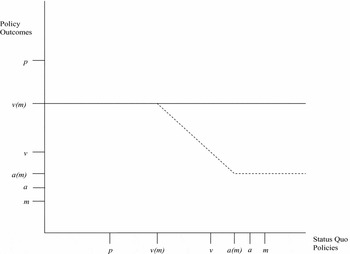
Figure 3 summarizes how this improvement is expected to occur with respect to the model presented previously, contrasting it with policy outcomes in the absence of this process. The policy outcome (on the vertical axis), q*, that is expected to occur for every status quo policy (on the horizontal axis), q, uses the configuration of preferences in the Veto Pivot and Limitation Rider regimes.Footnote 8 In Figure 3, the president, veto pivot, appropriations committee, and floor are represented as in Figure 2, and the indifference points relative to the floor for the veto pivot and appropriations committee are represented by v(m) and a(m), respectively. The solid line is orthogonal to the vertical axis at v(m) across all status quo policies in the Veto Pivot Regime, indicating that the president uses his influence over agencies to shift any status quo policy to the point closest to his most preferred policy, which cannot be overturned by a new law. This outcome is what is expected by Ferejohn and Shipan (Reference Ferejohn and Shipan1990) in the presence of an executive veto.
Policy Outcomes with and without Limitation Riders from the Appropriations Committee

The dotted line depicts outcomes expected under the same configuration of preferences when the appropriations committee can offer limitation riders. For status quo policies where q ≥ v(m), there are no differences among policy outcomes across the regimes. Even with limitation riders available to the appropriations committee, the president influences the bureaucracy so that policy outcomes, q*, equal v(m), rendering it impossible for new legislation to create outcomes farther from his ideal policy than v(m). For status quo policies such that v(m) < q < a(m) [where a(m) = m − (2a − m)], however, no policy change occurs when limitation riders can be offered. That is, q* = q. Here, the president would like to direct the bureaucracy to move policy outcomes to v(m), as in the Veto Pivot Regime. However, the appropriations committee prefers q to v(m) for all status quo policies in this region and would therefore propose a limitation rider to block a policy creating v(m). As a result, the president takes no action, leaving the status quo intact. Finally, when q ≤ a(m), the president influences the bureaucracy to create q* = a(m). Critically, because of the availability of limitation riders, policy outcomes are closer to the legislative majority's ideal policy when v(m) < q than they would be if limitation riders did not exist. The improvement in policy to the floor is represented by the distance between the solid and dotted lines in Figure 3. In summary, the model describes the process through which the appropriations committee keeps decisions from moving away from its preferences—and, by extension, the preferences of the chamber majority. In this way, it is consistent with the process described previously in which appropriations staff communicates with agencies on policy matters and in which agencies—for the most part—accommodate these requests without limitation riders even being necessary.
Of course, for limitation riders to serve as a mechanism that limits the legislative majority's agency losses, the appropriations committee's ideal policy must be as depicted in Figures 2 and 3: close to m. Such proximity ensures that a(m) is close to m and that, by extension, limitation riders will serve the legislative majority's priorities. Is this the case? Scholarship on the House Appropriations Committee, stressing that committee's role in serving its parent chamber (Deering and Smith Reference Deering and Smith1997; Fenno Reference Fenno1966; Smith and Deering Reference Smith and Deering1990), suggests that it is. In addition, Adler's (Reference Adler2000) analysis reveals that memberships of the House Appropriation Committee's subcommittees largely reflect the membership of the House as a whole. In total, then, research on the representativeness of the House Appropriations Committee indicates that the preferences of appropriators are similar to those of the floor.
One clear implication from the model is that the availability of limitation riders improves policy outcomes for congressional majorities more under divided government than under unified government. Under divided government, the president's ideal policy, p, is farther from the chamber's median member, m, than under unified government. Assuming that the appropriations committee is a good agent of the chamber median (i.e., a is close to m), how much limitation riders improve policy for the chamber median depends on m's proximity to p. When p is closer to m, as in unified compared to dived government, limitation riders do less to improve how close the expected policy outcome, q*, is from m. Therefore, limitation riders should be viewed as a mechanism that enhances Congress’ ability to influence bureaucratic policy decisions under divided government.
Uncertainty and the Volume of Limitation Riders
When Congress observes all agency decisions and their policy consequences, as described previously, there should be no limitation riders. This prediction emerges because the model expects the president to instruct agencies to make decisions creating policies as close to his ideal policy as possible that cannot be overturned by new legislation. However, uncertainty on the president's part should result in policies to which appropriators object. As Cameron (Reference Cameron2000, 99–101) discusses with respect to the president's calculations about whether a veto can be overridden, a range of legislators can be pivotal, depending on what combination of members are present for an override vote.
Extending such uncertainty to the model developed previously, the president's beliefs, ap, about the ideal policy of the pivotal member of the appropriations committee, a, and his beliefs, mp, about the ideal policy of the chamber's median member, m, can be represented as a random variable, ep = (mp − m) − (ap − a), with mean 0 and variance σ2, where positive errors lead to policy outcomes, q*, to the left of 2a − m, the indifference point of the appropriators, and negative errors lead to policy outcomes to the right of this indifference point. In examining the Limitation Rider Regime in Figure 2, it is clear that when mp > m (the president believes the median member of the chamber is more conservative than he or she really is), and the president accurately gauges the preferences of the pivotal appropriator (ap = a), he will influence agencies to create q* to the left of 2a − m. Such a decision would trigger a limitation rider by the appropriations committee because q* < 2a − m. Likewise, if the president accurately gauges the ideal policy of the chamber median (mp = m) but believes the pivotal appropriator is more liberal than he or she really is (ap < a), then the president instructs agency personnel to create q* < a − m, triggering a limitation rider. In this way, bureaucratic policy decisions under uncertainty are reformulated as q* = (2a − m) − ep. Therefore, when ep is positive, the agency creates q* to the left of the real indifference point of the appropriators (2a − m), leading to limitation riders.
Based on these considerations, under what circumstances should one expect a higher volume of limitation riders? There will be more limitation riders as policy disagreement between the president and the appropriations committee increases. This is simply because, as such policy disagreement increases, there is a higher volume of policies that the president and agencies would like to move toward p, and away from a, to which the appropriations committee would object. When ep is 0 or negative, the appropriations committee takes no action because these decisions cannot be overturned. When ep is positive, though, the appropriations committee will propose a limitation rider. Because greater policy disagreement between the appropriators and the president provides more opportunities for positive values of ep, more policy disagreement should lead to more limitation riders. To place this outcome in the context of the process used to insert limitation riders into appropriations bills communicated by the personal staffer of the appropriations committee member, the agency does not accommodate the committee's request to alter its policy decision because it does not believe a limitation rider would pass when ep > 0. Of course, when this is the case, the agency is wrong and the appropriations committee proposes a limitation rider.
The first hypothesis that emerges from the model under uncertainty, then, is that there will be a greater number of limitation riders under divided government than unified government. This prediction emerges because divided government is the primary mechanism that produces policy disagreement between the president and the appropriations committee. As emphasized previously, at least with respect to the House Appropriations Committee, appropriators are viewed by scholars as serving the priorities of their parent chamber (although see Kiewiet and McCubbins Reference Kiewiet and McCubbins1991). Therefore, under divided government, the median member of the appropriations committee will be a member of the chamber's majority party and will experience substantial policy disagreement with the president.Footnote 9
To be more precise, the president would like to move q* as close to his ideal policy as possible. Even in the absence of limitation riders, the president is still constrained by the filibuster pivot (e.g., Cameron Reference Cameron2000; Kiewiet and McCubbins Reference Kiewiet and McCubbins1988), as shown in Figures 2 and 3. Using the priorities depicted in the Limitation Rider Regime of Figure 2, rather than pursuing his ideal priority, the president wants to move q* to 2v − m. Of course, the president recognizes that he is constrained by the appropriations committee's indifference point, 2a − m. As with the divided government hypothesis, when ep is positive, the president instructs the agency to create q* < 2a − m. This miscalculation leads to a limitation rider blocking the bureaucratic action that attempts to create q*. As noted previously, there will be more such miscalculations as the distance between the indifference point of the appropriators and the expected policy outcome increases because there are more policies that the president would like to move in a manner that appropriators would disagree with as this distance increases. This result leads to the second hypothesis that, as the distance between the expected policy outcome in the absence of limitation riders (2v − m in the Limitation Rider Regime) and the indifference point of the appropriations committee (2a − m) increases, there will be more limitation riders.
Before proceeding to the analysis, it is important to emphasize that these predictions about when limitation riders are expected in appropriations bills squares well with existing accounts of how the majority party in Congress pursues its policy priorities through the appropriations process during divided government. In particular, Kiewiet and McCubbins (Reference Kiewiet and McCubbins1991, 68) discuss the Holman rule, which, on its adoption in 1885 altered House rules to allow appropriations language to change existing law as long as the changes resulted in the reduction of spending. The authors attribute the impetus behind the rule as allowing Democrats to “induce Republican presidents to accept policy measures that they would veto if allowed to consider separately” (70). They go onto note that the rule was subsequently eliminated when the Democrats lost control of Congress; however, in sessions when Democrats faced a Republican president, it was reenacted for this purpose (Stewart Reference Stewart1989). In this way, it is not merely that congressional majorities benefit more from limitation riders or, more generally, from using the appropriations process to change policy (Aldrich and Rohde Reference Aldrich and Rohde2000) during divided government. Rather, limitation riders are employed—and congressional rules are constructed to facilitate their use—because of policy conflict between the legislative and executive branches brought on by divided government. This account is consistent with the previous prediction about divided government leading to a greater volume of limitation riders.Footnote 10
DATA AND METHODS
To assess the hypotheses, I examine data on limitation riders in the 12 major appropriations bills reported by the House Appropriations Committee between 1993 (FY 1994) and 2002 (FY 2003).Footnote 11 I focus on limitation riders in House bills because that chamber's rules protect the jurisdictional prerogatives of its committees to a greater degree than occurs in the Senate. Therefore, if I find that limitation riders impinge on policies within House committee jurisdictions in the manner predicted previously, there will be stronger support for the perspective than by examining limitation riders proposed by Senate appropriators.
To test the perspective, it was necessary to disaggregate the bills into subsections because different authorizing committees have jurisdiction over programs and agencies funded within appropriation bills and, in a number of cases, the location of the authorizing committee determines the expected policy outcome because its policy priorities are closer to the president than those of the veto pivot. As an example of jurisdictional diversity within appropriations bills, the annual Department of Veterans Affairs, Housing and Urban Development, and Independent Agencies appropriations bill funded programs and agencies within the jurisdiction of many authorizing committees, including, but not limited to, the Committee on Veterans’ Affairs, the Committee on Banking and Financial Services, the Committee on Science, and the Committee on Energy and Commerce. Online Appendix A describes the process employed to identify what subsections of appropriations bills fell within the jurisdictions of what authorizing committees. The unit of analysis, then, is the authorizing committee-appropriations bill pairing. One pairing includes all subsections from an appropriations bill that apply to programs and agencies within the jurisdiction of an authorizing committee. Sixty-five pairings, or panels, emerged from this process. Subsequently, I refer to these pairings as appropriations jurisdictions.Footnote 12
Within these jurisdictions, I measured the number of limitation riders that affected the substance of agencies’ policy decisions. To do so, I coded each of the 4,042 limitation riders in the 12 bills across 10 years for whether they affected policy. Online Appendix B describes the rules used to code whether limitation riders affected policy and demonstrates that the coding decisions are reliable. The dependent variable for the analysis, then, is the number of limitation riders that affected policy in the appropriations jurisdictions. In addition, I also estimate models that measure the total number of limitation riders in appropriations jurisdictions because it is possible that limitation riders that did not explicitly bear on policy nevertheless affected policy in some way that is impossible to discern from reading the legislation.Footnote 13
To assess the first hypothesis, I include a dummy variable for divided government equal to 1 when there is split control of the U.S. House and the presidency; 0, otherwise. This variable will be positively and significantly related to the number of limitation riders, according to the first hypothesis. To assess the second hypothesis developed previously for each appropriations jurisdiction, I create a variable that measures the distance between the House Appropriations Committee's indifference point and the policy outcome expected in the absence of limitation riders (the solid line in Figure 3). To create this variable, it is necessary to calculate the expected policy outcome, o, given the policy preferences of the median member of the relevant authorizing committee, c, the median member of the chamber, m, the president, p, and the preferences of the legislator who controls whether a veto is overturned, v. When p < v < c < m or m > c > v > p (as in the Veto Pivot Regime in Figure 2), o = 2v − m if |m − (2v − m)| ≤ |m − p|. If |m − p| < |m − (2v − m)|, however, o = p. Similarly, when p < c < v < m or m > v > c > p (as in the Authorizing Committee Regime in Figure 2), o = 2c − m if |m − (2c − m)| ≤ |m − p|. However, if |m − p| < |m − (2c − m)|, o = p.Footnote 14 Once o is calculated, it is possible to create the measure of relative proximity described previously: |a(m) − o|, where a(m) = 2a − m.Footnote 15 To calculate this measure, I employ first-dimension DW-NOMINATE scores, which provide estimates of members’ preferences for governmental intervention in the economy ranging from −1 (the most liberal position in favor of intervention) to +1 (the most conservative position opposed to intervention) as indicators of policy preferences (Lewis and Poole Reference Lewis and Poole2004; Poole and Rosenthal Reference Poole and Rosenthal1997).Footnote 16 Because this measure attains higher values as the distance between the appropriations committee's indifference point and the expected policy outcome increases, this variable is expected to be positively and significantly related to the number of limitation riders.
Because these data come from appropriations jurisdictions funded in annual bills and the dependent variable is a count of limitation riders, I estimate the following models using a time-series cross-section negative binomial estimator.Footnote 17 In addition, I specify fixed effects for the appropriations jurisdictions (panels). The fixed effects control for factors that vary across jurisdictions but do not vary over time, including political dynamics of the jurisdictions such as the level of conflict between stakeholders in the policy area and the scope of the jurisdictions. For example, during the 10 years spanned by the data, the Energy and Commerce Committee had jurisdiction over the language from the Department of Veterans Affairs, Housing and Urban Development, and Independent Agencies bill funding the Environmental Protection Agency. During this period, this jurisdiction was characterized by a high level of conflict between business and environmental groups, whereas conflict was low in other jurisdictions (e.g., agricultural programs). In this way, the fixed effects specification controls for such variables. In addition, the fixed effects guard against “panel heteroscedasticity” in that, without them, factors unique to the jurisdictions (but not controlled for in the model) will be contained in the error for observations within the jurisdictions (Beck and Katz Reference Beck and Katz1995).Footnote 18
Finally, I control for the level of policy-making activity in the jurisdictions over the 10-year period. For each appropriations jurisdiction, I include a measure of the number of presidential vetoes of bills that were referred to the authorizing committee with jurisdiction in that panel. This measure varies across congressional sessions, with the number of vetoes equaling the number of bills referred to the committee that were ultimately vetoed by the president during the congressional session when the appropriations legislation was considered.Footnote 19 Similarly, I include a variable measuring the number of executive orders issued by the president in the jurisdiction of the relevant authorizing committee.Footnote 20 Both measures indicate the degree to which the president is interested in influencing policies funded in the appropriations jurisdictions over the period. The more such activity on the part of the president, the more likely it is that appropriators will have cause to propose limitation riders. I also control for the number of laws for which statutory authority has expired per year in the jurisdiction of the relevant authorizing committee.Footnote 21 Expired laws force agencies to deal with new problems without legislative guidance, suggesting that members of Congress will be interested, and will potentially object to, the policy decisions created by agencies. Therefore, because there are more expired laws in a jurisdiction, the appropriations committee may have more reasons to propose limitation riders. In addition, I control for the number of nonlegislative hearings held by the relevant authorizing committee in each year.Footnote 22 Such hearings indicate that committees are considering the policy issues in their jurisdictions without resorting to legislation, suggesting that the committees are attempting to influence bureaucratic policy decisions through oversight. Appropriators may propose limitation riders in response to these decisions. Summary statistics for all variables employed in the following analysis are presented in Table D1 in Online Appendix D.
FINDINGS
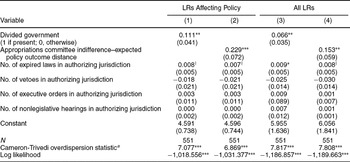
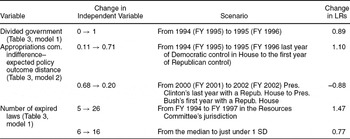
Table 3 presents the estimates from the models of the number of limitation riders affecting policy in the appropriations jurisdictions and all limitation riders in the jurisdictions. In model 1, as is the case with all models presented in Table 3, the statistically significant log likelihood allows for the rejection of the null hypothesis that the independent variables jointly equal zero. Supporting the theory on limitation riders developed previously, the coefficient for divided government in model 1 of Table 3 is positively and significantly related to the number of limitation riders affecting policy. Table 4 provides information about the magnitude of this association. At first blush, this increase in 0.89 limitation riders, calculated from the divided government variable's partial derivative, may seem negligible. However, in this fixed effects specification, the independent variables only vary within panels. Table D2 in Online Appendix D provides the mean within panel standard deviation for the variables in the analysis. Because the mean within panel standard deviation of limitation riders is 2.32, the predicted change in limitation riders amounts to more than one-third of the value of the mean within panel standard deviation of the dependent variable. Placed in the appropriate context, the magnitude of the relationship is both substantively meaningful and statistically significant.
Negative Binomial Estimates of Number of Limitation Riders (LRs) Forbidding Policy Decisions by Agencies, FY 1994–FY 2003 (Fixed Effects)

Notes: The standard errors are in parentheses. A likelihood ratio test is used to test each model's log likelihood against the constant only model.
a The Cameron-Trivedi statistic follows a chi-squared distribution with one degree of freedom.
*** p < .001; ** p < .01; * p < .05; † p < .10 (one-tailed tests).
Predicted Change in Limitation Riders (LRs) Due to Changes in Significant Independent Variables

Notes: SD, standard deviation. These predictions are based on the partial derivatives of the independent variables calculated at the mean of the variables in the model.
Similarly, model 2 in Table 3 provides support for the second hypothesis in that the coefficient for the Appropriations Committee's Indifference Point—Expected Policy Outcome variable is positively and significantly related to the number of limitation riders affecting policy. Prior to the elections in 1994 (FY 1995), the space between appropriators’ indifference point and expected policy outcome in jurisdictions where this outcome was determined by the veto pivot (a 0.11 difference in first-dimension DW Nominate coordinates) was relatively short. However, after the historic midterm elections ushered in a Republican majority for the first time in 40 years, and the median appropriator resided in the Republican caucus, this distance increased substantially (to a 0.71 difference in DW Nominate coordinates).Footnote 23 As shown in Table 4, this 0.60 increase in the distance between the indifference point of the appropriators and the expected policy outcome is associated with an increase of just more than one limitation rider. Similarly, after a Republican president took office in 2001 and the House remained in Republican hands, this distance shrank again. As seen in Table 4, this change leads model 1 to predict nearly one fewer limitation rider in appropriations jurisdictions.
As noted, these predicted changes may appear negligible. Recall, however, that limitation riders do not need to be used to be effective. According to the theory developed previously, agencies anticipate limitation riders and improve how well policy responds to the preferences of the appropriations committee and, by extension, the floor majority (compared to the policy that would be made if limitation riders were not available). It is when, due to uncertainty about appropriators’ preferences or to facilitate position taking for a political principal, that limitation riders are necessary. As a result, the coefficient estimates for relative proximity cannot speak to how much limitation riders improve policy from the standpoint of the appropriations committee and the floor majority. To emphasize the point, this is because there should be many instances of improved policy outcomes without the need to resort to limitation riders. What is important from the standpoint of the theory, then, is that the relationship between relative proximity and limitation riders is positive and significant, as is predicted. That changes in relative proximity observed in the data are predicted to lead to sizeable changes in the number of riders within appropriation jurisdictions emphasizes that model 1 strongly supports the theory developed previously.
Although the number of vetoes, executive orders, and oversight hearings are not related to the volume of riders imposed on agencies, the number of expired laws is positively and significantly associated with the number of riders within jurisdictions in models 1 and 2 in Table 3. As an example of the predicted effect of expired laws on limitation riders affecting policy in model 1, a change in 21 expired laws in panels under the House Resources Committee from 1994 to 1997 is associated with an increase of nearly 1.5 limitation riders. In addition, a standard deviation increase in the number of expired laws is predicted to lead to 0.60 additional limitations. This finding suggests that more policy decisions are left to the bureaucracy when Congress does not reauthorize laws, leading Congress to intervene with a higher volume of limitation riders when the agencies’ policy decisions stray too far from what the House Appropriations Committee will tolerate.Footnote 24
In case limitation riders not coded as affecting policy nevertheless affect policy outcomes in difficult to perceive ways, models 3 and 4 in Table 3 reestimate models 1 and 2, respectively, for all limitation riders offered in appropriations bills. The findings of these analyses are identical. In summary, these findings offer strong support for the theory on limitation riders developed previously.
Although these findings are supportive, they do face limitations. In particular, the data analyzed span only 10 years, during which there were only two changes from unified to divided government (unified under President Clinton and the Democrats, divided under President Clinton and the Republicans, and unified President Bush and the Republicans). In this way, these findings may provide a narrow empirical foundation for the theory. In addition, because the analysis examines all limitation riders and all such riders affecting policy, it is possible that Congress merely uses limitation riders to quash small, noncontroversial decisions to which agencies and the president attach little importance. Finally, one might argue that limitations can be removed during later stages of legislation.
To address these concerns, I supplement the preceding analysis by examining all limitation riders forbidding regulatory activity in appropriations laws from 1989 to 2009.Footnote 25 In expanding the period from which data are drawn, the analysis increases the number of instances in which government transitions from divided to unified government. Rather than two transitions from three periods of control in the analysis presented in Table 2, there are five transitions from six periods: Bush I-Democratic Congress, Clinton-Democratic Congress, Clinton-Republican Congress, Bush II-Republican Congress, Bush II-Democratic Congress, and Obama-Democratic Congress.Footnote 26 Therefore, if I observe that policy conflict is associated with a higher volume of limitation riders in this analysis, then the finding will strengthen the empirical support for the theory's predictions. In focusing on regulations, this analysis also isolates the decisions that agencies attempt to make using the most expansive policy-making authority in the possession of executive agencies in the United States (Kerwin Reference Kerwin2003). Regulations provide agencies with the capacity to issue rulings constraining the actions of private entities that have the force of law. Therefore, if Congress curtails regulatory actions to a greater extent as policy conflict with the president increases, then the previous model will receive support with respect to the most expansive form of bureaucratic authority in the United States. Finally, the analysis examines limitations in appropriations laws, rather than bills, meaning that these limitations were not removed at a later stage of the legislative process.
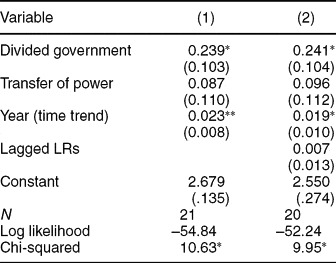
The findings of the analysis of limitations forbidding regulations from 1989 to 2009 are presented in Table 5. Because appropriations jurisdictions were reorganized after 2002, it is not possible to disaggregate these limitations into appropriations jurisdictions. Therefore, the unit of analysis is the year, and the dependent variable is the count of limitations forbidding regulatory action in the year. As a result, the second hypothesis from the model with uncertainty cannot be tested. To support the first hypothesis from the model with uncertainty, the variable indicating the presence of divided government should be positively and significantly associated with the number of limitations forbidding regulations. The models presented in Table 5 also control for whether each year resulted in a partisan transition in control of at least one branch of government (1 if this was the case; 0, otherwise). This variable controls for the possibility that it is a switch in control of government that leads to limitation riders—rather than, or in addition to, policy disagreement between the president and Congress. Finally, I include the year during which the limitation riders forbade regulatory actions (ranging from 0 in 1989 to 20 in 2009) to account for the apparent increase in the use of limitations over time. I estimate the model with (model 1) and without (model 2) a lagged dependent variable, employing Poisson regression to estimate the models because the dependent variable is a count and the null hypothesis that the variance equals the mean of the dependent variable cannot be rejected.Footnote 27
Poisson Estimates of Number of Limitation Riders (LRs) Forbidding Regulations, 1989 (FY 1990) to 2009 (FY 2010)

Notes: Estimates are unstandardized coefficients (standard errors are in parentheses). Tests for over-dispersion did not reject the null hypothesis that the variance of the dependent variable exceeds its mean in any of the models.
**p < .01; *p < .05.
The statistically significant chi-squared statistics for models 1 and 2 indicate the null hypothesis that the variables in the models jointly equal zero can be rejected. Importantly, in model 1 without, and model 2 with, the lagged dependent variable, the dummy variable for divided government is positively and significantly related to the number of limitation riders forbidding regulations. This finding, then, provides additional support for the previous theory in that, across many periods of divided and unified control and for the most expansive form of bureaucratic policy-making authority, the hypothesis for the model with uncertainty that there will be a higher volume of limitation riders under divided control is supported. The positive and significant time trend variable in both models indicates that Congress increasingly used limitations to constrain regulatory authority over this period. Neither model supports the prediction that a change in partisan control leads to limitation riders.Footnote 28
To provide readers with a sense of the substantive effects, I conducted a simulation to obtain the number of limitation riders forbidding regulatory actions predicted by the models under different conditions.Footnote 29 The mean of the dependent variable, which ranges from 15 to 29, is 21.81, and its standard deviation is 4.31. In 1999, under divided government when there had not been a partisan transition, model 1 predicts approximately 26 limitation riders to constrain regulatory actions. However, if there had been unified government in this year, this prediction would have been 19. Model 2 produces a similar prediction. Therefore, the presence of divided government is associated with more than a 1.5 standard deviation increase in limitation riders forbidding regulations compared to unified government. This substantively large increase in the number of limitation riders undercutting regulations by agencies provides additional support for the preceding theory.
DISCUSSION AND CONCLUSION
Limitation riders are placed in appropriations legislation in a manner consistent with the theory developed in this article. These findings support the argument that congressional majorities have more leverage over bureaucratic policy making than is currently appreciated in the literature on interbranch policy making. Because the House Appropriations Committee can block agencies’ policy decisions, agencies must be responsive to the priorities of congressional majorities. Of course, this responsiveness is tied to the necessity agencies have to respond to the committee. If the House Appropriations Committee represents the floor majority poorly, then agency responsiveness to appropriators will not help the floor. However, the fact is that the committee represents the floor well during some of the years covered by the data in this study (Adler Reference Adler2000) and historically (Deering and Smith Reference Deering and Smith1997; Fenno Reference Fenno1966; Maltzman Reference Maltzman1997; Smith and Deering Reference Smith and Deering1990).
Importantly, recognizing that limitation riders provide an effective mechanism of control over agencies has implications that extend beyond matters of whether, or how much, political control of the bureaucracy exists. In particular, appreciating the role that limitation riders have for bureaucratic control should revise how one understands the choices that legislators make regarding the institutional design of agencies in general and how much discretion to provide to agencies specifically. Theoretical and empirical research on agency design stresses that lawmaking coalitions delegate less policy authority to agencies as disagreement between lawmakers and agencies increases (Bawn Reference Bawn1995; Epstein and O'Halloran Reference Epstein and O'Halloran1999; Huber and Shipan Reference Huber and Shipan2002; Huber, Shipan, and Pfahler Reference Huber, Shipan and Pfahler2001; Lewis Reference Lewis2003; Wood and Bohte Reference Wood and Bohte2004). The basis for this prediction is that coalitions’ political and policy priorities are not well served by agencies with which coalitions experience policy disagreements. After all, such agencies can be expected to create policies that do not promote, and may even undermine, the political and policy goals of the coalitions. As a result, agencies receive less discretion under these circumstances and/or are constrained by administrative procedures and structural impediments. More generally, as policy disagreement increases, bureaucratic discretion decreases because agencies’ policy decisions are out of reach of lawmakers. However, if a device unappreciated by prior scholarship—limitation riders—enhances lawmakers’ ability to influence bureaucratic decisions, then agency policy choices are within the grasp of lawmakers to a greater degree than research on delegation recognizes. The implication, then, is that lawmakers’ willingness to delegate may be less elastic to policy disagreement than is appreciated by prior research.
None of this is to say that prior research stressing that policy disagreement between lawmakers and agencies leads to less bureaucratic discretion is incorrect. On the contrary, assuming the line of thought expressed in the preceding paragraph is correct, the findings presented here suggest that the empirical support for these theories is all the more impressive. Rather, this discussion suggests that researchers may benefit from thinking about the conditions that lead lawmakers to limit agency discretion when there is policy conflict with the executive branch. Along these lines, Huber and Shipan (Reference Huber and Shipan2002) argue and show that interbranch policy disagreement only leads to less discretion when the legislature possesses sufficient capacity to create policies. Absent such a minimum level of capacity, lawmakers have no choice but to delegate even when they know the bureaucracy will make policies inconsistent with the lawmakers’ priorities. Similarly, the availability of limitation riders may condition when interbranch policy disagreement leads to less discretion. In particular, for limitation riders to be a credible deterrent to agencies, the House Appropriations Committee requires good information about the policy consequences of agencies’ decisions. In some cases, this information may be available because of active fire alarm oversight by interest groups (McCubbins and Schwartz Reference McCubbins and Schwartz1984); however, in other cases, appropriators may be starved of such information. This line of thought suggests that, when lawmaking coalitions believe that such information will be available, interbranch policy conflict may not lead to diminished discretion. Yet, when lawmakers doubt that such information will be available, they may reduce the volume of discretion provided to agencies. In this way, this research on limitation riders has implications for advancing the understanding of delegation and theories of agency design.
Also of importance to the theory of institutional design of the bureaucracy is that the enhanced ability to block agency decisions with which lawmakers disagree should open up opportunities for lawmakers to delegate to expert agencies with which lawmakers disagree. Scholars emphasize that lawmakers are willing to live with some agency losses when the need for expertise is sufficiently high (Bawn Reference Bawn1995; Epstein and O'Halloran Reference Epstein and O'Halloran1999; Huber and Shipan Reference Huber and Shipan2002). The research presented here, though, suggests that lawmakers are not always forced to choose. Because agency policies to which lawmaking majorities object can be blocked more easily than prior scholarship recognizes, lawmakers are better positioned to take advantage of agency expertise than has been previously appreciated. This is because lawmakers can delegate to agencies with which they disagree in the hope of taking advantage of the expertise and rely on limitation riders to veto decisions with which they disagree. As a result, lawmaking coalitions are more free to delegate to agencies based on their reputations for effective performance (Carpenter Reference Carpenter2001; Carpenter and Krause Reference Carpenter and Krause2009). Of course, constraining agencies through limitations may provide a disincentive for the development of expertise, suggesting that using limitation riders to pursue control while taking advantage of expertise may not be so straightforward.
Prior to concluding, it is important to emphasize that this study does not imply that limitation riders are a panacea for congressional majorities who disagree with bureaucratic decisions. Even though appropriations bills are more difficult politically for the president to veto than most legislation, the fact remains that he can do so. Therefore, when Congress issues limitation riders to prevent agencies from making decisions that the president supports strongly, the president may view it as worthwhile to veto the appropriation bill. This occurred in 2007 when the Democrat-controlled Congress attempted to use a limitation rider to prevent President Bush from using an executive order to expand the influence held by the Office of Management and Budget over agency decisions. President Bush threatened to veto the omnibus appropriations act in which the limitation rider was embedded. In the end, the Democratic Congress withdrew the limitation.Footnote 30
An additional matter to consider is that, although this study assumes that the president controls agency policy making completely to facilitate the model and empirical analysis, this assumption is unlikely in many cases. This observation suggests that the preceding theory and findings constitute only a partial account of the role of limitation riders as a congressional tool to influence the bureaucracy. In fact, it may be the case that limitation riders are more effective when it comes to influencing the bureaucracy than suggested. The basis for this possibility is that, in cases when the agency is acting to pursue its own priorities, there is no possibility of asking the president to threaten to veto an appropriations bill containing a limitation, thus changing the bargaining scenario from the Limitation Rider Regime to the Veto Pivot Regime president in Figure 2.
That limitation riders are not foolproof mechanisms for congressional majorities to limit agency losses from bureaucratic policy decisions, and that this study employs simplifying assumptions, however, should not serve to undermine the significance of the theory and findings presented in this article. At a minimum, limitation riders provide Congress with much more influence than scholars have appreciated over not only everyday policy decisions within agencies (which in and of itself would be significant), but also over the substance of regulations about which members of Congress, and their constituencies, care for political and policy reasons. Even if, as discussed previously, the president can challenge the use of limitation riders on policy matters salient to him, limitation riders allow Congress to influence bureaucratic policy choices regularly. This ability is critical to governing in an era characterized by large delegation to the executive branch—an ability that past research on interbranch policy-making discounts.




Comments
No Comments have been published for this article.