



Perinatal depression and anxiety disorders affect approximately 17.2–24.7% Reference Wang, Liu, Shuai, Cai, Fu and Liu1,Reference Roddy Mitchell, Gordon, Lindquist, Walker, Homer and Middleton2 and 15.2–27.6% Reference Dennis, Falah-Hassani and Shiri3,Reference Roddy Mitchell, Gordon, Atkinson, Lindquist, Walker and Middleton4 of women, respectively, during pregnancy and the first postpartum year. These conditions significantly compromise maternal well-being and offspring development, elevating risks of preterm birth, Reference Liu, Cnattingius, Bergström, Östberg and Hjern5–Reference Genova, Neri, Trombini, Stella and Agostini7 impairing maternal-infant bonding Reference Dubber, Reck, Müller and Gawlik8 and predisposing children to later social–emotional, cognitive and behavioural problems. Reference Rogers, Obst, Teague, Rossen, Spry and Macdonald9–Reference Gelaye, Rondon, Araya and Williams11 Given the complexities of using medication during the perinatal period, psychological treatments are often preferred over pharmacotherapy due to safety concerns in pregnancy and breastfeeding. Reference Howard and Khalifeh12,Reference Battle, Salisbury, Schofield and Ortiz-Hernandez.13
Evidence-based psychological treatments demonstrate efficacy for perinatal depression and anxiety, with meta-analyses reporting moderate to large effect sizes. Reference Cuijpers, Franco, Ciharova, Miguel, Segre and Quero14–Reference Branquinho, Rodriguez-Muñoz, Maia, Marques, Matos and Osma16 The majority of the evidence base exists for cognitive–behavioural therapy (CBT) Reference Sockol17 and interpersonal psychotherapy (IPT), Reference Sockol18 which show robust therapeutic effects on perinatal depression and/or anxiety. Additional established approaches include mindfulness-based intervention (MBI), Reference Leng, Yin and Ng19 psychoeducation, Reference Wang, Xu, Liu, Yan, Chen and Li20 problem-solving therapy (PST), Reference Elansary, Kistin, Antonio, Fernández-Pastrana, Lee-Parritz and Cabral21 behavioural therapy, Reference Montazeri, Hasanpour, Mirghafourvand, Gharehbaghi, Tehrani and Rezaei22 supportive counselling (SPC) Reference Cuijpers, Miguel, Ciharova, Harrer and Karyotaki23 and psychodynamic therapy (PDT), Reference Valverde, Mollejo, Legarra and Gómez-Gutiérrez24 which also demonstrate effectiveness in treating perinatal mental health conditions.
Despite the availability of multiple effective psychological treatments, clinicians still lack evidence-based guidance for selecting optimal treatments for individual patients. Existing quantitative syntheses rely predominantly on pairwise meta-analyses, which compare only two interventions at a time, leaving optimal treatment selection as an unresolved clinical challenge. Reference Cuijpers, Franco, Ciharova, Miguel, Segre and Quero14,Reference Sockol, Epperson and Barber15 Additionally, since perinatal anxiety has received considerably less research attention than depression, the efficacy of psychological treatments for perinatal anxiety had yet to be quantitatively synthesised.
Aim of the study
To address these gaps, this network meta-analysis (NMA) evaluated the comparative efficacy of psychological treatments for both perinatal depression and anxiety. By leveraging direct and indirect evidence, the study compared treatment efficacy, thereby informing clinical decision-making in perinatal mental health.
Method
This study adhered to the Preferred Reporting Items for Systematic Reviews and Meta-Analyses extension for Network Meta-Analyses of Health Care Interventions (PRISMA-NMA) reporting guidelines. Reference Hutton, Salanti, Caldwell, Chaimani, Schmid and Cameron25 The study protocol was pre-registered in PROSPERO (CRD42024599869).
Search methods and selection criteria
A systematic search was conducted across PubMed, Embase, MEDLINE and PsycInfo for English-language literature published from 1 Jan 1990 to 16 Jan 2025. Searches were limited to 1990 onwards due to: (a) improvements in bibliographic indexing and abstract availability post-1990, Reference Chalmers, Dickersin and Chalmers26 and (b) the establishment of evidence-based medicine standards and structured psychotherapeutic protocols during the 1990s. Reference Chambless, Sanderson, Shoham, Johnson, Pope and Crits-Christoph27 Reference lists of earlier meta-analyses were manually screened. The complete search strategy is detailed in the supplementary material available at https://doi.org/10.1192/bjp.2026.10694 (online supplementary material, pp. 1–3). Study selection was independently conducted by two investigators (X.H. and T.W.) and disagreements were resolved by consensus.
Inclusion criteria: (a) adult pregnant or postpartum women (≤12 months post-delivery); (b) participants had clinically significant perinatal depression or anxiety diagnosed by diagnostic criteria or validated scale cut-offs; (c) RCTs comparing any psychological treatment against a control or another psychological treatment; (d) validated outcome measures assessing depressive and/or anxiety symptom severity levels. Exclusion criteria: (a) duplicate samples or non-peer-reviewed studies, (b) trials lacking sufficient data for calculation, (c) studies comparing similar treatment strategies, or (d) unclassifiable psychological treatments (e.g. combined CBT and family therapy). To ensure the clinical relevance of the included sample, we employed a two-stage screening process: (a) validation of diagnostic criteria or clinical cut-off scores for case identification; (b) confirmation that the minimum baseline severity (Mean-1 s.d.) reached clinically significant thresholds for either depression or anxiety.
Data extraction
Data extraction was performed independently by two investigators (X.H. and T.W.) from 11 June to 23 August 2025, with discrepancies resolved through discussion with senior investigators (L.L. and W.X.). Primary outcomes were short-term symptom levels, defined as the assessments that were closest to the end of treatment and occurred within 3 months post-intervention. The secondary outcomes were a long-term effect observed in 3–12 months post-treatment.
When multiple scales were used, we prioritised scales most frequently used in the included studies: the Edinburgh Postnatal Depression Scale (EPDS) and Patient Health Questionnaire-9 for depression, and the Generalised Anxiety Disorder-7 (GAD-7) and State-Trait Anxiety Inventory for anxiety. Results from intention-to-treat analyses were preferentially used.
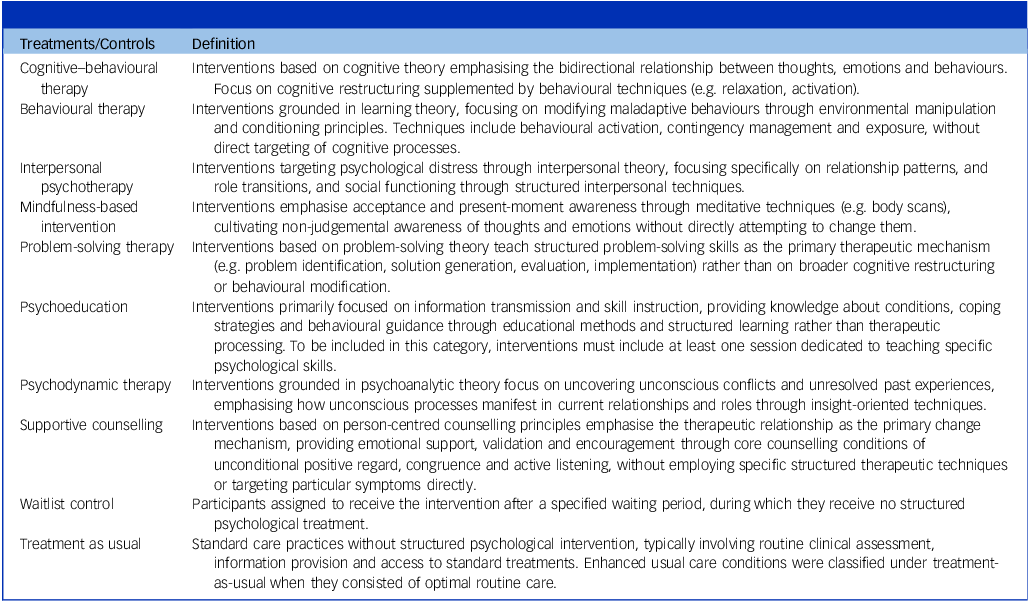
Based on theoretical frameworks and trial availability, treatments were categorised into eight commonly studied and distinct approaches: CBT, IPT, MBI, psychoeducation, behavioural therapy, PST, PDT and SPC. Control conditions were classified as inactive comparators encompassing treatment-as-usual (TAU) and waitlist control. Definitions for these conditions are in Table 1.
Definition of treatments and controls
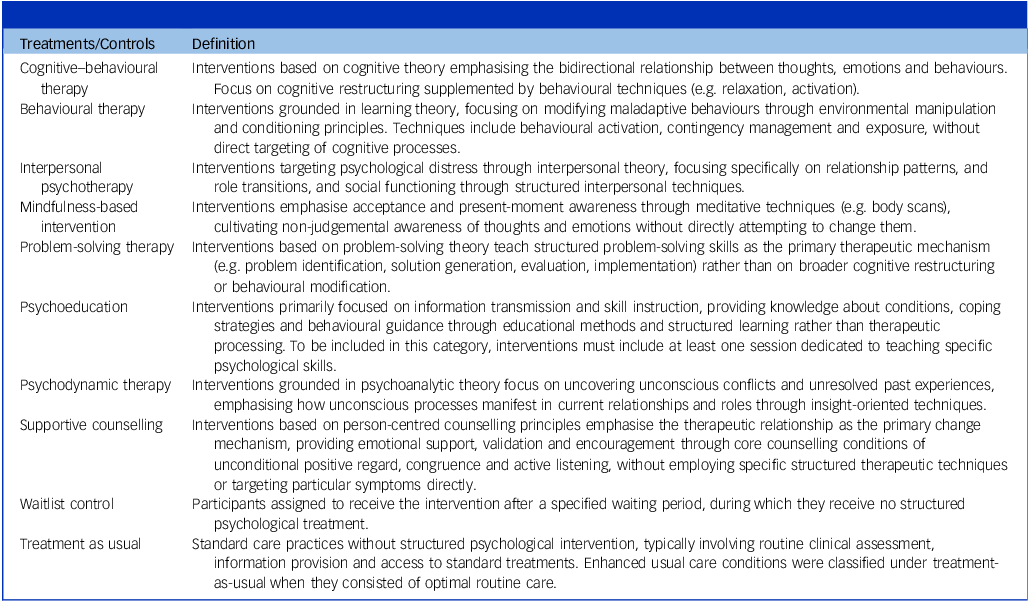
Table 1 Long description
The table categorizes treatments and controls based on theoretical frameworks and trial availability. It includes eight distinct approaches: cognitive-behavioral therapy, interpersonal psychotherapy, mindfulness-based interventions, psychoeducation, behavioral therapy, problem-solving therapy, psychodynamic therapy, and supportive counseling. Control conditions are classified as inactive comparators, encompassing treatment-as-usual and waitlist control. The table provides definitions for these conditions. It has two columns: Treatments/Controls and Definition. The Treatments/Controls column lists the different therapeutic approaches and control conditions, while the Definition column provides detailed descriptions of each. For example, cognitive-behavioral therapy focuses on the bidirectional relationship between thoughts, emotions, and behaviors, using techniques like cognitive restructuring and behavioral activation. Behavioral therapy is grounded in learning theory and aims to modify maladaptive behaviors through environmental manipulation and conditioning. Interpersonal psychotherapy targets psychological distress through interpersonal techniques, focusing on relationship patterns and role transitions. Mindfulness-based interventions emphasize acceptance and present-moment awareness through meditative techniques. Problem-solving therapy teaches structured problem-solving skills. Psychoeducation focuses on information transmission and skill instruction about conditions and coping strategies. Psychodynamic therapy aims to uncover unconscious conflicts and past experiences. Supportive counseling emphasizes the therapeutic relationship as the primary change mechanism, providing emotional support and validation. Control conditions include waitlist control, where participants receive the intervention after a waiting period, and treatment as usual, which involves standard care practices without structured psychological intervention.
For effect size calculation, we extracted sample sizes, the mean and s.d. When these values were missing, other statistical data that could be converted to the mean and s.d. were extracted using established conversion formulas. Sample characteristics (mean age, baseline perinatal period, depression/anxiety diagnosis, sample size), intervention details (intervention strategies, intensity, modality, providers/facilitators) and study characteristics (year of publication, country, control group, outcome measures) were coded.
Assessment of evidence confidence
Within-study risk of bias was evaluated using the Cochrane Risk of Bias Tool 2.0 (RoB 2.0). Reference Sterne, Savović, Page, Elbers, Blencowe and Boutron28 The certainty of evidence was assessed using the Confidence in Network Meta-analysis (CINeMA) framework. Reference Nikolakopoulou, Higgins, Papakonstantinou, Chaimani, Del Giovane and Egger29 To better contextualise the clinical importance of findings, imprecision and heterogeneity assessments were based on the minimal clinically important difference (MCID) of EPDS and GAD-7, the primary instruments used in the included trials. The MCID was defined as a 4-point reduction as established by validation studies. Reference Mao, Sun, Wang, Huang, Lu and Cao30,Reference Toussaint, Hüsing, Gumz, Wingenfeld, Härter and Schramm31 Mean differences from the network meta-analysis were converted into EPDS units using the formula mean differences = s.m.d. × s.d. Reference Gallardo‐Gómez, Richardson and Dwan32,Reference Murad, Wang, Chu and Lin33 The conversion was performed using a range of plausible s.d. derived from representative or perinatal populations with varying depression or anxiety severity. Two independent investigators (W.X., X.H.) conducted the evaluations, with inter-rater reliability assessed by Cohen’s k. Disagreements were resolved through discussion and arbitration by the senior review author (L.L.).
Statistical analysis
All statistical analyses were performed using R (version 4.2.2 for Windows; R Foundation for Statistical Computing, Vienna, Austria; https://www.R-project.org/). To evaluate the transitivity assumption of NMA, we compared the distribution of potential effect modifiers across treatment comparisons using the Kruskal–Wallis test. Reference Feir-Walsh and Toothaker34 Treatment effects were calculated as Hedge’s g standardised mean differences with 95% credible intervals (CrIs) for symptom scores using Bayesian NMA via the ‘gemtc’ package (v.1.0.2). Reference Denwood35,Reference Hedges36 The detailed calculation formulas are provided in the online supplementary material (pp. 4–6). Treatment rankings were determined using surface under the cumulative ranking curve (SUCRA) values. Reference Salanti, Ades and Ioannidis37
Model convergence was assessed using the Brooks–Gelman–Rubin potential scale reduction factors (SRFs < 1.05) and trace and density plots. Direct-indirect evidence consistency was assessed via the node-splitting method. Reference Donegan, Williamson, DAlessandro and Tudur Smith38 When significant inconsistency was detected, we investigated whether study-level covariates could explain the discrepancy between direct and indirect evidence. Publication bias was evaluated with funnel plots and Egger’s tests (for comparisons with ≥10 studies). Reference Egger, Smith, Schneider and Minder39 Network heterogeneity was quantified using the between-studies variance (τ 2) and I 2 statistics. Reference Donegan, Williamson, DAlessandro and Tudur Smith38
Meta-regression analyses were performed to identify potential effect modifiers, with significantly associated variables (P<0.05) undergoing further subgroup analyses. Reference Donegan, Williamson, DAlessandro and Tudur Smith38 Pre-specified sensitivity analyses evaluated the consistency of pooled effects by excluding outliers. Additional post-hoc sensitivity analyses included: (a) exclusion of studies with high risk of bias; and (b) restriction of analyses to high-income countries due to insufficient studies for subgroup analysis. Complete analytical details are provided in the online supplementary material (pp. 4–6).
Results
Study selection and characteristics
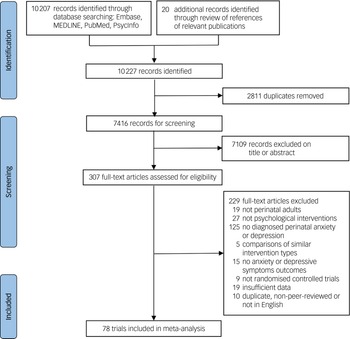
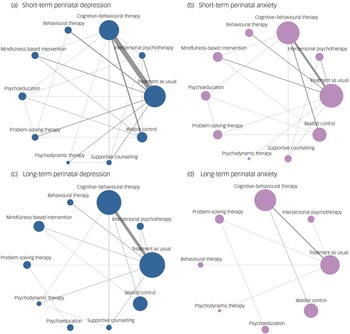
The database search identified 10 207 records, from which 78 studies met the inclusion criteria (Fig. 1). A complete list of included and excluded studies is in the online supplementary material (pp. 7–30). The NMA included 71 RCTs (9954 participants) reporting short-term depression outcomes and 37 RCTs (5268 participants) reporting short-term anxiety outcomes. Moreover, 31 studies (4412 participants) reported long-term perinatal depression outcomes, and 13 studies (2561 participants) reported long-term anxiety outcomes. Network geometry illustrating direct comparisons is depicted in Fig. 2.
Diagram for the search and selection process.
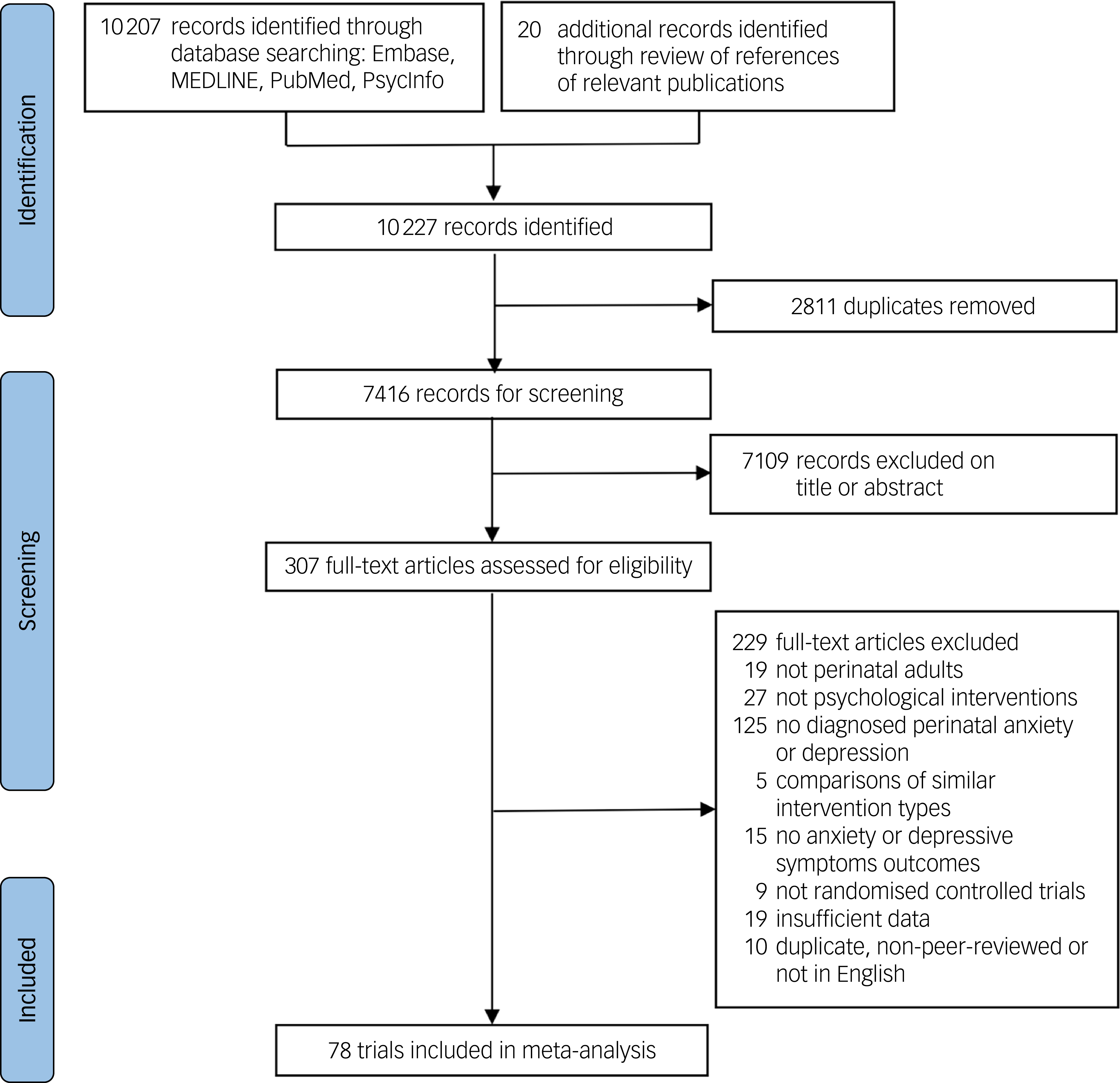
Fig. 1 Long description
The flowchart begins with the identification phase, where 10 207 records are identified through database searching and 20 additional records through reference review, totaling 10 227 records. After removing 2811 duplicates, 7416 records remain for screening. Of these, 7109 records are excluded based on title or abstract, leaving 307 full-text articles to be assessed for eligibility. In the inclusion phase, 229 full-text articles are excluded for various reasons, such as not being perinatal adults, not involving psychological interventions, no diagnosed perinatal anxiety or depression, comparison of similar intervention types, no anxiety or depressive symptoms outcomes, not being randomised controlled trials, insufficient data, or being duplicate, non-peer-reviewed, or not in English. Ultimately, 78 trials are included in the meta-analysis.
Network meta-analysis structure plots for perinatal depression and anxiety. Note: Each node represents a specific psychological treatment, with node size proportional to the number of participants involved. Line thickness indicates the number of studies comparing the two interventions.
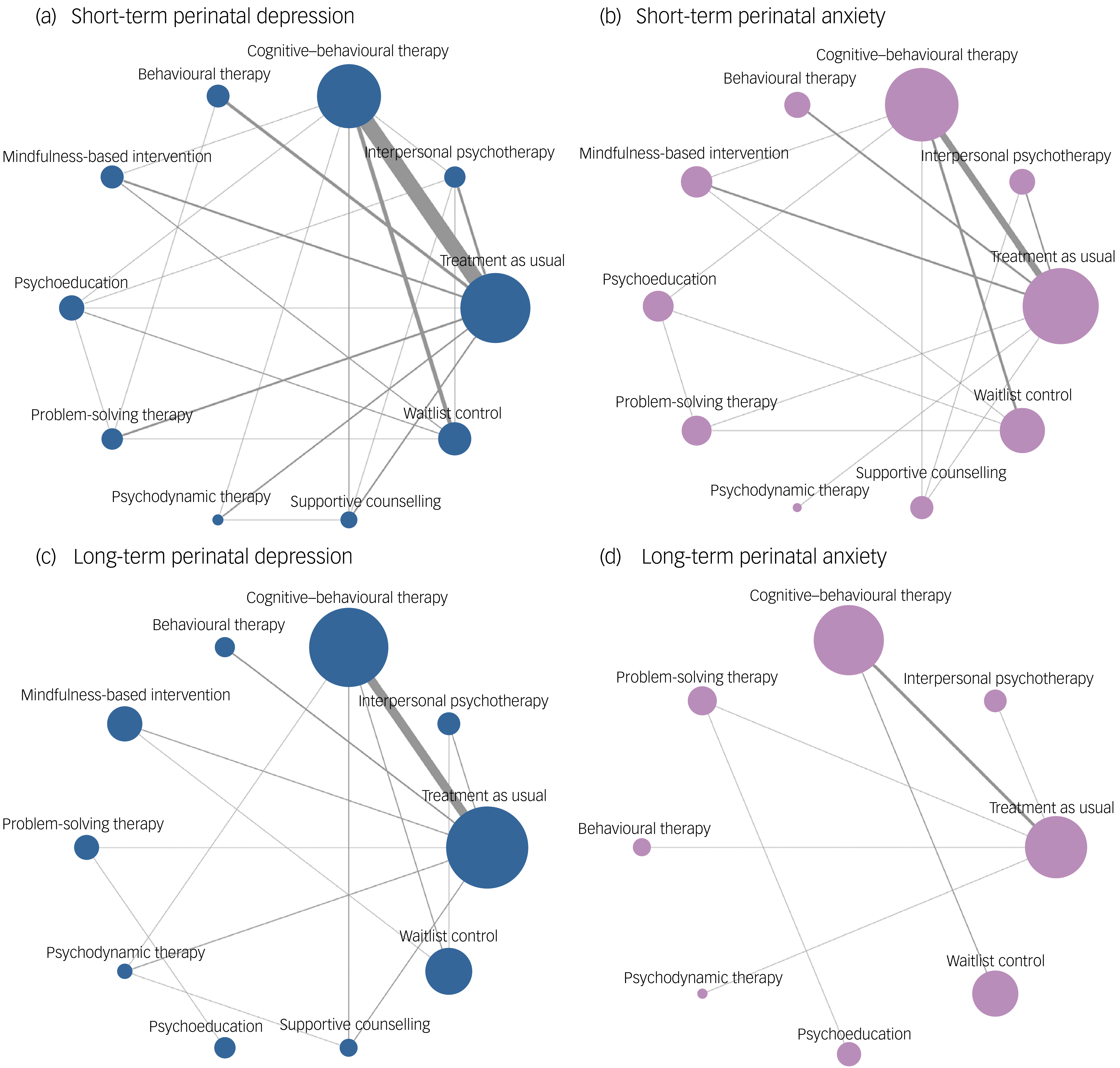
Fig. 2 Long description
Four network meta-analysis structure plots compare psychological treatments for perinatal depression and anxiety. Each plot features nodes representing specific treatments, with node size indicating the number of participants. Lines connect nodes, with thickness showing the number of studies comparing treatments. The plots are divided into short-term perinatal depression, short-term perinatal anxiety, long-term perinatal depression and long-term perinatal anxiety. Treatments include cognitive behavioural therapy, interpersonal psychotherapy, behavioural therapy, mindfulness-based intervention, psychoeducation, problem-solving therapy, psychodynamic therapy, supportive counseling, treatment-as-usual and waitlist control. The plots illustrate the relationships and comparative studies between these treatments.
Study characteristics are detailed in the online supplementary material (pp. 31–44). Participants’ mean age was 29.49 years (s.d. = 2.69), with a median follow-up of 20 weeks (range: 12–48) in the analysis. Depression or anxiety was diagnosed using diagnostic criteria in 34.6% of studies (n = 27) or clinical thresholds on validated scales in 65.4% of studies (n = 51). Most trials were conducted in high-income countries (n = 58, 74.3%), delivered individually (n = 46, 59.0%) and face-to-face (n = 59, 75.6%). Treatment ranged from 1 to 36 sessions (typically 45-90 min). Additionally, 41 treatments (52.6%) were administered postpartum, 33 (42.3%) during pregnancy and the remainder (n = 4, 5.1%) during both periods.
Risk of bias
Of the studies, 8 (10.3%) were classified as low risk, 59 (75.6%) as having some concerns and 11 (14.1%) as high risk (online supplementary material, pp. 46–52). The most common sources of bias were selective reporting in 62 studies (79.5%) due to unavailable pre-registered statistical analysis, followed by blinding concerns of outcome measurement in 41 studies (52.6%), which are common challenges in psychological interventions. Other concerns included unclear randomisation validity in 32 studies (41.0%), potential protocol deviations in 33 studies (42.3%) and potential unbalanced attrition in 5 studies (6.4%). Inter-rater reliability showed substantial agreement (k = 0.88, 95% CI 0.77–0.98).
Network meta-analyses of perinatal depression
Transitivity assessment revealed no violation for most effect modifiers (online supplementary material, pp. 53–6), thereby supporting the validity of the network. For short-term depression outcomes presented in Table 2, 3 psychological treatments significantly outperformed TAU: MBI (s.m.d. −2.02, 95% CrI −2.65 to −1.42; 4 studies, 490 participants for direct comparison), IPT (s.m.d. −0.65, 95% CrI −1.09 to −0.20; 5 studies, 412 participants) and CBT (s.m.d. −0.55, 95% CrI −0.77 to −0.33; 32 studies, 4561 participants). MBI showed significant superiority over other treatments; however, this effect was based on only 5 studies, over 50% of which had a high risk of bias.
Relative effects for perinatal depression

Table 2 Long description
The table presents a comparison of the effectiveness of different psychological treatments for short-term depression outcomes. It includes data on Behavioral therapy, Cognitive Behavioral Therapy (CBT), Interpersonal Therapy (IPT), Mindfulness-Based Intervention (MBI), Problem-Solving Therapy (PST), Psychoeducation, Supportive Counseling (SPC), and Treatment As Usual (TAU). The table has 8 rows and 10 columns, with column headers indicating different treatments and row labels showing the comparison results. Notable trends include MBI showing significant superiority over other treatments, though this effect is based on a limited number of studies with a high risk of bias. IPT and CBT also significantly outperformed TAU. The data is presented with standardized mean differences (s.m.d.) and 95% credible intervals (CrI).
BT, behavioural therapy; CBT, cognitive–behavioural therapy; IPT, interpersonal psychotherapy; MBI, mindfulness-based intervention; PDT, psychodynamic therapy; PE, psychoeducation; PST, problem-solving therapy; SPC, supportive counselling; TAU, treatment-as-usual; WL, waitlist control. The upper section (light-shaded) represents long-term symptom outcomes; the lower section indicates short-term symptom results. The table shows the standard mean differences (95% credible intervals) for pairwise comparisons between treatments in columns versus rows. Bold text indicates statistically significant results.
Based on SUCRA rankings, MBI had the highest probability of being ranked first (SUCRA 99.9%), followed by IPT (SUCRA 73.6%) and CBT (SUCRA 66.1%). However, SUCRA values should be interpreted cautiously given substantial between-study heterogeneity. The NMA showed moderate global heterogeneity (I 2 = 12%, τ 2 = 0.37). Pairwise comparisons showed heterogeneity ranging from I 2 = 0.0 to 97.1% (online supplementary material, pp. 57–76).
For long-term therapeutic outcomes, both MBI (s.m.d. −1.17, 95% CrI −1.80 to −0.52; 2 studies, 382 participants) and CBT (s.m.d. −0.39, 95% CrI −0.66 to −0.14; 17 studies, 1955 participants) showed sustained effects compared with TAU. SUCRA values were highest for MBI (93.7%), followed by IPT (64.7%) and CBT (58.2%). Network heterogeneity was small to moderate (I2 = 5%, τ2 = 0.24), with local heterogeneity ranging from I2 = 0.0 to 97.0% (online supplementary material, pp. 77–91).
Both short- and long-term depression analyses exhibited good model convergence (SRFs all <1.01; online supplementary material, pp. 59–70; 79–85). Inconsistencies were observed in comparisons of MBI versus TAU and waitlist comparisons, and may reflect substantial between-study heterogeneity (online supplementary material, pp. 92–4). Where applicable, funnel plot inspection and Egger’s test suggested no evidence of publication bias (P = 0.627 for short-term, P = 0.075 for long-term outcomes).
Network meta-analyses of perinatal anxiety
Three treatments significantly outperformed TAU (Table 3): MBI (s.m.d. −1.67, 95% CrI −2.55 to −0.84; 5 studies and 509 participants for direct comparison), behavioural therapy (s.m.d. −1.02, 95% CrI −1.96 to −0.07; 4 studies, 348 participants) and CBT (s.m.d. −0.54, 95% CrI −1.00 to −0.06; 14 studies, 1703 participants). MBI demonstrated greater efficacy than CBT, IPT and PST, largely based on indirect evidence. SUCRA rankings placed MBI highest (SUCRA 96.0%), followed by behavioural therapy (77.9%) and CBT (60.9%). The network showed moderate-to-large heterogeneity (I2 = 9%, τ2 = 0.83), with local heterogeneity spanning from I2 = 0.0 to 97.6% (online supplementary material, pp. 57–76).
Relative effects for perinatal anxiety

Table 3 Long description
The table compares the effectiveness of various treatments for perinatal anxiety, including MBI, behavioral therapy, CBT, IPT, PDT, psychoeducation, PST, SPC, TAU, and waitlist. It presents standardized mean differences (s.m.d.) with 95% credible intervals (CrI) for each treatment. The table includes data from multiple studies and participants, highlighting that MBI, behavioral therapy, and CBT significantly outperformed treatment as usual (TAU). MBI demonstrated greater efficacy than CBT, IPT, and PST, largely based on indirect evidence. The surface under the cumulative ranking curve (SUCRA) rankings placed MBI highest, followed by behavioral therapy and CBT. The network showed moderate-to-large heterogeneity, with local heterogeneity spanning from 20.0 to 97.6 percent. The table provides a detailed comparison of the treatments’ effectiveness, including direct and indirect evidence, and the number of studies and participants involved.
BT, behavioural therapy; CBT, cognitive–behavioural therapy; IPT, interpersonal psychotherapy; MBI, mindfulness-based intervention; PDT, psychodynamic therapy; PE, psychoeducation; PST, problem-solving therapy; SPC, supportive counselling; TAU, treatment-as-usual; WL, waitlist control. The upper section (light shaded) represents long-term symptom outcomes; the lower section indicates short-term symptom results. The table shows the standard mean differences (95% credible intervals) for pairwise comparisons between treatments in columns versus rows. Bold text indicates statistically significant results.
For long-term perinatal anxiety, only behavioural therapy demonstrated sustained efficacy at follow-up compared with TAU (s.m.d. −0.49, 95% CrI −0.91 to −0.07); however, this estimate derives from a single trial (n = 130) and should be interpreted with caution. Psychoeducation showed significant superiority over PDT (s.m.d. 0.92, 95% CrI 0.05 to 1.78), but this finding was based solely on indirect evidence and cannot rule out chance. The network of long-term outcomes indicated small heterogeneity (I2 = 1%, τ2 = 0.01), with pairwise heterogeneity from I2 = 13 to 94.3% (online supplementary material, pp. 77–91).
Results indicated excellent model convergence (SRFs all < 1.01; online supplementary material, pp. 59–70; 79–85) and consistency between direct and indirect treatment effects (P all > 0.05; online supplementary material, pp. 92–4). Where applicable, no evidence of publication bias was observed through funnel plot inspection and Egger’s test (P = 0.980) for available short-term perinatal anxiety comparison.
Additional analyses
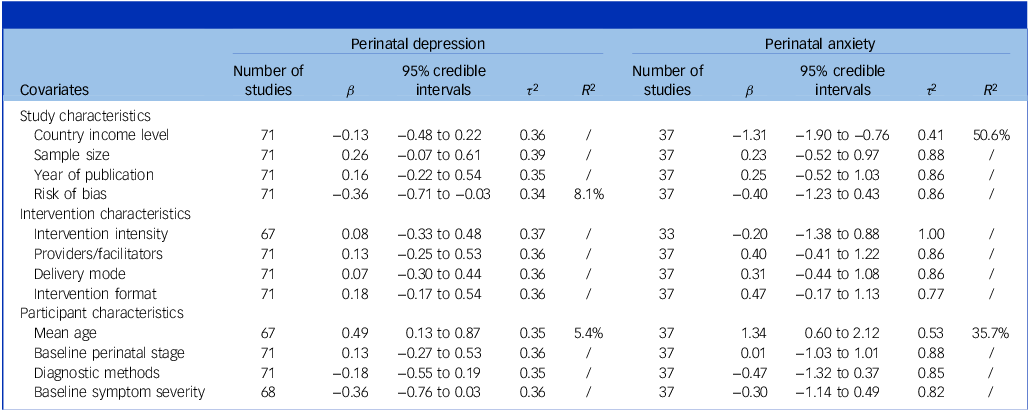
Meta-regression for short-term perinatal depression revealed two significant moderators (Table 4). Greater treatment effects were associated with higher risk of bias (β = −0.36, 95% CrI −0.71 to −0.03; R 2 = 8.1%) and younger mean participant age (β = 0.49, 95% CrI 0.13 to 0.87; R 2 = 5.4%). For short-term perinatal anxiety, younger age (β = 1.34, 95% CrI 0.60 to 2.12; R 2 = 35.7%) and lower country income levels (β = −1.31, 95% CrI −1.90 to −0.76; R 2 = 50.6%) were associated with greater effects.
Meta-regression for short-term perinatal depression and anxiety
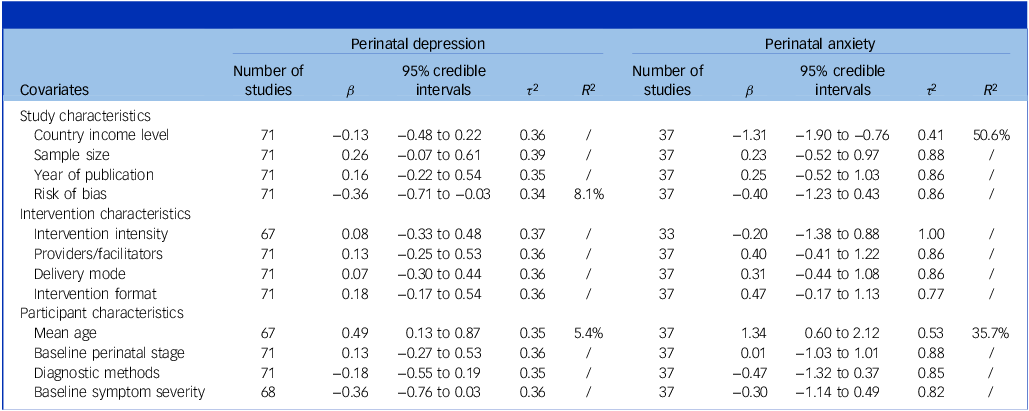
Table 4 Long description
The table presents a meta-regression analysis for short-term perinatal depression and anxiety. It includes covariates such as study characteristics, intervention characteristics, and participant characteristics. The table has 18 rows and 12 columns, with columns for the number of studies, beta values, 95% credible intervals, and R-squared values. For perinatal depression, significant moderators include higher risk of bias and younger mean participant age. For perinatal anxiety, significant moderators include younger age and lower country income levels. The table provides detailed statistical data for each covariate.
Moderators tested: country income level (high-income countries versus low- and middle-income countries based on World Bank classification); risk of bias (low versus some concerns versus high); intervention intensity (hour × sessions); providers/facilitators (professionals versus trained professionals versus peers/self-help); delivery mode (in-person versus remote); intervention format (group versus individual versus mixed); age (continuous); baseline perinatal stage (prenatal versus postpartum versus perinatal); diagnostic methods (diagnostic criteria versus scale cut-offs); baseline symptom severity (mild versus moderate-to-severe, determined by comparing mean baseline scores against validated scale thresholds, see online supplementary material, pp. 95–7).
Sensitivity analyses, including exclusion of outliers, removal of high-risk studies and restriction to high-income countries, confirmed the robust effects of MBI, CBT and IPT on perinatal depression. Constrained by the limited number of studies, the evidence for perinatal anxiety was less conclusive: only behavioural therapy demonstrated a consistent effect, and this was not maintained when the analysis was restricted to high-income countries (online supplementary material, pp. 100–1).
Subgroup analyses detailed the effects by modifiers (online supplementary material, pp. 102–7). For both depression and anxiety, effects varied by mean participant age, with younger women (age <30 years) showing larger treatment benefits than older women (age ≥30 years) in CBT and MBI. Heterogeneity was notably reduced in several comparisons (e.g. CBT versus TAU, IPT versus TAU) and inconsistency in MBI versus TAU and waitlist comparisons also resolved in subgroup analyses, suggesting that baseline age partially accounts for the variability in treatment effects.
Overall, CINeMA evaluation (online supplementary material, pp. 114–22) showed moderate confidence in CBT versus TAU for short-term depression and anxiety, with some concerns regarding within-study bias, imprecision and heterogeneity. Evidence confidence was generally low or very low for the remaining comparisons. The included comparison was mostly downgraded for heterogeneity (100.0%), reporting bias (94.0%), imprecision (90.0%) and within-study bias (90.0%).
Discussion
This NMA of 78 RCTs involving 11 345 participants represents one of the most comprehensive comparative syntheses of psychological treatments for perinatal depression and anxiety to date. CBT demonstrated consistent therapeutic effects for both conditions at post-intervention, supported by moderate certainty of evidence. While other treatments (e.g. IPT, MBI and behavioural therapy) also showed promising effects, confidence in these findings was limited by small evidence bases, high risk of bias and substantial heterogeneity, yielding low or very low certainty. Furthermore, we identified that participant age, country income level and risk of bias were key factors contributing to the observed heterogeneity.
Three treatments (CBT, IPT, MBI) showed efficacy for perinatal depression compared with TAU, with CBT maintaining long-term benefits. For perinatal anxiety, CBT, MBI and behavioural therapy were effective in the short term, yet only behavioural therapy maintained its benefits at follow-up, based on limited evidence. These findings have significant clinical importance, given the persistence of perinatal depression and anxiety and their established association with subsequent maternal mental health disorders. Reference Astbury, Pinnington, Milgrom and Bei40–Reference Meltzer-Brody and Stuebe42 These findings align with, and extend, previous pairwise meta-analyses reporting moderate effects for CBT (d = 0.61–0.65) Reference Sockol17 and IPT (d = 0.33–0.69) Reference Sockol18 for perinatal depression, and large MBI effects (d = 1.44–2.37) Reference Leng, Yin and Ng19 across conditions. Two recent NMAs similarly identified large MBI effect sizes and supported CBT efficacy. Reference Zeng, Niu, Zhu, Li, Li and Gao43,Reference Smith, Dang, Shen, Hung, Lam and Kwok44 Extending prior work that lacked CINeMA evaluations Reference Smith, Dang, Shen, Hung, Lam and Kwok44 or clinically meaningful change thresholds, Reference Zeng, Niu, Zhu, Li, Li and Gao43 we integrated both to comprehensively evaluate evidence certainty. This approach yielded more prudent clinical recommendations: while MBI showed the largest effect size, very low evidence certainty precludes strong recommendations; conversely, CBT demonstrated moderate certainty with robust effects, supporting its role as a first-line therapy. The present study also extends previous NMAs by focusing exclusively on clinically significant populations, providing the first comprehensive NMA for perinatal anxiety and empirically demonstrating differential effects between waitlist and TAU control conditions. Nevertheless, the efficacy evidence for perinatal anxiety remains comparatively limited, with CBT currently the only intervention supported by moderate certainty of evidence. These findings may reflect the larger research base for depression. Perinatal anxiety presentations are more heterogeneous and complex, Reference Zimmermann, Mahanna, Shashkova, Drouhard, Carr and Sheldrick45 requiring flexible and multifaceted clinical responses. These factors highlight the urgent need for further research in this understudied area.
Differences in the short- and long-term efficacy across treatments likely result from variations in the evidence base and treatment-specific mechanisms. The transdiagnostic efficacy of CBT may reflect its targeting of cognitive–behavioural mechanisms potentially shared by perinatal anxiety and depression, providing generalisable skills for managing evolving perinatal stressors such as sleep deprivation, role transitions and infant care demands. Reference Forsell, Bendix, Holländare, Szymanska von Schultz, Nasiell and Blomdahl-Wetterholm46–Reference O’Mahen, Himle, Fedock, Henshaw and Flynn48 IPT’s sustained efficacy for depression may relate to its focus on social relationships and role transitions, Reference Bright, Charrois, Mughal, Wajid, McNeil and Stuart49 which are recognised as key determinants of perinatal depression. Reference Qi, Zhao, Liu, Li and Hu50,Reference Yin, Sun, Jiang, Xu, Gan and Zhang51 However, limited evidence precluded definitive conclusions for anxiety. For other interventions, the lack of sustained effects stems mainly from an insufficient number of long-term trials and underpowered analyses. Another contributing factor may be the nature of the intervention strategies themselves. One possible explanation for the lack of sustained anxiety benefits from MBI is the challenge of maintaining daily mindfulness practice (typically 30–45 min) amid postpartum demands. Reference Pan, Lin, Kuo, Chiu and Ling52,Reference Lönnberg, Jonas, Bränström, Nissen and Niemi53 Similarly, the benefits of PST for depression may not persist because its narrow focus on resolving current problems may leave patients inadequately equipped to handle the ongoing challenges of evolving infant developmental stages. Reference Nezu, D’Zurilla, Zwick and Nezu54 Behavioural therapy showed promise for anxiety, but as an umbrella construct for goal-directed techniques such as behavioural activation and relaxation, Reference Johnson, Edge, Holmes and Carver55,Reference Toussaint, Nguyen, Roettger, Dixon, Offenbächer and Kohls56 the sustainability and transferability of its gains require further evaluation through high-quality trials.
Our study also highlights several methodological limitations in the current literature. In our NMA, a substantial proportion of the included studies (79.5%) raised concerns regarding the selective reporting of outcomes. We advocate for the future use of publicly accessible pre-registration platforms, which could enhance transparency, increase the visibility of null findings and reduce publication bias. Reference Cashin, Richards, DeVito, Mellor and Lee57 Furthermore, 52.6% of the studies were at potential risk of bias due to the measurement of outcomes, Reference Li, Laplante, Paquin, Lafortune, Elgbeili and King58 primarily attributable to a lack of blinding during allocation and outcome assessment. While blinding is inherently challenging in psychosocial intervention trials, this limitation can potentially affect protocol adherence or amplify expectancy effects, potentially resulting in overestimation or underestimation of true treatment effects. Reference Huneke, Fusetto Veronesi, Garner, Baldwin and Cortese59 Future studies should incorporate objective biomarkers (e.g. cortisol levels), or clinician-rated structured diagnostic interviews to enhance confidence in outcome measures. Finally, inadequate reporting of randomisation processes and allocation concealment was noted in 41.0% of the studies. Comprehensive disclosure of these methodological details is crucial for establishing allocation validity and supporting the reliable application in clinical practice. Reference Schulz and Grimes60
For clinical application, psychological treatments demonstrate comparable effects to pharmacological treatments for perinatal depression. Reference Brown, Wilson, Ayre, Robertson, South and Molyneaux61,Reference McDonagh, Matthews, Phillipi, Romm, Peterson and Thakurta62 For instance, CBT showed a treatment effect comparable to that of selective serotonin reuptake inhibitors (s.m.d. −0.30, 95% CI −0.55 to −0.05), Reference Brown, Wilson, Ayre, Robertson, South and Molyneaux61 though direct comparisons remain scarce. Furthermore, when translating the results into clinically important changes on scale scores, we observed that the 95% CrIs for most treatments, including CBT, were wide and crossed the clinical significance boundary. This indicates uncertainty about their generalisable benefits across populations. Therefore, we advocate that medical decisions be guided by careful consideration of individual contextual factors, such as symptom severity. Given medication safety concerns during pregnancy and breastfeeding, Reference Battle, Salisbury, Schofield and Ortiz-Hernandez.13 including risks of neonatal adaptation syndrome Reference Grigoriadis, VonderPorten, Mamisashvili, Eady, Tomlinson and Dennis63 and persistent pulmonary hypertension, Reference Grigoriadis, VonderPorten, Mamisashvili, Tomlinson, Dennis and Koren64 psychological treatments constitute important first-line options for mild-to-moderate symptoms. 65 Combined psychotherapy and pharmacotherapy should be reserved for severe depression, treatment-resistant cases or when rapid symptom reduction is critical for maternal or infant safety. Reference Dunlop66
The present study identified substantial variation in treatment effects across studies, consistent with previous perinatal meta-analyses that reported high heterogeneity (I 2 up to 97.6%). Reference Cuijpers, Franco, Ciharova, Miguel, Segre and Quero14,Reference Sockol, Epperson and Barber15,Reference Sockol18,Reference Leng, Yin and Ng19 The association between higher risk of bias and larger depression effects reinforces caution when interpreting findings for treatments with limited or methodologically weaker evidence bases. The significant income-level effect for anxiety is particularly concerning given that 74.3% of trials were conducted in high-income settings, raising concerns about generalisability to low- and middle-income settings. Younger maternal age predicted better treatment response for both conditions, potentially reflecting a lower comorbidity burden, higher engagement or generational differences in mental health literacy. Reference Saccone, Gragnano, Ilardi, Marrone, Strina and Venturella67,Reference Farrer, Leach, Griffiths, Christensen and Jorm68 Beyond participant-level moderators, control condition differences also contributed to effect size variation. Consistent with the nocebo hypothesis, Reference Chavarria, Vian, Pereira, Data-Franco, Fernandes and Berk69,Reference Furukawa, Noma, Caldwell, Honyashiki, Shinohara and Imai70 comparisons against the waitlist control yielded more favourable efficacy results than those against TAU in this study. This finding suggests prior NMAs merging waitlist and TAU may have overestimated efficacy for interventions primarily compared against waitlist control, highlighting the critical need to specify and standardise control conditions in future research.
Limitations
Several limitations warrant consideration. First, network sparsity with only a limited proportion of possible treatment comparisons that had direct evidence constrained comparative effectiveness estimates. Second, evidence quality was limited, with only 10.3% of studies at low risk of bias. CINeMA assessment yielded moderate confidence for CBT but low or very low for other treatments. Meta-regression confirmed that higher risk of bias predicted larger effects, suggesting that treatment effects may be overestimated and the superiority of MBI in SUCRA rankings could be exaggerated. Third, identified moderators explained only 5.4–50.6% of variance, indicating that treatment effects in individual settings may differ substantially. The unmeasured factors (e.g. treatment adherence, trauma history, physical comorbidities) likely contribute to residual variability and warrant investigation by future studies. Another limitation concerns the variability of TAU across different settings and studies. Due to ethical considerations, participants allocated to TAU were often permitted to seek additional mental health services during the trial period, potentially leading to conservative estimates of treatment efficacy. Finally, publication bias assessment was limited by sparse network connectivity, introducing the possibility that unpublished null findings may bias our effect estimates.
This comprehensive NMA establishes CBT as the best-supported psychological treatment for both perinatal depression and anxiety, with moderate confidence evidence for short-term efficacy and sustained effects for depression. IPT and behavioural therapy show promising but less certain short-term effects for depression and anxiety, respectively. MBI yielded the largest effect sizes, but these estimates are fragile given few contributing trials and high risk of bias. In the future, pre-registered RCTs with blinded assessments, longer follow-up periods and more diverse samples are urgently needed. A greater focus on anxiety is also critical to inform precise treatment selection and improve perinatal mental health.
Supplementary material
The supplementary material is available online at https://doi.org/10.1192/bjp.2026.10694
Data availability
All data utilised in this review are publicly available in the original studies included in this analysis.
Acknowledgements
During the preparation of this manuscript, the authors used DeepSeek-V3 (https://chat.deepseek.com), accessed between 21 September 2025 and 3 November 2025, to check spelling, grammar and punctuation. No modifications were made to the algorithm, nor was custom data added to the public corpus. The authors reviewed and edited all content and take full responsibility for the manuscript. No competing interests arose from the use of this tool.
Author contributions
L.L.L. designed the study. X.H. and T.W. selected the articles and extracted the data W.X. and X.H. assessed the quality of evidence. W.X. analysed the data. W.X. and L.L.L. wrote the first draft of the manuscript, and K.N., X.H. and T.W. contributed to the review and editing of the final manuscript. All authors agreed with the final version of the manuscript.
Funding
This research received no specific grant from any funding agency, commercial or not-for-profit sectors.
Declaration of interest
None.






eLetters
No eLetters have been published for this article.