INTRODUCTION
Neospora caninum is an obligate intracellular apicomplexan parasite closely related to Toxoplasma gondii and represents an important causative agent of abortions in cattle, worldwide (Reichel et al. Reference Reichel, McAllister, Pomroy, Campero, Ortega-Mora and Ellis2014). The efficient transplacental transmission of N. caninum and the apparent incapability of the host immune response to prevent this process still remain the most intriguing aspects of this pathogen despite many attempts by different immunization approaches in both cattle and the pregnant mouse model.
In pregnant animals, physiological changes lead to immunomodulation especially at the maternal-fetal interface, characterized by a downregulated T helper (Th) 1-biased response through decreasing interferon gamma (IFN-γ), tumour necrosis factor (TNF) and interleukin (IL)-12 production and increasing IL-4 and IL-10 expression (Roberts et al. Reference Roberts, Walker and Alexander2001; Beagley and Gockel, Reference Beagley and Gockel2003; Kano et al. Reference Kano, Kudo, Kamiya, Kobayashi, Maeda and Omata2007) and an induction of a regulatory phenotype in both antigen presenting cells (APCs) and T cells (Fiorentino et al. Reference Fiorentino, Zlotnik, Vieira, Mosmann, Howard, Moore and O'Garra1991; Rowe et al. Reference Rowe, Ertelt, Aguilera, Farrar and Way2011). This profile prevents fetal rejection and helps maintaining the pregnancy but, at the same time, favours parasite reactivation, multiplication and subsequent transmission to the fetus (Roberts et al. Reference Roberts, Walker and Alexander2001; Quinn et al. Reference Quinn, Miller and Ellis2004). On the other hand, if dams mount a Th1-biased immune response to control parasite proliferation, the pro-inflammatory cytokines could damage the placenta and compromise the pregnancy. Thus, an appropriately balanced Th1/Th2 immune response appears to be crucial in pregnant cattle (Innes et al. Reference Innes, Bartley, Maley, Wright and Buxton2007) and in experimentally infected mice (Monney and Hemphill, Reference Monney and Hemphill2014). However, the achievement of this specific immune balance in N. caninum infected dams remains a big challenge. This is reflected by the fact that the vast majority of antigen formulations shown to confer protection in the non-pregnant neosporosis mouse model were rendered non-protective when assessed in pregnant mice immunized prior to mating (Monney and Hemphill, Reference Monney and Hemphill2014). A good example is the N. caninum chimeric antigen Mic3-1-R which conferred excellent degree of protection in non-pregnant mice but failed to protect against vertical transmission and offspring death in the pregnant mouse model of neosporosis (Debache et al. Reference Debache, Guionaud, Alaeddine and Hemphill2010; Monney et al. Reference Monney, Rutti, Schorer, Debache, Grandgirard, Leib and Hemphill2011, Reference Monney, Debache, Grandgirard, Leib and Hemphill2012; Debache and Hemphill, Reference Debache and Hemphill2013).
The OprI molecule is a lipoprotein from the outer membrane of Pseudomonas aeruginosa, which targets toll-like receptor 2 (TLR2) and therefore exhibits adjuvant properties (Basto et al. Reference Basto, Piedade, Ramalho, Alves, Soares, Cornelis, Martins and Leitao2012). TLR2 activation has been associated with stimulation of Th1, Th2 and T regulatory (Treg) type immune responses. Moreover, TLR2 activation has been implicated in the induction of cross-presentation by APCs (Basto and Leitao, Reference Basto and Leitao2014; Basto et al. Reference Basto, Badenes, Almeida, Martins, Duarte, Santos and Leitao2015). In addition, N. caninum recognition by TLR2 in mice has been shown to participate in the generation of an effective immune response (Mineo et al. Reference Mineo, Oliveira, Gutierrez and Silva2010). The capacity of OprI to modulate adaptive immune responses in vitro and in vivo has been demonstrated in virus infections such as African swine fever, bacterial infections such as tuberculosis, and parasite infections such as Leishmania major (Leitao et al. Reference Leitao, Malur, Cartaxeiro, Vasco, Cruz, Cornelis and Martins2000; Cote-Sierra et al. Reference Cote-Sierra, Bredan, Toldos, Stijlemans, Brys, Cornelis, Segovia, de Baetselier and Revets2002; Gartner et al. Reference Gartner, Baeten, Otieno, Revets, De Baetselier and Huygen2007). Thus, OprI directly linked to the antigen emerges as an interesting adjuvant candidate for a sub-unit vaccine against neosporosis in pregnant mice, especially since a well-adjusted Th1/Th2 balance is required avoiding excessive inflammation.
In the present study, OprI was fused to the chimeric N. caninum antigen Mic3-1-R employing a previously developed cloning and production system (Basto et al. Reference Basto, Piedade, Ramalho, Alves, Soares, Cornelis, Martins and Leitao2012). The potential of this new immunogenic formulation to activate the innate immunity and modulate the humoral and T cell immune response and the influence on congenital neosporosis in the pregnant mouse model was analysed and discussed.
MATERIALS AND METHODS
Neospora caninum culture, inoculum and crude extract preparation
Neospora caninum of the Nc-Spain7 isolate (Regidor-Cerrillo et al. Reference Regidor-Cerrillo, Gomez-Bautista, Pereira-Bueno, Aduriz, Navarro-Lozano, Risco-Castillo, Fernandez-Garcia, Pedraza-Diaz and Ortega-Mora2008) was grown in vitro by continuous passages in Vero cell cultures. Infected cultures were maintained in RPMI 1640 medium supplemented with 2% heat-inactivated fetal calf serum (FCS), 2% L-glutamine, 1% antibiotic-antimycotic (100 U of penicillin, 100 µg of streptomycin and 0·25 µg of amphotericin B mL−1) at 37 °C and 5% CO2. The mouse inoculum was prepared as described by Arranz-Solís et al. (Reference Arranz-Solís, Aguado-Martínez, Müller, Regidor-Cerrillo, Ortega-Mora and Hemphill2015). Infected monolayers with more than 90% of tachyzoites being intracellular were removed from the surface with a cell scraper, passed through a 21-gauge needle to break the vacuoles, and viable tachyzoites (diluted 1:10 in Trypan blue) were counted in a Neubauer chamber. The tachyzoite suspension was diluted with culture medium to achieve a final concentration of 5 × 10⁵ viable tachyzoites mL−1. Parasites were maintained in ice and mice were infected by subcutaneous injection of 200 µL suspension (corresponding to 105 tachyzoites) within the following 30 min. To prepare N. caninum crude extract for enzyme-linked immunosorbent assay (ELISA), infected Vero cells were scraped, passed through a 21-gauge needle and the tachyzoites purified on Sephadex G25 PD-10 columns (GE Healthcare, Buckinghamshire, England). Tachyzoites were then pelleted by centrifugation at 300 × g for 15 min at 4 °C, subjected to three freeze-thaw cycles, sonicated for 6 × 20 s at 57 W in a Branson Sonifier Cell Disruptor (Skan AG, Allschwill, Switzerland) and filtered through a 20 µm sterile filter. Final protein concentration was determined using the Protein Assay Dye Reagent Concentrate (Bio-Rad, Hercules, CA, USA).
Production of OprI-Mic3-1-R and Mic3-1-R antigens
The complete coding sequence of the chimeric N. caninum antigen Mic3-1-R (Monney et al. Reference Monney, Rutti, Schorer, Debache, Grandgirard, Leib and Hemphill2011) was cloned in the pOLP plasmid at the multiple cloning site-2 (MCS2) downstream of OprI sequence (Basto et al. Reference Basto, Piedade, Ramalho, Alves, Soares, Cornelis, Martins and Leitao2012). OprI-MIC3-1-R was expressed in Rosetta(DE3)pLysS Escherichia coli strain (Novagen) and subsequently extracted from the outer membranes in order to exclusively purify the lipidated mature form. The entire procedure was done according to Basto et al. (Reference Basto, Morais, Marcelino, Leitao and Santos2014); Basto et al. (Reference Basto, Piedade, Ramalho, Alves, Soares, Cornelis, Martins and Leitao2012). Briefly, after isopropyl-β-D-thiogalactopyranoside (IPTG) induction, the bacterial outer membranes were isolated by differential solubilization in sarkosyl, and lipopolysaccharides (LPS) were extracted by hot phenol/water treatment. The resulting outer membrane proteins contained in the phenol phase were precipitated, washed and solubilized in a binding buffer (20 mm NaH2PO4, 0·5 M NaCl, 20 mm imidazole, 6 M guanidine hydrochloride, 2% (v/v) Triton X-100, pH 7·4) supplemented with 20 mm β-mercaptoethanol and 1 × protease inhibitor cocktail (for use in purification of His6-tagged proteins, dimethyl sulfoxide solution, Sigma), and were purified by nickel-affinity chromatography (Basto et al. Reference Basto, Morais, Marcelino, Leitao and Santos2014). The non-OprI Mic3-1-R antigen was produced as previously described by Monney et al. (Reference Monney, Rutti, Schorer, Debache, Grandgirard, Leib and Hemphill2011) with some modifications. The pET151-Mic3-1-R construct was transformed into BL21(DE3) competent cells. After IPTG induction, bacteria were re-suspended in the binding buffer supplemented with 20 mm β-mercaptoethanol and 1 × of protease inhibitor cocktail and ultra-sonicated (2 × 10 min at 57 W). The lysate was gently shaken over night at 4 °C, clarified by centrifugation (3000 × g , 30 min) and submitted to hot phenol/water treatment. The proteins contained in the phenol phase were then precipitated, washed and solubilized in binding buffer and submitted to nickel-affinity chromatography as above (Basto et al. Reference Basto, Morais, Marcelino, Leitao and Santos2014). The eluates of both purified recombinant proteins were dialyzed against phosphate-buffered saline (PBS). The protein contents were analysed by sodium dodecyl sulphate polyacrylamide gel electrophoresis (SDS-PAGE) and quantified by the bicinchoninic acid (BCA) Protein Assay Kit (Thermo Scientific Pierce). Endotoxin levels were quantified by the Limulus Amebocyte Lysate (LAL) Kinetic-QCL (Lonza) following manufacturer's instructions. The final LPS content was below 0·13 EU µg−1 in purified OprI-Mic3-1-R and 0·03 EU µg−1 in Mic3-1-R.
Murine bone marrow-derived dendritic cells (BM-DCs) stimulation by OprI-Mic3-1-R and Mic3-1-R
All mouse procedures were conducted in compliance with the Swiss and European Union (Directive no. 86/609/EEC) legislation for the use of animals for experimental purposes and approved by the veterinary office of the Canton of Bern (license number 115/14). The authors certified the use of the minimum number of animals to produce statistically reproducible results.
BM-DCs were generated in vitro from bone marrow cells obtained from naïve BALB/c mice as previously described (Basto et al. Reference Basto, Badenes, Almeida, Martins, Duarte, Santos and Leitao2015). After 7 days differentiating with granulocyte macrophage-colony stimulating factor (GM-CSF)-containing DC medium (RPMI 1640 medium containing 2 mm L-glutamine, 100 IU mL−1 penicillin, 100 µg mL−1 streptomycin, 10% FCS, 20 mm HEPES, 1 mm sodium pyruvate, 50 µ m β-mercptoethanol, 20 ng mL−1 GM-CSF), non-adherent and loosely adherent cells were cultured and stimulated for 24 h with OprI-Mic3-1-R or Mic3-1-R (1 and 5 µg mL−1), ultrapure LPS at 0·1 µg mL−1 (Invivogen) or DC medium. Culture supernatants were collected and tested by ELISA for TNF-α according to manufacturer's instructions (eBioscience).
Immunization schedule, and immune response analysis
Six weeks-old BALB/c mice were purchased from Charles River Laboratories (Sulzfeld, Germany) and maintained under conventional day/night cycle housing conditions with water and food ad libitum. Euthanasia was performed in a CO2 chamber. The mice were used for the experiment after 2 weeks of acclimatization.
Groups of 25 females mice were immunized three times, at 2-week intervals, by intraperitoneal injection with either 10 µg OprI-MIC3-1-R in 100 µL PBS (OprI-M group) or 10 µg MIC3-1-R plus 5 µg of saponin emulsified in 100 µL PBS (M + S group) (Monney et al. Reference Monney, Rutti, Schorer, Debache, Grandgirard, Leib and Hemphill2011). Saponin was chosen as a classic adjuvant because it was previously employed together with Mic3-1-R for immunization protocols allowing a comparable group between this and previous studies (Monney et al. Reference Monney, Rutti, Schorer, Debache, Grandgirard, Leib and Hemphill2011, Reference Monney, Debache, Grandgirard, Leib and Hemphill2012). A third group (PBS) received PBS only. Six days after the third inoculation, five mice per group were euthanized. Blood was collected by intra-cardiac puncture and serum recovered for immunoglobulin G (IgG) analysis. The spleen was aseptically removed for splenic lymphocytes re-stimulation in vitro.
Challenge with N. caninum, clinical monitoring and sample collection
Two weeks after the third inoculation, the remaining 20 immunized mice per group were submitted to oestrus synchronization by the Whitten effect (Whitten, Reference Whitten1957) and mated with males (2 females and 1 male per cage) during three nights. At mid-gestation (7–9 days of pregnancy), mice were subcutaneously challenged with 105 tachyzoites of Nc-Spain7 isolate. Other two groups of non-immunized animals received either the same dose of tachyzoites or PBS (PBS/INF and PBS/PBS, respectively). Two pregnant mice per group were euthanized on day 18 of pregnancy and placentas were snap-frozen in liquid nitrogen and stored at −80 °C for RNA isolation. Surviving non-pregnant mice were euthanized at day 30 post-infection (pi). Dams and their pups were maintained together until day 30 post-partum (pp) (41–44 pi) when all surviving animals were euthanized.
Data on pregnancy rate (percentage of pregnant mice), litter size (average of number of pups born per dam), neonatal mortality (stillborn pups or pups that died within the first two days pp) and postnatal mortality (pups dead between day 3 and 30 pp) were recorded. All animals were examined daily for clinical signs (pups twice per day) until the end of the experiment. All animals exhibiting nervous signs and/or a significant loss of body condition were immediately euthanized. Upon euthanasia, blood was extracted by cardiac puncture and sera stored at −80 °C. Brains from non-pregnant mice, dams and surviving pups were also collected and immediately frozen at −20 °C.
Cerebral parasite burden
Brains from non-pregnant mice, dams and surviving pups were analysed by N. caninum-specific real-time polymerase chain reaction (PCR) on Nc5 region of N. caninum DNA as previously described (Muller et al. Reference Muller, Vonlaufen, Gianinazzi, Leib and Hemphill2002). DNA extraction from brain tissue was performed using the DNeasy® Blood & Tissue kit (Qiagen) according to the manufacturer recommendations. The DNA concentration in all samples was determined using the QuantiFluor dsDNA System (Promega, Madison, Wi.) according to the manufacturer protocol and adjusted to 5 ng µL−1 with sterile DNase free water. Quantitative real-time PCR was performed using the Rotor-Gene 6000 real-time PCR machine (Corbett Research, Qiagen). The parasite load was calculated by interpolation from a standard curve with DNA equivalents from 1000, 100 and 10 N. caninum tachyzoites included in each run.
Splenic lymphocytes re-stimulation in vitro
Freshly recovered spleens of mice sacrificed 6 days after the last immunization were aseptically disaggregated in full RPMI medium (RPMI 1640 medium containing 1% antibiotic-antimycotic-100 U of penicillin, 100 µg of streptomycin and 0·25 µg of amphotericin B mL−1, 2% L-glutamine, 10% FCS and 55 µ m β-mercaptoethanol) and by passing through a sieve. Red blood cells were lysed (1X RBC Lysis Buffer, ebiosciences) and the resulting cell suspensions were washed twice with full RPMI media, seeded in a 100-mm Petri dish and were incubated for 2 h at 37 °C with 5% CO2 to remove adherent cells. Non-adherent cells were cultured at 1 × 10⁶ cells mL−1 and re-stimulated with concanavalin A (ConA; 2 µg mL−1; Sigma), Mic3-1-R (4 µg mL−1) or remained non-stimulated (negative control). Supernatants were collected after 72 h and tested for cytokines by multiplex bead immunoassay.
Assessment of levels of cytokines by multiplex bead immunoassay
Levels of IFN-γ, IL-4, IL-10, IL-12(p70) and IL-17 were measured in the supernatants of re-stimulated splenic lymphocytes using the MILLIPLEX® MAP Mouse Cytokine/chemokine kit (Millipore Corp., Billerica, MA, USA) according to the manufacturer's protocol. Microtiter filter plates were run on Luminex instruments (Bio-Plex™ 200 system). Calibration curves from the provided recombinant standards were calculated with Bio-Plex Manager software using a five parametric logistic curve fitting. When the cytokine concentration was below the detection limit, an arbitrary value corresponding to the detection limit of undiluted samples (provided by the kit manufacturer) was used for statistical analysis.
RNA levels of IFN-γ in placental tissues
IFN-γ transcript expression levels in placental tissues were measured by real-time quantitative reverse transcription-PCR (RT-PCR) in relation to the expression of β-actin transcripts. Frozen placentas were directly disrupted and homogenized in lysis buffer RLT containing β-mercaptoethanol (10 µL mL−1 of buffer RLT) by rapid agitation in the presence of 1·4 mm ceramic beads (Lysing Matrix D, MP Biomedicals, Switzerland) in a FastPrep®-24 Instrument (MP Biomedicals, Switzerland). Homogenates corresponding to no more than 30 mg of tissue were used for subsequent RNA isolation using the RNeasy® Mini kit (Qiagen) according to the manufacturer recommendations. An in-column DNA digestion step with DNase I (Qiagen) was included. RNA concentration was measured by spectrophotometry at 260 nm and purity was estimated by measuring the ratio 260/280 nm. Synthesis of complementary DNA (cDNA) was performed by Omniscript RT kit (Qiagen) using random primers and RNasin (Promega). The primers sequences for cDNA amplification were as follows: for IFN-γ forward 5′-GGAACTGGCAAAAGGATGG-3′ and reverse 5′-CTGTGGGTTGTTGACCTCA-3′; and for β-actin forward 5′-ACACCCGCCACCAGTTCG-3′ and reverse 5′-CCATTCCCACCATCACACC-3′. Real-time PCR was carried out with FastStart Essential DNA Green Master (Roche) using SYBR green reagent in a Rotor-Gene 6000 real-time PCR machine (Corbett Research, Qiagen). For both genes a standard curve of Log of input cDNA vs cycle threshold (Ct) was built using a positive control cDNA and the slope calculated to know the PCR efficiencies. The amplification efficiencies of IFN-γ and β-actin were employed to calculate the mRNA levels of each gene for each sample as 10Ct/slope. The final result was expressed in arbitrary units (AU) after normalizing mRNA levels of IFN-γ with mRNA levels of β-actin (Muller et al. Reference Muller, Sterk, Hemphill and Muller2007). All samples were analysed in triplicate.
Analysis of serum Ig by ELISA
Levels of N. caninum-specific or Mic3-1-R-specific IgG1 and IgG2a were measured by ELISA as previously described (Monney et al. Reference Monney, Rutti, Schorer, Debache, Grandgirard, Leib and Hemphill2011). Briefly, 96-well plates were coated over night at 4 °C with 200 ng of N. caninum crude extract or 100 ng of Mic3-1-R in 100 µL of coating buffer per well. After three washes, plates were blocked with 1% bovine serum albumin in wash buffer (PBS with 0·05% Tween-20 (v/v)) and serum samples incubated at 1:100. After three washes, plates were incubated with either goat anti-mouse IgG1 or IgG2a conjugated with alkaline phosphatase (AP) (SouthernBiotech, Birmingham, USA). Reaction was developed with AP substrate and absorbance values as optical density (OD) at 405 nm read in a tunable microplate reader (EnSpire™ 2300 Multilabel Reader, Switzerland). In order to compare OD values between samples analysed in different plates, the same positive and negative serum controls were added in each plate and OD values for each sample were converted into a relative index per cent (RIPC) using the following formula RIPC = (OD405 sample – OD405 negative control)/(OD405 positive control – OD405 negative control) × 100.
Statistical analysis
Cytokine levels, symptoms score and parasite burden in brain between groups were compared by the non-parametric Kruskal–Wallis test; when statistical differences were detected a Dunn's multiple comparison post-test was applied to compare pair-by-pair. RIPC values of IgG1 and IgG2a between groups were compared by one-way analysis of variance (ANOVA) followed by a Tukey's Multiple Comparison test to compare pair-by-pair. Ratios IgG1:IgG2a were compared in each group between non-pregnant mice and dams by Mann–Whitney U test. To compare the mortality along time of dams and pups, survival proportions at each time-point were plotted and survival curves were compared by Log-rank test. Statistical significance for all analyses was established at P < 0·05. All statistical analyses were carried out using GraphPad Prism 6 (v.6·01) software.
RESULTS
OprI fused to Mic3-1-R induced a strong activation of naïve BM-DCs
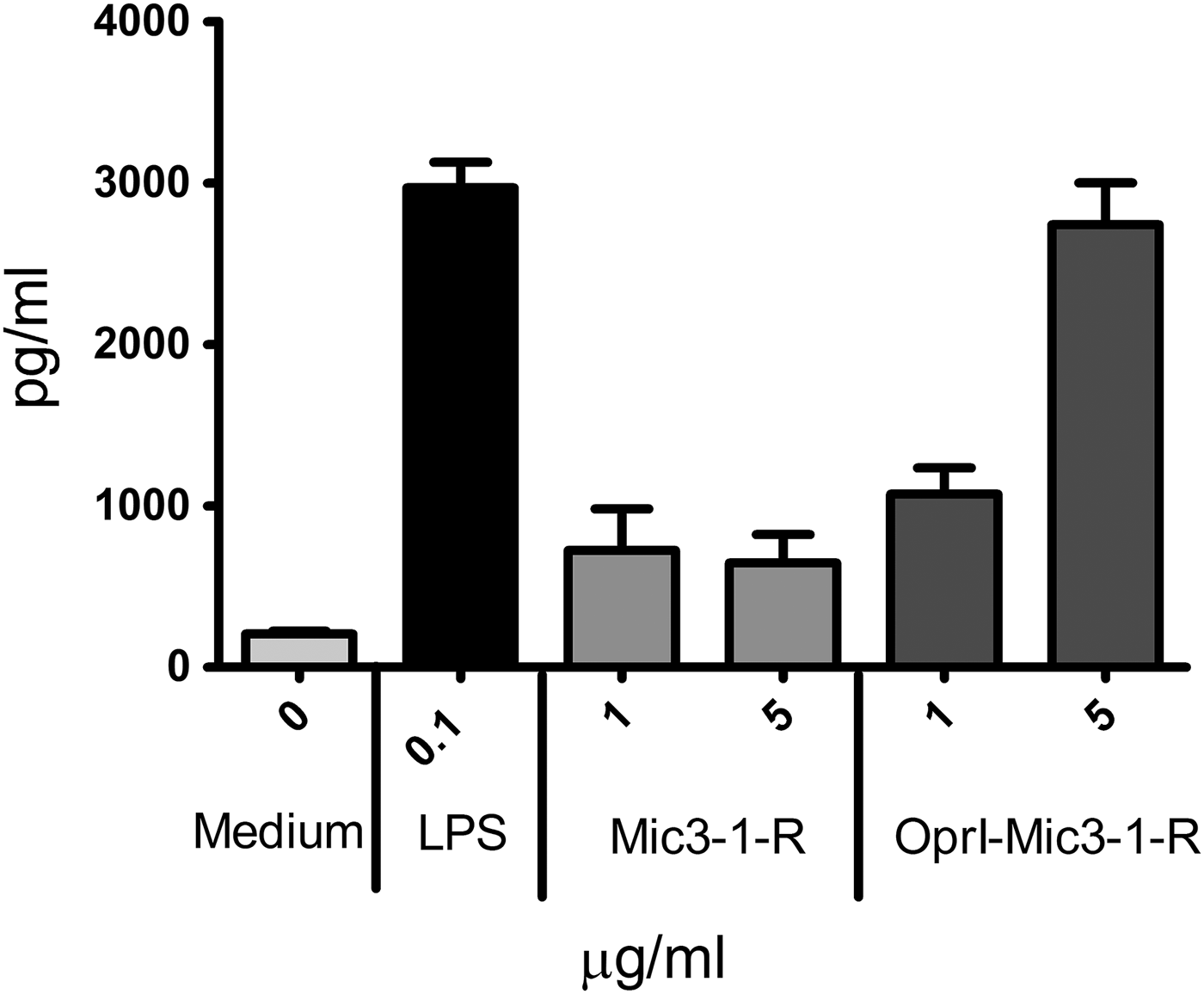
In order to investigate whether the fusion of Mic3-1-R with OprI leads to the activation of BM-DCs, we stimulated BM-DCs from naïve mice with either OprI-Mic3-1-R or Mic3-1-R and measured TNF-α released in the supernatant after 24 h. While Mic3-1-R only marginally activated BM-DCs, OprI-Mic3-1-R induced a potent BM-DCs activation. At 1 µg mL−1 of OprI-Mic3-1-R, TNF-α levels were already higher than those induced by Mic3-1-R at 5 µg mL−1. At 5 µg mL−1 of OprI-Mic3-1-R, TNF-α levels were almost as high as in LPS-activation (Fig. 1).
In vitro naïve BM-DCs stimulation with OprI-Mic3-1-R, Mic3-1-R recombinant proteins (1 and 5 µg mL−1), LPS (100 ng mL−1) or DC-full medium (Medium). Bars represent the TNF-α mean value of triplicates and the error bars the standard error of the mean (s.e.m.). Abbreviations: BM-DCs, bone marrow-derived dendritic cells; LPS, lipopolysaccharides; TNF, tumour necrosis factor.

OprI-Mic3-1-R induced an immune response with Th1/Th2 properties while Mic3-1-R + saponin a Th2-biased response
OprI-Mic3-1-R induced significantly higher N. caninum-specific IgG2a than Mic3-1-R + saponin
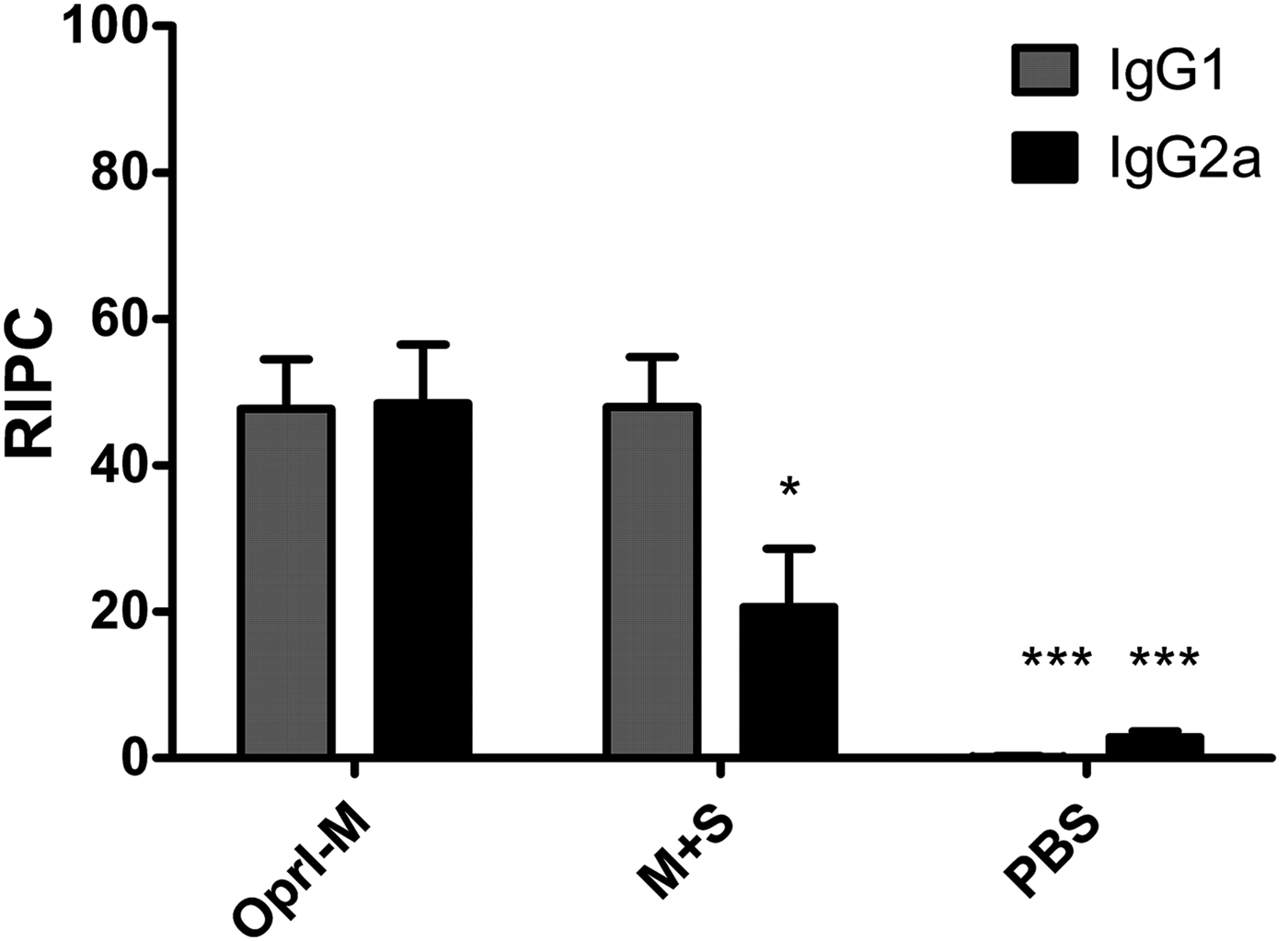
Specific Ig against N. caninum crude extract induced by the immunogenic formulations were analysed in sera from immunized mice (Fig. 2). Mice from the OprI-Mic3-1-R group (OprI-M) and Mic3-1-R + saponin group (M + S), but not from the PBS-treated group, developed N. caninum-specific IgGs. Both groups developed high and similar levels of IgG1 (P > 0·05) but mice immunized with OprI-M developed higher IgG2a levels than mice immunized with M + S (P < 0·05) (Fig. 2). Both OprI-M and M + S immunized mice developed equal and high levels of both IgG1 and IgG2a against the recombinant Mic3-1-R (data not shown).
Specific IgG1 and IgG2a response against Neospora caninum crude extract measured by ELISA of mice immunized either with the OprI-Mic3-1-R recombinant protein (OprI-M) or with Mic3-1-R emulsified in saponin (M + S). Naïve mice (PBS) were included as a negative control. Sera were collected 6 days after the third immunization. Results are expressed as the mean of RIPC values (relative index per cent) and error bars represent the standard error of the mean (s.e.m.) in each group.* indicates significantly lower than OprI-M (* is P < 0·05; *** is P < 0·001). Abbreviations: ELISA, enzyme-linked immunosorbent assay; IgG, immunoglobulin G; PBS, phosphate-buffered saline; RIPC, relative index per cent.

OprI-Mic3-1-R induced a cytokine profile with mixed Th1/Th2/Th17 properties whereas Mic3-1-R induced a Th2-biased response
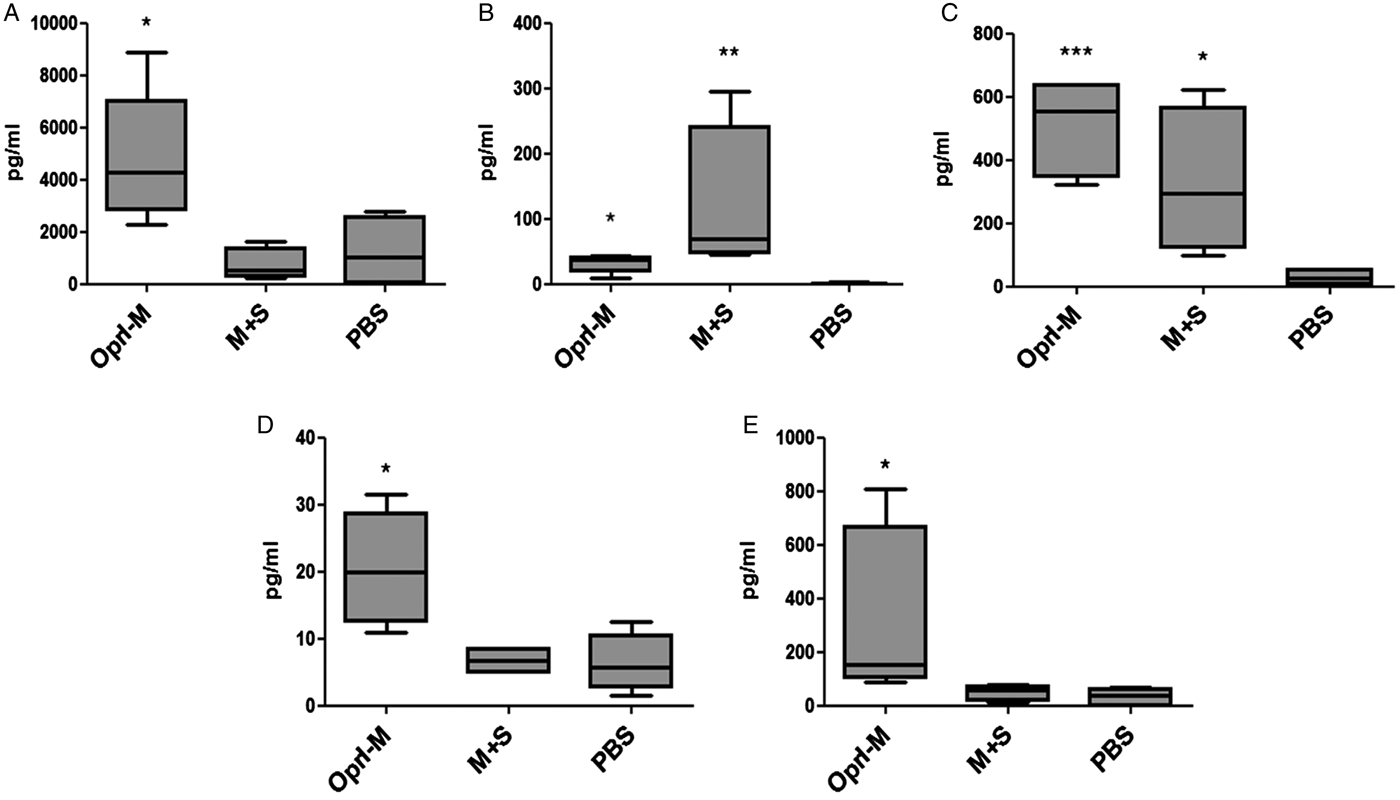
In order to address the polarization of cellular immune response induced by the immunogenic formulations, splenocytes were re-stimulated in vitro with Mic3-1-R antigen and cytokines quantified in the supernatants. Splenocytes of both the OprI-M group and M + S group exhibited a clearly distinct Th profile (Fig. 3). A significant increase of IFN-γ, IL-4, IL-10, IL-12(p70) and IL-17 levels was detected in supernatants of splenocytes of OprI-M-immunized animals (P < 0.05) (Fig. 3). On the other hand, no significant levels of IFN-γ, IL-12(p70) and IL-17 were detected in cultures of M + S-immunized mice, but instead a significant increase of IL-4 and IL-10 levels was found compared with the PBS group (P < 0.05). In addition, IL-4 levels were significantly higher compared with splenocyte cultures of OprI-M mice (P < 0.05) (Fig. 3).
Cytokine responses in immunized mice upon splenocyte restimulation with Mic3-1-R in vitro. (A) IFN-γ, (B) IL-4, (C) IL-10, (D) IL-12p70 and (E) IL-17. Splenocytes were obtained from mice 6 days after the third immunization either with OprI-Mic3-1-R recombinant protein (OprI-M), Mic3-1-R together with saponin (M + S) or with PBS (PBS). Boxes represent median, first and third quartiles and whiskers the 10th and 90th percentiles values. * indicates significantly higher values compared with the PBS group for each cytokine. (* is P < 0·05; ** is P < 0·01; *** is P < 0·001). Abbreviations: IFN-γ, interferon gamma; IL, interleukin; PBS, phosphate-buffered saline.

Placental IFN-γ was upregulated in OprI-Mic3-1-R mice but not in Mic3-1-R after challenge with N. caninum at mid-gestation
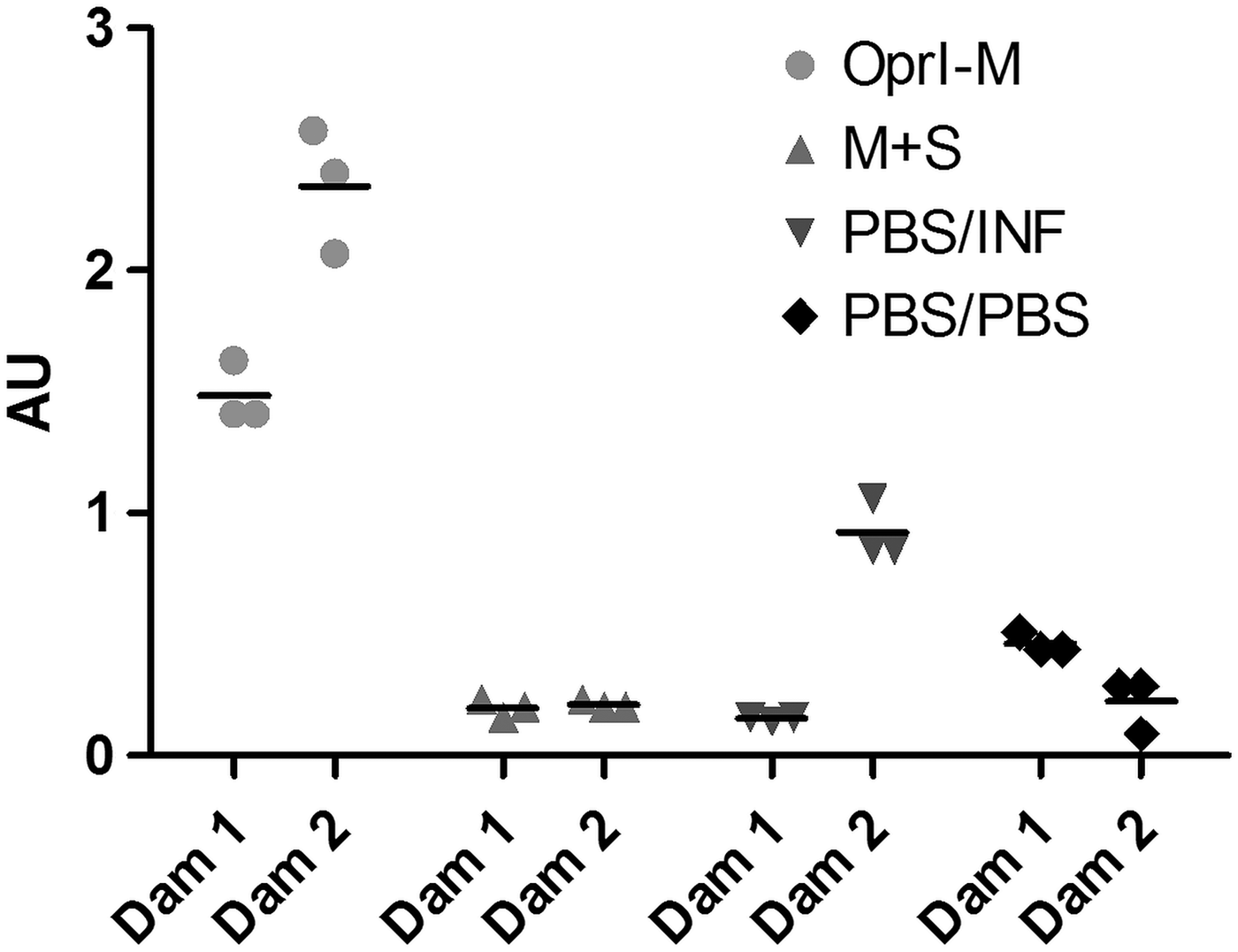
Two pregnant mice per group were euthanized 2 days prior to birth, and placentas were collected to quantify RNA expression levels of IFN-γ by RT-PCR. IFN-γ transcript expression was increased in placentas from both dams immunized with OprI-M compared with M + S-immunized dams (Fig. 4).
mRNA expression levels of IFN-γ in placenta from two dams per group euthanized at day 18 of pregnancy. Mice were immunized either with OprI-Mic3-1-R recombinant protein (OprI-M), Mic3-1-R together with saponin (M + S) or with PBS (PBS/INF) and were challenged at day 7–9 of pregnancy. A non-immunized control group remained unchallenged (PBS/PBS). Relative expression of IFN-γ is expressed in AU after normalizing with mRNA expression levels of β-actin. Each dam was analysed by triplicate (dot) and bars represent the median value. Abbreviations: AU, arbitrary units; IFN-γ, interferon gamma; PBS, phosphate-buffered saline.

After challenge with N. caninum, non-pregnant mice immunized with OprI-Mic3-1-R, but not those immunized with Mic3-1-R, elicited lower IgG1:IgG2a ratios than dams
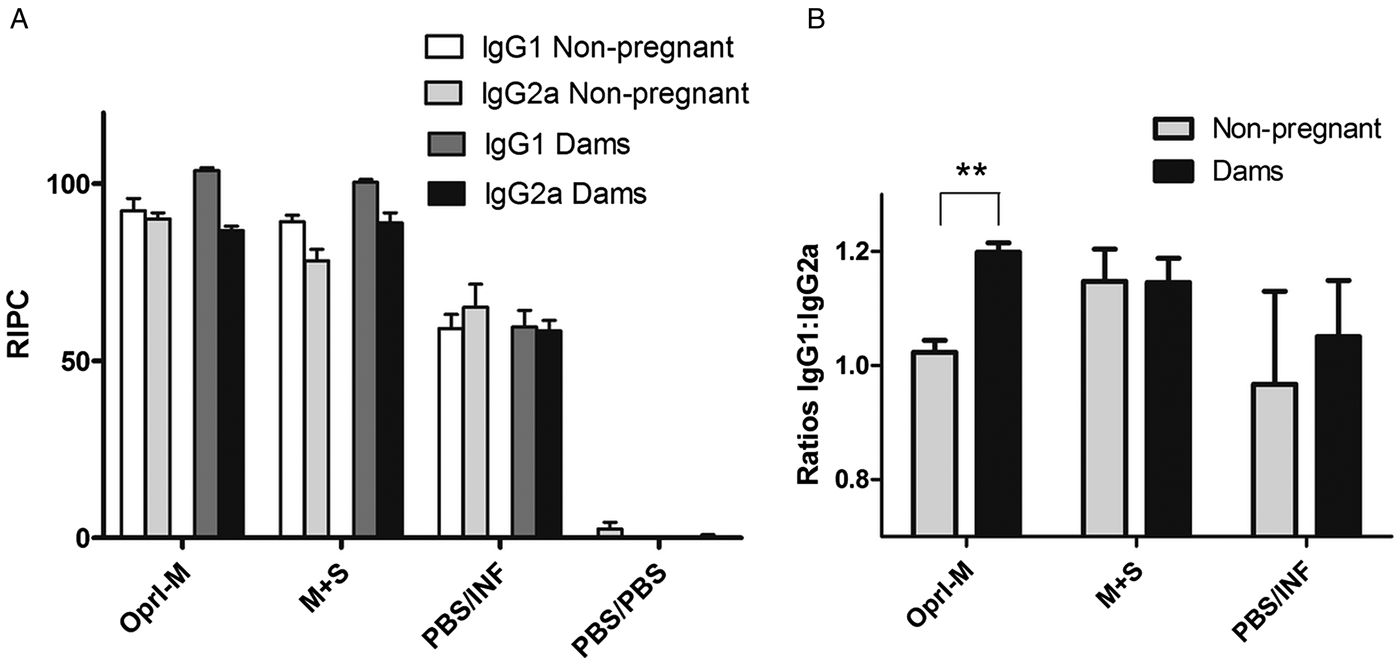
IgG1 and IgG2a responses against Mic3-1-R recombinant protein were analysed by ELISA (Fig. 5A). In non-pregnant mice, IgG1 levels from OprI-M and M + S groups were statistically higher than those from non-vaccinated infected mice (PBS/INF group) (P < 0·05). In case of IgG2a, only OprI-M elicited significantly higher levels than PBS/INF group (P < 0·05). In dams, both IgG1 and IgG2a levels from OprI-M and M + S were statistically higher than those from PBS/INF (P < 0·0001). When IgG1:IgG2a ratios (Fig. 5B) were compared between non-pregnant mice and dams, the OprI-M group showed higher ratios in dams compared with non-pregnant mice (P < 0·001) whereas this difference was not detected in either the M + S group or the PBS/INF group (P > 0·05). These results suggest that after challenge only mice immunized with OprI-Mic3-1-R that did not become pregnant were able to maintain a low ratio IgG1:IgG2a, but this tendency was overridden after pregnancy.
Humoral immune response against Mic3-1-R recombinant protein measured by ELISA of non-pregnant mice and dams after challenge with Neospora caninum, on days 30 and 41–44 pi, respectively. (A) represents the mean of RIPC values (relative index percent) of IgG1 and IgG2a levels. (B) shows the IgG1:IgG2a ratios for each group of mice. OprI-M: mice immunized with OprI-Mic3-1-R; M + S: mice immunized with Mic3-1-R with saponin; PBS/INF: mice non-immunized. These three groups were challenged with N. caninum at day 7–9 of pregnancy. PBS/PBS: non-immunized, non-challenged. Error bars represent the standard error of the mean (s.e.m.) in each group. (** is P < 0·01 between IgG1:IgG2a ratios from non-pregnant mice and dams). Abbreviations: ELISA, enzyme-linked immunosorbent assay; IFN-γ, interferon gamma; IgG, immunoglobulin G; IL, interleukin; PBS, phosphate-buffered saline; pi, post-infection; RIPC, relative index per cent.

Neither OprI-Mic3-1-R nor Mic3-1-R immunization led to reduced cerebral infection in adults or vertical transmission to offspring
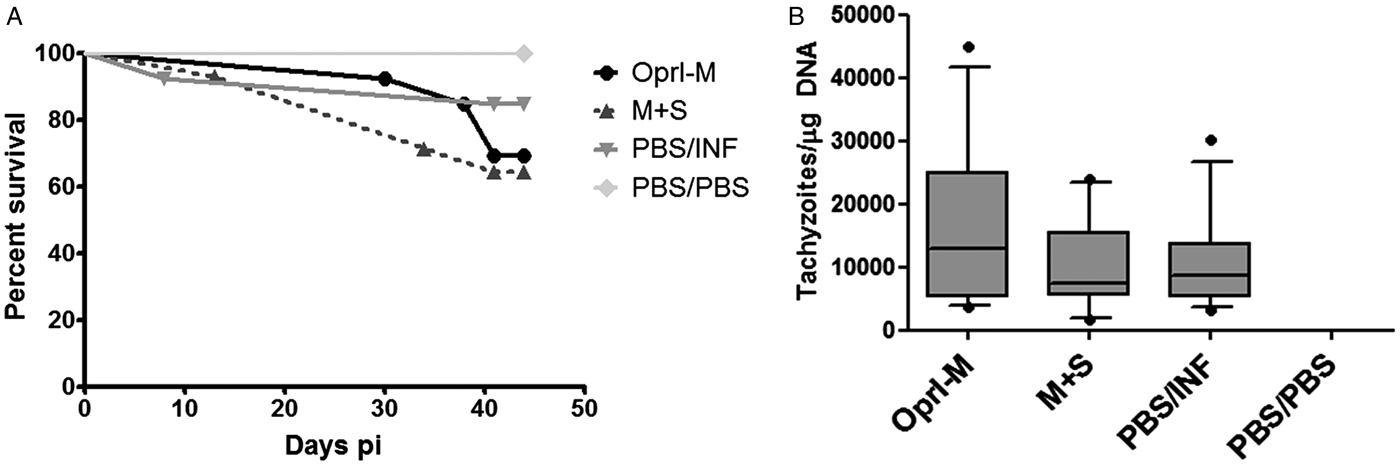
The effects of immunization of mice with OprI-Mic3-1-R and Mic3-1-R were assessed in challenge experiments. With regard to pregnancy rate and litter size, no differences among groups were detected (P > 0·05) (Table 1). The antigen formulations did not induce protection against neosporosis neither in adults nor in offspring. Between 71·4 and 84·6% of dams from the three infected groups showed clinical signs (Table 1). Mortality rates were between 35·7% (5 in 14 dams) in the M + S group and 15·4% (2 in 13 dams) in the PBS/INF group, nevertheless the differences in the survival curves were not statistically significant (P > 0·05) (Table 1, Fig. 6A). N. caninum DNA was detected in the brains of all infected dams and no statistically significant differences in parasite burden were detected among immunized groups and non-immunized infected group (Fig. 6B). All non-pregnant animals were also positive by N. caninum-PCR and no differences in parasite burden in brain were detected (data not shown). Offspring mortality in the first 30 days pp was almost 100% in the three challenged groups without differences in the survival curves (P > 0·05) (data not shown). Vertical transmission could not be prevented; only the survivor from the PBS/INF group was found N. caninum-PCR negative (Table 2).
Outcome of Neospora caninum infection in dams. (A) Kaplan-Meier survival curves of dams. (B) Cerebral parasite burden measured by real-time PCR in the dams. Boxes represent median, first and third quartiles; whiskers 10th and 90th percentiles; and circles outlier values. OprI-M: mice immunized with OprI-Mic3-1-R; M + S: mice immunized with Mic3-1-R with saponin; PBS/INF: mice non-immunized. These three groups were challenged with N. caninum at day 7–9 of pregnancy. PBS/PBS: non-immunized, non-challenged. Abbreviations: INF, interferon; PBS, phosphate-buffered saline; PCR, polymerase chain reaction.

Reproductive performance and outcome of Neospora caninum infection in dams

INF, interferon; PBS, phosphate-buffered saline.
a Number of pregnant mice/number of mice in the group (%).
b Excluding two dams per group that were euthanized before giving birth in order to obtain placentas.
c Number of delivered pups per dam.
d Proportion of dams presenting at least one clinical sign (%).
e Proportion of dams euthanized upon severe clinical signs (%).
f Proportion of dams tested positive for N. caninum DNA in the brain (%).
Outcome of Neospora caninum infection in pups

INF, interferon; PBS, phosphate-buffered saline.
a Total number of pups born (alive or dead) from each group.
b Proportion of pups born dead or that died within the first 2 days post-partum (%).
c Proportion of pups dead from day 3 to 30 pp (%).
d Proportion of dead pups from day 3 to 30 pp plus N. caninum-polymerase chain reaction (PCR) positive surviving pups (%). Dead pups are considered positive for N. caninum PCR as shown previously (Dellarupe et al. Reference Dellarupe, Regidor-Cerrillo, Jimenez-Ruiz, Schares, Unzaga, Venturini and Ortega-Mora2014).
DISCUSSION
The cross-talk between innate and acquired immunity is a key aspect in the development of efficient immune responses against pathogens (Basto and Leitao, Reference Basto and Leitao2014). The activation of APCs by pathogen-associated molecular patterns (PAMPs) through TLRs leads to an efficient activation of T cells (Akira, Reference Akira2009) but this aspect has not been considered frequently when potentially protective antigens have been investigated in anti-N. caninum immunization studies. In this work we investigated the effect on the innate immunity and the subsequent acquired immune response of the TLR2-ligand OprI fused to the N. caninum Mic3-1-R, a chimeric antigen composed by predicted epitopes of NcMIC3, NcMIC1 and NcROP2 secretory proteins (Monney et al. Reference Monney, Rutti, Schorer, Debache, Grandgirard, Leib and Hemphill2011).
We have successfully exploited the recently developed cloning system, lipoprotein expression and depyrogenation methods (Basto et al. Reference Basto, Piedade, Ramalho, Alves, Soares, Cornelis, Martins and Leitao2012, Reference Basto, Morais, Marcelino, Leitao and Santos2014) for N-terminal fusion of the OprI lipoprotein to N. caninum Mic3-1-R. The recombinant lipoprotein was exclusively purified from the outer membrane of the bacteria which guaranteed the presence of only the lipidated mature form, which is the TLR2-binding active form (Cote-Sierra et al. Reference Cote-Sierra, Bredan, Toldos, Stijlemans, Brys, Cornelis, Segovia, de Baetselier and Revets2002), in the final purified elution (Basto et al. Reference Basto, Piedade, Ramalho, Alves, Soares, Cornelis, Martins and Leitao2012).
Among the functions that have been described for TLR2 activation are the promotion of both Th1 and Th2 responses together with Treg activation (Basto and Leitao, Reference Basto and Leitao2014). The combination of these apparently antagonistic effects of TLR2 activation attired our attention for N. caninum vaccination especially in the context of pregnancy. TLR2-ligands induce DC activation and the secretion of pro-inflammatory cytokines. In addition, enhancement of direct- and cross-presentation of exogenous antigens by APCs and both CD4+ and cytotoxic CD8+ T cell activation have been attributed to TLR2 engagement (Basto and Leitao, Reference Basto and Leitao2014; Basto et al. Reference Basto, Badenes, Almeida, Martins, Duarte, Santos and Leitao2015). Although these mechanisms seem to be essential to eliminate intracellular pathogens such as N. caninum, the damage caused by direct killing of infected host cells and the associated tissue inflammation could be the cause of the protection failure of Th1-inducing immunogenic formulations in mice in the past, especially when applied in the pregnant mouse model (Debache and Hemphill, Reference Debache and Hemphill2013; Monney et al. Reference Monney, Grandgirard, Leib and Hemphill2013). However, TLR2 activation has also been associated with Th2 cell activation via IL-12 suppression and IL-10 production as well as anti-inflammatory effects via Treg cell activation (Basto and Leitao, Reference Basto and Leitao2014). We hypothesized that the fusion of the OprI molecule to N. caninum antigens could be used as a tool to modulate the innate immunity and the T-cell response towards a well-adjusted Th1/Th2/Treg phenotype which could be essential for an eventual protective antigen formulation during pregnancy by diminishing tissue damage, whereas still killing the parasite or at least limiting its proliferation.
First, we could confirm that OprI after fusion with Mic3-1-R stimulates BM-DCs, since high levels of TNF-α were secreted by BM-DCs upon incubation with the recombinant protein. Although Mic3-1-R also induced higher levels of TNF-α than only medium, those levels were four times lower than LPS and OprI-Mic3-1-R. Residual levels of LPS in the Mic3-1-R final product (even after hot water/phenol extraction) could explain those levels of TNF-α upon Mic3-1-R incubation with BM-DCs. In contrast, the TNF-α levels induced by OprI-Mic3-1-R were similar to those secreted upon LPS stimulation demonstrating the specific capacity of OprI as APC-activation inductor and indeed its adjuvanticity when linked to Mic3-1-R. The APC activation by OprI has been previously shown for OprI lipoprotein alone (Basto et al. Reference Basto, Piedade, Ramalho, Alves, Soares, Cornelis, Martins and Leitao2012) but also for other OprI-fused antigens including the model antigen ovalbumin (OVA) (Basto et al. Reference Basto, Badenes, Almeida, Martins, Duarte, Santos and Leitao2015) and the gp63 protein of Leishmania major (Cote-Sierra et al. Reference Cote-Sierra, Bredan, Toldos, Stijlemans, Brys, Cornelis, Segovia, de Baetselier and Revets2002).
In a second step, we immunized BALB/c mice with either OprI-Mic3-1-R or Mic3-1-R emulsified in saponin, and the in vivo antibody profile and cytokine profile after lymphocyte recall was studied. In accordance with what has been previously described (Monney et al. Reference Monney, Rutti, Schorer, Debache, Grandgirard, Leib and Hemphill2011, Reference Monney, Debache, Grandgirard, Leib and Hemphill2012), Mic3-1-R emulsified with saponin induced a strong Th2-biased response, characterized by high ratio IgG1:IgG2a and enhancement of IL-4 and IL-10 but not IFN-γ or IL-12(p70). In contrast, OprI-Mic3-1-R elicited an immune response with mixed Th1/Th2 properties. Levels of IL-4 were lower than those obtained from splenocytes derived from mice immunized with Mic3-1-R+saponin but levels of the anti-inflammatory cytokine IL-10 were similar, or even higher, and accompanied by higher levels of IFN-γ and IL-12(p70). Interestingly, splenocytes from the OprI-Mic3-1-R immunized group but not from the Mic3-1-R + Saponin also produced IL-17, a cytokine typical of Th17 polarization and related with inflammatory processes. In addition, the IgG1:IgG2a ratio of N. caninum-specific IgG from OprI-Mic3-1-R mice was significantly lower than in Mic3-1-R + saponin mice. Basto et al. (Reference Basto, Badenes, Almeida, Martins, Duarte, Santos and Leitao2015) also described an immunomodulation towards a profile with mixed characteristics by OprI-OVA, however in that study IFN-γ production was absent in recall lymphocytes. These differences highlighted that although OprI is a potent molecule to re-orientate the immune response, this should be specifically analysed for each particular antigen.
After challenge with N. caninum, none of the formulations could prevent vertical transmission and congenital neosporosis, however, differences in the immune response could be detected between OprI and non-OprI immunized mice. IFN-γ transcripts were upregulated in placental tissues in OprI-Mic3-1-R immunized dams but not in Mic3-1-R + saponin dams. This highlights again the capability of OprI to modify the expected Th2-biased response associated with saponin-emulsified Mic3-1-R. It is possible that a non-antigen dependent effect of the OprI have contributed for this modulation. This and other possible effects of OprI TLR2/1 stimulation should be addressed in the future. The fact that in both cases vertical transmission took place points out the necessity to increase our understanding of the immune mechanisms which should be induced during pregnancy. Previously, a Th1-biased immune response maintained after challenge was associated with protection against L. major infection in mice immunized with OprI fused to the Gp63 antigen (Cote-Sierra et al. Reference Cote-Sierra, Bredan, Toldos, Stijlemans, Brys, Cornelis, Segovia, de Baetselier and Revets2002). However, in congenital neosporosis a Th1 polarized immune response with a storm of inflammatory cytokines, especially in placenta tissues, could be detrimental in terms of vertical transmission and offspring survival (Monney et al. Reference Monney, Grandgirard, Leib and Hemphill2013; Canton et al. Reference Canton, Konrad, Moore, Caspe, Palarea-Albaladejo, Campero and Chianini2014). Nevertheless, a predominant Th2-biased response in pregnant mice has also been correlated with susceptibility to neosporosis (Quinn et al. Reference Quinn, Miller and Ellis2004; Kano et al. Reference Kano, Masukata, Omata, Kobayashi, Maeda and Saito2005). Whether the induction of specific Treg cells localized in the fetal-maternal interface could help in preventing the deleterious effects of effector immune mechanisms on pregnancy is not yet studied. Interestingly, TLR2 activation has been previously shown to induce both the development of regulatory responses (Dillon et al. Reference Dillon, Agrawal, Banerjee, Letterio, Denning, Oswald-Richter, Kasprowicz, Kellar, Pare, van Dyke, Ziegler, Unutmaz and Pulendran2006; Manicassamy et al. Reference Manicassamy, Ravindran, Deng, Oluoch, Denning, Kasturi, Rosenthal, Evavold and Pulendran2009) and the homing of lymphocytes to mucosae (Wang et al. Reference Wang, Villablanca, De Calisto, Gomes, Nguyen, Mizoguchi, Kagan, Reinecker, Hacohen, Nagler, Xavier, Rossi-Bergmann, Chen, Blomhoff, Snapper and Mora2011). Thus, the OprI-based system can be a relevant tool to address these issues in neosporosis pregnant models.
The analysis of the humoral immune response after challenge revealed that the IgG1:IgG2a ratio of anti-Mic3-1-R antibodies was near to 1 in OprI-Mic3-1-R immunized non-pregnant mice but higher in dams from the same group. This difference was not observed in M + S and PBS/INF infected groups. This switch in the antibody profile between non-pregnant mice and dams exclusively observed in OprI-Mic3-1-R immunized mice suggested again that a balanced Th1/Th2 response induced by OprI-Mic3-1-R in non-pregnant mice was overridden at pregnancy. This apparent loss of the OprI-inducing immunomodulation during pregnancy could explain the lack of protection against vertical transmission and subsequent neosporosis in offspring.
In conclusion, we have demonstrated that the lipoprotein OprI is a potent tool to activate the innate immunity and to modulate the adaptive immune response when it is fused to a N. caninum antigen. However, the fusion of OprI with the chimeric Mic3-1-R antigen did not improve protection against transplacental transmission. Attempts to accurately predict target antigens and the appropriate polarization of the cellular immune response associated with protection have failed in most studies on N. caninum vaccines, especially in pregnant models. Thus, further studies should focus (i) on how pregnancy affects the immune response against vaccines that are applied prior to pregnancy, and (ii) on the identification of novel antigens which generate protective T cell responses (Yang et al. Reference Yang, Rogers and Liew1991; Rocchi et al. Reference Rocchi, Bartley, Inglis, Collantes-Fernandez, Entrican, Katzer and Innes2011), both of which could contribute to the development of an efficient vaccine. The use of OprI fusion will be helpful to fine-tune the innate and adaptive immune responses induced by these new antigen candidates, and to adapt them to the pregnancy-mediated immunomodulation.
ACKNOWLEDGEMENTS
We thank Dr. Luis Miguel Ortega-Mora for kindly providing the Nc-Spain7 isolate of N. caninum and Dr. Denis Grandgirard from the Institute for Infection Diseases of the University of Bern for the analysis of cytokines levels by multiplex bead immunoassay.
FINANCIAL SUPPORT
This work was supported by the Swiss National Science Foundation (A. Hemphill, grant No. 310030 146162) and by Fundação para a Ciência e a Tecnologia, Portugal (A.P. Basto and A. Leitão, grant No. PTDC/CVT/113889/2009).