I. INTRODUCTION
The kinetic model described in Ref. Reference Ziabicki and Misztal-Faraj1 offers the possibility to predict development of phase structure in three-phase systems. The kinetic transition functions Eij describing progress of the transition of phase i into phase j result in nucleation and crystal growth and are controlled by a number of molecular characteristics specific for the material and individual transitions. According to the classical theory of phase transitions,Reference Kolmogoroff2–Reference Evans5 two basic classes of kinetic processes can be distinguished: “growth” (with a linear rate  ) of a constant number,
 , of “predetermined nuclei” present in the system at the start of the process and “sporadic nucleation” (with rate
 ) combined with simultaneous, n-dimensional growth

In steady isothermal conditions, nucleation rate  and growth rates
 are constants and Eq. (1) reduces to the so-called Avrami equations:

Steady-state nucleation rate for a transition i → j readsReference Ziabicki and Misztal-Faraj1:

and the linear growth rate reads:

where Δhij is heat of the transition; Tij is the equilibrium transition temperature; v 0 is the volume of a single kinetic element; σij is the interface tension; and  is the activation energy of molecular motions, h and k, respectively, Planck and Boltzmann constants. The frequency function based on sporadic nucleation

and that controlled by predetermined nucleation

provide measures of isothermal transition rates. After time t = (1/vij), initial fraction of the source phase,  , is reduced to (
 ), the rest being converted into the target phase j.
II. THE MODEL SYSTEM
Effect of various factors on the kinetics of three-phase transitions will be based on a model monotropic system consisting of three phases: amorphous (liquid) “0,” high-temperature, metastable solid “1,” and stable, low-temperature solid “2.” The material characteristics used in the previous worksReference Ziabicki and Misztal-Faraj1, Reference Sajkiewicz, Gradys, Ziabicki and Misztal-Faraj6 define a “reference system” to be compared with systems with modified properties. Complete and reliable material characteristics of polymorphic systems are hardly available. The core of the reference system consists of experimental data available for isotactic polypropylene (primary data); other data have been estimated from relations between thermodynamic functions [Eqs. (8) and (9)] and correlation between heats of melting and interface tensions [Eq. (18)].
In the first part of this studyReference Ziabicki and Misztal-Faraj1 we have analyzed isothermal crystallization of the model system at various temperatures. It was demonstrated that in low temperatures a mixture of solid polymorphs “2” and “1” is formed directly from the amorphous phase “0.” Phase composition of this mixture lasts unchanged for a period of time (“waiting period”) and then phase “1” is converted into the stable target phase “2.” With increasing temperature, the ratio of phase fractions x 1/x 2 is reduced and so is “waiting period.” Above some temperature, the “waiting period” disappears and the kinetics of crystallization reduce to direct conversion of phase “0” into phase “2” with a small contribution of the two-step process transformation

III. MATERIAL CHARACTERISTICS
The material characteristics controlling transition kinetics include heats, Δhij, and entropies, Δsij, of individual transitions, interface tensions, σij, activation energies of molecular motions,  , and concentration of predetermined nuclei,
 . Single subscripts (superscripts) identify phases and pairs of subscripts (superscripts) identify transitions.
Thermodynamic characteristics are not independent of each other. From the definition of heat (entropy) differences, it follows:

and, assuming constant heats and entropies

Activation energy of molecular motions within the source phase,  , is important for the steady-state kinetics and transient processes. In our model,
 is assumed as one related to self-diffusion. Considering temperature-dependent self-diffusion coefficient, Di, one obtains

It should be stressed that  in our model is concerned solely with molecular mobility. Some authorsReference Meyer7 use the term “activation energy” (for nucleation, crystal growth, or crystallization) to describe the “total kinetic barrier” including mobility and thermodynamic effects. In our model,
 is a constant, mobility-related characteristic of the mother phase. Temperature-dependent thermodynamic barriers for nucleation and growth, ΔG*(T), appear together with
 in the expressions for nucleation and growth rates

For liquids (melts), activation energy  depends on the size of the moving kinetic elements and effective “viscosity” of the environment. In organic polymers, the molecular weight, degree of branching, and local crosslinking may be important. For transitions starting from the solid state, various mobility mechanisms may be involved, like vacancy formation, vacancy-to-vacancy jumping, motion of various defects within the crystal lattice, etc.Reference Mehrer8 Activation energy for motions within the liquid phase is smaller than that within solid phases. For the current analysis, we will assume

for direct crystallization from the melt and

for melting or polymorphic transition of phase “1.”
An important role is played by interface tension, σij, which affects potential barriers for nucleation and growth

Some values of interface tension can be obtained experimentally. Others, particularly solid–solid characteristics, have to be estimated. TurnbullReference Turnbull9 proposed correlation between solid–melt interface tensions, σj 0, and the corresponding heats of melting, Δhj 0.

where Cj is a constant; μj is the number density of kinetic units (atoms, molecules) in crystal lattice of the phase j; Δhj 0 is the heat of melting of the solid j per unit mass; Mj is the molecular mass of a single kinetic unit; and N A is the Avogadro number. The correlation in Eq. (15) has been found to be reasonably consistent with experimental data and theoretical models.Reference Bai and Li10 The consequence of Eq. (15) is approximate relation between interface tensions for two polymorphic solids j, k, with respect to the melt “0” and their heats of melting

Interface tension between polymorphic solids is not covered by the Turnbull correlation. A rough estimate of σjk can been obtained from the Antonoff formulaReference Antonoff11

which combined with the Turnbull correlation yields

Material characteristics for the model system have been listed in Ref. Reference Ziabicki and Misztal-Faraj1.
An important role in the kinetics of phase transitions is played by “predetermined nuclei.” The number of such nuclei per unit volume effective in the transition i → j,  , is assumed to be controlled by the target phase, j, i.e.,

Predetermined nuclei may consist of incompletely melted crystals, structural defects, or foreign particles like pigments, catalysts, dyestuffs, etc. Some additives are universally effective as nucleation agents for various materials and various transitions; some others behave in a selective way, stimulating formation of a specific polymorphic phase.Reference Varga, Mudra and Gottfried12 Concentration of predetermined nuclei may change in a wide range depending on the origin of the material and its history. The presence of predetermined nuclei converts transition rate into the sum of predetermined and sporadic mechanisms.

IV. EFFECTS OF MATERIAL CHARACTERISTICS ON TRANSITION RATES
We will analyze effects of material characteristics on the frequencies of the transitions involved [Eqs. (5) and (6)]. In the basic set of material characteristics for the model system,Reference Ziabicki and Misztal-Faraj1 individual characteristics (or their combinations) will be modified.
A. Activation energy of molecular motions, 

Molecular motions within the source phase control the rates of all transitions. Nucleation and growth rates depend on the respective activation energies. Assuming constant activation energy  , the transition frequencies read

We will consider change of activation energies of all transitions by the constant factor “a”

All other characteristics are kept constant (on the level assumed for the reference system.Reference Ziabicki and Misztal-Faraj1)
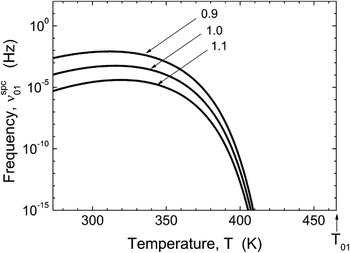
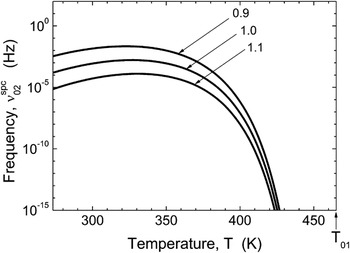
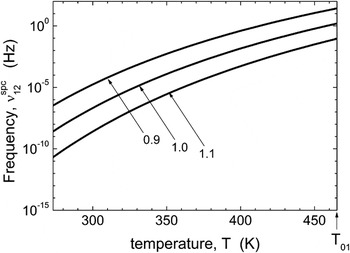
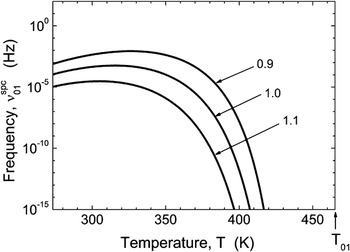
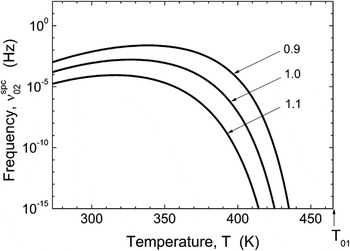
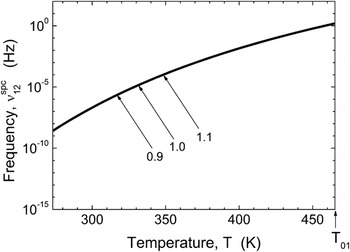
Figures 1–3 present transition frequencies based on sporadic nucleation,  , as functions of temperature at three levels of the activation energy. Variation of
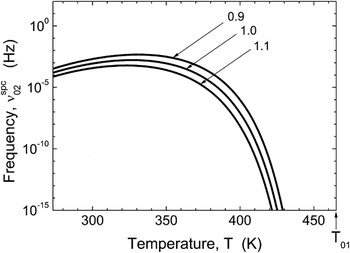
 by the factor a = 0.9 ÷ 1.1 does not change temperature behavior of individual transitions. In the temperature range where direct transitions “0”→ “1” and “0” → “2” exhibit maxima, an increase of
 from 0.9·to 1.1·
 reduces the corresponding frequencies
 and
 by two to three orders of magnitude and shifts their maxima by a few degrees toward higher temperatures (Figs. 1 and 2). Polymorphic transition frequency
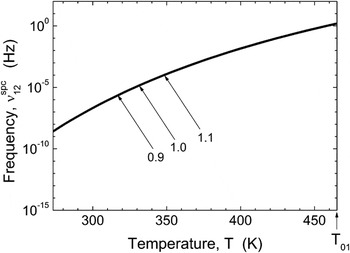
 is reduced by two to four orders of magnitude in the range of temperatures studied (Fig. 3).
Frequencies of the transition “0” → “1” based on sporadic nucleation as functions of temperature. Activation energy modified:  . Modification factor, a, indicated.

Frequencies of the transition “0” → “2” based on sporadic nucleation as functions of temperature. Activation energy modified:  . Modification factor, a, indicated.

Frequencies of the transition “1” → “2” based on sporadic nucleation as functions of temperature. Activation energy modified:  . Modification factor, a, indicated.

B. Heat, Δh ij, entropy, Δsij, and interface tension, σij
Heat and entropy play an essential role in the thermodynamics and kinetics of phase transitions. Δhij affects equilibrium transition temperature, Tij, and potential barriers for the processes of nucleation and crystal growth. Variation of Δhij may be accompanied by changes of entropy, transition temperature, and interface tension. In Sec. IV. B and IV. C, we assume interface tensions proportional to the respective heats of the transition [Eq. (18)]. Effect of interface tension at constant thermodynamic characteristics will be analyzed in Sec. IV. D.
An additional assumption in the present Section involves constant transition temperatures, Tij. In other words, transition entropies, Δsij, are changed proportionally to the respective heats, Δhij. The following modifications of material characteristics will be analyzed:

With the above assumptions, transition frequencies become simple functions of melting enthalpy. From Eqs. (5) and (23), we obtain

Figures 4–6 present transition frequencies  with enthalpies Δhij ,ref multiplied by the factor a = 0.9 ÷ 1.1. For direct transitions “0” → “1” and “0” → “2,” an increase of Δh0j is associated with slight reduction of the transition frequency (Figs. 4 and 5). In the range of temperatures close to the maxima, an increase of Δh 0j from 0.9 to 1.1·Δh 0j,ref reduces transition frequencies by less than one order of magnitude. The controlling term is exponential in Eq. (24). Reduction of the direct transition frequencies is the stronger the smaller is undercooling (T 0j − T). In the vicinity of the transition temperatures T 0j, transition frequencies
 become very sensitive to the respective enthalpies, Δh 0j. On the other hand, the polymorphic transition “1” → “2” is almost independent of the respective enthalpy (Fig. 6). Unlike direct crystallization frequencies, reduced by increased enthalpy, frequency of the polymorphic transition “1” → “2” is slightly increased by higher enthalpy as controlled by the preexponential term (Δh 12)2. An increase of Δh 12 from 0.9 to 1.1·Δh 12,ref yields a 6% increase of the transition frequency
 .
Frequencies of the transition “0” → “1” based on sporadic nucleation as functions of temperature. Heat of the transition Δh 01 and interface tension σ 01 modified: Δh 01 = a·(Δh 01)ref; σ 01 = a·(σ 01)ref Modification factor, a, indicated.

Frequencies of the transition “0” → “2” based on sporadic nucleation as functions of temperature. Heat of the transition Δh 02 and interface tension σ 02 modified: Δh 02 = a·(Δh 02)ref; σ 02 = a·(σ 02)ref Modification factor, a, indicated.

Frequencies of the transition “1” → “2” based on sporadic nucleation as functions of temperature. Heat of the transition Δh 12 and interface tension σ 12 modified: Δh 12 = a·(Δh 12)ref; σ 12 = a·(σ 12)ref Modification factor, a, indicated.

C. Heat, Δhij, interface tension, σij, and transition temperatures, Tij
Alternatively, we will consider the change of enthalpies and interface tensions at constant entropies. Consequently, transition temperatures Tij change proportionally to Δhij

Transition frequencies assume the following form

where transition temperatures Tij are proportional to varying enthalpies Δhij.
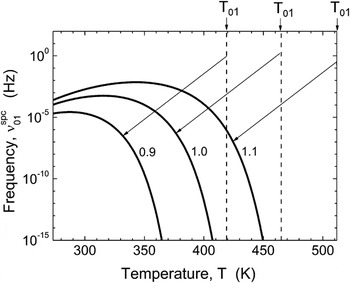
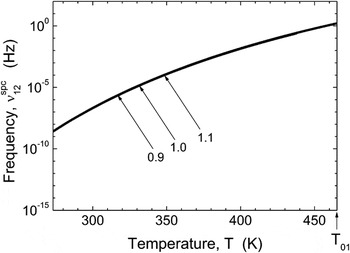
Figures 7–9 present effects of simultaneous modification of heats and transition temperatures according to Eqs. (25) and (26). With heats Δhij and Tij modified by the factor a = 0.9 ÷ 1.1, direct transition frequencies  increase by many orders of magnitude; positions of their maxima being shifted by 4 ÷ 25 K toward higher temperatures (Figs. 7 and 8). The main reason for such a behavior is the increase of the transition temperatures, T 01 and T 02, accompanied by an increase of undercooling T 0j − T. The equilibrium temperatures T 01 are shown in Fig. 7; similar behavior is expected for T 02. Degree of undercooling plays a crucial role in the direct transitions. On the other hand, very high transition temperature, T 12 (and high degree of undercooling), make the polymorphic transition “1” → “2” insensitive to Δh 12, where no effect of the parameter a is evident as shown in Fig. 9. An increase of Δh 12 from 0.9 to 1.1·Δh 12,ref yields an increase of
 by 12%.
Frequencies of the transition “0” → “1” based on sporadic nucleation as functions of temperature. Heat of the transition, Δh 01, interface tension, σ 01, and transition temperature, T 01, modified: Δh 01 = a·(Δh 01)ref; σ 01 = a·(σ 01)ref; T 01 = a·(T 01)ref. Modification factor, a, indicated.

Frequencies of the transition “0” → “2” based on sporadic nucleation as functions of temperature. Heat of the transition, Δh 02, interface tension, σ 02, and transition temperature, T 02, modified: Δh 02 = a·(Δh 02)ref; σ 02 = a·(σ 02)ref; T 02 = a·(T 02)ref. Modification factor, a, indicated.

Frequencies of the transition “1” → “2” based on sporadic nucleation as functions of temperature. Heat of the transition, Δh 12, interface tension, σ 12, and transition temperature, T 12, modified: Δh 12 = a·(Δh 12)ref; σ 12 = a·(σ 12)ref; T 12 = a·(T 12)ref. Modification factor, a, indicated.

D. Interface tension σij at constant thermodynamic characteristics
Now, we are going to analyze the effect of interface tension at constant enthalpy and entropy of the transition. Unlike in Sec. IV. B and IV. C, interface tension will not be coupled with enthalpy. Configuration of the variables assumes the form

Transition frequencies reduce to

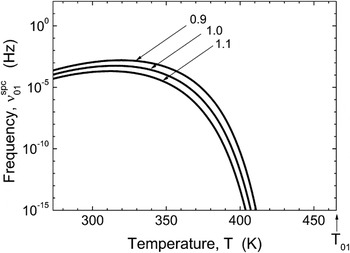
What we are going to demonstrate in this section is a purely kinetic effect of σij on primary and secondary nucleation [Eq. (28)] without changing thermodynamic properties of the system. The results are shown in Figs. 10–12.
Frequencies of the transition “0” → “1” based on sporadic nucleation as functions of temperature. Interface tension, σ 01, modified: σ 01 = a·(σ 01)ref. Modification factor, a, indicated.

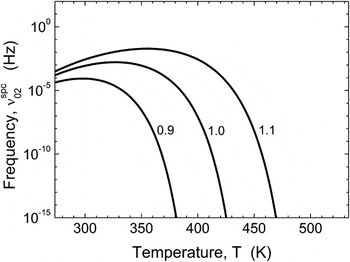
Frequencies of the transition “0” → “2” based on sporadic nucleation as functions of temperature. Interface tension, σ 02, modified: σ 02 = a·(σ 02)ref. Modification factor, a, indicated.

Frequencies of the transition “1” → “2” based on sporadic nucleation as functions of temperature. Interface tension, σ 12, modified: σ 12 = a·(σ 12)ref. Modification factor, a, indicated.

For direct transitions “0” → “1” and “0” → “2,” the effect of increasing interface tension resembles that of activation energy,  . In the range of maxima, transition frequencies are reduced by 2.5 ÷ 3.5 orders of magnitude (Figs. 10 and 11). On the other hand, effect of σ 12 on the polymorphic frequency
 increases less than 1% when the interface tension σ 12 is raised from 0.9·to 1.1·σ 12,ref.
V. CONCENTRATION OF PREDETERMINED NUCLEI,

The analysis presented in Sections IV.A–IV.D was confined to processes controlled by “sporadic nucleation.” Introduction of predetermined nuclei changes the structure of the transitions. Predetermined nuclei stimulate phase transitions in the conditions where thermodynamic or kinetic barriers make sporadic nucleation very slow. Concentration of such nuclei may vary in a wide range, depending on their chemical nature and sample history. Concentration of predetermined nuclei in polyethylene and isotactic polypropylene was reported as 105 ÷ 1012 cm–3.Reference Supaphol and Spruiell13–Reference Byelov, Panine, Remeire, Biemond, Alfonso and de Jeu15
We will compare transition frequencies based on sporadic nucleation,  , with those related to predetermined nucleation,
 with concentrations of predetermined nuclei,
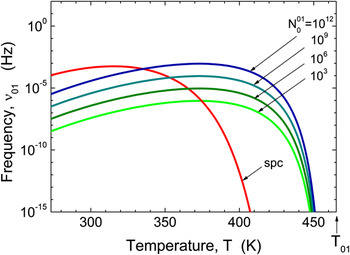
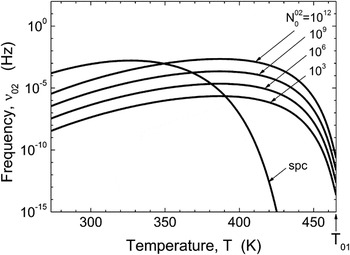
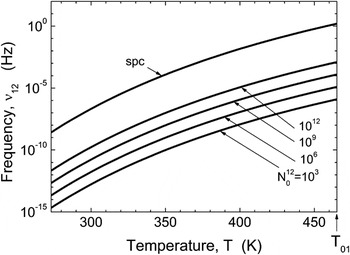
 , ranging from 103 to 1012 cm–3. Figures 13–15 present frequencies for individual transitions as functions of temperature. The corresponding sporadic nucleation characteristic,
 , is also given in each diagram. In the low-temperature range, frequencies of the direct crystallization controlled by predetermined nucleation,
 and
 , are lower than those characteristic for sporadic nucleation. Therefore, predetermined nuclei with the concentration of 103 ÷ 1012 cm–3 are not expected to affect kinetics except for very short times. At higher temperatures,
 and
 are higher than the corresponding sporadic nucleation characteristics (Figs. 13 and 14). On the other hand, frequency of the predetermined polymorphic transition “1” → “2” is smaller than
 in the entire range of crystallization temperatures covered by simulation (Fig. 15).
Frequencies of the transition “0” → “1” based on sporadic (spc) and predetermined nucleation as functions of temperature. Concentration of predetermined nuclei,  (in cm–3 units), indicated.

Frequencies of the transition “0” → “2” based on sporadic (spc) and predetermined nucleation as functions of temperature. Concentration of predetermined nuclei,  (in cm–3 units), indicated.

Frequencies of the transition “1” → “2” based on sporadic (spc) and predetermined nucleation as functions of temperature. Concentration of predetermined nuclei,  (in cm–3 units), indicated.

Two other effects of predetermined nucleation have been reported by B. Misztal-Faraj and A. Ziabicki (unpublished data).Reference Misztal-Faraj and Ziabicki16 Naturally, addition of predetermined nuclei shifts start and end of the transition to shorter times. The addition of nuclei effective in formation of phase “1” may cause the metastable solid phase “1” to appear in the conditions where purely sporadic nucleation leads to a direct “0” → “2” transition.
VI. CONCLUSIONS
Kinetics of phase transitions are controlled by external conditions (temperature, pressure) and material properties. Effects of temperature on isothermal transitions have been discussed in Ref. Reference Ziabicki and Misztal-Faraj1. Variation of transition rates in a typical three-phase system under modification of individual material characteristics have been analyzed in this article.
Activation energy of molecular motions,  (Section IV.A; Figs. 1–3), and interface tension, σij, at constant thermodynamic properties (Section IV.D; Figs. 10–12) reduce transition rates without changing thermodynamic characteristics of individual transitions. The mechanism of this effect consists in raising barriers which have to be overcome in the processes of nucleation and crystal growth. Activation energy
 is related to molecular motions, and σij affects potential barrier appearing in the formation of critical size nuclei.
Proportional increase of the transition enthalpies, Δhij, entropies, Δsij, and interface tensions, σij (Section IV.B; Figs. 4–6), leads to reduction of transition rates and a slight shift of the maximum rates toward lower temperatures. An opposite effect—strong increase of transition rates and shift of their maxima to higher temperatures—is observed when an increase of transition enthalpy and interface tension is accompanied by an increase of transition temperature T ij (Section IV.C; Figs. 7–9).
Significant effect of predetermined nuclei present in the system at the start of the process is observed in the range of higher temperatures. In lower temperatures, kinetics of all transitions are dominated by sporadic nucleation (Section V; Figs. 13–15). At higher temperatures, kinetics of direct transitions “0” → “1” and “0” → “2” consist of a mixture of sporadic and predetermined nucleation mechanisms. In the vicinity of the critical temperatures, T 0j, all transitions are controlled by the predetermined mechanism. On the other hand, the polymorphic transition “1” → “2” in the entire range of temperatures is controlled by sporadic nucleation (Fig. 15).