Introduction
Squamous cell carcinoma (SCC) of the head and neck is the sixth most common cancer in the world.Reference Jain, Kumar, Pai and Parikh1 Laryngeal SCC, the largest subgroup of head and neck SCC, represents the second main upper respiratory tract tumour in terms of incidence and mortality rates; these rates are only just behind those of lung cancer.Reference Micozkadioğlu, Unal, Pata, Baştürk and Cinel2 Laryngeal SCC significantly impairs quality of life.Reference Che, Chen, Xu, Shang, Sun and Fu3 Despite many advances in the diagnosis and treatment of this disease, the overall survival rate (approximately 35–70 per cent) has remained unchanged over the past decades as a result of the uncontrolled recurrence of local lymph node metastasis.Reference Wang, Lin, Han, Cai, Zhao and Sun4 Thus, it is necessary to find new ways to diagnose and treat laryngeal SCC.
MicroRNAs are a class of non-coding, small RNAs (about 20–23 nucleotides in length) that are produced by a Dicer-dependent mechanism. These have been linked to several types of human tumour.Reference Zhou, Guo, Lou, Zhang, Zhong and Jiang5 MicroRNAs play critical roles in the control of many biological processes, such as cellular development, differentiation, proliferation, apoptosis and metabolism. Over- or under-expressed microRNAs are common in tumours and may function as oncogenes or tumour suppressor genes respectively.Reference Guo, Miao, Xiao, Huan, Jiang and Meng6 MicroRNA-519a (a member of the microRNA-519 family) has a suppressive activity in humans and often shows altered expression. Recently, Abdelmohsen et al. found that the expression of microRNA-519a was reduced in ovarian, lung and kidney carcinoma tissues, compared with adjacent non-cancerous tissues.Reference Abdelmohsen, Kim, Srikantan, Mercken, Brennan and Wilson7
HuR (‘human antigen R’), the ubiquitous RNA-binding protein also known as Drosophila embryonic lethal, abnormal vision (‘ELAV’)-like 1, is one of the most studied RNA-binding proteins associated with tumours.Reference Kruys, Wathelet, Poupart, Contreras, Fiers and Content8 It may increase the expression of cell cycle or growth related proteins by binding and stabilising their messenger RNAs.Reference Hackermüller, Meisner, Auer, Jaritz and Stadler9, Reference López de Silanes, Zhan, Lal, Yang and Gorospe10 Several studies have shown that abnormal HuR expression is associated with the occurrence of a variety of tumours, including breast, colon, ovarian and gastric cancers.Reference Dixon, Tolley, King, Nabors, McIntyre and Zimmerman11, Reference López de Silanes, Fan, Yang, Zonderman, Potapova and Pizer12 Recently, Cho et al. used an immunohistochemical method to reveal that HuR was over-expressed in laryngeal SCC tissues.Reference Cho, Han, Soh, Lee and Son13 In addition, Abdelmohsen et al. found that HuR may be a target of microRNA-519a.Reference Abdelmohsen, Kim, Srikantan, Mercken, Brennan and Wilson7
In our previous study, we clarified the role of the HuR gene in laryngeal cancer development.Reference Shen, Ye, Zhang, Jiang, Xiao and Guo14 The current study was designed to detect microRNA-519a expression in laryngeal SCC tissues and human epithelial type 2 cells, and to investigate the possible mechanisms for microRNA-519a effects on laryngeal SCC cell growth.
Materials and methods
Cell culture and tissue samples
The human laryngeal SCC cell line human epithelial type 2 was purchased from China Center for Type Culture Collection (Wuhan, China). Cells were cultured at 37°C in a humidified atmosphere of 5 per cent carbon dioxide with Dulbecco's modified Eagle medium containing 10 per cent heat-inactivated fetal bovine serum, with 100 U/ml penicillin and 100 µg/ml streptomycin. Exponentially growing cells were used for the experiments.
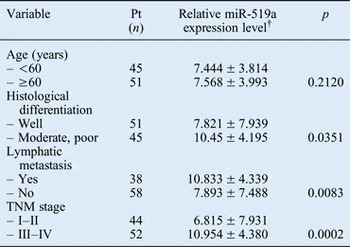
Tumour tissues and adjacent non-cancerous tissues were obtained from 96 laryngeal SCC patients at the Department of Otorhinolaryngology (Head and Neck Surgery), Lihuili Hospital of Ningbo University (a tertiary care centre in China) from March 2006 to March 2011. The clinicopathological characteristics of the laryngeal SCC patients are summarised in Table I. No chemotherapy or radiotherapy was administered prior to surgery. All specimens were evaluated by two pathologists according to World Health Organization guidelines and the Union for International Cancer Control pathological tumour–node–metastasis (TNM) staging criteria. The tissues were frozen immediately in liquid nitrogen and stored at −80°C until used.
Relationships between micro RNA-519A levels and clinicopathological data*

* In laryngeal cancer patients. †Average Δthreshold cycle value ± standard deviation. MiR-519a = microRNA-519a; TNM = tumour–node–metastasis
Informed consent was obtained from all patients. The study was approved by the Human Research Ethics Committee of Lihuili Hospital of Ningbo University.
Transfection of microRNA-519a mimic
To study the possible effect of microRNA-519a on laryngeal SCC, its mimic was transfected into human epithelial type 2 cells. Cells were seeded in 96-well plates at a concentration of 2 × 10⁵ cells per well without antibiotics. Twenty-four hours later, human epithelial type 2 cells (40–60 per cent confluence) were transfected using Lipofectamine 2000 reagent (Invitrogen, Karlsruhe, Germany) with microRNA-519a mimic, which was synthesised by Shanghai GenePharma (Shanghai, China). The primer sequences for microRNA-519a mimic were 5′-AAAGUGCAUCCUUUUAGAGUGU-3′ (forward) and 5′-ACUCUAAAAGGAUGCACUUUUU-3′ (reverse). The sequences for the non-specific control were 5′-UUCUCCGAACGUGUCACGUTT-3' (forward) and 5′-ACGUGACACGUUCGGAGAATT-3 (reverse). Forty-eight hours after transfection, cells were collected for quantitative reverse transcription polymerase chain reaction analysis, cell cycle analysis and Western blotting analysis.
MTT assay
An MTT assay was used to observe the growth effect of microRNA-519a mimic on human epithelial type 2 cells. Cells were transfected with microRNA-519a (50, 100 or 150 nM) mimic or non-specific control for 48 hours. Subsequently, 30 µl of 0.5 per cent 3-(4,5-dimethylthiazol-2-yl)-2,5-diphenyltetrazolium bromide (MTT) solution was added into each of the 96 wells. The cells were then incubated at 37°C for another 4 hours, the medium was removed and 150 µl of dimethyl sulphoxide was added to solubilise the formazan. The microplate was shaken on a rotary platform for 10 minutes. Finally, the optical density values were measured at a wavelength of 492 nm using a Wellscan reader (Labsystems, Santa Fe, New Mexico, USA). The survival rate was calculated using the following equation: survival rate (per cent) = optical density test/optical density control × 100 per cent. Three independent experiments were then carried out.
Total RNA preparation and reverse transcription
Total RNA was extracted from human epithelial type 2 cells and tissues using TRIzol reagent (Invitrogen) following the manufacturer's protocol. Concentration and purity of total RNA samples were measured using the SmartSpec Plus spectrophotometer (Bio-Rad, Hercules, California, USA). Complementary DNA was generated using the miScript reverse transcription kit (Qiagen, Hilden, Germany). In line with the manufacturer's protocol, 4 µl total RNA, 1 µl miScript reverse transcriptase mix, 4 µl miScript reverse transcription buffer and 11 µl ribonuclease-free water were mixed and incubated for 60 minutes at 37°C, and for 5 minutes at 95°C. Then, 80 µl of autoclaving distilled water was added to the reverse transcription product.
Quantitative real-time polymerase chain reaction
Quantitative real-time polymerase chain reaction was performed with an Mx3005P system (Stratagene, La Jolla, California, USA) using a miScript SYBR green polymerase chain reaction kit (Qiagen) with the specific primers. The 20 µl polymerase chain reaction mixtures comprised 2 µl reverse transcription product, 10 µl 2× QuantiTect SYBR green polymerase chain reaction master mix, 1 µl 10× miScript universal primer (Qiagen), 1 µl 10× specific primer and 6 µl ribonuclease-free water. The mixtures were incubated at 95°C for 15 minutes. This was followed by 40 amplification cycles of 94°C for 15 seconds, 55°C for 30 seconds and 70°C for 30 seconds. The threshold cycle was defined as the fractional cycle number at which the fluorescence passed the fixed threshold.
Polymerase chain reaction analysis was performed using gene-specific primers. Their sequences were as follows: 5′-GTGACATCGGGAGAACGAAT-3′ (forward) and 5′-GCGGTCACGTAGTTCACAAA-3′ (reverse) for HuR; 5′-CCCTATCAACTTTCGATGGTAGTCG-3′ (forward) and 5′-CCAATGGATCCTCGTTAAAGGATTT-3′ (reverse) for 18S ribosomal RNA; 5′-AAAGTGCATCCTTTTAGAGTGT-3′ for microRNA-519a; and 5′-CGACTGCATAATTTGTGGTAGTGG-3′ for U1 small nuclear RNA, which was used to normalise the levels of microRNA-519a.
Relative gene expression was calculated using the comparative threshold cycle method.Reference Xiao, Guo, Miao, Jiang, Huan and Zhang15 Firstly, the threshold cycle for each sample was determined. Next, the Δthreshold cycle values (the difference between the threshold cycle of the sample and that of a reference) were calculated: Δthreshold cycle microRNA-519a = threshold cycle microRNA-519a – threshold cycle U1; and Δthreshold cycle HuR = threshold cycle HuR – threshold cycle 18S. The ΔΔthreshold cycle values were determined, and the normalised microRNA-519a expression values were calculated with the formula 2–ΔΔthreshold cycle. The experiment was repeated three times.
Western blotting
Western blotting was used to explore the molecular mechanism of the microRNA-519a growth suppression effect on human epithelial type 2 cells. Lysates from cells were prepared using radioimmunoprecipitation buffer and processed as described previously.Reference Jiang, Guo, Xiao, Miao, Huang and Li16 Approximately 30 µg boiled lysates were subjected to electrophoresis on a 12 per cent sodium dodecyl sulphate polyacrylamide gel; these then migrated onto a polyvinylidene fluoride membrane (Millipore, Bedford, Massachusetts, USA). The membranes were blocked with 5 per cent defatted milk for 2 hours. They were then incubated with rabbit anti-HuR, cyclin-dependent kinases 1 or 2, cyclin D1, or cyclin A antibodies (all purchased from Santa Cruz Biotechnology, Santa Cruz, California, USA) at 4°C overnight. They were subsequently incubated for 2 hours with alkaline phosphatase conjugated goat anti-rabbit antibody (Boster, Wuhan, China) at room temperature. The expression of β-actin (Sigma-Aldrich, Saint Louis, Missouri, USA) was used as a normalisation control for protein loading.
Cell cycle analysis
Cell cycle analysis was used to further explore the molecular mechanism of the microRNA-519a growth suppression effect. Human epithelial type 2 cells were digested and collected at 48 hours post-transfection. They were then washed with phosphate buffered saline twice, harvested and fixed in 70 per cent ethanol (volume per volume) overnight at 4°C. Cell cycle analysis, using propidium iodide staining according to the manufacturer's protocol, was performed with a FACSCalibur flow cytometer (Becton-Dickinson Biosciences, San Jose, California, USA). G0/G1, S (synthesis) and G2/M (mitosis) cell cycle fractions were analysed using CellQuest Pro software (Becton-Dickinson Biosciences).
Statistical analysis
Statistical analysis was performed using the Statistical Package for the Social Sciences software version 17.0 (SPSS, Chicago, Illinois, USA). Data were presented as mean ± standard deviation. The data were assessed for significance using the t-test, rank test or normal approximate method as appropriate, and survival analysis was performed using the Cox proportional hazards model. Associations between the expression of different markers and patient survival were determined using Kaplan–Meier analysis. Differences were considered statistically significant at p < 0.05.
Results
Reduced microRNA-519a in cancerous tissue
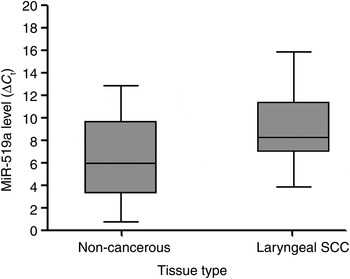
The expression levels of microRNA-519a in 96 laryngeal SCC tissues and adjacent non-cancerous tissues were measured using real-time reverse transcription polymerase chain reaction. The Δthreshold cycle method was used for analysis. MicroRNA-519a expression was significantly lower in laryngeal SCC tissues than in adjacent non-cancerous tissues (p < 0.0001) (Figure 1).
Boxplot showing microRNA-519a expression in 96 laryngeal squamous cell carcinoma tissues and adjacent non-cancerous tissues (p = 0.0001). MiR-519a = microRNA-519a; ∆C t = Δthreshold cycle value; SCC = squamous cell carcinoma

MicroRNA-519a and clinicopathological features
We investigated the relationships between microRNA-519a expression levels and clinicopathological features of laryngeal SCC patients. We found that the positive detection rates of microRNA-519a were associated with TNM stage, lymphatic metastasis and histological differentiation (Table I).
Survival analysis
The laryngeal SCC patients were followed up for three years. Of these 96 patients, 17 died and 3 did not complete follow up; data for these latter patients were incorporated into the patient death group. The overall 3-year survival rate was 79.17 per cent (76 out of 96 patients). For early laryngeal SCC cases, the survival rate was 84.09 per cent (37 out of 44 patients). For advanced cases, the survival rate was 75.00 per cent (39 out of 52 patients).
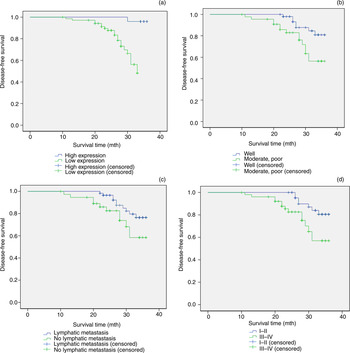
The results showed that higher Δthreshold cycle values for microRNA-519a were associated with greater risk of death (Figure 2a). Lower microRNA-519a expression levels were associated with a shorter mean disease-free survival time (p < 0.001). Disease-free survival was also correlated with histological differentiation and TNM stage (p < 0.05; Figures 2b and 2d respectively), but was not correlated with lymphatic metastasis (p = 0.066; Figure 2c).
Kaplan–Meier curves showing disease-free survival in relation to: (a) microRNA-519a expression (chi-square = 12.840, p = 0.000); (b) histological differentiation (chi-square = 5.925, p = 0.015); (c) lymphatic metastasis (chi-square = 3.382, p = 0.066); and (d) tumour–node–metastasis stage (chi-square = 5.788, p = 0.016). Mth = months

MicroRNA-519a mimic tumour suppression effect
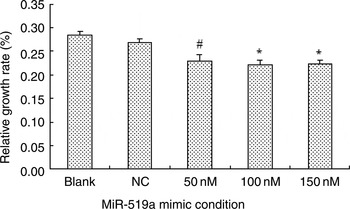
As mentioned above, microRNA-519a was down-regulated in laryngeal SCC tissues, and the expression was associated with TNM stage, lymphatic metastasis and histological differentiation. In light of these findings, we examined the tumour suppression effect of microRNA-519a mimic on laryngeal SCC human epithelial type 2 cells. Cells were transfected with microRNA-519a (50, 100 or 150 nM) mimic or non-specific control for 48 hours, and cell viability was then examined by MTT assay. As shown in Figure 3, the growth of human epithelial type 2 cells was significantly inhibited by microRNA-519a mimic; however, there was no significant difference in cell proliferation between the ‘blank’ and non-specific control conditions. The non-specific control was used as the control in the subsequent experiments.
Effect of microRNA-519a mimic on relative human epithelial type 2 cell growth rate. Data represent percentage of transfected cells relative to untransfected (‘blank’) cells (expressed as mean ± standard deviation from three independent experiments) (#p < 0.05, *p < 0.01, compared with non-specific control). MiR-519a = microRNA-519a; NC = non-specific control

MicroRNA-519a post-translationally regulated HuR
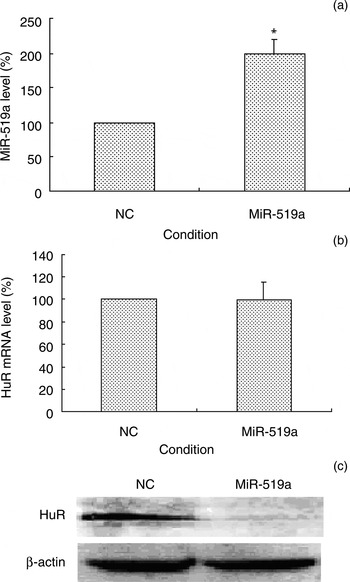
In order to understand the molecular mechanisms by which microRNA-519a affected human epithelial type 2 cell growth, we investigated whether microRNA-519a reduced HuR expression. Real-time reverse transcription polymerase chain reaction results showed that the level of microRNA-519a expression was higher in cells transfected with microRNA-519a mimic than in the non-specific control condition (Figure 4a). There was no significant difference for the messenger RNA levels of HuR (Figure 4b).
Effects of microRNA-519a mimic (vs non-specific control) on: (a) microRNA-519a expression (mean ± standard deviation from three independent experiments, *p < 0.01), and (b) HuR messenger RNA levels. (c) Western blot results, showing lower HuR protein levels in human epithelial type 2 cells transfected with microRNA-519a mimic than in non-specific control condition. MiR-519a = microRNA-519a; NC = non-specific control

We then explored the effect of microRNA-519a on HuR protein levels. Western blotting results showed that the levels of HuR protein were lower in human epithelial type 2 cells transfected with microRNA-519a mimic than in the non-specific control condition (Figure 4c).
MicroRNA-519a altered cell cycle distribution
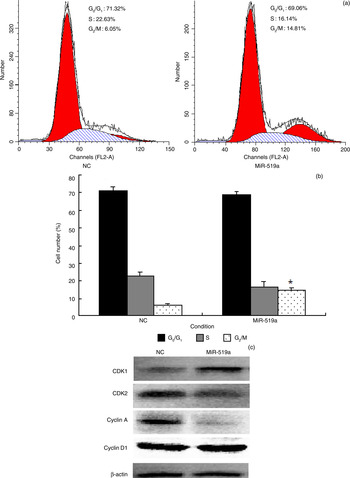
In order to explore the mechanism of the microRNA-519a growth suppression effect on human epithelial type 2 cells, we monitored the changes in cell cycle distribution by flow cytometry. The results showed that the cells transfected with microRNA-519a mimic were arrested at the G2/M phase, with a decreased S phase (Figures 5a and 5b).
MicroRNA-519a cell cycle distribution findings, showing (a) example histograms of flow cytometry FL2A (pulse area measurement) results; and (b) calculations of relative G0/G1, S and G2/M compartments (*p < 0.01). (c) Western blot results of cell cycle regulatory proteins, showing that microRNA-519a increased cyclin-dependent kinase 1, and decreased cyclin-dependent kinase 2 and cyclin A protein levels, but did not change cyclin D1 levels. (Results representative of three independent experiments.) NC = non-specific control; MiR-519a = microRNA-519a; CDK = cyclin-dependent kinase

We then investigated the expression levels of cell cycle related proteins, such as cyclins and cyclin-dependent kinases, in order to confirm the flow cytometry results and further explore the underlying mechanism. As shown in Figure 5c, microRNA-519a significantly increased the protein level of cyclin-dependent kinase 1, and decreased the protein levels of cyclin-dependent kinase 2 and cyclin A. However, there was no significant change in the level of cyclin D1.
Discussion
MicroRNAs are a class of non-coding, small RNAs that regulate gene expression by promoting decay or suppressing translation of their target messenger RNAs at the post-transcriptional level. MicroRNAs are thought to have a widespread influence on gene expression, with more than 60 per cent of human protein coding genes being subject to regulation by microRNAs.Reference Bartel17 MicroRNAs play critical roles in the occurrence and development of cancer by regulating the expression of various oncogenes or tumour suppressors.Reference Chekulaeva and Filipowicz18 Recent studies have revealed that the expression levels of a number of microRNAs are low in human tumour, and most of these microRNAs may act as tumour suppressors.Reference Nie, Liu, Zheng, Chen, Wu and Xu19, Reference Ugras, Brill, Jacobsen, Hafner, Socci and Decarolis20 Such findings highlight the possible value of microRNA in the diagnosis and therapy of laryngeal SCC. The results of the current study demonstrated a crucial relationship between the levels of microRNA-519a expression and laryngeal SCC, and the tumour suppressor mechanism of microRNA-519a in laryngeal SCC cells.
Low levels of microRNA-519a expression have been found in several kinds of cancers, such as ovarian, lung and kidney cancer.Reference Abdelmohsen, Kim, Srikantan, Mercken, Brennan and Wilson7 In this study, we investigated the level of microRNA-519a expression in laryngeal SCC tissues. The findings revealed significantly lower microRNA-519a expression levels in laryngeal SCC tissue compared with adjacent non-cancerous tissues (Figure 1). To our knowledge, this is the first report of microRNA-519a down-regulation in laryngeal SCC. In addition, microRNA-519a expression in laryngeal SCC patients was significantly correlated with histological differentiation, lymphatic metastasis and TNM stage (Table I), suggesting that microRNA-519a plays an important role in the early stages of laryngeal SCC. Specifically, lower microRNA-519a expression was associated with higher laryngeal SCC malignancy.
All laryngeal SCC patients were followed up for three years. MicroRNA-519a expression appeared to have a significant effect on overall survival and disease-free survival in these patients (Figure 2). Furthermore, microRNA-519a expression was an independent predictor of disease-free survival after laryngeal cancer surgery. Multivariate survival analysis was performed using the Cox proportional hazards model. The findings suggested that lower microRNA-519a expression was associated with a shorter mean disease-free survival time. Disease-free survival was also correlated with histological differentiation (p = 0.015), TNM stage (p = 0.016) and lymphatic metastasis (p = 0.066). These results indicated that microRNA-519a plays a vital role in the occurrence and development of laryngeal SCC, and may be a potential prognostic parameter for laryngeal SCC.
Although the results revealed low expression of microRNA-519a in laryngeal SCC (Figure 1) and the importance of the relationship between microRNA-519a and laryngeal SCC (Table I, Figure 2), the specific role of microRNA-519a in laryngeal SCC remained unclear. In this study, which used the human epithelial type 2 laryngeal carcinoma cell line as a model, we found, for the first time, that the increase of microRNA-519a expression significantly inhibited the growth of human epithelial type 2 cells (Figure 3). In addition, we found that 100 nM was an appropriate concentration for the microRNA-519a mimic (Figure 3) (100 nM was the concentration adopted in the subsequent experiments).
The findings of this study indicated that microRNA-519a has a potential tumour suppressor role in laryngeal SCC. However, the exact mechanism of microRNA-519a in laryngeal SCC had never been explored. Abnormal expression of microRNA-519a is related to cell growth, apoptosis and cell cycle.Reference Marasa, Srikantan, Martindale, Kim, Lee and Gorospe21 In the present study, abnormal expression of microRNA-519a was found to contribute (at least in part) to a reduction in tumour growth by lowering the abundance of the RNA-binding HuR protein.
HuR, which is a well-known RNA-binding protein, has the function of diminishing tumour growth. MicroRNA-519a appears to function primarily through its association with the coding region of HuR messenger RNA, whereas most microRNAs interact with the 3'-untranslated region of target messenger RNAs.Reference Abdelmohsen, Srikantan, Kuwano and Gorospe22 Several studies have found that HuR is over-expressed in tumour cells compared with normal counterpart cells.Reference Khabar23 In addition, Abdelmohsen et al. found that HuR may be a target of microRNA-519a.Reference Abdelmohsen, Kim, Srikantan, Mercken, Brennan and Wilson7
In order to verify the relationship between microRNA-519a and HuR, and to explore the tumour suppressor mechanism of microRNA-519a in laryngeal SCC, we investigated the influence of microRNA-519a exogenous expression on HuR messenger RNA and protein levels in human epithelial type 2 cells. We found that the abundance of HuR protein was lower in microRNA-519a transfected human epithelial type 2 cells (Figure 4c). However, the HuR messenger RNA levels remained unchanged (Figure 4b), despite the increase in microRNA-519a expression (Figure 4a). These findings indicate that neither transcription nor messenger RNA stability contributed to the down-regulation of HuR.
HuR promotes tumour development by enhancing the expression of proteins that inhibit apoptosis, promote proliferation (e.g. cyclins E, A2 and B1), increase angiogenesis and enhance tumour invasion.Reference Abdelmohsen and Gorospe24 HuR is predominantly nuclear, but during cellular growth and activation, it translocates to the cytoplasm. Here it binds to adenylate-uridylate-rich messenger RNAs, including those involved in inflammation and cancer (e.g. vascular endothelial growth factor and cyclo-oxygenase-2), and promotes their messenger RNA stabilisation.Reference Dormoy-Raclet, Ménard, Clair, Kurban, Mazroui and Di Marco25
Cyclo-oxygenase-2, which plays an important role in inflammation and tumour development,Reference Kolev, Uetake, Iida, Ishikawa, Kawano and Sugihara26 was found to have the binding site for HuR in its 3'-untranslated region.Reference Dixon, Kaplan, McIntyre, Zimmerman and Prescott27, Reference Ristimäki, Narko and Hla28 Altered expression of HuR promotes cyclo-oxygenase-2 expression in colon cancer cells, which suggests that dysregulation of these RNA-stabilising factors can lead to the over-expression of carcinogenic proteins.Reference Dixon, Tolley, King, Nabors, McIntyre and Zimmerman11 In addition, HuR was shown to locally regulate the translation of cyclo-oxygenase-2 messenger RNA upon ultraviolet C irradiation; the mechanism was translational regulation of ultraviolet-C-induced cyclo-oxygenase-2 expression at global levels and in RNA-binding proteins.Reference Tong, Van Dross, Abu-Yousif, Morrison and Pelling29 A correlation between HuR and cyclo-oxygenase-2 expression was found in colon, breast, gastric and laryngeal carcinoma cells.Reference Dixon, Tolley, King, Nabors, McIntyre and Zimmerman11, Reference Shen, Ye, Zhang, Jiang, Xiao and Guo14, Reference Do, Araujo, Kalil, Bacchini, Bertoni and Unni30, Reference Mrena, Wiksten, Thiel, Kokkola, Pohjola and Lundin31 In addition, our previous study confirmed that a decline in HuR could inhibit human epithelial type 2 cells by reducing the expression of cyclo-oxygenase-2.Reference Shen, Ye, Zhang, Jiang, Xiao and Guo14 Together, these findings and those of the current study (Figures 3 and 4) indicate that microRNA-519a can inhibit the growth of laryngeal SCC cells by suppressing the expression of HuR at post-transcriptional and translational levels.
In order to further explore the tumour suppression mechanism of microRNA-519a, we investigated the cell cycle distribution, which is closely related to cell proliferation. The results revealed that human epithelial type 2 cells were significantly arrested at the G2/M phase after being transfected with microRNA-519a mimic (Figures 5a and 5b).
It is well known that mammalian cell growth is partly regulated by cyclins and cyclin-dependent kinases.Reference Park, Song, Kim, Sung, Ryu and Lee32 Wang et al. have reported that HuR regulates cyclin A and cyclin B1 messenger RNA stability during cell proliferation.Reference Wang, Caldwell, Lin, Furneaux and Gorospe33 Cyclin A associates with cyclin-dependent kinase 2 during the S phase, and with cyclin-dependent kinase 1 at the S–G2 boundary and into the G2 phase. In addition, the elevation of cyclin-dependent kinase 1 decreases the cytoplasmic level of HuR and weakens its interaction with target transcripts (e.g. cyclin A messenger RNAs).Reference Kim, Abdelmohsen, Lal, Pullmann, Yang and Galban34 We also found that the protein levels of cyclin-dependent kinase 2, cyclin A and HuR (Figure 4c) were decreased, and cyclin-dependent kinase 1 levels were increased, when the microRNA-519a expression level was elevated (Figure 5c). The decline of the cyclin A and cyclin-dependent kinase 2 complex inhibited the activation of DNA replication machinery, and the increase of cyclin-dependent kinase 1 promoted the S into the G2 phase, thus the population of cells in the S phase was decreased (Figures 5a and 5b). The G2 phase is marked by the expression of cyclin B, and the inactivation of cyclin B and cyclin-dependent kinase 1 complexes. Targets of the cyclin B and cyclin-dependent kinase 1 complex include structural proteins involved in the execution and timing of mitotic events.Reference Biggar and Storey35 The increased protein level of cyclin-dependent kinase 1 led to the decrease of HuR (Figure 5c), and the G2/M phase was arrested (Figures 5a and 5b).
• Laryngeal squamous cell carcinoma (SCC) is a common upper respiratory tract tumour with a high mortality rate
• This novel study investigated the expression and function of microRNA-519a in laryngeal SCC
• MicroRNA-519a may function as a tumour suppressor by inhibiting HuR expression
• MicroRNA-519a is a potential therapeutic target for laryngeal SCC
In summary, the study findings suggest that microRNA-519a is involved in laryngeal carcinogenesis. The growth of laryngeal SCC human epithelial type 2 cells was suppressed as a result of elevated microRNA-519a levels. In addition, microRNA-519a may inhibit the growth of laryngeal SCC cells by altering cell cycle related protein expression through the down-regulation of HuR expression, thus changing the distribution of the cell cycle. Our findings suggest that microRNA-519a has potential as a therapeutic target for laryngeal SCC.
Acknowledgements
This work was supported by grants from the Ningbo Social Developmental Key Research Project (number 2012C5015), the Scientific Innovation Team Project of Ningbo (number 2012B82019), the Medical and Health Research Project of Zhejiang Province (number 2012ZDA042) and the K C Wong Magna Fund (Ningbo University).