INTRODUCTION
Depression is a frequent issue in palliative care settings, with an estimated frequency of 14% according to the Diagnostic and Statistical Manual of Mental Disorders (DSM) (Meyer et al., Reference Meyer, Sinnott and Seed2003; Mitchell et al., Reference Mitchell, Chan and Bhatti2011). Depression in advanced cancer patients results in impaired quality of life and probably shorter survival (Lloyd-Williams et al., Reference Lloyd-Williams, Dennis and Taylor2004; Reference Lloyd-Williams, Shiels and Taylor2009; Delgado-Guay et al., Reference Delgado-Guay, Parsons and Li2009; Satin et al., Reference Satin, Linden and Phillips2009). The two main criteria for its diagnosis are depressed mood and anhedonia (loss of interest or absence of pleasure). To these can be added the following symptoms: diminished ability to think or concentrate, feelings of worthlessness or excessive guilt, psychomotor agitation or retardation, insomnia or hypersomnia, significant weight loss or gain without dieting, fatigue, and recurrent suicidal ideation. Even if depressive symptoms directly affect the patient, they can also have serious consequences on family members, whether at the individual level (e.g., sleep disturbance, anxiety, irritability, depression) or at the dynamic family level (e.g., role reversal, conflicts) (Cohen et al., Reference Cohen, O'Leary and Foran2010).
Palliative care in cancer advocates comprehensive multidisciplinary and person-centered care, aiming to relieve the patient's physical, psychological, and social suffering and to support the patient's family (Ahmedzai et al., Reference Ahmedzai, Costa and Blengini2004; Bruera & Hui, Reference Bruera and Hui2010). When facing serious illness, family members (e.g., husband, spouse, children, and parents) often appear as the primary resource for the healthcare team. They should therefore be considered as major partners in the patient's care, and as one of the most important supports for the patient (Thomas et al., Reference Thomas, Morris and Harman2002; Teschendorf et al., Reference Teschendorf and Schwartz2007).
Of cancer patients who have significant depression, 75% do not receive any psychological and/or pharmacological treatment (Pascoe et al., Reference Pascoe, Edelman and Kidman2000; Rhondali et al., Reference Rhondali, Perceau and Berthiller2012), although the benefit of such treatment has been well established (Breitbart, Reference Breitbart1995; Newell et al., Reference Newell, Sanson-Fisher and Savolainen2002; Rodin et al., Reference Rodin, Lloyd and Katz2007; Strong et al., Reference Strong, Waters and Hibberd2008; Uitterhoeve et al., Reference Uitterhoeve, Vernooy and Litjens2004; Rayner et al., Reference Rayner, Price and Evans2011). This issue can be partially explained by the difficulties encountered in identifying depression in this population. Indeed, patients experienced a mix of symptoms related to cancer, and depression, some of which may have multiple etiologies (such as fatigue, anorexia, and sleep disorders) (Clayton, Reference Clayton1974; Brenne et al., Reference Brenne, Loge and Kaasa2013). Depressive symptoms are rarely identified by the family, because they mix up cancer-related symptoms and depressive symptoms associated with the advanced phase of cancer (e.g., fatigue, weight loss) (Brenne et al., Reference Brenne, Loge and Kaasa2013). Another factor is that they often consider depression an expected outcome associated with a diagnosis of advanced cancer (Noorani & Montagnini, Reference Noorani and Montagnini2007; Rayner et al., Reference Rayner, Loge and Wasteson2009; Mellor et al., Reference Mellor, McCabe and Davison2013).
Our aim was to explore cancer patient caregivers' perceptions of depression, and also to identify the role they believe they should play in the management of this illness.
METHOD
The local ethics committee and institutional review board of the Hospices Civils de Lyon approved our study. All participants gave written informed consent before inclusion in the study. The present article respects the consolidated criteria for reporting qualitative research (COREQ) guidelines (Tong et al., Reference Tong, Sainsbury and Craig2007).
Participants
For this study, we recruited caregivers from the palliative care unit (PCU) at Centre Hospitalier de Lyon-Sud. We included caregivers aged 18 years or older with a relative admitted to the PCU for advanced cancer. Advanced cancer was defined as locally advanced or metastatic cancer. Families who were particularly distressed (according to the team), patients with terminal illness, patients discharged before the interview, or non-French-speaking caregivers were excluded.
Procedure
One of the authors (AL) conducted semistructured interviews with caregivers of inpatients admitted to our PCU between March 26 and June 14, 2012. Families of all the patients admitted to the unit during this period (N = 56) were notified about the purpose of our research. Caregivers were then invited to participate, and an appointment was scheduled if they agreed.
We conducted two preliminary interviews to test the quality of the questions that were planned to be asked of participants. The interviews were conducted in a private room. All interviews were tape-recorded and then transcribed verbatim. The names and personal information of participants were removed from transcripts, and participants were assigned a code number. All audio files were kept in a secure location. Participants were asked to provide demographical information (age, sex, relationship with the patient). During this semistructured interview, questions aimed to find out what caregivers thought about depression in cancer patients and how they perceived their role with respect to their loved one. The specific questions that were employed during the interview are available on request from the authors.
Data Analysis
These interviews were subjected to qualitative analysis. The authors (AC, WR, AL) first independently conducted an open coding of each interview, which consisted of multiple reviews of the transcripts to identify and categorize data (Lindlof & Taylor, Reference Lindlof and Taylor2002). The second step divided the interview into “units of meaning” to highlight, in a third step, the underlying meaning of what the participants wanted to express. We then completed this open coding (i.e., analysis of each interview independently) using axial coding to connect interviews. During this last step, all the elements were categorized into major themes. One of the authors (WR) transcribed the reported quotes.
To complete our analysis, we used ALCESTE software (Analyse de Lexème Co-occurents dans les Enoncés Simples d'un Texte [analysis of lexeme cooccurrence in a text]). The hypothesis developed with this program considers distribution of the vocabulary in a corpus as a linguistic trace of a cognitive work of the reconstruction of a specific object by an individual (Reinert, Reference Reinert1983; Geka & Dargentas, Reference Geka and Dargentas2010). ALCESTE allows lexical distributions analysis in a short sequence of a corpus to produce “simple statements.” The objective is to obtain a first classification of these statements based on cooccurrences of words in order to identify the main lexical classes. The classifications obtained represented the ideas and dominant themes of the corpus. The coefficient of association of a statement to a class was calculated using a chi-square (χ2) test.
Sample Size Determination
In qualitative research, sample size is determined when none of the analysts recognize new or unique themes. This is known as data saturation. In our study, data saturation was reached after 15 interviews.
Presenting Results
Quotes from the participants are set off by indentation to support our conclusions. Minimal editing was done to preserve authenticity. We employed ellipses (. . .) to indicate that part of the quote was truncated and irrelevant information deleted from a quote. When it was necessary to clarify the context, we added information in square brackets [. . .].
RESULTS
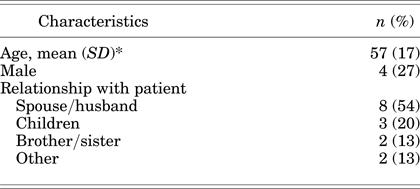
Participants (Table 1)
Out of the 56 patients admitted during the study period, 15 were included. Some 36 families refused to participate (5 were not interested, 16 were discharged before the interview took place, 3 families were in great distress, and 12 patients were admitted for terminal illness), and 5 patients did not have a caregiver.
Participants' characteristics (N = 15)

* SD, standard deviation.
The average length of interviews was 18 minutes (standard deviation (SD), 3 min). The longest interview lasted 24 minutes and the shortest 12 minutes. The mean age of participants was 57 years (SD = 17) and the majority were women (n = 11, 73%). Of the 15 participants, 8 (54%) were the patient's partner and 3 (20%) were children.
Qualitative Analysis
General Definition of Depression and Cancer-Related Depression
Relatives reported several items related to a definition of depression, especially visible symptoms such as changes in behavior. Participants linked depression with emotional suffering that is difficult to express:
It is a disease (. . .) severe, disabling.
It's when the soul is tired.
You have so much on the back.
The dark thoughts.
It started with fatigue I believe.
She [the patient] wants to stop everything; she wants to die.
Small symptoms that reveal something.
This is a terrible malaise.
A change of character.
It is something that puts you in a tunnel [where] you do not get out.
Participants highlighted that in cancer-related depression patients might also express some irritability and despair, and usually tend to avoid social contact (social withdrawal):
To withdraw into yourself, to be less open to others, (. . .) this can be verbal and/or physical aggression.
She sees that there is nothing more to do [about the cancer].
It's always about the disease; people think they will not survive.
You don't want to receive [people]; you don't want to go out.
Caregivers reported depression identification to be difficult if their loved one did not complain:
She [the patient] doesn't give us any clue of her mental state, and therefore it is very difficult to detect if she is depressed.
Several caregivers believed that terminal illness invariably causes depression, and they expressed difficulty in distinguishing sadness from depression:
It must be serious, but it all depends on the degree of depression.
When you are sick [with cancer] you must be depressed. (. . .) It's part of the disease in general.
Caregivers' Perceptions of Their Role in the Management of Depression
Relatives reported emotional symptoms such as depression as significantly less important than physical symptoms such as pain. Some of them reported that maintaining a combative attitude toward depressive symptoms was important:
Depression, we can fight against, unlike cancer.
For us the most important thing was to manage pain; depression was a second-line symptom.
It happened that he cried in my arms. I try to comfort him. I told him, “We must continue to fight; you know that we love you.”
I told him, “Your son, your daughter, they love you, you know.”
My son told him, “You're not going to give up in front of this disease.”
Other participants told us they did not feel comfortable facing the depression of their loved ones and preferred to seek help from mental health services:
I do not think I'd be strong enough to help.
I would ask for the assistance of a competent person.
The vast majority of participants felt they had a role to play in the care of their loved one; some even considered this a duty. They considered that they should listen to the patient when needed, that they should provide a physical presence and stimulation when the situation was difficult. They also considered themselves as partners of the healthcare team and pointed out that as a family they were able to see any changes in their loved one's behavior:
I would try (. . .) to boost him [the patient].
I was his shrink.
We must work together and collaborate [with psychologists].
Depression Impacts on Caregivers and on Their Interactions with the Patient
Relatives believed that depression had a negative and severe impact on their own mood and on their daily life:
It will be hard to accept that not only she has a cancer, but also she has depression.
I do not think I would fall into depression myself, but then it would make me (. . .) it would be a shock to me anyway.
These negative consequences can be psychological and spiritual, including emotional suffering and self-doubt regarding their actions and attitudes toward the patient:
I would suffer of this [if the patient is depressed].
Is what I'm doing correct, do I make a mistake?
At night, I wake up. Sometimes I feel like I hear the phone ringing (. . .) I feel distressed.
Caregivers reported that depression in their loved one could be a source of conflict usually by having a negative impact on their communication and on their daily relationships:
I wonder if I would continue to try to communicate.
It would be really painful for me to try to [support him].
There was a lot of irritation, a lot of anger.
Some participants considered depression as an opportunity to get closer, to show attention to their sick relative, and to put more emphasis on familial unity, especially in the context of cancer:
It would strengthen our regard for each other.
We try to find a mutual agreement to be back on our feet again.
Caregivers' Perceptions of the Support Provided by the Psychologist
Caregivers described the intervention of a psychologist as a positive step for their loved one. They argued that a cancer patient with depression could not get out of depression alone and that only a specialist could help to verbalize anxiety, fears, and challenges. The role of the mental health specialist is also to fulfill a long-term supporting function for both patients and their caregivers. By being outside of the family, the psychologist could more easily address some difficult issues that could not be discussed within the family:
Ask [about] the fears she has, like dying, (. . .) about his anxiety.
It will be a relief.
We [the family] are too involved (. . .) It is not possible to really help.
She could say what she had to say without feeling judged.
While recognizing the benefits of psychological support for their sick relative, most participants did not consider it useful for themselves, except in extreme circumstances:
You know I do not think too much about me.
You really have to be exhausted.
For those who have already seen a psychologist, they reported that they were expecting advice on how to support their sick relative as well as an opportunity to be listened to and supported:
Advice about the support that I can provide to [the patient].
Help me to accept what is coming after.
Results of the ALCESTE Analysis
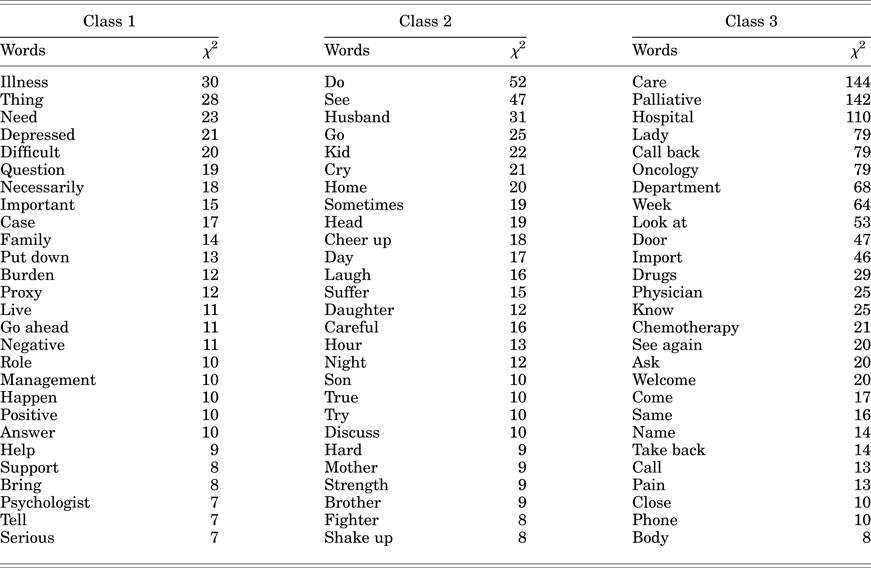
The scope of our analysis included 82% of the full verbatim (excluding interviewer questions) transcripts and revealed three classes of meaning (Table 2).
Specific words from the three classes identified in the corpus*

* Only words with χ2 score >7 appear in this table.
Class 1 consisted of terms related to the cancer-related depression and its expected occurrence in the context of serious illness (illness, depressed, necessarily) and specific vocabulary describing the relationship between patients and caregivers (go ahead, role, answer, management, help, support, bring):
Because of the long run against the disease and according to the stage of extension this is more and more difficult, and (…) well (…) we can understand that the person who is suffering from advanced cancer may fall into depression.
This class also contains several words describing the negative valence of the cancer-related depression (difficult, important, burden, negative, serious). The words family and proxy also highlight the importance of the family's inclusion in the management of depression as well as the limits of their own role:
As the patient's family, we all have a role to play in cases like this.
For my parents or someone in my family, of course, yes, I would have a role to play.
The psychologist succeeds in putting the good words where the family did not.
Class 2 showed a significant presence of words related to family relationships (husband, daughter, son, mother, brother) as well as caregivers' perception of what they could do (cry, cheer up, try, discuss, fighter, shake up). In this class, we also found several words related to temporality (sometimes, day, hour, night) highlighting the substantial investment required by caregivers to take care of their loved one:
I took care of his father day and night; I took care of his mother; now it is him.
Class 3 is related to palliative care and the medical environment (hospital, oncology, department, chemotherapy drugs, and physicians). In this class, we found that for some patients “advanced cancer” associated with “palliative care” was perceived as a death sentence and that for them, in this case, depressive symptoms were more than expected:
This is when you hear palliative care automatically, uh (. . .) I thought he would die there, that he would never get out.
DISCUSSION
Our study aimed to explore caregivers' perceptions of depression in advanced cancer patients. Our qualitative analysis suggests that cancer patients' caregivers have a good theoretical knowledge of depression in the general population. However, caregivers also acknowledge that in the context of cancer, and because of their relationship with the patient, identification of depressive symptoms can be challenging.
The difficulties for caregivers in identifying depressive symptoms probably have several explanations:
-
1. First, patients might experience a mix of symptoms related to cancer and symptoms related to depression, some of which might have multiple etiologies (fatigue, anorexia, sleep disorders) (Clayton, Reference Clayton1974; Lloyd-Williams et al., Reference Lloyd-Williams, Dennis and Taylor2004; Lloyd-Williams & Friedman, Reference Lloyd-Williams and Friedman2001; Rhondali et al., Reference Rhondali, Perceau and Berthiller2012).
-
2. Another explanation might be related to the specificity of cancer-related depression (Newell et al., Reference Newell, Sanson-Fisher and Girgis1998). Indeed, symptoms such as loss of pleasure or excessive guilt were not reported in the definitions given by caregivers. Brenne and colleagues recently reported that symptoms such as despair, anxiety, and social withdrawal are common symptoms in depressed patients with advanced cancer, and therefore these symptoms should be utilized to diagnose depression (Brenne et al., Reference Brenne, Loge and Kaasa2013).
-
3. We also found that for several caregivers depression was an expected issue in the context of advanced cancer, which is consistent with the existing literature (Rayner et al., Reference Rayner, Loge and Wasteson2009; Noorani & Montagnini, Reference Noorani and Montagnini2007).
-
4. Finally, our results also point out that these difficulties were related to a lack of communication between patients and caregivers since the caregivers acknowledged that they did not realize that their loved one was depressed until they perceived clearly visible or expressed symptoms (Libert et al., Reference Libert, Merckaert and Slachmuylder2013). Healthcare professionals should be aware of these difficulties and therefore not rely only on caregivers' reports (Libert et al., Reference Libert, Merckaert and Slachmuylder2013).
Our results suggest that caregivers felt involved in the care of their loved one. They considered themselves partners in the patient's care with a supportive role (e.g., being present, listening) (Thomas et al., Reference Thomas, Morris and Harman2002; Teschendorf et al., Reference Teschendorf and Schwartz2007; Skalla et al., Reference Skalla, Smith and Li2013). They recognized that they could bring specific information (e.g., about habits, current behavior, and changes over time) to the healthcare team and also have specific expectations of psychologists (e.g., support for the patient, especially in case of depression, counseling for themselves, and mediation between the patient and themselves) (Alexander, Reference Alexander2004). Furthermore, this partnership, which increases social and family support, has been reported to have a beneficial effect on successful depression treatment (Goodwin et al., Reference Goodwin, Lee and Price2012).
However, by assuming the role of a partner in patient care, caregivers exposed themselves to emotional difficulties and an increased need for support and information (Epiphaniou et al., Reference Epiphaniou, Hamilton and Bridger2012; Girgis et al., Reference Girgis, Lambert and Johnson2013).
Finally, our results suggest that cancer-related depression increases caregiver burden and can result in negative consequences for family dynamics and daily life. The experience of depression in a loved one was reported to be very difficult for caregivers at an individual level (e.g., sleep disorders, anxiety) and also during the communication process. These findings are similar to the results of other studies on the impact of depression on cancer patients' caregivers, highlighting the importance of caregiver support and the need for education about the support and services that they can use for the patient and themselves (Mazzotti et al., Reference Mazzotti and Sebastiani2013).
Our results also suggest a significant impact on depression in advanced cancer caregivers; it is therefore crucial that healthcare professionals develop educational programs targeting cancer patients' families as well as specific interventions to minimize the impact of the burden of patient care on caregivers.
Our study has some limitations. This was a monocentric study, resulting in limited generalizability of our results. These findings should be confirmed by a multicenter study on a larger sample. The qualitative nature of the study can also be seen as a limitation due to data obtained from a small sample. However, qualitative research has been recognized as a good design when exploring a specific population, especially in palliative care (Chesebro & Borisoff, Reference Chesebro and Borisoff2007; O'Connor & Payne, Reference O'Connor and Payne2006). More research is necessary to confirm our findings and to determine the best way to support caregivers.
FUNDING
This research was supported by grants from the Fondation APICIL and the Fondation de France. There were no potential conflicts of interest.