Introduction
Over the last 10 years, there has been increasing reports of violence in Pakistan (Filza, Reference Filza2015; Anwar, Reference Anwar2016); with some regions including the Khyber Pakhtunkhwa province of North-West Pakistan particularly affected (Khan, Reference Levy and Sidel2014). This has resulted not only in high mortality rates, but also in high levels of psychiatric pathology and social deprivation (Khalily et al., Reference Khalily, Fooley, Hussain and Bano2011). Increased rates (up to 30%) of post-traumatic stress disorder (PTSD), major depressive disorder and/or other anxiety disorders have consistently been reported in individuals who have experienced or witnessed violent events (Levy & Sidel, Reference Lewis, Musharraf, Dorahy and Lewis2013; Razik et al. Reference Ruiz, Poythress, Lilienfeld and Douglas2013). Dissociative symptoms as a component of PTSD included now as a specifier in the Diagnostic and Statistical Manual-5 (DSM-5), or as individual symptoms have also previously been noted to be present at high rates (25%–80%) in individuals who have witnessed or being exposed to violence (Gershuny & Thayer, Reference Gershuny and Thayer1999; Britvić et al., Reference Britvić, Antičević, Kaliterna, Lušić, Beg, Brajević-Gizdić, Kudric, Stupalob, Krolob and Pivac2015). Indeed, the intensity, type (including sexual and physical violence) and frequency of traumatic events have been associated with the presence of dissociative symptoms (Briere, Reference Briere2006; Ruiz et al. Reference Soffer-Dudek, Lassri, Soffre Dudek and Shahar2008; Olsen et al. Reference Olsen, Clapp, Parra and Beck2013). However, a relative dearth of research has examined the clinical and socio-demographic factors associated with the presence of such dissociative symptoms in regions where high levels of violence are present; with no studies to date to our knowledge examining these factors in a Pakistan cohort.
The diagnostic criteria for PTSD utilizing the Diagnostic and Statistical Manual of Mental Disorders 5 (DSM-5) can be divided into five main clusters: (1) traumatic exposure, (2) presence of intrusive symptoms associated with traumatic event(s), (3) avoidance of stimuli associated with traumatic event(s), (4) negative alterations in mood and cognition and (5) alterations in reactivity and arousal, providing symptom duration is greater than 1 month, functional impairment is evident and symptoms are not attributable to the physiological effects of any psycho-active substance or another medical condition (American Psychiatric Association, 2014; Weathers et al. Reference Weathers, Litz, Palmieri, Schnurr, Marx and Keane2013a). Dissociative symptoms or reactions are categorized in the second cluster and occur on a continuum with the most extreme expression being a complete loss of awareness of present surroundings. In addition, as stated one can specify if PTSD occurs with dissociative symptoms which include persistent or recurring symptoms of depersonalization or derealization.
Dissociative symptoms can be categorized as three factors: (1) absorption or imaginal involvement, (2) depersonalization/derealization and (3) amnesia based on the widely used Dissociative Experiences Scale (DES) (Bernstein & Putnam, Reference Bernstein and Putnam1986). ‘Absorption’ refers to narrowing of the attention span to become immersed in a single stimulus (external or internal stimuli such as a thought or image) while neglecting other stimuli in the environment. This model has been supported in clinical populations but has less demonstrated specificity in non-clinical populations (Stockdale et al. Reference Weathers, Litz, Palmieri, Schnurr, Marx and Keane2002; Dalenberg & Paulson, Reference Dalenberg and Paulson2009; Ruiz et al. Reference Soffer-Dudek, Lassri, Soffre Dudek and Shahar2008; Soffer-Dudek et al. Reference Spitzer, First and Wakefield2015).
In this study, we aimed to ascertain the frequency and types of symptoms experienced by individuals (third-level students) in the Khyber Pakhtunkhwa province of North-West Pakistan secondary to witnessing or experiencing trauma who previously were not diagnosed with a DSM-5 mental disorder. In addition, we wanted to ascertain if dissociative symptoms experienced were predicted by specific demographic and/or clinical variables.
Method
Participants
Participants consisted of University students over 18 years of age, attending one of four Universities in the Khyber Pakhtunkhwa region who had experienced at least one previous traumatic event, who responded to an advertisement placed in the university relating to the study. Individuals who previously attained treatment for a Diagnostic and Statistical Manual-5 (DSM-5) mental disorder including a substance use disorder were excluded. Demographic data collected in 2016 included age, gender, educational, marital, family and socio-economic status.
Psychometric instruments
The following psychometric instruments were conducted.
1. Life Events Checklist (LEC-5): the LEC-5 is a 17-item self-report measure designed to screen for traumatic events in a respondent’s lifetime with responses on a six-point Likert scale ranging from ‘happened to me’ to ‘doesn’t apply’ (Weathers et al. Reference Weathers, Litz, Palmieri, Schnurr, Marx and Keane2013a). The LEC-R has good psychometric indices with a reliability co-efficient of 0.80 (Gray et al. Reference Gray, Litz, Hsu and Lombardo2004).
2. Post-traumatic stress disorder checklist (PCL-5): the PCL-5 is a 20-item self-report checklist that assesses symptoms of PTSD in adults (>18 years of age), with responses for each item on a five-point Likert scale ranging from ‘not at all’ to ‘extremely’. (Weathers et al. Reference Waller, Hamilton, Elliott, Lewendon, Stopa, Waters, Kennedy, Lee, Pearson, Kennerley, Hargreaves, Bashford and Chalkey2013b). The proposed cut-off for a diagnosis of PTSD on this 80 point scale is 38, with symptoms categorized as in DSM-5 into five clusters: (1) exposure to trauma, (2) re-experiencing or intrusive thoughts of trauma, (3) avoidance of stimuli associated with traumatic events, (4) negative alterations in mood and cognition, (5) alterations in reactivity and arousal. The PCL-5 has good psychometric indices with a reliability co-efficient of 0.95 (Ashbaugh et al. Reference Ashbaugh, Houle-Johnson, Herbert, El-Hage and Brunet2016).
3. Dissociative Experiences Scale (DES). The DES is a 28 items self-report visual analogue scale with scores ranging from 0% to 100% relating to the frequency of dissociative experiences for each item with values >30% suggestive of pathology (Bernstein & Putnam, Reference Bernstein and Putnam1986). It includes three components: (1) absorption or imaginative involvement, (2) amnesia and (3) depersonalization/derealization. The reliability co-efficient of the DES (translated into Urdu version for this study) was 0.94.
4. Depression Anxiety Stress Scale (DASS-42). The DASS-42 is a 42 item, self-report scale (Lovibond & Lovibond, Reference Lynn, Lilienfeld, Merckelbach, Giesbrecht, McNally, Loftus, Bruck, Garry and Malaktaris1995), assessing symptoms of depression and anxiety on a four-point Likert scale and includes three components: (1) depression, (2) anxiety and (3) stress. The DASS-42 has good psychometric indices with an overall reliability co-efficient of 0.94 and reliability coefficients of 0.83–0.85 for the three sub-components (Lovibond & Lovibond, Reference Lynn, Lilienfeld, Merckelbach, Giesbrecht, McNally, Loftus, Bruck, Garry and Malaktaris1995).
The DES (Lewis et al. Reference Lovibond and Lovibond2013) and DASS-42 (Zafar & Khalily, Reference Gray, Litz, Hsu and Lombardo2005) had previously been translated into Urdu, whilst the study authors translated the LEC-5 and PCL-5 into Urdu for the purpose of this study.
Ethical approval was attained before the commencement of this study from the Clinical Research Ethics Committee for the Psychology Department at the International Islamic University Islamabad with individual approval attained from the heads of each of the four third-level institutions included in this study.
Data analysis
Statistical analysis was performed using the Statistical Package for Social Sciences 22.0 for Windows (SPSS; IBM, Armonk, NY, USA). Independent t-tests were utilized to compare parametric data whilst χ 2 or Fisher’s exact tests were utilized to undertake analysis for categorical data. Regression analyses were performed to predict if demographic or clinical factors were predictive of symptoms of PTSD.
Results
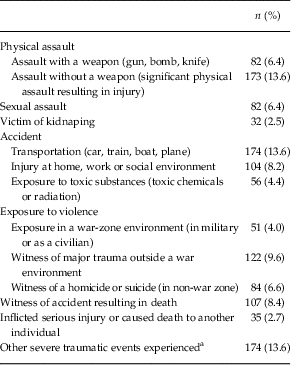
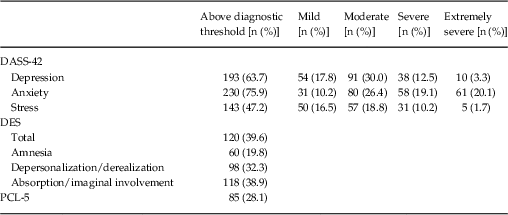
Demographic and clinical characteristics of the 303 participants fulfilling inclusion criteria are presented in Table 1. Of note, most students were single (85%), of socio-economic class III (85%) and 52% of participants were male. The median number of traumatic events experienced was 5, with the most commonly reported traumatic events being victim of an accident (26.2%) or of a physical assault (20.0%) (Table 2). Based solely on scores from psychometric instruments, there was a high prevalence of pathology (PTSD=28%; dissociative experiences=40%) with ‘extremely severe’ anxiety present in 20% of individuals (Table 3). The number of traumatic events experienced was weakly but significantly correlated with scores on all psychometric instruments (p<0.01) with the greatest correlations for total DES score (r=0.30) and PCL-5 (r=0.31). Male gender was associated with experiencing more traumatic events (χ 2=13.17, p<0.01). Gender was not associated with differences in DASS-42, PCL-5 or DES scores (after controlling for exposure to traumatic events).
Demographic and clinical data

DASS-42, Depression Anxiety Stress Scale-42; DES, Dissociative Experience Scale; NQF, National Qualifications Framework; PCL-5, Post-traumatic Stress Disorder Checklist-5.
a Scores reflect percentage scores with possible range of 0%–100%.
Traumatic events experienced

a Includes trauma related to medical or surgical treatment, diagnoses with life threatening injury, victim of significant verbal abuse, victim of natural disasters or fires.
Symptom severity

DASS, depression and Anxiety Stress Scale; DES, Dissociative Experiences Scale; PCL-5, Post-Traumatic Stress Disorder Checklist.
Cut-off scores on DASS-42 for depression (10–13=mild, 14–20=moderate, 21–27=severe, 28+=extremely severe), anxiety (8–9=mild, 10–14=moderate, 15–19=severe, 20+=extremely severe), and stress (15–18=mild, 19–25=moderate, 26–33=severe, 34+=extremely severe) (Lovibond & Lovibond, Reference Lynn, Lilienfeld, Merckelbach, Giesbrecht, McNally, Loftus, Bruck, Garry and Malaktaris1995).
Cut-off score for PCL-5 is 33 (Weathers et al. Reference Weathers, Litz, Palmieri, Schnurr, Marx and Keane2013b).
Cut-off score for DES and sub-components is 30% (Bernstein & Putnam, Reference Bernstein and Putnam1986).
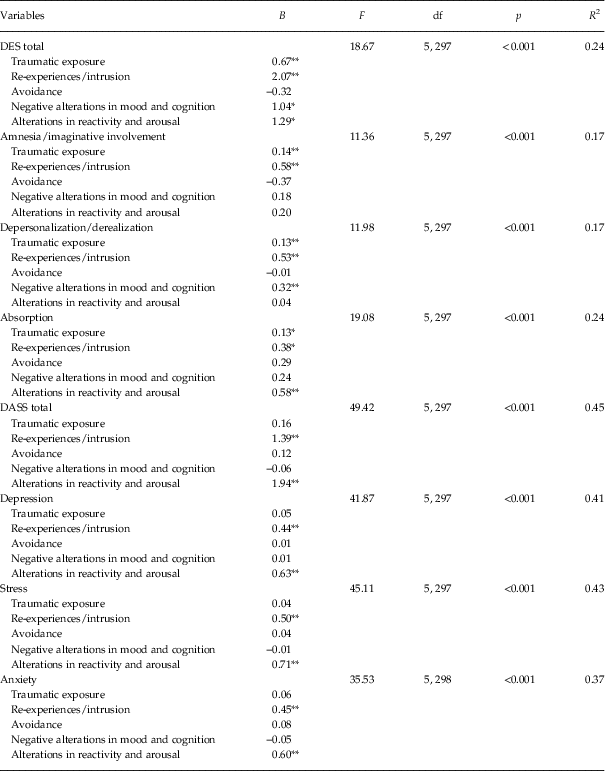
PTSD symptoms as measured with the PCL-5 were predictive of 24% of the variance of dissociative experiences, with symptoms of exposure to trauma (B=0.67, p<0.01) and re-experiencing or intrusive thoughts of the trauma (B=2.07, p<0.01) most predictive (Table 4). Similar findings were noted in relation to the predictive value of the PCL-5 for the sub-components of the DES scale, with negative alterations in mood and cognition and alterations in reactivity and arousal additionally predictive of depersonalization/derealization and absorption at p<0.01 (Table 4). PCL-5 scores were predictive of 45% of the variance of DASS-42 scores, with the DASS components of re-experiencing or intrusive thoughts of the trauma (B=1.39, p<0.01) and alterations in reactivity and arousal (B=1.94, p<0.01) most predictive for total and all three sub-scales of the DASS-42 (Table 4).
Predictive value of post-traumatic stress disorder checklist (PCL-5) total score

DES, Dissociative Experiences Scale; DASS, Depression Anxiety and Stress Scale.
*p<0.05, **p<0.01.
Discussion
In a cohort of previously undiagnosed and untreated third-level students in the Khyber Pakhtunkhwa province of North-West Pakistan, high levels of traumatic events had been experienced or witnessed, findings consistent with previous reports in a study conducted in Karachi (Khan et al. Reference Khan2016). In addition, high rates of symptoms consistent with PTSD, were noted, although individuals participated on the basis of experiencing a traumatic event. This high rate of PTSD is not surprising given a recent previous study in the region noting an approximate 15% rate of PTSD in the population (Razik et al. Reference Ruiz, Poythress, Lilienfeld and Douglas2013). Additionally high rates of anxiety and depressive symptomatology were noted and in excess of other studies conducted in the region in individuals exposed to trauma (Yazdani & Shafi, Reference Zafar and Khalily2014).
Dissociative symptoms were present in 40% of individuals with symptoms of PTSD statistically predictive for all three components of dissociative symptoms, with the greatest predictive value demonstrated for ‘absorption/imaginal involvement.’ Absorption/imaginal involvement was the most common dissociative symptom present, and shares some of the clinical features of PTSD including vivid recollections, difficulty in attention and concentration and has previously reported to be particularly elevated where traumatic events have been experienced (Alper et al. Reference Alper, Devinsky, Perrine, Luciano, Vasquez, Pacia and Rhee1997). Several theories exist to explain the presence of dissociative symptoms in PTSD, including the trauma/avoidance model and the cognitive/sensory deprivation model. The trauma/avoidance model suggests that dissociation occurs as a consequence of trauma exposure, largely to avoid experiencing difficult emotions, cognitions and physical sensations (Waller et al. Reference Yazdani and Shafi2001; Dalenberg et al. Reference Dalenberg, Brand, Gleaves, Dorahy, Loewenstein, Cardeña, Frewen, Carlson and Spiegel2012). The cognitive/sensory disintegration model views dissociation as occurring secondary to biological, cognitive and psychological trait-like factors that reduce the capacity to maintain sensory and cognitive integration under stress such as experience a significant trauma (Merckelbach & Muris, Reference Olsen, Clapp, Parra and Beck2001; Lynn et al. Reference Merckelbach and Muris2014).
The co-occurrence of dissociative symptoms in PTSD is associated with greater functional impairment (Cloitre et al. Reference Cloitre, Koenen, Cohen and Han2002; Norman et al. Reference Norman, Stein and Davidson2007) and lower response rates with trauma-focused treatment (Cloitre et al. Reference Cloitre, Stovall-McClough, Miranda and Chemtob2004; Spitzer et al. Reference Stockdale, Gridley, Balogh and Holtgraves2007; Price et al. Reference Razik, Ehring and Emmelkamp2014). Conversely, when identified, an amelioration in dissociative symptoms has been associated with additional improvements in overall stress levels and other co-morbid symptoms related to PTSD (Brand & Stadnik, Reference Brand and Stadnik2013), suggesting that therapeutic interventions for individuals diagnosed with PTSD should focus on all symptoms including dissociative symptoms.
This study has a number of limitations. First, definitive causality between exposure to trauma and the presence or onset of symptoms, was not possible given the cross-sectional nature of the study. Second, formal operational diagnoses were not attained in relation to PTSD or other diagnoses, however our aim was to ascertain the association between different symptoms in a cohort of traumatized individuals rather than assign diagnoses and all instruments employed have good psychometric indices.
Conclusion
Individuals with symptoms of PTSD, also experienced other psychopathology including dissociative symptoms; with the presence of intrusive thoughts and alterations in reactivity and arousal predictive of dissociative symptoms. The identification and treatment of dissociative and other symptoms in individuals who have been exposed to trauma may potentially ameliorate an individuals’ functioning and quality of life. Future studies adopting a longitudinal design may help clarify the interaction between symptoms experienced, and potentially identify appropriate therapeutic interventions that include strategies for managing dissociative symptoms.
Acknowledgments
The authors wish to acknowledge the third level institutions and their students whose engagement and participation made this research study possible.
Financial Support
This article received no specific grant from any funding agency, commercial or not-for-profit sectors.
Conflicts of Interest
None.
Ethical Standard
Ethics approval was attained prior to the commencement of this study from the Clinical Research Ethics Committee for the Psychology Department at the International Islamic University Islamabad. The authors assert that all procedures contributing to this work comply with the ethical standards of the relevant national and institutional committee on human experimentation with the Helsinki Declaration of 1975, as revised in 2008.