Weber (Reference Weber2022) contends that my arguments about the existence of “five laws of politics” (Cuzán Reference Cuzán2015, Reference Cuzán2019), although grounded in an “impressive” “evidence base,” are unconvincing. A key concept, the “intrinsic properties of politics and the state,” is undefined. More to the point, the adduced empirical relationships are not traced to “underlying social mechanisms” responsible for their operation. Without that knowledge, he submits, no stable pattern among variables of interest to a particular discipline rises to the “special status” of being called a law. However, Weber did not stop there. Helpfully, citing Duverger’s laws as an example, he proceeded to suggest how to close the “argumentative gap” (Weber Reference Weber2022, 459–60). My purpose in this response is to do just that, thereby cementing the special status of the “five laws of politics.”
Weber (Reference Weber2022, 457) accepted my concept of “a law of politics,” to wit: “‘an invariant or almost invariant empirical regularity that is descriptive of intrinsic properties of politics and the state’.” Then he highlights three “important feature[s]” of this definition: a “law of politics” is empirical, need not be deterministic, and describes something essential about politics and the state. Except, however, that those “intrinsic properties” were not specified. Moreover, the ontological and epistemological status of any alleged scientific law remains in doubt, he says, until two philosophical requirements are met. The empirical regularities (1) must be shown to be the outcome of “underlying mechanisms” of interacting parts or entities, and (2) must display “spatiotemporal stability.” In a social system, the entities of the mechanism consist of agents, persons, or “coordinated groups of individuals with common objectives” (Weber Reference Weber2022, 458–59).
To illustrate an argument that meets these requirements, Weber (Reference Weber2022, 459–60) cited Duverger’s famous laws connecting what the French politologist called “the system of balloting” and “the system of parties” (Duverger Reference Duverger, North, North and Brogan1959, 205). A “mechanical effect” is the product of the “electoral regime,” which in turn produces a “psychological effect” as voters and parties adapt to its results. A case in point: the single-member, district-plurality system. Under this system, citizens become reluctant to waste their vote on parties that—although closer to their preferences—stand little or no chance to win seats, while politicos opt to work within or ally themselves with one of the two major parties to remain viable.Footnote 1
As it happens, Duverger’s book includes the following elements constitutive of intrinsic properties of politics and the state:
[T]he two-party system seems to correspond to the nature of things, that is to say that political choice usually takes the form of a choice between two alternatives. A duality of parties does not always exist, but almost always there is a duality of tendencies. Every policy implies a choice between two kinds of solution: the so-called compromise solutions lean one way or the other. This is equivalent to saying that the centre does not exist in politics: there may well be a Centre party but there is no centre tendency, no centre doctrine. The term “centre” is applied to the geometrical spot at which the moderates of opposed tendencies meet: moderates of the Right and moderates of the Left. Every Centre is divided against itself and remains separated unto two halves, Left-Centre and Right-Centre. For the Centre is nothing more than the artificial grouping of the right wing of the Left and the left wing of the Right. The fate of the Centre is to be torn asunder, buffeted, and annihilated: torn asunder when one of its halves votes Right and the other Left, buffeted when it votes as a group first Right and then Left, annihilated when it abstains from voting. The dream of the Centre is to achieve a synthesis of contradictory aspirations; but synthesis is a power only of the mind. Action involves choice and politics involve action….There are no true Centres, only superimposed dualisms…” (Duverger Reference Duverger, North, North and Brogan1959, 215; spelling and capitalizations in the original; emphasis added).
According to Duverger, elections in a democracy present the electorate with two dualisms: a choice to vote or to abstain. The vote choice is to do so for the party in office (or one of its partners or allies in government) or for one in opposition. In 990 elections in developed and newer or less-developed democracies grouped under the respective labels of OECD (Organisation for Economic Co-operation and Development) and non-OECD (see the appendix), the following relationships were observed. On average, about 25% of the electorate stays home; of those who do show up at the polls, approximately 40% vote for the incumbents. These averages yield a support rate lower than one third, a fraction that regionally trends somewhat downward during the century of data under examination only in the OECD (β=-0.11, R-Sq.=0.26); thus, the “law of minority rule.” Duverger’s moderates decide the outcome of elections: thermostat-like, they lean one way in one election and the opposite way in another, depending on a number of factors. One is how far policy strays to the Right or the Left from the “geometric spot” (Budge Reference Budge2019; Erikson, MacKuen, and Stimson Reference Erikson, MacKuen and Stimson2002; Soroka and Wlezien Reference Soroka and Wlezien2009; Wlezien Reference Wlezien1995, Reference Wlezien2017). Chance also plays a part (Budge Reference Budge2019; Heggen and Cuzán Reference Cuzán2022a). Thus, the “law of electoral equipoise” or “alternation in office,” wherein parties of the Left (coded 1) and of the Right (coded -1) succeed each other in office with great regularity: the net ideological party score averages -0.19 and 0.12 in the OECD and non-OECD regions, respectively. This stable ideological balancing is the outcome of two other laws. The first is the “law of shrinking support,”Footnote 2 wherein incumbent vote falls, on average, from 2 to 3 percentage points per term in the developed democracies to two to three times that value in the non-OECD region, with no discernible time pattern in either case (Cuzán Reference Cuzán2022b). The second is the “law of the 60% maximum.”Footnote 3 Incumbent vote exceeds 60% in less than 5% of all election outcomes, with most of the exceptions occurring in the newer democracies and with no variation across the century of data being examined. Adducing to the party “machines” in the United States, Duverger pointed out the “legal and illegal advantages” that “positions of power” bestow (Reference Duverger, North, North and Brogan1959, 147–48). Thus, with the proviso that these advantages—helpful if nothing else for staying in office—are available to a greater or lesser extent in all regimes, the “law of incumbent advantage.” In the developed democracies, incumbents win reelection more than half of the time and, when they do, they receive about 3 to 4 percentage points more than when the opposition drives them from office. Outside of the OECD, incumbents win reelection only half of the time, but the victory vote gap is twice as large. Neither gap shows any sign of narrowing.
These five laws together constitute an interwoven collection of electoral regularities.Footnote 4 They are clearly observable in democracies—regimes that feature enforceable political rights and civil liberties that enable the electorate to make the choices of which Duverger wrote. Drawing on information supplied from a plurality of sources, citizens choose among parties or leaders on offer during campaigns, or they stay home if they find no appealing options, believe that their vote makes no difference, or have no interest in politics. The “out” parties leverage freedoms of speech, press, and assembly to criticize the party in government on policy overreach and myriad other issues (economic conditions, crime, corruption, scandals, and so on) and to mobilize their supporters.Footnote 5 For their part, the incumbents exploit state resources for partisan purposes, strategically manipulating levers of power and propaganda to pitch their case for another term—a case that becomes less likely to succeed the longer they remain in office (Heggen and Cuzán, Reference Cuzán2022a). In summary, the interactions among voters and parties that take place within the rules operating in modern democratic states constitute the social mechanisms underlying the five laws of politics.
These five laws together constitute an interwoven collection of electoral regularities.
The interactions among voters and parties that take place within the rules operating in modern democratic states constitute the social mechanisms underlying the five laws of politics.
The laws also exert themselves in dictatorships, only under different manifestations. To survive, a regime must flex its coercive arms to resist opposing currents and repress dissidents and potential rivals. It uses positive and negative incentives to elicit support, cooperation, or passive compliance from the population. Elections, if held at all, are manipulated to ensure the victory of the ruling party or coalition. These machinations reach absurd levels under a totalitarian party, which—making the most of the incumbent advantage—manufactures upwards of 90% turnout and an equal percentage of votes in its favor. However, the moment that such a dictatorship holds a more or less free election (as in many countries during the “Third Wave” of democratization of the 1990s), “as if pulled by an irresistible law of political gravity, like an avalanche incumbent vote plunges from its artificial highs” (Cuzán Reference Cuzán2022a, 72).
In the foregoing, “the intrinsic properties of politics and the state” are implied. To make them explicit: the state is an entity, something like a machine,Footnote 6 whose governors—carriers of particular ideas, interests, and partisan and personal agendas—cooperate and clash with one another in the making and implementing of policies that are binding on the population. Never—or almost never—is there unanimity about what is to be done, about ends or means. Competition or actual struggle for control of the decision making and coercive instruments of the machine is, in Duverger’s (Reference Duverger, North, North and Brogan1959) phrase, “in the nature of things.” A democratic regime constrains election winners in the exercise of state power, especially in its use against critics and rivals; allows a greater variety of inputs into policy making; and generates a more diverse political class. With two parties or multiparty “tendencies” on each side of the “geometric spot” setting goals and pushing and pulling the bureaucracy to implement them before they are ousted by a weary public (Budge Reference Budge2019, 168 ff), a “political equilibrium”—perhaps what Duverger (Reference Duverger, North, North and Brogan1959, 424–25) had in mind—is maintained.
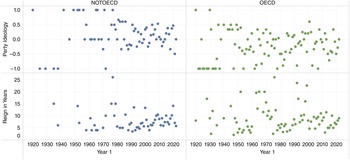
I conclude with two observations. The first is theoretical, specifying the scope of the five laws. They apply to all modern states—that is, to any national political entity (past, present, or future) whose governors claim the right to exercise sovereign authority, however it is acquired. The second observation is empirical. It demonstrates the spatiotemporal stability of what is arguably the signal characteristic of a democracy. That is, opposing parties or coalitions alternate in office about once per decade, netting a nearly neutral ideological score. As shown in figure 1, these statistics have remained constant for as long as a century in each region.
Mean Regional Party Ideology and Reign by Year
The total includes 22 developed democracies (grouped under the OECD label), and 58 newer or less developed ones whether or not they are formal members of the international organization. For the list, see the Appendix. A reign is the length of a party spell in office, in years. Party ideology is coded 1 for Left or Center Left, 1 for Right or Center Right, and 0 for ambiguous, of which there are only a few.

Having offered, in response to Weber and consistent with Duverger’s theorizing, a plausible mechanism for expecting the electoral patterns summarized in the five laws to persist indefinitely, I submit that the burden of argumentation now shifts to those who would question that they will continue to hold. Given the “intrinsic properties of politics and the state” argued here, what reasons are there for doubting that these spatiotemporal patterns will project into the future?Footnote 7
ACKNOWLEDGMENTS
Many thanks to Professor Weber for his thoughtful and stimulating critique of the “five laws” articles, to the editors of this journal for allowing a response, to the anonymous reviewers who made useful suggestions, and to Ian Budge and Josep Colomer for their helpful comments and encouragement. Thanks also to graduate assistants Carter Edwards and Grace Wheeler for proofing much of the data. The usual disclaimer applies: any errors of fact or interpretation are my own.
CONFLICTS OF INTEREST
The author declares that there are no ethical issues or conflicts of interest in this research.
DATA AVAILABILITY STATEMENT
Research documentation and data that support the findings of this study are openly available at the Harvard Dataverse at https://doi.org/10.7910/DVN/OKEKRX.
APPENDIX