In the aftermath of election day 2020, Donald Trump declared premature and then patently false victory on Facebook and Twitter. Trump cross-posted on both platforms, meaning he uploaded identical content to each of them. However, differing company policies governed the spread of his content. Facebook labeled Trump's status updates with clarifications about the electoral process but allowed all his posts to circulate freely.Footnote 1 Twitter labeled his tweets as “misleading” or “disputed” when they explicitly accused Democrats of stealing the election or dumping ballots. Such posts were taken out of circulation or subjected to higher standards for circulation. But it remained possible to embed disinformation tweets in websites beyond Twitter, and some disinformation tweets could be circulated with user commentary (known as a “quote tweet” rather than a retweet). Even when social media platforms close the door to circulation, they open a customizable window.
Social media posts may or may not be written with the intent to deceive, but they are uniformly published with the click of a button. Real-time publishing and delayed content moderation affirm the cyberlibertarian ethos that “information wants to be free.” Whether that information wants to be true, however, is a question that tech companies have sidestepped despite an election year in which Jack Dorsey (Twitter), Sundar Pichai (Alphabet), and Mark Zuckerberg (Facebook) found themselves in the hot seat. These CEOs testified before Congress on 28 October 2020 about the continued viability of section 230 of the Communications Decency Act of 1996. Section 230, also known as the twenty-six words that created the Internet, stipulates that “no provider or user of an interactive computer service shall be treated as the publisher or speaker of any information provided by another information content provider” (United States). “Interactive computer service” does not exactly roll off the tongue. Nor does “content intermediary,” another legalistic term for what in ordinary language is called a social media platform.
Section 230 protects the businesses behind Facebook, Instagram, Reddit, Twitter, YouTube, and a vast number of other sites from being held liable for the user-generated content they host and algorithmically mediate. It additionally gives these companies the right to restrict access to objectionable content, although historically platforms have wielded this power (or declined to wield it) in inconsistent, belated, and boneheaded ways. In 2020, both Joe Biden and Trump called for the repeal of section 230 for very different reasons. Biden argued its liability protections disincentivized social media companies from curbing the spread of misinformation, while Trump and others in the Republican Party claimed that the enforcement of content moderation policies had led to censorship of conservative opinions.
It is unlikely that section 230 will survive much longer in its current form given that even Facebook supports reforms and has issued a white paper with its recommendations (Bickert). What is most interesting about Facebook's white paper, for humanists and media historians in particular, is its continued use of the term publisher as a definitional foil for platform. Whereas a publisher faces stringent liability laws for works they put into circulation, an interactive computer service or platform is protected from liability based on its identity as an intermediary for an abundance of information. The publishing process, whether we are talking journalism, literature, or scholarship, takes time. It bears the marks of editorial intervention, fact-checking, and, if not agreement with, legitimation of the published content's quality. Publishers stand behind their authors. Platforms evanesce around their content creators. Social media companies are patrons of content when it serves their interests, mere pipes for the communication of content when it does not.
The rise of the platform as a discursive mode of self-characterization works to the advantage of social media companies in several ways: it separates algorithmic amplification from editorial decision-making; it names a service that appeals to multiple constituencies (individual consumers, advertisers, legacy media producers, and political campaigns); and it mixes physical and metaphysical “semantic territories” in evocative ways (Gillespie 349). Physical in that social media platforms are computational hardware and software architectures and metaphysical in that such architectures come wrapped in the rhetoric of free expression and communal promise. The proliferation of platform as an all-purpose alternative to publisher speaks to the term's utility for companies eluding regulation by claiming neutrality instead of selectivity. The stated aim of social media companies is to facilitate real-time communication. Vetting the quality of content not only opens them up to accusations of bias, it slows down transmission.
It will be up to legislators to hold social media companies to regulatory account, but it remains the vital task of scholars in the humanities to make collective sense of the mediascape their platforms have created. However tempting it might seem in the wake of 2020, we cannot just conflate the Internet with a hellscape and unplug. Nor can we consider Internet culture just one more context among many in which we elect to study literature. The Internet has eclipsed television as the determining environment of mass-mediated life. It has also arrived as a central player in the sociological formation of literature (Murray) and in the diffusion of literary practices into paraliterary spheres of textual activity (Vadde and Pressman). As social media companies took center stage in 2020, the national conversation centered on misinformation, free speech, and the polarized politics underlying the global and systemic crises of our day: climate change, COVID-19, and police violence against Black people. What this conversation missed, unfolding as it did through the prism of Facebook's and Twitter's failures, was a full accounting of the sociotechnical milieu that enabled the rise of these companies in the first place.
That milieu was created and popularized through a movement called Web 2.0. After section 230 passed in 1996 and the dot-com bubble burst in 2001, Internet culture was reconceived and rebranded under the Web 2.0 banner. What Tim Berners-Lee (the inventor of the World Wide Web) once imagined as a global information space, Tim O'Reilly (a venture capitalist, publisher, and classics major) pitched as a global participation space. O'Reilly organized the Web 2.0 conference in 2004. There the web itself was declared a platform and many of the vocabularies and principles that underpin social media crystallized in all their participatory and conscriptive dimensions.
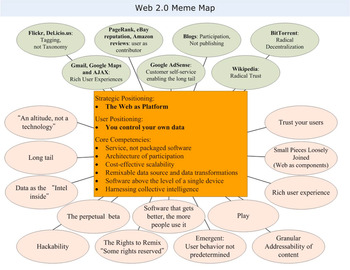
O'Reilly's vision of Web 2.0 gave the edge to companies that could market to users whose online activities added value rather than to consumers who bought a finished product. “Perpetual beta,” “trusting users as co-developers” (O'Reilly 30), software that “gets better the more people use it” (22). These slogans, addressed to software companies and emblazoned on a widely circulated infographic known as a “meme map” (fig. 1), were based on the idea that designing the social web meant amassing a crowdsourced labor pool and a monetizable data stream. When O'Reilly's allies like Lawrence Lessig and Clay Shirky presented Web 2.0 to a more general public, they added empowering and democratic-sounding phrases like Lessig's “free culture” (Free Culture xiv) and “amateur creativity” (Remix 33) and Shirky's “everyone is a media outlet” (55). Shirky touted the “effortlessness of publishing” on the Internet (65) and argued that the newfound ease of self-broadcasting would change the definition of the news itself from an “institutional prerogative” to an artifact of a “communications ecosystem” (66).
Tim O'Reilly's Web 2.0 meme map.

What is so scary about Shirky's words is not their ideological optimism but their implicit claim that the policies of technology organizations had no shaping force over the “ecosystem” they had helped design. The corporate and now cultural logic of the platform turns on the deprecation of gatekeeping and the promise of amplification. As news organizations and book-based publishing houses become increasingly dependent on digital intermediaries for real-time communication, what constitutes “news” and “literature” becomes ever more estranged from the professions used to setting the standards for both.Footnote 2 Scholars of communication have been at the forefront of studying the effects of social media on the amateurization of news. Citizen journalism runs the gamut from live tweeting protests or disaster sites to livestreaming various forms of eyewitness encounters, such as police stops. Such reporting is vital to communities; however, the technologies that enable it also enable the outright manipulation of the news. In alt-right corners of the Internet, fringe groups and trolls exploit the protocols of the web to trade “up the chain” from 4chan and subreddits to Trump's Twitter account and Fox News (Marwick and Lewis 38).Footnote 3
Is there analogous work to be done among scholars of literature? What would literary studies look like if we rethought the discipline for a post–Web 2.0 world? Of course, scholars in distinct areas of the field have been rethinking literature through the prism of digital technologies for a while now, but not within the sociotechnical framework of Internet culture or with the aim of analyzing the computing systems, business decisions, regulatory landscape, and literacy practices that enable it. Different subfields have grown out of the examination of born-digital literary texts, digitized literature, and structural changes to the publishing industry. Each exemplifies a distinct method of literary study. The study of electronic literature, for instance, has contributed the vital categories of medium specificity and forensic materiality to the formal analysis of aesthetically accomplished works (Hayles; Kirschenbaum). Sociologies of contemporary literature have reconsidered institutional definitions of literariness and literary value in the light of web-based self-publishing and e-commerce (Levey; McGurl). Quantitative literary studies have made use of big data (that is, large corpora of digitally encoded texts) and machine learning to rethink the scale and style of analysis properly called literary (Moretti; Piper; Underwood). Minority and postcolonial approaches to the digital humanities have asked how normative Whiteness and the colonial archive continue to structure the so-called openness and accessibility of the digital record (Liu; Risam).
Forms, institutions, scales, identities. These apertures of study cross paths in new ways when web-based platforms become players in literary history. Moreover, the concept of the platform itself is ever more salient to explaining cultures of reading, writing, distributing, and discussing literature online and off. As the printed book becomes one among many formats for distribution, the term platform offers a higher order generalization for thinking about the making and consumption of narrative, poetry, criticism, games, and other genres that fall under the literary scholar's purview.
Ian Bogost and Nick Montfort's development of “platform studies” was the first thoroughgoing attempt to integrate the analysis of specific computational platforms into the humanities, and their influence has been justly felt in game studies. While Bogost and Montfort's theorization of the platform rigorously illuminates the technical underpinnings of digital artifacts, it is not intended to have as much explanatory power over contemporary literary history. It leaves out the crucial conjunctures of print and digital media, sidelines the cultural dynamics by which computational infrastructures alter extant industries of book publication, and overlooks broad shifts in literacy pertinent to popular reading and writing practices.
Instead of importing Bogost and Montfort's approach to platforms, I have argued that studying web-based literary cultures begins by questioning the structural divisions in English departments (“Amateur Creativity”). Literary studies, composition and rhetoric, and creative writing respectively privilege aesthetic quality, literacy, and craft in their teaching missions. However, as individual and institutional reliance on digital intermediaries grows, literary forms and writing techniques develop in tandem with new literacy skills like coding and with shifts in perception about long-standing skills like reading and writing. Although English and literature departments view writing as annexed to reading, more young adults now exhibit a writing-based literacy (Brandt 91). They prioritize writing over reading and regard it as an avocation that can lead to a vocation in writing-centered professions like book publishing and journalism. This hobbyist but also aspirational pursuit of writing, anathema to the curricular order of literacies, flourishes in extracurricular collaborations with mentors and peers (115).
While social computing is certainly not responsible for the emergence of writing-based literacies, it accelerates the growth of informal writing en masse and the visibility of self-publishing.Footnote 4 Indeed, despite the growth of the computer science major and the craze for coding camps, the restructuring of the web as a platform has seen a greater proliferation of writing in text and image for the front end of the computer than of writing in code for the back end. Berners-Lee sought to develop a web in which the accessibility of markup languages such as HTML would enable users to program the web themselves. Although Berners-Lee did not intend for HTML code to be viewable by visitors to web pages, he thought the language set a low barrier to entry for those who wished to design and modify their own documents (Berners-Lee 42). Seen in retrospect, Web 1.0 afforded more possibility for user-generated code on a mass scale than Web 2.0, which afforded more possibility for user-generated content on a mass scale. The incentivizing of content production transformed the web from an aspirational “mass-coding platform” into the “mass text-writing platform” that exists today (Vee 213).
The turn from the open computing of Web 1.0 to the social computing of Web 2.0 corresponds with the closing off of programming skills from end users and the rise of a consumer base effectively barred from understanding how social media platforms work. Zuckerberg's zeal for so-called frictionless sharing on Facebook extends the ideology of user friendliness associated with computing products from the Apple Macintosh to the iPhone (Chun; Emerson). In design language, social media platforms and mobile devices strive to be “invisible” or “intuitive” while preventing consumers from tinkering with their hardware or software to learn more about how they work.
Social media companies grew powerful by shrugging off the responsibilities of publishers and securing their platforms from their users despite claims of openness. Yet the division between platform and publisher is neither stark nor stable. Facebook has rejected the identity of publisher in the press when it comes to facilitating the distribution of user content, but it has claimed that very identity in court to defend its policies for regulating data access by third-party app developers. In a 2018 case, Facebook's then lead counsel, Sonal Mehta, invoked publisher discretion to argue that Facebook's decisions about what to publish are protected under the First Amendment as a newspaper's or publishing house's would be. However, she shifted the “publishing function” of Facebook from content to data and from the user interface to the developer application programming interface. She claimed that as a publisher of data, Facebook has the right to decide when to make data accessible to third-party developers and when to pull access (Levin). Such pirouettes show how social media companies manipulate the platform-or-publisher dyad to navigate between data brokering on the one hand and content moderation on the other.
From the front end to the back end, social media companies use the legalities around publishing to defend their decisions about our content and data. These decisions obviously go beyond literary production, but twenty-first-century literature and art also illuminate them for a public in thrall to the design choices and community standards of privately owned platforms. Take Instagram's removal of the poet Rupi Kaur's menstruation photographs. While an undergraduate at the University of Waterloo, Kaur developed the photo series for a visual rhetoric course in which an assignment prompted her to write in images that challenged social norms (Rao). In March 2015, Kaur published a photo of herself lying on her bed with menstrual blood visible on the back of her pants and on the sheets. When the photo was censored by content moderators on Instagram, Kaur incorporated the decision into her captioning of the image for publication on Facebook to underscore the success of her project in revealing the sexism of Instagram's community standards (Kaur). Posting across Facebook, Instagram, and Tumblr, Kaur garnered millions of views and raised her Instagram follower count from 35,000 to 185,000 in three days.
Kaur's poetry and artwork aligned with feminist campaigns to reform Facebook's community standards with respect to female nudity in fine art, breastfeeding images, and acts of protest. A scandal of content moderation raised her profile and played no small role in launching her toward social media celebrity. However, it was also Kaur's branding strategy, which she described as “a very Apple way of doing things,” that ensured readers would recognize the aesthetics of a “Rupi poem” even if it circulated beyond her feed and without her name attached (qtd. in “Rupi Kaur Reinvents Poetry”). In August 2015, Milk and Honey (self-published before the menstruation photo series) would be republished by Andrews McMeel and spend two years on the New York Times best-seller list.
Kaur is the best known of the infamous “Instapoets,” a group of young writers who built their popularity through social media and self-publishing and whose work generally inspires derision at worst and ambivalence at best from the scholars, writers, and publishers that form the literary establishment. Yet the phenomenon of Instapoetry, like that of the “fast artwork,” speaks to a larger crisis of artistic definition and value occasioned by the information economy and addressed by postautonomous aesthetic theory. John Roberts develops the concept of the fast artwork to explain the dialectic of skilling, de-skilling, and re-skilling in visual art that relies on real-time telecommunications systems. The fast artwork offers a “liberation from craft” or a technical de-skilling in the vein of Duchamp's readymades; it trades discrete form for diffuse spread and “internal complexity” for “attenuated complexity” (220). Roberts goes on to argue that such artworks reveal how complexity itself cannot stand as a “normative criteria of value in art” because both internal complexity and attenuated complexity merely represent aesthetic preferences derived from how one defines and locates skill. Complexity can reside in the internal formal accomplishment of the work, in the idea motivating it, or in the seamlessness with which the work externally diffuses or disappears into the “capitalist sensorium” (221).
In a postautonomous world where the artwork is indistinguishable from the commodity, Roberts relocates autonomy away from the work itself and within the “de-temporalized” experience of the viewer. He suggests that such an experience, synonymous with the aesthetic, can be embedded in our “temporal involvement with a set of activities or processes” rather than limited to our absorption in discrete objects of art (223). Roberts derives his theory from the study of neo-avant-garde artists like Critical Art Ensemble and Superflex, who are known for encrypting artistic projects into nonartistic pursuits. Yet his insights expand beyond a narrow definition of art, as a subset of works deemed worthy of study, to an account of aesthetic experience analogous to Mark McGurl's account of literary experience as the “occasion for the real-time enjoyment of virtual quality time” (469). McGurl too thinks postautonomously, treating fiction as a commodity defined by its “partial temporal disjunction” from the real-time regime in which it is embedded (465). This disjunction, like the de-temporalization of the aesthetic encounter, shifts any remnant of autonomy from the work of fiction to the experience of reading fiction.
Given his objects of study (novels), McGurl does not go as far as Roberts in thinking about literary works that seem to disappear “absolutely into the flow of all other commodities,” including “vast amounts of decontextualized signs” (Roberts 220, 21). Yet if we were to think about genres born from social media—like Instagram poetry, Twitter fiction, or Facebook fiction—we would have an avenue for theorizing about literature that anticipates its own reception as undifferentiated content subject to human and machine intermediaries. This literary indistinction is something that Kaur counteracts through invisible branding but that, for example, Teju Cole courts in his Twitter projects ranging from what he calls “small fates” to the crowd-published short story “Hafiz.”Footnote 5
Understanding literary indistinction, strange as it may sound, is what scholars need to do to keep up with literature's changing contours and constituents within a platform-based Internet culture. It will entail thinking about the diffusion and splintering of literariness across circuits of prestige and popular attention. It will also demand learning more about the literacy practices of online communities and the design vocabularies of human-computer interaction. While it is by now cliché to speak of information overload on the Internet, it is ridiculous to suggest that ordinary people are incapable of carving out online spaces for curatorial or critical engagement. Indeed, we can look to fan-fiction communities, so-called piracy networks, and sleuthing groups to see how Internet users integrate information and organize themselves into collectives with social and emotional force. As what we in the university call literature becomes more entangled with social media, we face the challenge of educating ourselves on extracurricular literacies to discern how they might shape our curricular engagement with students. Instead of presenting literary study as an antidote to digital degeneration, what if it were a prerequisite for inquiry into the aesthetic forms and vernacular cultures of the Internet?