Why do dictatorships enter into international agreements? The field of international relations has established little on this question, and what has been established seems to be in residual form. Dictatorships are less likely than democracies to enter into certain economic agreements,1
they are less likely than democracies to enter into human rights agreements,2 and, generally speaking, the commitments of dictatorships are less credible than those of democracies.3For example, see Martin 2000.
Gandhi and Przeworski 2006a.
In her seminal piece on the effects of human rights treaties, Hathaway surprisingly finds that countries that had entered into the CAT subsequently experienced higher levels of torture than countries that had not ratified the convention. Hathaway notes, however, that it is not clear from the analysis whether the results are due to a selection effect or the inherent effects of the Convention itself: the analysis “cannot tell us whether the patterns that we observe are due to the impact of treaties or instead to factors that are associated both with ratification and with countries' human rights ratings.”5
Hathaway 2002, 1989.
Who cares? Is there really anything interesting about this question? Downs, Rocke, and Barsoom argue that governments do not want to cede sovereignty to international bodies and enter into international agreements only if they are de facto compliant with the agreement.6
Downs, Rocke, and Barsoom 1996.
Hathaway 2003, 19.
Consider Figure 1, which depicts the broad pattern of torture and entering into the CAT for democracies and dictatorships respectively. Note that because my question is about CAT selection (entering the agreement), the figure presents the annual rates of signing and ratifying the CAT by level of torture practiced by the government.

Practicing torture and entering into the CAT by regime type (1985–96)
What is torture and how is it measured? The CAT defines torture as any act inflicted under public authority by which severe pain or suffering (physical or mental) is intentionally inflicted on a person for the purposes of obtaining information or a confession, punishment, intimidation, coercion, or discrimination. The first measure of torture comes from Hathaway, whose data are from U.S. State Department Reports; she codes torture “by referring directly to the requirements” in the CAT.9
The Hathaway measure is also guided by other conventions, including the American Torture Convention, which has a similar definition of torture. Consistent with the CAT definition, punishments pursuant to a country's legal system (such as Sharia) are disregarded. See Hathaway 2002, 1969–72.
For Cingranelli and Richards, “Torture refers to the purposeful inflicting of extreme pain, whether mental or physical, by government officials or by private individuals at the instigation of government officials. Torture includes the use of physical and other force by police and prison guards that is cruel, inhuman, or degrading” (1999, 408). Torture can be anything from simple beatings, to other practices such as rape or administering shock or electrocution as a means of getting information, or a forced confession. When the U.S. State Department does not report torture, but Amnesty International does, the authors follow Amnesty International (also see Cingranelli and Richards 2003). Though the Hathaway and CIRI measures are the best currently available, they do not record certain features of torture that would be useful, such as the torture techniques employed (see Rejali 2007). Nevertheless, these measures are consistent with the definition of torture in the CAT, as opposed to other important but more general measures of human rights. For recent analyses of the impact of the CAT and other human rights treaties on broader conceptions of human rights, see Landman 2005a.
For a discussion of ontological and epistemological challenges facing the study of human rights, see Landman 2005b. I address the possibility of hidden torture below.
Even a cursory presentation of the data reveals differences by regime. Following Cheibub and Gandhi, I define dictatorship as a political system where the executive and/or the legislature are filled by means other than contested elections.12
“Contested” elections are those where incumbents face a legitimate chance of losing elections and comply with the results (Cheibub and Gandhi 2004). For further distinctions about how dictators come to power, see Geddes 1999.
Neumayer confirms that the CAT experiences of democracies and dictatorships is qualitatively different. He finds that while the CAT can have beneficial effects under democracy, it appears to increase human rights violations under dictatorship. He concludes that careful examination of why dictatorships enter into the CAT is necessary.13
A real puzzle of CAT selection is why dictatorships enter. This is the point of departure for my investigation.My study shows that domestic political institutions can, in part, explain the strange pattern of participation for dictatorships. In particular, it shows that dictatorships that have multiparty systems have higher levels of torture and are more likely to participate in the CAT.
The argument begins with a logic of torture, a practice I consider to be an unfortunate tool in the arsenal of statecraft. Torture is more likely to occur where power is shared. Consider two types of dictatorships: a dictatorship with multiple political parties versus a dictatorship that is “closed” to multiple parties, where power is concentrated in just one political party, one junta, or one man. Gandhi argues that “closed” dictatorships rely on fear and intimidation to rule, rather than the co-optation of groups organized through political parties.14
If this is so, perhaps the fear is so great that few individuals choose to defect against the regime. Individuals recognize that punishment for defection is a near certainty, so defection is not common. Consequently, less actual torture is necessary. But make no mistake; like all dictatorships, these are “protorture” regimes. They rely quite effectively on torture. Indeed, torture even takes place from time to time. As Rejali argues, the use of fear and the practice of torture are quite sophisticated. For example, torture may be used to obtain false confessions, which are then held over the heads of individuals in order to coerce their cooperation and support for the regime. In such situations, individuals fear prosecution for the falsely confessed crimes and are willing to act as informants for the dictatorship.15Rejali 1994.
See Poe, Tate, and Keith 1999; Davenport 2000; and Goodliffe and Hawkins 2006. It is not obvious that my argument applies to all forms of human rights abuses. Torture may be a special case. The argument may apply, however, to killings and disappearances intended to control and intimidate.
There is more torture where power is shared,17
such as where dictatorships allow multiple political parties. By legalizing parties, dictatorships explicitly endorse at least some alternative political points of view. Often dictatorships allow these parties to compete in elections to fill legislative seats that even may have some legislative jurisdiction.18Gandhi 2004.
Because the interest groups represented in parties exert some political power, however, they can pressure the dictatorial regime to make concessions. One concession these dictatorships can make is the gesture of entering into the CAT.
Much as Moravcsik and Landman have shown, that insecure actors in new democracies hope to “lock-in” human rights by tying their countries to international institutions,20
political parties in dictatorships pressure their governments to enter into the CAT. Certainly signing or even ratifying the CAT is far from “locking in” policy for most dictatorships, but it is a move in the right direction. Indeed, the CAT can, in some limited circumstances, have binding impacts, as Goodliffe and Hawkins highlight.21 Hawkins shows, for example, that domestic political interest groups helped pressure Augusto Pinochet of Chile to enter into the CAT.22Hawkins 2002.
What are the payoffs for the dictator? For the typical dictatorship, the costs of signing and ratifying the CAT are low and depend on domestic politics. One-party or no-party dictatorships, which rely more on fear to rule, do not want to make a concession and send the wrong signal to their citizenry by signing the CAT. Even the low costs of the CAT go against their interests, and they face no organized pressure from legal political parties to make concessions. However, multiparty dictatorships, in the face of pressure from legally organized political parties, are more likely than their closed dictatorship counterparts to sign and ratify the CAT. Under pressure from political parties, signing and ratifying the CAT is a small concession the regime can make to co-opt and win the support of various political groups. Signing the CAT may win only a small degree of support, but the costs are low, and there may also be benefits at the international level as some Western powers and nongovernmental organizations (NGOs) support the CAT.23
See Goodliffe and Hawkins 2006; Hawkins 2002; and Sobek, Abouharb, and Ingram 2006. Also see Hathaway 2004.
The remainder is organized as follows: After providing a brief background on the CAT, I present my argument. Then I present empirical evidence supporting my claims. I conclude with a brief discussion of policy implications along with suggestions for future research.
Background
The United Nations Convention Against Torture and Other Cruel, Inhuman or Degrading Treatment or Punishment (CAT) is one of several human rights conventions that are “principally a legacy of World War II.”24
Beitz 2001, 270.
Ibid., 271.
While the CAT calls for the end of torture, it clearly has not succeeded. What mechanisms does the CAT put in place to prevent the use of torture? The CAT mainly focuses on domestic measures. Generally, the CAT requires governments to make torture illegal and to take steps to prevent its use. Consider the following:
- Article 2 calls for signatories to “take effective legislative, administrative, judicial or other measures to prevent acts of torture in any territory under its jurisdiction.”
- Article 4 requires signatories to make torture illegal according to their domestic laws.
- Article 10 calls for education about the prohibition against torture to “persons who may be involved in the custody, interrogation or treatment of any individual subjected to any form of arrest, detention or imprisonment.”
- Article 14 calls for rights to be provided to victims of torture, including some form of compensation and rehabilitation.
Upon ratifying the CAT, and periodically thereafter, governments are required to submit reports describing the measures that are in place to prevent torture. But the international enforcement mechanism is weak.26
For studies of international agreements with “hard” human rights standards, see Hafner-Burton 2005; and Moravcsik 2000.
The CAT established an international monitoring board called the Committee Against Torture, consisting of “10 experts of high moral standing and recognized competence in the field of human rights,” who are elected by the countries participating in the CAT (Article 17). What can the committee do to end torture? First of all, the committee makes reports on government reports about the domestic efforts to comply with the CAT (Article 19). The committee can also take action (in the form of filing reports) if torture is alleged against a country, but only if the accused country has accepted key parts of the CAT. For example, only if the accused country has accepted Article 21 can the committee consider allegations of torture brought by other governments; otherwise, such allegations must be ignored. Only if the accused country has accepted Article 22 can the committee consider allegations of torture brought by (or on behalf of) individuals; otherwise, such allegations must also be ignored. Articles 21 and 22 appear to be of great concern to governments, as evidenced by low levels of acceptance. Many more dictatorships are willing to sign and ratify the CAT than are willing to submit to Articles 21 and 22. In fact, out of 122 dictatorships observed from 1984 to 1996, forty-six signed the CAT and thirty-eight ratified, but only five accepted Articles 21 and 22.27
Algeria (1989), Hungary (1989), Senegal (1996), Togo (1987), and Tunisia (1988). Since 1996, Uganda (2001) ratified Article 21; Azerbaijan (2002) ratified Article 22; and Cameroon (2000) and Paraguay (2002) ratified both.
For an alternative view on international institutions and sovereignty, however, see Raustiala 2003.
This is not to say, however, that the CAT is without international implications. Articles 5 through 8 deal with extradition and have severe implications. For example, Augusto Pinochet, the dictatorial ruler of Chile who signed and ratified the CAT in the late 1980s, was held on these provisions a decade later by British and Spanish courts.29
Goodliffe and Hawkins 2006, 360. For more on this question of “universal jurisdiction,” see Hawkins 2003.
So, beyond international implications, ratification can have domestic consequences. As Hafner-Burton and Tsutsui argue, “civil society provides the enforcement mechanism that international human rights treaties lack, and can often pressure increasingly vulnerable governments toward compliance.”30
Consider, for example, Egypt, which signed and ratified the CAT in 1986. The government reported to the Committee Against Torture, “Since the Convention was now regarded as an integral part of domestic law, it was of course on the curriculum of [police] training institutions … the crime of torture was [also] receiving a good deal of attention in the media.”31Committee Against Torture 1989, 25.
Thus, domestic actors in potential jeopardy of torture—such as those participating in alternative political parties—may favor the CAT, even if the convention does not go far enough to eliminate torture. It is a step in the right direction from their point of view. Governments, facing pressure from such political parties, may choose to sign and ratify at least the domestic portions of the CAT since the costs are relatively low. Why should they not? By doing so, they can make a statement that they oppose torture. Being antitorture is akin to being promotherhood. Who would choose not to make this kind of public declaration? In the next section, I argue that dictators relying on the fear of torture would not.
The Argument
Why do governments enter into the CAT? The pattern of participation for democracies is easy to understand. These governments are, by and large, de facto compliant so they sign. In the rare instances where torture is practiced and signing might be costly, democracies are less likely to sign. The puzzle is why dictatorships that practice torture enter into the CAT, while dictatorships that do not practice torture do not enter.
The Logic of Torture
To determine whether a dictatorship will enter into a convention against torture, it is useful to understand why a government would want to engage in torture in the first place. Recent research argues that the use of violence by governments is a strategic choice. Wantchekon and Healy suggest, “Torture can be a rational choice for … the endorsing state.”32
Wantchekon and Healy 1999, 596.
Ibid., 597.
Rejali 2007.
Reiter and Stam 2002 show this is even true during wartimes. Yet, Rejali 2007 explains democracies also face incentives to use “clean” torture techniques that do not leave obvious marks and are harder to detect.
A clue to answer this question is found in the work of Kalyvas on a related topic: the logic of violence in civil wars. Kalyvas argues that violence is employed strategically and that violence is necessary only when there are likely subversives against the regime within society. Kalyvas argues that the number of subversives—and hence the amount of violence exerted by governments—depends on the degree of control exerted by political actors.36
Using data from the Greek civil war in the 1940s, Kalyvas 2006 divides areas into those completely controlled incumbents/insurgents, those marginally controlled by incumbents/insurgents, and contested areas. He finds that political violence targeted at civilians was more prevalent in marginally secure areas than in completely secure areas. Contested areas also have low levels of political violence, not because defection does not occur, but because it is not denounced—there is too much fear.
Following this idea, I argue that torture is likely to be employed only in regimes that lack absolute power. As Kalyvas contends, “Where an organization enjoys a monopoly of violence, defection will be unlikely; it will be most likely where sovereignty is divided.”37
Kalyvas 2006.
Are there institutional arrangements under dictatorship indicating that power is not absolute? If so, one might expect higher levels of torture where power is shared than where there is a monopoly of power.
Gandhi has collected data on the institutional arrangements under dictatorship. She finds that there are some regimes that have open legislatures that actually have some independent power to consider certain types of legislation. There are also dictatorial regimes that allow for multiple political parties to compete in elections and fill the seats of the legislature. Hence, not all dictatorships are pure. Some share a degree of power with interest groups in society.39
Gandhi 2004.
In dictatorships “closed” to these institutions, citizens live under a kind of sword of Damocles. The “correct” political position is unambiguous, and defection against the regime leads to certain punishment. This acts as a deterrent against defection. This is not to say there is no torture. The median level of torture under all dictatorships is “occasional” according to both measures of torture I use. But the need to torture to elicit information and to exert social control may be lower where there is no power-sharing.
In dictatorships with multiple political parties, (at least some) alternative political points of view have been legally sanctioned. Some amount of dissent is tolerated and explicitly encouraged. Differences in opinion are allowed, indeed, institutionalized under a multiparty system. Thus political parties form, and various political opinions are expressed. Limits are ambiguous. But there are limits. With less deterrence and more ambiguity, some individuals go too far. Ironically, more torture is employed than in one-party or no-party dictatorships. Thus, I predict the presence of political parties to be associated with higher levels of torture.
Note that some torture may occur at local levels, some may target political groups that have not been legalized but who have formed in opposition to the views of the legalized parties, and some torture may be directed toward members of legal parties that go too far in their opposition. Some torture may be made public to intimidate, but torture may also be hidden using “clean” techniques.40
Rejali 2007.
Lust-Okar 2006. Regarding torture techniques, Rejali is conducting an ongoing data project.
Relying on only aggregate torture data, the next section shows that rates are higher under multiparty dictatorships. There is less fear, and thus less order. But the one-party and no-party dictatorships are not necessarily happier places to live; the fear of torture can be real, and the government is not interested in even making symbolic gestures against torture.
Note that, while beyond the purview of this study, it is possible that when things do go awry in “closed” dictatorships, perhaps they go the furthest in the torture they practice. Indeed, some of the most brutal dictatorships that come to mind are ones that did not allow multiple parties or alternative political points of view. Saddam Hussein's Iraq never allowed multiple parties, and torture was prevalent.42
Noninstitutionalized dictatorships may have lower day-to-day torture rates, but they may be more susceptible to outright insurgency when things go awry; see Gandhi and Vreeland 2004.
Yet there are many cases of dictatorships that did not allow multiple political parties and practiced relatively low levels of torture. They include Burkina Faso under Thomas Sankara (1983–87), Burundi under the dictatorship of Jean-Baptiste Bagaza (1981–87)43
Bagaza's rule began in 1976, but my earliest torture data begin in 1981.
Buyoya returned to power in 1996.
While the average levels of torture under these dictatorships were low in comparison to other dictatorships, all of them did practice torture from time to time. Torture increased, for example, toward the end of Buyoya's rule. Interestingly, the increase in torture occurred after Buyoya legalized political parties; civil war subsequently broke out. Hathaway reports that Kolingba practiced low levels of torture in Central African Republic from 1986 to 1991; torture became common in 1992, after Kolingba had legalized political parties—he was bloodlessly deposed through elections shortly thereafter.
The dictatorship of Paul Biya in Cameroon also experienced low levels of torture from 1985 through 1991, during which period multiple parties were not allowed. When the Biya dictatorship finally did legalize political parties in 1992, rates of torture reached their highest levels. In this case, the contrast is stark. According to the Hathaway scale, torture averaged 2.2 during the closed parties period, and 4.4 during the open parties period.
A similar pattern is found in Gabon under Omar Bongo, where torture averaged 2.2 according to the Hathaway scale during the closed party period from 1985 to 1989 but averaged 3.1 during the open party period from 1990 to 1996. The pattern, while not as stark, is also found in Mauritania under Moaouya Ould Sidi Ahmed Taya, where torture averaged 2.8 when parties were not allowed from 1985 to 1990, and torture averaged 3.3 when parties were legal.
Also consider Ibrahim Babangida's dictatorship in Nigeria. Torture levels averaged 2.3 when parties were officially closed (1985–88), but the average level went up to 4.0 when parties were legalized (1989–92). The dictatorship of Juvenal Habyarimana in Rwanda had low rates of torture averaging 1.5 from 1985–90 when parties were closed, but the torture rate averaged 3.7 when parties were legal from 1991–93.
In Cote d'Ivoire, the closed single-party dictatorship of Felix Houphouet-Boigny had but a few isolated incidences of torture from 1985 to 1989. In 1990, when Cote d'Ivoire legalized multiple parties, torture became more common, reaching “frequent” levels in 1992, according to the CIRI measure of torture. CIRI also reports that torture in Cote d'Ivoire reached “frequent” levels again in 1995 under Henri Konan Bedie. Interestingly, this is the same year the government signed and ratified the CAT.
There are also examples of the other type of case: multiparty dictatorships with high torture rates. Consider Egypt, where multiple parties were legalized under Anwar el-Sadat in 1976. Torture averaged 3.8 from 1985 to 1996, with “common” rates of torture from 1988 to 1994 and “prevalent” torture in 1995. Torture rates also reached “prevalent” levels in the open dictatorship of Mexico under Carlos Salinas (in 1991 and 1992)—multiple parties were legal throughout. Other examples of high torture rates under multiparty dictatorships include Paraguay (1986) and Georgia (1992–93).
Using systematic data below, I show that, compared to dictatorships without multiple parties, average rates of torture are higher in dictatorships that endorse alternative political points of view through legal parties. All of the dictatorships mentioned above practiced some degree of torture, but it seems less torture is required to maintain the “closed” one-party or no-party regimes.
Despite—or perhaps because of—higher rates of torture in dictatorships with multiple political parties, such dictatorships face political pressure from the legalized parties to enter into the CAT. The story is one of domestic institutions and their use under dictatorships. I now turn to why dictatorships enter into the CAT.
The Effect of Institutions Under Dictatorship
Why do some dictatorships institute multiple political parties while others do not? Theories of the role of institutions under dictatorship date back decades. For example, O'Donnell argues that the institutions of dictatorship serve to “encapsulate” parts of society into the regime.45
Yet, the systematic study of the effects of institutions under dictatorship in a large-n setting has largely been ignored until recently. Gandhi systematically codes dictatorships (1946–96) for whether legislatures existed, whether they had any legislative jurisdiction, and whether political parties participated in them.Some dictatorships face sufficiently weak opposition that they are not dependent on support from groups within society. They effectively rule through fear, as Gandhi argues. Yet other dictatorships “maintain institutions to solicit cooperation or to extend their tenure in power.”46
Gandhi and Przeworski 2006b, 15.
Gandhi 2004.
Gandhi's argument is as follows. Dictatorships care about survival, and they survive longer in office by appeasing the military through high expenditures. If other interest groups in society are strong enough, however, they make demands on the dictatorship. These segments of society can be co-opted or “encapsulated” into the regime through institutions such as legislatures and parties. But co-optation requires some concessions.48
For a story of cooptation addressing a broader range of regime types, see Bueno de Mesquita et al. 2003. For work on a narrower range of nondemocratic regimes, see Ramseyer and Rosenbluth 1998, for their study of oligarchic regimes.
I argue that entering into the CAT is another concession that institutionalized dictatorships make. While not costless, it is at least a relatively cheap concession. The international costs are low since nearly all dictatorships opt out of the international dimensions of the CAT. So the main implications are domestic. Indeed, the participation of certain dictatorships in the CAT may precisely reflect the division of power and struggle for it on the domestic front.49
Lust-Okar 2006.
The payoffs are thus as follows. Organized political parties benefit from policy concessions from dictatorships and offer support for the regime in return for such concessions. The CAT may not go as far as all parties would like, but it represents a step in the right direction. Dictatorships under institutionalized legal parties thus face pressure to enter into the CAT. While not costless, the CAT is a relatively cheap concession. The small cost is outweighed by the benefit from paying off organized parties who provide support for the regime in return for policy concessions. The trade-offs may be “just right”: facing domestic political pressure, the costs of entering the CAT may be just low enough to make signing and even ratifying worthwhile. What are the payoffs for one-party or no-party dictatorships? These dictatorships face no organized domestic pressure to enter into the CAT. So there is no domestic enticement. Furthermore, they rely on fear and intimidation to rule. Even a symbolic gesture against torture could introduce ambiguity over the limitations the dictatorship has. From a domestic political perspective, signing, much less ratifying, the CAT is not in the interest of such dictatorships. They receive no benefit by pleasing organized parties, and they face costs in terms of the message the CAT sends about their regime, as well as the potential costs even the minimal international enforcement the CAT might bring.
Therefore, in terms of the selection question—why dictatorships enter into the CAT—I predict that dictatorships facing legal political parties are more likely to enter than dictatorships without political parties.
The statistical tests below corroborate this hypothesis. Future research should, however, further explore the politics of just how political parties function under dictatorship and influence politics. Detailed case study work would enrich the understanding of the politics of domestic institutions under dictatorship.50
For example, see Gandhi 2004.
The Chilean case, documented by Hawkins, raises the interesting possibility of international legitimacy as a further payoff from entering into the CAT. Hawkins shows that international pressure contributed to the decision of the government to sign and ratify the CAT.51
Hawkins 2002.
I thank Ellen Lust-Okar for this suggestion. Westernization might explain why dictatorships adopt democratic institutions and why they sign international human rights agreements. It would not explain why torture should be higher in these countries, but perhaps causation runs the other way.
Some interesting countries that signed the CAT shortly after the document was drafted with political parties in place include the Gambia (signed and ratified in 1985), Tunisia (signed in 1987 and ratified in 1988), Poland (signed in 1986 and ratified in 1989), and Georgia (achieved independence in 1991, signed and ratified in 1994).
These anecdotes corroborate the connection between domestic political institutions under dictatorship and entering into the CAT. In the following section, I put these cases to more rigorous statistical analysis.
Summary
Each step in my argument follows intuition, but taken together, the argument seems counterintuitive. The puzzle to explain is why dictatorships that practice more torture are more likely to enter into the CAT than dictatorships that do not practice torture.
- The first part of my argument is that torture is more likely to be practiced where dictatorships share power. Hence dictatorships with multiple political parties are more likely to practice torture.
- The second step of my argument is that dictatorships facing multiple political parties have been found to grant concessions to interest groups within society. Hence I argue that the effect of the multiparty institution is to make a dictatorship more likely to enter into the CAT.
The problem is, of course, the following: If dictatorships facing multiple political parties must grant them concessions, why are there more instances of torture in these situations than in closed or noninstitutionalized dictatorship?
The answer is that one observes actual instances of torture, not potential torture. To think another way, one does not observe the level of torture off the equilibrium path. Less torture is observed under “closed” dictatorships because potential defectors recognize that if they act against the regime, they will be punished with certainty. When a dictatorship opens up and allows parties to operate, the degree of control of the dictatorship diminishes. Torture is not a certain punishment for defection. As a result, more defection occurs, and more torture actually takes place. Whether or not the level of torture under dictatorships with institutions represents a concession is a question that can be answered only by considering an unobserved counterfactual. What would the level of torture be under a closed dictatorship if individuals defected? Presumably it would be high, which is why few defect, and thus few are tortured.
So this answers the last piece of the puzzle: Why do dictatorships with lower levels of torture not enter into the CAT? These closed dictatorships rely on fear to maintain power. They are not opposed to using torture. The reason that they do not have to actually practice high levels of torture is that this fear is working. Citizens do not defect against the regime because if they did, they would be tortured. The last thing such a dictator wants to do is grant even a symbolic gesture against torture. Not entering into the CAT is a strategic gesture indicating that they can and will use torture to maintain control. More open dictatorships would also like to rely on fear, but they face organized political interests in the form of legalized political parties who alter their payoffs from entering into the CAT. For them, the small benefits outweigh the small costs.
Evidence
In this section, I evaluate empirically the two hypotheses of the previous section: (1) Do dictatorships with multiple political parties practice higher levels of torture than closed dictatorships? (2) Are dictatorships with multiple political parties more likely to sign and ratify the CAT? I address each of these questions in turn.
Torture and Political Parties Under Dictatorship
What is observed regarding patterns of torture under dictatorship? The Hathaway torture data include 967 country-year observations of from 1985 to 1996 covering 109 separate dictatorships.53
The CIRI torture data are described in a separate appendix. My full data set includes 119 dictatorships, but torture data are not available for all countries.
While a full-scale model of torture is beyond the purview of this study, more advanced statistical tests indicate that the differences in rates of torture between dictatorships with and without political parties is strong and robust. I test the relationship using three statistical models, controlling for other variables that may be associated with torture.
The models employed include (1) ordinal logit, which makes use of the full range of the 5-point ordinal scale of torture, as described in the first section above;54
Ordered logit differs from standard logit in that, while the standard logit model takes the form: logit(pit) = ln(pit /(1 − pit)) = α + β′sit (where α is a constant term, x is a vector of explanatory variables, β is a vector of parameters capturing the effect of x on the log odds of an event, and i indicates country and t indicates year), the ordered logit model is logit(pit1 + pit2 + ··· + pitk) = ln((pit1 + pit2 + ··· + pitk)/(1 − (pit1 + pit2 + ··· + pitk))) = αk + β′xit and pit1 + pit2 + ··· + pitk + pitk+! = 1, where k + 1 is equal to the total number of ordinal categories of the dependent variable. Standard logit can thus be thought of as a special case of ordinal logit where k = 1.
Chamberlain 1980. Also see Green, Kim, and Yoon 2001. One can include a series of dummy variables for each country to capture fixed effects in the ordinal logit model, but this is not recommended because it can lead to biased coefficients and standard errors; see Neumayer 2005, 936. When I do include such dummies, my results on the explanatory variable of interest (parties) hold, but Stata reports that the standard errors are questionable (results available from author on request). The likelihood function of “conditional” logit is L(β|dit,xit) = [prod ]iPr(Di1 = di1,Di2 = di2,…, DiTi = diTi|[sum ]t dit), where Ti is the last observed time for country i.
The Beck, Katz, and Tucker 1998 model estimates Pr(yi,tk = 1) = 1 − exp(−exi,tkβ+κtk), where κ represents a series of dummy variables marking the length of time an unbroken sequence of zeroes precede the current observation of the dependent variable. In lieu of an actual series of dummy variables, a smoothing spline is employed.
The control variables employed come from the work of Abouharb and Cingranelli, who analyze the determinants of torture across all political regimes.57
Abouharb and Cingranelli 2006 test for the effect of regime and find that dictatorships are more likely to practice torture than democracies. For more on regimes and torture, also see Abouharb and Cingranelli 2007. For a specific study of torture under democracy, see Rejali 2007.
Civil war is a particularly important control variable, since opposition to a regime and torture may be linked to domestic insurgency and civil war—under these situations, the targets of torture may be citizens of other countries.58
I thank the editors for this suggestion.
I also control for communist regime, using a dummy variable coded 1 for communist countries and 0 otherwise. This is an important factor for the following reason: Most communist regimes did not allow multiple parties.
Finally, I control for economic growth to see if economic contraction (associated with political instability)59
Przeworski et al. 2000.
Robust standard errors are reported for the ordinal logit and duration dependence specifications. When robust standard errors are included in the fixed-effects specification, the significance of the “parties” variable drops to the 10 percent level. This is due to the inclusion of irrelevant variables and missing data. When the insignificant variables (GDP/capita, Growth, Trade/GDP, and civil war) are dropped, the level of significance of the parties' coefficient increases to the 5 percent level even with robust standard errors (p-value = 0.021).
The effect of multiple parties on torture in dictatorships— using the Hathaway torture measure

Most of the control variables have the effects predicted by Abouharb and Cingranelli. To the extent they do not, there may be something different about the nature of torture under dictatorships that emerges when one focuses exclusively on this type of regime.
- GDP per capita (measured in thousands of 1995 purchasing power parity dollars), for example, does not have a consistent effect. It has a positive insignificant effect in the ordinal logit model, while it has a negative insignificant effect in the conditional logit and duration dependence logit models. When it comes to torture, level of economic development seems to matter less for dictatorships than it does for democracies. This may be a topic worthy of future research.
- Economic growth has a strangely positive effect in all three models—perhaps confirming the old idea that rapid economic change breeds instability.61The effect, however, is not significant when country fixed effects are accounted for, and the effect is of marginal significance when duration dependence is addressed.
Huntington 1968.
- Population (measured in millions) has the predicted effect—torture is more common in countries with large populations. The effect is positive in all three models, though not as statistically significant when duration dependence is accounted for.
- Trade also has the predicted effect—countries with low levels of trade are more likely to practice torture, although the effect is not significant when country fixed effects are included.
- Civil war has a strong positive and significant impact, except in the fixed effects model. This is because, in the countries with civil war in this sample (for example, Algeria and Angola), civil war is ongoing throughout most of the observations. It is safe to conclude that rates of torture are higher during civil wars.62
See Mitchell 2004 for detailed accounts.
- Communism (which does not vary by country in this sample, and thus drops out of the fixed effects specification) has a negative effect on torture, though not a robustly significant one.
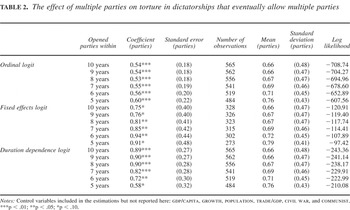
The effect of my key explanatory variable of interest—multiple political parties—is robustly positive and significant in all three models. Note the coefficients are of about the same magnitude in all three models (0.58, 0.71, and 0.80, respectively) with relatively small standard errors. What is the substantive interpretation of the results? I use Clarify software63
to perform simulations from the duration dependence logit model, holding all control variables to their median values.64I hold the count and spline variables to their two-year values (the median time).
Interestingly, when the count and spline variables are held to zero, which implies the government practiced torture the previous year, the predicted probability of torture is much higher. When parties are not present (under the “closed” dictatorship), the predicted probability of torture is 0.36 (95 percent confidence interval, 0.27–0.46). When multiple political parties are present, the predicted probability of torture is 0.55 (95 percent confidence interval, 0.47–0.64). The estimated difference in the probabilities is 0.19 (95 percent confidence interval, 0.09–0.28). Torture is more likely to continue where it previously existed. This prompted me to reevaluate the data using a dynamic version of logit, where I tested the effect of parties on the onset of torture (full results available from author on request). This model estimates Pr(yi,t = 1|yi,t−1 = 0) = F(β′xi,t−1), where F(·) represents the cumulative distribution of the logistic function. The model assumes a first-order Markov process and is equivalent to a discrete-time version of the exponential hazard model (see Amemiya 1985, chap. 11). The results confirm my hypothesis. Holding all control variables to their median values, the difference in the predicted probability of torture when there are not multiple parties versus when there are parties is 0.06 (95 percent confidence interval, 0.01–0.11).
To put this plainly, other things being equal, for every 100 observations of dictatorships with no political parties and low levels of torture during a year, one can expect seven of them to practice high levels of torture the following year (plus or minus four). For every 100 observations of dictatorships with political parties and low levels of torture during a year, one can expect fourteen of them to practice high levels of torture the following year (plus or minus six). I conclude that torture is, somewhat counterintuitively, more prevalent in dictatorships with multiple political parties than in one-party or no-party dictatorships.
A reasonable objection to this conclusion is that “closed” dictatorships may simply hide torture more effectively than dictatorships with multiple political parties. This possibility is not entirely inconsistent with my argument about entering into the CAT, which is that the political parties can pressure governments to sign international treaties. Political parties may also pressure governments to be more open about their torture practices. Furthermore, closed dictatorships may not want to introduce any increased international scrutiny by entering into the CAT. Yet, it is not clear the CAT actually brings additional scrutiny—most dictatorships that ratify do not acknowledge the international Committee Against Torture. Furthermore, dictatorships often use torture for the purposes of social control, and intimidation is effective only when torture is publicly known.66
See Wantchekon and Healy 1999.
Rejali 2007 argues that international scrutiny gives regimes an incentive to conceal torture. They can do so effectively by shifting torture techniques. “Clean” torturing, however, does require “upgrading” torturers. The police must be trained to use techniques that leave few marks. I attempt to account for this cost by controlling for development levels, but the question deserves further research.
Moreover, I am persuaded by the collectors of both the Hathaway and the CIRI data that torture is not systematically hidden. First of all, consider the study of Hafner-Burton and Tsutsui, which deals with this issue. They examined in detail whether U.S. State Department reports changed the nature of the reporting of torture after governments entered into the CAT. They found no change.68
Hafner-Burton and Tsutsui 2005, 1400–1.
Secondly, the coders of the torture data go back and make retroactive changes to the data whenever torture is revealed at a subsequent date. The data sources include U.S. State Department reports as well as Amnesty International reports, both of which rely on various means of collecting information about torture, including the reports of people who escape and report past torture they experienced. Such changes to the data are rare.69
Personal communication with David Cingranelli (2 November 2006). Whether these rare changes have systematic determinants is worthy of future research.
Nevertheless, the possibility that past torture may be subsequently revealed prompts me to reevaluate the results presented in Table 1 considering only dictatorships that eventually opened up to having multiple parties.70
I thank Jana Von Stein for this suggestion.
They are available from author on request.
The effect of multiple parties on torture in dictatorships that eventually allow multiple parties

Admittedly, there is no way to refute the possibility that there is unobserved torture.72
However, my confidence in the results presented here is further encouraged by a recently published rigorous and thorough large-n study of repression under dictatorship that finds single party dictatorships have the best civil liberties and personal integrity ratings (Davenport 2007). The comparison groups in this study are military and personalist dictatorships (following the classification of Geddes 1999). Further research should explore which of these groups allow multiparties and which are no-party dictatorships.
CAT Participation and Political Parties Under Dictatorship
Are dictatorships with political parties more likely to enter into the CAT? Out of 119 dictatorships observed from 1985 to 1996, forty-six signed the CAT. Only seventeen of these were dictatorships that did not have legalized multiple political parties, while twenty-nine of them were dictatorships with political parties, even though dictatorships with parties represented only 43 percent of the observations (not including years after countries signed). Similarly, thirty-eight dictatorships ratified the CAT. Only twelve were dictatorships without parties, while twenty-six of them were dictatorships with parties, even though dictatorships with parties represented only 45 percent of the observations (not including years after countries ratified). So dictatorships with parties appear to have an overall greater propensity to sign and ratify the CAT.
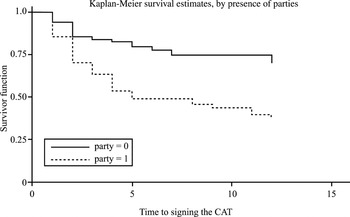
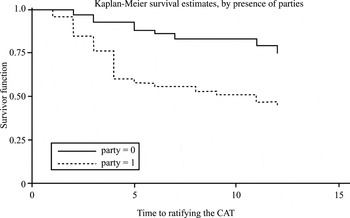
The time it took dictatorships with multiple political parties to sign and ratify the CAT was shorter on average than the time it took “closed” dictatorships. Consider Figures 2 and 3 that present the Kaplan-Meier “survival” estimates for dictatorships with and without multiple political parties. “Survival” here implies “time until signing” in Figure 2 and “time until ratifying” in Figure 3. Analysis time, depicted along the x-axis, begins in 1984 (or year of independence, whichever is later) and ends when a country signs/ratifies the CAT. The y-axis in the figures presents the proportion of countries that have not yet signed/ratified. So, at analysis time 0, 100 percent of the countries have not signed/ratified. As one moves across the x-axis, the lines descend, as more and more countries sign/ratify over time. Note that in both figures the dashed line, representing dictatorships with multiple parties, descends more rapidly than the solid line, which represents dictatorships without parties. Tests indicate that this difference is statistically significant for both signing and ratifying. Dictatorships with multiple political parties are more likely to enter into the CAT.

Signing the CAT

Ratifying the CAT
Do these patterns hold when tested more rigorously, controlling for other potential determinants of CAT selection? To answer this question, I estimate a series of duration models. While I have tested the relationship using a battery of survival models, including dynamic probit, Cox regression, and exponential hazard models,73
Results available from author on request.
In terms of control variables, I first introduce the log of the Hathaway torture scale. Recall from Figure 1 that while the rates of signing and ratifying the CAT are increasing in torture, the pattern is attenuated at the highest level. My theory is not that torture causes dictatorships to enter into the CAT, but I choose to use the log of the torture scale to give the variable the benefit of the doubt. The curve-fitting is intentional, employed to put my alternative story about the role of political institutions to a tougher test.
I then introduce a series of control variables that have been raised by others as important determinants for dictatorships entering into human rights arrangements.75
Several variables from the literature are not included because they pertain to variance among democracies, for example, the age of a democracy (see Landman 2005a).
Wotipka and Ramirez 2008.
For ratification, in addition to the full specification with all control variables, it is necessary to present a “stripped specification,” including only variables that do not suffer from widespread missing data. The two variables I drop do not have a statistically significant effect on ratification. Their inclusion contributes nothing to explaining CAT ratification but does limit the sample size because of missing data. I return to this below.
Table 3 presents the results for both signing and ratifying the CAT. Regarding the interpretation of the results, the hazard rates reported in Table 3 are straightforward. They indicate the impact that a variable has on the rate at which dictatorships sign the CAT (holding other variables constant) relative to a baseline “hazard”—or propensity to sign—of 1.00. Thus, for example, a hazard rate of 0.50 would indicate that the rate at which countries sign per year is cut in half; a hazard rate of 2.00 would indicate that the rate at which countries sign is doubled; and a hazard rate of 1.00 would indicate no effect. The p-values, indicating the level of statistical significance of the hazard ratios, are reported in parentheses.
The effect of multiple political parties on CAT participation in dictatorships (Weibull hazard model)

Consider the effect of the variable parties (multiple political parties) on signing the CAT. It is strong and statistically significant. Only one control variable has a marginally statistically significant effect: communist dictatorships were about 2.65 more likely to sign the CAT in any given year than other dictatorships. The other control variables (regional participation, world participation, Muslim participation, GDP per capita, population, and trade) do not have a significant effect. Note that this does not imply that other studies, particularly those considering normative trends, are incorrect. My study focuses exclusively on the puzzle of dictatorship participation, while other studies look at democracies as well. I return to the implications of my findings for other arguments below.
In terms of substantive impact, dictatorships with political parties appear to be more than twice as likely to sign the CAT than dictatorships that lack this institutional arrangement. The hazard ratio is estimated to be 2.11 in the specification with just torture (95 percent confidence interval: 1.15 to 3.87), and 2.87 in the full specification (95 percent confidence interval: 1.25 to 6.61).
Interestingly, regarding the puzzle laid out in the introduction, the level of torture is only marginally significant in the first specification, and in the other specification has a positive but statistically insignificant impact on signing the CAT. The relationship appears to be spurious. Torture does not impact the likelihood of dictatorships to sign the CAT.
Turning to ratification, the effect of parties is also strong and statistically significant. The lack of significance in the “full” specification is misleading. Note that when control variables are introduced, the number of observations drops from 795 to 558. This is due to the inclusion of variables that have no statistically significant impact but suffer from widespread missing data: gdp/capita and trade/gdp (note the hazard ratios for these variables are nearly 1.00 for both signing and ratifying). When they are dropped, the number of observations increases to 757, and the positive statistically significant impact of parties obtains.77
For the connection of missing data to political regime, see Rosendorff and Vreeland 2004.
In the torture specification that just includes the Hathaway measure of torture, the hazard ratio indicates that the rate at which dictatorships with parties sign is more than double that of dictatorships without parties (2.45 with a 95 percent confidence interval of 1.22 to 4.92). In the stripped specification, the estimated hazard ratio for parties is 2.87 with a 95 percent confidence interval of 1.23. to 6.72. As with signing the CAT, dictatorships that have multiple political parties are more likely to ratify the CAT than dictatorships without legalized multiple parties.
The control variables, including torture and communist, have no effect on the propensity of a dictatorship to ratify the CAT, with the notable exception of the regional score. The regional score has a strong impact, upholding the principal argument of Goodliffe and Hawkins.
Regarding the effect of the normative trend variables, further time should be spent considering their effects. The fact that I do not find them all significant for signing and ratifying, while others have found them significant is due, I believe, to two theoretically important factors:78
There is also a third issue, which is methodological. My use of the Weibull model allows me to explicitly model a positive time trend in the data. The positive, though not significant, value of p in most of the specifications above indicates that if there is a trend, it is positive, which is consistent with the normative story, but may be consistent with alternative stories as well. The Goodliffe and Hawkins “world score” variable has a 0.97 correlation with year. The region-specific variable is also highly correlated with year when one considers the correlation region by region (for almost all regions the correlation with year is greater than 0.9). Perhaps rather than continue to count countries for years after they sign/ratify, continued participation should be discounted so that normative clustering during key years can be analyzed.
- My focus is on dictatorships. The work testing normative trends has included all regime types and has assumed that the normative trends do not differ by regime. Yet, this is inconsistent with the theory. As Finnemore and Sikkink explain it, a “norm” is “a standard of appropriate behavior for actors with a given identity.”79Leaders of democracies and dictatorships probably see themselves as belonging to different groups. Goodliffe and Hawkins differentiate normative trends by looking at regions.80
Finnemore and Sikkink 1998, 891.
Perhaps similar group-specific work should be pursued looking at regime-cohorts. I suspect that normative trends depend on regime type, with democracies following regional and worldwide “democracy norms,” and dictatorships following different normative trends, if any at all.81Interestingly, Goodliffe and Hawkins 2006 found regional trends were more important for signing than for ratifying the CAT.
Even among dictatorships, there may be subgroups. Perhaps dictatorships with seemingly democratic institutions (like political parties) follow a different set of norms than other dictatorships. I thank Ellen Lust-Okar and Valerie Frey for this suggestion. For more on the various mechanisms by which cohorts of countries adopt similar policies, see Johnston 2001; Meseguer 2006; Simmons, Dobbin, and Garrett 2006; Elkins and Simmons 2005; Henisz, Zelner, and Guillén 2005; and Bearce and Bondanella 2007.
- My data on political parties under dictatorship end in 1996. It may take longer than a decade for a norm to develop among dictatorships. Finnemore and Sikkink argue that norms first develop domestically in a few countries. The international norm develops later: “The characteristic mechanism of the first stage, norm emergence, is persuasion by norm entrepreneurs…. The second stage is characterized more by a dynamic of imitation as the norm leaders attempt to socialize other states to become norm followers…. the norm ‘cascades’ through the rest of the population (in this case, of states).”82Finnemore and Sikkink acknowledge that there is some ambiguity as to how and under what circumstances this “cascading” occurs, but they claim there is eventually a “tipping point.” Perhaps the tipping point is later for dictatorships.
Finnemore and Sikkink 1998, 895.
With these points in mind, I reevaluated the rigorous and extensive Goodliffe and Hawkins study of norm cascades and the CAT. Using their replication data, I reanalyze their main models focusing on dictatorships (polity < 6) for the years up to 1996. Neither their regional score nor their world score obtains significance for signing. The good news for their study is that their results for democracies are thus even stronger than they report. This also indicates, however, that further research on the development of norms among authoritarian countries is required.
The interaction of international-level politics and domestic politics requires further study. My study has focused on domestic level variables. In particular, it focuses on the oft-ignored institutions of dictatorship to explore the oft-ignored variation of dictatorship participation in international arrangements. Future work should explore how international pressure interacts with the domestic institutions of dictatorship.
Conclusion
This study addresses a puzzle: dictatorships that practice higher levels of torture appear more likely to enter into the UN Convention Against Torture than dictatorships with lower levels of torture. I contend this is a spurious connection driven by two coincidental processes at the domestic level. (1) Dictatorships that legally endorse more than one political point of view by legalizing political parties ironically practice higher levels of torture than closed dictatorships. The argument follows that idea that violence is higher when power is divided. (2) Dictatorships with political parties face pressure to adopt policies to co-opt support, including the adoption of international arrangements such as the CAT. Dictatorships that do not face such organized political pressure prefer not to enter into a convention against torture because dictatorships are protorture regimes that rely on the fear of torture to rule. In the absence of political pressure, even the small cost associated with ratifying the CAT is too high.
The work presented in this article builds on a resurgent interest in dictatorships. Scholars of international relations have focused on why democracies cooperate and have made great advances. But the countries posing major problems these days are dictatorships. The field of international relations needs to take variations among dictatorships seriously and consider the importance of domestic institutions under authoritarian regimes.83
See Davenport 2007.
The fact that institutional arrangements under dictatorship influence CAT selection indicates that dictatorships with specific institutional arrangements may also be more likely to enter into other types of international arrangements, particularly other human rights treaties. If organized domestic political parties influence dictatorships to enter into the CAT, they may exert similar influence on their governments to enter into such conventions as the International Covenant on Civil and Political Rights; the International Covenant on Economic, Social and Cultural Rights; the Convention on the Elimination of all forms of Racial Discrimination; the Convention on the Elimination of All Forms of Discrimination Against Women; and the Convention on the Rights of the Child. It would be particularly illuminating not just to look at these other arrangements, but to do so at a level beyond the large-n. Detailed case study analysis of just who is represented in political parties under dictatorship, and who is left out, may reveal which international arrangements take precedence.84
For a discussion of the trade-offs among large-n, small-n, and case study research on human rights, see Landman 2002.
What do the findings presented here imply about the usefulness of the CAT? While certainly not a ringing endorsement, these results indicate that the apparent correlation between CAT participation and worsening respect for human rights may be overstated. Part of this correlation may be driven by a selection problem, as Hathaway and Neumayer have suggested. Once nonrandom selection is accounted for, the effect of the CAT may no longer appear to be an increase in torture. Indeed, the agreement may even serve to help reduce torture as governments adopt CAT provisions into domestic law. I argue that strong dictators believe acceding to the CAT will send the wrong domestic signal, and that domestic opposition in multiparty authoritarian regimes believe accession will improve their lot. It follows that either these beliefs are off-target, or that the CAT matters.
So from a policy point of view, the evidence presented in this article does not suggest that international conventions such as the CAT do harm.85
However, see Hafner-Burton and Tsutsui 2007.
Appendix 1. Revisiting Findings with CIRI Data on Torture
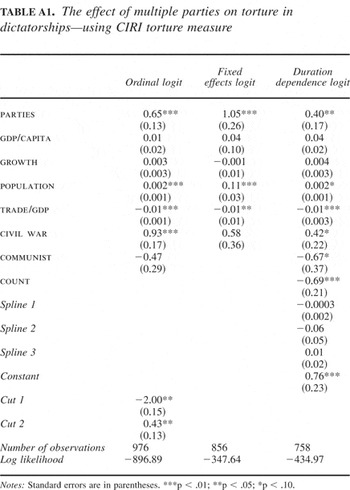
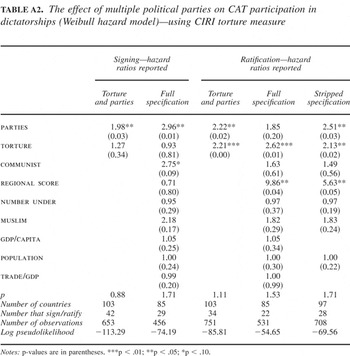
In this appendix, I revisit the major findings of this study, employing the CIRI measure of torture instead of the Hathaway scale. Tables A1 and A2 present the results.
The effect of multiple parties on torture in dictatorships—using CIRI torture measure

The effect of multiple political parties on CAT participation in dictatorships (Weibull hazard model)—using CIRI torture measure

There are 1,002 observations of torture available for the CIRI torture scale, with a mean of 2.4 (standard deviation 0.7). Average rates of torture under dictatorships without political parties is 2.2 (standard deviation 0.7), but rates of torture under dictatorships with political parties is 2.4 (standard deviation 0.7). A t-test indicates that the difference in average rates of torture is statistically significant beyond the 0.01 level (t = −3.60). Table A1 shows that this finding holds up to more rigorous tests. Note that in order to control for fixed effects and duration dependence, I dichotomize the CIRI scale, coding torture as 1 if there are frequent allegations, and 0 otherwise. The ordinal logit model in Table A1 makes use of the full range of the CIRI scale.
Regarding signing the CAT, employing the CIRI variable changes nothing substantively from what is presented in the main text. Regarding ratification, the party finding also holds, but surprisingly, there is one main difference from what is presented in the main text with the Hathaway measure. Whereas the effect of torture on the propensity of a dictatorship to ratify the CAT disappears once the political institution of multiple parties is accounted for—using the Hathaway scale—the effect persists with the CIRI scale. That is, torture remains a statistically significant determinant of ratifying the CAT even after introducing the parties variable. There are three ways of interpreting this. One way is argue that the more nuanced measure of torture developed by Hathaway is preferable because it has more subtle categories necessary to distinguish amongst dictatorships that have higher rates of torture than democracies in general. Another interpretation is that, while my argument about the relationships between parties and torture, and parties and CAT selection holds, torture also has an independent impact on dictatorships' propensity to ratify the CAT. A third interpretation is that the relationship between torture and CAT ratification is spurious and there is, as yet, another undetermined explanatory variable that is correlated with both torture and CAT ratification.
Note that the principal explanatory variable of interest—parties—has a similar effect as reported in the main text: dictatorships with political parties are 1.98 times more likely to sign the CAT in any given year than dictatorships without such institutions (95 percent confidence interval: 1.09 to 3.61) according to the “Torture” specification, and 2.96 times more likely according to the “Full” specification (95 percent confidence interval: 1.26 to 6.96). Regarding ratification, dictatorships with parties are 2.22 times more likely (95 percent confidence interval: 1.12 to 4.42) in the “Torture” specification, and 2.51 in the “Stripped” specification (95 percent confidence interval: 1.09 to 5.77).
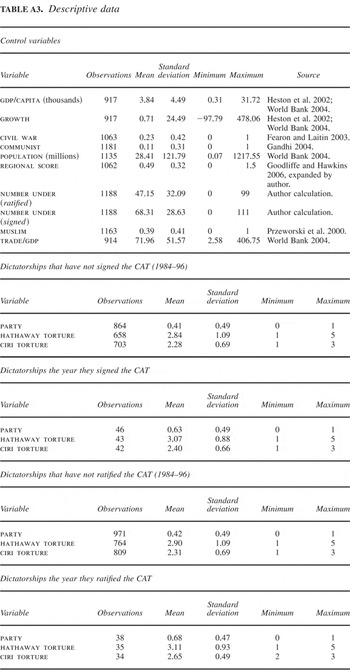
Appendix 2. Descriptive Data
Descriptive data