Introduction
Schizophrenia is the most prevalent and severe form of psychotic disorder, affecting about seven in 1000 adults and represents the eighth highest cause of disability among adolescents and adults (WHO, 2001, 2013). Traditionally, more than 90% of patients with severe mental illnesses, including patients with schizophrenia, are cared for by their family members at home in China (Ran et al. Reference Ran, Xiang, Chan, Leff, Simpson, Huang, Shan and Li2003a , Reference Ran, Xiang, Li, Shan, Huang, Li, Liu, Chen and Chan b ). Family caregivers of patients with schizophrenia experience high levels of burden. Moreover, many rural physicians in China do not receive any psychiatric training (Ran et al. Reference Ran, Xiang, Chan, Leff, Simpson, Huang, Shan and Li2003a ; Law et al. Reference Law, Liu, Hodges, Shera, Huang, Zaheer and Links2011). Many patients with schizophrenia usually do not receive any type of treatment unless they manifest severely destructive behavior (Xiang et al. Reference Xiang, Ran and Li1994; Ran et al. Reference Ran, Xiang, Huang and Shan2001). How to improve treatment adherence/compliance and improve the long-term prognosis of patients with schizophrenia is a crucial problem in China (Ran et al. Reference Ran, Xiang, Huang and Shan2001, Reference Ran, Xiang, Chan, Leff, Simpson, Huang, Shan and Li2003a ).
Poor medication adherence with antipsychotics may cause high rates of relapse and rehospitalization in patients with schizophrenia (Robinson et al. Reference Robinson, Woerner, Alvir, Bilder, Goldman, Geisler, Koreen, Sheitman, Chakos, Mayerhoff and Lieberman1999; Dossenbach et al. Reference Dossenbach, Arango-Davila, Silva Ibarra, Landa, Aguilar, Caro, Leadbetter and Assuncao2005; Barkhof et al. Reference Barkhof, Meijer, de Sonneville, Linszen and de Haan2012). Substantial evidence indicates that psychoeducational intervention is a very effective method of improving medication adherence and reducing relapse and rehospitalization (Mari & Streiner, Reference Mari and Streiner1994; Xiang et al. Reference Xiang, Ran and Li1994; Zhang et al. Reference Zhang, Wang, Li and Phillips1994; Dixon et al. Reference Dixon, Adams and Lucksted2000; Patterson & Leeuwenkamp, Reference Patterson and Leeuwenkamp2008). The results of a meta-analysis indicated that independent of treatment modality, psychoeducation produced a medium effect at post-treatment for relapse and a small effect size for knowledge (Lincoln et al. Reference Lincoln, Wilhelm and Nestoriuc2007). Psychoeducation could have a positive impact on knowledge gain, adherence to medication and global level of functioning (Pekkala & Merinder, Reference Pekkala and Merinder2002; Ran et al. Reference Ran, Xiang, Chan, Leff, Simpson, Huang, Shan and Li2003a ). Interventions engaging families were more effective on symptoms reduction by the end of treatment and preventing relapse at 7–12 months follow-up (Lincoln et al. Reference Lincoln, Wilhelm and Nestoriuc2007).
The duration of beneficial effects with family intervention is variable (Patterson & Leeuwenkamp, Reference Patterson and Leeuwenkamp2008). Many reliable effects, such as on relapse and rehospitalization, may begin to dissipate after 2 years and are generally no longer observable after 5 years (Hogarty et al. Reference Hogarty, Anderson, Reiss, Kornblith, Greenwald, Ulrich and Carter1991; Montero et al. Reference Montero, Masanet, Bellver and Lacruz2006). However, previous scientific proofs of the effectiveness of psychoeducational family intervention were based mainly on the results of 1- and 2-year follow-ups (Bäuml et al. Reference Bäuml, Pitschel-Walz, Volz, Engel and Kissling2007). A marked prophylactic effect in the Salford Family Intervention Project covering periods of 5 and 8 years, and the significant effects of psychoeducational group therapy on the 7-year course of schizophrenia could be found (Tarrier et al. Reference Tarrier, Barrowclough, Porceddu and Fitzpatrick1994; Bäuml et al. Reference Bäuml, Pitschel-Walz, Volz, Engel and Kissling2007). Although psychoeducation should be part of the standard therapy among patients with schizophrenia in management or treatment guidelines (APA, 2004; Kuipers et al. Reference Kuipers, Yesufu-Udechuku, Taylor and Kendall2014), there has been no research demonstrating the long-term (e.g. over 10 years) effectiveness of psychoeducational family intervention in the community. It is not clear whether the short-term (e.g. 9 months) psychoeducational family intervention will have sustained long-term (e.g. over 10 years) effect on patients with schizophrenia living in the community.
In the 9-month follow-up (n = 326) of psychoeducational family intervention in 1994, we found a gain in knowledge, a change in the relatives’ caring attitudes towards the patients, an increase in treatment compliance, and a decrease in relapse in the psychoeducational family intervention group (Ran et al. Reference Ran, Xiang, Chan, Leff, Simpson, Huang, Shan and Li2003a ). The present study, based on our previous 9-month follow-up study (n = 326) including psychoeducational family intervention (n = 126), medication (n = 103), and control groups (n = 97) (Ran et al. Reference Ran, Xiang, Chan, Leff, Simpson, Huang, Shan and Li2003a ), was conducted using a 14-year prospective follow-up design in Xinjin County, Chengdu, Sichuan, China.
Our research hypothesis was that short-term psychoeducational family intervention might have a positive long-term effect on the treatment adherence/compliance and outcome of persons with schizophrenia. The aim of this study was to explore the 14-year effectiveness of 9-month psychoeducational family intervention among patients with schizophrenia in a Chinese rural area.
Method
Study population
This is one of studies in the Chengdu Mental Health Project (CMHP) in Chengdu, China. All subjects with schizophrenia (three groups, n = 326) were identified from a 9-month cluster randomized controlled trial (CRCT) of psychoeducational family intervention for families experiencing schizophrenia in six townships of Xinjin County in 1994 (Ran et al. Reference Ran, Xiang, Chan, Leff, Simpson, Huang, Shan and Li2003a ). Based on an epidemiological investigation of schizophrenia in six townships in Xinjin county of Chengdu, subjects with schizophrenia were randomly assigned into three groups: family intervention group (medication plus psychoeducational family intervention, n = 126), medication group (medication alone, n = 103), and control group (no intervention, n = 97) (Ran et al. Reference Ran, Xiang, Chan, Leff, Simpson, Huang, Shan and Li2003a ). The main components of the family intervention included family education, multiple family workshops, and crisis intervention for 9 months. Patients’ relatives were taught basic knowledge on mental disorders, treatment and rehabilitation. The patient was encouraged to join the education meetings. The medication consisted of long-term injection of haloperidol decanoate (50–125 mg/month) and/or an oral depot. There was no significant difference of drug dose between the family intervention group and the medication group. In the control group (no intervention), medication was neither encouraged nor discouraged. The samples in the control group might go to see other doctors in the local area and then take medication by themselves. The details of the CRCT have been described in previous publication (Ran et al. Reference Ran, Xiang, Chan, Leff, Simpson, Huang, Shan and Li2003a , Reference Ran, Xiang, Simpson and Chan2005).
All subjects lived in rural Xinjin County and met ICD-10 criteria (WHO, 1992) for a diagnosis of schizophrenia based on standardized administration of the Present State Examination (PSE; Wing et al. Reference Wing, Cooper and Sartorius1974) by trained research interviewers. A 14-year follow-up study of all these subjects was conducted in 2008. The 14-year follow-up study was approved by the University's Committee on Human Research Subjects (CHRS) and all respondents gave informed consent at each stage of the study.
Measurement
The principal assessment tools included the PSE and Social Disability Screening Schedule (SDSS) in the baseline CRCT study in 1994 (Ran et al. Reference Ran, Xiang, Chan, Leff, Simpson, Huang, Shan and Li2003a , Reference Ran, Xiang, Simpson and Chan2005). For living subjects at the follow-up in 2008, at least one person familiar with each patient's life and circumstances and the patients themselves were interviewed. For deceased subjects, the next-of-kin or at least one person familiar with the patient, mainly family members, was interviewed. The Patients Follow-up Schedule (PFS) was used to collect information concerning demographic characteristics, causes and time of death, clinical symptoms, treatment information, and social functioning. The Positive and Negative Syndrome Scale (PANSS; Si et al. Reference Si, Yang, Shu, Wang, Kong, Zhou, Li and Liu2004) and Global Assessment of Functioning (GAF; APA, 2000) were also used in 2008. All the interviews were conducted by trained psychiatrists who were blind to the study using the PFS, PANSS, and GAF in 2008. All the trained raters in the 14-year follow-up did not know the design of the original study (CRCT) in 1994. For all subjects, medical and psychiatric treatment records were obtained from hospital, village doctors’ clinics, and traditional healers. For deceased subjects, information from the death certification and suicide note, where applicable, was also obtained. Given the difficulty of measuring the times of relapse in the 14-year follow-up, we did not include the relapse rate of the patients 14 years after completion of family intervention in this study.
The classification of each death as due to suicide, accident, or natural causes represented the consensus opinion of interviewers and independent researchers after reviewing all information obtained during the interviews. Subjects were defined as never-treated if they had never received any antipsychotic medication before. Subjects were defined as homeless and lost to follow-up if informants reported that they had wandered and slept in public places and that their whereabouts, at the time, were unknown. Subjects’ work ability was defined according to the performance at work including employment, housework and other tasks (Ran et al. Reference Ran, Chen, Chen, Ran, Tang, Lin, Li, Li, Mao and Hu2011).
Statistical analysis
The research team explored the current status of the previous cohort (n = 326) in 2008. The differences of the three groups (family intervention group, medication group, control group) who were still alive were assessed through comparing the demographic, symptoms, treatment, and social functioning in 2008. A χ2 test was used to assess the differences among the three groups in categorical data, and ANOVA was used to compare the differences among the three groups in continuous factors. The differences of death rate among the three groups were tested using Cox hazard regression analyses (survival analyses). Statistical analyses were performed using SPSS Windows software v. 20 (SPSS Inc., USA).
Results
Subjects in the follow-up
Among all subjects (n = 326, three groups) in 1994, we followed up and interviewed 312 subjects (95.7%) with schizophrenia and/or their key informants in 2008. Among all subjects alive (n = 245) in 2008, 238 subjects (97.1%) finished the follow-up evaluations. There were 92 cases in the psychoeducational family intervention group, 73 cases in the medication group and 73 cases in the control group. The rate of participant retention was 73.0%.
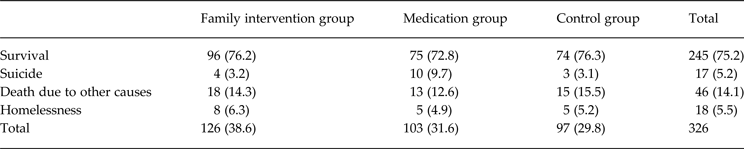
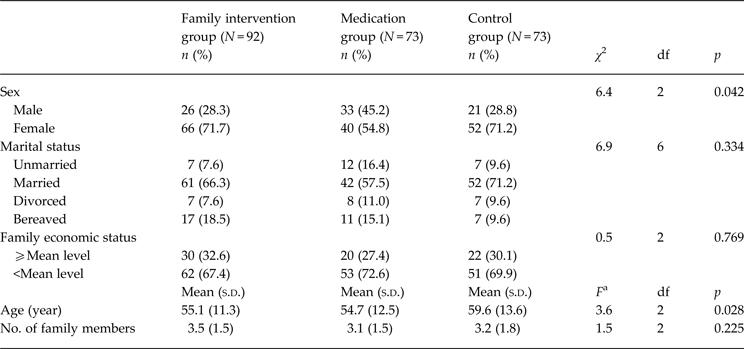
There were no significant differences of currents status in survival, death due to other causes, and homelessness among the three groups in 2008 (Table 1). There were no significant differences of survival rates among the three groups [family intervention group: 83.3%, drug treatment group: 78.6%, control group: 81.4%; hazard ratio (95% CI) 0.9 (0.6–1.3), p > 0.05]. There were no significant differences of marital status among the three groups (Table 2). Although there were no significant differences of gender in the 9-month follow-up in baseline data (1994), there was a significant higher rate of male patients in the medication group than the other two groups in the 14-year follow-up (2008).
Current status of subjects in 2008

Socio-demographic variables in the three groups in the 14-year follow-up

a ANOVA analysis.
The effectiveness of psychoeducational family intervention
Help-seeking behavior
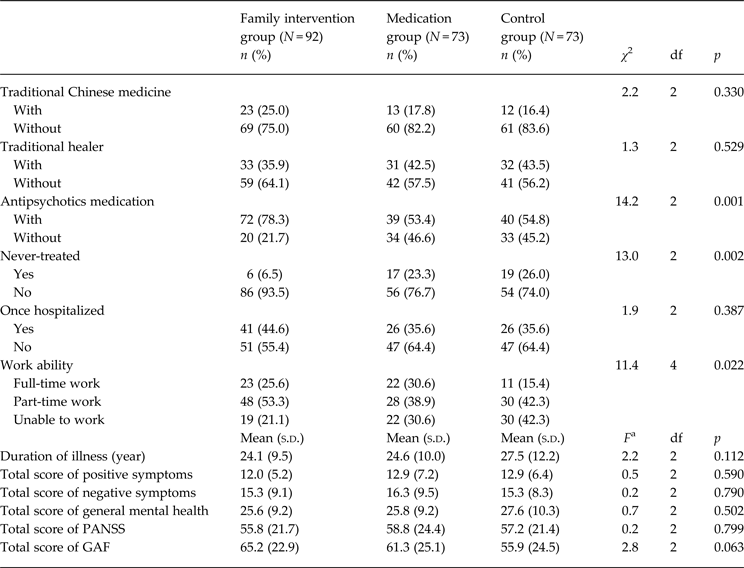
The psychoeducational family intervention group had significantly higher rates of antipsychotic medication than the medication and the control groups in the 14-year follow-up study (Table 3). The control and the medication groups had a significantly higher rate of never-treated than the psychoeducational family intervention group. Although there were no significant differences of the rate of once hospitalized among the three groups, the rate of once hospitalized in the psychoeducational family intervention group was mildly higher than that in other two groups.
Clinical variables in the three groups in the 14-year follow-up

PANSS, Positive and Negative Syndrome Scale; GAF, Global Assessment of Functioning.
a ANOVA analysis.
Symptoms
There were no significant differences of mean scores of the PANSS positive symptoms, negative symptoms, general mental health, and total scores among the three groups (Table 3).
Social functioning
The psychoeducational family intervention group showed significantly higher rate of full- and part-time work ability than the other two groups (Table 3). However even though the mean scores of GAF were higher in the psychoeducational family intervention group, there were no significant differences of mean scores of GAF among these three groups (p > 0.05).
Discussion
To our knowledge, this is the first 14-year prospective cohort study exploring the effectiveness of a 9-month psychoeducational family intervention in patients with schizophrenia in a rural community. The strengths of this study include the use of a large representative community sample in rural China, its prospective 14-year follow-up design and high rate (73.0%) of participant retention.
How to improve treatment is one of the most important issues in international mental health services. Evidence emphasizes the importance of antipsychotic medication for outcome at any stage of illness (Alem et al. Reference Alem, Kebede, Fekadu, Shibre, Fakadu, Beyero, Medhin, Negash and Kullgren2009; Ran et al. Reference Ran, Chan, Chen, Mao, Hu, Tang, Lin and Conwell2009; Kuipers et al. Reference Kuipers, Yesufu-Udechuku, Taylor and Kendall2014). Improved medication adherence/compliance is a particularly important goal for psychoeducational family intervention because of the link between non-adherence and the risk of relapse (Pitschel-Walz et al. Reference Pitschel-Walz, Bäuml, Bender, Engel, Wagner and Kissling2006; Patterson & Leeuwenkamp, Reference Patterson and Leeuwenkamp2008; Barkhof et al. Reference Barkhof, Meijer, de Sonneville, Linszen and de Haan2012). Although many positive outcomes of family intervention might appear to dissipate after 5 years (Patterson & Leeuwenkamp, Reference Patterson and Leeuwenkamp2008), the results of this study showed that psychoeducational family intervention could improve both the short-term and long-term treatment adherence/compliance in the 9-month and 14-year follow-ups (Ran et al. Reference Ran, Xiang, Chan, Leff, Simpson, Huang, Shan and Li2003a ). The improvements in treatment adherence/compliance in the 14-year follow-up may be the major effect of the 9-month psychoeducational family intervention. Based on the positive change of the relatives’ knowledge on the mental disorder, beliefs about mental illness and attitudes towards patients in the 9-month follow-up study, the better treatment adherence/compliance in the 14-year follow-up may be related to the knowledge gained on mental disorder, and the change in relatives’ beliefs about mental illness and their attitudes towards patients after the 9-month intervention (Ran et al. Reference Ran, Xiang, Chan, Leff, Simpson, Huang, Shan and Li2003a ). The change of relatives’ knowledge, beliefs and attitudes may enhance the treatment compliance, self-management of symptoms and relatives’ expectations of patients, which may reduce relapse and improve the long-term prognosis of the illness (Xiang et al. Reference Xiang, Ran and Li1994; Ran & Xiang, Reference Ran and Xiang1995; Lincoln et al. Reference Lincoln, Wilhelm and Nestoriuc2007; Patterson & Leeuwenkamp, Reference Patterson and Leeuwenkamp2008). Given that family members will frequently be involved in treatment decisions and lack of knowledge on mental illness in China, psychoeducational family intervention may be more feasible and effective in developing countries with similar situations as in rural China (Xiang et al. Reference Xiang, Ran and Li1994; Ran et al. Reference Ran, Xiang, Chan, Leff, Simpson, Huang, Shan and Li2003a ; Rummer-Kluge et al. Reference Rummer-Kluge, Pitschel-Walz, Bäuml and Kissling2006). Further research should be conducted in this area.
Evidence indicates that the short-term improvement of clinical status after the family intervention may be better than the long-term prognosis of clinical status (Penn & Mueser, Reference Penn and Mueser1996). The efficacy of psychoeducational family interventions in reducing relapse and hospitalization rates has been empirically established by a number of studies (Xiang et al. Reference Xiang, Ran and Li1994; McFarlane et al. Reference McFarlane, Link, Dushay, Marchal and Crilly1995; Pfammatter et al. Reference Pfammatter, Junghan and Brenner2006; McWilliams et al. Reference McWilliams, Hill, Mannion, Fetherston, Kinsella and O'Callaghan2012). Although clinical status was significant better in the psychoeducational family intervention group in the 9-month follow-up (Ran et al. Reference Ran, Xiang, Chan, Leff, Simpson, Huang, Shan and Li2003a ), the results of this 14-year follow-up study did not find significant differences of clinical symptoms among the three groups. The result is consistent with another 5-year follow-up study in which there were also no differences of symptoms between the treatment and control groups (Hornung et al. Reference Hornung, Feldmann, Klingberg, Buchkremer and Reker1999). This may be partly related to the patients’ longer duration of illness (e.g. over 24 years) in the 14-year follow-up, as the average duration of illness for effective family intervention may be more likely to range from 3 to 10 years (Falloon et al. Reference Falloon, Boyd, McGill, Williamson, Razani, Moss and Gilderman1982, Reference Falloon, Boyd, McGill, Williamson, Razani, Moss, Gilderman and Simpson1985; Montero et al. Reference Montero, Asencio, Hernandez, Masanet, Lacruz, Bellver, Iborra and Ruiz2001; Ran et al. Reference Ran, Xiang, Chan, Leff, Simpson, Huang, Shan and Li2003a ). Psychoeducational family intervention may be effective for preventing relapse while symptoms remain stable (Lincoln et al. Reference Lincoln, Wilhelm and Nestoriuc2007). Patients with schizophrenia with relatives taking part in psychoeducational interventions suffer from significantly fewer relapses and hospitalizations during follow-up (Buchkremer et al. Reference Buchkremer, Klingerberg, Holle, Moenking and Hornung1997; Pfammatter et al. Reference Pfammatter, Junghan and Brenner2006; Fiorillo et al. Reference Fiorillo, Bassi, de Girolamo, Catapano and Romeo2010; McWilliams et al. Reference McWilliams, Hill, Mannion, Fetherston, Kinsella and O'Callaghan2012). Given the important role of family members and family support in treatment of patients with mental disorders in China (Ran & Xiang, Reference Ran and Xiang1995; Ran et al. Reference Ran, Xiang, Chan, Leff, Simpson, Huang, Shan and Li2003a ), the authors strongly suggest that psychoeducational family intervention should be offered to all family caregivers of persons with schizophrenia.
Although antipsychotic therapy may not improve patients’ functional outcomes, family psychoeducation may improve patient's social functioning, either directly or by fostering the development of skills and so delaying disruptive relapse (Tarrier et al. Reference Tarrier, Barrowclough, Vaughn, Bamrah, Porceddu, Watts and Freeman1989; Li & Arthur, Reference Li and Arthur2005; Swartz et al. Reference Swartz, Perkins, Stroup, Davis, Capuano, Rosenheck, Reimherr, McGee, Keefe, McEvoy, Hsiao and Lieberman2007). Relevant changes in clinical performance should also be creating an impact on functioning outcome (Mari & Streiner, Reference Mari and Streiner1994). Although there were no significant differences of patients’ work ability among these three groups in the 9-month follow-up (Ran et al. Reference Ran, Xiang, Chan, Leff, Simpson, Huang, Shan and Li2003a ), the results of this 14-year follow-up study did indicate a mild to moderate improvement of patients’ work ability in the psychoeducational family intervention group. The results of this study indicate that patients’ social functioning might be improved in the psychoeducational family intervention group in the 14-year follow-up even though there was no significant change in the 9-month follow-up. The reasons for the improvement of social functioning in the psychoeducational family intervention group in the 14-year follow-up may include: (1) the improvement of relatives’ knowledge on mental illness, beliefs about the illness and their attitudes towards the patients; (2) more family members in the psychoeducational family intervention group would participate in taking care of the patients’ treatment and engaging patients in farming and household work; and (3) a relatively higher survival rate of female subjects in the psychoeducational family intervention group may be related to the better work functioning (Ran et al. Reference Ran, Chen, Chen, Ran, Tang, Lin, Li, Li, Mao and Hu2011). However, the results of this 14-year follow-up study indicate that the control group with a similar rate of female subjects as the psychoeducational family intervention group did not show improved social functioning. Further research should be conducted in this area.
Overall, the results of this 14-year follow-up study indicate that psychoeducational family intervention could produce sustained long-term effects, especially on the patients’ treatment adherence/compliance and work ability. The enhancement of illness concepts and treatment adherence/compliance may help patients and their family members to cope more effectively with the illness (Ran et al. Reference Ran, Xiang, Chan, Leff, Simpson, Huang, Shan and Li2003a ; Rummer-Kluge et al. Reference Rummer-Kluge, Pitschel-Walz, Bäuml and Kissling2006; Bäuml et al. Reference Bäuml, Pitschel-Walz, Volz, Engel and Kissling2007). Knowledge on mental illness is vital in improving relatives’ beliefs regarding mental illness, attitudes towards the patients, treatment adherence/compliance and patients’ social functioning. Psychoeducational family intervention may be more effective in rural areas of developing countries where family involvement in patients’ care is particularly frequent and many family members lack knowledge on mental illness.
Implications for mental health policy and services
The results of the present study have implications for improving long-term treatment and prognosis of patients with schizophrenia in China and elsewhere. Psychoeducational family intervention for patients with schizophrenia in the early stage of the illness should be taken into account when making mental health policy and developing psychosocial interventions to enhance the long-term prognosis. The authors of this study suggest that early psychoeducational family intervention and medication should become obligatory in development of community mental health services (Kuipers et al. Reference Kuipers, Yesufu-Udechuku, Taylor and Kendall2014). In order to improve the long-term outcome of schizophrenia, it is crucial to provide early psychoeducational family intervention and medication for persons with schizophrenia in rural China. Models and training of psychoeducational family intervention for mental health professionals should be studied further.
Limitations of the study
The limitations of this study include the possible recall bias for interviews with subjects and informants at long-term follow-up intervals, but such bias may be minimized by the use of multiple follow-up data sources. Patients who were dead or homeless were excluded from the analysis, which may have influenced the results. Given the long-term follow-up, it is difficult to control the different impact of many other factors (e.g. social development and welfare factors) on the patients in the three groups.
Acknowledgements
The 1994 Chengdu study was supported by a grant from the China Medical Board in New York (CMB, 92–557; M. Z. Xiang, PI). This study was supported in part by GRIP 1 R01 TW007260-01 (M. S. Ran, PI) from the Fogarty International Center of NIH and American Foundation for Suicide Prevention (AFSP) (M. S. Ran, PI). We thank all the patient participants, and the staff of the Xinjin Mental Hospital and Chengdu Mental Health Center for cooperation and data collection.
Declaration of Interest
None.