In recent years, dockworkers in Chile and Colombia have been engaged in major labor disputes with wide-ranging impacts for labor movement revitalization in both countries. Nevertheless, despite the similarities of sector and region, they have pursued highly divergent strategies to achieve their goals. In Chile, dockworkers developed a strategy I term class struggle unionism. This strategy focused on exercising power at the point of production through a series of coordinated national strikes in the ports, assisted by local community allies and international labor allies, who threatened a blockade of Chilean cargo. Their actions resulted in a stunning victory in which the dockworkers’ national organization—despite lacking legal recognition—compelled the government to engage in national tripartite collective bargaining at the sectoral level for the first time since the Allende era.
Conversely, in Colombia, dockworkers pursued a strategy of human rights unionism. This strategy focused on exercising power outside of the workplace, relying on international pressure and support, along with lawsuits, to fight for basic union recognition and a first contract since the early 1990s. Their efforts resulted in a first contract for a small group of workers in Colombia’s largest port, Buenaventura—an important, though limited, victory. How can we account for the very different strategies of unions organizing in the same region that share a common position in the economic system?
Dockworkers present an ideal case for research into questions of worker power, trade union strategy, and internationalism because of the central role they play in the circulation of commodities and capital (Bonacich and Wilson Reference Bonacich and Wilson2008) and the existence of two global union organizations that seek to represent their interests (Fox-Hodess Reference Fox-Hodess2017; Gentile Reference Gentile2010). Dockworkers have long been viewed as an exceptionally powerful and well-organized group of workers, with a high degree of militancy, or “strike-proneness” (Kerr and Siegel Reference Kerr, Abraham, Kornhauser, Dubin and Ross1954). Carmichael and Herod argue,
The fact that dockers are fixed in space, are from the same communities, and so are socialized in similar ways … means that they have had opportunities to develop the kinds of formal and informal networks emerging out of their communities’ habitus that can encourage solidarity and common action. (Carmichael and Herod Reference Carmichael and Andrew2012, 219)
In addition, “dockers have been able to use their employers’ geographical immobility, manifested through the spatial embeddedness of the latter’s capital investments in ports, against them when organizing” (Carmichael and Herod Reference Carmichael and Andrew2012, 218). Dockworkers’ concentration and embeddedness in local port communities and their central role in the accumulation of capital both nationally and transnationally have therefore constituted them as, at least potentially, a quite powerful group of workers. The specificities of their industry, moreover, allow them to move back and forth with relative ease among multiple scales—local, national, and transnational—as they seek an advantage in disputes (Carmichael and Herod Reference Carmichael and Andrew2012), often producing new economic geographies in the process (Herod Reference Herod1997).
Structural and Associational Power
The dominant theory of worker power in global labor studies, first proposed by Erik Olin Wright (Reference Wright2000) and later developed by Beverly Silver (Reference Silver2003), would suggest that dockworkers therefore possess a high degree of “structural power” and, more specifically, “workplace bargaining power,” which “accrues to workers who are enmeshed in tightly integrated production processes, where a localized work stoppage in a key node can cause disruptions on a much wider scale than the stoppage itself’ (Silver Reference Silver2003, 13). In other words, workplace bargaining power is the power workers possess at the point of production, to be leveraged through industrial action, compelling employers (or the state) to reach an agreement.
Dockworkers in countries like Chile and Colombia are predicted to have a high degree of workplace bargaining power as a result of their countries’ dependence on exporting primary goods through their ports. Nevertheless, in only one of the two cases—Chile—were dockworkers actually able to make use of their position in the economic system by stopping the flow of commodities and capital through the country’s ports. In Colombia, on the other hand, dockworkers relied on external pressure—what Silver would characterize as “associational power”—to compel employers to come to the bargaining table, without exercising power on the shop floor.
The cases, then, call attention to the limitations of the existing framework for worker power, which views “structural power” as the “power that results simply from the location of workers within the economic system,” while “associational power” results from “the formation of collective organizations of workers in trade unions and political parties” (Wright Reference Wright2000, 962). This framework dichotomizes structural power as economic, and associational power as social and political. However, it also dichotomizes structural power as a set of structural background conditions, and associational power as the agentic social and political actions workers take proactively, thereby reducing structure itself exclusively to the economy. Consequently, the framework makes it difficult to account for cross-national differences among workers who would seem to share a similar degree of power at the point of production but nevertheless pursue very different strategies, like the Chilean and Colombian dockworkers analyzed in this study.
Varieties of Capitalism (VoC)
Nevertheless, alternative explanations for cross-national strategic differences among trade unions—in particular, the Varieties of Capitalism approach—bend the stick too far in the other direction, overemphasizing national-level institutional factors at the expense of factors rooted in the economy. The Varieties of Capitalism (VoC) approach emerged initially as an attempt to disprove the “convergence” thesis—that is, that advanced capitalist democracies were converging on the same economic model, a thesis that had become all the more convincing with the rise of neoliberal globalization (Howell Reference Howell2003). Broadly speaking, VoC is a historical institutionalist approach interested in understanding how the organization of capitalist economies within given polities becomes institutionalized over time, leading to enduring crossnational differences via a process of path dependency (Howell Reference Howell2003).
In the field of industrial relations, this emphasis on the continuity of crossnational differences provides a useful jumping-off point for theorizing why “the same [trade union] strategy is likely to produce different results in different countries” (Frege and Kelly Reference Frege, John, Frege and Kelly2004, 182). Industrial relations scholars and others, building on the VoC tradition, provide useful correctives to the heavily firm-centric account of its originators, instead bringing the state and labor—and thus an analysis of unequal relationships of power—back into the analysis (Howell Reference Howell2003). This corrective has made it more possible to explain how change occurs in institutional arrangements over time (Hamann and Kelly Reference Hamann, John, Paul, Nicolas, Jack and Edmund2008)—a key critique of the original formulation of the theory.
Still, additional critiques remain pertinent. Heyes et al., for example, note that the VoC approach continues to suffer from a lack of “an analysis of capitalism as such … the concept of capital is not employed. There are no ‘capitalists’ in the VoC account, only ‘firms’” (Reference Heyes, Paul and Ian2012, 231). In particular, the neglect of workplace and industry-level factors structuring workers’ ability to engage in shop-floor contention makes it difficult to explain why workers in different worksites or economic sectors in the same country often pursue quite different strategies; for example, the West Coast and East Coast dockworkers in the United States in Kimeldorf’s classic study (Reference Kimeldorf1988). As Kimeldorf finds, “early patterns of occupational recruitment and industry structure … giving rise to radically different political cultures, made certain outcomes in the form of organizing strategies, modes of industrial conflict, and leadership policies more likely, though by no means certain” (Reference Kimeldorf1988, 161). These “radically different political cultures” consist of a union dominated by “reds” on the West Coast and a union dominated by “rackets” on the East Coast—a difficult phenomenon to account for without reference to more local and industry-specific factors than the nationally and institutionally focused VoC approach allows.
Additionally, the VoC approach, which focuses overwhelmingly on differences between the advanced capitalist democracies, has retained its heavily Eurocentric bias. As Ebenau (Reference Ebenau2012), a Latin Americanist, argues, there is “a relative ignorance of the systemic, transnational structures and processes in which institutions at the nation-state level are embedded” (210) as “parts of a hierarchically structured global political economy” in which “individual ‘varieties’ are not equal as units” (214). Silver’s World Systems framework, in contrast, is much better equipped to analyze these global dynamics, which often play such an important role in shaping the outcomes of labor disputes in Latin America and elsewhere in the Global South.
A final limitation of the VoC approach concerns an additional set of largely invisible background assumptions that also reflect its origins in the Global North: the expectation that labor-capital conflict takes place against a stable institutional framework, in which workers have effective recourse to the law and state-sanctioned or state-sponsored violence is rare or nonexistent. These assumptions, in fact, are not met in much of the Global South, including many countries in Latin America, where they are arguably far more fundamental to the outcomes of labor-capital disputes than the nuanced institutional differences emphasized by VoC theorists.
The Limitations of Existing Theoretical Approaches
To summarize, then, while Silver arguably overemphasizes the role of economic factors in explaining trade union strategy at the expense of sociopolitical factors, the varieties of capitalism approach arguably underemphasizes economic factors at the expense of the sociopolitical. Moreover, neither approach adequately theorizes key dimensions of the state’s role in labor conflicts outside the Global North. A broader theorization of the role of the state in labor conflicts—particularly in the Global South—therefore is needed.
To this end, I argue that “structural power”—like Wright’s (Reference Wright2000) and Silver’s (Reference Silver2003) “associational power”—is rooted in state and society. I therefore propose an expanded framework for structural power, detailed below, that takes account of its simultaneously economic, social, and political foundations, drawing on insights from economic sociology, which emphasizes that markets never exist in isolation but instead are constituted through social and political means (Polanyi Reference Polanyi2001). This expanded framework provides greater analytical leverage for explaining why workers who are presumed to share a high degree of power at the point of production, as a result of their common position in the economic system, may nevertheless pursue very different strategies in different sociopolitical contexts both within and between countries.
In his influential book on worker power, trade union strategy, and labor internationalism in Latin America, Anner (Reference Anner2011) argues that state contexts determine whether or not unions see a need to pursue new strategies, as a result of the retrenchment of industrial relations systems and unavailability of government allies. Yet there are many other ways in which state action shapes worker strategy in Latin America. Stillerman (Reference Stillerman2017), for example, examines industrial labor disputes in historical perspective in Chile and finds that the ability of workers located in economically strategic positions to resist their employers depends heavily on a range of state actions, including reclassification of skilled workers, implementation of public-private partnerships, and “legal provisions permitting union busting” (Reference Stillerman2017, 113). Stillerman thus finds that Silver “underestimates the state’s role in shaping investment and labor policy, especially in developing countries that underwent ISI” (113), as well as in “establishing income policies, or setting the terms of workers’ legal action” (99).
Santibáñez Rebolledo, writing on dockworker labor conflict in the early twentieth century in northern Chile, challenges the notion that dockworkers historically have had anything more than purely abstract, theoretical power at the point of production, as a result of their position in the economic system. Instead, in practice, the Chilean state systemically constrained dockworkers’ ability to exercise power by utilizing the armed forces and prisoners as strikebreakers, engaging in violent repression of striking workers, and allowing employers to create blacklists (Reference Santibáñez Rebolledo2016, 211)— a practice that continues in the present. Furthermore, Gill, in her study of working-class organization in the Colombian river port city of Barrancabermeja, similarly emphasizes the role of state-sanctioned violence as “one of the major tools that forges the development of capitalist relations” (Reference Santibáñez Rebolledo2016, 8).
It is this more capacious understanding of the role of the state in shaping worker power and trade union strategy that this study develops. Like Anner Reference Anner2011, I find that workers situated in the same industry often pursue different strategies in different national contexts. However, while Anner argues that this results from workers’ agency, in the form of union political orientations (Reference Anner2011, 11, 167), I instead argue that divergent strategies ultimately result from sociopolitical differences shaping workers’ ability to exercise power at the point of production. In particular, this study highlights the role of pervasive state-sanctioned violence and the absence of labor law enforcement in the Colombian case, which, taken together, tempered the impact of the dockworkers’ position in the economic system, discouraging workers from taking industrial action. As a consequence, Colombian dockworkers pivoted toward human rights unionism, a less risky strategy to life and livelihood in a context of pervasive violence, despite their predecessor union’s more militant history. Chilean dockworkers, conversely, maintained their shop-floor power in a relatively more normalized context for trade unionism. Consequently, they had more strategic possibilities available to them and ultimately chose a strategy of class struggle unionism as a result of their union’s political history. In other words, contra Anner Reference Anner2011, union political histories did not carry equal weight in all contexts, making an impact only in the case in which workers’ power at the point of production—and therefore a wider range of strategic possibilities—was maintained.
In contrast to the dominant strand of the Varieties of Capitalism literature, this article therefore argues that in Latin America, the sociopolitical factors that most strongly determine workers’ power and strategy are not found primarily in the formal institutions of labor relations—which, in any case, remain highly unfavorable to dockworkers in both countries—but instead in the state’s willingness to enforce the law, on the one hand, and its willingness to intercede on behalf of labor or capital by commission or omission in ways that go beyond the bounds of the law, on the other. In other words, like industrial relations scholars in the VoC school, I share the view that state action is determinative. But instead of emphasizing institutional arrangements, I emphasize dimensions of state action rarely considered by VoC theorists whose work focuses primarily on the Global North. Most critically, this article highlights the extent to which states agree to tacitly permit extralegal violence against trade unionists, to call in the police or army to punish striking workers, and to enforce the law as central to dispute outcomes.
Conjunctural Analysis of Workers’ Structural Power
This analysis builds on the insights of Antonio Gramsci and Nicos Poulantzas with respect to the simultaneously economic, political, and social roots of class formation and political strategy (Przeworski Reference Przeworski1977) and applies them to discussions of the roots of worker power and trade union strategy. Because of the state’s central role in reproducing the conditions for the accumulation of capital, international trade, and economic growth, conflicts between labor and capital always necessarily involve the state. State and society, therefore, are no mere contexts for the exercise of worker power; they are deeply imbricated in the constitution of workers’ power, both at the point of production and in the society at large. The state, in particular, constitutes workers’ power at the point of production by defining the rules of engagement of class struggle via repressive means (use of the police, army, courts, and prisons), as well as generative means (laws governing collective bargaining and industrial action). To be successful, worker strategy must therefore be responsive to the conjuncture of state, economy, and society that constitutes their power at specific times and places.
The different strategies employed by the Chilean and Colombian dockworkers, then, reflect the fact that they are responding to very different conjunctures. As Almeida (Reference Almeida2008) finds in his historical research on social movement mobilizations in El Salvador—and as I found in the Colombian case—under conditions of repression or weak effective guarantees of “associational freedoms and basic human rights,” trade unions and other civil society organizations “must use whatever political space the state offers in order to build civic organizations” (Almeida Reference Almeida2008, 214). Under these circumstances, the state is relatively unconcerned with building broad consent, in the Gramscian sense, and instead relies more heavily on coercion, permitting a high degree of violence and weak to nonexistent enforcement of labor law. Trade unionists, particularly those operating in conflict zones, like the Buenaventura dock-workers, therefore rely on external pressure, such as international alliances and lawsuits, to force the state’s hand, rather than the far riskier proposition of directly confronting employers (and, by extension, the state) at the point of production.
Although the Colombian state claims legitimacy primarily on the basis of its ability to manage civil conflict—a project based largely on coercion—the postdictatorship Chilean state claims legitimacy on the basis of its promise to expand rights and social protections—a project based largely on building consent. While many actors in civil society, and trade unionists in particular, rightly question the extent to which the post-Pinochet Chilean state has followed through on these promises, the state’s concern with maintaining legitimacy on this basis does appear to result in greater self-imposed limitations on permitting or carrying out action hostile to workers, compared to Colombia. As a result, in a number of sectors in recent years, from retail and warehousing to mining and the docks, workers have met with perhaps surprising success.
While it is undeniable that labor law in Chile, as in Colombia, remains hostile to workers, Chilean workers have relatively more effective recourse to the law, and extra-state violence targeting trade unionists is comparatively rare, providing activists with greater room to maneuver. When the Chilean state does resort to the use of force to quell militant labor struggles, as in the dockworkers’ dispute, there are clear limits to its willingness to adopt a strategy of outright coercion, as its legitimacy depends on its ability to make the, at least, partially credible claim that it upholds the human rights of its citizens.
Consequently, as Almeida (Reference Almeida2008) found in El Salvador during “periods of liberalization,” repression tends to result in a doubling down on militancy, as workers hedge their bets on the perceived limits of the state’s willingness to engage in actions that may risk a further intensification of protest. As a consequence, the Chilean state may prefer to offer concessions to contain the possibility of movement expansion and to shore up its legitimacy.
Implications for Trade Union Strategy
In the Chilean case, then, the relatively more favorable context for trade unionism, coupled with the maintenance of a union-controlled hiring hall system despite partial privatization of the ports, has allowed dockworkers to exploit the leverage provided by their central position in the economic system. In Buenaventura, Colombia, on the other hand, dockworkers’ power at the point of production has been weakened by a number of factors. Foremost among these are the climate of pervasive violence, carried out with impunity by paramilitary successor groups; the almost complete absence of labor law enforcement; and the presence of a large surplus labor force resulting from the armed conflict in the surrounding countryside, which, together with the privatization of the country’s ports, has severely undermined workers’ ability to control the labor supply, a key determinant of labor-capital conflict in ports globally.
These factors have tempered Colombian dockworkers’ ability to exploit the leverage provided by their central position in the economic system, leading them to pursue a human rights strategy of external pressure in lieu of shop-floor action. Nevertheless, given Colombian dockworkers’ weak power at the point of production, the decision to target for organizing a group of workers who possessed a relatively greater degree of shop-floor power—skilled machine operators with permanent contracts—made a critical difference. In a similar vein, in Chile, where dockworkers possessed a greater degree of power at the point of production to begin with, their position in the economic system was leveraged effectively with a well-conceived shop-floor strategy, targeting export-oriented ports handling primary commodities at key moments while counting on allied workers in other ports to refuse to handle diverted cargo. In the conclusions, I consider the implications of these findings for global union organizations seeking to represent Latin American workers.
Research Design
In total, 41 interviews were conducted with local and national union leaders and international labor and NGO allies. In-country interview-based research was carried out in early 2015 with dockworker unionists active in the Chilean port cities of Talcahuano (6), Valparaíso (4), San Antonio (2), Mejillones (1), Antofagasta (1), and Iquique (6). For the Colombian case, in-country interviews were carried out in early 2015 in the cities of Cartagena (3) and Buenaventura (5), with additional Colombia-specific interviews carried out in the Netherlands (1), England (1), and Denmark (4) in 2016 to better understand the significant international dimensions of the case. Additional interviews conducted in Argentina (1), Uruguay (1), France, (2), and Spain (3) in 2014 and 2015 contributed to the analysis of international solidarity in both cases. The smaller number of Colombia-specific interviews (14) reflects the fact that this case focuses on organizing efforts in a single port, while the Chilean case, with 20 country-specific interviews, was a nationwide strike. Interview-based research in both countries was supplemented by the large body of primary and secondary literature on the cases by scholars, journalists, NGOs, and political organizations.
As noted above, dockworker unions provide a key test case for understanding worker power because national economies depend on them for participation in the global capitalist system, particularly in economies that depend on the export of primary goods. Yet while Chile and Colombia share the characteristics of being middle-income, export-oriented South American countries with highly neoliberal orientations—among countries in Latin America, only Chile and Colombia make it into the top-tier rankings of the right-wing Heritage Foundation’s Index of Economic Freedom (2019)—significant sociopolitical differences in each country create very different contexts for trade unionism. The International Trade Union Confederation’s 2018 Global Rights Index ranks Chile in the middle of the scale as a country with “regular violations of [labor] rights,” but Colombia is the sole South American country to receive a ranking at the low end of the scale as a country with “no guarantee of [labor] rights.” By holding positions in the economic system constant while selecting countries in which the sociopolitical conditions for trade unionism are highly divergent, the research design for this study makes it possible to pinpoint the role of state and society in shaping worker power and strategy.
Colombia: International Pressure to Win Basic Union Rights
Colombia has historically had a relatively weak labor movement, due in large part to the longstanding armed conflict and high levels of state repression, consistently assisted by the United States (Bergquist Reference Bergquist1986). As Rochlin argues,
A Modern nation state that monopolized the use of force, institutionalized conflict resolution mechanisms, a state presence across the country, political legitimacy, and notions of balance and human rights have proven to be illusive for Colombia. This is true not only with respect to comparing Colombia to the North, but to Brazil, Argentina, Venezuela, Mexico, Chile and other states that have achieved some key components of the Modernist ideal. (Rochlin Reference Rochlin2011, 199)
Though strong labor unions have existed historically, particularly in export-oriented sectors, such as petroleum and the ports, gains have been substantially eroded since the 1970s. Consequently, Rochlin finds that “Colombian labor struggles within Latin America’s most violent, right-wing and criminalized economy” (Reference Rochlin2011, 199).
This is even more true in Buenaventura, an isolated city with a 90 percent Afro- Colombian population long neglected by the central state, in which paramilitary successor groups wield tremendous power (Centro Nacional de Memória Histórica 2015). With the exception of the recent militarization of the city since 2014, the federal government is notable for its near-total absence (Centro Nacional de Memória Histórica 2015). Additionally, according to Hawkins in his work on the Buenaventura dockworkers, “The industrial relations framework in Colombia offers little space for effective union organization” (Reference Hawkins, Eaton, Schurman and Chen2017, 24). As in Chile, the law does not permit unions “to negotiate collective bargaining agreements by industry or sector, a factor that significantly lowers the rate of CBA [collective bargaining agreement] coverage across the economy and the unions’ ability to take wages out of competition” (Reference Hawkins, Eaton, Schurman and Chen2017, 24).
Hawkins additionally highlights the tremendous gap between labor law as written and its almost nonexistent enforcement (Reference Hawkins, Eaton, Schurman and Chen2017, 29—30), even since the passage of the Labor Action Plan in 2011, which specifically targets the port sector and was put in place to mollify the U.S. government during negotiations on the Free Trade Agreement (Reference Hawkins, Eaton, Schurman and Chen2017, 40).
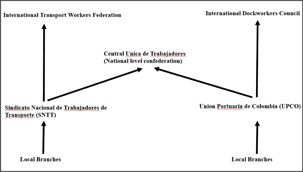
Nevertheless, Colombia is highly dependent on maritime transport, with 96.1 percent of imports entering the country by sea and 98.7 percent of exports leaving by sea (Hamburg Süd n.d.) through six major seaports. Two legitimate and competing national unions are engaged in organizing workers in the port sector, the Sindi-cato Nacional de Trabajadores del Transporte (SNTT) and the Unión Portuaria de Colombia (UPCO), in addition to a much larger number of what are essentially labor subcontractors masquerading as unions, which have not been included in this study. Both organizations are affiliated with the CUT, a left-wing national labor confederation. At the international level, the SNTT is an affiliate of the International Transport Workers’ Federation (ITF), while the UPCO is an affiliate of the International Dockworkers Council (IDC). (Please see the appendix for a list of trade union acronyms.)
The context for trade union organizing is extremely difficult, given the climate of state-sanctioned violence in the Buenaventura area. With regard to the ports, a national leader of the UPCO, based in Cartagena, reported,
I haven’t seen threats that have led to deaths. But if that did happen, the Union Portuaria couldn’t do anything …. Buenaventura and Uraba are really dangerous—there’s drug trafficking, guerrillas, paramilitaries. If one day one of those groups tells us not to go there anymore because they will kill us, we couldn’t go anymore. We don’t have the resources, the vehicles, nothing.
Lower-level violence and threats are even more prevalent. Buenaventura is, in fact, the most dangerous major city in the country. A Human Rights Watch Investigation found “a city where entire neighborhoods were dominated by powerful paramilitary successor groups … who restrict residents’ movements, recruit their children, extort their businesses, and routinely engage in horrific acts of violence against anyone who defies their will,” including murder via disappearances or dismemberment at “chop-up houses” (Schoening Reference Schoening2014). Local union reps from Buenaventura reported in interviews that many members had sent away one or more children to live in other parts of the country or join the army to avoid forcible recruitment into armed groups. Jhon Jairo Castro, a local leader in the UPCO, was issued a bulletproof vest after facing threats on his life following his participation in a delegation to Washington, DC to highlight labor conditions at the port (Hawkins Reference Hawkins, Eaton, Schurman and Chen2017, 36). A national survey of dockworkers carried out by the UPCO found that while 50 percent of those surveyed had a positive opinion of the labor movement, 70 percent of those surveyed reported being afraid to join a union out of fear of losing their jobs due to anti-union practices in the ports.
Colombian Trade Union Relationships

Nevertheless, from 1959 to 1993, Colombian dockworkers had one of the strongest labor unions in the country in terms of employment stability, wages, and benefits (Jiménez Pérez and Delgado Moreno Reference Jiménez, Nayibe and Wilson2008). Colombia’s ports were owned and operated by the state through the company COLPUERTOS. The law privatizing the ports (1991) paved the way for third-party contracting of labor services and severe informalization, destroying the union. The UPCO has estimated from its survey that today, approximately 4,000 port workers are employed directly, while approximately 12,000 are subcontracted workers—the vast majority of whom are Afro-Colom-bian—laboring in precarious situations of informality. Local leaders from both unions concurred that subcontracting is the root problem they face in organizing.
As a result, in addition to being the most dangerous major city in the country and despite hosting the country’s largest port, Buenaventura is the country’s poorest major city. Because of the ongoing armed conflict in the surrounding countryside—Buenaventura is the national leader in terms of internal displacement (Schoening Reference Schoening2014)—there is an enormous industrial reserve army in the city, and some workers are so desperate that they sleep on the street outside the port terminals waiting for work. Nearly 80 percent of the city’s 375,000 residents live in poverty (Nicholls and Sanchez-Garzoli Reference Nicholls and Gimena2011), and 40 percent are unemployed (Schoening Reference Schoening2014). As a national UPCO leader from Cartagena put it, “our [historical union’s] disappearance from Buenaventura made [higher economic] stratas 3, 4, 5, 6 disappear from the city.” A second national leader from Cartagena argued that historically,
the union was even strong outside of the port in Buenaventura—they determined the labor relations outside of the port. The union would fight for the rights of other workers. When that union disappeared with the privatization, subcontracting and precarity were seen not only in the port but in the whole city …. Before, the business owners didn’t dare do what they do now.
Today, basic amenities like regular access to potable water are sorely lacking, and the average life expectancy of 51 is far lower than the national average (Nicholls and Sánchez-Garzoli Reference Nicholls and Gimena2011).
The workforce is dominated by subcontractor agencies, allowing the terminal operators to evade their responsibility to provide mandated social benefits and permanent contracts; providing them access to a flexible labor force that can be expanded or contracted from day to day; and making it much more difficult for workers to organize (Nicholls and Sánchez-Garzoli Reference Nicholls and Gimena2011). A small minority of skilled workers at the port, employed on permanent contracts as machine operators, have somewhat better wages and working conditions than the vast majority of casual laborers, but their wages and conditions are still very poor, as is their job security. Work shifts can be as long as 36 hours, and wage theft is rampant (Bacon Reference Bacon2014). Overtime, holiday, night work, and weekend wages are not paid, nor are workers paid when work has to stop because of the rain, even though Buenaventura is one of the rainiest places in the world (Aricapa Reference Aricapa2006). Since the port was privatized, more than 30 on-the-job fatalities have been reported, along with many times more serious injuries (Nicholls and Sánchez-Garzoli Reference Nicholls and Gimena2011).
Unión Portuaria de Colombia
The UPCO was formed in 2002 by a group of retired Cartagena dockworkers who had been active in the former national union in COLPUERTOS, the state-owned ports company, which was dissolved in the early 1990s after the privatization of the ports (Interview, national UPCO leader, Cartagena). Between the early 1990s and the founding of the UPCO chapter in Buenaventura in 2008, union activity at the port was limited, and none of it ultimately successful (Interview, local UPCO rep, Buenaventura). In 1997, dockworkers participated in a weeklong citywide strike for an eight-hour workday.
There were some benefits. But it didn’t last long. Because the agreement that the union had, they had bad advice, and they didn’t sign it with the big companies but with the small cooperatives [illegal subcontractors] …. Also, some of the union leaders became very close with the Sociedad Portuaria and got benefits for themselves. (Interview, local UPCO rep, Buenaventura)
As a result, “the damage had been done. And it was difficult to regain the workers’ trust.”
In 2009, with significant support from the AFL-CIO’s Solidarity Center and the CUT labor federation (Hawkins Reference Hawkins, Eaton, Schurman and Chen2017), the UPCO began a campaign of grassroots organizing, including union trainings, assemblies, marches, and other base-building activities in Buenaventura. Organizing activities culminated in a mass mobilization in 2012 in support of 120 dockworkers who had gone on strike over the issues of subcontracting and wages and the working conditions of the directly employed. In the short term, the strike was a success, bringing together skilled machine operators on permanent contracts with unskilled casual workers (Hawkins Reference Hawkins, Eaton, Schurman and Chen2017, 38), and the UPCO reached an agreement on labor formalization with major terminal operators. However, the victory was short-lived, as false employer promises were used to coax workers away from the union (Interview, local UPCO rep, Buenaventura).
After another strike six months later, the employer refused to negotiate, and the government declined to intervene. The company issued threats and formed its own company union, canceling the contracts of subcontractors who employed union activists. Many activists were blacklisted from working at the terminal (Hawkins Reference Hawkins2013). As a result, “Starting with 120 members, we ended up with just 19. The pressure was really tough. The ministry did nothing. With those 19 comrades, we started doing consciousness raising. And little by little we regained credibility” (Interview, local UPCO rep, Buenaventura).
These experiences presented the union with a key dilemma: “either you go to a strike, which we don’t have the strength to do and they call us terrorists, or we go to a tribunal and it takes three, four, or even five years. The problem is the employers and the government. They’re both against us” (Interview, local UPCO rep, Buenaventura). Consequently, the union returned to a strategy of putting pressure on the primary operators and government, via legal complaints and international allies, to force the companies to get rid of the estimated 240 subcontractors in the port, directly hire workers, engage in collective bargaining, and compel the government to enforce labor law in the sector (Interviews, local and national UPCO leaders, Buenaventura and Cartagena). This strategy was facilitated, in part, through the campaign to include and subsequently enforce the labor provisions of the Free Trade Agreement between Colombia and the United States, which has provided ample opportunities to work with organizations from the United States, Colombia’s major trading partner (Interview, international NGO staff member). International partners framed the struggle in terms of human rights, both in trainings with union activists in Buenaventura and in advocating for them abroad (Hawkins Reference Hawkins, Eaton, Schurman and Chen2017, 33, 35).
In 2015, given the difficulties of organizing the subcontracted workforce, the UPCO in Buenaventura sought to organize permanent machine operators at the TCBUEN terminal of the port, following their short-lived success in 2012. IDC Latin America Zone Coordinator Mauricio Zarzuelo, from Buenos Aires, participated actively in the campaign and, along with Ricardo Suárez, president of the IDC’s Uruguayan affiliate, supported the UPCO in its negotiations with the employer (Interview, IDC leader, Buenos Aires). Nevertheless, as the UPCO was pivoting toward a focus on organizing permanent workers, the SNTT pivoted from the Caribbean coast to Buenaventura (Interview with international NGO staff member). Ultimately, though the UPCO was successful in signing a landmark agreement with the Sociedad Portuaria and TECSA in July 2015 (IDC 2015), the agreement fell apart after the SNTT succeeded in hiring a key national organizer from the UPCO and affiliating nearly all the UPCO’s new members (Interview with international NGO staff member).
Sindicato Nacional de Trabajadores de Transporte
The SNTT is a national union representing workers in the transportation sector. In 2004, at its congress, the CUT decided to prioritize the formation of sectoral unions in Colombia through the merger of smaller company-level unions (Interview, FNV staff member, Amsterdam). In the transportation sector, the FNV, the largest union in the Netherlands, provided funding for this initiative in a project carried out in conjunction with the ITF (Interview, FNV staff member, Amsterdam). Though the aim of the project was to amalgamate existing CUT-affiliated unions, the SNTT has primarily expanded via new organizing efforts (Interview, FNV staff member, Amsterdam).
The SNTT signed the union’s first collective bargaining agreement for dock-workers at the COMPAS terminal in the Port of Cartagena in 2012, a first for Colombian dockworkers since 1993 (Interview, local SNTT reps, Cartagena). Dockworkers active in the SNTT in Cartagena emphasized that they had succeeded in their efforts because they had focused on organizing permanent workers at the terminal, with an eye to building power at the point of production that could be leveraged to organized subcontracted workers over the long run (Interview, local SNTT reps, Cartagena). They contrasted their efforts with those of the Unión Por-tuaria in Cartagena: “about three years ago, they had a work stoppage here … it wasn’t successful. They fired them all” and “the rest of the subcontracted workers didn’t support them” because “to make a labor movement, you need political power within a company and they don’t have it [as a result of being subcontracted]. They can’t call a manager to negotiate” (Interview, local SNTT reps, Cartagena).
In 2015, when the SNTT began organizing in earnest in Buenaventura during the UPCO’s historic negotiations with TECSA, it received significant assistance from the ITF, entering into the negotiations and ultimately affiliating most of the UPCO’s members (Interviews with international NGO staff member). The SNTT accused the UPCO of myriad internal problems related to organizational transparency and democracy, as well as questioning the casual-worker—led organization’s ability to adequately represent permanent workers at the port (Interviews with international NGO staff member). The UPCO saw it differently. It accused the SNTT of opportunistically turning up at the last minute to poach its members using superior resources from international allies without having put in the long years of difficult, dangerous organizing work on the ground in Buenaventura that the UPCO had (Interviews with international NGO staff member).
In April 2016, the ITF held an international conference on port work in Cartagena, inviting affiliates from Northern Europe to participate. Danish dockworkers from the union 3F agreed to help the SNTT put pressure on Maersk, a Danish company that has regular consultation meetings with the Danish dockworkers’ union and that had acquired the TECSA terminal in Buenaventura the previous year (Interviews with national elected leader and staff member, 3F, Copenhagen). As a result of on-the-ground organizing efforts in Buenaventura, coupled with Maersk’s interest in preserving its reputation in Denmark as an ethical employer (Interviews with national elected leader and staff member, 3F, Copenhagen), the company signed an agreement with the SNTT in July 2016. However, the union has struggled to enforce the contract effectively in Buenaventura without bringing further power to bear at the point of production (Interviews with international NGO staff member).
Colombian Case Analysis
Because dockworkers’ shop-floor power has been eroded, both the SNTT and the UPCO have pursued a human rights strategy, focused primarily on external pressure rather than industrial action, in their efforts to organize and raise standards for port workers in Colombia. In essence, sociopolitical conditions have all but foreclosed the possibility of other strategies for the present. Dockworkers’ lack of viable alternative strategic pathways in this highly constrained context is most clearly evidenced by the total defeats suffered in 1997 and 2012, when they adopted a more militant approach involving mass organizing and industrial action in Buenaventura. The injection of significant funds from the ITF’s Dutch affiliate, as well as ITF training in professionalization and support from the Danish affiliate 3F, have given the SNTT a major advantage in implementing the human rights strategy.
Dockworkers lack shop-floor power in Buenvantura primarily because of the climate of state-sanctioned violence and the absence of labor law enforcement. Repression in Colombia has therefore tended to lead to diminished participation, as trade unionists correctly assume that the state does not view severe violations of their rights as a threat to its own legitimacy and consequently will not intervene to enforce even the most basic legal norms. For this reason, they have turned to a strategy of human rights unionism—built on external pressure via international allies and lawsuits—rather than a strategy of class struggle unionism focused on developing shop-floor militancy.
Yet despite the convergence of the two Colombian unions’ strategies as a result of the sociopolitical constraints they face, the SNTT has met with greater success. This was the result of the union’s long-term decision to target permanent machine operators, who, in an environment of exceptionally low shop-floor power for dock-workers in general, have a higher degree of shop-floor power, which was successfully utilized to pressure the employer, as well as the superior resources provided by the ITF.
Chile: A National Strike for Sectoral-Level Unionism
In contrast to Colombia, Chile historically had a strong labor movement—the most radical in Latin America (Bergquist Reference Bergquist1986; Palacios-Valladares Reference Palacios-Valladares2010). Close ties to left-wing parties in one of the most institutionalized democracies in the region fostered a culture of class struggle unionism with often explicitly political aims. But during the 17-year-long Pinochet dictatorship, trade union activists were among the most likely to be disappeared, imprisoned, or tortured, and labor law was rewritten to the detriment of workers. With the return to democracy in the early 1990s, hopes were high for labor movement revitalization, but the pacted transition, which ensured a significant degree of continuity with the Pinochet era, undermined the possibility of mass labor unrest (Winn Reference Winn2004). Nevertheless, in contrast to Colombia, Chile has among the lowest levels of violence in the region, and workers have at least some effective recourse to the law.
Although legal changes during the dictatorship, such as the shift from sectoral- level bargaining to unionization at the enterprise level, have, in many ways, undermined the labor movement’s power, they have also, counterintuitively, made it easier to form unions and maintain accountability to the membership, allowing unions to establish strong internal democracy and militancy in a relatively safe environment (Bank Muñoz Reference Bank Muñoz2017). Recent years have witnessed an upsurge of successful labor activism in many sectors, including mining, warehousing, retail, and education.
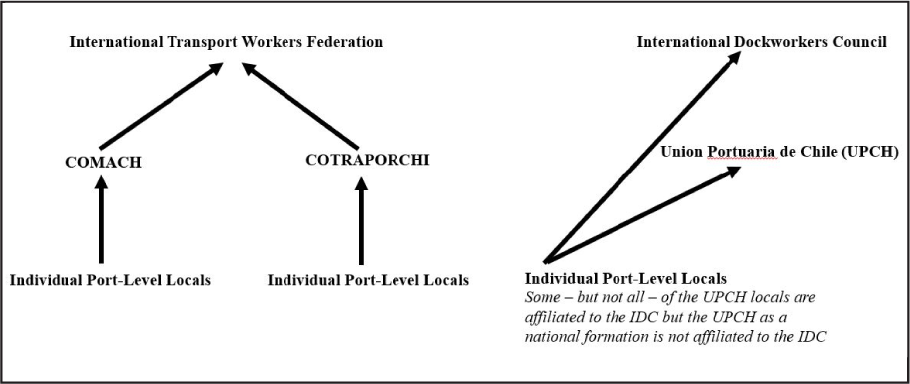
Chile’s economy is highly dependent on the country’s 36 ports, which handle around 95 percent of the country’s foreign commerce. A large majority of Chile’s dockworkers are affiliated with the autonomous and decentralized Unión Portuaria de Chile (UPCH), a national organization based on the principles of direct action and mutual aid, which groups together a range of left political tendencies at the local port level. (Despite the coincidence of name, the Unión Portuaria de Colombia and the Unión Portuaria de Chile are entirely separate organizations.)
Individual port locals from the northern part of the country have affiliated with the International Dockworkers Council, though the UPCH as a whole is not affiliated. Non-UPCH dockworker unions, from the COMACH and COTRA-PORCHI federations, are a minority in the country, with a presence in just a handful of ports. They are affiliated with the International Transport Workers Federation. Representing a minority of the country’s dockworkers, they are seen by the UPCH as “yellow unions.” This view was confirmed through an interview with a leader from a large COTRAPORCHI affiliate in Valparaiso: “we are service providers … we see ourselves as a business” and “we have a strong and good relationship with the employers … unfortunately in San Antonio and the 8th Region [Biobío], they win everything with conflict.”
Today, there are approximately eight thousand port workers in Chile, of whom the majority are casual workers. Legal changes to the status of port unions during the dictatorship, such as ending the system of registered work permits and instituting a system of casual labor (Gaudichaud Reference Gaudichaud2015)—coupled with the partial privati-zation of the ports beginning in 1998—threatened to erode dockworkers’ shop-floor power. Yet in contrast to Colombia, dockworkers have maintained a significant degree of power at the point of production through maintaining the nombrada, essentially a union-controlled hiring hall (Interviews, local union reps, Talcahuano and Iquique).
Chilean Trade Union Relationships

In the past 15 years, propelled by the Biobío region in the south, Chile’s port unions have gradually begun to reorganize themselves at the national level (Interviews, local union reps, Talcahuano). Many leaders located formative political experiences in a history of struggle by themselves or their families against the dictatorship, including within the Movimiento de Izquierda Revolucionaria (MIR), the principal extraparliamentary revolutionary party in Chile in the 1970s (Interviews, local union reps, Talcahuano). Today, many leaders in Talcahuano (the southern Biobío region) and in Iquique (in the far north) are closely connected to the Izquierda Libertaria, an anticapitalist formation that is strong in the student movement, while leaders in San Antonio formerly had ties to the center-left Socialist Party, and leaders at Mejillones were closely connected to a small Trotskyist party (Interviews, local union reps, Talcahuano, Iquique, San Antonio).
The UPCH, divided into five regional branches, was formed at the national level in 2011, following several years of organizing work. The UPCH has no executive officers but operates through a system of voceros, or spokespeople, who are only empowered to speak on decisions taken by dockworkers at their local assemblies, with regional and national-level meetings typically taking place every one to two months (Interviews, local union reps, Talcahuano). Additionally, unlike the local unions it comprises, the UPCH itself is steadfastly a sindicato de hecho—a de facto union—not a sindicato de derecho—a legally recognized union (Interviews, local union reps, Talcahuano). Proponents of the sindicato de hecho model point to the greater ease of co-opting and corrupting union leaders from legally recognized unions, as well as a range of tactical benefits of operating outside the bounds of labor law (Interviews, local union reps, Talcahuano and Iquique).
UPCH activists are united by an analysis of their power at the point of production: “the economy of this country passes through our hands. So if we stop work, the economy of this country stops. The foreign clients begin to get hungry” (Interview, local union rep, Talcahuano).
The most recent chapter in the Chilean dockworkers’ struggle began in March 2013 at the northern port of Angamos in the city of Mejillones. The UPCH affiliate at Mejillones had been engaged in a fight for the right, not recognized in Chilean law, to negotiate a collective agreement covering both permanent and casual workers at the port (Interview, local union rep, Iquique). Among the key issues was the right, as mandated under Chilean law, to a paid half-hour lunch break—the media hora. Employers nationally were not respecting this right (Interview, local union rep, Iquique).
Mejillones is a highly strategic port. It is the principal port for CODELCO (Osorio Reference Osorio2013), the state-owned copper company, nationalized under Allende, which is the top producer of copper in the world and a major source of revenue for the Chilean state. Nevertheless, Mejillones historically had much less of a union legacy than other ports (Interview, local union rep, Iquique). The port’s strategic position, the fight for the media hora, and the opportunity to build the union in Mejillones were key factors in the other UPCH affiliates’ decision to support the Mejillones union (Interviews, local union reps, Talcahuano, Iquique, San Antonio).
In total, the first national strike for the UPCH lasted three weeks, and 85 percent of the country’s ports participated (Interviews, local union reps, Talcahuano and Iquique). Hundreds of police officers were bused in to try to keep the port operational during the strike (Interview, local union rep, Iquique). Tear gas and water cannons were fired at striking dockworkers, and a union rep ended up in the hospital after being violently detained by the police (IDC 2013). The ITF-affiliated, non- UPCH unions did not participate, and accepted diverted cargo, undercutting the UPCH’s ability to exert pressure (Interview, local union rep, Iquique).
The strike threatened the Chilean fruit harvest, a key export industry, as well as retailers facing shortages of basic imported consumer goods (Ogalde Reference Ogalde2013); the National Chamber of Commerce estimated losses at US$2 billion. An agreement was subsequently reached with the employers, via the intermediation of the rightwing Piñera government, to pay a large settlement to each worker for not having respected the media hora (Interviews, local union reps, Talcahuano and Iquique). Ultimately, the employers did not follow through on the agreement, setting the stage for the conflict in 2014 (Interviews, local union reps, Talcahuano and Iquique).
Once again, the strike began with the UPCH affiliate in Mejillones and was met with a significant police presence. Dockworkers organized a round-the-clock blockade of the port, physically blocking with their bodies both cargo and potential strikebreakers from the ITF-affiliated unions (Interview, local union rep, Iquique). A dockworker union rep from Iquique who was sent to assist with the strike in Mejillones reported,
Our work was mainly to prevent them from being able to move cargo inside the port, and to prevent the train from entering … it arrives three times a day with copper from all the mines in the north of Chile … thousands and thousands of tons a day …. We had to go threaten the owner of the railway with the workers. I myself went, and I said, “if you try again to bring the train inside the port, you’re going to become a murderer and I’m going to become a martyr because I will throw myself on the trainline.” And that impacted him so much that he never tried again to get the train in or the police force or anything.
Additional clashes with police (which would also be a key feature of the strike in San Antonio), a preexisting mutual aid agreement, the decision to continue the fight for the media hora, and individual port issues led the other ports to join the strike in January 2014 (Interview, local union rep, Iquique).
In other words, while employer repression in response to industrial action in Colombia led to defeat and a pivot away from shop-floor action, in Chile, by contrast, the expectation that there were limits to the state’s willingness to violate democratic norms during disputes led to an intensification of the struggle, which quickly became national. Leaders from the UPCH across Chile understood that the most important victory in the strike would be not one of money but of power—obligating the government to engage in national sectoral-level collective bargaining for the first time since before the dictatorship, as well as winning a joint agreement for permanent and casual workers—all in spite of the law (Interviews, local union reps, Talcahuano, San Antonio, Iquique).
International solidarity was utilized to put pressure on the Chilean state to reach an agreement with the employers. The IDC sent a letter to the government threatening to boycott Chilean cargo at the height of the fruit harvest (Interview, IDC representative, Buenos Aires). The letter was widely publicized in the Chilean media, amplifying a movement that had struggled to gain public attention (Interviews, local union reps, Iquique and Antofagasta). The Association of Fruit Exporters, “When they found out about [the declaration] that came from outside the country … pressured the government” (Interview, local union rep, Iquique). Furthermore, union leaders argued that the IDC declaration had served to embarrass the Chilean government, which was particularly sensitive to perceptions outside the country (Interviews, local union reps, Iquique).
Finally, “for [the workers] it was like, wow! over there in Europe or in Spain or Argentina, they are paying attention to the conflict …. Psychologically, it helped people a lot with their spirits, to have the will to keep fighting” (Interview, local union rep, Iquique). In Chile, external support from student activists, along with- workers in other sectors, played a critical role as well (Interviews, local union reps, San Antonio, Talcahuano, Iquique).
Negotiations at the national level came to focus on the issue of enforcing the media hora—both implementing it in the present and paying back wages owed. Out of the ensuing negotiations, the government ultimately passed a ley corta clearly establishing the right to the media hora for dockworkers without increasing the length of the workday, setting a large sum per worker in back pay for the media hora, and establishing a National Day of the Dockworker commemorating dockworker leaders killed during the dictatorship. The agreement reached on the media hora back pay amounted to CLP$750,000—three times the monthly minimum wage—for each year worked, per worker, since 2005 (Gaudichaud Reference Gaudichaud2015). Additionally, the government promised to work subsequently on a ley larga, governing working conditions in the sector more broadly, as well as three ongoing mesas de diálogo to discuss specific health and safety issues facing dockworkers (Interview, local union rep, Antofagasta).
Though the national strike and subsequent negotiations with the government and employers resulted in a major, precedent-setting victory, lasting damage to the local unions in Mejillones and San Antonio undermined the UPCH’s ability to carry out actions at a similar scale in the near term. The main UPCH affiliate in Mejillones was all but destroyed after the employer, Ultraport, refused to rehire union leaders and activists who had participated in the strike, effectively instituting a blacklist. Farther south, a detailed investigation carried out by the nonpartisan Centro de Investigatión Periodística found that an employer conspiracy had resulted in splitting the union in San Antonio (Figueroa Reference Figueroa2014), though the UPCH still had a significant presence there. Leaders and activists from both Mejillones and San Antonio were blacklisted, as were supporters from the non—UPCH-affiliated ports of Arica, Coquimbo, and Valparaíso (Díaz and Santibáñez Reference Díaz and Camilo2014). Thus, although the Chilean dockworkers were able to win enforcement of their legally mandated lunch break, and although there were limits to the state’s willingness to engage in violent repression, the law in other respects was by no means on their side.
Since that time, the UPCH has been involved in efforts to unite workers in the core export-oriented productive sectors of the economy to build toward political strikes over key issues of interest to Chilean workers more generally, such as an end to the privatized AFP pension system created during the dictatorship, which they struck for in 2016 during national protests. As a local union rep from Iquique put it, “The political class as much as the citizenry know that when the dockworkers … strike, we go out en masse to the streets, we make ourselves heard.” As a result, “We believe that stopping the country [by stopping work], we can fix things for everyone …. Because [the ports] are the breaking point for the state, the losses are in the billions” (Interview, local union rep, Talcahuano).
Chilean Case Analysis
In a sociopolitical context that allowed workers to maintain a high degree of shop- floor power, workers drew from their union’s political history to pursue a class struggle strategy, pushing at the margins of the possible in 2013—14 and 2014—15. The expectation that minimal democratic norms would be respected during labor conflicts meant that employer and state repression led to increased participation in industrial action, rather than diminished participation, as in the Colombian case. Left-wing legacies, continued through the lived experience of UPCH activists—in particular, with the historical Movimiento de la Izquierda Revolucionaria and the contemporary Izquierda Libertaria—have contributed to the development of a militant and politically engaged unionism, built on the principle of mutual aid at the ports and bolstered by support from left-oriented groups in civil society and internationally. I therefore concur with Manky (Reference Manky2018, 595), who concluded from his research on subcontracted miner mobilizations in Chile that “in postauthoritarian societies of the Global South, and particularly in those where unionism has historically had a class orientation, political activists remain crucial actors.”
Nevertheless, class struggle unionism is not the only strategic possibility in Chile today. The ITF affiliates demonstrate that class collaborationism is also an available strategy, as are forms of microcorporatism (Bensusan Reference Bensusan2016; Palacios-Val- ladares Reference Palacios-Valladares2010) and, to a more limited extent, human rights unionism (Quevedo Reference Quevedo2016)—by no means a comprehensive list. Led by Valparaíso, the ITF-affiliated class collaborationist unions pursued a legalist strategy during the dispute, filing a lawsuit that would have achieved only minimal, strictly economic demands for the media hora while actively seeking to undermine the more militant actions and political objectives of the UPCH by serving as strikebreakers, filming actions, and otherwise collaborating with the authorities and employers.
The UPCH dockworkers’ highly sophisticated understanding of key pressure points in time and space enabled them to maximize the impact of their position in the economic system and was determinative for their victory. Union activists, aided by intellectuals from the Izquierda Libertaria, recognized the importance of the copper-exporting port of Mejillones and the container port of San Antonio, transferring organizers from other ports there during the strike to strengthen their efforts. Successfully shutting down Mejillones put significant pressure on the government to intervene to reestablish the international flow of copper from the publicly owned CODELCO mine. Holding the line at San Antonio and southern ports put significant pressure on other sectors of capital—in particular, exporters of fresh produce and forestry products who were vulnerable to time delays—to push for a speedy resolution to the dispute. As a local union rep from Talcahuano put it, “The region can’t deal with more than seven days of work stoppages [at the port]. There is a build-up of timber, of cellulose. The stores begin to run out. Winter begins to arrive. We use this very strategically.” The result was a major victory for Chilean workers in general, reestablishing a national precedent for tripartite sectoral-level collective bargaining covering both permanent and casual workers.
Conclusions
The dominant framework for understanding worker power would suggest that both Chilean and Colombian dockworkers, because of their central position in the economic system, have a high degree of power at the point of production to be leveraged through industrial action. Comparative research suggests, instead, that while Chilean dockworkers did, in fact, have a high degree of power at the point of production, the presumed shop-floor power of Colombian dockworkers in Buenaventura effectively did not exist in practice. To explain this finding, I consequently argue the need to expand our framework for understanding structural power to include state and society in addition to the economy. This more expansive understanding is better able to account for substantial cross-national variation among workers whose shared economic position would suggest a similar degree of power at the point of production but who nevertheless pursue highly divergent strategies.
Developing a framework that better delineates the roots of worker power at the point of production, in turn, allows for a more precise understanding of the field of possible strategies open to specific, economically defined groups of workers in given contexts. As did Anner (Reference Anner2011), I found that national-level sociopolitical context was the key factor that shaped strategy in both cases. Nevertheless, while Anner emphasizes retrenchment of industrial relations systems and the availability of state-level alliances, I highlight a number of other ways in which state and society matter.
In particular, this study emphasizes the role of state-sanctioned violence and lack of enforcement of labor law in determining the very different strategic pathway pursued in the Colombian case relative to the Chilean case. These conditions in Colombia have resulted in the creation of a highly uneven playing field for labor disputes, in which employers have at their disposal a wide range of tools to intimidate, cajole, and repress trade union activists. As a consequence, the Colombian dockworkers pursued a human rights strategy, relying primarily on external pressure via international allies and lawsuits, rather than industrial action. Yet given the low degree of shop- floor power that dockworkers in general possess in Buenaventura, the decision to focus on organizing a group of workers with a relatively high degree of shop-floor power—permanent machine operators—yielded positive, though tentative, results.
In Chile, conversely, while trade union activists hardly struggle in a workers’ paradise (Winn Reference Winn2004), the expectation that basic democratic norms concerning limits to violence and enforcement of the law will be respected has meant that workers have been able to effectively leverage their power at the point of production during disputes. The maintenance of a union-controlled hiring hall system in Chile, in spite of the partial privatization of the ports and in contrast to the Colombian case, moreover, underlines how critical control of the labor supply is to maintaining the shop-floor power of workers in the port industry. Chilean dockworkers, operating in a less constrained context than their Colombian counterparts, had available to them a wider variety of strategic pathways and ultimately adopted a class struggle strategy as a result of their union’s political history. Chilean dockworkers effectively leveraged their position in the economic system through targeting specific ports at specific moments, drawing the state into the conflict as a third negotiating partner.
In countries like Chile, with relatively open contexts for trade unionism, and in countries like Colombia, with highly constrained contexts for trade unionism, some generalizable conclusions for labor internationalism may be drawn from these cases. The role of the IDC in the Chilean case suggests that when workers have a high degree of shop-floor power, international industrial pressure, in the form of blockades or solidarity strikes, may be best suited to win broader gains for workers. The role of the ITF in the Colombian case, conversely, suggests that when workers’ shop-floor power is severely eroded by sociopolitical forces, international normative pressure targeting both states and transnational employers, as well as funding to support organizing, training, and other basic union activities, can provide an advantage. The difficulties the Colombian dockworkers have faced in enforcing and building on their gains despite strong international support nevertheless suggest that there may be limits to a strategy largely removed from building shop-floor power.
The cases, then, are suggestive of the wide variety of global union organization responses—from international blockades to normative pressure to financial support—that may be appropriate for different local and national contexts. I concur with Von Bülow’s finding that
there is no single type of labor internationalism waiting to be discovered. To understand the potential of and the obstacles to labor collective action across borders, it is crucial to consider the complex interactions between dynamic domestic political contexts and labor’s embeddedness in new multiscale and cross-sectoral networks. (Von Bülow 2009, 21)
This analysis concludes that instead of adopting a “one size fits all” model, global union organizations should develop a flexible and responsive approach to international solidarity. Such an approach should begin with the supposition that workers who share a similar position in the economic system may yet possess divergent degrees of power at the point of production, as a result of national sociopolitical factors, and strategy should therefore be developed accordingly.
Appendix: Organizational Acronyms
3F (Denmark) Fagligt Fælles Forbund
COMACH (Chile) Confederación Marítima de Chile
COTRAPORCHI (Chile) Confederación de Trabajadores Portuarios de Chile
CUT (Colombia) Central Única de Trabajadores
FNV (Netherlands) Federatie Nederlandse Vakbeweging
IDC International Dockworkers Council
ITF International Transport Workers Federation
SNTT (Colombia) Sindicato Nacional de Trabajadores de Transporte
UPCH (Chile) Unión Portuaria de Chile
UPCO (Colombia) Unión Portuaria de Colombia