Why should we talk about electroacoustic music listening as opposed to music listening in general? Theoretical approaches regarding electroacoustic music and music in general seem to go together: the work, as a stimulus, is thought to induce listening strategies in listeners through surface contrasts and textures (Weale Reference Weale2005a). However, ‘much electroacoustic music privileges listening as a creative act’ (Weale Reference Weale2005b). Moreover, research on electroacoustic music listening is still rare in music psychology. Cognitive theorists have been tackling the topic (Hirst Reference Hirst2008; Kendall Reference Kendall2014; Windsor Reference Windsor1994), but rigorous experimental designs have rarely been used in electroacoustic music, compared to tonal music (and when they exist, conclusions about the perception and listening of actual works of music cannot easily be drawn – see Dean and Bailes Reference Dean and Bailes2011, Reference Dean and Bailes2012; Lembke Reference Lembke2018).
Besides, research in electroacoustic music listening has often been led by people who seemed biased by their own aesthetics as composers. This research has generally resulted in esthesic analytical models based on a specific perspective towards sounds, music and/or form. Pierre Schaeffer’s Traité des objets musicaux (Schaeffer Reference Schaeffer1966) can illustrate this: although ‘reduced listening’ aims for a listening practice detached from any style or genre, Schaeffer’s research and writings are infused with the aesthetics of ‘musique concrète’ and with its techniques and preference for setting aside anecdotal references. Denis Smalley’s ‘spectromorphology’ (Smalley Reference Smalley1997) allows us to understand Smalley’s interest in continuity as well as in spectral and spatial balance; it could easily be at a loss when facing, for instance, a plunderphonics work. Lasse Thoresen’s ‘music-as-heard’ (Thoresen Reference Thoresen2015), based on the Gestalt theory, has been explicitly used to discredit some avant-garde aesthetics (Thoresen Reference Thoresen2016: 90). François Bayle’s ‘image-de-son’ (Bayle Reference Bayle1993), although not an analytical model, is particularly useful for understanding Bayle’s music and aesthetics and could certainly not account for static music such as drones.
If we want to study listening, we should seek out rigorous methods and theories leading to conclusions unrelated to their authors’ aesthetic preferences. This would ideally lead to less poetry, to less extrapolation in the interpretation of results and to more explicitly stated limitations. One instance of this is Leigh Landy’s research (see Landy Reference Landy2016 for an overview). The ‘something to hold on to factor’ (Landy Reference Landy1994) was elaborated using the analysis of experimental music to point out specific characters and elements in a work of music which might help listeners to make sense of this work. Its concrete application was assessed with the Intention/Reception project (see Weale Reference Weale2005c and Landy Reference Landy2007). Five acousmatic works were used. Landy and Weale’s conclusions did not go beyond their observations – they did not offer a complete model for the perception of electroacoustic music, nor did they seek to imply that some aesthetics were more suited to listeners than others. They merely observed that listeners tended to relate to music differently and to appreciate it more when they were given information about composers’ intentions, and that they were able to perceive composers’ intentions when they tried to do so. This was particularly the case when the work did not feature ‘real-world’ sounds, which seemed to constitute ‘something to hold on to’ on their own.
Thus beyond composers’ theories and experimental designs, there are empirical explorations of listening, relying on actual listeners’ testimonies. These explorations search for the best way to help listeners discover new works and genres and to introduce them to new listening possibilities. Among these, we will be talking about the idea of ‘listening behaviours’ coined by François Delalande (Reference Delalande1989, Reference Delalande1998). This idea accounts for an act of reception implying attention management and a specific relation to time and space as well as a symbolic interpretation of perceived entities, along with a way of expressing all this in words. Delalande theorised three main listening behaviours, which will be discussed in the next section.
The aim of this article is to review existing research about listening behaviours in acousmatic music, to put forward methodological limits and biases and to propose a stronger methodological basis for the study of listening, based on my doctoral research (Marty Reference Marty2018).
1 REVIEW OF EXISTING RESEARCH ON LISTENING BEHAVIOURS
Since Schaeffer limited his research to object perception, Delalande wanted to find out more about listening to actual musical works. After a few years of meeting with other people from the Groupe de Recherches Musicales (GRM) to listen to works and talk about their listening experiences, he collaborated with Jean-Christophe Thomas in a more controlled design: listeners, after hearing a work of music, would be asked to talk about what they heard and how they listened to it. The method evolved over the course of the first research project in 1979 (using ‘Sommeil’ from Pierre Henry’s Variations pour une porte et un soupir, with eight listeners), ranging from one to three hearings of the piece. It was then reviewed and a definitive method was used for the second project in 1989 (using Debussy’s piano piece La terrasse des audiences du clair de lune with ten listeners) as follows: after listening to another piano piece by Debussy, each listener was presented with three hearings of La terrasse, each followed by a semi-structured interview.
Both projects led to written transcriptions of interviews and discussions between Delalande and Thomas about what could be drawn from the content of the interviews. Delalande’s papers about these projects (1989, 1998) do not fit the criteria for experimental psychology and cognitive sciences because they were largely driven by the wish to develop esthesic analysis models relying (however freely) upon actual listeners’ testimonies. The freedom he took in defining these models may be the most important limitation to his papers: the method for content analysis is not explicitly stated, quotations from interviews are somewhat sparse and they do not illustrate the evolution of listeners’ experiences and discourses through several hearings. Obtaining and going through the original transcriptions of the interviews and discussions about content analysis (GRM-held documents, also available as appendices to Marty Reference Marty2018), we can see that, while the method for content analysis does not seem to have been defined explicitly, a thorough confrontation of ideas took place between Delalande and Thomas to obtain the three main listening behaviours (taxonomic – some listeners listed sound objects and tried to make sense of the work’s structure; empathic – some others reported sensations related to sound qualities and to the work’s unfolding, while its structure was not relevant to them; figurative – others yet interpreted ‘Sommeil’ as a scenery with a monster breathing in and out or a heartbeat heard from within). He also observed some complementary orientations (such as immersive listening, searching for a law of organisation or not listening). According to Delalande, listening behaviours were mutually exclusive – by which he meant that two listening behaviours could not be present at the same time during listening, although they could follow one another.
To better understand to what extent we can trust Delalande’s conclusions, we can point to some stable aspects of his methods. First, listeners were at the very least acquainted with the music genre they were exposed to – some even knew the specific works. This is because they were mostly electroacoustic practitioners from the GRM and thus a very select group. Second, there were several hearings, each followed by an interview – and listeners were aware of this. Their discourse may thus have been biased, and it appeared difficult for some of them to differentiate what they said about their experience from what they said about listening and music in general. This means the listening behaviours proposed by Delalande resulted from the interpretation of listeners’ discourses based on their memory and on their understanding of a work through several hearings. Considering memory biases and the difficulty one may encounter when trying to describe a non-verbal experience with words (which will be discussed below), there was no way to know if their testimony made for an honest and complete account of their listening experience. Furthermore, listeners may also have been focusing their attention more than usual, specifically on the piece of music without doing anything else at the same time, which is but one listening practice. Therefore the conclusions cannot be extended beyond this specific listening practice.
No experimental validation was done for this research project. However, the three main listening behaviours were empirically validated during seminars and conferences as a good way to describe listeners’ discourses and to help guide listeners towards different aspects of ‘Sommeil’ and La terrasse. Based on these and on further projects (see Delalande Reference Delalande2010 for an overview), Delalande concluded that different listening behaviours implied different ways to resolve perceptive conflicts, such as the choice to focus one’s attention on global morphology, on form segmentation through time, or rather on polyphonic layers and salience of sound entities.
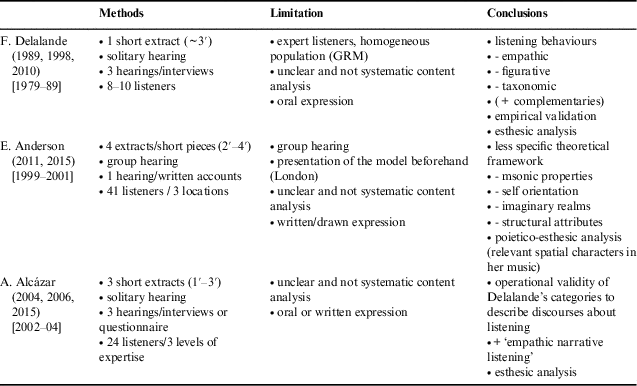
However, the methods’ limits meant that Delalande could not reach substantial conclusions. Therefore, he deemed it important to reproduce these results in a more controlled setting. He supervised Antonio Alcázar in his doctoral research between 2001 and 2004, reproducing the 1989 method with three electroacoustic extracts – Michel Redolfi’s Le cauchemar de l’éléphant blanc (from Jazz, d’après Matisse, 1989–93), an extract from Régis Renouard Larivière’s Futaie (1996) and an extract from Francis Dhomont’s Points de fuite (1982) – with 24 listeners divided into three groups according to their expertise: electroacoustic practitioners, expert musicians and non-experts. One difference with Delalande’s research was introduced, most certainly because it made it easier to recruit a larger number of participants: some listeners produced a written – rather than oral – account of their experience.
Alcázar concluded that Delalande’s three behaviours were the most obvious ways to make sense of listeners’ testimonies, which can be gathered from reading the testimonies (available in Spanish in Alcázar Reference Alcázar2004 and with French translations in Marty Reference Marty2018). However, some aspects of testimonies may imply that these three behaviours are not as clear-cut and independent as Delalande thought they were. Alcázar himself defined ‘empathic narrative listening’ as containing elements from figurative listening while defining the listener as the main character exploring the imaginary space made up from the music. Other testimonies may suggest that figurative listening may also be mixed with elements of taxonomy. Actually, the segmentation of materials in analyses by Alcázar with figurative and taxonomic orientations are identical. The difference lies in listeners’ large-scale representation: with taxonomic analysis, the form makes sense through an element of tension evoked by the music, whereas in empathic listening, tension is felt by listeners. With figurative analysis, it is the narrative or descriptive thread that keeps the extract together, without tension being necessarily a part of it. Table 1 differentiates the three main listening behaviours according to the way listeners distinguish entities and relate to tension and structure, based on Alcázar’s observations.
Possible interpretation of relevant characters in different listening behaviours as observed by Alcázar.

One of the most interesting conclusions by Alcázar was the comparison between experts and non-experts: he observed that experts’ discourses relied more on taxonomic listening than those of non-experts. This might be because experts’ discourses generally rely on specialised vocabulary and description of structure and form. It must also be mentioned that music experts and electroacoustic experts interviewed by Alcázar were all university teachers.
As part of her PhD in composition, Elizabeth Anderson (Reference Anderson2011) set out to verify Delalande’s insight with four different works – an extract from Annette Vande Gorne’s Bois (1986), an extract from Stéphane Roy’s Crystal Music (1994), an extract from Ludger Brümmer’s The Gates of H (1993) and the first of Jacques Lejeune’s Deux aperçus du jardin qui s’éveille (1984) – and more subjects (12 from City University London, 17 from the International School of Brussels and 12 from the Académie de Musique de Soignies). However, she did this in different and much less controlled conditions (some testimonies are available in Anderson Reference Anderson2011; all testimonies are available in French and English in Marty Reference Marty2018). Listeners heard the extracts in groups, and reacted to them on paper, through writing and drawing (mostly used by the child participants). This was a major difference that made it difficult to compare between Delalande’s and Anderson’s observations. This can explain Anderson’s extension of Delalande’s categories: figurative listening became ‘imaginary realms’, including elements of surrealism; empathic listening became ‘self-orientation’, including all references to oneself, from sensations to aesthetic appreciation and interpretation; taxonomic listening became ‘structural attributes’ and was linked to all structural functions and form.
Based on her interpretation of listeners’ writings and drawings, Anderson concluded that listening behaviours were not mutually exclusive and thus could coexist. However, the fact that the testimonies were written means that we cannot know whether these explanations, if they were in fact part of listeners’ experiences, coexisted as a moment in time or rather followed each other. In fact, Anderson’s research cannot serve as a basis to evaluate Delalande’s behaviours but sheds different light on listeners’ testimonies as evidence of listening experience. However, in Delalande, Alcázar and Anderson, listeners’ testimonies are judged reliable to assess listeners’ mental constructs and listening experience. While this may be partly true in Delalande because of the repeated listening and specificity of the oral interviews trying to better understand discourses, Anderson’s proposals are more apt for describing listeners’ discourses rather than their representations. Delalande’s behaviours are not completely detached from discourse either – we saw this with Alcázar concluding that experts relied more on taxonomic listening because they used more taxonomic discourse. The methodology we will be presenting in the second part of this article will be made to allow for a more reliable distinction between listeners’ discourse and listeners’ experience.
Table 2 synthesises Delalande’s, Alcázar’s and Anderson’s methods and conclusions about listening behaviours. It must be mentioned that listening behaviours have also been studied with instrumental music. Delalande himself used a piano prelude by Debussy in 1989 and drew his 1998 conclusions from Pierre Henry’s ‘Sommeil’ (researched in 1979) partly based on his observations from 1989. Francesco Spampinato (Reference Spampinato2015a, Reference Spampinato2015b) used extracts from Debussy and Ravel to refine the definition of empathic listening behaviours through the idea of a gradual ‘coupling’ (embrayage) between listeners’ bodies and musical gestures. Moreover, some authors furthered the idea of listening behaviours in different ways without consulting actual listeners. Smalley (Reference Smalley1992) differentiated listeners’ engagement with music in reflexive, indicative and interactive relationships and linked this distinction to Delalande’s behaviours (respectively empathic, figurative and taxonomic). Kaltenecker (Reference Kaltenecker2010, Reference Kaltenecker2016) observed a similar distinction in eighteenth- and nineteenth-century listeners’ reports, with four forms of listening: reflexive, imaginative, ineffable and sublime. Thoresen (Reference Thoresen2016) extended the notion of listening behaviour following a semiotic approach to account for the relation between listener, performer, music and composer.
Synthesis of research projects about electroacoustic music listening behaviours (1979–2016).

Note: in parentheses, publication dates; in square brackets, data collection dates.
2 CONTRIBUTION
I led a small-scale experiment as part of my master’s thesis (Marty Reference Marty2012, before I knew much about Delalande’s approach), and found that similar categories made for an acceptable description of listeners’ reports on four extracts from Trevor Wishart’s Journey into Space. These categories also seemed to be close to cognitive approaches regarding mental representations (Meunier Reference Meunier2009): empathic listening could be explained by a reliance on action-based representations (using dynamic representations of bodily movement and actions as a basis); figurative listening could be related to pictorial representations (i.e., mental maps inside which relations and actions work by analogy with the real world); taxonomic listening could be explained as propositional/conceptual representations (whereby abstract concepts could coexist and be put in relation with one another with references to one’s knowledge and abstract understanding of the world). The limitations found in these four research designs (Delalande, Alcázar, Anderson and myself) have to do with data collection and content analysis. Testimony collection always relies on an oral or written account of listeners’ remembrance of their listening experience. This means conclusions one may draw from such testimonies were hindered by memory’s fundamental flaws as well as by social, professional and personal factors influencing the way listeners build their discourses. Thus, to extract listeners’ experiences from their discourses, content analysis should be a lot more rigorous and systematic. This was the starting point for the experimental part of my doctoral research.
2.1 Method
The elicitation interview (entretien d’explicitation) was developed by Pierre Vermersch (Reference Vermersch1994) to address these difficulties in pedagogical settings, guiding pupils through the exploration of how they resolved problems to make them aware of automated, unconscious processes responsible for their failures. This method finds its theoretical bases in phenomenology and neuro-linguistic programming (NLP), which means some of its bases are scientifically weak. NLP has been shown several times to have little if any proof of its theories, some of them having been clearly shown to hold no truth (Witkowski Reference Witkowski2010). ‘Psychophenomenology’, as coined by Vermersch, thus seems to be more of a metaphor (useful to learn the elicitation method) than a scientific framework. However, the basic principle of the elicitation interview is to help listeners differentiate between what they are thinking and saying at the time of the interview, and what they have experienced at another point in time. This is the difference between knowing and remembering, between semantic memory and episodic memory, which has been widely studied by modern neurocognitive sciences, bearing the conclusion that people are able to differentiate between these two kinds of memory when asked to (Piolino Reference Piolino2003; Piolino, Desgranges and Eustache Reference Piolino, Desgranges and Eustache2009). The conscious use of an ‘actor perspective’, recommended by Vermersch through the induction of first-person pronouns and present tense, has also been shown to induce discourse related more to episodic than semantic memory (Eich, Handy, Holmes, Lerner and McIsaac Reference Eich, Handy, Holmes, Lerner and McIsaac2011). Lastly, it has long been known that episodic memory encoded both events and contexts, and that exposure to (or remembrance of) contextual elements could help remembrance of whole memories (Meunier Reference Meunier2009). Vermersch could mention these experimental observations to support his idea that having people describe the context of the action about which they are interviewed can help them get closer to the description of their actual experience.
Unfortunately, the people who created and pursue the teaching of the elicitation interview work outside universities and research centres and are quite reluctant to refer to modern sciences to prove how the elicitation interview works, for multiple reasons. Claire Petitmengin did lead one study aiming to evaluate the efficacy of the elicitation interview when trying to have people remember more truthfully their own mental processes (Petitmengin, Remillieux, Cahour and Carter-Thomas Reference Petitmengin, Remillieux, Cahour and Carter-Thomas2013). Previous experiments had been led with standard interview methods asking listeners to choose between two photographs, then asking them to explain why they chose one photograph rather than another (Johansson, Hall, Sikström and Olsson Reference Johansson, Hall, Sikström and Olsson2005; Johansson, Hall, Sikström, Tärning and Lind Reference Johansson, Hall, Sikström, Tärning and Lind2006 Nisbett and Wilson Reference Nisbett and Wilson1977). When asking for the explanation, researchers sometimes switched photographs – they were thus asking people to explain a choice they did not make. In these experiments, most people justified the choice of the photograph they were shown whether it was the one they originally chose or not. In fact, most of them did not realise the photograph was not the one they chose. Petitmengin et al. showed that the elicitation interview seemed to allow more people to realise when the photograph was the wrong one, even when both photographs were hidden from view longer than in the original experimental settings.
Methodologically speaking, I chose to practise the elicitation interview using only the techniques for which I could find some scientific validation. The interview usually starts with a suggestion: ‘Now, if you agree, I suggest you take some time to let a moment from your experience come back to you – when you have something, you can tell me.’ Once the participant starts talking, some rules guide the interview towards more episodic memory while avoiding general discourses.
• The most important thing was to always check explicitly whether what they were saying was elaborated during the interview or during the experience, and whether the participants themselves considered their own words as apt descriptions of their experience (‘You talk about light fairies flying, is this something you pictured while you were listening, or something you thought of now?’). If they were talking about something they thought of during the interview, it proved useful to ask them whether this was in any way present while they were listening.
• As should be the case in any interview interested in the participants’ representations and experiences, I avoided as much as possible the use of content-bearing questions. Where content was present (for instance when I wanted to ascertain that I understood something correctly), I used multiple choices and offered other possibilities, to avoid influencing listeners’ representations too much (‘So these fairies, you actually picture them at that moment, or maybe it’s more of a sensation, or maybe an idea, a metaphor, or something else?’).
• Since memory encodes events and their context, I occasionally helped listeners recall their experience by having them recall the context (‘What do you see at that moment?’, ‘So you’re looking at the screen, what else are you seeing?’). This seemed to give a better access to episodic memory, anchoring the participants in the moment they were describing.
• Encouraging the use of first-person pronouns and present tense when talking about what happened (‘So you’re hearing this sound, what happens right after that?’) also seemed to help get a better access to episodic memory. Particularly when two participants were using past tense and listing events, responding with first-person pronouns and present tense helped one change perspective and helped the other one understand that the aim of the interview was not a description of what was in the music, but a description of his detailed subjective experience.
• Whenever the participants seemed to be done talking and remembering about a specific moment, I got back to the question from the beginning of the interview, giving them the possibility to elaborate on another moment from their experience. If nothing more came back to them, I asked them if they wanted to say anything else. In most cases this led to more remembrance afterwards. Then it allowed me to end the interviews.
The content analysis was then a step-by-step process to separate general knowledge and remarks from the description of the listening experience (following Vermersch Reference Vermersch2012). After transcribing the whole interview, sentences were numbered and parts related to the description of listening experiences were put forward. Because the interview often leads people to describe moments without necessarily following the chronology of the work, chronology was then reconstituted as much as possible. In my experience, there were very few cases where the context and description were not clear enough to indicate the time point in the musical piece it related to – this is the main purpose of the question ‘What happens right after/before that?’, often used during the interview. Chronology was then summarised, and an interpretation in terms of listening experience was offered.
2.2 Previous research
A first data collection (presented in Marty and Terrien Reference Marty and Terrien2016) was realised in 2013–14 with seven French people interviewed after listening to an extract of Chat Noir by Elizabeth Anderson (available for listening at http://musimediane.com/delatour_marty/). All were musicians with different levels of expertise. Four underwent an elicitation interview: a music theory teacher, a musicology student, a conducting student and an electroacoustic composition student. Three underwent a semi-structured interview, all of them university students in arts or musicology.
The analysis of their testimonies showed that standard semi-structured methods, using primers, were quite apt to help interviewees build a discourse and question themselves about different aspects of what they heard, while the elicitation interview was best suited to help them talk about their actual experience (and mostly to help us learn about this experience). While Delalande, Alcázar and Anderson had observed mostly stable behaviours all along a musical extract, frequent changes in behaviours from all four listeners were quite apparent here, often related to the structure of the extract. At this point, we distinguished between:
• internal focus, when listeners seemed to be managing their own attentional processes;
• external focus, when listeners were interpreting musical and sonorous content in diverse ways closely – this was closely related to Delalande’s three main behaviours, although a fourth category seemed useful to explain some reference to sound parameters with no apparent interest in taxonomy, sensations, emotions or extramusical references;
• secondary focus, when several behaviours seemed to coexist or when one behaviour seemed to be built based on another one.
From the interpretation of this previous data, we concluded that Delalande’s reception behaviours did not prescribe the perception of any specific content but offered different reception frameworks, different ways to guide oneself through a work of music.
2.3 Material and population
The same extract was used in 2016 with another French listener, ‘V’, non-expert in music (although he had studied trumpet as a child), undergoing three elicitation interviews following three hearings of the extract. The results presented here are related to his testimonies and to the reinterpretation of testimonies from the previous research. As such, this is more of a case study than an actual experiment gathering a larger number of people to be able to draw more general conclusions.
2.4 Results
It is not possible to include here complete translations of the interviews. However, a database gathering all testimonies from projects dedicated to the study of listening behaviours is being created, with translations in French and English. Here, I will put forward translated quotations to explain how the whole interview was analysed and interpreted.
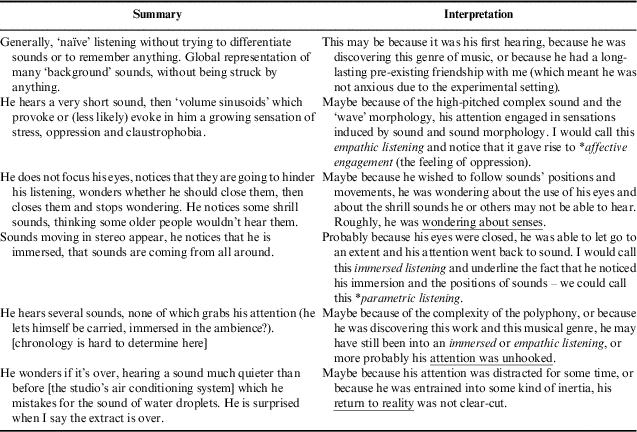
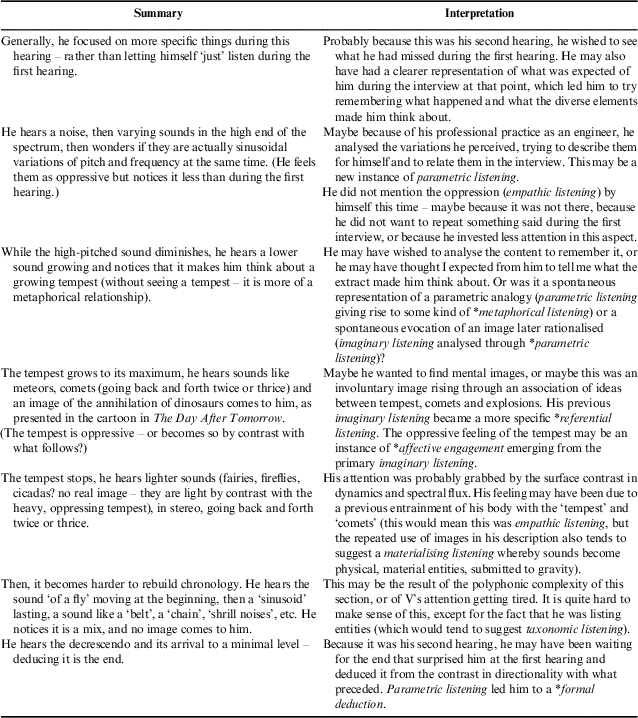
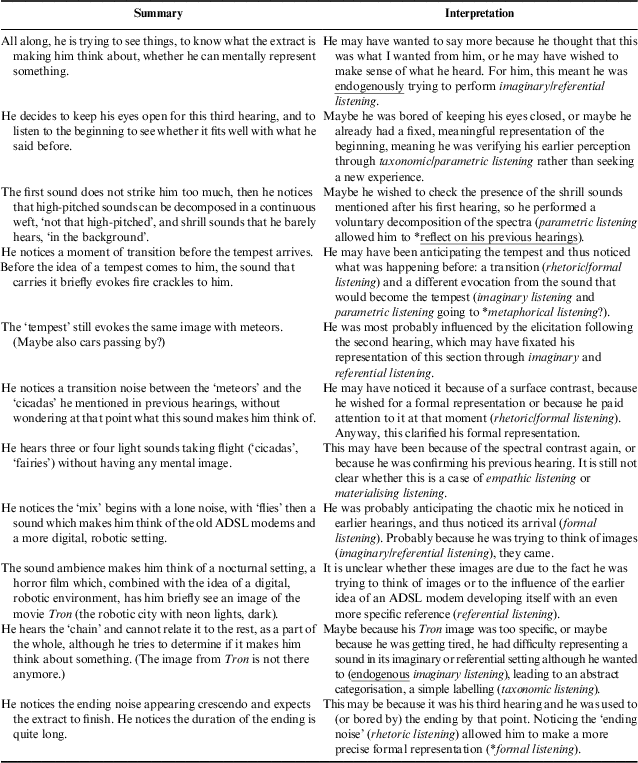
Tables 3, 4 and 5 present the summary of V’s listening experiences in the left column. The right column contains possible reasons for what is experienced along with a general account of the experience and an interpretation in terms of listening behaviours. Attention management processes are underlined, simple listening behaviours are in italics, while asterisks indicate a behaviour seemingly built upon the result of another. The interpretation in terms of listening behaviours were elaborated after the general interpretation and possible explanations for his account of his experience, so that recurrent and typical behaviours were easier to pinpoint. The first line of each table, with the tinted background, sums up the general notions that came out of the testimonies. The most striking observation, compared to previous studies, was the fact that not only did a wide array of behaviours appear in each hearing, some behaviours also seemed to emerge from the results of other behaviours. For instance, the growth of a low sound made V think about a tempest, which led him to hear comets and meteors when the louder sounds came in, which in turn led him to think about a specific scene from the movie The Day After Tomorrow where a child is watching the annihilation of the dinosaurs in a cartoon: noticing the evolution of a sound made him think about a phenomenon from the real world, which evoked a specific mediatic reference.
Summary and interpretation of V’s first interview.

Summary and interpretation of V’s second interview.

Summary and interpretation of V’s third interview.

2.5 Discussion
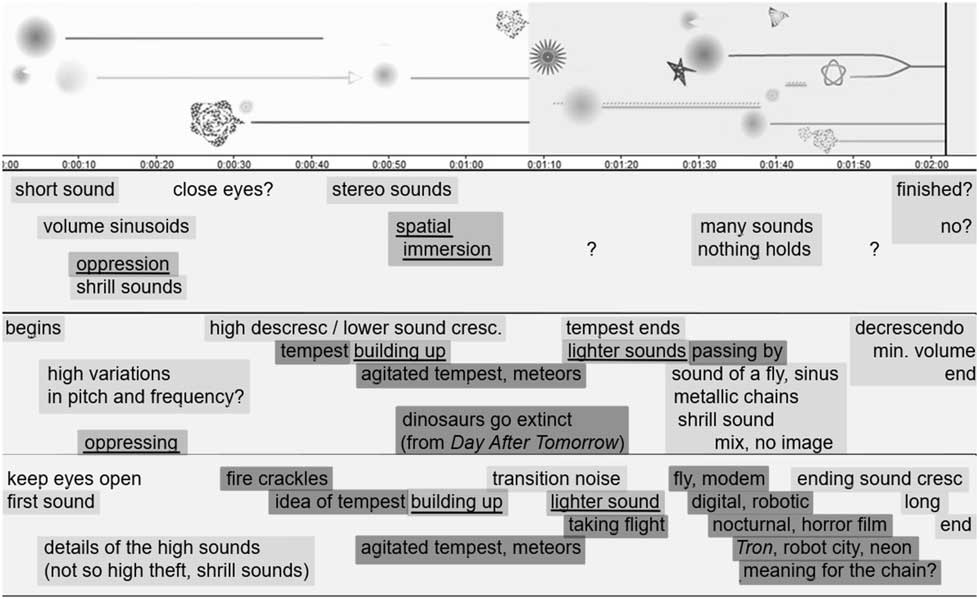
V’s listening behaviours were put together and compared for similarities in cognitive processes, mental representations and relationships to time and space. They were then compared with similar hypotheses from the previous research (with listeners B, C, L and T) and grouped into macro-categories.
Figure 1 renders this into a summed-up schema synchronised with a graphic score of the extract. In the full-colour figure, individual listening behaviours are distinguished with colours (while the grayscale figures only make the distinction between macro-categories):
General account of V’s testimonies interpreted in terms of listening behaviours (for a full colour image, see http://nicolas-marty.com/wp-content/uploads/OSmartyF1.tif).

• blue represents an interest in sonic parameters with no specific structural overtone (I call this parametric listening) – this happened often for V at the beginning of the extract, when he explicitly noticed the high-pitched variations and characterised them through their abstract parameters and their variations;
• light purple is closer to taxonomic listening (listing entities) – interestingly, this did not appear in these testimonies, except for V and B, at a point where they could not make sense of what was happening because too many sounds were happening at the same time or because they had lost track of the form;
• dark purple takes more interest in form (rhetoric listening, formal listening) – V, maybe because he is not an expert musician, did not seem to manifest this behaviour too often – L, as an expert musician, electroacoustic composer and music theory teacher, noticed the role of the first sound as a ‘trigger’ and thought that the first 30 seconds at least were more an introduction than the beginning of the piece;
• yellow is concerned with a dynamic engagement of the listener with sound (empathic listening) – it is not exactly clear whether this happened for V, although the notion of a growing tempest related to a growing stress on his part seemed to indicate this kind of behaviour;
• orange implies emotions (affective engagement) – this was most clear with B who, hearing ‘the sound of the waves’ when the granular low sound came in the first section, felt happy and noticed it;
• light green refers to general analogies with the real world (imaginary listening) – this was explicit in V’s testimony when he talked about the similarity between sounds growing and a tempest coming, between sounds moving through space and meteors passing by – B seemed to give the moving noisy sound around 1′ an actual physical materiality, describing it as ‘pushing down’/‘crunching’ pleasant sounds from before (this may actually be another behaviour, which I would call materialising listening);
• dark green means very specific references (referential listening) – V thought about Tron and The Day After Tomorrow, B thought about Minority Report at the beginning of the extract, and this helped them make sense of it (due to the few instances of this behaviour, it remains unclear how this kind of reference may function in the same way or in a different way from imaginary listening);
• brown (not highlighted in the grayscale version) refers to attention management processes – V’s and B’s attention drifted away, they both tried to find something to hold on to in the second section, V tried explicitly to make analogies and references with sounds during his third hearing, he wondered whether he should close his eyes or not during the first hearing and chose to keep his eyes open at the beginning of the third hearing.
Overall, the macro-categories were chosen as follows:
• blue and purple (light gray squares in the grayscale version) represent an interest in structure and form, which I propose to call a structural listening behaviour;
• yellow and orange (underlined medium gray squares in the grayscale version) represent embodied listening behaviours;
• green (dark gray squares in the grayscale version) refers to imagery-based listening behaviours;
• brown (not highlighted in the grayscale version) refers to attention management processes.
‘Abstract sonic elements’, which were first identified as a category on their own, were included in the ‘structural’ category because while they were not specifically interested in structure, participants were paying attention to specific sound parameters and eventually tracking their evolution. ‘Attention management processes’ and some ‘odd’ behaviours observed in Marty and Terrien (Reference Marty and Terrien2016) could not be grouped into categories. This was notably the case for Smalley’s (Reference Smalley1997) technological listening, whereby listeners are interested in the processes behind the sound’s manufacture and the overall technique and technology behind a work. Although the previous research led me to group this behaviour in the ‘structural’ category, new insight from the later interviews made obvious that for some behaviours, either an expansion of category should be made, or other categories should be created. This was also the case with a participant thinking as she was listening that she did not like what she was hearing and later that she would have done it differently (had she been the composer). However, these ‘odd’ behaviours were not numerous enough in this sample to make up for new categories. Further investigation is thus needed to assess how to make the model more suited to more diverse listening experiences.
Beside attention management processes and ‘odd’ behaviours (observed in the previous research testimonies), the three macro-categories I was able to derive from the testimonies were quite close to Delalande’s original idea: taxonomic listening is one kind of structural behaviour; empathic listening is one kind of embodied behaviour; figurative listening is one kind of imagery-based behaviour. One difference lies in that Delalande thought of listening behaviours as global representations constructed by listeners over several hearings of a work and verbalised afterwards, while I studied listening behaviours trying to be as disconnected as possible from the biases related to verbalisation and memory, to be able to get as close as possible to the listening experience in its chronology. Another difference is that Delalande constituted his categories directly from the testimonies he collected, while I interpreted the testimonies as diverse listening behaviours (i.e., diverse ways to make sense of what was heard) and then grouped them into categories according to their apparent similarity. The grouping is thus partly arbitrary, and some cases were more ambiguous than others.
So what can we actually get out of this article? First, the elicitation interview appeared to be a reliable way to get listeners to describe their listening experience rather than to talk about what they know. Prompts from the interviewer may or may not help participants get a clearer and more trustworthy remembrance of their experience. Asking for details and checking that we understand correctly what the participant is trying to express does not guarantee a truthful account of what went on during listening. But at the very least, questions helping to make the distinction between episodic and semantic memory during the interview are helpful for content analysis and interpretation.
In terms of listening behaviours, I had shown that three macro-categories derived from Delalande’s were a functional way of describing listeners’ discourses (Marty Reference Marty2018; Marty and Terrien Reference Marty and Terrien2014). With this data collection, there seems to be a functional way to describe listeners’ experiences as well, at least to a certain extent. To allow for a fuller description of listeners’ experiences, the listening behaviours pertaining to the three macro-categories need to be completed with other listening behaviours (such as ‘technological listening’ or ‘poietic engagement’) and attention management processes (such as attentional drifts or wondering how to proceed with one’s senses or what to pay attention to). ‘Mixed’ listening behaviours should also be mentioned, whether they are successive (building up from a low sound to a tempest, to a reference to a movie scene) or apparently combined (such as fairies and cicadas, for which it was quite hard to determine how the image themselves were present in V’s mind during listening, and how they were related to a sense of lightness).
3 LIMITATIONS AND PERSPECTIVES
The research presented here is based on an exploratory use of the elicitation interview, and observations should be taken with caution. Very few listeners were interviewed (only one in the specific setting described here) – but the point was not to be quantitative and to draw general conclusions about listening, but to explore in depth the listening experience of a few people and the use of the elicitation interview for this purpose. The setting itself was very specific: solitary listening on a stereo system with people knowing they will be interviewed afterwards – but as Smalley reminded, ‘the fact that under the conditions of a listening experiment, listeners might not adopt their “normal” behaviour, does not invalidate the listening-type: it is still a real behaviour’.Footnote 1 However, since the content analysis was carried out by me as interviewer and researcher interested in listening behaviours, one may think the categories emerged from my desire to put them forward, rather than from the interview material itself. I will leave this point to readers’ appreciation as soon as the listening behaviours database is ready (for now, complete testimonies can be found in Marty Reference Marty2018 in French, along with the full development of the categories). Although I am not an expert at using the elicitation interview, the few times content could have been induced in a listener’s response, their response was put aside as something to be considered separately, not necessarily as part of their experience. The elicitation interview itself imposes limitations on what can be reliably discovered: it may get us closer to the listening experience than would be the case with usual semi-structured interviews, but it still implies the verbalisation and call to memory with its fallibility and biases.
The appearance of listening behaviours outside of the three categories’ scope was particularly interesting because it suggested there might be another way to arrange categories to account for all of them in a different way. Another macro-category could maybe be defined to account for ‘odd’ behaviours, provided we collect many more testimonies with the elicitation interview. The merit of this method was also to put forward the multiplicity of behaviours inside a macro-category, allowing for a wider model for listening and for the hypothesis of unobserved listening behaviours – some of which are exposed in Marty (Reference Marty2018), most of which will have to wait for further research to evaluate their relevance in different settings. Following this path, a better understanding of listening behaviours will allow for an interesting approach to esthesic analysis and to the pedagogy of listening, offering more possibilities to listeners, and helping them delve more easily into new works and genres.