On March 10, 1910, Pío Coronel informed his readers that he was abandoning his home in the western province of Pinar del Río and saddling up his horse to set out on an important journalistic and political assignment. The black press journalist noted that once he got wind of Cuban president José Miguel Gómez's plans to set off from the presidential palace on a political campaign across the island, he kissed his wife goodbye and took off in pursuit with little more than a pen and a shoulder bag. In the following weeks, Pío galloped hundreds of miles across the Cuban countryside, or, as he called it, the “ill-fated American Colony,” to report on how black communities from Havana to Guantánamo received President Gómez. In other words, Pío showcased Cuba's black public sphere, which despite its effervescent political and civic life was outside the purview of Cuba's mainstream reporters. As this article argues, it was also largely neglected by subsequent generations of historians.
Pío made no attempt to hide his frustration with the political and social climate in the young republic, which he viewed as a continuation of the colonial state whose foundation and prosperity depended on the blood and labor of those who were currently suffering the most: people of color. Nor did Pío sugarcoat his disdain for the Liberal Party president, whom he dubbed the “Czar Criollo,” in reference to the way Gómez pandered to black voters during election years only to renege once in office. According to the journalist, President Gómez's island-wide “imperial excursion,” coming just before congressional elections, was a shameless public relations stunt to demonstrate that the Liberal Party still enjoyed the support of the black population—this despite its recent media campaigns to discredit Cuba's first black political party, the Partido Independiente de Color (PIC).Footnote 1 Less than a month before the tour, Martín Morúa Delgado, the most prominent representative of color among the Liberals and also senate president, proposed a bill that would ban the PIC, including its media outlets, and all other “racially motivated” organizations. The government touted the senator's mixed racial heritage as proof that the bill charging the PIC for allegedly discriminating against whites through a political platform that exclusively represented the interests of black people was “colorblind.” Footnote 2
In its first announcement of the president's tour, the Liberal Party's newspaper La Lucha left readers wondering about its exact purpose, as it stated, ambiguously, that the President's tour “is and isn't political,” only to admit later that “measuring public opinion” was never free of politics.Footnote 3 Clearer to readers was the paper's portrayal of the wealth and power of the party and its president. For more than two weeks, mainstream dailies described in detail the extravagant festivities and famed personalities who accompanied the president, the elegance of the first-class car in which they rode, and the shining outward appearance citizens glimpsed as the train breezed in and out of towns.Footnote 4 La Lucha, for instance, reported that the stop in Matanzas was greeted by the entire city's societies and clubs, more than a thousand men on horseback and more than 200 cars, filled with “all of the social bodies.” Five bands filled the air with music and turned the visit into an elaborate spectacle, the paper insisted.Footnote 5
Previsión (Havana), the PIC's national flagship publication since its foundation in 1908, suffered from irregular publication, printing at best every five days. Thus, its readers would have to wait more than a week to read Pío's perspective on the president's visit to Matanzas. However, what Pío lacked in timeliness and modern transportation, he made up for in newsworthy contrast. As the most progressive organ of the black press in Cuba, Previsión offered a counter-metric to public opinion that accounted for the neglected narratives of Cuba's black public sphere. Pío reported that black matanceros welcomed President Gómez with varied reactions, from indifference to “a glacial coldness.” For the black press journalist, the cold shoulder was not a sign of collective ennui, but a defiant public demonstration that the black community would not tolerate state-backed intimidation. Pío went so far as to compare the Liberal Party's recent affronts to the PIC with terror campaigns conducted under the colonial government's strong-handed repression of slave rebellions in 1812 and 1844.Footnote 6
As a journalist for Previsión, Pío was an outspoken supporter of the black party and its president, Evaristo Estenoz. Indeed, Pío's role in Previsión was to serve as a political fact-checker, providing readers of the internationally circulated newspaper with a counterpoint to the mainstream media's coverage of Gómez's alleged popularity. Pío and other PIC correspondents also supplied the public with exclusive reports on Estenoz's political campaign in Cuba, a news story the mainstream press largely ignored.Footnote 7 Previsión's contrasting coverage of national politics was just one of the myriad ways in which the PIC's reporting differed from mainstream journalism. Yet it would be misleading to suggest that the PIC's print materials, which included at least six newspapers, literary texts, and hundreds of pamphlets and manifestos, merely reacted to other media platforms’ distortion of their campaign ideas.Footnote 8
The main goals of this article are to showcase the wide range of readers that identified with the PIC and their conceptualizations of black identity and racial justice. Part and parcel of this line of inquiry are concerns with the social sphere and space in which PIC members and potential affiliates circulated their ideas. Whereas the mainstream press occasionally published interviews with PIC leaders and included opinion pieces from affiliates, the third-party contender (to Liberals and Conservatives) relied principally on its own media outlets to disseminate its platform. This uneven coverage not only affected the PIC's possibilities of winning elections and supporters in the early twentieth century, but defined how the black political party has entered the historical memory. Considering the circumstances that rendered certain narratives neglected not only opens a space to contemplate silenced voices but demands a reassessment of the entire social milieu and political movements that are considered essential to Cuba's first republican period. This article homes in on the processes and goals of community building that defined the PIC's campaign and assesses their appeal through a consideration of everyday readers’ contributions. Through a close reading of national and secret police reports, criminal court records, and newspaper coverage, I demonstrate how rumor and speculative partisan reporting played a significant role in distorting and silencing the voices of people of color during the PIC's campaign. Pío's unfavorable reporting on the president, for instance, was enough to provoke the secret police and their extensive web of surveillance to monitor his movements. Less than 24 hours after a judge issued a request to identify and monitor Pío, a detective reported back with Pío's real name, home address, and the identities of his family members.Footnote 9
The complicity between the state and mainstream media raises several important issues. How reliable are (partisan) newspapers as producers of fact? When there are discrepancies among media outlets on the reporting of a given event, how is the veracity of the event to be determined? Similarly, how much credence should be given to mainstream coverage as a measure of the impact or significance of social movements? These are questions scholars of the black press continually face, as the content and authors we value are rarely published in mainstream venues. Part of this questioning concerns the privileging of certain archival materials or “the process and conditions of production of narratives” as Michel-Rolph Trouillot argued in Silencing the Past.Footnote 10 According to Trouillot, power produces histories that obliterate certain pasts through myriad processes of silencing, from the creation and organization of the archive to historians’ selection of reference material. Consequently, a “theory of the historical narrative must acknowledge both the distinction and the overlap between process and narrative” and how views about race have framed research methodologies.Footnote 11
In Cuba, the “black press” is not a category used in library sciences or archival categorization, making the identification of such print materials an arduous and often fruitless endeavor.Footnote 12 Selective digitization of primary sources has compounded the problem of indexical absences and access. Lara Putnam states it plainly, “Digitized, text-searchable primary sources make visible and accessible a much wider swath of historical actors. But they do not make visible everyone equally.”Footnote 13 The Cuban government until very recently did not make an effort to shed light on this history, which has meant that researchers of the PIC have relied principally on scattered governmental documents and the (now digitized) newspapers from Cuba's Liberal and Conservative parties.
The palpable bias of the coverage about the PIC in mainstream newspapers raises questions about the reliability of the studies that depend heavily on these sources to elucidate the story of the black political party. For instance, the manifestos published in mainstream media signed by black Cubans who denounced the PIC as racist reveal more about the political machinations of the state apparatus and the contours of a binding discourse of racial harmony than they do about the popular reaction to the PIC. Thus, it is not surprising that the majority of historians, consulting such sources, have viewed the PIC as a minor player in the history of Cuban politics, one that failed to gain traction among a popular base, including people of color.Footnote 14 If we are to take the dissident manifestos at face value and conclude that the PIC was unable to attract affiliates, we must apply the same rigor to black counter-archives. For every letter by a black Cuban denouncing the PIC in the newspapers of the Liberal and Conservative parties, there were dozens of letters of support in any given issue of the PIC's own newspapers.
As with the contrast between Pío's coverage of President Gómez's political campaign and Estenoz's rallies, a more profound and multifaceted story emerges when marginalized sources such as black press publications and the PIC's propaganda materials are consulted. My analysis focuses on this neglected and extensive archive of PIC materials, including circulars, letters, manifestos, and party invitations, with the specific objective of examining the connections between publishing, readership, and popular politics. Whereas other scholars have made valuable contributions to our understanding of where the party fits into a larger context of national politics and black political activism, I approach the PIC as a sociocultural organization that launched an unprecedented racial justice campaign that had mass appeal among readers of color in Cuba and beyond.Footnote 15 The PIC refused to allow the normalization of the discontent from unfulfilled political and social promises that permeated the black public sphere in Cuba, pushing their readers to demand more than political representation by insisting on a politics of resistance. The party created a space in which people of color could dream of and discuss alternative futures that were otherwise unimaginable or unspeakable. As was observed in the 1910 criminal court hearing against the PIC, even the prosecution admitted that the general tone of PIC propaganda was “a cry of love and hope to blacks.”Footnote 16
The PIC has been the focus of numerous scholarly articles, books, and documentaries in the past two decades, in part fueled by the centenary of the 1912 massacre in which the government killed thousands of people of color who were charged with revolting against the government. As noted, the majority of these publications rely on reports in the mainstream press and government records to assess the PIC's place in national politics, with special attention to the violence in 1912. Yet, this was not always the case. In 1950, Cuban historian Serafín Portuondo Linares wrote the first in-depth study of the PIC, Los independientes de color.Footnote 17 Although he did not include references in this groundbreaking history, Portuondo consulted criminal records, court cases, political hearings, and, notably, the PIC's own propaganda materials, including the newspaper Previsión, to emphasize the social and popular appeal of the party. The text swiftly received harsh criticism from Cuba's Communist Party, which rejected it for not following Marxist methodology. In 1951, the PIC countered with an argument that would define later interpretations: the PIC was the result of the 1898 US military intervention and served to further weaken the working class by dividing it along racial lines.Footnote 18 In the years following the 1959 Revolution, the PIC and the 1912 massacre barely registered as topics of study within Cuba, where histories of the first republic privileged analyses of economic structures over race.
Cuban historian Rafael Fermoselle, publishing outside Cuba, relied on materials housed in the US National Archives in Washington, DC, including diplomatic correspondence and government reports, to conclude that the PIC was plagued by corrupt leaders who attempted to subvert the Cuban Republic through a US military intervention in the hopes of prompting the island's annexation to the United States.Footnote 19 The centralization of US military intervention and the effects of the Platt Amendment have cast a long shadow on the ways in which historians have studied the PIC. Although it would be shortsighted to study the PIC solely on its own, apart from the larger political context that defined Cuba's first republic, filtering the party's actions through the lens of US-Cuban relations means that the PIC's distinctive social message and its relationships with affiliates have taken a back seat.
In 1990, Tomás Fernández Robaina's El negro en Cuba, 1902–1958 broke new ground by making black Cubans central in the historicization of anti-racism activism. Returning to the PIC's own propaganda materials, neglected since Portuondo's 1950 book, Robaina argued that the party attracted a more popular base than the historiography had maintained.Footnote 20 Yet, the title of Robaina's chapter on the PIC, “Were they [independientes] racist, annexationist?,” reveals the constraints the prevailing analytical framework placed on studies about the PIC.Footnote 21 Aline Helg's Our Rightful Share: The Afro-Cuban Struggle for Equality, 1886–1912 (1995) stands as the most rigorous and well-rounded study of the PIC's social campaign for racial justice and the state's repressive actions against its members.Footnote 22 Helg's excavation of US and Cuban archives, including extensive references to the PIC's own publications, portrays the PIC as a sophisticated and influential political movement, unsettling the claim that the party was a puppet of external forces.
Following the publication of Our Rightful Share, especially after its 2000 translation into Spanish and the 2002 re-edition of Portuondo's work, PIC publications became a standard reference for histories on Cuba's first republic.Footnote 23 Despite this growing attention to the PIC, scholarship continues to privilege military and governmental records, mainstream periodicals, and legal documents over the PIC's own propaganda materials. The bulk of the renewed attention to the PIC has focused on the 1912 massacre and its implications for future black political and social projects in Cuba.Footnote 24 The need to revisit the neglected narratives of the PIC, and to probe further the relations between its propagandists and potential readers and voters, became clear with what Alejandro de la Fuente acknowledged as the “inopportune” timing of Cuban historian Rolando Rodríguez's La conspiración de los iguales.Footnote 25 Publishing in 2010 in the midst of preparations for the centennial of the 1912 massacre, Rodríguez neglected the PIC's publications and rehashed the thesis that the PIC sought to subvert the Cuban republic. However, perhaps the most compelling reason for renewed scholarly attention to the PIC's neglected archives and their significance for understanding the interplay between print culture and popular politics is to complement contemporary antiracist activism that has turned to the PIC's history to address inequality in the twenty-first century.Footnote 26
In strictly chronological terms, scholarship has tended to jump from the PIC's failure in the 1908 elections to the disbandment of the party in 1910 to the armed protest in 1912. The PIC's media campaign in late 1909 through 1910 is merely glossed over.Footnote 27 However, this was a crucial period of political and social mobilization in which a textual community was nurtured into a potential electorate. While I argue that the PIC had greater appeal than the historiography maintains, I am less interested in assessing whether the PIC failed in its political campaign and more in exploring its members’ political and social imagination and conceptualization of racial justice and identity. My analysis suggests that the PIC displayed a keen interest in creating institutional structures that could appeal to and strengthen readership and economic solidarity among people of color.
Shifting the standards of evaluation for social movements away from a success/failure binary toward “the merits or power of the visions themselves,” as Robin Kelley argues, allows us to better understand the questions that concerned social actors and the problems that shaped their alternative visions.Footnote 28 To further appreciate the role of PIC propagandists and affiliates in the civil rights movement and their work in forging diasporic networks, I analyze the positionality and rhetorical strategies of the writers as well as their experiments with form and genre. This methodological approach, couched in public sphere theory, privileges the social, affective, and artistic life of the party to demonstrate that people of color responded to the PIC's radical forms of organized resistance, and that they did so in large part in response to its uncompromising approach to black power and pride that prioritized community formation. Finally, the “visions themselves,” voiced in the PIC's literary and journalistic materials, elevate previously unexamined texts and communities into Cuban and African Diaspora literary history. The literature, newspapers, letters, and pamphlets analyzed here do not just enrich the story of the PIC but constitute in their whole larger narratives about civil rights, popular politics, and emancipatory reading practices.
Building a Home for Political Kinship
The formal legalization of a racialized political party on August 7, 1908, marked the start of the PIC's propaganda campaign and its first victory. The PIC sent a profound message to the Cuban community: the path to equality would begin with acknowledging the ongoing problems of racism, debunking the myth of racial harmony, and creating specific strategies to combat these ideological and practical problems.Footnote 29 From its first constitutional act, the Agrupación Independiente de Color, later renamed the Partido Independiente de Color, explained its raison d'être, which was rooted in political and social exclusion. President Evaristo Estenoz and Secretary Gregorio Surín wrote that the Agrupación had assessed “the general sentiment of the entire raza de color, “that consulted us daily,” and, following the August 1908 elections in which not a single black politician was elected to office, concluded that the only way to bring about “an era of moral peace” was to create a candidate list made up of men of color.Footnote 30 Thus, the denunciation of the exclusion of black representatives in the formal political arena was coupled with a demand for a revalorization of black citizens and culture. The PIC underscored that white society did not truly understand black affairs and that the only way to correct this was to maintain aggressive and public black spaces of debate that could be channeled into the political realm.
PIC newspapers, pamphlets and speeches, like their late nineteenth-century black press predecessors, aimed to mobilize and rouse black Cubans to resist racial discrimination by providing a communal space where those excluded from the dominant public could share grievances, debate strategies of resistance, and formulate political goals. The language of kinship and race matters did not mean, however, that the PIC recruited and welcomed only affiliates of color: it aimed to forge alliances across racial, class, and regional bounds. While the propaganda materials clearly sought to recruit members to the political party, the PIC's political and social message reached a community of readers far beyond a rigidly defined membership. Previsión had subscription points in every major city in Cuba, with a total circulation exceeding 9,000.Footnote 31 Its main international subscribers were in Mexico, Hawaii, Puerto Rico, and the United States—where readers received discounted rates—although the PIC maintained that the paper was available worldwide.
PIC propagandists and writers referenced the black diasporic experience for varied reasons, mainly two: to establish difference and to recognize their connectedness with people of African descent outside of Cuba, articulating what Earl Lewis has described as “overlapping diasporas.”Footnote 32 For example, Previsión published a letter from a man from Mérida, Yucatán, who informed the PIC that he had founded there an organization called Sociedad Protectora de Previsión, to promote the party in Mexico, raise campaign funds, and combat racism locally. He noted that suffering and witnessing racism in Mexico, in addition to reading the PIC's newspapers, had mobilized him to action.Footnote 33 There are many examples of personal correspondence with international readers that suggest solidarity with the PIC's agenda.Footnote 34 Even for readers who did not intend to join the ranks of the party, the emphasis on black solidarity, class consciousness, and the rebuke of the mainstream political discourse that insisted on the existence of racial harmony appealed to the desire for empowerment and equality. In short, no other black press newspaper in Cuba had such a large circulation or garnered so much attention in the mainstream media.
The prevailing view among historians has been that the PIC failed to circulate its political objectives to a large public, and that its platform appealed to a narrow base that suited its leaders, who composed a “petite black bourgeoisie,” largely veterans of the wars of independence who did not ascend the ranks of the mainstream parties.Footnote 35 This disavowal prevents scholars from taking seriously the textual community and the radical sociopolitical imagination the black political party forged. The PIC advocated for greater integration of black people into public society, governmental positions, and diplomatic service; the end of racial discrimination; and the lifting of the ban on “non-white” immigration. While issues specific to black veterans and people of color more broadly were central to the PIC's political program, the party also addressed a range of topics that went beyond or intersected with race. Its program included demands that would benefit the conditions of Cuba's working and popular classes through expansive and free public educational programs up to the university level, the implementation of an eight-hour work day, the (re)distribution of national lands to Cubans, and the prioritization of Cuban laborers over foreigners. Other progressive measures sought to abolish the death penalty, reform the judicial and penitentiary systems, and form a labor commission that would mediate disputes between employers and employees.Footnote 36 Focused on and committed to literacy and community building, Previsión printed these goals in nearly every issue.
One strategy the PIC used to promote literacy and civic engagement was the dedication of large sections of its newspapers to letters to the editor from international and local supporters. Letter writers described how they had become politicized, for the first time, after reading PIC newspapers and the party's political program. Others wrote that no party before the PIC had invigorated them so much that they would hop on a train to attend a political rally, engage in door-to-door fundraising, or pick up a pen to write a letter of support. Many of these letter writers expressed embarrassment about their lack of rhetorical skills due to their rudimentary education. To be sure, whites in Cuba enjoyed higher literacy rates than blacks across the age and geographic spectrum, in particular among adults; this fact in itself is an indicator of the effect on afterlives of a slave society and the continued unequal access to educational institutions.Footnote 37 Yet, less than perfect literacy did not prevent supporters from praising the party and its leaders. Thus, a veteran dedicated several poems to Estenoz in a personal letter he handwrote to the PIC president, using a purple pencil.Footnote 38 Such letters suggest a diverse and popular base rather than an exclusively elite following.
PIC publications continued the tradition of black press newspapers that fought for the interests of people of color through a focus on issues that specifically or most directly affected the black population.Footnote 39 By adding a formal political dimension to the print-based black public sphere, in which literacy was a central tool of emancipation, the PIC aimed to capitalize on the networks and active momentum of this “counterpublic.”Footnote 40 The mainstream news’ exclusion of serious reporting by and about black Cubans during the colonial period continued into the republic, and this general context of racial exclusion, combined with the PIC's innovative campaign strategies, created fertile ground for a racial pride discourse. Intergenerational solidarity between activists was central to politicizing and connecting the black community; as one columnist expressed it: “With the pen, word and sword the previous generation of the raza de color accomplished their task,” in their fight for the abolition of slavery and the independence of Cuba. Yet, in the current republic, he added, “youth of color” must fight for black civil rights since it was clear that political rights meant nothing without social justice.Footnote 41
The PIC's aggressive and direct rhetoric and uncompromising demands set it apart from its predecessors in the black press and its mainstream peer publications. Juan de Dios Cepeda's circular, “Men of Color, Beware!,” encapsulates the PIC's message and tone.Footnote 42 Cepeda expressed impatience at inaction in the face of rampant racism. He reserved his severest critique for black politicians who propped themselves up as the only people of color who should be able to voice concerns for the black collective, “believing that once they are personally satisfied the rest of us should remain silent.” Apart from being silenced, he added, the “black bosses” must be afraid that whites will call them racists if they demand equal rights or they have forgotten who they purport to represent and “their condition as men of color.” Cepeda was not the first black Cuban to challenge politicians of color, yet his insistence on the importance of his positionality as a black man and his right to participate in the democratic process without the mediation of a (black) politician in the dominant parties was novel:
I, as a Cuban and as a black man, alone or accompanied by my friends, will fight … against whomever opposes. I have the advantage of knowing the wickedness of white Cubans and the concealed hypocrisy of many blacks, and as a free man I have the right to think as my judgment dictates, and so long as I don't obligate others to think as I do, anyone is free to censure, combat or help me. But this is how I, as a black man, think.Footnote 43
Cepeda and other PIC affiliates refuted the idea of colorblindness that censured intersectionality and racial justice activism.Footnote 44 The PIC, as a third party, appealed to voters who felt excluded from the bipartisan apparatus by promising political voice and efficacy to the black public, whose disenchanted citizens had long voiced their opinions but lacked a clear political outlet. As Ronald Jacobs observed, “The power of something like the black press is not tied directly to the number of people who read it,” but to the “fact that people know it is there, available to read should the need be perceived.”Footnote 45 According to Cepeda, the PIC deemed the mainstream political system incapable of effectively translating the debates and issues of the black public sphere into political action. In sum, the PIC claimed to have responded to the black public—”that consulted us daily”—and demanded a formal and political channel in which the concerns of the black counter-public could be vocalized, printed and put into action.Footnote 46
Consider the letter from a supporter in Marianao (Havana) who, like hundreds of others from across the island, expressed why he supported the PIC and what Previsión meant to him: “I am a black dot, one out of the anonymous mass of my race, who longs for the vindication of my people through our own effort, through the impenetrable union and solidarity of our family.” He railed against the cultural imperialism that posited white culture as Cuban culture and the idea that racial unity and affirmation equated to racism, “The whites’ God is of ivory. Why can't our deity be of ebony or iron? … We must take distance from the foreign … and make a circle for ourselves where we can come together and forge our race at its center … blackness before all else.”Footnote 47 This letter registers the language of kinship central to the PIC's campaign for racial justice, which sought to channel into the public and political spheres the often private or unseen connections among people of color. Lino D'ou, a mulatto Conservative politician who supported the legality of the PIC yet never joined its ranks, wrote that black people had used their “tools” to construct the national “house” only to be denied entrance, so the PIC was building a house of its own where the black family could seek refuge from “inclement weather” and strengthen its bonds.Footnote 48 To be sure, not all were as willing as D'ou to accept the PIC's emancipatory rhetoric about black power or to endorse the construction of black political kinship in plain sight.
On December 20, 1909, Previsión published on its front page a letter from a reader, whom it described as an “exemplary citizen and defender of the rights of our race.” The author of the letter, Agustín Ramos, discussed how Previsión was consumed by the Cuban public. He explained that some people proudly read the newspaper in public spaces and openly debated its views, while others, “the fainthearted,” read it only in private. He added, “They slyly read it in a corner of their house, behind a door, so no one knows they receive it, or they wait until their friend with a subscription finishes to then read it with a studied indifference as if they had stumbled upon it by chance.” For some, the fear of being “caught” reading Previsión was so great, Ramos insisted, that “they are careful to fold Previsión inside another newspaper so others see only the bold letters of the title El Triunfo [Liberal newspaper] and nobody is the wiser that they have the other paper.”Footnote 49 People of color had motive to hide their affiliation or even interest in the party: a mere copy of Previsión could be enough to warrant arrest.Footnote 50 The concealment of racially uplifting reading materials behind the façade of a mainstream newspaper that discredited a black political party encapsulated the bind anti-racism activists faced in an allegedly colorblind republic. In embedding Previsión inside a Liberal paper, these readers literally and symbolically forged “race at its center.”
Privileged Voices and Sources
The mainstream newspapers that PIC readers used to shield Previsión from the public eye wove a drastically different narrative about the party's development. Liberal Party newspapers such as La Lucha and El Triunfo, along with Conservative Party media like La Discusión and El Día, published polarizing opinion pieces about “the public's” reaction to the PIC; the vast majority strongly opposed the party. A number of the articles or manifestos directed against the PIC were signed by people of color. As mentioned, historians have considered the content of these open letters against the PIC, in conjunction with the lackluster turnout for the 1908 elections, as proof that the party did not garner widespread support in Cuba. The implicit argument is that if the sector of the population that suffered from racism publicly denounced the political party with the most forthright and aggressive antiracism platform, who would have been its followers?
As I have argued, through an inclusive social and political platform, the PIC appealed to a community in and beyond the island. Yet, aside from challenging the dominant historiographical claim that the PIC failed to attract a strong popular base, there is value in taking into consideration the manifestos against the PIC written by black citizens and leaders: such consideration is important to better understand the parameters of the antiracism discourse in Cuba at the turn of the twentieth century. Similarly, analyzing the responses from black citizens published in mainstream partisan newspapers furthers an understanding of why and how the PIC circumvented the Conservative and Liberal Parties.
Before the official constitution of the PIC in 1908, rumor and speculation buzzed about the creation of a black political party throughout Cuba and the United States. Reports from José Jérez Varona, chief of the Secret Service Bureau in Havana, register a cacophony of contradictory information about the nature of the nascent organization and its affiliates. Varona claimed that Morúa Delgado, the Liberal and senate president, was “the real inspirer and director” of the movement, which was “making secret propagation and obtaining followers” in black societies throughout the island. The head of the Secret Service in Santa Clara reported that “the negro movement is under the direction of Estenoz and … Juan Guilbertk [sic] Gómez and others belonging to different parties but working together in the interests (as they believe) of their race.” He insisted on “careful attention and cautious handling” of the movement, citing that “the propaganda of negro equality … is being preached in most, if not all, of the towns in this province.”
Other informants referenced Gualberto Gómez as a principal detractor of the “movement,” whose estimated size fluctuated by the thousands. For example, one US official chalked up the mobilizations to petty attention-grabbing: “The gatherings of the negroes at the house of General Estenoz are held simply for the purpose of annoying the white politicians.” For his part, Major Frederick Foltz, aide to the US provisional governor, refuted claims about the leadership of both Gualberto Gómez and Morúa Delgado, “as these men are regarded as having separated themselves from the negro race by failing to push their claims with sufficient force.” He added that “there are many colored men of sufficient education and force to serve as leaders for a racial demonstration, and there will be sufficient cohesion among the negroes to give the movement loyal support.”Footnote 51 As US and Cuban officials attempted to formulate a narrative about the growing dissidence and to determine its size and form, media outlets published sensationalist stories in which they speculated about the formation of a black political party.
La Lucha published a cartoon on its front page mocking the presidential pretensions of Evaristo Estenoz, who was depicted as a diminutive “false prophet” appearing before an elderly black woman in the countryside, presumably chosen to symbolize faithful families of color (see Figure 1).Footnote 52
“Gallo tapado”

Although neither Estenoz nor the PIC professed religious affiliation, political opponents often assigned them a spiritual or mystical appeal, no doubt an attempt to discredit the party as incongruent with modernity and representative politics.Footnote 53 The editorial column printed adjacent to the cartoon did not make a direct reference to mobilized black citizens, but urged bipartisan solidarity and collaboration in a moment of “crisis.”Footnote 54 La Lucha's director, Antonio San Miguel, had a reputation for using his newspaper to distort public opinion. He was even credited for inciting the Liberal Revolution of 1906.Footnote 55 In short, La Lucha made clear what would become apparent in the media's representation of the PIC: that the mainstream parties could and would disagree on specific political issues but they must at least agree on the need to maintain the black vote within the control of white politicians and leadership.
Whether it was a political strategy to discredit the autonomy of the PIC or an inability to conceive of an independent black political party, mainstream media frequently reduced the PIC to a puppet of larger political machinations. The satirical magazine La Política Cómica (Havana) riffed off the popular belief that the leaders of the mainstream parties were “married” to elite black public figures. A cartoon titled “Matrimonios políticos” portrayed emasculated and feminized versions of Morúa Delgado, Gualberto Gómez, and Estenoz holding hands with their respective “political husbands,” José Miguel Gómez, Alfredo Zayas, and Mario García Menocal.Footnote 56 As was the case in the La Politica Cómica cartoon, the PIC was most often associated with the Conservative Party. The presumed connection to the Conservatives was due in part to the former ties to that party of several PIC leaders, including Gregorio Surín, and Pedro Ivonnet. Further suspicion was raised when Freyre de Andrade, a well-known Conservative, served as the PIC's legal representative during its criminal prosecution in 1910.Footnote 57
Liberal Party newspapers, including El Triunfo and La Lucha, were particularly vehement in their response to autonomous black mobilizations. As soon as the PIC officially registered as a party, following the provincial elections on August 1, 1908, in which not a single black candidate was elected, Liberal papers began to publish manifestos from black citizens across the country who professed adherence to a united Cuba and abhorrence of the PIC. These manifestos did not address specific positions or policies of the PIC, but attacked the concept of and need for a black political party.
The PIC held its first public meeting the evening of September 20 in Havana's Cristo Park. Rumors, speculation, and accusations hit the newsstands the same day. El Triunfo, for one, published the provocatively titled manifesto “¡¡Alerta raza de color!!” signed by 16 men who identified as black. They assumed the PIC was in the pocket of the Conservative Party, which they associated with the Autonomist Party of the colonial period, going so far as to claim that votes for the PIC would be the equivalent of “enslaving people of color.”Footnote 58 A week later, El Triunfo published another manifesto in which a group of black Liberals from Regla (Havana) fanned rumors that the PIC was a scheme of the Conservative Party and insisted that the Liberal Party, in contrast, was “[the] only savior of our race and the patria cubana.”Footnote 59 El Triunfo did not provide its readers with articles on the PIC that would have clarified the party's platform. By contrast, Conservative Party newspapers were less opinionated in their coverage of the PIC's public debut. For example, La Discusión did not publish manifestos that aggressively denounced the PIC but did print articles about the Conservative Party's longtime commitment to the well-being of la raza de color.Footnote 60
Many letters in mainstream newspapers were signed by only one or two individuals, who invariably identified themselves as “gente de color.” Diario de la Marina published a letter from two black men who wrote that they were saddened to read a report in El Mundo about the creation of a “Partido de la raza de Color.” They saw the party as an attempt to “introduce the race question in our patría” and provoke “political anarchy.” They insisted that blacks in Cuba enjoyed equal opportunities and that those who did not thrive had only their lack of merit to blame, a recurrent excuse for unequal distribution of public jobs.Footnote 61 They urged the leaders of the PIC to consider that whites might decide to echo their move and form an exclusively white political body. The results would be disastrous, they argued, “since whites own all the money and the future, and have many more intellectuals than us.” The letter writers, presumably fearing that blacks might lose even the minimal protections afforded by a white patriarchy, concluded with a plea for the black leaders to repent.Footnote 62
This letter, like the majority of the manifestos from black citizens against the PIC, threatened to undermine its argument by discrediting the impetus behind the formation of a black political party that aimed to prioritize the rights of the marginalized. In the example above, the authors conceded that whites controlled the economy and the “future” of the republic, all the while maintaining that race was a non-issue. The newspapers that published these manifestos fell into a similar trap. The structure of the discourse of racial harmony prohibited the recognition of racial distinctions, yet in order to validate themselves as credible dissenters of a racially defined party, the manifesto authors had to mark themselves as people of color.
From the party's inception, PIC propaganda materials not only drafted concrete political strategies to combat ongoing racism as already noted but also denounced the hypocrisy of the discourse of racial harmony. One way in which PIC propagandists flipped the script about racialization and alleged colorblindness was through the creation of a reoccurring front-page column in Previsión, cleverly titled “Cinematógrafo cubano” in reference to the invented, arbitrary, and produced quality of racial categories.Footnote 63 Once race ceased to determine mobility, the party would happily dissolve, the PIC declared. In the meantime, the column's purported goal was to make a “pastime” or “sport” out of debunking the myth of racial harmony through the identification of the mainstream press’ criminalization of black people. “Cinematógrafo” reprinted excerpts from the criminal incidents section of various newspapers in which black people were racially marked—”black chicken thief Ramón Padilla”—and juxtaposed them with clippings that referenced white criminals just by their names or the title don/doña.Footnote 64 In other instances, the satirical column reproduced the coverage about the PIC's campaign to highlight the extent of conflicting and disingenuous reporting about the party. For example, “Cinematógrafo” responded to an accusatory article that the PIC was mobilizing black troops from Haiti and Santo Domingo in the hopes of forming a black republic, “All of this seems too theatrical. … Humanity is comedic, man is comedic!”Footnote 65 By cramming a plethora of contradictory content in the space of a two-column spread, “Cinematógrafo” invited readers to marvel at the Machiavellian theater that played out in mainstream rags.Footnote 66
In a similar vein, Previsión frequently printed cartoons as a strategy to visualize the hypocrisy of the myth of racial harmony. Take, for instance, a sketch that depicted black politicians in the Liberal and Conservative parties with their hands cuffed and feet constrained in stocks as they rejoice the gospel of colorblindness preached in a tribunal. In the background a white official cracks a whip to ensure compliance to the caption: “Union … we are all equal. Long live Democracy! Put up with a little more and you will save the patria. ‘With all … and for all’.”Footnote 67 In late 1909 Julián V. Sierra, a PIC leader from Havana, launched a new cartoon series that featured José Rosario, a black campesino he created to challenge “Liborio,” a character in a mainstream cartoon of the same name who was used to represent the pueblo cubano. Sierra explained that Liborio's whiteness was unjustifiable because “the Cuban nation [is] one of the most heterogeneous in the world,” adding that it was impossible to understand Cuban history and race relations through Liborio alone, as it all hinged on the interactions between Liborio and José Rosario. In a sweeping narrative, Sierra traced José Rosario's sufferings from the slaying of his “relative” José Antonio Aponte during the 1812 antislavery rebellion to his heroic sacrifices in the wars of independence and finally his advocacy of the PIC in the racially divided republic. In the revisionist visual history, the black population was the impetus for social change and political revolution, having to convince the retrograde and cowardly Liborio to enter modernity.Footnote 68 If the cartoon series served as a historical corrective it also functioned as a powerful contemporary message. For example, after the Rural Guard arrested 30 people of color at a PIC meeting in Güines, Previsión printed a scathing article denouncing the arbitrary arrests alongside one of Sierra's cartoons. To escape the Rural Guard's persecution, José Rosario purposefully galloped out of town to Oriente where he planned to rally supporters, passing a pitiful Liborio who cried out, “You depart and leave me all alone.”Footnote 69
The partisan manifestos signed by black citizens warned that the PIC would steal votes from either the Conservative or Liberal Party and result in the marginalization of blacks, who, according to their authors, were doing just fine. The fact is that both the Conservative and Liberal parties, which consolidated internal factions in September, increased their number of black candidates in the November 1908 elections, likely in response to the threat posed by the PIC.Footnote 70 La Lucha took a particularly active role in visualizing the Liberal Party's support of black candidates, printing portraits of the party's black candidates throughout the month of October, a practice that did not extend to white candidates. The Liberal Party secured every seat in the senate in the November 14, 1908, elections.
The Business and Hopes of Reading
In a publishing market that experimented with an array of political branding and marketing tactics, the PIC “sold” a message of solidarity and promised to be the home where civil rights could be secured. Previsión frequently interspersed messages of racial pride and mobilization in the advertising section of the paper, such as one that read, “Men of Color, Your Rights Are in Jeopardy.” Like other major newspapers, Previsión published advertisements as a way to sustain printing costs. Advertisers ranged from tobacco companies and private schools to print shops, clothing stores, and hair salons. PIC newspapers sold advertising space to a wide range of businesses, including large companies that were known to support the mainstream political parties.
Occasionally, the placement of advertisements seemed to promote meaningful interaction with the issue's articles. For instance, the medical supply company Licor de Berro ran a series of ads for a cough syrup that featured prominent Liberal politicians, who wrote short blurbs testifying to the medicine's effectiveness. In 1910, just as Morúa Delgado submitted the amendment that would eventually criminalize the PIC and other race-based associations, Licor de Berro recruited the mulato senator for its campaign. Previsión published the ad alongside letters from readers who expressed outrage that a politician of color would attempt to undermine a movement for racial equality.Footnote 71 The PIC did not openly explain its rationale for publishing the ad, nor did they print editorials that explicitly denounced Morúa Delgado. However, the message to readers was clear enough. Morúa Delgado was interpreted as a sellout who put his personal gain above that of the collective to which he pandered for ulterior motives.Footnote 72 Ironically, Morúa Delgado died of an acute illness in the midst of the medical ad campaign. The New York Times later reported on the rumor that Morúa Delgado's early death was “due as much to his mental condition as his disease,” as he never recovered from the “denunciations his angry fellow negroes had hurled at him” following passage of the Morúa Amendment.Footnote 73
the party welcomed advertisers more or less indiscriminately due to financial needs. Yet, Previsión did feature a number of ads for black freelancers and business owners, a common practice in the black press. Take, for example, the advertisements for the Colegio Episcopal San Pedro y San Pablo, an industrial school in Limonar, Matanzas. Its director, Episcopalian minister Emilio Planas y Hernández, emphasized with bold lettering and underlining why the boarding school was of particular interest for readers of Previsión: “[It's] the only one that admits dark- skinned students (in the Republic).”Footnote 74 Indeed, the aims of Planas y Hernández's school coalesced with the PIC agenda, not only because it recognized the need to establish institutions that directly benefited and served people of color, but also due to the school's unique profile as an industrial boarding school. As noted, education, labor rights, and equal employment were at the top of the PIC's political platform. Reverend Planas y Hernández modeled his school after Booker T. Washington's Tuskegee Institute in Alabama and aimed to prepare young Cubans for success through the acquisition of transferrable labor skills such as carpentry and printmaking.Footnote 75
The fact that an Episcopalian minister sympathized with the PIC points to the breadth of the party's appeal and its newspapers’ readership. Planas y Hernández's school targeted poor, rural families of color, a population that, historians argued, the PIC failed to engage. On the other hand, the PIC's inclusion of a conservative perspective demonstrates the party's willingness to create a forum to discuss alternative solutions to achieve social and racial justice. Although the PIC earned little profit from selling advertising space to Planas y Hernández, the industrial school for black children presented an alternative path to education and employment in a restricted labor market, a project the PIC was happy to endorse.
A perspective on labor and education that was more aligned with the PIC's platform, which linked economic prosperity to racial consciousness, came from black journalist and novelist Policarpo Mira. On March 20, 1910, Mira wrote a letter to Previsión in which he praised the PIC for its message of racial pride and shared what he described as his modest contribution to the party and his race. He wrote that he was on an island-wide tour promoting his latest novel and would be donating all profits to the party. In the previous month, he reported sales of 180 copies of El camino: cuentecillo ‘especialmente para la familia de color.’ Footnote 76 Mira's letter is of tremendous significance, in no small part because this previously unknown novel makes him one of just three black Cuban novelists to publish in the early republic.Footnote 77 As luck would have it, the Biblioteca Nacional de Cuba's card catalog registered “Mira, Policarpo” in its alphabetically ordered general author category. Between the mainstream press's lack of attention to black authors—a digital key word search was of no help here, as the mainstream press did not publicize the novel—and insufficient indexical categories in Cuban library sciences, scattered references in the black press are often the only means by which to identify important thinkers and artists like Mira. According to a black historiographer of his era, Mira lived in the United States at the turn of the century, and there he organized clubs, schools and newspapers for people of color.Footnote 78 Mira was an early supporter of the PIC and eventually served as secretary of the Guanabacoa regional PIC committee.Footnote 79
Mira's novel gained significant attention in the black press, which welcomed a nuanced and positive depiction of a black family in a marketplace saturated with stereotypes of black people.Footnote 80 Nevertheless, the ideas in El camino, which Mira finished in September 1907, just as black intellectuals and activists were brainstorming the PIC's organization, were surely more impactful for the party's propaganda campaign than its financial profits. It is unclear whether Mira originally conceptualized his book as a protest novel that could aid in the propaganda campaign of the burgeoning black political party. Regardless of his initial political and literary intentions in 1907, as early as 1910 Mira was utilizing the novel to support the PIC both ideologically and financially. Given Previsión's willingness to publish updates on Mira's book tour and profits, it is likely that the PIC reciprocated Mira's conviction that the novel's themes were congruous with the party's own views on society, race, culture, and a path to equality.
Mira prefaced his allegorical story with a historical reflection on reading practices during slavery. He wrote that many slaves learned to read “thanks to scraps of newspapers and torn pages from some book or other found in the streets.” The significance of these scraps of newspapers was profound, he insisted, not only because of their function as tools of literacy but also for what they revealed about the power of print culture. Collective readings, and presumably discussions, wrote Mira, armed readers with critical skills to challenge universal and universalizing institutions that oppressed determined sectors of society.Footnote 81 Although he did not explicitly state the connection between slavery during colonialism and racial segregation in republicanism, Mira clearly envisioned his book “Particularly for Families of Color” as a tool to forge community and combat oppression. Indeed, for Mira, reading black press publications with his “race brothers” was a principal means to conceptualize the diasporic experience as inherent in modernity, not outside or antithetical to it.Footnote 82
Following a prologue, the first three-quarters of El camino is set up as a story of tragic realism. It narrates the life of a young, poor black woman, María Gilda, who works in the house of a wealthy white couple as an “apprentice.” She busies herself mastering the tasks of the domestic sphere—cooking, sewing, cleaning—and improving her scarce knowledge of grammar, history and arithmetic until the sexual advances from her boss, Doctor Leonald, undermine her ability to progress.Footnote 83 Doctor Leonald, a former general of the wars of independence, eventually overpowers and rapes María Gilda, who, predictably, is accused of provoking an affair. Desperate, unemployed, and disavowed by her father, María Gilda picks up a newspaper and searches for a job as a domestic worker.Footnote 84 The final section of the novel takes on an overt political tone. According to the narrator, domestic service and its related perils embodied an enormous threat for black women of the first post-slavery generation such as María Gilda.Footnote 85
Mira did not criticize the labor of domestic service but the larger social and economic structures of which it was a product, namely the excessive accumulation of wealth that was linked to individual worth. Part of Mira's solution, seemingly replicating the anticolonial struggle, was to remove the corrupt white general from the body politic, a feat made possible only when the black family acts collectively. María Gilda's brother, Lázaro, refuses to see his disenfranchised sister as the problem, identifying the perpetrator in the economic structure that allowed whites to amass fortunes on cheap black labor as well as the individuals who embodied a racist state. Lázaro eventually convinces his father, “elegant and magnificent … a pure African,” of María Gilda's innocence, and the father restores his family's honor by fatally wounding Doctor Leonald in a duel.Footnote 86
The narrative's powerful denunciation of state violence against people of color climaxes in a conversation between Lázaro and a black journalist and civil-rights advocate about the legacy of slavery and Cuba's anti-black immigration policy that left families of color bereft of equal opportunities.Footnote 87 The fictionalized conversation recorded what many PIC leaders and supporters feared in the years following the novel's publication: that the immigration of white European families threatened to deprive black Cubans of jobs.Footnote 88 The activist argued that black people must utilize their voting rights to defend against those who want to “annihilate … the raza de color.”Footnote 89 If Mira offered an abridged version of the PIC's stance on immigration, voting, and labor rights, his redemptive and hopeful conclusion encapsulated the optimism and ambition of a party that envisioned an egalitarian future.
El camino concludes with Lázaro dreaming of a public “affirmative action” educational program that would fund the education of poor black children throughout the Cuban provinces and allow greater numbers of black people to become working professionals.Footnote 90 He envisions public assemblies where sound economic prosperity and dedication to education are the main topics, not “false promises, that we affiliate with this or that [political] party.”Footnote 91 For her part, María Gilda breaks through the glass ceiling that relegated many women of color to domestic service and becomes a business owner, opening a clothing store with the financial support of Lázaro.Footnote 92 Adding to the redemptive tone, before his death in the duel the corrupt white general, Doctor Leonald, recognizes his crime and opens a bank account for his and María Gilda's illegitimate “mestizo” child so he can receive an education.Footnote 93
In a didactic epilogue, Mira made sure that readers grasped the allegorical interpretation of El camino—about a black family that ascended the social and economic ladder thanks to reparations from a “corrupt, patriarchal” white general and the support of the black community. Although he shared Planas y Hernández's concern for a strong moral education, Mira did not absolve the state of responsibility for improving conditions for black families. Furthermore, Mira identified a path to advancement for people of color in social and economic bonds in a united black family: “Let's emulate Lázaro, with work and sound finances; not with a selfish economy that aims to solve only the specific interests of each individual, but an economy that accounts for the entire family.”Footnote 94 One can imagine, as Mira traveled around Cuba selling copies of his book for and about black families, that he also engaged in public readings from his novel and conversation about the PIC, a party he believed could bind political kinship and build strong communities.
Moved to action after what he described as the mysterious “forced disappearance” of the newspaper El Eco Social, the “only representation of Eastern Cuba's black family” in Santiago de Cuba, Mira formed a literary group in his hometown that aimed to mobilize black people in a fight for civil rights and racial pride. Through readings of black press publications, the militant participants aimed to make visible the “black grandmother” who had been relegated to the shadows of an allegedly white family. Mira concluded with the quote from a participant in bold lettering, “I do not care about the extinction of my race, if my race dies with dignity.”Footnote 95 It is safe to say that the dream of an economically connected and socially empowered “black family” did not end with Mira's novel and reading group.
Reading and Dreaming of Diaspora
On January 25, 1910, Previsión printed on its front page an announcement about the creation of a new enterprise that promised a radical elevation in the social and economic well-being of black people throughout the island. The corporation [compañía anónima], which took its name from the PIC's flagship newspaper, sought to “forge a strong and powerful nucleus for our race,” capable of sustaining the printing costs of the party's propaganda materials. The brief article advertised the sale of 2500 stocks and bonds, available in increments of five and ten pesos. Listed were the names of investors and their stake in the Previsión corporation, from five to 100 pesos, along with the total capital amassed to date: 11,500 pesos. Interested investors were advised to contact the corporation president, Agapito Rodríguez Pozo, the accountant, Francisco de P. Luna, or the treasurer, Maximinio Díaz, all prominent members of the PIC. These vague factoids, printed with slight modifications for about a month, would be the only remnants of the black trust if not for an article by journalist and politician Ramón Vasconcelos five years later.
By September 1915, Vasconcelos, a PIC sympathizer who was imprisoned for rebellion in 1912 although he had never registered as an official member, had logged two months as the editor of what would become the longest-standing daily column by a journalist of color in a mainstream newspaper to date.Footnote 96 “Palpitaciones de la raza de color” in La Prensa provided a forum for debate, similar to that of Previsión, about issues that went otherwise ignored. Publishing under the pseudonym Tristán, Vasconcelos launched the column with the specific purpose of discussing the recent attempts to unify Havana's elite black societies.Footnote 97 In the first few weeks, Tristán adopted a rigid and conservative stance regarding how people of color and black societies should organize and express themselves, publishing pieces that almost exclusively supported his views. Eventually, however, the column grew into a diverse forum of sincere debate in which Cubans throughout the island, mostly but not exclusively black, opined on a variety of issues.
The democratization of the column stemmed from Vasconcelos's disillusionment with corrupt black politicians and the Unification project, which he linked to the more general “tendency to bolster a racial representation that ten or 12 people monopolize at the expense of the collective.”Footnote 98 It was within this struggle to push beyond a politics of representation to a politics of resistance that Vasconcelos penned the article “Sueño de verano” [Summer Dream], a nostalgic look backward at a plan hashed out “not so long ago” that was, he poetically waxed, “two centuries” ahead of its time.Footnote 99 Tristán framed the La Prensa article as a letter to a fictional interlocutor, a rhetorical strategy he employed when dealing with controversial topics. He informed “Meleagro” that a group of black men in Havana had brainstormed a project that would have freed blacks from their dependence on white-owned businesses, “It was a corporate trust of sorts, or better yet, a syndicate similar to those that Belgian laborers organized to avoid abuses from their employers, but organized along the lines of our political parties.” Without naming the PIC, Vasconcelos elaborated on Previsión's report regarding the sale of bonds in small increments, adding that the goal was to amass 780,000 pesos that would then be invested in Cuba's central bank. With the compounded interest, the trust would be used to create organizations throughout Cuban cities, each with its own administrators. The trust would acquire commercial and industrial establishments and buy tracts of land that would then be distributed, along with necessary resources, to local committees. “To the point,” clarified Tristán, “the company acquires two supply warehouses in Havana, three coffee plantations in Cienfuegos, an establishment in Santa Clara and four farms in Oriente [Eastern province].” Finally, the earnings from the enterprises would help the trust grow exponentially.Footnote 100
The real novelty of the project, marveled Tristán, was the requisite to participate: “Selective but necessary criteria to be an employee, stockholder, or partner of the company … belong to the raza de color.” The corporation intended for black people to be the principal beneficiaries of their own labor so that the country's wealth would not accumulate in the pockets of the “white capitalists,” as one PIC supporter wrote. Economic autonomy would mean political freedom.Footnote 101 If the formation of a political party that centralized the rights of people of color unsettled the foundation of a purportedly colorblind society, the idea of an exclusively black-owned corporation surely would have rocked Cuba to its very core. Despite the handful of announcements in Previsión in early 1910 that advertised the sale of bonds, it appears that the corporation never took hold. Tristán concluded his “Sueño de verano” on an ambiguous note, “But do not think I am crazy for believing it possible to introduce here.”Footnote 102 Reflecting on the corporation three years later, Tristán attempted to rekindle the PIC's politics of protest at a moment in which the black textual community was dispersed after the closure of many black newspapers and a reductive politics of representation threatened to distort the lived realities and voices of black Cubans. Tristan's column, in a white mainstream newspaper, made a radical gesture in recognizing and applauding the memory of the PIC and its emancipatory plans, such as autonomous (black) newspapers and corporations.
There are striking parallels between the corporation Previsión and the Black Star Line (BSL), the steamship company operated from 1919 to 1922 by the Universal Negro Improvement Association (UNIA) and Marcus Garvey. Although the BSL was more international in scope, aiming to promote commerce among black communities in North America, the Caribbean, and Africa, it sought, as did Previsión, to invigorate the economic potential of people of color through a corporation run by and for black people. UNIA was particularly popular and active in Cuba, where by the mid 1920s it had developed the largest number of branches outside of the United States.Footnote 103 The PIC's political and social imaginary undoubtedly paved the path for UNIA's success in Cuba; PIC newspapers maintained an active dialogue with the African American community.Footnote 104 Estenoz allegedly boasted that he was very successful in his fundraising campaigns among African Americans, not a small number of whom took advantage of the absence of Jim Crow-style segregation to found businesses and invest in Cuba.Footnote 105
Where Previsión fell short in its publicity campaign, the BSL excelled. Its five-dollar shares were sold by traveling agents, through advertisements in the widely circulated newspaper The Negro World, and at UNIA conventions and meetings. In response to the unexpected success of the operation, Garvey triumphantly remarked, “They said that the Negro had no initiative; that he was not a business man, but a laborer; that he had not the brain to engineer a corporation, to own and run ships; that he had no knowledge of navigation, therefore the proposition was impossible. Oh! ye of little faith. The Eternal has happened.”Footnote 106 Garvey's words speak to the myriad forces that undermined black empowerment and the significance of attempts to counter a status quo that deemed black people second-class citizens.
Ultimately, however, as a business venture the BSL was a disaster. The enterprise sank within a matter of years due to internal turmoil and poor management of company resources, in conjunction with persecution and sabotage by the US Bureau of Investigation and other entities.Footnote 107 For the PIC, persecution by government and media threatened to undermine organizational efforts from the outset. As early Cuban secret police reports about the PIC acknowledged, the PIC's propaganda, with its emphasis on black social and economic solidarity, reminded voters that with “sufficient unity of purpose” the black majority could easily win positions of power—”undoubtedly more dangerous to the monied interests of the island than open revolt.”Footnote 108 It is doubtfully coincidental that the Morúa bill that aimed to criminalize the PIC was introduced to the Senate just two weeks after the party published its plan to develop a black corporation.Footnote 109 In a word, big business and the dominant political apparatus had reason to collude in thwarting the PIC's path to property and business ownership, particularly when it implicated a global black community.
Conclusion: The Power Behind Persecution
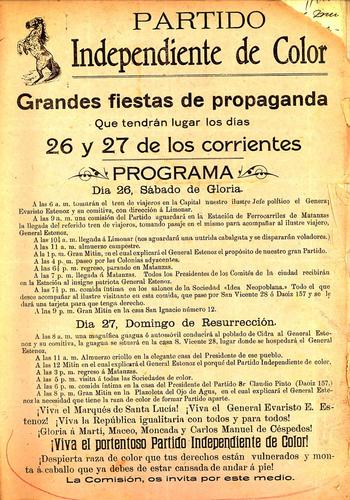
As we have seen, following its failure in the 1908 elections, the PIC orchestrated a highly organized and influential campaign in Cuba and beyond. The number of municipal committees spiked from November 1909 through April 1910.Footnote 110 PIC leaders campaigned across the island and hosted numerous public festivals in support of the party, attracting hundreds of supporters. In late March, PIC leaders Evaristo Estenoz, Julián V. Sierra, Gregorio Surín, and Pedro Ivonnet led a speaking campaign in Oriente, where they addressed large crowds of laborers and campesinos who came from surrounding rural areas such as El Cobre, San Luis, La Maya, and Alto Songo to hear the leaders’ demands for racial equality.Footnote 111 In April, they rallied workers in the sugar mills of Santa Clara before their stop in Matanzas, where they visited the city's black societies and held large rallies that included picnics in the countryside, fireworks, and horse shows (see Figure 2).Footnote 112 Later that month, Estenoz declared in an interview that the PIC had 93,000 members and had secured 100,000 voters to support its candidates in the upcoming elections.Footnote 113
“Raza de color, your rights are in jeopardy! Wake up and get on a horse, as you must be tired of walking!”

Yet, as the PIC increased its propaganda efforts, so did its opponents increase theirs. If the mainstream media's attempt to discredit the PIC by refusing to publish newsworthy articles about its platform worked for the 1908 elections before the party had consolidated, the press and the Cuban state now adopted more aggressive strategies as the party gained momentum in the following election season. In late January 1910, right after the PIC floated its plan for a black corporation, one of its most radical attempts to restructure the economy that disadvantaged black Cubans, Previsión printed a particularly incendiary article that called on black people to address racist reproach with violent self-defense: “Any man of color who does not kill instantly the cowardly aggressor who persecutes him in a public place is a wretch, unworthy of being a man, a dishonor to his homeland and his race.”Footnote 114 The government seized on the opportunity and immediately imprisoned Estenoz and censured the newspaper. As noted, on February 11, Senator Morúa Delgado submitted to the senate an amendment to the electoral law that eventually banned the PIC. However, the Morúa Amendment was just one part of a multifaceted operation waged by mainstream partisan media, along with the national government and armed forces, to discredit and criminalize the PIC.
On April 22, 1910, the government ordered the mass imprisonment of PIC leaders on charges of illicit association and conspiracy to foment an armed revolution against the state. Within three days, 59 suspected PIC affiliates, including 24 of the party's top leaders, were behind bars, each with an inflated bail of US$10,000. By the end of 1910, hundreds of people of color would be interrogated and imprisoned. Havana's central prison alone processed over 220 suspects.Footnote 115 The intricacy and extent of this persecution attests to the perceived strength and momentum that the party had gained by 1910, and the ensuing events underscore the extent of structural racism in the early republic and the need to revisit the components of that structure.Footnote 116
My call for greater examination of the PIC's political and social imagination is a case for the value of fleeting and unrealized projects and the import of quotidian connections. By refusing to disavow the PIC's propaganda materials, juxtaposing them with dominant sources and homing in on how everyday black citizens interpreted the party's message of black power and autonomy, I hope to revalue the far-reaching imagination of a public that is frequently excluded from histories of ideas and modernity. That contemporary historians have only one set of election results from which to quantitatively approach the party, those from 1908, is not an indicator of the party's failure, but a measure of the extent to which the party threatened to disrupt a status quo that did not permit autonomous black political organization. It cannot be underemphasized that in 1910, the year in which the PIC had secured regional committees in every province of the country, the party was unable to present candidates for office because their leaders had been wrongfully imprisoned. What remains are the unprecedented political and social imaginings in the black press. These sources not only shed new light on the PIC's popular appeal but also offer a glimpse into the literary and cultural production of black Cubans at the turn of the century.
The history of the PIC and the development of its historiography offer powerful lessons regarding the connections between publishing, readership, and popular politics. My invitation for a nuanced study of the PIC's investment in forging a community of readers through the activation of popular politics is inseparable from my argument regarding the creation of neglected narratives and their place within historiographical production. I opened this article with a vignette about black press journalist Pío Coronel, who was literally left in the dust as he galloped behind the presidential train along with the mainstream media that painted a glowing picture of the president's campaign across Cuba. By the time Pío published his counter-narrative, which emphasized the (cold) reaction of the black public sphere in the PIC's newspaper, many Cubans had already formed an opinion about the supposed success of the president's tour. The delay in Pío's publication did not make his perspective less important, nor did it make the connections he forged with black readers less powerful. Paralleling Pío's uphill battle against the resources and technology of the dominant political apparatus, decades of neglect had left Previsión and other PIC publications in a layer of dust. The PIC and its readers, past and present, faced myriad barriers to access. The PIC attempted to turn these barriers to readership and literacy into central components of its approach to cultivating a popular political movement.
Regardless of the growing momentum and availability of institutional resources for digitizing archival materials, access to marginalized sources such as Previsión demands a concerted effort, due to the increased visibility of the already dominant. As mainstream newspapers become readily available through online databases, scholars of popular political movements are forced to reckon with the uneven interplay between publishing, readership, and politics. Including Cuba's black press in digitization and preservation efforts is one way to check the inertia of dominant narratives, but by no means is it the only recourse. The PIC managed to forge a community of readers and supporters in the face of outright institutional opposition. Its leaders created bonds under precarious conditions where alternative reading practices proved emancipatory for a public that had long been denied the right to self-representation. Recent activist initiatives, such as Gloria Rolando's documentaries about “breaking the silence” around the massacre of 1912 and hip-hop artists’ musical tributes to PIC leaders, signal the profound potential of more rigorous examinations of the intellectual and social space the PIC created—one in which people of color could imagine alternative futures and forge political kinship across generations.Footnote 117