


Most educators and education specialists have emphasised the important role of successful school adjustment in the academic achievement and subsequent learning of children (Early, Pianta, Taylor, & Cox, Reference Early, Pianta, Taylor and Cox2001; Rimm-Kaufman & Pianta, Reference Rimm-Kaufman and Pianta2000). School adjustment is a multidimensional construct (Ratelle, Duchesne, & Guay, Reference Ratelle, Duchesne and Guay2017) that encompasses both academic achievement and school engagement and generally refers to the extent to which a child complies with school regulations and procedures, and interacts appropriately with peers and teachers, without being overwhelmed by stress. The academic dimension of school adjustment is associated with the way students handle the assigned homework and class activities, and their performance in exams. The social dimension includes involvement with social activities in school, such as cooperating with classmates and showing a respectful attitude to peers and teachers. The personal-emotional aspect of school adjustment pertains to the way students cope with pressure and stress (Ratelle et al., Reference Ratelle, Duchesne and Guay2017).
Family cohesion, family adaptability, and school adjustment
Understanding the adjustment of children in school entails the consideration of various intrinsic, social, and family- and school-related factors. According to the circumplex model of family functioning (Olson, Sprenkle, & Russell, Reference Olson, Sprenkle and Russell1989), neither high nor low, but moderate levels of adaptability and cohesion among family members nurtures optimal family functioning. Adaptability is defined as the extent to which the family system is flexible. It refers to the ability of family members to change the power structure, role relationships, and relationship rules in the family as and when situational and developmental demands arise (Slicker, Reference Slicker1997). Feldman (Reference Feldman2008) showed that while higher levels of adaptability were associated with enhanced academic performance, they were also associated with behaviour conduct problems in both child bullies and victims. Consistent with these findings, Wang and Fletcher (Reference Wang and Fletcher2015) assert that parental acceptance serves to facilitate higher levels of psychosocial competence, while behavioural control is negatively associated with problem behaviours in children, In the context of adaptability, Heidari, Fallahi, and Hajiloo (Reference Heidari, Fallahi and Hajiloo2018) concluded that school adjustment is predicted positively by authoritative parenting style and secure attachment style, and negatively by insecure attachment style. Similarly, children’s perception of academic autonomy support from their parents has been reported to have significant direct positive effects on their academic achievement, self-esteem and academic motivation, and indirect effects on their academic motivation mediated by self-esteem, while direct negative effects on self-esteem and academic achievement were observed for children’s perception of parental academic planning control (Jiang, Yau, Bonner, & Chiang, Reference Jiang, Yau, Bonner and Chiang2017).
Within the framework of the circumplex model of family functioning, family cohesion, defined as the emotional bonding that family members have toward one another (Olson et al., Reference Olson, Sprenkle and Russell1989) and as the ability of the family members to cooperate, communicate and solve problems (Cuffe, McKeown, Addy, & Garrison, Reference Cuffe, McKeown, Addy and Garrison2005), has also been associated with positive outcomes in children. Youth from cohesive families respond adaptively to social challenges and manage negative emotions effectively (Morris, Silk, Steinberg, Myers, & Robinson, Reference Morris, Silk, Steinberg, Myers and Robinson2007), while those from less cohesive families experience high levels of emotional distress and emotion dysregulation (Carthy, Horesh, Apter, & Gross, Reference Carthy, Horesh, Apter and Gross2010). The shared affection, support, commitment and helpfulness that members in cohesive families exhibit towards each other (Barber & Buehler, Reference Barber and Buehler1996) is predictive of social problem-solving skills and social self-efficacy in children (Leidy, Guerra, & Toro, Reference Leidy, Guerra and Toro2010), lower levels of alcohol-related problems in adolescence (Reeb et al., Reference Reeb, Chan, Conger, Martin, Hollis, Serido and Russell2015), and healthy lifestyles in female college students (An & Western, Reference An and Western2019). The strong emotional bonds measured by family cohesion promote family support and are inversely related to depression (Guassi Moreira, & Telzer, Reference Guassi Moreira and Telzer2015) and suicide ideation (Joel Wong, Uhm, & Li, Reference Joel Wong, Uhm and Li2012), indices of mental health that can impact school adjustment (Finning et al., Reference Finning, Ukoumunne, Ford, Danielsson-Waters, Shaw, Jager and Moore2019). In an investigation of the role of family cohesion in school adjustment, Qin, Wan, Qu, and Chen, (Reference Qin, Wan, Qu and Chen2015) found that family cohesion can predict school belonging positively both directly and indirectly through interpersonal security and achievement goals, suggesting the importance of family cohesion to school adjustment. Similarly, Rezaei-Dehaghani, Keshvari, and Paki, (Reference Rezaei-Dehaghani, Keshvari and Paki2018) found family expressiveness, socialisation and cohesion to be reliable predictors of academic achievement.
Social acceptability and school adjustment
Social acceptability is generally defined as an indicator of likability or receiving positive regard from peers (Coie & Dodge, Reference Coie and Dodge1983). According to the ecological model for child development (Bronfenbrenner, Reference Bronfenbrenner and Bronfenbrenner2005), at the microsystem level, children’s relationships with their peers also have a direct impact on school adjustment, underscoring the importance of social skills that facilitate the establishment of optimal relationships with peers (Selen & Tuncay, Reference Selen and Tuncay2019). Socially accepted students are described as friendly, responsible and socially skilled individuals. Children with such behavioural styles tend to experience enhanced academic development as they share learning resources more with their peers, have a higher sense of belonging and show greater engagement at school (Guo, Zhou, & Feng, Reference Guo, Zhou and Feng2018; Llorca, Richaud, & Malonda, Reference Llorca, Richaud and Malonda2017). A lack of the sense of relatedness to and acceptance by peers hampers students’ cognitive engagement with the classroom (Furrer & Skinner, Reference Furrer and Skinner2003) and contributes to lower levels of academic achievement in both the early (Zhang, Eggum-Wilkens, Eisenberg, & Spinrad, Reference Zhang, Eggum-Wilkens, Eisenberg and Spinrad2017) and later school years (Gallardo, Barrasa, & Guevara-Viejo, Reference Gallardo, Barrasa and Guevara-Viejo2016; Tetzner, Becker, & Maaz, Reference Tetzner, Becker and Maaz2016). Two explanations (Vandenbroucke, Spilt, Verschueren, & Baeyens, Reference Vandenbroucke, Spilt, Verschueren and Baeyens2018) for this association between peer acceptance and academic performance are possible. It is likely that negative experiences with peers can cause stress, which in turn is associated with impaired functioning of prefrontal brain regions, thereby exerting a negative impact on executive functioning and working memory. Alternatively, it is plausible that when stressed due to peer rejection, children attempt to restore the relationship, which utilises cognitive resources that precludes their investment in other cognitive tasks.
The role of school engagement
A construct relevant to positive psychology, school engagement is a major factor contributing to school adjustment (Gutiérrez, Tomás, Romero, & Barrica, Reference Gutiérrez, Tomás, Romero and Barrica2017). School engagement has been defined as the extent to which students are committed to and involved in the curriculum, school and social activities (Tilbury Creed, Buys, Osmond, & Crawford, Reference Tilbury, Creed, Buys, Osmond and Crawford2014). School engagement is conceived of as a multidimensional construct with emotional, behavioural and cognitive components influenced by contextual and relational factors, such as relationships with peers, teachers and family members, and is predictive of a wide range of academic trajectories and outcomes, including school dropout (Miranda-Zapata, Lara, Navarro, Saracostti, & de-Toro, Reference Miranda-Zapata, Lara, Navarro, Saracostti and de-Toro2018). Emotional engagement refers to the student’s level of emotional response or emotional bond to the school, school-related activities, teachers and classmates. Emotional engagement motivates students to engage and persevere in school work, and is indicated by a student’s feelings about learning, positive attitude, interest and intrinsic motivation (Moreira, Dias, Matias, Castro, Gaspar, & Oliveira, Reference Moreira, Dias, Matias, Castro, Gaspar and Oliveira2018). Behavioural engagement refers to students’ interactions and responses in academic, social or extracurricular activities in school, and is indicated by class attendance, absence of disruptive behaviour, effort and persistence with schoolwork, finishing set tasks, mean overall grades and participation in extracurricular activities (Zhu, Tian, Zhou, & Huebner, Reference Zhu, Tian, Zhou and Huebner2019). Cognitive engagement includes students’ perceptions and beliefs about themselves, their school, their teachers and their fellow students, self-concepts, future aspirations and expectancies (Moreira et al., Reference Moreira, Dias, Matias, Castro, Gaspar and Oliveira2018).
Students’ engagement with school has been linked to various aspects of student development such as school integration, school satisfaction or academic achievement (Serrano & Andreu, Reference Serrano and Andreu2016). On the other hand, low school engagement has been reported to be associated with or resulting in socially undesirable behaviours, risk behaviours, grade retention, diminished mental health, school dropout and/or low academic performance (Gutiérrez et al., Reference Gutiérrez, Tomás, Romero and Barrica2017; Quin, Heerde, & Toumbourou, Reference Quin, Heerde and Toumbourou2018). A substantial body of research has been conducted on school engagement and its correlates. Recent research has shown that moderate behavioural engagement is associated with higher achievement in science (Bae & Debusk-Lane, Reference Bae and Debusk-Lane2019). Student engagement and academic performance bear a reciprocal relationship with bidirectional predictability (Moreira et al., Reference Moreira, Dias, Matias, Castro, Gaspar and Oliveira2018). Similarly, students’ behavioural engagement with school and their subjective wellbeing (Zhu et al., Reference Zhu, Tian, Zhou and Huebner2019), and their intentional self-regulation and engagement (Stefansson, Gestsdottir, Birgisdottir, & Lerner, Reference Stefansson, Gestsdottir, Birgisdottir and Lerner2018), are reported to be reciprocally predictive over time, mutually reinforcing each other. Furthermore, supportive school environments have been found to buffer the negative effect of poor academic performance on cognitive engagement (Moreira et al., Reference Moreira, Dias, Matias, Castro, Gaspar and Oliveira2018).
Attempts have also been made to predict engagement, and various factors such as prior engagement, academic grades, family, peer and teacher support have been found to make unique contributions to various indicators of engagement (Fernández-Zabala, Goñi, Camino, & Zulaika, Reference Fernández-Zabala, Goñi, Camino and Zulaika2016; Quin et al., Reference Quin, Heerde and Toumbourou2018). In a study by Krauss, Kornbluh, and Zeldin (Reference Krauss, Kornbluh and Zeldin2017), attending after-school co-curricular and community-based youth programs, and family processes such as parental monitoring and family cohesion emerged as predictors of cognitive and emotional school engagement. Some studies have focused on the mediating or moderating effects of school engagement. Gutirrez et al. (Reference Gutiérrez, Tomás, Romero and Barrica2017) found that school engagement mediates the effect of perceived support from friends, peers and teachers on satisfaction with school, and Miranda-Zapata et al. (Reference Miranda-Zapata, Lara, Navarro, Saracostti and de-Toro2018) claimed that cognitive engagement and affective engagement moderated the effect of contextual variables on school performance and attendance at classes respectively.
The role of academic self-concept
Academic self-concept, generally conceptualised as an offshoot of global self-concept (Kadir & Yeung, Reference Kadir and Yeung2016), refers to the self-perception of a student’s academic ability in a specific school subject such as math, science or language (Marsh & Craven, Reference Marsh and Craven2006). This estimation of academic ability is based on a comparison of the student’s standing with respect to the average academic ability of peers, or on the value accorded by society to the entire school. Empirical research on academic self-concept over the last several decades has demonstrated that a student’s self-perception of academic competence is an important precursor of the student’s educational aspirations (Guo, Marsh, Parker, Morin, & Yeung, Reference Guo, Marsh, Parker, Morin and Yeung2015), educational decisions (Aar, Peters, Cruijsen, & Crone, Reference Aar, Peters, Cruijsen and Crone2019), mastery and performance approach goals (Maltais, Duchesne, Ratelle, & Feng, Reference Maltais, Duchesne, Ratelle and Feng2017), academic adjustment (Nasiri, Micaelimanee, & Issazadegan Reference Nasiri, Micaelimanee and Issazadegan2017), and scholastic achievement (S. Chen, Yeh, Hwang, & Lin, Reference Chen, Yeh, Hwang and Lin2013; Han, Reference Han2019; Lösch et al., Reference Lösch, Lüdtke, Robitzsch, Kelava, Nagengast and Trautwein2017). Some researchers have investigated factors that impact on academic self-concept. It has been found that when academic self-concept is high, previous academic efforts and grades have positive effects on subsequent academic self-concept (Marsh et al., Reference Marsh, Pekrun, Lichtenfeld, Guo, Arens and Murayama2016). In addition, short-term self-enhancement through over-reporting of grades (Sticca, Goetz, Nett, Hubbard, & Haag, Reference Sticca, Goetz, Nett, Hubbard and Haag2017), downward comparison of a student’s own achievement with that of peers, and with the student’s prior achievements and with achievement in other areas (Wolff, Helm, Zimmermann, Nagy, & Möller, Reference Wolff, Helm, Zimmermann, Nagy and Möller2018) tended to increase academic self-concept. Students’ self-perceived competence has also been shown to have indirect relations with the range of educational outcomes, even after controlling for factors such as the previous achievement histories (K. Liu, Cheng, Chen, & Wu, Reference Liu, Cheng, Chen and Wu2009; Wouters, Germeijs, Hilde, & Verschueren, Reference Wouters, Germeijs, Hilde and Verschueren2011).
An individual’s academic self-concept typically works in a reciprocal relationship with achievement, with academic self-concept and achievement being both a cause and an effect of each other (Han, Reference Han2019; Marsh & Craven, Reference Marsh and Craven2006; Marsh & O’Mara, Reference Marsh and O’Mara2008; Niepel, Brunner, & Preckel, Reference Niepel, Brunner and Preckel2014; Preckel, Niepel, Schneider, & Brunner, Reference Preckel, Niepel, Schneider and Brunner2013). The role of academic self-concept as a mediator in relation to certain cognitive variables and academic achievement has also been identified. Academic self-concept has been reported as mediating the relation between academic attitudes and academic achievement (Veas, Castejón, Miñano, & Gilar-Corbí, Reference Veas, Castejón, Miñano and Gilar-Corbí2019), between parent–child discrepancies in educational aspiration and child academic achievement (Lv et al., Reference Lv, Zhou, Liu, Guo, Zhang, Liu and Luo2018), and between students’ level of perceived challenge (being over- or underchallenged) and their career aspirations (Krannich et al., Reference Krannich, Goetz, Lipnevich, Bieg, Roos, Becker and Morger2019).
Contextual parameters associated with children’s academic self-concept have also been studied. Self-perceived scholastic competencies were predicted by classroom organisation, rule clarity and student involvement (Kokkinos & Hatzinikolaou, Reference Kokkinos and Hatzinikolaou2011). According to Bronfenbrenner’s (Reference Bronfenbrenner1986) ecological systems theory, academic achievement is dependent on a complex interaction involving the child, their families and the wider sociocultural context. Regarding the relevance of parent-child relationships to academic success, Lowe and Dotterer (Reference Lowe and Dotterer2013) stressed the importance of sustained parental monitoring of adolescents in the academic outcomes of children. Furthermore, adolescents are reported to experience higher academic self-concept when they perceive maternal psychological control as providing satisfaction for the adolescent’s needs for autonomy, relatedness and competence (Lu, Walsh, White, & Shield, Reference Lu, Walsh, White and Shield2017). Sahil and Hashim (Reference Sahil and Hashim2011) concluded that parents’ social support for children affects their levels of school engagement through the mediating role of academic self-concept. In a recent study, teachers’ higher expectations were associated with higher academic self-concept in students, which in turn predicted their higher achievement (Szumski & Karwowski, Reference Szumski and Karwowski2019). K. Chen, Chang, and Hsueh (Reference Chen, Chang and Hsueh2018) indicated that academic self-concept and learning engagement positively mediated the relationship between social context and academic achievement. Also, higher academic self-concept has been reported to be directly associated with lower test anxiety and higher intrinsic motivation, both of which impact achievement (Khalaila, Reference Khalaila2015). Domain-specific academic self-concepts were also found to mediate the relations between achievement and test anxiety (Arens, Becker, & Möller, Reference Arens, Becker and Möller2017), and academic self-concept was found to mediate the relations between academic attitudes toward teachers and school and academic achievement (Veas et al., Reference Veas, Castejón, Miñano and Gilar-Corbí2019).
The role of academic self-concept as a potential mediator between family adaptability/cohesion and school-related consequences, including school engagement, school adjustment and academic achievement, have yet to be examined. Given that various dimensions of parental involvement (e.g., exchange of factual and emotional information between parents and their children, parent-child discussions and parent-child communication) have been reported to be associated with the academic and emotional functioning of children (Lv, Lv, Yan, & Luo, Reference Lv, Lv, Yan and Luo2019), and that child-perceived parental support has been found to be related to task-persistent behaviour, a motivational aspect of academic achievement (Silinskas & Kikas, Reference Silinskas and Kikas2019), as well as that higher educational qualifications and socioeconomic level of parents have also been found to impact the cognitive performance and academic achievement of children (Alves, Gomes, Martins, & Almeida, Reference Alves, Gomes, Martins and Almeida2017), it is plausible that a home environment characterised by the degree of family adaptability/cohesion will affect the academic self-concept of children and indirectly impact on their emotional functioning in school.
The present study
The literature reviewed indicates that school adjustment is influenced by a network of family-related, peer-related and child-related variables. In addition, school adjustment is influenced by school-related factors such as academic self-concept and school engagement. Findings from empirical studies suggest that family-related variables play a decisive role in children’s adjustment to school either by directly influencing children’s academic achievement or indirectly by affecting the children’s perception of their academic competencies, which in turn may impact children’s engagement with school-related activities. Engagement is also affected by the child’s perceived acceptability by peers. Therefore, the present study aimed to investigate the mediating role of school engagement and academic self-concept in the relationship between family adaptability/cohesion and social acceptability with school adjustment. We anticipate that the study will provide valuable information about the interaction of family and school factors in school adjustment in Iranian students and have practical implications for school psychologists to increase elementary students’ adjustment with school.
Method
Participants
Participants included 268 students (M age = 12.05; SD = 0.75 years) enrolled in the 5th and 6th grades of elementary schools located in Ardabil (northwest of Iran) during the academic year of 2017–2018. The students were selected through cluster sampling with the school as the sampling unit; 48.88 % (131) of participates were male and 51.12% (137) were female. Of these, 126 individuals (47%) were in the 5th grade and 142 individuals (53%) were in the 6th grade. Also, 42 individuals (15.7%) were an only child; 76 (28.4%) were the first child; 90 (33.6%) were the second child; 40 (14.9%) were the third child; 18 (6.7%) were the fourth child, and 2 (0.7%) were the fifth (or more) child of their family.
Measures
The school adjustment survey (SAS; Santa Lucia & Gesten, Reference Santa Lucia and Gesten2000)
This 34-item self-report tool assesses students in terms of motivation, achievement expectations, and relationships with teachers and peers (Santa Lucia & Gesten, Reference Santa Lucia and Gesten2000). In this survey, students are asked to state the degree to which they agree with each of the 33 statements on a 5-point scale ranging from (0) strongly disagree to (4) strongly agree. The factor analysis on this scale showed the following five factors: School Spirit (Cronbach’s alpha = .85), Goal-Orientation (Cronbach’s alpha = .79), Child-Peer Relations (Cronbach’s alpha = .63), Child-Teacher Relations (Cronbach’s alpha = .84), and Alienation (Cronbach’s alpha = .63). In the present study, these coefficients were obtained in the range of .78 for Alienation to .96 for Child-Peer Relations.
The academic self-concept questionnaire (ASQC; W. Liu & Wang, Reference Liu and Wang2005)
This questionnaire has been designed based on the Academic Self-Esteem subscale (Battle, Reference Battle1981), the School Subjective Self-Concept (Marsh, Relich, & Smith, Reference Marsh, Relich and Smith1983), and the General and Academic Status scales (Piers & Harris, Reference Piers and Harris1964). The ASQC consists of two 10-item subscales: students’ academic confidence (10 items) and students’ academic effort (10 items). The confidence subscale assesses students’ feelings and perceptions regarding their academic competence, and the effort subscale assesses students’ commitment, involvement and interest regarding school assignments. A validation study showed a convergent validity between this scale and Battle’s Academic Self-Esteem Scale (Reference Battle1981) (r = .73), Marsh et al.’s (Reference Marsh, Relich and Smith1983) School Subjects Self-Concept Scale (r = .71), and Piers and Harris’ (Reference Piers and Harris1964) General and Academic Status scale (r = .63). Results of the reliability analysis showed that Cronbach’s alpha for the total scale was .82, indicating the internal consistency of the items. The two subscales also had satisfactory discriminating power (Cronbach’s alphas = .71 for students’ academic confidence and .76 for students’ academic effort; W. Liu & Wang, Reference Liu and Wang2005). In Iran, a study was conducted with a group of elementary students and the following Cronbach’s alpha coefficients were obtained for the two subscales and for the total scale: students’ confidence (.77), students’ effort (.83), and the total scale (.91; Basharpoor, Issazadegan, Zahed, & Ahmadian, Reference Basharpoor, Issazadegan, Zahed and Ahmadian2013).
School engagement scale (SES; Wang, Willett, & Eccles, Reference Wang, Willett and Eccles2011)
This test consists of three aspects of behavioural, emotional, and cognitive engagement. Behavioural engagement consists of two subscales (Attentiveness and Compliance) and is measured on a 5-point Likert scale from 1 (almost never) to 5 (almost always). Emotional engagement consists of two subscales (School Belonging and Valuing School Education) and is measured on a 5-point Likert scale from 1 (I completely agree) to 5 (I completely disagree). Cognitive engagement consists of two subscales (Self-Regulated Learning and Cognitive Strategy Use) and is measured on a 5-point Likert scale from 1 (almost never) to 5 (almost always). Based on the results of the confirmatory factor analysis conducted by Wang et al. (Reference Wang, Willett and Eccles2011), the factor loadings of all questions on the six subscales were significant in the range of .51 to .89 at the .05 significance level. The reliability coefficients of all subscales were equal to/higher than .70 (Attentiveness = .70; Compliance = .78; School Belonging = .75, Valuing of School Education = .72; Self-Regulated Learning = .78; and Cognitive Strategy Use = .77).
Social acceptability questionnaire (SAQ)
This self-report questionnaire was designed by Samooei, Bagherzadeh, and Sabzavari (Reference Samooei, Bagherzadeh and Sabzavari2005) and assesses the need for social approval in children. In preschool children, internal consistencies of .48 and .51 were obtained for girls and boys respectively; however, in elementary school children, internal consistencies of .79 and .85 were reported for boys and girls respectively. The test-retest reliability obtained after five weeks was reported to be .58. This questionnaire was designed with 17 three-item questions which included scores 2 (yes), 1 (somewhat), and 0 (no). The lowest and highest scores of the questionnaire are 0 and 38 respectively. Higher scores indicate higher levels of social acceptability and vice versa. The internal consistency of this questionnaire (Cronbach’s alpha = .77) and split-half reliability (.66) were found to be acceptable.
The family adaptability and cohesion evaluation scale II (FACES II; Olson, Russell, & Sprenkle, Reference Olson, Russell and Sprenkle1983)
This scale is a 30-item self-report measure assessing family functioning. This instrument consists of two scales: adaptability and cohesion. The adaptability scale consists of 14 items that address a family’s adaptive capacity and flexibility of family members in stressful situations (‘In our family, everyone shares responsibilities’; Cronbach’s alpha = .83). The cohesion scale consists of 16 items that determine the degree of emotional bonding and individuality in a family (‘Family members feel very close to each other’; Cronbach’s alpha = .80). Olson et al. (Reference Olson, Russell and Sprenkle1983) reported internal consistency coefficients of .81 and .80 for the subscales of adaptability and cohesion respectively. This indicates the suitable construct validity of this scale. In the present study, Cronbach’s alpha coefficients of .95 and .97 were obtained for the family cohesion and adaptability subscales respectively.
Procedure
First, one district from among the two existing educational districts in Ardabil city was randomly selected. A list of private and public schools in the identified district was obtained. Then, two girls’ schools and two boys’ schools were randomly selected from among the elementary schools in that district. Next, one 5th-grade classroom and one 6th-grade class was randomly selected in each of the selected schools. Parental consent and student assent were obtained before the study began.
Participating students sat in their normal seats in their own classrooms and individually completed the self-report measures of school adjustment, academic self-concept, school engagement, social acceptability, and the family adaptability and cohesion evaluation.
Data analysis
Descriptive statistics were used to explain participants’ general characteristics, family adaptability/cohesion, social acceptability, school engagement, academic self-concept and school adjustment. Path analyses were used to evaluate the difference of linear structural relations for the variables. The maximum likelihood estimation method was used for path analysis to determine model specification, model estimation, and goodness-of-fit assessment. The collected data were analysed via SPSS23 and Lisrel 8.7.
Results
Data distribution was examined for normality. All the variables were considered to be normally distributed as skew indices ranged between −2 and 2 and kurtosis was between −7 and 7 (West, Finch, & Curran, Reference West, Finch, Curran and Hoyle1995).
Correlation results
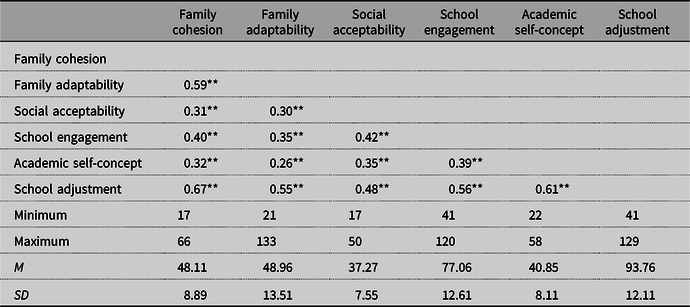
Table 1 shows the means, standard deviations and intercorrelations among family cohesion, family adaptability, social acceptability, school engagement, academic self-concept and school adjustment. As described in Table 1, the correlational results show that family cohesion, family adaptability, social acceptability, school engagement and academic self-concept are positively related to school adjustment. Furthermore, family cohesion, family adaptability and social acceptability are positively related to school engagement and academic self-concept.
Descriptive Statistics and Correlations for the Study Variables

Note: *p < .05: **p < .01
Fitness of path model
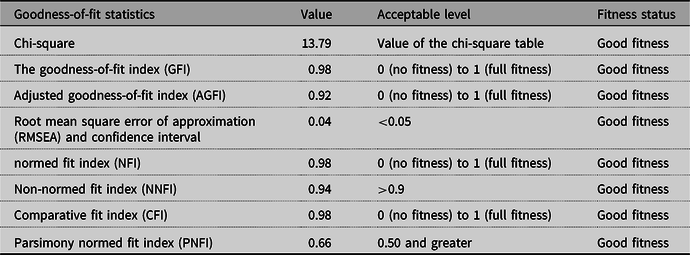
The fit of the hypothesised model was examined using LISREL (Jöreskog & Sörbom, Reference Jöreskog and Sörbom2001) and goodness of fit indices were obtained. The values for this model were: χ2(4, minimum n = 268) = 13.79 (p = .06) with a comparative fit index (CFI) of .98. Steiger’s (Reference Steiger1990) root mean square error of approximation (RMSEA) was .04, indicating that the errors of approximation for fitting the model to the population were small and the hypothesised model was a good fit to the data (Browne & Cudeck, Reference Browne, Cudeck, Bollen and Long1993). All indices of fit are displayed in Table 2.
Fit Statistics for the Hypothesised Model

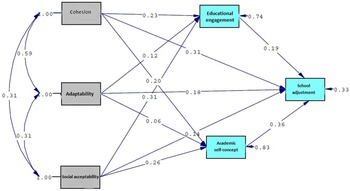
In the structural equation model, besides testing the model and evaluating goodness-of-fit indices, the estimated structural coefficients must be assessed to test research hypotheses. These estimated parameters are presented in Figure 1.
The structural coefficients of the conceptual research model.

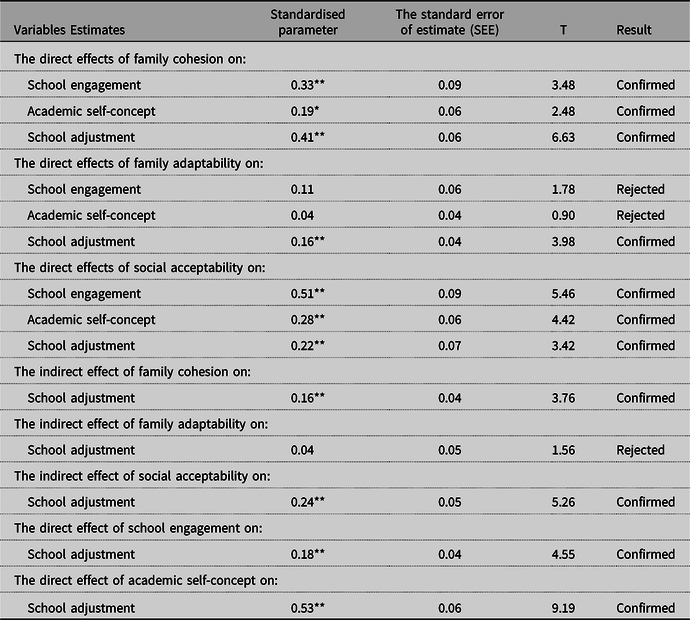
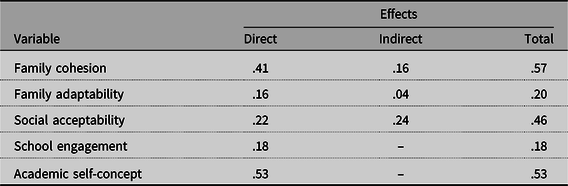
The results shown in Table 3 indicate that family cohesion has a direct positive effect on school adjustment. It also has an indirect effect through the mediating role of school engagement and academic self-concept. Family adaptability has only a direct effect on school adjustment. Social acceptability has both direct and indirect effects (through the mediating role of school engagement and academic self-concept) on the school adjustment.
Estimates of the Coefficients of Direct and Indirect Relations

Note: * p < .05: **p < .01.
As described in Table 4, family cohesion, family adaptability and social acceptability affect school adjustment both directly and indirectly through the mediating role of school engagement and academic self-concept. School engagement and academic self-concept have only direct effects on school adjustment (p < .05).
Direct, Indirect, and Total Effects of Family Cohesion/Adaptability, Social Acceptability, School Engagement and Academic Self-Concept on School Adjustment

Discussion
We aimed to test the model of structural relationships of family adaptability/cohesion and social acceptability with school adjustment, considering likely the mediating roles of school engagement and academic self-concept. Our results appear to provide support for this model.
The direct effect of family cohesion and family adaptability on school adjustment
The direct effect of family adaptability and cohesion on school adjustment found in the present study is consistent with the results of studies by Carthy et al. (Reference Carthy, Horesh, Apter and Gross2010), Heidari et al. Reference Heidari, Fallahi and Hajiloo2018), Jiang et al. (Reference Jiang, Yau, Bonner and Chiang2017), Morris et al. (Reference Morris, Silk, Steinberg, Myers and Robinson2007), Qin et al. (Reference Qin, Wan, Qu and Chen2015), Rezaei-Dehaghani et al. (Reference Rezaei-Dehaghani, Keshvari and Paki2018) and Wang and Fletcher (Reference Wang and Fletcher2015), who found significant relationships between family cohesion/adaptability and various dimensions of school adjustment. Together, these findings confirm that a blend of parental flexibility and control through an authoritative parenting style fosters in children a sense of being supported, who then feel motivated to strive for academic success and competent to deal effectively with the academic and emotional challenges at school. Olson and Gorall (Reference Olson, Gorall and Walsh2003) used the concepts of togetherness and separateness to account for family cohesion and proposed that a functional family differs from a dysfunctional one in its ability to balance separateness and togetherness in accordance with the situational needs of the family. School adjustment is a multidimensional task that calls for flexibility and adaptability. Students who are raised in an efficiently structured family environment acquire the ability to maintain a balance between closeness to others and separation from them, which results in better adjustment.
The direct effect of social acceptability on school adjustment
Social acceptability was also observed to have a direct effect on school adjustment, a finding documented by several researchers (e.g., Furrer & Skinner, Reference Furrer and Skinner2003; Guo et al., Reference Guo, Zhou and Feng2018; Selen & Tuncay, Reference Selen and Tuncay2019; Tetzner et al., Reference Tetzner, Becker and Maaz2016). Social acceptability indexed by peer acceptance potentially instills a sense of relatedness in children and brings about opportunities for emotional and cognitive engagement through shared experiences and learning. Students with high levels of social acceptability interact more frequently with peers, thereby getting the exposure required for internalising peer group norms and refining their communication and cognitive-emotion regulation skills, which in turn contribute to the development of prosocial behaviour and better adjustment in school. Children who experience peer rejection or exclusion are at risk of developing externalising problems (Reijntjes et al., Reference Reijntjes, Kamphuis, Prinzie, Boelen, van der Schoot and Telch2011) and academic difficulties, plausibly through decreased working memory performance and executive functioning (Vandenbroucke et al., Reference Vandenbroucke, Spilt, Verschueren and Baeyens2018). Overall, peer acceptance plays a very significant role in the adjustment of children in school.
The direct effect of school engagement on school adjustment
School engagement had a direct effect on school adjustment, validating findings of previous research (Bae & Debusk-Lane, Reference Bae and Debusk-Lane2019; Gutiérrez et al., Reference Gutiérrez, Tomás, Romero and Barrica2017; Quin et al., Reference Quin, Heerde and Toumbourou2018; Serrano & Andreu, Reference Serrano and Andreu2016). Congruent with the self-determination theory (Ryan & Deci, Reference Ryan and Deci2000) and stage-environment fit theory (Eccles & Midgley Reference Eccles, Midgley, Ames and Ames1989), this finding affirms that children’s perception that the school context meets their psychological needs enhances their academic motivation, influencing their engagement and performance in school. Teacher-student relations reflected by explicit expectations and consistent responses from teachers facilitate student participation in academic tasks and promote positive identification with the school (Wang & Peck, Reference Wang and Peck2013). Emotional engagement with school is the emotional connection a student feels with the school. It is an important component of school adjustment because students’ interest in school and positive attitudes about school are likely to impact their motivation and appreciation for school-related activities (Ladd & Dinella, Reference Ladd and Dinella2009). Finally, the cognitive component of school engagement leads to the cognitive investment of students in learning and the use of self-regulation strategies for learning. These three components of school engagement can prepare the ground for school adjustment and provide students with appropriate mental health at school (Wang & Peck, Reference Wang and Peck2013).
The direct effect of academic self-concept on school adjustment
Our study showed that academic self-concept has a direct effect on school adjustment. Links between academic self-concept and students’ involvement with studying, academic attitudes and academic achievement have been reported in previous research (Szumski & Karwowski, Reference Szumski and Karwowski2019; Veas et al., Reference Veas, Castejón, Miñano and Gilar-Corbí2019). This implies that a student’s academic self-concept may impact their motivation to learn, their ability to handle academic demands, and ultimately, their adjustment to school.
The mediating role of school engagement and academic self-concept in the relation between family cohesion and school adjustment
The results of this study showed that the relation between family cohesion and school adjustment as mediated by school engagement and academic self-concept. This is consistent with the findings of Calafat, Gracia, Juan, Becona, and Fernandez-Hermida (Reference Calafat, Gracia, Juan, Becona and Fernandez-Hermida2014), Krauss et al. (Reference Krauss, Kornbluh and Zeldin2017), and Leidy et al. (Reference Leidy, Guerra and Toro2010), and related to the interaction between family and educational factors in school adjustment. Family cohesion can provide a supportive environment for child development, in which the child learns social interaction skills through imitation and reinforcement. Within a cohesive and supportive family system, children can learn skills to process and respond to emotional interpersonal events appropriately. These skills may not only boost an individual’s social self-efficacy but also enhance students’ interest in the school environment and increase their desire for learning. Therefore, a coherent family environment, characterised by the intimacy and unity of its members, fosters a sense of emotional security in children, enabling them to generate effective coping strategies to deal with novel and challenging interpersonal events in school. Success in navigating these events augments children’s perceptions of their competencies, resulting in better school adjustment.
The relationship between social acceptability and school adjustment as mediated by school engagement and academic self-concept
The results of our study indicate that the relationship between social acceptability and school adjustment is mediated by school engagement and academic self-concept. This is also congruent with the results of Buhs (Reference Buhs2005), K. Chen et al. (Reference Chen, Chang and Hsueh2018), Gutiérrez et al. (Reference Gutiérrez, Tomás, Romero and Barrica2017), and Schwartz, Gorman, Nakamoto, and McKay (Reference Schwartz, Gorman, Nakamoto and McKay2006). Social acceptability is a major dimension of self-esteem and an important element in preparing children for adapting to school (Lindsey, Reference Lindsey2014). Many childhood psychopathology indicators such as depression, anxiety, nocturnal enuresis, attention-deficit/hyperactivity, obesity, and sexual abuse experience are associated with low levels of self-esteem (Sukumaran, Vickers, Yates, & Garralda, Reference Sukumaran, Vickers, Yates and Garralda2003). In light of these findings, it can be assumed that students with high levels of social acceptability within their family and among their peers deal with school demands effectively and acquire higher levels of academic adequacy and competence. This can increase their school engagement and facilitate their adjustment to the school environment. These findings underscore the importance of social acceptability to school engagement and adjustment.
Limitations and future directions
Our findings must be interpreted in the context of certain limitations. First, our study sample comprised 5th- and 6th-grade students of elementary schools in northwest Iran; therefore, the results cannot be easily generalised beyond the sample to schools of different demographic and cultural characteristics. Future studies with more heterogeneous samples are needed to increase the external validity of the results. Second, we used a cross-sectional sample with a correlational research design, which precludes any causal inferences. Utilising a longitudinal design may help reveal causal connections. Finally, all the variables of the hypothesised model were measured by self-report instruments, with no access to more objective external data. The inclusion of other data available to schools such as student grades, annual reports, and parent and/or staff surveys in future research is recommended.
Implications
The results of this study support the interaction of family and school factors in students’ adjustment to school. Parents are recommended to provide a coherent and supportive family environment in order to facilitate the adjustment of their child to the school environment using participation in parenting programs such as the Triple P-positive parenting program (Ashori et al., Reference Ashori, Afrooz, Arjmandnia, Pourmohamadreza-Tajrishi and Ghobri-Bonab2015). More importantly, school professionals should offer more attention and support to students experiencing volatile family relationships. Students’ adjustment to school can be promoted via encouraging them to participate in school activities, communicate with peers and teachers, and discover more benefits regarding interpersonal communication. The mediating roles of school engagement and academic self-concept imply that fragile, unstable family relationships may increase children’s vulnerability to adjustment difficulties through undermining their confidence in their ability to deal with interpersonal and academic tasks. Our results suggest that collaboration between the family and school systems via strong and bilateral communication methods will facilitate the school adjustment of elementary students. School professionals can also invite parents of students with low school adjustment to participate in parenting programs aimed at enhancing family functioning. Our results also suggest that school adjustment levels may be enhanced by encouraging students to participate in school-related cognitive, emotional or behavioural activities. Such activities would provide opportunities for increased school engagement and will serve to reinforce students’ academic self-concept and improve academic achievement.
Acknowledgment
This study was supported by a grant from the Ministry of Research and Technology to University of Mohaghegh Ardabili (grant # 509-1397-0209).